

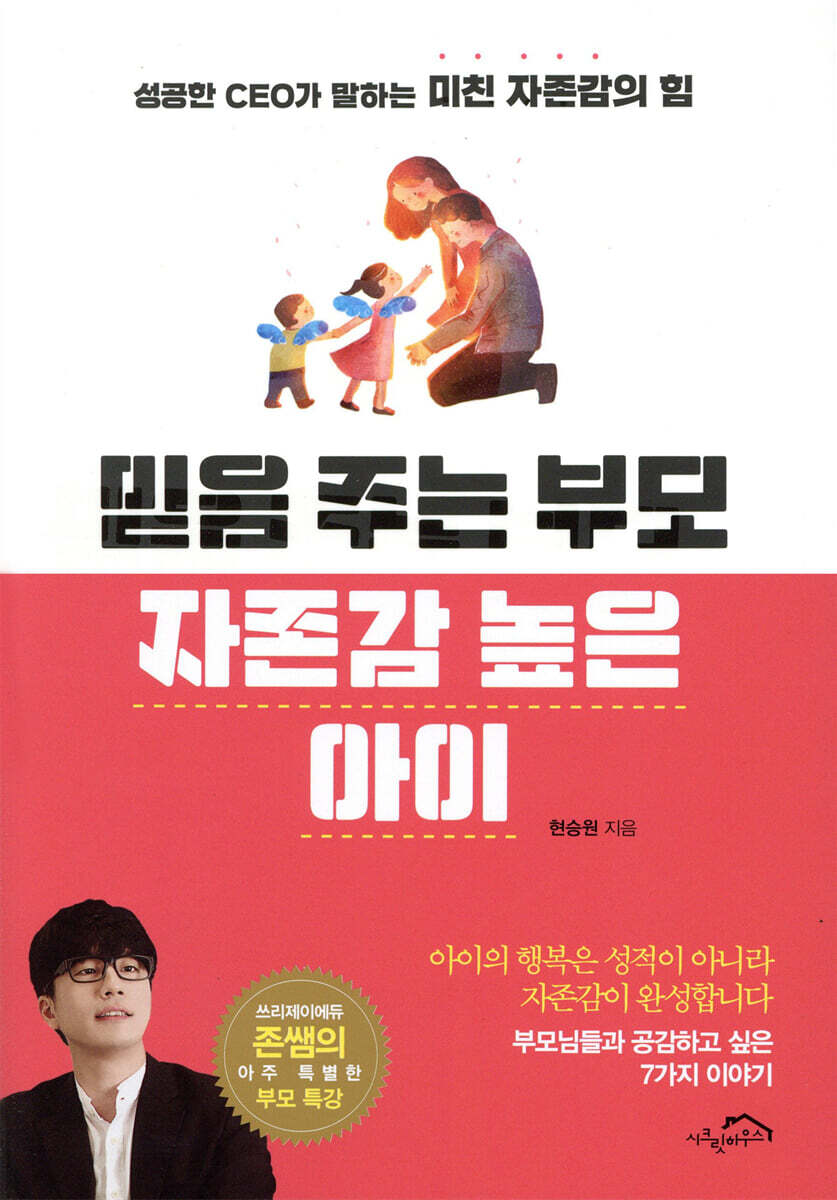
Parents who give faith give children high self-esteem
 |
Description
Book Introduction
Parental love boosts a child's self-esteem. The Power of Insane Self-Esteem That Turned an Ordinary Kid into a Successful CEO [3J Edu] Star Instructor, CEO of Education Company with Annual Sales of 72 Billion Won Teacher John's very special lecture for parents CEO Seungwon Hyun, founder of Dshare Co., Ltd., which started as [Three J Edu] in 2011 and has been growing at a rapid rate of over 40% every year. He was an ordinary child who never did well in school and had no special talents. However, this child, who no one paid attention to, grew up to become a star instructor, ‘Teacher John’, and in just 8 years since starting his business, he created an educational company with annual sales of 72 billion won (expected for 2019). “If you had to pick just one secret to your success in business, what would it be?” He answers without hesitation whenever asked about his secret to success. “It’s all thanks to the self-esteem my parents gave me.” The driving force that made a child who ranked 34th in his class work hard and not be discouraged toward his goal of becoming an ‘English instructor,’ and the strength that allowed him to not be discouraged despite the countless crises that came his way while running a business. It was all thanks to the endless ‘crazy self-esteem’ that my parents taught me. The book, "Parents Who Give Trust, Children with High Self-Esteem," is filled with wisdom and insights that parents who want their children to live happily should never forget, such as how important a child's self-esteem is, what miracles can be created by building trust between parents and children, and why having children keep an allowance and instilling financial sense are essential elements that determine a child's happiness, based on honest experience by the author, a successful businessman and popular English instructor in his 30s. After a long time of fighting with students and parents, he realized that the truly important subjects were not Korean, English, or math. I have seen countless children who, despite having good grades, were unable to live happily. Because he felt deeply that the role of parents is truly important during childhood, he wants to share with readers through “Faithful Parents, High Self-Esteem Children” seven things he hopes parents will keep in mind while raising their children. These seven stories are not the author's personal thoughts, but a great legacy he received from his parents and that readers must pass on to their children. |
- You can preview some of the book's contents.
Preview
index
Prologue: A child's success begins with a change in parental perspective.
Lecture 1.
Crazy self-esteem for my child
Parents who give faith
When you feel loved, your self-esteem also increases.
Does praising a child only make them worse?
Confidence and self-esteem are different.
[This lecture's key points] Raising your child's self-esteem
Lecture 2.
If you want your children to live without worrying about money
Save your child's money as it is.
It is important to develop the habit of writing down your allowance.
Record-keeping habits
The habit of prioritizing
Saving habits
Gain experience in investing and owning.
[This lecture's key points] Developing financial awareness in your children
3rd lecture.
Honesty nurtures the vessel of life.
Why should I be honest?
Honesty first, honesty second
What should I do with a child who lies?
Honesty is the best policy.
Foster positive thinking rather than cleverness.
If you want your children to be happy, pass on honesty.
[This lecture's key point] Raising honest children
Semifinals.
Dreams, Stimulate Your Child's Strengths
Dreaming and working towards the same dream with your child
When parents waver, children waver too.
Put your heads together and share your thoughts
Dreams keep changing, goals come first!
Stimulate the desire for recognition
In any field, the experience of being number one is important.
Provide diverse experiences and build the competitive edge of your dreams.
If you achieve small goals one by one,
[This lecture's key point] Raising children with dreams
Lecture 5.
Why didn't I read books when I was young!
Children who read books and children who don't read books
This is the real power of reading
[This lecture's key points] Developing reading habits in your child
Lecture 6.
Raise your child to be a considerate and humble child.
You'll be successful just by being good at greeting people?
Happiness begins with a grateful heart.
[This lecture's key point] Raising children who are considerate and humble.
Lesson 7.
Pass on the happiness of sharing as a legacy.
A taste of great happiness
What will you pass on to your children?
Equations of multiplication, not division
True happiness comes from sharing what you earn.
[This lecture's key point] Raising children who know how to share
Epilogue: Children will never give up if their parents believe in them and support them.
Lecture 1.
Crazy self-esteem for my child
Parents who give faith
When you feel loved, your self-esteem also increases.
Does praising a child only make them worse?
Confidence and self-esteem are different.
[This lecture's key points] Raising your child's self-esteem
Lecture 2.
If you want your children to live without worrying about money
Save your child's money as it is.
It is important to develop the habit of writing down your allowance.
Record-keeping habits
The habit of prioritizing
Saving habits
Gain experience in investing and owning.
[This lecture's key points] Developing financial awareness in your children
3rd lecture.
Honesty nurtures the vessel of life.
Why should I be honest?
Honesty first, honesty second
What should I do with a child who lies?
Honesty is the best policy.
Foster positive thinking rather than cleverness.
If you want your children to be happy, pass on honesty.
[This lecture's key point] Raising honest children
Semifinals.
Dreams, Stimulate Your Child's Strengths
Dreaming and working towards the same dream with your child
When parents waver, children waver too.
Put your heads together and share your thoughts
Dreams keep changing, goals come first!
Stimulate the desire for recognition
In any field, the experience of being number one is important.
Provide diverse experiences and build the competitive edge of your dreams.
If you achieve small goals one by one,
[This lecture's key point] Raising children with dreams
Lecture 5.
Why didn't I read books when I was young!
Children who read books and children who don't read books
This is the real power of reading
[This lecture's key points] Developing reading habits in your child
Lecture 6.
Raise your child to be a considerate and humble child.
You'll be successful just by being good at greeting people?
Happiness begins with a grateful heart.
[This lecture's key point] Raising children who are considerate and humble.
Lesson 7.
Pass on the happiness of sharing as a legacy.
A taste of great happiness
What will you pass on to your children?
Equations of multiplication, not division
True happiness comes from sharing what you earn.
[This lecture's key point] Raising children who know how to share
Epilogue: Children will never give up if their parents believe in them and support them.
Detailed image

Into the book
Why did I choose to teach in a field outside my major? After years of arguing with students and parents, I realized that what truly matters isn't Korean, English, math, social studies, or science.
I have worked with hundreds of thousands of students, but I have seen countless children who, despite their good grades, were unable to find their own identity and live happily.
What I felt deeply each time was that the role of parents in childhood is truly important.
---From the "Prologue"
First of all, you have to trust your precious child.
We must first engrave in our hearts the extremely ordinary fact that ‘my precious and valuable child’.
Instead of saying hurtful things or finding faults in your child, you should tell them you love them and look for things to praise them for.
Then, strength comes into the shoulders of the child who had been feeling weak.
The thought that my parents believe in me gives me confidence and makes me interested in studying.
A child who would get tired and give up after studying for 30 minutes will study for an hour because he or she thinks he or she will be praised.
It is an amazing miracle that confidence and self-esteem create.
That is why I emphasize this to parents first and foremost.
“The worse your grades, the more praise you need.
“We need to start by raising the child’s self-esteem.”
---From "Crazy Self-Esteem for My Child"
What benefits can I expect from keeping a budget journal? The first benefit, I believe, is developing a "recording habit."
Children can develop the habit of recording the money they spend by writing it down one by one with their bare hands.
By writing it down like this, you can clearly engrave in your mind the fact that 'money decreases when you spend it.'
It is very important to realize that allowance, and even money, is a limited resource and that if you spend it, it will eventually converge to '0'.
Until now, whenever I wanted ice cream, I would just say, “Mom, ice cream!” and money would come out of my mom’s wallet, so I thought I could spend money like a fountain pen.
But as children receive and spend their allowance and keep a record of it in their allowance ledger, they begin to realize:
That money is a limited resource.
This is a very important teaching
---From "If you want your children to live without worrying about money"
I am still deeply grateful to my parents for not scolding me sexually but for being dishonest.
Grades can be improved by studying hard, but honesty is a character trait and attitude towards life that is difficult to reverse once shaken.
It's hard to do something bad the first time, but it's easy to repeat it.
Once you fall into temptation, your heart is easily shaken from then on.
So how could I not be grateful to my parents who have raised me since I was young?
---From "Honesty Grows the Vessel of Life"
At some point, the practice of submitting family mottos to schools disappeared.
That's probably why there seem to be fewer families with family mottos than before, and since there's nothing to submit to school, the warm atmosphere of creating family mottos has disappeared.
I think that setting family rules is absolutely necessary.
This is because organizations formed by individuals, from small families to large corporations and even nations, need a single, clear slogan that encompasses the purpose of forming the organization and the direction it will take.
If we talk about the slogan at this time, it would be the family motto, if it was a company, it would be the company motto, and if it was a country, it would be the constitution or governing ideology.
Only with such an explicit slogan can the individuals within it unite and exert their power effectively.
---From "Dreams, Stimulate Your Child's Strengths"
Many people consider sharing what they have with others to be a negative action.
Then they give various reasons why they shouldn't share.
I can't help it because I can only see what's mine disappearing before my eyes.
But I think sharing is a plus action.
I think it's a multiplication equation, not a division equation.
Because sharing multiplies happiness.
Doesn't that mean your possessions won't decrease? No.
It may be less now, but bigger things will definitely come back.
---From "Leave the Happiness of Sharing as a Legacy"
If you want your child to be happy, parents must give in.
First, you have to open your arms and hug them.
You have to be the first to talk, smile, and have a conversation.
Before you nag, you should tell them you love them and praise them.
Only then can the child change.
You can live your life with confidence.
You can create the wonderful results your parents have been waiting for.
Lastly, I would like to ask you this.
Let's tell our children, who are more precious than anything in the world, that we love them.
Let's hug and say I love you every time our eyes meet, not just once a day.
Then, one day soon, you will see a miracle.
Miracles start in small places like this.
I have worked with hundreds of thousands of students, but I have seen countless children who, despite their good grades, were unable to find their own identity and live happily.
What I felt deeply each time was that the role of parents in childhood is truly important.
---From the "Prologue"
First of all, you have to trust your precious child.
We must first engrave in our hearts the extremely ordinary fact that ‘my precious and valuable child’.
Instead of saying hurtful things or finding faults in your child, you should tell them you love them and look for things to praise them for.
Then, strength comes into the shoulders of the child who had been feeling weak.
The thought that my parents believe in me gives me confidence and makes me interested in studying.
A child who would get tired and give up after studying for 30 minutes will study for an hour because he or she thinks he or she will be praised.
It is an amazing miracle that confidence and self-esteem create.
That is why I emphasize this to parents first and foremost.
“The worse your grades, the more praise you need.
“We need to start by raising the child’s self-esteem.”
---From "Crazy Self-Esteem for My Child"
What benefits can I expect from keeping a budget journal? The first benefit, I believe, is developing a "recording habit."
Children can develop the habit of recording the money they spend by writing it down one by one with their bare hands.
By writing it down like this, you can clearly engrave in your mind the fact that 'money decreases when you spend it.'
It is very important to realize that allowance, and even money, is a limited resource and that if you spend it, it will eventually converge to '0'.
Until now, whenever I wanted ice cream, I would just say, “Mom, ice cream!” and money would come out of my mom’s wallet, so I thought I could spend money like a fountain pen.
But as children receive and spend their allowance and keep a record of it in their allowance ledger, they begin to realize:
That money is a limited resource.
This is a very important teaching
---From "If you want your children to live without worrying about money"
I am still deeply grateful to my parents for not scolding me sexually but for being dishonest.
Grades can be improved by studying hard, but honesty is a character trait and attitude towards life that is difficult to reverse once shaken.
It's hard to do something bad the first time, but it's easy to repeat it.
Once you fall into temptation, your heart is easily shaken from then on.
So how could I not be grateful to my parents who have raised me since I was young?
---From "Honesty Grows the Vessel of Life"
At some point, the practice of submitting family mottos to schools disappeared.
That's probably why there seem to be fewer families with family mottos than before, and since there's nothing to submit to school, the warm atmosphere of creating family mottos has disappeared.
I think that setting family rules is absolutely necessary.
This is because organizations formed by individuals, from small families to large corporations and even nations, need a single, clear slogan that encompasses the purpose of forming the organization and the direction it will take.
If we talk about the slogan at this time, it would be the family motto, if it was a company, it would be the company motto, and if it was a country, it would be the constitution or governing ideology.
Only with such an explicit slogan can the individuals within it unite and exert their power effectively.
---From "Dreams, Stimulate Your Child's Strengths"
Many people consider sharing what they have with others to be a negative action.
Then they give various reasons why they shouldn't share.
I can't help it because I can only see what's mine disappearing before my eyes.
But I think sharing is a plus action.
I think it's a multiplication equation, not a division equation.
Because sharing multiplies happiness.
Doesn't that mean your possessions won't decrease? No.
It may be less now, but bigger things will definitely come back.
---From "Leave the Happiness of Sharing as a Legacy"
If you want your child to be happy, parents must give in.
First, you have to open your arms and hug them.
You have to be the first to talk, smile, and have a conversation.
Before you nag, you should tell them you love them and praise them.
Only then can the child change.
You can live your life with confidence.
You can create the wonderful results your parents have been waiting for.
Lastly, I would like to ask you this.
Let's tell our children, who are more precious than anything in the world, that we love them.
Let's hug and say I love you every time our eyes meet, not just once a day.
Then, one day soon, you will see a miracle.
Miracles start in small places like this.
---From the "Epilogue"
Publisher's Review
How does self-esteem bring happiness to children?
How do parents want their children to grow up? A child who excels in school, a smart child, a loving child, a cheerful child, a talented child, a bright child, a confident child, an honest child, a kind child, a healthy child…
From start to finish, it is the heart of a parent to want to raise their child without any shortcomings.
A child's self-esteem is important.
This is something that numerous experts have emphasized so far.
It is said that parental love, attention, listening, and constant praise increase a child's self-esteem.
So many parents try to build their children's self-esteem and accept their emotions.
I tried my best to raise them in an affluent environment.
But the news of selfish, extreme, and violent children continues.
Is this really all there is? Could it be that we're just boosting the children's selfish self-esteem?
The crazy self-esteem that author Hyun Seung-won talks about includes not only the family self-esteem that grows from parental love, but also the social self-esteem that grows from the love of neighbors and society.
Social self-esteem is also enhanced when praise, support, and love received not only at home but also from neighbors and the community have a positive effect.
The author was not a good student, was not good looking, and was not a child who showed any special talent in anything.
However, he confesses that because he grew up hearing from his parents and neighbors that he was a 'precious child', the idea that 'I am a very precious and valuable person' was firmly established in his mind.
However, that doesn't mean that I grew up without getting scolded.
If you lie or do something bad, you will be severely scolded.
It was thanks to my parents' philosophy that they should teach their children the right attitude as they are precious.
A child who receives love from his parents, love from his entire family, and love from his neighbors and those around him cannot be unhappy.
A child who is praised at home, in the community, and in society cannot have low self-esteem.
A child who is loved wherever he or she is with the right attitude and character will grow up to be a positive, proactive person who values his or her own happiness.
They will also grow into adults who know how to think about the happiness of others as well as their own.
A child's character, formed by a heart that is considerate and sharing with others, self-esteem, and love, will be a very important factor in helping the child become a person who can contribute to society.
A child's self-esteem begins with trust in their parents.
How is a child's self-esteem built? The author argues that a child's self-esteem is born from the foundation of their parents' faith and trust.
It's only natural that parents trust their children and children trust their parents.
But will children truly trust their parents? Will that trust be maintained as they grow? This is something to consider.
How can we instill trust in our children? Author Hyun Seung-won says, "There's a crucial moment when children begin to trust their parents."
And the decisive moment that made the author firmly believe in his parents was the moment he saw his Nonghyup bankbook when he was five years old.
Meanwhile, his mother saved up the gold ring that young Seungwon had received, the New Year's money she had received during the holidays, and the allowance that her older relatives had given her, and she put all of it into a bank account that was opened in Seungwon's name.
“Seungwon, this is yours.
This is the money you received during that time.
From now on, Seungwon will save all the money you receive here.
“Okay?” After that, the author’s mother kept her promise and saved all of Seungwon’s money, and when he became a college student, she gave him the bankbook.
Some people might think that saving up a child's money is not a very important thing.
Or, some might say, what's wrong with saving all your child's money and then spending it on your child?
However, this anecdote clearly shows how important it is to 'keep a promise to a child' and how much trust it gives to the child.
Many parents make promises, big and small, with their children in their daily lives.
But it is common for this to not be followed.
Parents may forget promises that are not kept, but children do not.
Children believe what their parents say.
However, promises that are not kept once or twice will gradually disappoint the child, and if disappointment is repeated, it will create a gap of hurt and distrust in the child's heart.
There is a question that author Hyun Seung-won always asks whenever he gives a lecture to parents.
“Is there anyone who saved up the gold ring their child received for their 100th day or first birthday, or the New Year’s money and allowance they received from relatives or adults, without spending a single penny?” Few parents would confidently raise their hand to this question.
Most people are relieved and think, 'It's not just me!'
At such times, he blurts out some harsh words.
“You have been stealing from your children and using their money until now.
“If a child grows up seeing a life that is taken away from them from a young age, how can they grow up to live a life of accumulation?”
The author tells us to keep our promises to our children.
A family is also a small society.
The basic trust a child has in his or her parents further develops into social trust and faith, and serves as an important foundation for the child to maintain harmonious relationships as a member of society.
He also emphasizes that children should save their money as it is.
Just as a parent's money is not a child's, a child's money is not a parent's money.
Don't we all know that money can cause fights and even turn parents and children into enemies?
As a CEO running a business, the author reflects on his childhood and says that the ownership, responsibility, and economic principles his parents naturally taught him have been of great help in his current business.
The experience of ownership is the best way to build self-esteem.
The experience of having something that is mine, something that belongs to no one else, gives me a surprisingly high sense of self-satisfaction.
Give your child the opportunity to have the precious experience of being 'completely mine'.
The book, “Faithful Parents, High Self-Esteem Children,” also talks about the precious qualities of character that parents must pass on to their children.
Through self-esteem, ownership and responsibility, and honesty, children develop good habits and can further discover their dreams and vision.
Reading habits, humility, and a heart for sharing are all things that can never be properly learned unless you are young.
Even if you learn something as an adult, it doesn't sink in deeply and you can't put it into practice easily.
In other words, the author emphasizes that basic character education, not immediate grades, is the path to a child's true happiness and success.
As the African proverb goes, “It takes a village to raise a child,” raising a child is a daily struggle with challenges and crises.
Author Hyun Seung-won will also support and run alongside all parents raising children in this land as they strive for their children's happiness.
When we tell our children, who are more precious than anything in the world, that we love them, miracles will begin.
How do parents want their children to grow up? A child who excels in school, a smart child, a loving child, a cheerful child, a talented child, a bright child, a confident child, an honest child, a kind child, a healthy child…
From start to finish, it is the heart of a parent to want to raise their child without any shortcomings.
A child's self-esteem is important.
This is something that numerous experts have emphasized so far.
It is said that parental love, attention, listening, and constant praise increase a child's self-esteem.
So many parents try to build their children's self-esteem and accept their emotions.
I tried my best to raise them in an affluent environment.
But the news of selfish, extreme, and violent children continues.
Is this really all there is? Could it be that we're just boosting the children's selfish self-esteem?
The crazy self-esteem that author Hyun Seung-won talks about includes not only the family self-esteem that grows from parental love, but also the social self-esteem that grows from the love of neighbors and society.
Social self-esteem is also enhanced when praise, support, and love received not only at home but also from neighbors and the community have a positive effect.
The author was not a good student, was not good looking, and was not a child who showed any special talent in anything.
However, he confesses that because he grew up hearing from his parents and neighbors that he was a 'precious child', the idea that 'I am a very precious and valuable person' was firmly established in his mind.
However, that doesn't mean that I grew up without getting scolded.
If you lie or do something bad, you will be severely scolded.
It was thanks to my parents' philosophy that they should teach their children the right attitude as they are precious.
A child who receives love from his parents, love from his entire family, and love from his neighbors and those around him cannot be unhappy.
A child who is praised at home, in the community, and in society cannot have low self-esteem.
A child who is loved wherever he or she is with the right attitude and character will grow up to be a positive, proactive person who values his or her own happiness.
They will also grow into adults who know how to think about the happiness of others as well as their own.
A child's character, formed by a heart that is considerate and sharing with others, self-esteem, and love, will be a very important factor in helping the child become a person who can contribute to society.
A child's self-esteem begins with trust in their parents.
How is a child's self-esteem built? The author argues that a child's self-esteem is born from the foundation of their parents' faith and trust.
It's only natural that parents trust their children and children trust their parents.
But will children truly trust their parents? Will that trust be maintained as they grow? This is something to consider.
How can we instill trust in our children? Author Hyun Seung-won says, "There's a crucial moment when children begin to trust their parents."
And the decisive moment that made the author firmly believe in his parents was the moment he saw his Nonghyup bankbook when he was five years old.
Meanwhile, his mother saved up the gold ring that young Seungwon had received, the New Year's money she had received during the holidays, and the allowance that her older relatives had given her, and she put all of it into a bank account that was opened in Seungwon's name.
“Seungwon, this is yours.
This is the money you received during that time.
From now on, Seungwon will save all the money you receive here.
“Okay?” After that, the author’s mother kept her promise and saved all of Seungwon’s money, and when he became a college student, she gave him the bankbook.
Some people might think that saving up a child's money is not a very important thing.
Or, some might say, what's wrong with saving all your child's money and then spending it on your child?
However, this anecdote clearly shows how important it is to 'keep a promise to a child' and how much trust it gives to the child.
Many parents make promises, big and small, with their children in their daily lives.
But it is common for this to not be followed.
Parents may forget promises that are not kept, but children do not.
Children believe what their parents say.
However, promises that are not kept once or twice will gradually disappoint the child, and if disappointment is repeated, it will create a gap of hurt and distrust in the child's heart.
There is a question that author Hyun Seung-won always asks whenever he gives a lecture to parents.
“Is there anyone who saved up the gold ring their child received for their 100th day or first birthday, or the New Year’s money and allowance they received from relatives or adults, without spending a single penny?” Few parents would confidently raise their hand to this question.
Most people are relieved and think, 'It's not just me!'
At such times, he blurts out some harsh words.
“You have been stealing from your children and using their money until now.
“If a child grows up seeing a life that is taken away from them from a young age, how can they grow up to live a life of accumulation?”
The author tells us to keep our promises to our children.
A family is also a small society.
The basic trust a child has in his or her parents further develops into social trust and faith, and serves as an important foundation for the child to maintain harmonious relationships as a member of society.
He also emphasizes that children should save their money as it is.
Just as a parent's money is not a child's, a child's money is not a parent's money.
Don't we all know that money can cause fights and even turn parents and children into enemies?
As a CEO running a business, the author reflects on his childhood and says that the ownership, responsibility, and economic principles his parents naturally taught him have been of great help in his current business.
The experience of ownership is the best way to build self-esteem.
The experience of having something that is mine, something that belongs to no one else, gives me a surprisingly high sense of self-satisfaction.
Give your child the opportunity to have the precious experience of being 'completely mine'.
The book, “Faithful Parents, High Self-Esteem Children,” also talks about the precious qualities of character that parents must pass on to their children.
Through self-esteem, ownership and responsibility, and honesty, children develop good habits and can further discover their dreams and vision.
Reading habits, humility, and a heart for sharing are all things that can never be properly learned unless you are young.
Even if you learn something as an adult, it doesn't sink in deeply and you can't put it into practice easily.
In other words, the author emphasizes that basic character education, not immediate grades, is the path to a child's true happiness and success.
As the African proverb goes, “It takes a village to raise a child,” raising a child is a daily struggle with challenges and crises.
Author Hyun Seung-won will also support and run alongside all parents raising children in this land as they strive for their children's happiness.
When we tell our children, who are more precious than anything in the world, that we love them, miracles will begin.
GOODS SPECIFICS
- Date of publication: August 28, 2019
- Page count, weight, size: 216 pages | 366g | 148*210*20mm
- ISBN13: 9791196508999
- ISBN10: 1196508992
You may also like
카테고리
korean


korean

![GQ KOREA Mark (Monthly): December [2025]](http://librairie.coreenne.fr/cdn/shop/files/8ef265dbbfbf186523ed75ba7319009d.jpg?v=1765340328&width=3840)


