

Parenting for New Moms and Dads
 |
Description
Book Introduction
Japan, a leading medical country, ranks first in childbirth and childcare on Amazon Japan!
Bestseller for 4 consecutive years from 2014 to 2017!
The best parenting encyclopedia chosen by Japanese mothers is finally published in Korean!
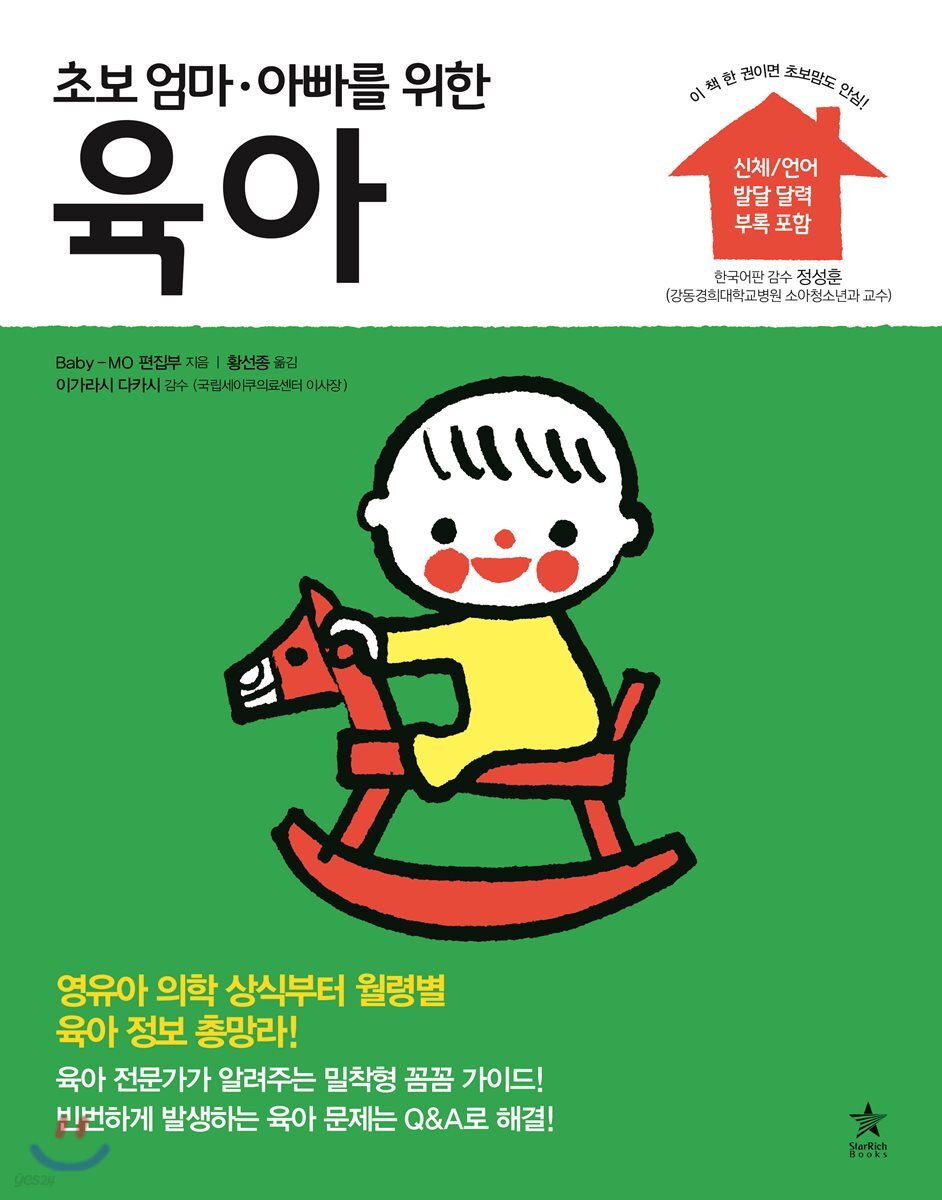
"Parenting for New Moms and Dads" is a practical parenting book that covers information on childcare for each stage of a child's development, including the level of development and characteristics of each month, from newborns to three years old.
Basic and practical care methods, health management, developing good lifestyle habits, vaccinations, safety measures and first aid, common diseases, and nursing methods are explained in detail and in a friendly manner, supported by abundant photos and illustrations.
This book is not only a guide for new mothers and fathers in this low birth rate era, who often have nowhere to turn for advice when faced with parenting issues, but also for domestic mothers who are thirsty for diverse and broad parenting knowledge from abroad.
Bestseller for 4 consecutive years from 2014 to 2017!
The best parenting encyclopedia chosen by Japanese mothers is finally published in Korean!
"Parenting for New Moms and Dads" is a practical parenting book that covers information on childcare for each stage of a child's development, including the level of development and characteristics of each month, from newborns to three years old.
Basic and practical care methods, health management, developing good lifestyle habits, vaccinations, safety measures and first aid, common diseases, and nursing methods are explained in detail and in a friendly manner, supported by abundant photos and illustrations.
This book is not only a guide for new mothers and fathers in this low birth rate era, who often have nowhere to turn for advice when faced with parenting issues, but also for domestic mothers who are thirsty for diverse and broad parenting knowledge from abroad.
- You can preview some of the book's contents.
Preview
index
To begin with
Reviewer's note
Life with a child begins
How long will parenting be difficult? Future predictions
Part 1: Growth and development of babies by month (0-3 years old), daily life, and concerns
After eating and sleeping for 0 months, they gradually become accustomed to the world they are seeing for the first time.
At 1 month, the baby's waking hours become slightly longer and a sleep-feeding rhythm begins to develop.
After two months, his expressions have become richer and he smiles brightly when you touch him.
Column 1: Let's make happy memories: Going out with your child
Double your weight in 3 months! You can now hold up your head on your own.
Neck control is almost complete at 4 months! Touching and licking are developing the five senses.
Starting solid foods at 5 months! Starting to roll over.
Column 2: Take advantage of government childcare support services
He sits for a short time, but after six months, he starts to hide his face and cry at night.
As I sit for 7 months, I see far away. The curiosity of 'what is that?' becomes the driving force behind my movement.
Once they can crawl at 8 months, they will move wherever their curiosity leads them.
Even babies who start to hold and stand at nine months old can pick up objects with their thumb and index finger.
At 10 months old, he explores his surroundings with great curiosity! He can even walk against walls and stand for a short time.
At 11 months, language comprehension increases rapidly, emotions develop, and self-assertion becomes stronger.
column3 Sending your child to daycare
Happy first birthday! Some children are learning to walk.
Walking independently for 1 year and 3 months! Expressive, complex, and delicate emotions.
At 1 year and 6 months, the baby walks briskly, almost like running! He can understand simple directions from his mother and father.
2-3 years: Dressing, drawing, and doing various tasks on their own
Column 4: Practice without rushing, aiming for one year! Weaning off diapers
Part 2 The Basics of Childcare: Knowing Just This Makes It Easy!
How to Hold a Baby / Changing Diapers / Bathing a Newborn / Bathing with Mom and Dad
Let's clean the eyes, ears, nose, etc. / Choose and dress the child's underwear & clothes / Prepare the child's bed
Part 3: Everything About Breastfeeding or Formula Feeding
The Role of Breast Milk and Formula / How to Breastfeed / How to Make and Feed Formula / Q&A on Breast Milk
Column 5: Mothers' Biggest Concern: When and How to Wean
Part 4: How to Proceed with Weaning & Toddler Food: The "Practice Period" to Allow Your Baby to Eat the Same Foods as Adults
Basic knowledge of baby food / Stage-by-stage weaning progress chart / Gulp-eating period (around 5-6 months) / Mumble-eating period (around 7-8 months) / Weaning period (around 9-11 months) / Self-eating period (around 1 year to 1 year and 6 months) / Toddler food period (Completion of weaning food to around 3 years) / Column 6 Food allergies that should not be excluded at the mother's discretion
Part 5: Praising and Yelling: Surprisingly Difficult! Lifestyle Habits & Rules
Early to bed and early to rise lifestyle habits / teeth growth order / how to brush teeth / praising / scolding
Column 7: Many Moms Don't Want Postpartum Sex?
Part 6: Protect Your Child from Illness! Vaccinations You Need to Know
Basic knowledge of vaccination / Vaccination schedule and how to get vaccinated / Types of vaccination / Haemophilus influenzae type b (Hib) / Streptococcus pneumoniae / Hepatitis B / Rotavirus / DTaP, polio / BCG / MMR / Chickenpox / Japanese encephalitis / Influenza / Q&A on vaccinations
Part 7 Safety accident countermeasures and emergency treatment to prevent risks in advance
Indoor Safety Accident Prevention / First Aid You Need to Know / Falling or Bumping / Foreign Object Stuck in Your Throat / Oops! I Fell into Water / Burned / When You Have a Nosebleed / When You Are Bleeding / When You Have a Wound in Your Mouth / When a Foreign Object Gets in Your Eyes, Nose, or Ears / When Your Finger Is Stuck / When You Are Cut or Scratched / Chest Compression
Part 8: I Want to Alleviate Pain, Even a Little! Hospital and Nursing
How to care for a sick child / When the child has a fever / When the child has diarrhea or vomits / When the child coughs or wheezes / When the child has a runny nose / When the child has eye discharge / When the child is constipated
How to administer medicine / How to use / Powder / Syrup / Dry syrup / Suppository / Eye drops / Topical medicine / Ear drops
Fever / Cold / Influenza / Rash / Mumps / Urinary tract infection / Meningitis / Kawasaki disease / Herpangina / Pharyngeal conjunctival fever / Topics If you have convulsions
Skin rash / measles / rubella / hand, foot and mouth disease / chickenpox / streptococcal infection / erythema infectiosum
Coughing hard / Bronchitis/Pneumonia / Bronchiolitis / Croup (acute laryngitis) / Whooping cough
Vomiting and diarrhea / Acute gastroenteritis (viral) / Acute gastroenteritis (bacterial) / Intussusception / Hypertrophic pyloric stenosis
Allergies / Atopic dermatitis / Topics What is bronchial asthma?
Skin Diseases / Infant Eczema / Heat Rash / Diaper Rash / Candidal Dermatitis / Impetigo Contaminant / Molluscum Contagiosum / Contact Dermatitis / Hives / Insect Bites / Spots / Topics What is Heatstroke?
Eye and ear diseases / nasolacrimal duct obstruction / conjunctivitis / ptosis / acute otitis media / otitis media with effusion / otitis externa
Diseases of bones, muscles, and joints / hip dislocation / elbow subluxation / congenital clubfoot / rickets
Abdominal and genital diseases / umbilical hernia / inguinal hernia / scrotal hydrocele / cryptorchidism / glans preputitis / phimosis
Index
Reviewer's note
Life with a child begins
How long will parenting be difficult? Future predictions
Part 1: Growth and development of babies by month (0-3 years old), daily life, and concerns
After eating and sleeping for 0 months, they gradually become accustomed to the world they are seeing for the first time.
At 1 month, the baby's waking hours become slightly longer and a sleep-feeding rhythm begins to develop.
After two months, his expressions have become richer and he smiles brightly when you touch him.
Column 1: Let's make happy memories: Going out with your child
Double your weight in 3 months! You can now hold up your head on your own.
Neck control is almost complete at 4 months! Touching and licking are developing the five senses.
Starting solid foods at 5 months! Starting to roll over.
Column 2: Take advantage of government childcare support services
He sits for a short time, but after six months, he starts to hide his face and cry at night.
As I sit for 7 months, I see far away. The curiosity of 'what is that?' becomes the driving force behind my movement.
Once they can crawl at 8 months, they will move wherever their curiosity leads them.
Even babies who start to hold and stand at nine months old can pick up objects with their thumb and index finger.
At 10 months old, he explores his surroundings with great curiosity! He can even walk against walls and stand for a short time.
At 11 months, language comprehension increases rapidly, emotions develop, and self-assertion becomes stronger.
column3 Sending your child to daycare
Happy first birthday! Some children are learning to walk.
Walking independently for 1 year and 3 months! Expressive, complex, and delicate emotions.
At 1 year and 6 months, the baby walks briskly, almost like running! He can understand simple directions from his mother and father.
2-3 years: Dressing, drawing, and doing various tasks on their own
Column 4: Practice without rushing, aiming for one year! Weaning off diapers
Part 2 The Basics of Childcare: Knowing Just This Makes It Easy!
How to Hold a Baby / Changing Diapers / Bathing a Newborn / Bathing with Mom and Dad
Let's clean the eyes, ears, nose, etc. / Choose and dress the child's underwear & clothes / Prepare the child's bed
Part 3: Everything About Breastfeeding or Formula Feeding
The Role of Breast Milk and Formula / How to Breastfeed / How to Make and Feed Formula / Q&A on Breast Milk
Column 5: Mothers' Biggest Concern: When and How to Wean
Part 4: How to Proceed with Weaning & Toddler Food: The "Practice Period" to Allow Your Baby to Eat the Same Foods as Adults
Basic knowledge of baby food / Stage-by-stage weaning progress chart / Gulp-eating period (around 5-6 months) / Mumble-eating period (around 7-8 months) / Weaning period (around 9-11 months) / Self-eating period (around 1 year to 1 year and 6 months) / Toddler food period (Completion of weaning food to around 3 years) / Column 6 Food allergies that should not be excluded at the mother's discretion
Part 5: Praising and Yelling: Surprisingly Difficult! Lifestyle Habits & Rules
Early to bed and early to rise lifestyle habits / teeth growth order / how to brush teeth / praising / scolding
Column 7: Many Moms Don't Want Postpartum Sex?
Part 6: Protect Your Child from Illness! Vaccinations You Need to Know
Basic knowledge of vaccination / Vaccination schedule and how to get vaccinated / Types of vaccination / Haemophilus influenzae type b (Hib) / Streptococcus pneumoniae / Hepatitis B / Rotavirus / DTaP, polio / BCG / MMR / Chickenpox / Japanese encephalitis / Influenza / Q&A on vaccinations
Part 7 Safety accident countermeasures and emergency treatment to prevent risks in advance
Indoor Safety Accident Prevention / First Aid You Need to Know / Falling or Bumping / Foreign Object Stuck in Your Throat / Oops! I Fell into Water / Burned / When You Have a Nosebleed / When You Are Bleeding / When You Have a Wound in Your Mouth / When a Foreign Object Gets in Your Eyes, Nose, or Ears / When Your Finger Is Stuck / When You Are Cut or Scratched / Chest Compression
Part 8: I Want to Alleviate Pain, Even a Little! Hospital and Nursing
How to care for a sick child / When the child has a fever / When the child has diarrhea or vomits / When the child coughs or wheezes / When the child has a runny nose / When the child has eye discharge / When the child is constipated
How to administer medicine / How to use / Powder / Syrup / Dry syrup / Suppository / Eye drops / Topical medicine / Ear drops
Fever / Cold / Influenza / Rash / Mumps / Urinary tract infection / Meningitis / Kawasaki disease / Herpangina / Pharyngeal conjunctival fever / Topics If you have convulsions
Skin rash / measles / rubella / hand, foot and mouth disease / chickenpox / streptococcal infection / erythema infectiosum
Coughing hard / Bronchitis/Pneumonia / Bronchiolitis / Croup (acute laryngitis) / Whooping cough
Vomiting and diarrhea / Acute gastroenteritis (viral) / Acute gastroenteritis (bacterial) / Intussusception / Hypertrophic pyloric stenosis
Allergies / Atopic dermatitis / Topics What is bronchial asthma?
Skin Diseases / Infant Eczema / Heat Rash / Diaper Rash / Candidal Dermatitis / Impetigo Contaminant / Molluscum Contagiosum / Contact Dermatitis / Hives / Insect Bites / Spots / Topics What is Heatstroke?
Eye and ear diseases / nasolacrimal duct obstruction / conjunctivitis / ptosis / acute otitis media / otitis media with effusion / otitis externa
Diseases of bones, muscles, and joints / hip dislocation / elbow subluxation / congenital clubfoot / rickets
Abdominal and genital diseases / umbilical hernia / inguinal hernia / scrotal hydrocele / cryptorchidism / glans preputitis / phimosis
Index
Detailed image

Publisher's Review
◈ Japan's best parenting bible
It has been ranked #1 in the childbirth and childcare category of Japan's largest online marketplace [Amazon.com] for four consecutive years, and is published by the editorial department of Baby-mo, Japan's top childcare magazine, and supervised by Professor Takashi Igarashi of the National Seiku Medical Center, a leading medical institution in Japan.
Accurate medical information, backed by thorough verification, has garnered enthusiastic responses and strong support from Japanese mothers.
Meanwhile, this Korean edition was reviewed by Professor Jeong Seong-hun, a pediatrics authority and Department of Pediatrics and Adolescent Medicine, Kyung Hee University Hospital, Gangdong, further enhancing its reliability.
This book, written by the best parenting experts from Korea and abroad, is expected to become an essential practical guide for new mothers and fathers not only in Japan but also in Korea.
◈ Published for mothers who lack domestic parenting knowledge.
The recent death of a newborn at a university hospital in Korea is a case that clearly shows how insensitive the domestic medical community is to medical hygiene.
These days, with considerable distrust growing in the domestic medical infrastructure and environment, mothers who have completed pregnancy and childbirth and are now seriously engaged in childcare are turning their attention to the childcare markets of advanced countries.
This book contains parenting know-how from Japan, the world's second-largest medical market after the United States.
All the parenting information from medically advanced countries is included in this one book.
Additionally, the delicate and meticulous coaching unique to Japan, which is incorporated throughout the book, provides great reassurance to mothers who are sensitive to even the smallest situations, and the cute illustrations filled with Japanese sensibility double the pleasure of reading.
This book is like a drop of rain in a drought for mothers who have been seeking more diverse and extensive know-how beyond the limited parenting information available domestically.
◈ Includes Korea's childcare support system and services.
This Korean version has been 'localized' to reflect some of the information in the country.
In particular, it faithfully contains information on our government's support programs and systems related to childcare, such as the childcare portal site 'I Love Children' and the 'Infant and Toddler Health Checkup System'.
It also clearly includes the latest information (2018) on services such as childcare allowances and childcare cost support, application guidelines, etc.
After a thorough re-editing process tailored to the domestic situation and meticulous review by Professor Jeong Seong-hun, it was reborn as a complete guide for new Korean mothers and fathers.
◈ It is composed of abundant photos and illustrations to help understanding.
We provide detailed and friendly information on your child's growth process, special features, and points to watch out for by month, using various photos and cute illustrations.
In addition, each chapter includes appropriate visual aids to aid understanding.
In particular, the appendix [Monthly Physical Development Calendar] and [Mind and Language Development Calendar] stand out with their cute illustrations and colorful colors unique to this book.
This chapter has been compiled separately from the book for the convenience of readers.
The child's development is divided into 'motor skills', 'fingers', 'mind', and 'language', and the main development points are introduced, so you can refer to and enjoy the development process of your child through the included baby photos.
◈ You can solve frequently occurring problems at once.
We've compiled Q&A for each topic to address common parenting issues and questions many people have.
Among them, the most important or essential parts are summarized again in the form of a column in the last chapter of each part.
It also includes advice and stories from people who have already experienced parenting, based on age and situation, so it can serve as a guide for similar situations and reduce trial and error.
The conflicting parenting experiences of experienced mothers can sometimes be a great guide and a vitamin that soothes the heart in difficult situations.
This is a practical, concise guide to raising children aged 0-3, tailored to your baby's physical and intellectual development as they grow each day.
◈ Includes disease prevention and safety accident response methods.
Growing children are beings who don't know where they will end up.
They can't control their overflowing activity, which can create dangerous situations that can make their mom and dad's hearts sink.
Sometimes, a child who was previously healthy suddenly becomes unwell and starts to feel sick.
We introduce the basics of vaccination, vaccination methods, types, etc. for our children who do not yet have strong immune systems, and also provide detailed information on various diseases and conditions that infants and young children are prone to.
We also provide safety measures and first aid methods for various situations, such as when you fall, get burned, or get your finger caught.
If we prepare in advance, we can raise our children in a safe and comfortable environment.
It has been ranked #1 in the childbirth and childcare category of Japan's largest online marketplace [Amazon.com] for four consecutive years, and is published by the editorial department of Baby-mo, Japan's top childcare magazine, and supervised by Professor Takashi Igarashi of the National Seiku Medical Center, a leading medical institution in Japan.
Accurate medical information, backed by thorough verification, has garnered enthusiastic responses and strong support from Japanese mothers.
Meanwhile, this Korean edition was reviewed by Professor Jeong Seong-hun, a pediatrics authority and Department of Pediatrics and Adolescent Medicine, Kyung Hee University Hospital, Gangdong, further enhancing its reliability.
This book, written by the best parenting experts from Korea and abroad, is expected to become an essential practical guide for new mothers and fathers not only in Japan but also in Korea.
◈ Published for mothers who lack domestic parenting knowledge.
The recent death of a newborn at a university hospital in Korea is a case that clearly shows how insensitive the domestic medical community is to medical hygiene.
These days, with considerable distrust growing in the domestic medical infrastructure and environment, mothers who have completed pregnancy and childbirth and are now seriously engaged in childcare are turning their attention to the childcare markets of advanced countries.
This book contains parenting know-how from Japan, the world's second-largest medical market after the United States.
All the parenting information from medically advanced countries is included in this one book.
Additionally, the delicate and meticulous coaching unique to Japan, which is incorporated throughout the book, provides great reassurance to mothers who are sensitive to even the smallest situations, and the cute illustrations filled with Japanese sensibility double the pleasure of reading.
This book is like a drop of rain in a drought for mothers who have been seeking more diverse and extensive know-how beyond the limited parenting information available domestically.
◈ Includes Korea's childcare support system and services.
This Korean version has been 'localized' to reflect some of the information in the country.
In particular, it faithfully contains information on our government's support programs and systems related to childcare, such as the childcare portal site 'I Love Children' and the 'Infant and Toddler Health Checkup System'.
It also clearly includes the latest information (2018) on services such as childcare allowances and childcare cost support, application guidelines, etc.
After a thorough re-editing process tailored to the domestic situation and meticulous review by Professor Jeong Seong-hun, it was reborn as a complete guide for new Korean mothers and fathers.
◈ It is composed of abundant photos and illustrations to help understanding.
We provide detailed and friendly information on your child's growth process, special features, and points to watch out for by month, using various photos and cute illustrations.
In addition, each chapter includes appropriate visual aids to aid understanding.
In particular, the appendix [Monthly Physical Development Calendar] and [Mind and Language Development Calendar] stand out with their cute illustrations and colorful colors unique to this book.
This chapter has been compiled separately from the book for the convenience of readers.
The child's development is divided into 'motor skills', 'fingers', 'mind', and 'language', and the main development points are introduced, so you can refer to and enjoy the development process of your child through the included baby photos.
◈ You can solve frequently occurring problems at once.
We've compiled Q&A for each topic to address common parenting issues and questions many people have.
Among them, the most important or essential parts are summarized again in the form of a column in the last chapter of each part.
It also includes advice and stories from people who have already experienced parenting, based on age and situation, so it can serve as a guide for similar situations and reduce trial and error.
The conflicting parenting experiences of experienced mothers can sometimes be a great guide and a vitamin that soothes the heart in difficult situations.
This is a practical, concise guide to raising children aged 0-3, tailored to your baby's physical and intellectual development as they grow each day.
◈ Includes disease prevention and safety accident response methods.
Growing children are beings who don't know where they will end up.
They can't control their overflowing activity, which can create dangerous situations that can make their mom and dad's hearts sink.
Sometimes, a child who was previously healthy suddenly becomes unwell and starts to feel sick.
We introduce the basics of vaccination, vaccination methods, types, etc. for our children who do not yet have strong immune systems, and also provide detailed information on various diseases and conditions that infants and young children are prone to.
We also provide safety measures and first aid methods for various situations, such as when you fall, get burned, or get your finger caught.
If we prepare in advance, we can raise our children in a safe and comfortable environment.
GOODS SPECIFICS
- Date of issue: June 15, 2018
- Page count, weight, size: 224 pages | 792g | 227*303*12mm
- ISBN13: 9791185982465
- ISBN10: 1185982469
You may also like
카테고리
korean


korean

![GQ KOREA Mark (Monthly): December [2025]](http://librairie.coreenne.fr/cdn/shop/files/8ef265dbbfbf186523ed75ba7319009d.jpg?v=1765340328&width=3840)


