

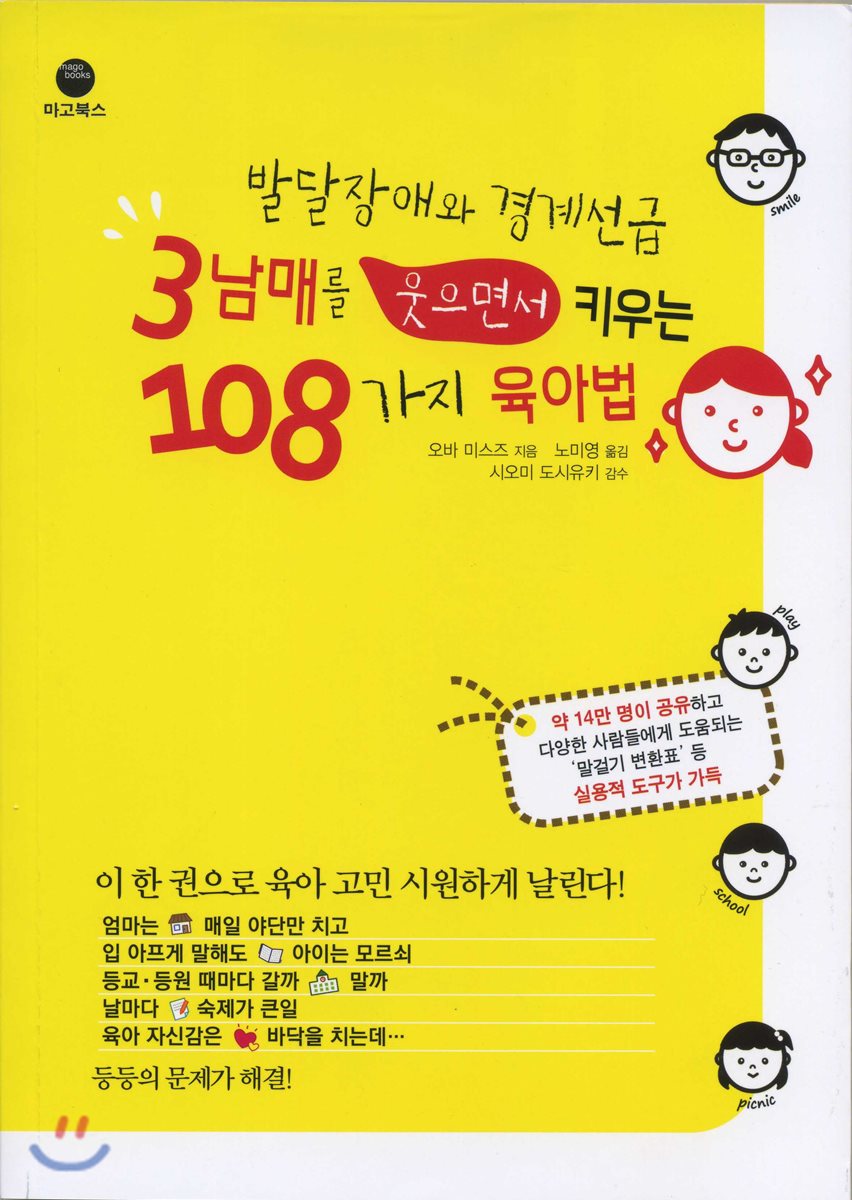
108 Parenting Tips for Raising Three Children with Developmental Disabilities and Borderline Disorders with Smiles
 |
Description
Book Introduction
Parenting a child with developmental disabilities and difficult feelings
This kind of 'skill' and that kind of 'ingenuine thinking' are great powers!
A wealth of parenting tools you can use starting today.
- Increase your small 'I did it!' experiences
- Boost your motivation with the ‘Points Notebook’!
- Easy to understand with ‘Speech Conversion’!
- Create a ‘Support Book’ to provide support to those around you!
- Tools can be powered up by slightly modifying them!
- Difficult letters are helped by underwriting.
Author Misuzu Oba, nicknamed "Rakuraku Mom," is a well-known source of parenting information among Japanese mothers with children with developmental disabilities and other difficult-to-raise children.
His "Speech Transformation Chart" for children with developmental disabilities has been shared over 140,000 times on Facebook, and nearly 20,000 parents, teachers, and support staff are currently liking his parenting tips, which can be applied directly to real-life situations.
The author herself is a mother raising three children with developmental disabilities and borderline disabilities.
In the past, parenting was frustrating because parents would hit an unknown wall and just scold their children.
Then, he discovered that his child had a problem with his temperament. After going through trial and error every day and researching, "How can I convey this to my child in an easy-to-understand way?", he is now able to "raise my child comfortably with a smile."
This book is full of practical, immediately actionable ideas learned along the way.
The words sound plausible, but the content is not so easy to apply to daily life. Rather, the author's specific know-how gained from struggling with his own children in real life is conveyed in an easy-to-understand manner.
The warm gaze and advice given to mothers in similar situations are also special.
This book provides practical help to all mothers and fathers struggling with parenting issues, regardless of whether or not their children have developmental disabilities.
This kind of 'skill' and that kind of 'ingenuine thinking' are great powers!
A wealth of parenting tools you can use starting today.
- Increase your small 'I did it!' experiences
- Boost your motivation with the ‘Points Notebook’!
- Easy to understand with ‘Speech Conversion’!
- Create a ‘Support Book’ to provide support to those around you!
- Tools can be powered up by slightly modifying them!
- Difficult letters are helped by underwriting.
Author Misuzu Oba, nicknamed "Rakuraku Mom," is a well-known source of parenting information among Japanese mothers with children with developmental disabilities and other difficult-to-raise children.
His "Speech Transformation Chart" for children with developmental disabilities has been shared over 140,000 times on Facebook, and nearly 20,000 parents, teachers, and support staff are currently liking his parenting tips, which can be applied directly to real-life situations.
The author herself is a mother raising three children with developmental disabilities and borderline disabilities.
In the past, parenting was frustrating because parents would hit an unknown wall and just scold their children.
Then, he discovered that his child had a problem with his temperament. After going through trial and error every day and researching, "How can I convey this to my child in an easy-to-understand way?", he is now able to "raise my child comfortably with a smile."
This book is full of practical, immediately actionable ideas learned along the way.
The words sound plausible, but the content is not so easy to apply to daily life. Rather, the author's specific know-how gained from struggling with his own children in real life is conveyed in an easy-to-understand manner.
The warm gaze and advice given to mothers in similar situations are also special.
This book provides practical help to all mothers and fathers struggling with parenting issues, regardless of whether or not their children have developmental disabilities.
index
Chapter 1: The Basics of How to Treat Children
1.
I keep getting angry at my child → Stop using 'means' to get angry
2.
I don't know what to do → What are the options that will 'instill confidence in my child'?
3.
The most important thing in parenting → Communicating love in an easy-to-understand way
4.
It exploded and I couldn't do anything about it → They were being so skinship-y that it was overwhelming
5.
Not listening to what others say at all → Instead of denying what the child says, listen and empathize.
6.
A parade of failures and troubles → Even the obvious is praised
7.
I can't do this or that! → Tackle each task one by one.
8.
I can't do it, I can't concentrate → Increase the small 'I did it!'
9.
Not listening to instructions/commands/prohibitions → Convey them by ‘converting to speaking’!
10.
I don't know how to support my child! → "Reassurance" is the foundation of support.
11.
Creating an environment 1 → Add ‘opening device’ and ‘security guard’ to the information.
12.
Creating an Environment 2 → Organizing Your Home Environment with the "Our Home Mark"
13.
Creating an Environment 3 → Solve it yourself with the 'Usage Card'
14.
Creating an Environment 4 → Use Timers and Alarms
15.
Children are not touched equally → Practice your octopus-like skills!
Chapter 2: Basics on How to Communicate Easily
16.
No matter how much I tell you, you still don't know → Use 'visual aids' and 'visualization'!
17.
I feel like I've been nagging all day long → If you 'write it down', you'll have ears to listen!
18.
I'm trying but it's not going well → I'm trying to compensate for my weaknesses by studying things.
19.
Still not working well, can't concentrate → Show me the 'model' and do it together!
20. There are many frustrations in daily life → Get strength with the 'Point Notebook'!
21.
Repeating the same mistakes → Gain experience through 'feedback'
22.
Praise doesn't build confidence → "I did it" journaling builds confidence
Chapter 3: Family Life Studies
23.
It takes time to prepare → The chaos of the morning is solved with the 'Preparation Card'
24.
Poor body temperature control → Prepare yourself mentally by checking the weather in the morning
25.
I am a picky eater → I enjoy eating, and I eat my favorite foods.
26.
Eat with your hands or eat while walking → 'Eat with your hands and eat while walking' is reasonable
27.
Spills and dirt during a meal → Communicate how to deal with it with an 'OK Card'
28 Breakfast → 'My own menu' is OK, 'eating alone' is NG
29 Dinner → Eating less and eating separately
30 Snacks → Snacks are a treasure trove of experiences.
31. Inedible items are served during school lunch → This conveys sensory hypersensitivity.
32 If you have food allergies → Diet should be appropriate
33. I am not good at using the bathroom → I put up a 'How to Use the Bathroom' sign.
34 Children who can't organize have rich imagination.
35 I can't tell whose item it is! → Each person decides on an image color.
36 Always a mess! → Kill two birds with one stone with 'object name labels'
37 I can't see the important stuff! → All in one lump in a 'dedicated box'
38. Don't look for something and do something else → Attach a string to items you frequently lose.
39 I Hate Baths → 6 Fun Bath Games
40 Survival with a baby who won't sleep → Stay together as much as possible, and rest as much as possible!
41. If you don't develop the basic habits of daily living → Create a 'children's task list'
Chapter 4: Research for Outings
42 Shopping with kids is hard! → If I don't plan on buying anything for them, I won't take them!
43 Wanting to have anything without thinking → What they really want is 'Mom'
44 Eating out is a pain → Eating out without stress
45. Making a fuss at the hospital → Hospital/dentist selection points
46 Disappears in the blink of an eye → Solved with a 'children's cell phone'
47 As soon as you arrive at the hotel, you say, "I want to go home." → Create a "guide" to reassure them.
48. I wander around in the crowd → 'I'm walking while watching my dad's back'
49 It's dangerous anyway → Reduce the risk to the extent possible
Chapter 5: School/Kindergarten Life Research
50 Reluctant to go to school/daycare → 100 points just for going
51 Anxiety about entering elementary school → Create a concrete image before entering school
52. Crying after entering kindergarten! → Reassure with "A Day in the Life" video.
53. Unable to pack according to the schedule → Pack together 'card game style'
54. Trying to go to school empty-handed → Helping you remember everything in a quiz format
55. I am sensitive to loud noises or voices → Ask permission to use earmuffs.
56 Do not write down the contact information → The contact information is resolved by marking it with a circle
57 My backpack is empty → Prevent lost items with a 'lid list'
58. Sticky slippers, swimsuits that have become dried pollack → Put them in a transparent, 'fully visible bag'
59 If the print is wrinkled → If you forget to take it out, use tags and order cards
60 Unable to participate in sports events or games → Reassure yourself with a 'program for me'
Chapter 6 Learning Support
61 It's slow to open the relevant section of the textbook → This can be resolved with the index.
62. For children who are clumsy, forgetful, or flustered, choose and modify easy-to-use tools.
63 I can't take notes at all! → Create a "textbook notebook."
I hate getting my 64 letters corrected → I ask the teacher to do the 'good job, good job' strategy.
65 I can't focus on my homework → I do it within the 'possible range'
66 My nerves are scattered here and there → Create an environment where I can concentrate with a ‘partition’
67 Homework Helpers 7 Tips 1: I Can't! I Don't Know! → Mom and Teacher with Colored Pencils
68 Homework Helpers 2: Difficulty Reading and Writing → Expand to 'Loupe' and 'Copier'
69 Homework Helper 3: If you have difficulty memorizing the order or Chinese characters, use a 'Learning Support Card'
70 Homework Helpers 4: If there is too much, you can't do it → Cover it with a 'bookend' so that only the part you are working on is visible.
71 Homework Helpers 5: My child is having trouble studying?! → Just use the method that suits your child!
72 Homework Helpers 6: Can't Concentrate → Use Gum and Music to Help
73 Homework Helpers 7: Lack of Interest → IT Devices are a Powerful Ally!
74 Homework is boring and annoying! → Approach homework in a fun way.
75 I'm overwhelmed with all the vacation homework → I'm making a list of all the homework.
76 I can't write essays/picture diaries/book reviews → Solve it with fill-in-the-blank essays and interviews!
77 Unable to complete independent research! → Complete with a collage of photos and short essays.
78 Not starting homework → Determine whether it is immersion or escapism
79 Still can't do homework → Last resort is 'Two-person triangle'!
80 Test scores and report cards are a headache → Tests and report cards are free developmental tests
81 The teacher does not recognize the child's difficulties → The child conveys 'what is difficult'
82 I want to establish a solid connection with the school → I create and distribute a "Support Book."
83 I don't know how to convey this to the teacher → Express specific difficulties/responses/gratitude
At the end of the 84th semester, I don't know what to do because I have so much luggage → Little by little, I'm making a 'bring home list'
85. What to do when you don't want to go to school → There are levels to "I don't want to go."
86 When you don't want to go to school, how to overcome it Level 1 → Set up a reward
87 Level 2 Countermeasures for When You Don't Want to Go to School → Reduce the Burden by Removing Obstacles
88 Level 3: When you don't want to go to school → Request specific understanding and response from the school.
89 Level 4: When You Don't Want to Go to School → School Isn't 'Everything'
Chapter 7: How to Deal with Parenting Fatigue
90 Getting annoyed with your child → Irritation is evidence that you are trying too hard.
91 There's no end to the things you have to do → Prioritize with 'sticky notes'
92 I can't finish all the housework → Dust doesn't pile up like a mountain
93 Trouble → Anger → Tired → Trouble → You can escape the vicious cycle with the first step.
94 I get bored quickly and don't continue → I can continue in this way and that way.
95 They gossip about being raised as a spoiled brat → Distinguish between spoiling and supporting.
96 But stress still builds up → Let your complaints out!
97. Anxiety over trivial things → Set a 'time out' for yourself.
98 But I still get angry → There are no perfect parents.
99 I'm concerned about what I can't do → I'm okay with just the 'possible range'
100 Escaping from reality → Returning to reality by 'feeling' the child
101 Feeling like you're running out of love → Receive kind care from others (paid service available)
102 No time to rest → Use the service to secure rest time
103 I am in bad condition.
Feeling down → Don't put off your own maintenance
104 I don't know what to do → Asking an expert will open the way.
105 I may have reached my limit now → I usually train myself to say ‘please help me’
106 The child does not look lovable → Love image training
107 I was too loud today → All's well that ends well
108 When will things stabilize? → That day will never come.
1.
I keep getting angry at my child → Stop using 'means' to get angry
2.
I don't know what to do → What are the options that will 'instill confidence in my child'?
3.
The most important thing in parenting → Communicating love in an easy-to-understand way
4.
It exploded and I couldn't do anything about it → They were being so skinship-y that it was overwhelming
5.
Not listening to what others say at all → Instead of denying what the child says, listen and empathize.
6.
A parade of failures and troubles → Even the obvious is praised
7.
I can't do this or that! → Tackle each task one by one.
8.
I can't do it, I can't concentrate → Increase the small 'I did it!'
9.
Not listening to instructions/commands/prohibitions → Convey them by ‘converting to speaking’!
10.
I don't know how to support my child! → "Reassurance" is the foundation of support.
11.
Creating an environment 1 → Add ‘opening device’ and ‘security guard’ to the information.
12.
Creating an Environment 2 → Organizing Your Home Environment with the "Our Home Mark"
13.
Creating an Environment 3 → Solve it yourself with the 'Usage Card'
14.
Creating an Environment 4 → Use Timers and Alarms
15.
Children are not touched equally → Practice your octopus-like skills!
Chapter 2: Basics on How to Communicate Easily
16.
No matter how much I tell you, you still don't know → Use 'visual aids' and 'visualization'!
17.
I feel like I've been nagging all day long → If you 'write it down', you'll have ears to listen!
18.
I'm trying but it's not going well → I'm trying to compensate for my weaknesses by studying things.
19.
Still not working well, can't concentrate → Show me the 'model' and do it together!
20. There are many frustrations in daily life → Get strength with the 'Point Notebook'!
21.
Repeating the same mistakes → Gain experience through 'feedback'
22.
Praise doesn't build confidence → "I did it" journaling builds confidence
Chapter 3: Family Life Studies
23.
It takes time to prepare → The chaos of the morning is solved with the 'Preparation Card'
24.
Poor body temperature control → Prepare yourself mentally by checking the weather in the morning
25.
I am a picky eater → I enjoy eating, and I eat my favorite foods.
26.
Eat with your hands or eat while walking → 'Eat with your hands and eat while walking' is reasonable
27.
Spills and dirt during a meal → Communicate how to deal with it with an 'OK Card'
28 Breakfast → 'My own menu' is OK, 'eating alone' is NG
29 Dinner → Eating less and eating separately
30 Snacks → Snacks are a treasure trove of experiences.
31. Inedible items are served during school lunch → This conveys sensory hypersensitivity.
32 If you have food allergies → Diet should be appropriate
33. I am not good at using the bathroom → I put up a 'How to Use the Bathroom' sign.
34 Children who can't organize have rich imagination.
35 I can't tell whose item it is! → Each person decides on an image color.
36 Always a mess! → Kill two birds with one stone with 'object name labels'
37 I can't see the important stuff! → All in one lump in a 'dedicated box'
38. Don't look for something and do something else → Attach a string to items you frequently lose.
39 I Hate Baths → 6 Fun Bath Games
40 Survival with a baby who won't sleep → Stay together as much as possible, and rest as much as possible!
41. If you don't develop the basic habits of daily living → Create a 'children's task list'
Chapter 4: Research for Outings
42 Shopping with kids is hard! → If I don't plan on buying anything for them, I won't take them!
43 Wanting to have anything without thinking → What they really want is 'Mom'
44 Eating out is a pain → Eating out without stress
45. Making a fuss at the hospital → Hospital/dentist selection points
46 Disappears in the blink of an eye → Solved with a 'children's cell phone'
47 As soon as you arrive at the hotel, you say, "I want to go home." → Create a "guide" to reassure them.
48. I wander around in the crowd → 'I'm walking while watching my dad's back'
49 It's dangerous anyway → Reduce the risk to the extent possible
Chapter 5: School/Kindergarten Life Research
50 Reluctant to go to school/daycare → 100 points just for going
51 Anxiety about entering elementary school → Create a concrete image before entering school
52. Crying after entering kindergarten! → Reassure with "A Day in the Life" video.
53. Unable to pack according to the schedule → Pack together 'card game style'
54. Trying to go to school empty-handed → Helping you remember everything in a quiz format
55. I am sensitive to loud noises or voices → Ask permission to use earmuffs.
56 Do not write down the contact information → The contact information is resolved by marking it with a circle
57 My backpack is empty → Prevent lost items with a 'lid list'
58. Sticky slippers, swimsuits that have become dried pollack → Put them in a transparent, 'fully visible bag'
59 If the print is wrinkled → If you forget to take it out, use tags and order cards
60 Unable to participate in sports events or games → Reassure yourself with a 'program for me'
Chapter 6 Learning Support
61 It's slow to open the relevant section of the textbook → This can be resolved with the index.
62. For children who are clumsy, forgetful, or flustered, choose and modify easy-to-use tools.
63 I can't take notes at all! → Create a "textbook notebook."
I hate getting my 64 letters corrected → I ask the teacher to do the 'good job, good job' strategy.
65 I can't focus on my homework → I do it within the 'possible range'
66 My nerves are scattered here and there → Create an environment where I can concentrate with a ‘partition’
67 Homework Helpers 7 Tips 1: I Can't! I Don't Know! → Mom and Teacher with Colored Pencils
68 Homework Helpers 2: Difficulty Reading and Writing → Expand to 'Loupe' and 'Copier'
69 Homework Helper 3: If you have difficulty memorizing the order or Chinese characters, use a 'Learning Support Card'
70 Homework Helpers 4: If there is too much, you can't do it → Cover it with a 'bookend' so that only the part you are working on is visible.
71 Homework Helpers 5: My child is having trouble studying?! → Just use the method that suits your child!
72 Homework Helpers 6: Can't Concentrate → Use Gum and Music to Help
73 Homework Helpers 7: Lack of Interest → IT Devices are a Powerful Ally!
74 Homework is boring and annoying! → Approach homework in a fun way.
75 I'm overwhelmed with all the vacation homework → I'm making a list of all the homework.
76 I can't write essays/picture diaries/book reviews → Solve it with fill-in-the-blank essays and interviews!
77 Unable to complete independent research! → Complete with a collage of photos and short essays.
78 Not starting homework → Determine whether it is immersion or escapism
79 Still can't do homework → Last resort is 'Two-person triangle'!
80 Test scores and report cards are a headache → Tests and report cards are free developmental tests
81 The teacher does not recognize the child's difficulties → The child conveys 'what is difficult'
82 I want to establish a solid connection with the school → I create and distribute a "Support Book."
83 I don't know how to convey this to the teacher → Express specific difficulties/responses/gratitude
At the end of the 84th semester, I don't know what to do because I have so much luggage → Little by little, I'm making a 'bring home list'
85. What to do when you don't want to go to school → There are levels to "I don't want to go."
86 When you don't want to go to school, how to overcome it Level 1 → Set up a reward
87 Level 2 Countermeasures for When You Don't Want to Go to School → Reduce the Burden by Removing Obstacles
88 Level 3: When you don't want to go to school → Request specific understanding and response from the school.
89 Level 4: When You Don't Want to Go to School → School Isn't 'Everything'
Chapter 7: How to Deal with Parenting Fatigue
90 Getting annoyed with your child → Irritation is evidence that you are trying too hard.
91 There's no end to the things you have to do → Prioritize with 'sticky notes'
92 I can't finish all the housework → Dust doesn't pile up like a mountain
93 Trouble → Anger → Tired → Trouble → You can escape the vicious cycle with the first step.
94 I get bored quickly and don't continue → I can continue in this way and that way.
95 They gossip about being raised as a spoiled brat → Distinguish between spoiling and supporting.
96 But stress still builds up → Let your complaints out!
97. Anxiety over trivial things → Set a 'time out' for yourself.
98 But I still get angry → There are no perfect parents.
99 I'm concerned about what I can't do → I'm okay with just the 'possible range'
100 Escaping from reality → Returning to reality by 'feeling' the child
101 Feeling like you're running out of love → Receive kind care from others (paid service available)
102 No time to rest → Use the service to secure rest time
103 I am in bad condition.
Feeling down → Don't put off your own maintenance
104 I don't know what to do → Asking an expert will open the way.
105 I may have reached my limit now → I usually train myself to say ‘please help me’
106 The child does not look lovable → Love image training
107 I was too loud today → All's well that ends well
108 When will things stabilize? → That day will never come.
Into the book
I have a Facebook page called "Developmental Disability Idea Support Tool and Rakuraku Research Notes" under the nickname "Rakuraku (downbeat) Mom," and I share my experiences and ideas for parenting and support tools.
In the past, things like the "Speech Conversion Table" became a hot topic online, but now, regardless of whether or not their child has a developmental disability, over 16,000 parents, teachers, and supporters are waiting for my article to be posted.
In this book, I have poured out all of my childcare know-how and parenting ideas, to the point of "exploding everything," so that mothers like me, who struggle through difficult situations every day, and children like my child, who often lose confidence after being scolded or failing, can find some comfort.
However, when I tried the methods introduced here at home, my child did not say things like, "He started to really like school" or "His developmental disability got better."
But I started to think that somehow, 'my child and I were able to do it in our own way' and 'in our own way', and that things will work out somehow in the future too.
I am not an expert in parenting, education, coaching, psychology, or anything like that.
All I have is a 'permanent parental license' and a driver's license that were issued to me the moment my first child was born.
But when it comes to 'our child', I have been watching more closely than anyone else in the world.
Obviously, you have been watching your child better than anyone else in the world.
I believe that all mothers are 'experts on their children' and 'professionals in raising their children'.
Of course, when I was a beginner, I was helpless and helpless, not knowing what to do and being manipulated by my child every day.
I was getting tired of getting angry every time I did something with my child.
But after learning 'How to Raise Our Children', parenting became quite comfortable and enjoyable.
If you think about it, there are a lot of ways to communicate so that a child who doesn't understand no matter how much you talk to him or her understands.
I would be very happy if this book could be of help to my fellow business partners.
--- From the preface
Even movements that seem simple to adults can be a series of complex movements for children, making it difficult for them to do or concentrate.
Moreover, when parents demand too much at once, there are few opportunities to praise them.
For example, if you think, "I have to finish the Chinese character copying homework with good posture/and careful handwriting/before dinner," and "I have to praise them when they finish it all," you will never have the opportunity to praise your older child who has a writing disability.
I acknowledge it by saying, “(Even though it took a long time) you wrote it with care”, “(Even though it’s crooked) you finished it all.”
When I look at other kids, I get anxious and think, 'They know how to do this and that,' but it's okay if I take it one step at a time.
If there is a task that your child is currently working hard on, you can ignore everything else and be lenient in your evaluation.
for example,
^ When the grade changes, the first priority is to get used to the class.
For other things, close your eyes.
^ When your head is full of things with friends (conflicts, fights, etc.), don't nag about things related to studying or living.
^ After the difficult sports season of adjusting, I catch up on the parts of my studies that I missed after I have stabilized a bit.
^ The moment you succeed in your task, don't go ahead and say, "I hope you succeed in ○○ next time too," and talk about the next task.
I am conscious of this, etc.
Mr. Convex's mind is always incredibly busy.
Therefore, parents should lower the hurdles so that their children can achieve success by concisely completing each task, one at a time, and then move on to the next step.
--- pp.51-52
Last year, my youngest child started kindergarten, and I had free time for the first time in eight years.
During my three pregnancies and childbirths, I was always home with a baby or toddler, so I couldn't 'take a breather at home alone' for eight years.
The day after the entrance ceremony, after leaving my daughter with her teacher, I felt like jumping up and down to go home.
My daughter cried loudly, not knowing whether to say 'but' or 'as expected'.
Every year, around the time of schooling, chicks, whether they have a convex or not, start squeaking.
Because at that time, I had seen the kindergartens busily running around with all the teachers, including the office workers, holding the children in their arms, so I accepted it as natural for my daughter to cry.
Among the reasons why a child who is separated from his or her mother cries, it seems that the mother is worried and anxious, thinking, "I wonder if my mother will go somewhere while I am away," and the child with a younger sibling is worried, "I wonder if my mother will be taken away by my younger sibling."
My daughter didn't believe me when I told her, "I'm just doing laundry at home like I usually do," so I decided to take photos and videos of my daily activities.
This is also a kind of visual aid.
“Let’s meet up when I get back from kindergarten,” I promised, and then took a selfie of myself doing chores and added a short video caption, “I’m going to start doing laundry now.
I added voice messages like “What is our cute youngest doing?”
After returning home, my daughter watched the video over and over again, and finally felt relieved that 'Mom isn't going anywhere.'
--- pp.152-153
My second child seems to feel pressured when problems are lined up.
For this reason, when printing out math practice problems or calculation problems, use two opaque bookends so that only the problem you are currently working on is visible.
This can be applied not only to bookends but also to pencils to 'show only what you are doing'.
For example, my first child is bad at handwriting, but I can help him solve it by covering the parts except for the calculations with a pencil and having him do them one digit at a time.
I'm applying it to homework that I'm feeling discouraged about and that I'm not making much progress on.
Another way to make the print appear smaller is to simply fold it in half or quarters.
Also, if you place a bookend with a grid drawn on it under the print, the guidelines will be visible, so you can use it as a reference when writing formulas or writing in the answer space.
Even a problem this vast will eventually end if you tackle it one by one.
--- p.187
There is a method called 'time out' that is said to be effective not only for children with ADHD but also for most children.
If a child engages in excessive behavior such as violence or verbal abuse, the child is isolated in a designated area and a time period is set for ‘exclusion from participation.’
This hasn't really worked for my kids, but when I start to feel anxious, I say, "I'm tired, I'm going to take a break," and then set my own voluntary "time out."
I think that 'rest when you're tired' is the simplest and most effective self-control.
It is generally said that the appropriate length of 'time out' is 'age x 1 minute'.
3 minutes for 3 years old.
I'm 40 years old, so I'd like to rest for 40 minutes, but that's not really possible.
When I'm resting alone in the bedroom, the kids sometimes come diving in one after another, but I don't care.
If you said you were going to rest, then you are going to rest.
Especially during vacations, I consciously secure time to rest.
If the workload increases for about a month and a half and work continues on holidays, fathers will also start complaining more.
In some cases, it is a matter of litigation.
For the sake of peace in the home, you must actively avoid being lazy.
I'm creating 'Mom's Nap Time' during the vacation period.
The children also roll around nearby, with the condition that 'we can all be quiet together'.
We don't work overtime.
I finish it right when it's time to leave work (in my case, by 9 PM!) in 'civil servant mode'.
And as I continued to demonstrate how to take a break and 'cool down', when my older child felt anxious and irritable, he started saying, "I'll go up to the second floor for a bit!" and then he would go off on his own and read comics or something, and when he felt better, he would come down from the second floor.
I think the ultimate antidote to frustration is 'rest'.
I don't think any mental training can compete with the effectiveness of 'resting'.
'Rest when you're tired', 'Rest when you're anxious and irritated'. If you practice these simple but conscious principles, your emotions and physical condition will become considerably more stable and you won't be swayed by your children.
In the past, things like the "Speech Conversion Table" became a hot topic online, but now, regardless of whether or not their child has a developmental disability, over 16,000 parents, teachers, and supporters are waiting for my article to be posted.
In this book, I have poured out all of my childcare know-how and parenting ideas, to the point of "exploding everything," so that mothers like me, who struggle through difficult situations every day, and children like my child, who often lose confidence after being scolded or failing, can find some comfort.
However, when I tried the methods introduced here at home, my child did not say things like, "He started to really like school" or "His developmental disability got better."
But I started to think that somehow, 'my child and I were able to do it in our own way' and 'in our own way', and that things will work out somehow in the future too.
I am not an expert in parenting, education, coaching, psychology, or anything like that.
All I have is a 'permanent parental license' and a driver's license that were issued to me the moment my first child was born.
But when it comes to 'our child', I have been watching more closely than anyone else in the world.
Obviously, you have been watching your child better than anyone else in the world.
I believe that all mothers are 'experts on their children' and 'professionals in raising their children'.
Of course, when I was a beginner, I was helpless and helpless, not knowing what to do and being manipulated by my child every day.
I was getting tired of getting angry every time I did something with my child.
But after learning 'How to Raise Our Children', parenting became quite comfortable and enjoyable.
If you think about it, there are a lot of ways to communicate so that a child who doesn't understand no matter how much you talk to him or her understands.
I would be very happy if this book could be of help to my fellow business partners.
--- From the preface
Even movements that seem simple to adults can be a series of complex movements for children, making it difficult for them to do or concentrate.
Moreover, when parents demand too much at once, there are few opportunities to praise them.
For example, if you think, "I have to finish the Chinese character copying homework with good posture/and careful handwriting/before dinner," and "I have to praise them when they finish it all," you will never have the opportunity to praise your older child who has a writing disability.
I acknowledge it by saying, “(Even though it took a long time) you wrote it with care”, “(Even though it’s crooked) you finished it all.”
When I look at other kids, I get anxious and think, 'They know how to do this and that,' but it's okay if I take it one step at a time.
If there is a task that your child is currently working hard on, you can ignore everything else and be lenient in your evaluation.
for example,
^ When the grade changes, the first priority is to get used to the class.
For other things, close your eyes.
^ When your head is full of things with friends (conflicts, fights, etc.), don't nag about things related to studying or living.
^ After the difficult sports season of adjusting, I catch up on the parts of my studies that I missed after I have stabilized a bit.
^ The moment you succeed in your task, don't go ahead and say, "I hope you succeed in ○○ next time too," and talk about the next task.
I am conscious of this, etc.
Mr. Convex's mind is always incredibly busy.
Therefore, parents should lower the hurdles so that their children can achieve success by concisely completing each task, one at a time, and then move on to the next step.
--- pp.51-52
Last year, my youngest child started kindergarten, and I had free time for the first time in eight years.
During my three pregnancies and childbirths, I was always home with a baby or toddler, so I couldn't 'take a breather at home alone' for eight years.
The day after the entrance ceremony, after leaving my daughter with her teacher, I felt like jumping up and down to go home.
My daughter cried loudly, not knowing whether to say 'but' or 'as expected'.
Every year, around the time of schooling, chicks, whether they have a convex or not, start squeaking.
Because at that time, I had seen the kindergartens busily running around with all the teachers, including the office workers, holding the children in their arms, so I accepted it as natural for my daughter to cry.
Among the reasons why a child who is separated from his or her mother cries, it seems that the mother is worried and anxious, thinking, "I wonder if my mother will go somewhere while I am away," and the child with a younger sibling is worried, "I wonder if my mother will be taken away by my younger sibling."
My daughter didn't believe me when I told her, "I'm just doing laundry at home like I usually do," so I decided to take photos and videos of my daily activities.
This is also a kind of visual aid.
“Let’s meet up when I get back from kindergarten,” I promised, and then took a selfie of myself doing chores and added a short video caption, “I’m going to start doing laundry now.
I added voice messages like “What is our cute youngest doing?”
After returning home, my daughter watched the video over and over again, and finally felt relieved that 'Mom isn't going anywhere.'
--- pp.152-153
My second child seems to feel pressured when problems are lined up.
For this reason, when printing out math practice problems or calculation problems, use two opaque bookends so that only the problem you are currently working on is visible.
This can be applied not only to bookends but also to pencils to 'show only what you are doing'.
For example, my first child is bad at handwriting, but I can help him solve it by covering the parts except for the calculations with a pencil and having him do them one digit at a time.
I'm applying it to homework that I'm feeling discouraged about and that I'm not making much progress on.
Another way to make the print appear smaller is to simply fold it in half or quarters.
Also, if you place a bookend with a grid drawn on it under the print, the guidelines will be visible, so you can use it as a reference when writing formulas or writing in the answer space.
Even a problem this vast will eventually end if you tackle it one by one.
--- p.187
There is a method called 'time out' that is said to be effective not only for children with ADHD but also for most children.
If a child engages in excessive behavior such as violence or verbal abuse, the child is isolated in a designated area and a time period is set for ‘exclusion from participation.’
This hasn't really worked for my kids, but when I start to feel anxious, I say, "I'm tired, I'm going to take a break," and then set my own voluntary "time out."
I think that 'rest when you're tired' is the simplest and most effective self-control.
It is generally said that the appropriate length of 'time out' is 'age x 1 minute'.
3 minutes for 3 years old.
I'm 40 years old, so I'd like to rest for 40 minutes, but that's not really possible.
When I'm resting alone in the bedroom, the kids sometimes come diving in one after another, but I don't care.
If you said you were going to rest, then you are going to rest.
Especially during vacations, I consciously secure time to rest.
If the workload increases for about a month and a half and work continues on holidays, fathers will also start complaining more.
In some cases, it is a matter of litigation.
For the sake of peace in the home, you must actively avoid being lazy.
I'm creating 'Mom's Nap Time' during the vacation period.
The children also roll around nearby, with the condition that 'we can all be quiet together'.
We don't work overtime.
I finish it right when it's time to leave work (in my case, by 9 PM!) in 'civil servant mode'.
And as I continued to demonstrate how to take a break and 'cool down', when my older child felt anxious and irritable, he started saying, "I'll go up to the second floor for a bit!" and then he would go off on his own and read comics or something, and when he felt better, he would come down from the second floor.
I think the ultimate antidote to frustration is 'rest'.
I don't think any mental training can compete with the effectiveness of 'resting'.
'Rest when you're tired', 'Rest when you're anxious and irritated'. If you practice these simple but conscious principles, your emotions and physical condition will become considerably more stable and you won't be swayed by your children.
--- pp.254-255
Publisher's Review
Some reader reviews and 108 parenting tips
Japanese readers expressed their hope that the book would be shared with all mothers who struggle with parenting, whether they have children with developmental disabilities or are difficult children, through the following reviews:
“It was really helpful because it was full of ideas that I could immediately apply to my daily life.”
“This is a practical book full of ideas and love.
As a school teacher myself, there are so many ideas worth referencing.”
“I am a mother of three children in a similar situation to the author.
I was saved by coming across this book.
“I found great comfort in knowing that I could relax a little more, and the practical know-how I put into practice has had a huge impact on my children.”
“I am a support facility staff member.
“This is a great book that is easy to understand even for beginners and a reference for field experts.”
“My child was recently diagnosed with a developmental disability.
It's so specific that it seems like it will become my bible.
“It is full of affection and humor, and soothes the hearts of mothers who are tired of raising children, regardless of whether they have a disability.”
“I am the mother of a child with a developmental disability.
I've read about 30 books on the subject, but this is the only one that has truly answered my daily concerns.
“The child who used to panic and use violence every day is slowly changing.” (From Amazon Japan)
This book, which introduces the author's unique support tools along with photos from everyday life, consists of 7 chapters and 108 parenting methods.
Some of the 108 are as follows:
1.
I keep getting angry at my child → Stop using 'means' to get angry
9.
Not listening to instructions/commands/prohibitions → Transmitting through 'conversion to speaking'
20.
Frustration in daily life → Get strength with a 'point notebook'
22.
Praise doesn't build confidence → "I did it" journal entry builds confidence
23.
It takes time to prepare → The chaos of the morning is solved with the 'Preparation Card'
27.
Spills and spills during a meal → Communicate how to deal with it with an 'OK Card'
47.
As soon as you arrive at the hotel, say "I want to go home" → Create a "guide" to reassure them.
45.
Making a fuss at the hospital → Hospital/dental clinic selection points
51.
Anxiety about entering elementary school → Create a concrete image before entering school
55.
Vulnerable to loud noises or voices → Ask permission to use 'earmuffs'
77.
Unable to complete independent research → Complete with a collage of photos and short texts
85.
What to do when you don't want to go to school → There are levels to "I don't want to go."
90.
Getting annoyed with your child → Annoyance is evidence that you are trying too hard
105.
Maybe it's the limit now → I usually practice 'Please help me'
Japanese readers expressed their hope that the book would be shared with all mothers who struggle with parenting, whether they have children with developmental disabilities or are difficult children, through the following reviews:
“It was really helpful because it was full of ideas that I could immediately apply to my daily life.”
“This is a practical book full of ideas and love.
As a school teacher myself, there are so many ideas worth referencing.”
“I am a mother of three children in a similar situation to the author.
I was saved by coming across this book.
“I found great comfort in knowing that I could relax a little more, and the practical know-how I put into practice has had a huge impact on my children.”
“I am a support facility staff member.
“This is a great book that is easy to understand even for beginners and a reference for field experts.”
“My child was recently diagnosed with a developmental disability.
It's so specific that it seems like it will become my bible.
“It is full of affection and humor, and soothes the hearts of mothers who are tired of raising children, regardless of whether they have a disability.”
“I am the mother of a child with a developmental disability.
I've read about 30 books on the subject, but this is the only one that has truly answered my daily concerns.
“The child who used to panic and use violence every day is slowly changing.” (From Amazon Japan)
This book, which introduces the author's unique support tools along with photos from everyday life, consists of 7 chapters and 108 parenting methods.
Some of the 108 are as follows:
1.
I keep getting angry at my child → Stop using 'means' to get angry
9.
Not listening to instructions/commands/prohibitions → Transmitting through 'conversion to speaking'
20.
Frustration in daily life → Get strength with a 'point notebook'
22.
Praise doesn't build confidence → "I did it" journal entry builds confidence
23.
It takes time to prepare → The chaos of the morning is solved with the 'Preparation Card'
27.
Spills and spills during a meal → Communicate how to deal with it with an 'OK Card'
47.
As soon as you arrive at the hotel, say "I want to go home" → Create a "guide" to reassure them.
45.
Making a fuss at the hospital → Hospital/dental clinic selection points
51.
Anxiety about entering elementary school → Create a concrete image before entering school
55.
Vulnerable to loud noises or voices → Ask permission to use 'earmuffs'
77.
Unable to complete independent research → Complete with a collage of photos and short texts
85.
What to do when you don't want to go to school → There are levels to "I don't want to go."
90.
Getting annoyed with your child → Annoyance is evidence that you are trying too hard
105.
Maybe it's the limit now → I usually practice 'Please help me'
GOODS SPECIFICS
- Publication date: November 15, 2017
- Page count, weight, size: 288 pages | 400g | 150*210*17mm
- ISBN13: 9791187282020
- ISBN10: 1187282022
You may also like
카테고리
korean


korean

![GQ KOREA Mark (Monthly): December [2025]](http://librairie.coreenne.fr/cdn/shop/files/8ef265dbbfbf186523ed75ba7319009d.jpg?v=1765340328&width=3840)


