

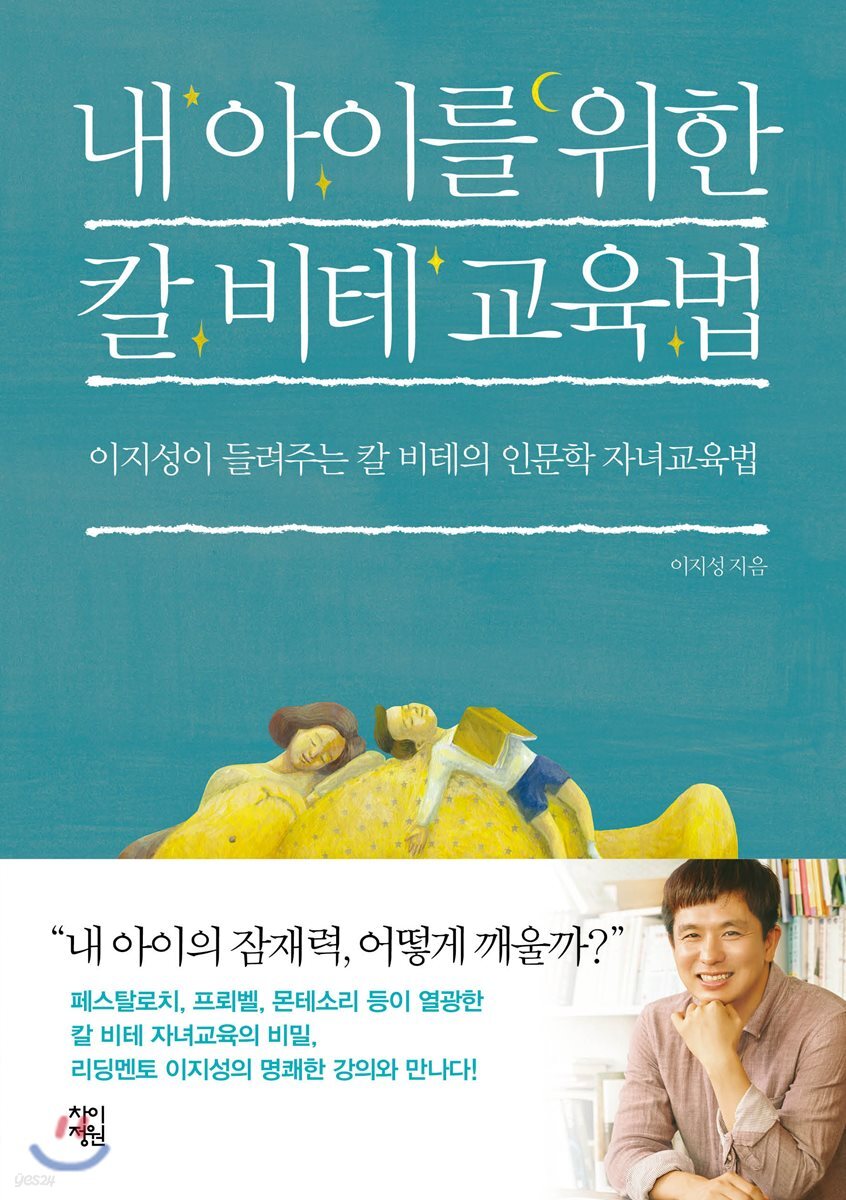
The Carl Vite Method for My Child
 |
Description
Book Introduction
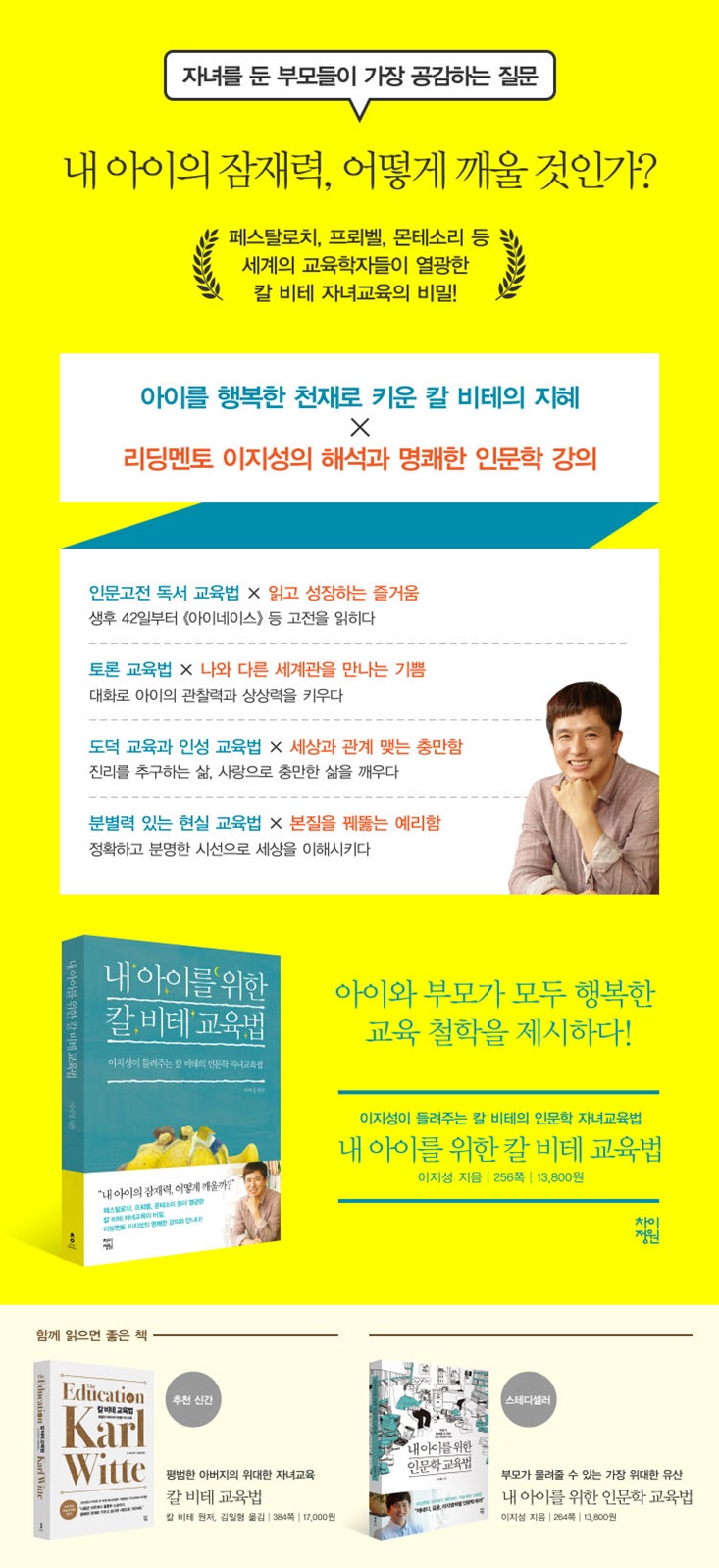
“How can I awaken my child’s potential?”
The secrets of Carl Witte's child education that enthusiasts like Pestalozzi, Froebel, and Montessori raved about
Meet the clear lectures of leading mentor Lee Ji-seong!
『The Carl Witte Education Method for My Child』 is the second book on humanities education for children written by Leading Mentor Lee Ji-seong, following the best-selling 『The Humanities Education Method for My Child』, which presents a ‘Korean-style’ humanities education method for parents seeking a new educational method.
The author first encountered Carl Witte while working as an elementary school teacher.
While searching for special educators' teaching methods to find out the causes of problems that inevitably arise in child education, such as why children become dumber rather than smarter as they learn, and why parents and children fail to understand each other, I came across the Carl Witte Method.
This book, which had been actively read around the world for a long time, was buried for over 100 years immediately after its publication, and was rediscovered by Professor Leo Winner of Harvard University, and has remained a bible for children's education around the world to this day.
In addition to Professor Leo Wiener, many educators around the world, including Harvard University psychologist Sidis, Mrs. Stoner, Pestalozzi, Froebel, and Montessori, were enthusiastic about the Carl Witte Method.
What was so special about the educational methods of Carl Witte, the father who raised an ordinary child into a genius? Lee Ji-seong, a writer who discusses humanities-based parenting in 21st-century South Korea, focuses on Witte's teaching methods: reading classics, discussion, moral and character education, and practical education that fosters discernment.
The educational method of father Karl Witte, who directly criticized the traditional German education system, which aimed to create citizens who were only loyal to the state and had lost the ability to criticize, and who stuck to his own educational philosophy and ultimately raised his children to be happy geniuses.
The author views this from the perspective of the 21st-century Korean education market, adding a realistic and critical interpretation to once again present a new humanities education method.
In particular, the educational philosophy of Carl Witte that the author paid the most attention to is ‘parents’ faith in their children.’
Carl Witte believed that if parents create a good environment for their children, they will develop their innate abilities.
I believed that parents' faith awakens their children's potential.
Talent is not something that is born, it is something that is made.
The author emphasizes, through Carl Witte's educational method, that the true education that should be achieved in Korea is one that believes in the potential of the child.
The secrets of Carl Witte's child education that enthusiasts like Pestalozzi, Froebel, and Montessori raved about
Meet the clear lectures of leading mentor Lee Ji-seong!
『The Carl Witte Education Method for My Child』 is the second book on humanities education for children written by Leading Mentor Lee Ji-seong, following the best-selling 『The Humanities Education Method for My Child』, which presents a ‘Korean-style’ humanities education method for parents seeking a new educational method.
The author first encountered Carl Witte while working as an elementary school teacher.
While searching for special educators' teaching methods to find out the causes of problems that inevitably arise in child education, such as why children become dumber rather than smarter as they learn, and why parents and children fail to understand each other, I came across the Carl Witte Method.
This book, which had been actively read around the world for a long time, was buried for over 100 years immediately after its publication, and was rediscovered by Professor Leo Winner of Harvard University, and has remained a bible for children's education around the world to this day.
In addition to Professor Leo Wiener, many educators around the world, including Harvard University psychologist Sidis, Mrs. Stoner, Pestalozzi, Froebel, and Montessori, were enthusiastic about the Carl Witte Method.
What was so special about the educational methods of Carl Witte, the father who raised an ordinary child into a genius? Lee Ji-seong, a writer who discusses humanities-based parenting in 21st-century South Korea, focuses on Witte's teaching methods: reading classics, discussion, moral and character education, and practical education that fosters discernment.
The educational method of father Karl Witte, who directly criticized the traditional German education system, which aimed to create citizens who were only loyal to the state and had lost the ability to criticize, and who stuck to his own educational philosophy and ultimately raised his children to be happy geniuses.
The author views this from the perspective of the 21st-century Korean education market, adding a realistic and critical interpretation to once again present a new humanities education method.
In particular, the educational philosophy of Carl Witte that the author paid the most attention to is ‘parents’ faith in their children.’
Carl Witte believed that if parents create a good environment for their children, they will develop their innate abilities.
I believed that parents' faith awakens their children's potential.
Talent is not something that is born, it is something that is made.
The author emphasizes, through Carl Witte's educational method, that the true education that should be achieved in Korea is one that believes in the potential of the child.
- You can preview some of the book's contents.
Preview
index
Prologue: The Unchanging Value of Humanities Education 200 Years Later
│Lecture 1│ Carl Witte's Timeless Educational Method: Who is Carl Witte?
Is this your first time learning the Carl Witte method? / The Carl Witte we don't know / The father who raised an ordinary child into a genius / Parent Insight 1│What kind of parent am I? / The era in which Carl Witte Jr. was born / The first country in the West to implement national education / Do you have an educational philosophy for your child? / Parent Insight 2│Is our country's education really that bad?
│Lecture 2│ Happy Children Grow into Happy Adults: What is Happiness?
Two Happinesses of German Society 200 Years Ago / Parent Insight 1│Parents Must Be Happy First / Raise Children Who Know the Joy of Life / The Joy of Reading and Growing Up: Reading / The Joy of a Mature Person: Art / The World's Greatest Classroom: Nature / Building Happy Relationships through Heart-Worship: Sharing / Parent Insight 2│Parents' Attitudes That Create Happy Children
│Lecture 3│ Smart Children and Wise Children Are Different: Carl Witte's Humanities Classics Reading Education Method
Children grow as much as their parents believe / Stories told to children's subconscious / Reading classics starting from 42 days after birth / Let your child draw a big picture with his or her first book / Parent Insight 1│Problems with reading education in Korea / What kind of books did Carl Witte read to children / Children who enjoy reading as play / Let them read beyond the book / Parent Insight 2│How should we read?
│Lecture 4│ The Art of Conversation: Raising Thinking Children: Carl Witte's Debate Education Method
Western debate education methods that create geniuses / Develop children's observation and imagination through dialogue / Children who communicate with their five senses in nature / Meeting experts who foster a desire to learn / Intense experiences lead to poignant conversations / Let children think before parents answer / Talk through travel / Parental Insights│Let's go on a humanistic journey with our children.
│Lecture 5│ Connecting with the World: More Important Than Knowledge Education: Carl Witte's Character Education Method
Why we value character education / Parent Insight 1│Character education that is unfamiliar to us / Teach the truth / Teach love / Teach humility / Teach emotions / Bedtime stories to tell your child / Parent Insight 2│Parenting is not about college entrance exams
│Lecture 6│ If you keep your child centered, he will walk on his own: Carl Witte's realistic education method
The Core of Carl Witte's Education: What is Discernment? / How is Discernment Cultivated? / Parent Insight 1│What Led Carnegie to Success? / Self-Education: Children Can Do It Themselves / Understanding the World Through Economic Education / Parent Insight 2│Some Misconceptions About Economic Education
│Lecture 7│ Parents' Education of Their Children Has the Power to Change Society
: How Pestalozzi and his successors applied Carl Witte's educational method
Recognized by the greatest educators / The special educational method of Pestalozzi, the saint of education / Parent Insight 1│Children grow as much as expected / Using mathematics as a principle of character education / Visual education that thinks with intuition and intelligence / Parent Insight 2│Visual education in the age of artificial intelligence / The fruits of Pestalozzi's education / What Pestalozzi and Carl Witte have in common
│Episode 8│Even Our Ordinary Children Can Become Geniuses: How I Will Apply the Karl Witte Education
You Don't Have to Be a Karl Witte / Break Free from Stereotypes / A Journey Beyond the Textbook / Becoming a Parent Who Walks Steadily / The Answer Lies with Parents and Children
|Appendix|A Guide for Parents New to Carl Witte Education
│Lecture 1│ Carl Witte's Timeless Educational Method: Who is Carl Witte?
Is this your first time learning the Carl Witte method? / The Carl Witte we don't know / The father who raised an ordinary child into a genius / Parent Insight 1│What kind of parent am I? / The era in which Carl Witte Jr. was born / The first country in the West to implement national education / Do you have an educational philosophy for your child? / Parent Insight 2│Is our country's education really that bad?
│Lecture 2│ Happy Children Grow into Happy Adults: What is Happiness?
Two Happinesses of German Society 200 Years Ago / Parent Insight 1│Parents Must Be Happy First / Raise Children Who Know the Joy of Life / The Joy of Reading and Growing Up: Reading / The Joy of a Mature Person: Art / The World's Greatest Classroom: Nature / Building Happy Relationships through Heart-Worship: Sharing / Parent Insight 2│Parents' Attitudes That Create Happy Children
│Lecture 3│ Smart Children and Wise Children Are Different: Carl Witte's Humanities Classics Reading Education Method
Children grow as much as their parents believe / Stories told to children's subconscious / Reading classics starting from 42 days after birth / Let your child draw a big picture with his or her first book / Parent Insight 1│Problems with reading education in Korea / What kind of books did Carl Witte read to children / Children who enjoy reading as play / Let them read beyond the book / Parent Insight 2│How should we read?
│Lecture 4│ The Art of Conversation: Raising Thinking Children: Carl Witte's Debate Education Method
Western debate education methods that create geniuses / Develop children's observation and imagination through dialogue / Children who communicate with their five senses in nature / Meeting experts who foster a desire to learn / Intense experiences lead to poignant conversations / Let children think before parents answer / Talk through travel / Parental Insights│Let's go on a humanistic journey with our children.
│Lecture 5│ Connecting with the World: More Important Than Knowledge Education: Carl Witte's Character Education Method
Why we value character education / Parent Insight 1│Character education that is unfamiliar to us / Teach the truth / Teach love / Teach humility / Teach emotions / Bedtime stories to tell your child / Parent Insight 2│Parenting is not about college entrance exams
│Lecture 6│ If you keep your child centered, he will walk on his own: Carl Witte's realistic education method
The Core of Carl Witte's Education: What is Discernment? / How is Discernment Cultivated? / Parent Insight 1│What Led Carnegie to Success? / Self-Education: Children Can Do It Themselves / Understanding the World Through Economic Education / Parent Insight 2│Some Misconceptions About Economic Education
│Lecture 7│ Parents' Education of Their Children Has the Power to Change Society
: How Pestalozzi and his successors applied Carl Witte's educational method
Recognized by the greatest educators / The special educational method of Pestalozzi, the saint of education / Parent Insight 1│Children grow as much as expected / Using mathematics as a principle of character education / Visual education that thinks with intuition and intelligence / Parent Insight 2│Visual education in the age of artificial intelligence / The fruits of Pestalozzi's education / What Pestalozzi and Carl Witte have in common
│Episode 8│Even Our Ordinary Children Can Become Geniuses: How I Will Apply the Karl Witte Education
You Don't Have to Be a Karl Witte / Break Free from Stereotypes / A Journey Beyond the Textbook / Becoming a Parent Who Walks Steadily / The Answer Lies with Parents and Children
|Appendix|A Guide for Parents New to Carl Witte Education
Detailed image
Into the book
If parents do not know the happiness that comes from art, nature, and sharing, no matter how well they educate their children, they will not be able to make them happy.
Carl Vite says:
“To raise happy children, parents must become happy people.
“If parents teach their children while they are unhappy, they are teaching the children how to be unhappy.” This is Carl Witte’s core message.
If parents are happy first, children can be even happier.
--- pp.46-47 From “Parents Must Be Happy First”
Carl Witte believed that the optimal age for language learning was under the age of four.
So I tried to show as many things as possible during this period.
After the child grew up a little, I taught him everything that came into view, including objects in the house, flowers, and insects.
Beyond simply teaching the names of objects, it enriches vocabulary by using verbs and adjectives, and also provides scientific and historical explanations of those objects.
For example, if there is a lamp, you teach the name 'lamp' and tell the story of how it lights up.
It's a little disconcerting given our preconceived notions.
Usually, when children are young, we think they won't understand properly and we skip over the details.
But Carl Vite thought of Carl as if he were an adult and explained it to him.
Basically, it was thought that a child's brain was similar to an adult's brain.
It was thought that if you repeat the same words and actions every day, your brain will receive a certain stimulation, and eventually you will develop the ability to recognize it in your subconscious.
--- pp.66-67 From “Children grow as much as their parents believe”
Carl Witte first realized that the books you read in your life, especially in your childhood, can make a difference in your life.
So, I carefully selected the books considering my child's reading ability and the content of the books.
When my child was young, I read books to his subconscious, whether he listened or not.
After my child grew up a little, I started telling him stories to get him interested in reading.
I used exaggerated facial expressions, realistic voices, and gestures to capture the child's interest, as if I was telling a story.
He was telling an exciting story, but then suddenly stopped talking at the most exciting part.
If your child is curious and asks you to continue the story, tell them to read the book themselves to find out the rest of the story.
Through that process, I became familiar with books.
Or I suggest:
“Then, would you like to think about it and finish it?”
Dasan Jeong Yak-yong also used this method in raising his children.
Looking at “Letters from Exile,” we see that Jeong Yak-yong also read books in a way that made up his own stories.
Especially when reading something like a history book, when you reach the end, you put the book down and try to write your own story.
Rather than just writing whatever you want, you should predict what conclusion that person would reach based on what you have read before.
As you go through that kind of training, you will develop your own perspective on history.
--- pp.83-84 From “Children who enjoy reading as play”
Many parents worry when their children enter school age.
There is a lot of interest in how to start learning English, whether it is good to start learning math in advance, how to foster interest in science, and how far to get your child to play the piano.
But this is a kind of pseudo-intelligence.
Starting to study early does not necessarily mean you will achieve more.
There is no guarantee that children who start studying early will go to a good university.
Rather than that, it is important to first understand that if you nurture your child's morality and help him grow as a person, his grades will naturally follow.
Karl Witte realized this fact and emphasized moral education from an early age.
(…) Raising children requires unwavering conviction to walk a new educational path that I believe is right.
There's no need to be anxious if the kid next door solves a difficult math problem and speaks fluently in English.
We must realize that Korean education is flawed and that there is a real education out there, and believe that only through that kind of education can we bring out our children's full potential.
Carl Vite says:
“To raise happy children, parents must become happy people.
“If parents teach their children while they are unhappy, they are teaching the children how to be unhappy.” This is Carl Witte’s core message.
If parents are happy first, children can be even happier.
--- pp.46-47 From “Parents Must Be Happy First”
Carl Witte believed that the optimal age for language learning was under the age of four.
So I tried to show as many things as possible during this period.
After the child grew up a little, I taught him everything that came into view, including objects in the house, flowers, and insects.
Beyond simply teaching the names of objects, it enriches vocabulary by using verbs and adjectives, and also provides scientific and historical explanations of those objects.
For example, if there is a lamp, you teach the name 'lamp' and tell the story of how it lights up.
It's a little disconcerting given our preconceived notions.
Usually, when children are young, we think they won't understand properly and we skip over the details.
But Carl Vite thought of Carl as if he were an adult and explained it to him.
Basically, it was thought that a child's brain was similar to an adult's brain.
It was thought that if you repeat the same words and actions every day, your brain will receive a certain stimulation, and eventually you will develop the ability to recognize it in your subconscious.
--- pp.66-67 From “Children grow as much as their parents believe”
Carl Witte first realized that the books you read in your life, especially in your childhood, can make a difference in your life.
So, I carefully selected the books considering my child's reading ability and the content of the books.
When my child was young, I read books to his subconscious, whether he listened or not.
After my child grew up a little, I started telling him stories to get him interested in reading.
I used exaggerated facial expressions, realistic voices, and gestures to capture the child's interest, as if I was telling a story.
He was telling an exciting story, but then suddenly stopped talking at the most exciting part.
If your child is curious and asks you to continue the story, tell them to read the book themselves to find out the rest of the story.
Through that process, I became familiar with books.
Or I suggest:
“Then, would you like to think about it and finish it?”
Dasan Jeong Yak-yong also used this method in raising his children.
Looking at “Letters from Exile,” we see that Jeong Yak-yong also read books in a way that made up his own stories.
Especially when reading something like a history book, when you reach the end, you put the book down and try to write your own story.
Rather than just writing whatever you want, you should predict what conclusion that person would reach based on what you have read before.
As you go through that kind of training, you will develop your own perspective on history.
--- pp.83-84 From “Children who enjoy reading as play”
Many parents worry when their children enter school age.
There is a lot of interest in how to start learning English, whether it is good to start learning math in advance, how to foster interest in science, and how far to get your child to play the piano.
But this is a kind of pseudo-intelligence.
Starting to study early does not necessarily mean you will achieve more.
There is no guarantee that children who start studying early will go to a good university.
Rather than that, it is important to first understand that if you nurture your child's morality and help him grow as a person, his grades will naturally follow.
Karl Witte realized this fact and emphasized moral education from an early age.
(…) Raising children requires unwavering conviction to walk a new educational path that I believe is right.
There's no need to be anxious if the kid next door solves a difficult math problem and speaks fluently in English.
We must realize that Korean education is flawed and that there is a real education out there, and believe that only through that kind of education can we bring out our children's full potential.
--- pp.232-233 From "You Don't Have to Be a Karl Vite"
Publisher's Review
“Why were Harvard professors so enthusiastic about Carl Witte?”
Every parent has a desire to raise their children to be healthy and smart.
This is the same for all parents, regardless of the East or West or the era.
A pastor father who lived a simple life in a small German village 200 years ago also had a strong desire and conviction for his children's education.
This is the story of Karl Witte, the father who raised the world-renowned genius jurist of 19th century Germany.
Carl Witte Jr. learned his native language at the age of three, mastered six languages including English, Italian, and Latin by the age of nine, and was listed in Guinness World Records as the "world's youngest doctorate" at the age of 12.
The unique educational philosophy of his father, Carl Witte, was undoubtedly a major factor in his child, who was born prematurely and had developmental disabilities, growing up to be a happy genius.
Pestalozzi, who is called the saint of education, actively recommended his educational method.
That is how the Karl Witte Method of Education (1818) was published.
However, the Karl Witte Method of Education did not receive much attention at the time and was buried for nearly 100 years.
This was partly because Germany, where Karl Witte lived, and all of Europe were marred by war, but also because it contained content that ran counter to the traditional educational ideals of Germany at the time.
Carl Witte believed that even ordinary children could grow into geniuses, and that nurturing that potential required careful education tailored to each stage of a child's development.
His unique educational philosophy was finally rediscovered and re-examined by Professor Leo Wiener of Harvard University after another 100 years.
Not only that, Professor Burley, Harvard University psychologist Sidis, and Mrs. Stoner have also left behind examples of successful cases of raising their children according to Carl Witte's educational method, and this book has been established as the bible of child education to this day.
The Ordinary Yet Great Father Carl Witte X 'Humanities Mentor' Lee Ji-seong
Presenting an educational philosophy that makes both children and parents happy!
《Carl Witte's Education Method》, known as a world-wide bestseller and a book on child education since its publication in 1818.
This book had a huge influence on world education legends such as Pestalozzi, Froebel, and Montessori.
From ordinary to extraordinary, what was so special about Carl Witte's parenting methods? This book reinterprets the wisdom of Carl Witte, who raised a child into a happy genius 200 years ago, through the humanistic perspective of 21st-century "leading mentor" author Lee Ji-seong.
The author, who presented a "Korean-style" humanities education method in his previous work, "Humanities Education for My Child," will once again provide clear answers so that Korean parents can realistically apply the secrets of a great educational method that has been passed down for 200 years.
This book is a reconstruction of a lecture given at Chai Education, which provides various humanities curricula for parents and teachers, such as 'Reading 100 Books a Year', 'Beginning the Analects', and 'Humanities Education Study'.
Carl Witt's unique teaching method is presented in a lecture format, making it accessible even to those who are new to the Carl Witt method.
It introduces not only ideal educational methods such as character education and moral education, but also realistic educational methods such as reading education and economic education in a balanced way. Although it is an educational method that has been praised as the bible of child education for 200 years, rather than blindly accepting it, it includes a separate [Parent Insight] in each chapter so that it can be put into practice realistically by considering the domestic educational environment.
The appendix includes [A Guide for Parents New to the Carl Witte Method], which contains the author's responses to questions from parents who want to apply the Carl Witte method more specifically to their children's education.
The Wisdom of Carl Witte on Raising Children into Happy Geniuses
Humanities Classics Reading Education Method × The Joy of Reading and Growing
Carl Witte said that the feeling of one's heart opening and growing when reading a book is happiness.
He began reading various humanities classics, starting with the Aeneid, when the child was 42 days old.
The criteria were whether the child was growing through books and whether he or she had improved personally today compared to yesterday.
Debate Education Method × The Joy of Encountering Worldviews Different from Yours
Carl Vite walked and talked with his child for two or three hours before breakfast.
The conversation was mainly about things I had read in the humanities classics.
When talking to a child, maintain an equal relationship so that the child can gain confidence and continuously seek the truth.
Moral Education and Character Education × Fulfillment in Relationships with the World
Carl Witte knew that a person with the right character is truly free and happy.
That is why character education was considered more important than knowledge education.
Specifically, I wanted my child to live a life of pursuing truth, a life filled with love, and a life of continuous emotional exchange with others.
Discerning realistic education × Sharpness that penetrates the essence
Discernment is the ability to see through to the essence accurately.
You need to have discernment to have an accurate view of society.
Karl Witte accurately informed the child of the truth about society, and also taught him to always be aware of people and to confidently demand his rights.
Every parent has a desire to raise their children to be healthy and smart.
This is the same for all parents, regardless of the East or West or the era.
A pastor father who lived a simple life in a small German village 200 years ago also had a strong desire and conviction for his children's education.
This is the story of Karl Witte, the father who raised the world-renowned genius jurist of 19th century Germany.
Carl Witte Jr. learned his native language at the age of three, mastered six languages including English, Italian, and Latin by the age of nine, and was listed in Guinness World Records as the "world's youngest doctorate" at the age of 12.
The unique educational philosophy of his father, Carl Witte, was undoubtedly a major factor in his child, who was born prematurely and had developmental disabilities, growing up to be a happy genius.
Pestalozzi, who is called the saint of education, actively recommended his educational method.
That is how the Karl Witte Method of Education (1818) was published.
However, the Karl Witte Method of Education did not receive much attention at the time and was buried for nearly 100 years.
This was partly because Germany, where Karl Witte lived, and all of Europe were marred by war, but also because it contained content that ran counter to the traditional educational ideals of Germany at the time.
Carl Witte believed that even ordinary children could grow into geniuses, and that nurturing that potential required careful education tailored to each stage of a child's development.
His unique educational philosophy was finally rediscovered and re-examined by Professor Leo Wiener of Harvard University after another 100 years.
Not only that, Professor Burley, Harvard University psychologist Sidis, and Mrs. Stoner have also left behind examples of successful cases of raising their children according to Carl Witte's educational method, and this book has been established as the bible of child education to this day.
The Ordinary Yet Great Father Carl Witte X 'Humanities Mentor' Lee Ji-seong
Presenting an educational philosophy that makes both children and parents happy!
《Carl Witte's Education Method》, known as a world-wide bestseller and a book on child education since its publication in 1818.
This book had a huge influence on world education legends such as Pestalozzi, Froebel, and Montessori.
From ordinary to extraordinary, what was so special about Carl Witte's parenting methods? This book reinterprets the wisdom of Carl Witte, who raised a child into a happy genius 200 years ago, through the humanistic perspective of 21st-century "leading mentor" author Lee Ji-seong.
The author, who presented a "Korean-style" humanities education method in his previous work, "Humanities Education for My Child," will once again provide clear answers so that Korean parents can realistically apply the secrets of a great educational method that has been passed down for 200 years.
This book is a reconstruction of a lecture given at Chai Education, which provides various humanities curricula for parents and teachers, such as 'Reading 100 Books a Year', 'Beginning the Analects', and 'Humanities Education Study'.
Carl Witt's unique teaching method is presented in a lecture format, making it accessible even to those who are new to the Carl Witt method.
It introduces not only ideal educational methods such as character education and moral education, but also realistic educational methods such as reading education and economic education in a balanced way. Although it is an educational method that has been praised as the bible of child education for 200 years, rather than blindly accepting it, it includes a separate [Parent Insight] in each chapter so that it can be put into practice realistically by considering the domestic educational environment.
The appendix includes [A Guide for Parents New to the Carl Witte Method], which contains the author's responses to questions from parents who want to apply the Carl Witte method more specifically to their children's education.
The Wisdom of Carl Witte on Raising Children into Happy Geniuses
Humanities Classics Reading Education Method × The Joy of Reading and Growing
Carl Witte said that the feeling of one's heart opening and growing when reading a book is happiness.
He began reading various humanities classics, starting with the Aeneid, when the child was 42 days old.
The criteria were whether the child was growing through books and whether he or she had improved personally today compared to yesterday.
Debate Education Method × The Joy of Encountering Worldviews Different from Yours
Carl Vite walked and talked with his child for two or three hours before breakfast.
The conversation was mainly about things I had read in the humanities classics.
When talking to a child, maintain an equal relationship so that the child can gain confidence and continuously seek the truth.
Moral Education and Character Education × Fulfillment in Relationships with the World
Carl Witte knew that a person with the right character is truly free and happy.
That is why character education was considered more important than knowledge education.
Specifically, I wanted my child to live a life of pursuing truth, a life filled with love, and a life of continuous emotional exchange with others.
Discerning realistic education × Sharpness that penetrates the essence
Discernment is the ability to see through to the essence accurately.
You need to have discernment to have an accurate view of society.
Karl Witte accurately informed the child of the truth about society, and also taught him to always be aware of people and to confidently demand his rights.
GOODS SPECIFICS
- Date of publication: July 28, 2017
- Page count, weight, size: 256 pages | 446g | 152*215*16mm
- ISBN13: 9791188388028
- ISBN10: 1188388029
You may also like
카테고리
korean


korean

![GQ KOREA Mark (Monthly): December [2025]](http://librairie.coreenne.fr/cdn/shop/files/8ef265dbbfbf186523ed75ba7319009d.jpg?v=1765340328&width=3840)


