

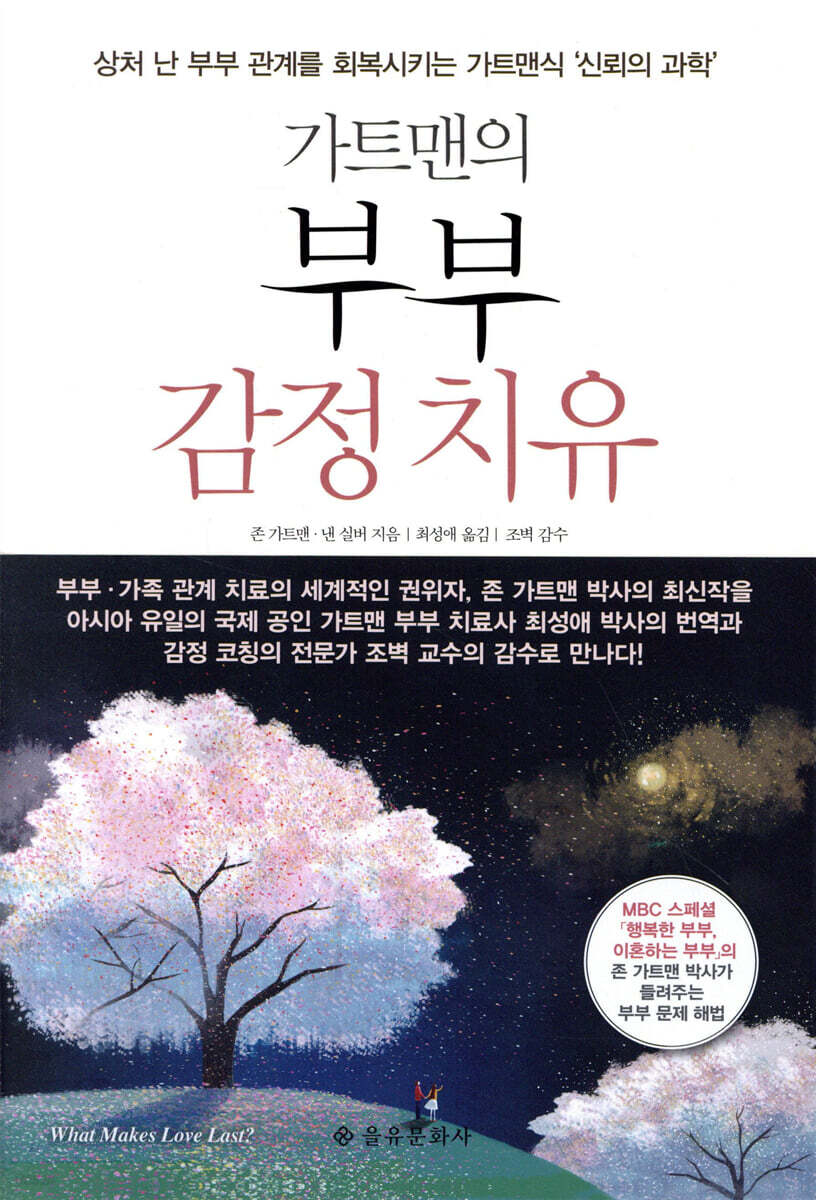
Gottman's Couple's Emotional Healing
 |
Description
Book Introduction
The obvious truth that 'love cannot last when trust is broken' is proven by science.
A new book by Dr. John Gottman, a world authority on couples and family relationship therapy.
This book scientifically examines the state of a couple's relationship and scientifically suggests ways to improve problems accordingly. It covers everything from resolving conflicts big and small to recovering from major problems like infidelity, and by addressing the problem from the beginning, it helps couples uncover the root of the conflict and understand each other's feelings.
A new book by Dr. John Gottman, a world authority on couples and family relationship therapy.
This book scientifically examines the state of a couple's relationship and scientifically suggests ways to improve problems accordingly. It covers everything from resolving conflicts big and small to recovering from major problems like infidelity, and by addressing the problem from the beginning, it helps couples uncover the root of the conflict and understand each other's feelings.
- You can preview some of the book's contents.
Preview
index
Recommendation
Before entering
introduction
1.
Measuring Your Trust Indicators
2.
'Good', 'Neutral', and 'Terrible'
3.
“I didn’t know it would turn out like this!” (Why do people cheat?)
4.
men, porn, sexual urges
5.
Ten Different Paths to Betrayal
6.
The essence of trust and coordination
7.
Emotional Tuning for Beginners: The Art of Intimate Communication
8.
A conversation that reaches out to each other
9.
Resolving conflicts big and small
10.
Recovery from infidelity
11.
Building a bond through intimate sexual relations
12.
How to Know When It's Time to Break Up
13.
Learning to Trust Again: A Lifesaving Skill
14.
What is true love?
Appendix 1.
Four helpful phrases for intimate conversation
Appendix 2.
Suggestions for progressing through Gottman's post-marital conflict emotional management toolbox
: Healing past wounds and hurt feelings
Appendix 3.
Why Couples Stop Having Sex: A Game Theory Analysis
Acknowledgements
Search
Before entering
introduction
1.
Measuring Your Trust Indicators
2.
'Good', 'Neutral', and 'Terrible'
3.
“I didn’t know it would turn out like this!” (Why do people cheat?)
4.
men, porn, sexual urges
5.
Ten Different Paths to Betrayal
6.
The essence of trust and coordination
7.
Emotional Tuning for Beginners: The Art of Intimate Communication
8.
A conversation that reaches out to each other
9.
Resolving conflicts big and small
10.
Recovery from infidelity
11.
Building a bond through intimate sexual relations
12.
How to Know When It's Time to Break Up
13.
Learning to Trust Again: A Lifesaving Skill
14.
What is true love?
Appendix 1.
Four helpful phrases for intimate conversation
Appendix 2.
Suggestions for progressing through Gottman's post-marital conflict emotional management toolbox
: Healing past wounds and hurt feelings
Appendix 3.
Why Couples Stop Having Sex: A Game Theory Analysis
Acknowledgements
Search
Into the book
A flood of emotions is fatal to a relationship.
When your body's reactions are extreme, rational thinking becomes nearly impossible.
This leads to what psychologists call "tunnel vision," where the eyes and ears focus solely on warning signs and escape routes, and nothing else.
Your sense of humor stops, as does your ability to listen attentively, solve problems, and understand other people's feelings.
Because they are unaware of these consequences of emotional overload, most therapists will ask a couple who is too distressed to empathize at all to express empathy to their partner.
This will only make your relationship worse.
Depending on the situation, a person who is overwhelmed by emotions may either fight (i.e., attack) their partner or refuse to talk (i.e., run away? I call this "stonewalling").
-p70
We remember 'unsolved problems' almost twice as well as problems we've finished or organized.
Arguments between lovers that end in confessions, reconciliation, and a deeper understanding of one another tend to be quickly forgotten, but the resulting relationship is stronger and more enduring.
But when the sliding door moment leads to an unprocessed regrettable event, the wound becomes accessible to our active memory (because of the Zeigarnik effect) and is remembered over and over again.
Like a pebble in a shoe, the memory constantly irritates you, ultimately increasing your negative attitude toward your spouse.
-p75
Not surprisingly, pornography and sex addiction have always been linked.
Even if you don't have obsessive-compulsive disorder, watching pornography can threaten your relationship with your spouse or partner.
Watching porn and masturbating releases the hormones oxytocin and vasopressin, which are associated with attachment, meaning that porn users may become attached to and fixated on impersonal images.
There is no problem when a couple uses pornography to increase satisfaction during sexual intercourse.
However, in most cases, pornography is viewed alone, and even if the habit does not meet the technical definition of compulsion, it can be a cause of betrayal of one's spouse.
Most porn encourages us to take the steps we've discussed earlier to betray our spouses.
-p113
Forgive and forget is the most common piece of advice, but this is the wrong approach.
Besides this, there are other incorrect treatment methods.
Counselors often advise couples not to try to control their spouse even if they have discovered that the other person is having an affair.
The betrayed party may be advised to resist the urge to constantly check in with and hold their partner accountable.
They advise that continuing to doubt will hinder treatment, but in fact, the opposite is true.
The injured party needs to be assured that such a terrible thing will not happen again in the future.
To maintain a marital relationship, the cheating partner must understand and tolerate that these needs are symptoms of post-traumatic stress disorder caused by the affair.
It means that you need to constantly reassure them for a while.
This process will repeat itself until sufficient trust is built through therapeutic counseling.
-p235
When your body's reactions are extreme, rational thinking becomes nearly impossible.
This leads to what psychologists call "tunnel vision," where the eyes and ears focus solely on warning signs and escape routes, and nothing else.
Your sense of humor stops, as does your ability to listen attentively, solve problems, and understand other people's feelings.
Because they are unaware of these consequences of emotional overload, most therapists will ask a couple who is too distressed to empathize at all to express empathy to their partner.
This will only make your relationship worse.
Depending on the situation, a person who is overwhelmed by emotions may either fight (i.e., attack) their partner or refuse to talk (i.e., run away? I call this "stonewalling").
-p70
We remember 'unsolved problems' almost twice as well as problems we've finished or organized.
Arguments between lovers that end in confessions, reconciliation, and a deeper understanding of one another tend to be quickly forgotten, but the resulting relationship is stronger and more enduring.
But when the sliding door moment leads to an unprocessed regrettable event, the wound becomes accessible to our active memory (because of the Zeigarnik effect) and is remembered over and over again.
Like a pebble in a shoe, the memory constantly irritates you, ultimately increasing your negative attitude toward your spouse.
-p75
Not surprisingly, pornography and sex addiction have always been linked.
Even if you don't have obsessive-compulsive disorder, watching pornography can threaten your relationship with your spouse or partner.
Watching porn and masturbating releases the hormones oxytocin and vasopressin, which are associated with attachment, meaning that porn users may become attached to and fixated on impersonal images.
There is no problem when a couple uses pornography to increase satisfaction during sexual intercourse.
However, in most cases, pornography is viewed alone, and even if the habit does not meet the technical definition of compulsion, it can be a cause of betrayal of one's spouse.
Most porn encourages us to take the steps we've discussed earlier to betray our spouses.
-p113
Forgive and forget is the most common piece of advice, but this is the wrong approach.
Besides this, there are other incorrect treatment methods.
Counselors often advise couples not to try to control their spouse even if they have discovered that the other person is having an affair.
The betrayed party may be advised to resist the urge to constantly check in with and hold their partner accountable.
They advise that continuing to doubt will hinder treatment, but in fact, the opposite is true.
The injured party needs to be assured that such a terrible thing will not happen again in the future.
To maintain a marital relationship, the cheating partner must understand and tolerate that these needs are symptoms of post-traumatic stress disorder caused by the affair.
It means that you need to constantly reassure them for a while.
This process will repeat itself until sufficient trust is built through therapeutic counseling.
-p235
--- From the text
Publisher's Review
Secrets revealed by the Love Lab on how to gain trust, prevent infidelity and betrayal, and sustain faith and love!
“Good,” “neutral,” and “terrible” states, sliding door moments, cockroach colonies, a flood of emotions… …
The unfamiliar words listed above are ones Dr. Gottman coined to help explain his process for measuring trust in couples, the moments that determine a couple's relationship, the situations where you spend too much time in a "terrible" state and can't escape, and the emotional states that are fatal to a relationship.
Just like the words that are easy to see, the contents of this book are also really easy to understand.
This is likely the result of Nan Silver's efforts to make Dr. Gottman's professional and scholarly research accessible and digestible.
This book is the culmination of Gottman's 40 years of research, which scientifically examines the state of marital relationships and scientifically suggests ways to improve marital problems.
It tells us what words and actions close the other person's heart and break trust, and what methods can be used to break free from such moments that accumulate and become disconnected. It also shows the cases of couples who participated in counseling and experiments, along with the conversations they had, so that it is concrete and applicable.
It also covers everything from resolving small conflicts to recovering from a major problem like infidelity, but rather than focusing solely on solutions, it helps you understand why your spouse creates such conflicts, which helps you realize the origin of the problem and greatly helps you understand each other's feelings.
Dr. Gottman doesn't view infidelity solely from a physical perspective.
Comparing yourself mentally to someone else or having something else take priority over your spouse is also considered infidelity.
That's probably because those things are the beginning of an affair and hurt the other person's feelings.
This may be an unfamiliar or refreshing shock to those who think that only physical infidelity is infidelity.
Let's talk a little more about the strange story here.
What does it mean to scientifically examine a couple's relationship? Is it even possible? Science isn't a big deal.
All you have to do is create a standard or data to measure and extract objective results from the experiment.
However, you will have to worry a lot about what criteria to use for measurement and how to analyze the data.
It's only natural that Dr. Gottman had such moments, as he was the first to attempt scientific research in the field of marital relationships.
They measured things like heart rate, blood flow, and the amount of stress hormones in sweat and urine, took personality tests on the couples who participated in the experiment, recorded their occupation, education, income, age, years of marriage, number of children, and thoughts on marriage on questionnaires, and conducted in-depth oral interviews to create data and tracked the couples for 5, 10, and 15 years, but they had difficulty finding commonalities between happy couples.
This is because there was no commonality in commonly expected things such as occupation, education, and income.
So, we carefully analyzed the videotapes of the couples who participated in the experiment.
They measured intonation, volume, pitch, eye contact and facial muscle movement, gestures, body movements, and the distance between the two people, and compared the heart rate, sweat, and blood flow measured at the time of filming with the values measured during the replay while showing a scene of a couple having a heated argument.
As a result of measuring and studying data from approximately 3,000 couples over 36 years, we found an answer that was completely different from common sense or conventional wisdom about couples that predicted that such couples would live happily or that such couples would break up.
What people who get divorced have in common is a negative way of fighting.
So what about happy couples? They showed much more positivity in the little things in everyday life.
Little things like how you react to what your partner says can tell you a lot about the future of your relationship.
Dr. Gottman says trust is the antidote to betrayal and infidelity and the fundamental principle that makes relationships work.
Happy couples always find that trust gives them a sense of security, deepens their love, and allows friendship and sexual intimacy to blossom.
On the other hand, unhappy couples lack these things.
This book contains ways to move beyond a state of need and build trust and intimacy.
As you follow the book step by step, you will be able to achieve emotional harmony on your own and will see the path to becoming a happy couple.
How about experiencing Gottman's "science of trust" by first checking your current marital relationship using calculation methods such as the trust index (which Dr. Gottman uses when diagnosing counselors), the negative emotion tidal wave index, and the couple relationship assessment in the book?
“Good,” “neutral,” and “terrible” states, sliding door moments, cockroach colonies, a flood of emotions… …
The unfamiliar words listed above are ones Dr. Gottman coined to help explain his process for measuring trust in couples, the moments that determine a couple's relationship, the situations where you spend too much time in a "terrible" state and can't escape, and the emotional states that are fatal to a relationship.
Just like the words that are easy to see, the contents of this book are also really easy to understand.
This is likely the result of Nan Silver's efforts to make Dr. Gottman's professional and scholarly research accessible and digestible.
This book is the culmination of Gottman's 40 years of research, which scientifically examines the state of marital relationships and scientifically suggests ways to improve marital problems.
It tells us what words and actions close the other person's heart and break trust, and what methods can be used to break free from such moments that accumulate and become disconnected. It also shows the cases of couples who participated in counseling and experiments, along with the conversations they had, so that it is concrete and applicable.
It also covers everything from resolving small conflicts to recovering from a major problem like infidelity, but rather than focusing solely on solutions, it helps you understand why your spouse creates such conflicts, which helps you realize the origin of the problem and greatly helps you understand each other's feelings.
Dr. Gottman doesn't view infidelity solely from a physical perspective.
Comparing yourself mentally to someone else or having something else take priority over your spouse is also considered infidelity.
That's probably because those things are the beginning of an affair and hurt the other person's feelings.
This may be an unfamiliar or refreshing shock to those who think that only physical infidelity is infidelity.
Let's talk a little more about the strange story here.
What does it mean to scientifically examine a couple's relationship? Is it even possible? Science isn't a big deal.
All you have to do is create a standard or data to measure and extract objective results from the experiment.
However, you will have to worry a lot about what criteria to use for measurement and how to analyze the data.
It's only natural that Dr. Gottman had such moments, as he was the first to attempt scientific research in the field of marital relationships.
They measured things like heart rate, blood flow, and the amount of stress hormones in sweat and urine, took personality tests on the couples who participated in the experiment, recorded their occupation, education, income, age, years of marriage, number of children, and thoughts on marriage on questionnaires, and conducted in-depth oral interviews to create data and tracked the couples for 5, 10, and 15 years, but they had difficulty finding commonalities between happy couples.
This is because there was no commonality in commonly expected things such as occupation, education, and income.
So, we carefully analyzed the videotapes of the couples who participated in the experiment.
They measured intonation, volume, pitch, eye contact and facial muscle movement, gestures, body movements, and the distance between the two people, and compared the heart rate, sweat, and blood flow measured at the time of filming with the values measured during the replay while showing a scene of a couple having a heated argument.
As a result of measuring and studying data from approximately 3,000 couples over 36 years, we found an answer that was completely different from common sense or conventional wisdom about couples that predicted that such couples would live happily or that such couples would break up.
What people who get divorced have in common is a negative way of fighting.
So what about happy couples? They showed much more positivity in the little things in everyday life.
Little things like how you react to what your partner says can tell you a lot about the future of your relationship.
Dr. Gottman says trust is the antidote to betrayal and infidelity and the fundamental principle that makes relationships work.
Happy couples always find that trust gives them a sense of security, deepens their love, and allows friendship and sexual intimacy to blossom.
On the other hand, unhappy couples lack these things.
This book contains ways to move beyond a state of need and build trust and intimacy.
As you follow the book step by step, you will be able to achieve emotional harmony on your own and will see the path to becoming a happy couple.
How about experiencing Gottman's "science of trust" by first checking your current marital relationship using calculation methods such as the trust index (which Dr. Gottman uses when diagnosing counselors), the negative emotion tidal wave index, and the couple relationship assessment in the book?
GOODS SPECIFICS
- Date of issue: February 10, 2014
- Page count, weight, size: 392 pages | 600g | 153*224*30mm
- ISBN13: 9788932472256
- ISBN10: 8932472254
You may also like
카테고리
korean


korean

![GQ KOREA Mark (Monthly): December [2025]](http://librairie.coreenne.fr/cdn/shop/files/8ef265dbbfbf186523ed75ba7319009d.jpg?v=1765340328&width=3840)


