

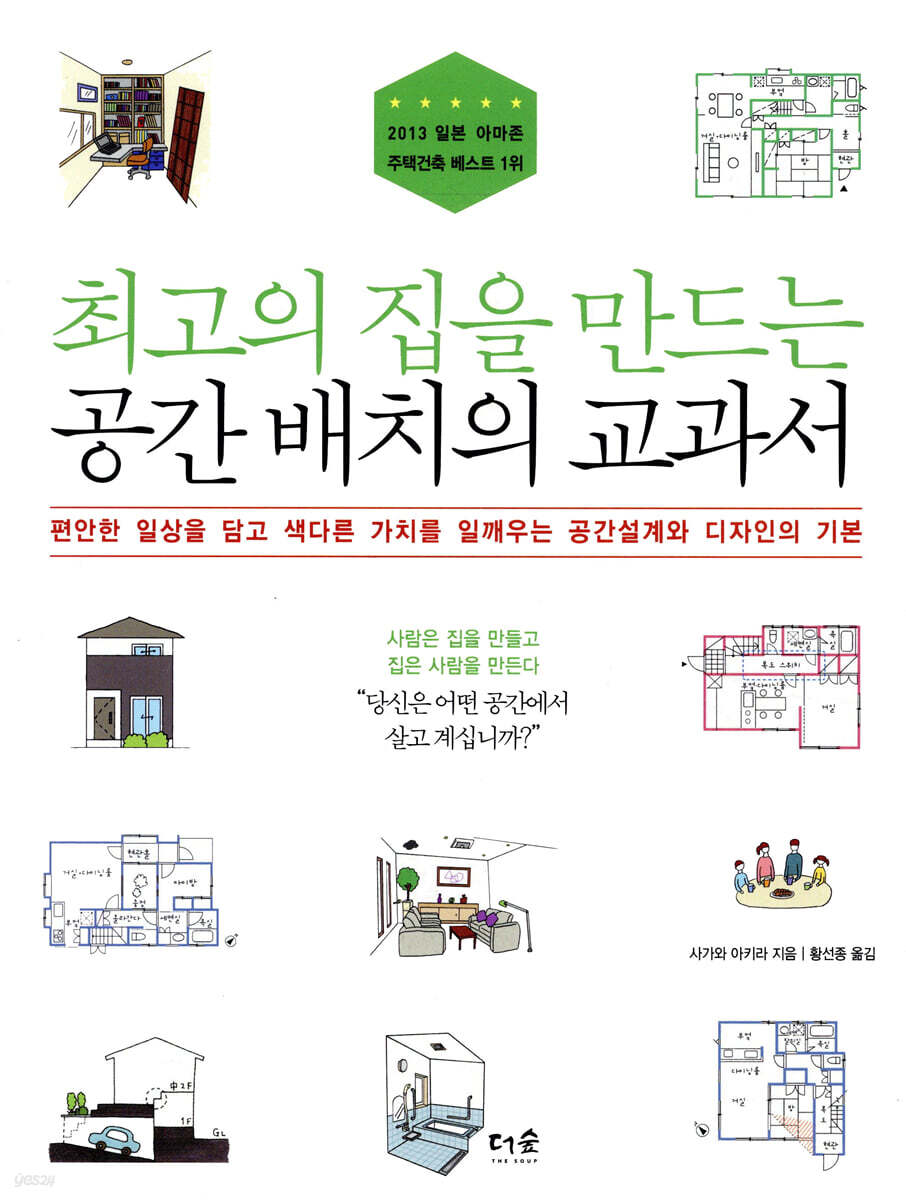
A textbook on space layout for creating the best home
 |
Description
index
preface
Chapter 1.
mental attitude
01_The difference between the building owner and the construction owner. The construction owner's mindset is "Please take good care of me" rather than the building owner's mindset of "This is my house."
02_Before considering space layout, the image of families is changing: one-person households, two-person households…
03_The quality of a home changes depending on its title. What do you want to create among 'products', 'works', and 'things'?
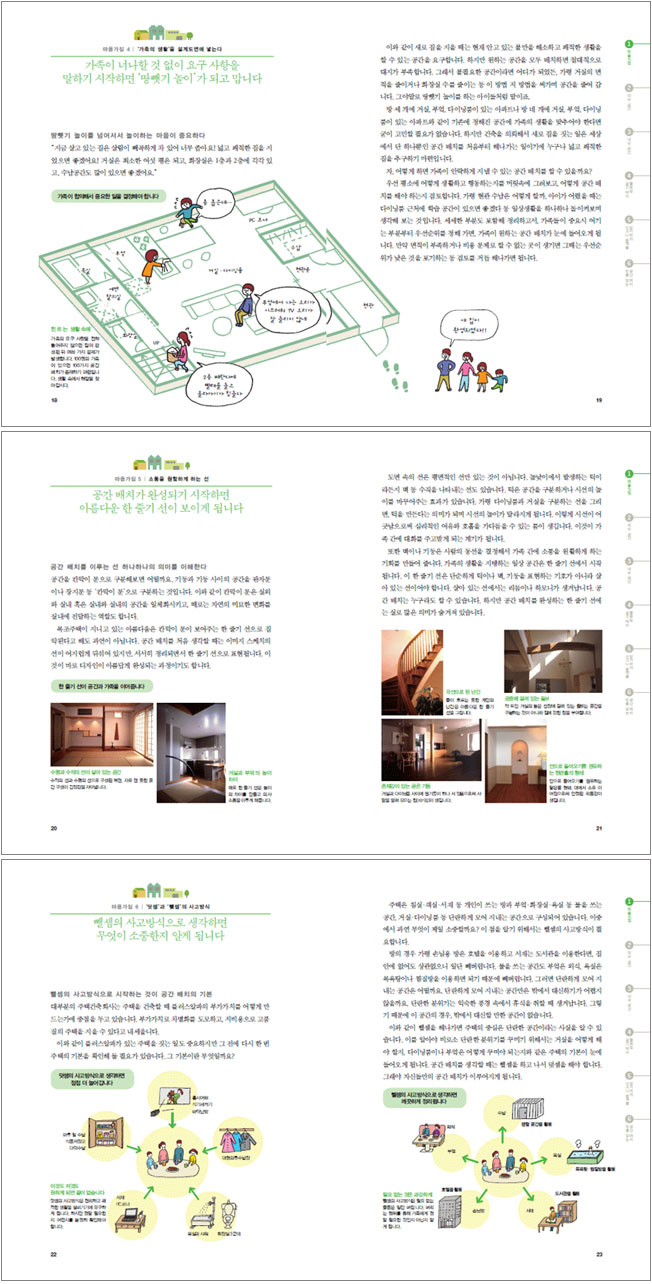
04_ Incorporating 'family life' into the blueprint When family members start to make demands without exception, it becomes a 'game of grabbing land'.
05_Once the space layout that facilitates communication begins to be completed, a beautiful single line will appear.
06_Thinking about 'Addition' and 'Subtraction' Thinking about subtraction will help you understand what is important.
07_Think in three dimensions, not in planes. Think in terms of length × width × height, not length × width.
08_Spatial layout is determined by sunlight. Sunlight can create a space that relaxes the mind.
09_Space layout requires margins. Having "useless space" allows you to relax.
10_Be careful about the layout of spaces that harm family relationships. Excessively independent rooms can cause a breakdown in communication.
11_Think about the beauty that grows with the passage of time. The more you live there, the more you should aim for a home that becomes more stylish.
Column / Home Building 1.
Building a Home That Strengthens Family Bonds_Episode 1 with Architectural Clients
Chapter 2.
external space
01_The location and size of external facilities. The appearance and plan also change depending on the location of water and gas pipes.
02_Look at the shape and characteristics of the building site. You must fully understand the shape of the building site, which affects the spatial layout.
03_The relationship between the building site, the road, and the adjacent building. The shape of the house is determined by the direction of the road.
04_Conduct a local investigation. The land must be examined by multiple people, not just one person.
05_Each facility within the site and its location must be checked for facilities pulled from the road.
06_Window Location and Security Measures: In addition to creating a sense of openness, security and privacy measures should also be considered.
07_Consider the amount of sunlight. Where on the land does sunlight reach the most?
08_Think about the design of the exterior. Creating an expression on the exterior will increase attachment.
09_Building a Stable House You need to understand the relationship between house building methods and spatial layout.
10_The role and shape of roofs, eaves, and awnings What should we do if there are more than 100 days in a year when more than 1mm of rain falls?
11_High ceilings in buildings and interiors are not always good.
12_Planning the External Structure We introduce seven points for successfully deploying the external structure.
13_The yard of the building and garden trees should be decorated to suit your lifestyle, as it is a place where you can express your individuality.
14_The front door and driveway, which are the face of the house, must be in harmony with the street.
15_Key points for external space layout External space must be carefully checked in advance because it cannot be easily changed later.
Column / Home Building 2.
There's No Right Time to Build a House_Episode 2 with Architectural Clients
Chapter 3.
interior space
01_Expressions that determine spatial layout Collect expressions you have in mind about your home.
02_Where will we create a cozy space? Wherever the family gathers, that's where we feel cozy.
03_Determine the interior space. To create a zoning plan, you need to determine the space you need for living.
04_The overall layout is determined by the location of the stairs. The overall layout is determined based on the entrance and stairs.
05_The space, hallway, and stairs that connect the upper and lower floors create a soft space by creating depth.
06_Safe stair width and height Stairs should be designed with safety in mind, not just design.
07_By creating an intermediate space between the inside and outside, such as an entrance hall, a porch, and a veranda, you can create a space for relaxation.
08_What is the living room for? The living room should be the most comfortable space in the house.
09_What style should I decorate my dining room in? The living room is a 'somehow cozy space', while the dining room is a 'specifically cozy space'.
10_Connecting the dining room and living room The key is how to connect the dining room and living room.
11_The Relationship Between the Dining Room and the Kitchen The dining room and kitchen are the intersections within the house.
12_Think about the layout of your kitchen. The layout of your kitchen changes depending on where you place the refrigerator.
13_The relationship between ventilation and lighting in the living room, dining room, and kitchen. The living room, dining room, and kitchen must have proper ventilation and lighting to function properly.
Column / 10 Cases of Space Layout Failures
14_Creating a Child's Room Children's rooms are bound to change, so it's okay for each room to look different.
15_Let's learn about the hygiene area. We design it with comfort in mind.
16. Things to watch out for when arranging a bathroom and toilet. Problems that anyone can easily overlook.
17_The housework route is the 'laundry route'. If the location of the washing machine changes, the housework route also changes.
18_Privacy of sanitary space must be guaranteed and it must not be too small.
19_Let's store efficiently. For efficient storage, divide it into 'things used daily' and 'things not used daily'.
20_Have you considered earthquake resistance? How can we improve earthquake resistance?
21_Space layout considering future changes. Consider removable walls during the design phase to accommodate changes in family relationships.
22_Window shapes and opening/closing methods Windows connect the inside and outside and provide comfort.
23_Think about the function of windows. Windows should be placed with summer heat and winter cold in mind.
24_Do you need a basement and a rooftop? A basement is useful when you need an extra room, and a rooftop is useful as additional space.
25_How to Choose Comfortable Appliances: Underfloor heating, a hydromassage bath, electric locks… Do you really need them?
26_Points to check the internal space Check the important parts first and then gradually check the details.
Key Checklist for Interior Spaces
Chapter 4.
How to use space layout
01_Imagine living in your new home. Lack of imagination is the root cause of failure. Check the space layout as if walking through a drawing.
02_Communication is easy. Creating a difference in perspective creates psychological freedom.
03_Deepening the bond between parents and children It is important to create as many opportunities as possible for family members to meet face to face.
04_A house you want to return to. The reason you feel like "this is my home" is because of the memories you share with your family.
05_Easy to Make Memories Even seemingly useless spaces can become the perfect places to create memories.
06_Promotes child growth by dividing the space so that the family can feel the presence of the family.
07_Utilizing the Land: The transformed land is where you can experience the thrill of building a house.
08_For a house to survive, the 'four lifespans' are crucial.
09_Using Light: The Wisdom of Using Light According to the Season
10_Considering low-cost housing, using standards is the key to saving money.
11_Achieving low costs. Cost reduction is achieved through 'finishing work' and 'equipment work'.
12_Utilize narrow spaces widely. The more difficult the land conditions, the more powerful the design can be.
Column / Home Building 3.
Planting a Tree of Memories in the Entrance_Episode 3 with an Architectural Client
Chapter 5.
Let's prevent accidents and problems
01_Where there are dangers and problems How safe is the house we live in?
02_Stairs and Bathrooms Stairs and bathrooms are places where accidents occur frequently, even though they are only used for a short time.
03_Windows and doors, small steps: Infants and toddlers often get hurt on windows and doors, and the elderly often trip and fall on steps.
04_Glass, leaks, condensation. Wind and sunlight are welcome, but moisture and thieves must be kept out.
05_Indoor/Outdoor Noise, Moisture Noise or moisture problems affect family relationships and the lifespan of your home.
06_The number of outlets and air conditioner outlets required is important, but so is the location where they are installed.
Column / Home Building 4.
The client selects and pays for the building materials themselves_Episode 4 with the client
Chapter 6.
Seamless space layout
01_To prevent ground defects before space layout, conduct a ground survey and foundation check.
02_Drawings required to build a house There are four types of drawings that the building owner must see.
03_High-airtightness and high-insulation houses As airtightness and insulation increase, the problems of new house syndrome and condensation are reduced.
04_How to light it? Depending on the lighting, it can become a functional space or a comfortable space.
05_Consider the size of the furniture. Keeping the proportion of furniture in a room to less than 30% creates a stable atmosphere.
06_Choosing interior materials with 'reflectivity' in mind creates a peaceful space.
07_Decide on a color scheme. The interior is determined by the color scheme, not the furniture.
08_Create your own space. Transform even a small space into your own unique space with just one idea.
09_Points of a 3-story house: The stairs of a 3-story house are carefully designed.
10_Building a 2-generation home Do you clearly understand the pros and cons of a 2-generation home?
11_Let's live happily with our pets. A comfortable space for both people and pets.
In lieu of a review
Chapter 1.
mental attitude
01_The difference between the building owner and the construction owner. The construction owner's mindset is "Please take good care of me" rather than the building owner's mindset of "This is my house."
02_Before considering space layout, the image of families is changing: one-person households, two-person households…
03_The quality of a home changes depending on its title. What do you want to create among 'products', 'works', and 'things'?
04_ Incorporating 'family life' into the blueprint When family members start to make demands without exception, it becomes a 'game of grabbing land'.
05_Once the space layout that facilitates communication begins to be completed, a beautiful single line will appear.
06_Thinking about 'Addition' and 'Subtraction' Thinking about subtraction will help you understand what is important.
07_Think in three dimensions, not in planes. Think in terms of length × width × height, not length × width.
08_Spatial layout is determined by sunlight. Sunlight can create a space that relaxes the mind.
09_Space layout requires margins. Having "useless space" allows you to relax.
10_Be careful about the layout of spaces that harm family relationships. Excessively independent rooms can cause a breakdown in communication.
11_Think about the beauty that grows with the passage of time. The more you live there, the more you should aim for a home that becomes more stylish.
Column / Home Building 1.
Building a Home That Strengthens Family Bonds_Episode 1 with Architectural Clients
Chapter 2.
external space
01_The location and size of external facilities. The appearance and plan also change depending on the location of water and gas pipes.
02_Look at the shape and characteristics of the building site. You must fully understand the shape of the building site, which affects the spatial layout.
03_The relationship between the building site, the road, and the adjacent building. The shape of the house is determined by the direction of the road.
04_Conduct a local investigation. The land must be examined by multiple people, not just one person.
05_Each facility within the site and its location must be checked for facilities pulled from the road.
06_Window Location and Security Measures: In addition to creating a sense of openness, security and privacy measures should also be considered.
07_Consider the amount of sunlight. Where on the land does sunlight reach the most?
08_Think about the design of the exterior. Creating an expression on the exterior will increase attachment.
09_Building a Stable House You need to understand the relationship between house building methods and spatial layout.
10_The role and shape of roofs, eaves, and awnings What should we do if there are more than 100 days in a year when more than 1mm of rain falls?
11_High ceilings in buildings and interiors are not always good.
12_Planning the External Structure We introduce seven points for successfully deploying the external structure.
13_The yard of the building and garden trees should be decorated to suit your lifestyle, as it is a place where you can express your individuality.
14_The front door and driveway, which are the face of the house, must be in harmony with the street.
15_Key points for external space layout External space must be carefully checked in advance because it cannot be easily changed later.
Column / Home Building 2.
There's No Right Time to Build a House_Episode 2 with Architectural Clients
Chapter 3.
interior space
01_Expressions that determine spatial layout Collect expressions you have in mind about your home.
02_Where will we create a cozy space? Wherever the family gathers, that's where we feel cozy.
03_Determine the interior space. To create a zoning plan, you need to determine the space you need for living.
04_The overall layout is determined by the location of the stairs. The overall layout is determined based on the entrance and stairs.
05_The space, hallway, and stairs that connect the upper and lower floors create a soft space by creating depth.
06_Safe stair width and height Stairs should be designed with safety in mind, not just design.
07_By creating an intermediate space between the inside and outside, such as an entrance hall, a porch, and a veranda, you can create a space for relaxation.
08_What is the living room for? The living room should be the most comfortable space in the house.
09_What style should I decorate my dining room in? The living room is a 'somehow cozy space', while the dining room is a 'specifically cozy space'.
10_Connecting the dining room and living room The key is how to connect the dining room and living room.
11_The Relationship Between the Dining Room and the Kitchen The dining room and kitchen are the intersections within the house.
12_Think about the layout of your kitchen. The layout of your kitchen changes depending on where you place the refrigerator.
13_The relationship between ventilation and lighting in the living room, dining room, and kitchen. The living room, dining room, and kitchen must have proper ventilation and lighting to function properly.
Column / 10 Cases of Space Layout Failures
14_Creating a Child's Room Children's rooms are bound to change, so it's okay for each room to look different.
15_Let's learn about the hygiene area. We design it with comfort in mind.
16. Things to watch out for when arranging a bathroom and toilet. Problems that anyone can easily overlook.
17_The housework route is the 'laundry route'. If the location of the washing machine changes, the housework route also changes.
18_Privacy of sanitary space must be guaranteed and it must not be too small.
19_Let's store efficiently. For efficient storage, divide it into 'things used daily' and 'things not used daily'.
20_Have you considered earthquake resistance? How can we improve earthquake resistance?
21_Space layout considering future changes. Consider removable walls during the design phase to accommodate changes in family relationships.
22_Window shapes and opening/closing methods Windows connect the inside and outside and provide comfort.
23_Think about the function of windows. Windows should be placed with summer heat and winter cold in mind.
24_Do you need a basement and a rooftop? A basement is useful when you need an extra room, and a rooftop is useful as additional space.
25_How to Choose Comfortable Appliances: Underfloor heating, a hydromassage bath, electric locks… Do you really need them?
26_Points to check the internal space Check the important parts first and then gradually check the details.
Key Checklist for Interior Spaces
Chapter 4.
How to use space layout
01_Imagine living in your new home. Lack of imagination is the root cause of failure. Check the space layout as if walking through a drawing.
02_Communication is easy. Creating a difference in perspective creates psychological freedom.
03_Deepening the bond between parents and children It is important to create as many opportunities as possible for family members to meet face to face.
04_A house you want to return to. The reason you feel like "this is my home" is because of the memories you share with your family.
05_Easy to Make Memories Even seemingly useless spaces can become the perfect places to create memories.
06_Promotes child growth by dividing the space so that the family can feel the presence of the family.
07_Utilizing the Land: The transformed land is where you can experience the thrill of building a house.
08_For a house to survive, the 'four lifespans' are crucial.
09_Using Light: The Wisdom of Using Light According to the Season
10_Considering low-cost housing, using standards is the key to saving money.
11_Achieving low costs. Cost reduction is achieved through 'finishing work' and 'equipment work'.
12_Utilize narrow spaces widely. The more difficult the land conditions, the more powerful the design can be.
Column / Home Building 3.
Planting a Tree of Memories in the Entrance_Episode 3 with an Architectural Client
Chapter 5.
Let's prevent accidents and problems
01_Where there are dangers and problems How safe is the house we live in?
02_Stairs and Bathrooms Stairs and bathrooms are places where accidents occur frequently, even though they are only used for a short time.
03_Windows and doors, small steps: Infants and toddlers often get hurt on windows and doors, and the elderly often trip and fall on steps.
04_Glass, leaks, condensation. Wind and sunlight are welcome, but moisture and thieves must be kept out.
05_Indoor/Outdoor Noise, Moisture Noise or moisture problems affect family relationships and the lifespan of your home.
06_The number of outlets and air conditioner outlets required is important, but so is the location where they are installed.
Column / Home Building 4.
The client selects and pays for the building materials themselves_Episode 4 with the client
Chapter 6.
Seamless space layout
01_To prevent ground defects before space layout, conduct a ground survey and foundation check.
02_Drawings required to build a house There are four types of drawings that the building owner must see.
03_High-airtightness and high-insulation houses As airtightness and insulation increase, the problems of new house syndrome and condensation are reduced.
04_How to light it? Depending on the lighting, it can become a functional space or a comfortable space.
05_Consider the size of the furniture. Keeping the proportion of furniture in a room to less than 30% creates a stable atmosphere.
06_Choosing interior materials with 'reflectivity' in mind creates a peaceful space.
07_Decide on a color scheme. The interior is determined by the color scheme, not the furniture.
08_Create your own space. Transform even a small space into your own unique space with just one idea.
09_Points of a 3-story house: The stairs of a 3-story house are carefully designed.
10_Building a 2-generation home Do you clearly understand the pros and cons of a 2-generation home?
11_Let's live happily with our pets. A comfortable space for both people and pets.
In lieu of a review
Detailed image
Into the book
A home has a great influence on family relationships as well as the personality formation of the people who live there.
People make houses, but houses also make people.
In the future, people's lives will become more diverse.
Until now, the most common forms have been 'families who contract to take care of a child for a certain period of time, like a homestay,' or 'two-generation families' where parents and children live together.
In the future, we can expect to see various types of families, such as 'cooperative families' where people live with uncles, aunts, nephews, and nieces.
In this way, the appearance of the family changes.
Building a house can be said to be an act that truly expresses one's lifestyle.
Before planning your space, shouldn't you first examine and confirm your own outlook on life? - One-person households, two-person households... The family landscape is changing.
“What kind of house do you want to build?” I ask this question to people who come to me for consultation about building a house.
But surprisingly few people can answer this question clearly.
In a way, it's natural.
For most people, building a home is their first experience, and their only experience is the house they grew up in.
If you think about the layout of the space, it is similar to the house you have lived in so far, which is also natural.
In such cases, there is one way.
When you create something, there are times when an image strangely comes to mind when you hear a certain expression.
Collect expressions that you have in mind about home or house.
As an example, I have collected six expressions.
This is an expression I often use when thinking about spatial arrangements.
① Connect: Rather than simply connecting rooms, connect the sounds of people.
② Transmit: Use pillars, beams, recycled old trees, etc.
It can also be a message to children.
③ Gather: Arrange the fireplace and furniture to bring the family together.
④ Place: Place the shape that was previously on the construction site back in its original location.
⑤ Surround: Create a space surrounded by the house.
⑥ Make the inside visible: Make the inside visible by using opaque glass or vertical/horizontal grids.
A home should have a certain kind of heart.
Once we find an expression that expresses our feelings, we use that as a keyword and get together as a family to discuss how to arrange the space.
This is the joy and first step of building a home. - Collect expressions you have in mind about home.
There are people who regret building a house.
The reasons vary, including complaints about the room's layout, size, storage, wiring, and openings.
This is what happens when you lack imagination.
Even if you get a detailed explanation when building it, it's difficult to share images.
So what should I do?
First, look at the layout of the room.
I've heard countless stories of people struggling to decide where to place a room and then failing.
I worked hard to gather information about the house, but I couldn't organize it in my head and was so caught up in the details that I didn't think about what was truly important.
Before designing, you should clearly write down your wishes and previous thoughts for each room.
Writing it down like this will help you avoid confusion and reduce failures.
Next, check the area.
Whether you are purchasing new furniture such as a table, sofa, or bed or using existing furniture, include it in the drawing.
This will give you some idea of the size and breadth of the space compared to your current home.
Then, imagine walking through the drawing and check up, down, left, and right.
The drawing is usually written with north at the top, but turn the drawing so that the direction you are walking is straight ahead.
By looking at the drawing from different angles, you can check whether the view is blocked or not, and the brightness, etc.
And it's a good idea to write down what comes to mind at the time and check with the designer later.
Also, since the direction of light is different in the morning, afternoon, and evening, I walk around the drawing while thinking about how sunlight enters. - Lack of imagination is the cause of failure. I check the spatial arrangement as if I were walking around the drawing.
People make houses, but houses also make people.
In the future, people's lives will become more diverse.
Until now, the most common forms have been 'families who contract to take care of a child for a certain period of time, like a homestay,' or 'two-generation families' where parents and children live together.
In the future, we can expect to see various types of families, such as 'cooperative families' where people live with uncles, aunts, nephews, and nieces.
In this way, the appearance of the family changes.
Building a house can be said to be an act that truly expresses one's lifestyle.
Before planning your space, shouldn't you first examine and confirm your own outlook on life? - One-person households, two-person households... The family landscape is changing.
“What kind of house do you want to build?” I ask this question to people who come to me for consultation about building a house.
But surprisingly few people can answer this question clearly.
In a way, it's natural.
For most people, building a home is their first experience, and their only experience is the house they grew up in.
If you think about the layout of the space, it is similar to the house you have lived in so far, which is also natural.
In such cases, there is one way.
When you create something, there are times when an image strangely comes to mind when you hear a certain expression.
Collect expressions that you have in mind about home or house.
As an example, I have collected six expressions.
This is an expression I often use when thinking about spatial arrangements.
① Connect: Rather than simply connecting rooms, connect the sounds of people.
② Transmit: Use pillars, beams, recycled old trees, etc.
It can also be a message to children.
③ Gather: Arrange the fireplace and furniture to bring the family together.
④ Place: Place the shape that was previously on the construction site back in its original location.
⑤ Surround: Create a space surrounded by the house.
⑥ Make the inside visible: Make the inside visible by using opaque glass or vertical/horizontal grids.
A home should have a certain kind of heart.
Once we find an expression that expresses our feelings, we use that as a keyword and get together as a family to discuss how to arrange the space.
This is the joy and first step of building a home. - Collect expressions you have in mind about home.
There are people who regret building a house.
The reasons vary, including complaints about the room's layout, size, storage, wiring, and openings.
This is what happens when you lack imagination.
Even if you get a detailed explanation when building it, it's difficult to share images.
So what should I do?
First, look at the layout of the room.
I've heard countless stories of people struggling to decide where to place a room and then failing.
I worked hard to gather information about the house, but I couldn't organize it in my head and was so caught up in the details that I didn't think about what was truly important.
Before designing, you should clearly write down your wishes and previous thoughts for each room.
Writing it down like this will help you avoid confusion and reduce failures.
Next, check the area.
Whether you are purchasing new furniture such as a table, sofa, or bed or using existing furniture, include it in the drawing.
This will give you some idea of the size and breadth of the space compared to your current home.
Then, imagine walking through the drawing and check up, down, left, and right.
The drawing is usually written with north at the top, but turn the drawing so that the direction you are walking is straight ahead.
By looking at the drawing from different angles, you can check whether the view is blocked or not, and the brightness, etc.
And it's a good idea to write down what comes to mind at the time and check with the designer later.
Also, since the direction of light is different in the morning, afternoon, and evening, I walk around the drawing while thinking about how sunlight enters. - Lack of imagination is the cause of failure. I check the spatial arrangement as if I were walking around the drawing.
--- From the text
Publisher's Review
#1 in the Home & Construction category on Amazon Japan in 2013! (48 weeks)
The basics of home design and brilliant ideas
Learn easily, enjoyably, and meaningfully with over 400 illustrations!
What is the most important and fundamental aspect of building a home? More important than fancy and expensive interior materials, vast and wealthy land, or hiring a renowned architect, is how to effectively and beautifully accommodate the comfortable daily lives of those who will live there within a limited space.
Akira Sagawa, a master of Japanese residential architecture, has published a book titled "Textbook of Spatial Arrangement to Create the Best Home," which concisely summarizes all the information on spatial arrangement in one volume.
This book has been ranked number one in the Japanese Amazon home architecture category for 48 weeks since its publication, and is considered a top bestseller and must-read in the architecture field.
The most notable feature of this book is that it maximizes practicality by organizing 81 key points regarding the spatial arrangement of a home one by one under clear headings.
In addition, by providing friendly explanations through over 400 friendly and warm illustrations, the most important point, 'the special nature of a house as a private space,' was fully understood, and the reader was able to acquire basic knowledge and perspective on spatial arrangement.
In this book, the author emphasizes that before making plans to arrange space, you should carefully reflect on your own outlook on life and divide the space accordingly.
The author's exceptional sensibility and perspective, which meticulously examines the growth process of the person living within the space, the meaning of that space, and even aspects we had not yet known or considered, while focusing on the space essential to living, transcends the limitations of a practical book and demonstrates that architecture is a field that can communicate with the humanities.
This will be a great opportunity for building owners, architects, and architecture students to forget for a moment the nature of architecture, which requires constant pursuit of new things, and to find the basics and start again from the basics.
People make houses, and houses make people.
“What kind of house do you live in?”
“People build houses, and houses also build people.” These words, which begin the book, are the author’s most fundamental thoughts on architecture and can be said to be the core of the book.
By structuring and rearranging space with people and life at the center, it is not limited to a flashy and pretty architecture book, but contains mature perspectives and practical information gained from field experiences.
The author says that a home has a profound influence not only on the relationships between family members, but also on the personality formation of the people who live there.
For example, in this era where nuclear families are common, the author's suggestions for children's rooms are truly refreshing.
They say that children grow up in a rich space, and that children need to feel protected by their parents when they are young. So, rather than completely separating the child's privacy from the family, they say that if the children's room is on the second floor, create a space that connects the first and second floors so that the children and parents can feel each other's presence. They also say that in the living room on the first floor, create a space where they can sit facing each other and communicate.
The author also advises planning the space as open as possible rather than making it overly detailed.
If we design our homes efficiently to accommodate the changes in family composition over time, we can say that a home is not just a place to stay for a short period of time, but a space where family memories and lives coexist.
Moreover, the careful consideration of the relationship with neighbors that can be seen throughout the design is a warm heart of an architect who hopes that the house will be reborn as a space for sharing with neighbors, a place where the heart of giving to those around them sprouts, rather than a house that overemphasizes privacy.
Also, don't forget the advice to keep in mind the accidents that can occur in the house when arranging the space.
It suggests various countermeasures against the dangers of stairs by installing a landing in the middle of the stairs to prepare for the dangers of stairs, bathroom floors should be constructed with small tiles rather than large tiles to prevent slipping, and even the difference in flooring between the bedroom and living room can threaten our safety.
From over 200 private residences to award-winning public architecture designs,
Living information about home construction gained through extensive field experience!
For the 'apartment dwellers' who live in spaces that are identical to each other, a house where their own life is vividly alive is like a dream.
The author, who has designed over 200 private homes, says that there are 200 stories hidden in each of those 200 homes.
The project shows that the appearance of a home cannot be the same for everyone, including a 70-year-old client who asked for a house to be built for his disabled twin children to live in until they die, the oldest client at 75, a daughter who gave a house to her parents on their golden wedding anniversary, and a client who built two houses on the same construction site.
The author says that while building these 'houses containing different lives', he came to understand his architectural clients on a human level.
As such, it is said that the design of a private home can only begin when there is mutual understanding between the designer and the person who will live in the home.
If people find common ground and share their thoughts on housing, the home will become the best stage for the entire family that will live there.
The basics of home design and brilliant ideas
Learn easily, enjoyably, and meaningfully with over 400 illustrations!
What is the most important and fundamental aspect of building a home? More important than fancy and expensive interior materials, vast and wealthy land, or hiring a renowned architect, is how to effectively and beautifully accommodate the comfortable daily lives of those who will live there within a limited space.
Akira Sagawa, a master of Japanese residential architecture, has published a book titled "Textbook of Spatial Arrangement to Create the Best Home," which concisely summarizes all the information on spatial arrangement in one volume.
This book has been ranked number one in the Japanese Amazon home architecture category for 48 weeks since its publication, and is considered a top bestseller and must-read in the architecture field.
The most notable feature of this book is that it maximizes practicality by organizing 81 key points regarding the spatial arrangement of a home one by one under clear headings.
In addition, by providing friendly explanations through over 400 friendly and warm illustrations, the most important point, 'the special nature of a house as a private space,' was fully understood, and the reader was able to acquire basic knowledge and perspective on spatial arrangement.
In this book, the author emphasizes that before making plans to arrange space, you should carefully reflect on your own outlook on life and divide the space accordingly.
The author's exceptional sensibility and perspective, which meticulously examines the growth process of the person living within the space, the meaning of that space, and even aspects we had not yet known or considered, while focusing on the space essential to living, transcends the limitations of a practical book and demonstrates that architecture is a field that can communicate with the humanities.
This will be a great opportunity for building owners, architects, and architecture students to forget for a moment the nature of architecture, which requires constant pursuit of new things, and to find the basics and start again from the basics.
People make houses, and houses make people.
“What kind of house do you live in?”
“People build houses, and houses also build people.” These words, which begin the book, are the author’s most fundamental thoughts on architecture and can be said to be the core of the book.
By structuring and rearranging space with people and life at the center, it is not limited to a flashy and pretty architecture book, but contains mature perspectives and practical information gained from field experiences.
The author says that a home has a profound influence not only on the relationships between family members, but also on the personality formation of the people who live there.
For example, in this era where nuclear families are common, the author's suggestions for children's rooms are truly refreshing.
They say that children grow up in a rich space, and that children need to feel protected by their parents when they are young. So, rather than completely separating the child's privacy from the family, they say that if the children's room is on the second floor, create a space that connects the first and second floors so that the children and parents can feel each other's presence. They also say that in the living room on the first floor, create a space where they can sit facing each other and communicate.
The author also advises planning the space as open as possible rather than making it overly detailed.
If we design our homes efficiently to accommodate the changes in family composition over time, we can say that a home is not just a place to stay for a short period of time, but a space where family memories and lives coexist.
Moreover, the careful consideration of the relationship with neighbors that can be seen throughout the design is a warm heart of an architect who hopes that the house will be reborn as a space for sharing with neighbors, a place where the heart of giving to those around them sprouts, rather than a house that overemphasizes privacy.
Also, don't forget the advice to keep in mind the accidents that can occur in the house when arranging the space.
It suggests various countermeasures against the dangers of stairs by installing a landing in the middle of the stairs to prepare for the dangers of stairs, bathroom floors should be constructed with small tiles rather than large tiles to prevent slipping, and even the difference in flooring between the bedroom and living room can threaten our safety.
From over 200 private residences to award-winning public architecture designs,
Living information about home construction gained through extensive field experience!
For the 'apartment dwellers' who live in spaces that are identical to each other, a house where their own life is vividly alive is like a dream.
The author, who has designed over 200 private homes, says that there are 200 stories hidden in each of those 200 homes.
The project shows that the appearance of a home cannot be the same for everyone, including a 70-year-old client who asked for a house to be built for his disabled twin children to live in until they die, the oldest client at 75, a daughter who gave a house to her parents on their golden wedding anniversary, and a client who built two houses on the same construction site.
The author says that while building these 'houses containing different lives', he came to understand his architectural clients on a human level.
As such, it is said that the design of a private home can only begin when there is mutual understanding between the designer and the person who will live in the home.
If people find common ground and share their thoughts on housing, the home will become the best stage for the entire family that will live there.
GOODS SPECIFICS
- Date of issue: October 30, 2013
- Page count, weight, size: 191 pages | 470g | 170*225*20mm
- ISBN13: 9788994418643
- ISBN10: 8994418644
You may also like
카테고리
korean


korean

![GQ KOREA Mark (Monthly): December [2025]](http://librairie.coreenne.fr/cdn/shop/files/8ef265dbbfbf186523ed75ba7319009d.jpg?v=1765340328&width=3840)


