

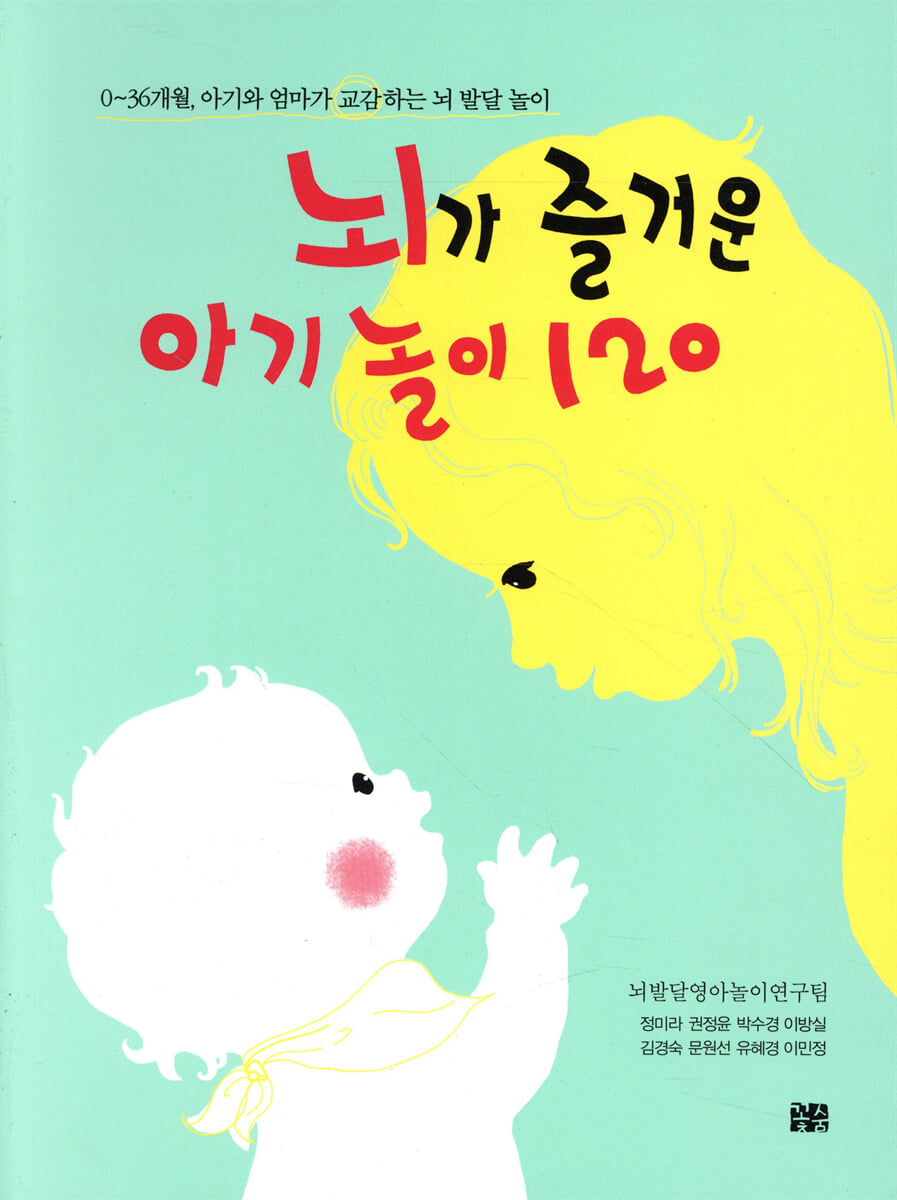
120 Brain-Fun Baby Games
 |
Description
Book Introduction
Why is communication with the mother most important in a baby's first three years?
120 brain development activities tailored to the developmental stages of babies aged 0 to 36 months.
《120 Brain-Fun Activities for Babies》 is a brain development parenting book consisting of 120 activities in 6 stages by month of age.
120 diverse activities that develop four areas—sensory cognition, social-emotional development, physical motor skills, and communication—are created through enjoyable interactions between mother and baby.
The authors of this book are members of the 'Brain Development Infant Play Research Team', comprised of experts in early childhood education, brain science, and pediatrics. Since 2010, they have been conducting brain-based convergence research to improve the infant care environment with research support from the Social Science of Korea (SSK) program of the National Research Foundation of Korea.
The results of this study confirmed that play through interaction with the mother has a significant impact on the formation of a baby's stable attachment and brain development.
The results showed that one thing that is crucial for a baby's brain development is to grow up with a stable emotional foundation through enjoyable interaction with the mother in daily life.
This book, which contains play methods using various materials in everyday life, is a practical parenting book that teaches moms and dads, or grandparents, how to communicate with their babies in an appropriate way and have fun playing with them.
Each play requires no special equipment.
Anyone can follow along using materials commonly found in everyday life.
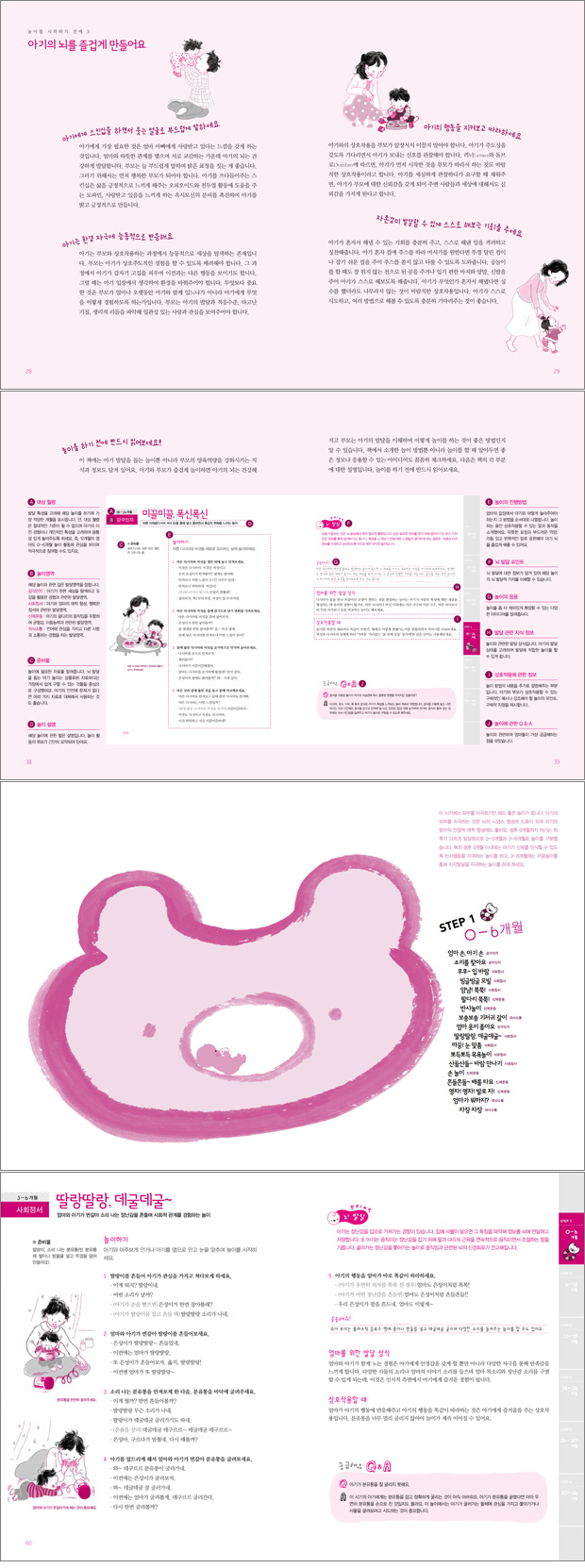
We provide friendly information on the materials needed for each game, how to play, the effects of play, and development-related information.
In particular, the section that teaches how to play includes conversation techniques and pictures necessary for interaction between baby and mother to ensure that the play is effective.
120 brain development activities tailored to the developmental stages of babies aged 0 to 36 months.
《120 Brain-Fun Activities for Babies》 is a brain development parenting book consisting of 120 activities in 6 stages by month of age.
120 diverse activities that develop four areas—sensory cognition, social-emotional development, physical motor skills, and communication—are created through enjoyable interactions between mother and baby.
The authors of this book are members of the 'Brain Development Infant Play Research Team', comprised of experts in early childhood education, brain science, and pediatrics. Since 2010, they have been conducting brain-based convergence research to improve the infant care environment with research support from the Social Science of Korea (SSK) program of the National Research Foundation of Korea.
The results of this study confirmed that play through interaction with the mother has a significant impact on the formation of a baby's stable attachment and brain development.
The results showed that one thing that is crucial for a baby's brain development is to grow up with a stable emotional foundation through enjoyable interaction with the mother in daily life.
This book, which contains play methods using various materials in everyday life, is a practical parenting book that teaches moms and dads, or grandparents, how to communicate with their babies in an appropriate way and have fun playing with them.
Each play requires no special equipment.
Anyone can follow along using materials commonly found in everyday life.
We provide friendly information on the materials needed for each game, how to play, the effects of play, and development-related information.
In particular, the section that teaches how to play includes conversation techniques and pictures necessary for interaction between baby and mother to ensure that the play is effective.
- You can preview some of the book's contents.
Preview
index
Before you start playing 1 _ The first 3 years determine the rest of your life
Before you start playing, 2. Stimulate your five senses to help your brain develop.
3 Before Playing _ Make Your Baby's Brain Fun
Play with your baby - How to use '120 brain-friendly baby activities'
STEP 1.
0-6 months
Mother's hand, baby's hand
Find the sound
Hoho~ Breathe in your mouth
Spinning Mobile
Yum yum! Slurp slurp!
Stretch out your arms and legs!
Reflection play
Fluffy diaper change
I like mom's clothes
Tinkle, tinkle, roll~
Peekaboo! Eye contact
Crispy bath play
Gentle breeze~ Meet the wind
Hand play
Rocking rocking~ Let's get on the boat
Kick! Kick! Kick!
What is Mom doing?
Sleep, sleep
STEP 2.
6-12 months
Knock knock! Open the door.
Fruit sniff sniff, fruit yum yum
Handkerchief magic
My face in the mirror
Shh! What are you talking about?
Bubibubi, kiss side~
Push push push as I please
Chichik boom boom! Ding~
Clean, clean
Slippery, slippery~ Swoosh!
Boom! Boom! Playing ball
palms, soles
Car play
First spoon
Catch the light
Fisherman's Wharf Trip
Good night, friends
Baby, baby, what are you doing?
View animal picture books
Ding ding ding! Dong dong dong!
View the Peekaboo picture book
STEP 3.
12-18 months
Mini telescope
Bread Chef
It's the same
Lunchbox block
Finger play
Fun drawer
Protect my body!
Pointing to body parts
Creep, creep, creep~ flour
Chickapuka! Sweep sweep
Blanket Playground
Over the hill
Dance with Mom
First steps
I can do it too!
Knock knock! Corn stalks
Our family
View tactile book
Please! Please!
STEP 4.
18-24 months
Sound Hide and Seek
scent pouch
Slippery, soft
Blocks of each other
Find the lid
Playing in the water
Should we roll it?
Toy stamp
The sound I made
Baby doll care
Hello
Exciting sand play
Run, cart!
Fly, airplane!
Balloon jet
stocking tug-of-war
Just stop!
Zigzag walk
Balloon swing
Let's go, groan!
Photo Album Game
Laundry Friends
STEP 5.
24-30 months
Walk barefoot
Magnet fishing
What is the same as what?
Paper Friends
Transforming clay
Flutter, fluttering ribbons
This is the land of clouds
Playing hospital with mom
Shadows are dancing
Building a house
Tongs game
Blanket
Plastic bottle bowling
Climbing stairs
Curiosity Box
What does that mean?
animal imitation
North Art Picture Book
My hands, my face
I wear it alone
STEP 6.
30-36 months
Dancing Petals
I am a cook
Bead painting
What could it be?
Cut it small, small
Sing and dance
Flutter flutter~ Scarf butterfly
Fun murals
Yum yum! Setting the table
I'm doing laundry
Grow up~
Sewing game
I went to the playground
Soap bubble drawing
One, two, three! One, two, three!
Baby Star Story
Words starting with the letter 'lee'
Introducing my drawing
Cup doll
I read it too
Before you start playing, 2. Stimulate your five senses to help your brain develop.
3 Before Playing _ Make Your Baby's Brain Fun
Play with your baby - How to use '120 brain-friendly baby activities'
STEP 1.
0-6 months
Mother's hand, baby's hand
Find the sound
Hoho~ Breathe in your mouth
Spinning Mobile
Yum yum! Slurp slurp!
Stretch out your arms and legs!
Reflection play
Fluffy diaper change
I like mom's clothes
Tinkle, tinkle, roll~
Peekaboo! Eye contact
Crispy bath play
Gentle breeze~ Meet the wind
Hand play
Rocking rocking~ Let's get on the boat
Kick! Kick! Kick!
What is Mom doing?
Sleep, sleep
STEP 2.
6-12 months
Knock knock! Open the door.
Fruit sniff sniff, fruit yum yum
Handkerchief magic
My face in the mirror
Shh! What are you talking about?
Bubibubi, kiss side~
Push push push as I please
Chichik boom boom! Ding~
Clean, clean
Slippery, slippery~ Swoosh!
Boom! Boom! Playing ball
palms, soles
Car play
First spoon
Catch the light
Fisherman's Wharf Trip
Good night, friends
Baby, baby, what are you doing?
View animal picture books
Ding ding ding! Dong dong dong!
View the Peekaboo picture book
STEP 3.
12-18 months
Mini telescope
Bread Chef
It's the same
Lunchbox block
Finger play
Fun drawer
Protect my body!
Pointing to body parts
Creep, creep, creep~ flour
Chickapuka! Sweep sweep
Blanket Playground
Over the hill
Dance with Mom
First steps
I can do it too!
Knock knock! Corn stalks
Our family
View tactile book
Please! Please!
STEP 4.
18-24 months
Sound Hide and Seek
scent pouch
Slippery, soft
Blocks of each other
Find the lid
Playing in the water
Should we roll it?
Toy stamp
The sound I made
Baby doll care
Hello
Exciting sand play
Run, cart!
Fly, airplane!
Balloon jet
stocking tug-of-war
Just stop!
Zigzag walk
Balloon swing
Let's go, groan!
Photo Album Game
Laundry Friends
STEP 5.
24-30 months
Walk barefoot
Magnet fishing
What is the same as what?
Paper Friends
Transforming clay
Flutter, fluttering ribbons
This is the land of clouds
Playing hospital with mom
Shadows are dancing
Building a house
Tongs game
Blanket
Plastic bottle bowling
Climbing stairs
Curiosity Box
What does that mean?
animal imitation
North Art Picture Book
My hands, my face
I wear it alone
STEP 6.
30-36 months
Dancing Petals
I am a cook
Bead painting
What could it be?
Cut it small, small
Sing and dance
Flutter flutter~ Scarf butterfly
Fun murals
Yum yum! Setting the table
I'm doing laundry
Grow up~
Sewing game
I went to the playground
Soap bubble drawing
One, two, three! One, two, three!
Baby Star Story
Words starting with the letter 'lee'
Introducing my drawing
Cup doll
I read it too
Detailed image
Publisher's Review
The art of play that stimulates the baby's five senses and makes the brain happy
The key to brain development play is to form stable attachments through skin contact and positive interactions.
When a baby communicates sufficiently with its mother, its brain develops evenly.
What does it mean to have a well-developed brain? A well-developed brain doesn't simply mean improved memory.
Rather, it refers to developing the ability to properly recognize a situation when faced with a problem and find an appropriate solution.
Babies develop these interaction and problem-solving skills through play.
Even for newborn babies, interaction with their mothers is essential.
There is a reason why, since ancient times, babies have been rubbed with their hands and feet, stroked with their arms, legs, and stomach, and played with them in games like peek-a-boo and squeaky-squeak.
Even in these ordinary games, the wisdom of parents is hidden, as they make eye contact with their babies, communicate with them, stimulate their five senses, and respond positively to their babies' actions.
The first priority for play, which forms attachment and develops a baby's brain, is to stimulate the five senses.
It is important to continuously communicate with your baby while stimulating all five senses: sight, hearing, touch, smell, and taste.
For example, just looking at peek-a-boo, it is a developmental game that starts with visual stimulation and gradually teaches object permanence.
Small activities such as using objects that make noise, playing with flour or sand, or showing the taste of food when starting to eat solid foods stimulate the baby's five senses and help develop the brain.
As you experience how objects you passed by without noticing become toys and small experiences you didn't even realize become play, you realize how precious every moment you spend with your baby is.
Another requirement for brain development play is to entertain the baby's brain.
While playing with your baby, the process of making skin-to-skin contact with your baby by smiling and speaking softly is very important.
Responding positively and actively to your baby's behavior while playing and encouraging him to do things on his own will help him grow into a child with strong self-esteem.
Exploring new things with your baby while listening to various sounds also provides enjoyable stimulation to the baby's brain, making it an effective brain development activity.
At this time, provide opportunities for diverse exploration experiences by allowing children to directly touch objects and nature around them.
These types of games are more effective when experienced repeatedly.
When playing, it is important to consider individual differences and ensure that the play is baby-led.
This book contains 120 games that provide repeated opportunities for sensory and motor exploration, foster positive connection, and foster enjoyment.
We hope that through step-by-step play, each area of the brain will be developed evenly, and that both the baby and the mother will be happy by forming a stable attachment.
Although it is said that anyone can give birth and raise children, the role of parent requires a lot of preparation.
In traditional societies where three generations lived together in extended families, the wisdom needed to give birth and raise a child was naturally inherited.
But these days, opportunities like this are not easily given to us.
These days, mothers raising young children know that play is important for their babies, but they worry about how to play with them and what kind of play is helpful for their babies' development, especially their brain development.
Because they don't know how, they take their newborn babies to cultural centers or play schools and buy expensive educational materials.
But there is a different kind of play that babies need to grow well.
It is a play experience that allows you to naturally interact with your family in a pleasant atmosphere at home.
The 'Brain Development Infant Play Research Team' created this book to guide these parents on the right path.
We want to provide information about your baby's brain development and help you learn how to play well with your baby so that you can fulfill your role as a parent.
Brain development is often thought of as the process of becoming smarter, but true brain development occurs through forming a stable attachment with parents and positive interactions that are tailored to the baby's developmental needs and characteristics.
As a result, the goal of brain development education is ‘mother and baby being happy together.’
For the past three years, the 'Brain Development Infant Play Research Team' has been conducting individual coaching programs to strengthen the parenting skills of parents with infants and toddlers.
We also directly run an infant play program based on brain development and have confirmed the effectiveness of the play program in helping babies' brain development.
Based on these research results, we completed “120 Fun Brain Games for Babies.”
All the games presented in this book are easy for moms and dads to do while bathing, putting to sleep, feeding, changing diapers, or taking their babies for a walk.
_ From 'Why is the communication between a baby and a mother most important for brain development?'
The key to brain development play is to form stable attachments through skin contact and positive interactions.
When a baby communicates sufficiently with its mother, its brain develops evenly.
What does it mean to have a well-developed brain? A well-developed brain doesn't simply mean improved memory.
Rather, it refers to developing the ability to properly recognize a situation when faced with a problem and find an appropriate solution.
Babies develop these interaction and problem-solving skills through play.
Even for newborn babies, interaction with their mothers is essential.
There is a reason why, since ancient times, babies have been rubbed with their hands and feet, stroked with their arms, legs, and stomach, and played with them in games like peek-a-boo and squeaky-squeak.
Even in these ordinary games, the wisdom of parents is hidden, as they make eye contact with their babies, communicate with them, stimulate their five senses, and respond positively to their babies' actions.
The first priority for play, which forms attachment and develops a baby's brain, is to stimulate the five senses.
It is important to continuously communicate with your baby while stimulating all five senses: sight, hearing, touch, smell, and taste.
For example, just looking at peek-a-boo, it is a developmental game that starts with visual stimulation and gradually teaches object permanence.
Small activities such as using objects that make noise, playing with flour or sand, or showing the taste of food when starting to eat solid foods stimulate the baby's five senses and help develop the brain.
As you experience how objects you passed by without noticing become toys and small experiences you didn't even realize become play, you realize how precious every moment you spend with your baby is.
Another requirement for brain development play is to entertain the baby's brain.
While playing with your baby, the process of making skin-to-skin contact with your baby by smiling and speaking softly is very important.
Responding positively and actively to your baby's behavior while playing and encouraging him to do things on his own will help him grow into a child with strong self-esteem.
Exploring new things with your baby while listening to various sounds also provides enjoyable stimulation to the baby's brain, making it an effective brain development activity.
At this time, provide opportunities for diverse exploration experiences by allowing children to directly touch objects and nature around them.
These types of games are more effective when experienced repeatedly.
When playing, it is important to consider individual differences and ensure that the play is baby-led.
This book contains 120 games that provide repeated opportunities for sensory and motor exploration, foster positive connection, and foster enjoyment.
We hope that through step-by-step play, each area of the brain will be developed evenly, and that both the baby and the mother will be happy by forming a stable attachment.
Although it is said that anyone can give birth and raise children, the role of parent requires a lot of preparation.
In traditional societies where three generations lived together in extended families, the wisdom needed to give birth and raise a child was naturally inherited.
But these days, opportunities like this are not easily given to us.
These days, mothers raising young children know that play is important for their babies, but they worry about how to play with them and what kind of play is helpful for their babies' development, especially their brain development.
Because they don't know how, they take their newborn babies to cultural centers or play schools and buy expensive educational materials.
But there is a different kind of play that babies need to grow well.
It is a play experience that allows you to naturally interact with your family in a pleasant atmosphere at home.
The 'Brain Development Infant Play Research Team' created this book to guide these parents on the right path.
We want to provide information about your baby's brain development and help you learn how to play well with your baby so that you can fulfill your role as a parent.
Brain development is often thought of as the process of becoming smarter, but true brain development occurs through forming a stable attachment with parents and positive interactions that are tailored to the baby's developmental needs and characteristics.
As a result, the goal of brain development education is ‘mother and baby being happy together.’
For the past three years, the 'Brain Development Infant Play Research Team' has been conducting individual coaching programs to strengthen the parenting skills of parents with infants and toddlers.
We also directly run an infant play program based on brain development and have confirmed the effectiveness of the play program in helping babies' brain development.
Based on these research results, we completed “120 Fun Brain Games for Babies.”
All the games presented in this book are easy for moms and dads to do while bathing, putting to sleep, feeding, changing diapers, or taking their babies for a walk.
_ From 'Why is the communication between a baby and a mother most important for brain development?'
GOODS SPECIFICS
- Date of publication: July 25, 2013
- Page count, weight, size: 292 pages | 540g | 180*240*20mm
- ISBN13: 9788958761648
- ISBN10: 8958761644
You may also like
카테고리
korean


korean

![GQ KOREA Mark (Monthly): December [2025]](http://librairie.coreenne.fr/cdn/shop/files/8ef265dbbfbf186523ed75ba7319009d.jpg?v=1765340328&width=3840)


