

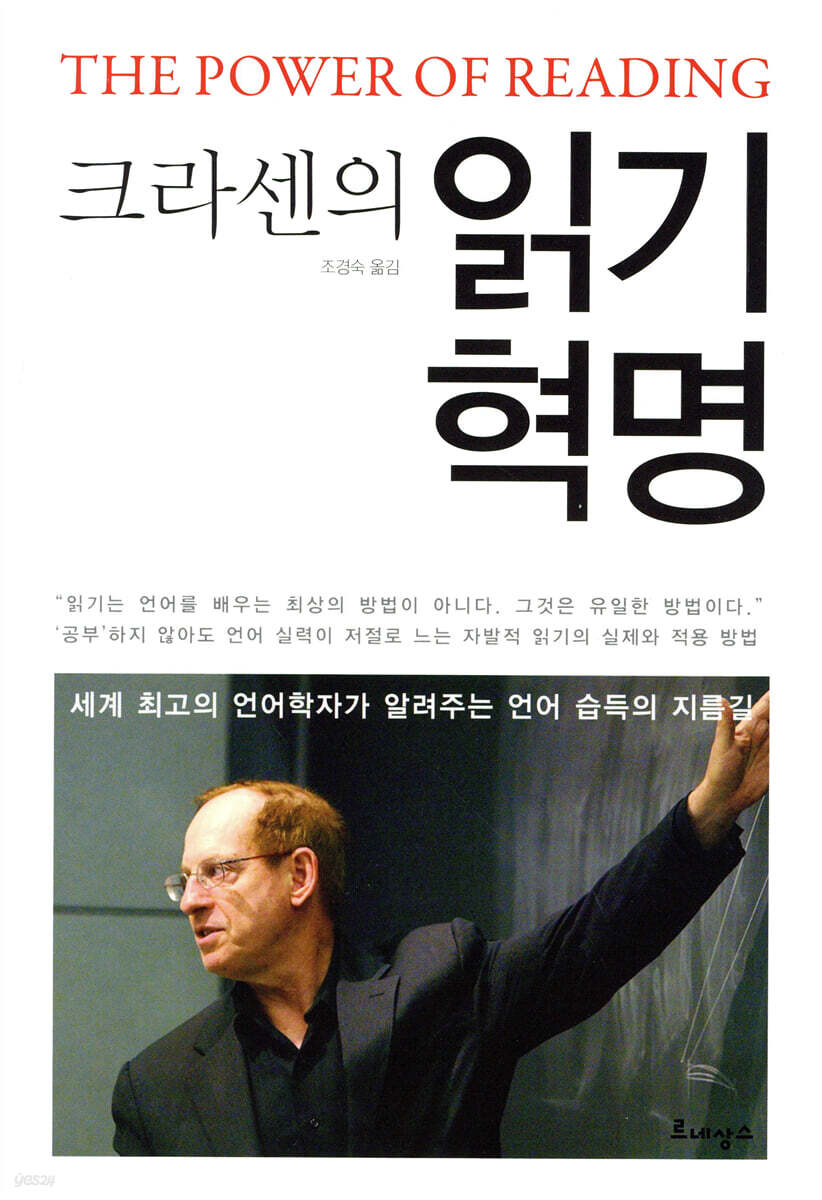
Krashen's Reading Revolution
 |
Description
Book Introduction
The culmination of years of research by Professor Stephen Krashen, the founder of foreign language acquisition theory!
Since its first publication in 1994, The Power of Reading has been recognized as the most influential authority on language education.
This book presents groundbreaking research findings that fundamentally change the way educators and linguists teach language.
Professor Stephen Krashen, a leading authority in language education, has scientifically revealed the power of reading through meticulous research conducted in several countries over several decades.
According to Krashen's research, there is only one way to acquire a language, whether it is your native language or a foreign language.
Reading the books you want to read as much as you want.
Professor Krashen calls this method of reading 'spontaneous reading'.
Readers have demonstrated the surprising effects of voluntary reading through various experiments.
This book provides concrete evidence that reading improves various skills, including writing, grammar, vocabulary, and reading comprehension.
This book also provides detailed information on how to practically apply voluntary reading at home and at school.
The author also provides clear conclusions regarding the questions many people have about reading books.
For example, it's clear what effect light reading materials like comics or teen romances have, whether rewards offered to encourage reading are effective, and whether post-reading tests help improve reading skills.
You can also learn how to get children who hate reading or have difficulty reading to become engrossed in reading.
Since its first publication in 1994, The Power of Reading has been recognized as the most influential authority on language education.
This book presents groundbreaking research findings that fundamentally change the way educators and linguists teach language.
Professor Stephen Krashen, a leading authority in language education, has scientifically revealed the power of reading through meticulous research conducted in several countries over several decades.
According to Krashen's research, there is only one way to acquire a language, whether it is your native language or a foreign language.
Reading the books you want to read as much as you want.
Professor Krashen calls this method of reading 'spontaneous reading'.
Readers have demonstrated the surprising effects of voluntary reading through various experiments.
This book provides concrete evidence that reading improves various skills, including writing, grammar, vocabulary, and reading comprehension.
This book also provides detailed information on how to practically apply voluntary reading at home and at school.
The author also provides clear conclusions regarding the questions many people have about reading books.
For example, it's clear what effect light reading materials like comics or teen romances have, whether rewards offered to encourage reading are effective, and whether post-reading tests help improve reading skills.
You can also learn how to get children who hate reading or have difficulty reading to become engrossed in reading.
- You can preview some of the book's contents.
Preview
index
The Fastest and Most Enjoyable Way to Learn a Language
Chapter 1: Scientifically Revealing the Power of Reading
Spontaneous reading is the only way to learn a language.
Children who enjoy class time/Dramatic effects on learning foreign languages/Reading more makes you write better/Relationship between reading and TOEFL scores/Relationship between knowing authors' names and vocabulary/Vocabulary increases when you encounter unfamiliar words in context/Will vocabulary improve if you memorize words diligently?
Language is difficult to learn through 'study'
Language is too complex to be learned by learning rules and words one by one. / Reading and writing skills can be developed without instruction. / People whose writing skills improved dramatically through reading. / You can acquire spelling without being taught how to spell. / Studying English grammar is not helpful.
Learning a language should be fun.
Children experience immersion while reading/The effects of reading at bedtime.
If you read a lot of books, textbooks become easier.
Commonalities of Creative People/To Reduce Anxiety About Writing
It is difficult to learn a language through repetitive training and practice.
Chapter 2: A Special Way to Raise a Child Who Reads
The book must be nearby.
If you have a lot of books at home, you read more. If you have a well-stocked classroom library, you read more. If you have a good school library, you read more. If you have easy access to a public library, you read more. Having a lot of books doesn't solve everything.
There is a separate environment that makes you read books.
Why Libraries Matter/School Library Quality and Reading Scores/What Matters Most in Educating Poor Children/Let's Revisit Classroom Libraries/The Difference Between Having and Not Having a Librarian/People Who Are Good at Their Native Language Are Good at Foreign Languages/The Great Teacher's Dilemma
Reading aloud helps people read more
Let me introduce you to a book like your first kiss.
Books that stimulate children's desire to read
Children read more when they see others reading.
If you give them time to read, they will read on their own.
How mothers raise children who read well
Four Factors That Develop Reading Habits
Misconceptions and Truths About Comics
Are comics good or evil? / Does reading too many comics delay language development? / How to read comics properly / Does reading too many comics prevent you from reading other books? / Comics and children who hate reading / Comics and studying English / The power of comics
Use teen romance and magazines
Is light reading enough?
Are Rewards Effective in Reading Education?
Should I take the test after reading the book? / Things to think about before taking the test
Chapter 3: Now, the way we study must change.
When you're nervous, the part of your brain responsible for language learning stops working.
Two Crucial Factors in Developing Writing Skills
Style comes from reading/Writing a lot doesn't make you a good writer/Writing develops problem-solving skills
Watching TV and reading
The level of language used on TV/TV and language development/What has a greater influence than TV
There are shortcuts to learning a foreign language.
When you read books with pleasure, your language skills improve without you having to put in any effort.
Chapter 1: Scientifically Revealing the Power of Reading
Spontaneous reading is the only way to learn a language.
Children who enjoy class time/Dramatic effects on learning foreign languages/Reading more makes you write better/Relationship between reading and TOEFL scores/Relationship between knowing authors' names and vocabulary/Vocabulary increases when you encounter unfamiliar words in context/Will vocabulary improve if you memorize words diligently?
Language is difficult to learn through 'study'
Language is too complex to be learned by learning rules and words one by one. / Reading and writing skills can be developed without instruction. / People whose writing skills improved dramatically through reading. / You can acquire spelling without being taught how to spell. / Studying English grammar is not helpful.
Learning a language should be fun.
Children experience immersion while reading/The effects of reading at bedtime.
If you read a lot of books, textbooks become easier.
Commonalities of Creative People/To Reduce Anxiety About Writing
It is difficult to learn a language through repetitive training and practice.
Chapter 2: A Special Way to Raise a Child Who Reads
The book must be nearby.
If you have a lot of books at home, you read more. If you have a well-stocked classroom library, you read more. If you have a good school library, you read more. If you have easy access to a public library, you read more. Having a lot of books doesn't solve everything.
There is a separate environment that makes you read books.
Why Libraries Matter/School Library Quality and Reading Scores/What Matters Most in Educating Poor Children/Let's Revisit Classroom Libraries/The Difference Between Having and Not Having a Librarian/People Who Are Good at Their Native Language Are Good at Foreign Languages/The Great Teacher's Dilemma
Reading aloud helps people read more
Let me introduce you to a book like your first kiss.
Books that stimulate children's desire to read
Children read more when they see others reading.
If you give them time to read, they will read on their own.
How mothers raise children who read well
Four Factors That Develop Reading Habits
Misconceptions and Truths About Comics
Are comics good or evil? / Does reading too many comics delay language development? / How to read comics properly / Does reading too many comics prevent you from reading other books? / Comics and children who hate reading / Comics and studying English / The power of comics
Use teen romance and magazines
Is light reading enough?
Are Rewards Effective in Reading Education?
Should I take the test after reading the book? / Things to think about before taking the test
Chapter 3: Now, the way we study must change.
When you're nervous, the part of your brain responsible for language learning stops working.
Two Crucial Factors in Developing Writing Skills
Style comes from reading/Writing a lot doesn't make you a good writer/Writing develops problem-solving skills
Watching TV and reading
The level of language used on TV/TV and language development/What has a greater influence than TV
There are shortcuts to learning a foreign language.
When you read books with pleasure, your language skills improve without you having to put in any effort.
Into the book
Ellie conducted a study in Singapore with approximately 3,000 children aged 6 to 9, which lasted from one to three years.
Students who participated in the reading program performed significantly better on tests of reading comprehension, vocabulary, speaking, grammar, listening, and writing skills than students who learned using traditional methods.
Research was also conducted in South Africa and Sri Lanka.
Children who were encouraged to read for fun performed significantly better on reading comprehension and writing tests than those who learned using traditional methods.
--- p.24
A series of studies since 1935 have clearly shown that grammar instruction is ineffective for reading and writing.
The most thorough study was conducted in New Zealand.
In this study, high school students participating in English classes were divided into three groups (traditional grammar, transformational grammar, and no grammar) and assessed annually for three years.
The researchers found no differences in reading comprehension, style, writing skills, or vocabulary between the three groups.
A follow-up study conducted a year later also found no difference.
The researchers concluded:
“English grammar, whether traditional or inflectional, has no impact on the language development of middle and high school students.” Learning complex grammatical structures does not help with reading or writing.
Rather, mastering complex grammar is possible through reading.
--- p.44
Numerous studies have shown that reading can develop language skills, leading to one clear conclusion:
Reading is the only way to develop reading comprehension, writing skills, a rich vocabulary, advanced grammar skills, and the ability to spell accurately.
After extensive research, I have concluded that there is only one way to acquire a language.
Language can only be acquired when the content is understood or accepted with understanding in a situation where there is little anxiety.
Understanding the content of a book in a low-anxiety environment is precisely the concept of autonomous reading.
If so, we need to reexamine the direct teaching method through repetitive training and practice that we are using.
--- p.
59
Some libraries exclude books from their catalogs that people want to read.
Michael, 10, points this out.
“It’s strange how good librarians don’t put books like The Hardy Boys or Tom Corbett, the Space Cadet in their libraries!” Researcher Nell suggests that many librarians consider themselves “guardians of good books.” --- p.84
Bon Sprecken and Krashen observed reading time in a middle school during the school year and reported that 90% of the students were reading.
According to the results of this study, the more books there were in the classroom library, the more teachers read along with students, the less students were asked to bring books to read, and the more teachers made a deliberate effort to have students read specific books, the more reading activities in the classroom were promoted. --- p.100
Carson, a neurosurgeon, was a poor student until the fifth grade.
His mother had him borrow two books from the library every week, read them, and report back on the content every weekend.
Carson was reluctant, but he followed his mother's advice.
The important thing here is that Carson's mother allowed her son to read whatever books he wanted.
At first, Carson chose books about his favorite subjects: animals, nature, science, etc.
Carson was a poor student in traditional subjects, but by fifth grade he was an excellent student in science.
As my reading expanded, I became a top fifth grade expert who could answer any question related to science.
Carson's reading skills and vocabulary improved through reading books.
This had a positive impact on all other subjects as well.
For example, in mathematics, “he was the best student when it came to solving word problems.” Reading also influenced spelling skills.
"I continued reading throughout the summer, and by the time I was in sixth grade, I could spell a lot of words without consciously memorizing them."
The initial stimulation Carson received from his mother had dramatic results.
"As I continued to read, my spelling, vocabulary, and reading comprehension improved, and class time became much more enjoyable.
My grades improved so much that by middle school I was at the top of my class." What is clear is that Carson's mother encouraged him to read just the right amount.
That is, because he was able to choose his own books, he was able to enjoy reading and thus no longer needed reading guidance. --- p.103
Although tests that ask for comprehension of content after reading are extremely popular, their effectiveness has not been conclusively proven.
Before purchasing a test program, you should first consider whether children have easy access to interesting books and whether they have enough time and space to read them. --- p.142
Mason compared the effectiveness of three activities for university students learning English in Japan.
The three activities were writing a short commentary on what I read in my native language (Japanese), writing a commentary on what I read in English, and writing a commentary and correcting errors in what I read in English.
After three semesters, he found no differences between the three groups in writing accuracy (or reading achievement).
Moreover, the extra time invested in writing did not contribute to language development.
That is, the two groups that wrote in English invested two more hours per week in writing, but it had no effect on language development.
Language acquisition occurs from input, not output, and from understanding, not speaking.
So, writing one page a day won't improve your writing style or ability.
Smith advises:
“To learn how to write newspaper articles, you must read newspapers.
Just reading textbooks won't be enough.
If you want to write for a magazine, it's better to skim magazines than to take a course on writing magazine articles.
“If you want to write poetry, read poetry.” --- p.151
When people learning a foreign language enjoy reading books, they start at the level of simple everyday conversation and progress to the level of speaking the language needed for advanced literary studies or business.
People studying a foreign language can steadily improve their language skills by reading books with enjoyment, without having to sit in a classroom and listen to a teacher, or even without having anyone to talk to.
It is also a good idea to encourage people learning a foreign language to read books written in their native language for fun.
Reading books in your native language for fun significantly develops your ability to read foreign languages. --- p.165
When children read for fun, when they are 'captivated by the book', they acquire language unconsciously and effortlessly.
Children will become excellent readers, acquire a large vocabulary, develop the ability to understand and use complex grammatical structures, improve their writing style, and become good (though not perfect) spellers.
When you read a book, your reading and writing skills actually develop.
People who read well rarely have serious problems with grammar, spelling, etc.
People who read well also write well.
Because it has to be that way.
They unconsciously acquire good writing skills through reading and acquire everything in the field of writing. --- p.168
Parents should know that children gain more from reading books than from working with workbooks.
Children learn more from reading comics, novels, magazines, etc. than from working on workbooks.
Although not everything that is enjoyable is beneficial, reading and writing skills develop most effectively when they are enjoyable.
Students who participated in the reading program performed significantly better on tests of reading comprehension, vocabulary, speaking, grammar, listening, and writing skills than students who learned using traditional methods.
Research was also conducted in South Africa and Sri Lanka.
Children who were encouraged to read for fun performed significantly better on reading comprehension and writing tests than those who learned using traditional methods.
--- p.24
A series of studies since 1935 have clearly shown that grammar instruction is ineffective for reading and writing.
The most thorough study was conducted in New Zealand.
In this study, high school students participating in English classes were divided into three groups (traditional grammar, transformational grammar, and no grammar) and assessed annually for three years.
The researchers found no differences in reading comprehension, style, writing skills, or vocabulary between the three groups.
A follow-up study conducted a year later also found no difference.
The researchers concluded:
“English grammar, whether traditional or inflectional, has no impact on the language development of middle and high school students.” Learning complex grammatical structures does not help with reading or writing.
Rather, mastering complex grammar is possible through reading.
--- p.44
Numerous studies have shown that reading can develop language skills, leading to one clear conclusion:
Reading is the only way to develop reading comprehension, writing skills, a rich vocabulary, advanced grammar skills, and the ability to spell accurately.
After extensive research, I have concluded that there is only one way to acquire a language.
Language can only be acquired when the content is understood or accepted with understanding in a situation where there is little anxiety.
Understanding the content of a book in a low-anxiety environment is precisely the concept of autonomous reading.
If so, we need to reexamine the direct teaching method through repetitive training and practice that we are using.
--- p.
59
Some libraries exclude books from their catalogs that people want to read.
Michael, 10, points this out.
“It’s strange how good librarians don’t put books like The Hardy Boys or Tom Corbett, the Space Cadet in their libraries!” Researcher Nell suggests that many librarians consider themselves “guardians of good books.” --- p.84
Bon Sprecken and Krashen observed reading time in a middle school during the school year and reported that 90% of the students were reading.
According to the results of this study, the more books there were in the classroom library, the more teachers read along with students, the less students were asked to bring books to read, and the more teachers made a deliberate effort to have students read specific books, the more reading activities in the classroom were promoted. --- p.100
Carson, a neurosurgeon, was a poor student until the fifth grade.
His mother had him borrow two books from the library every week, read them, and report back on the content every weekend.
Carson was reluctant, but he followed his mother's advice.
The important thing here is that Carson's mother allowed her son to read whatever books he wanted.
At first, Carson chose books about his favorite subjects: animals, nature, science, etc.
Carson was a poor student in traditional subjects, but by fifth grade he was an excellent student in science.
As my reading expanded, I became a top fifth grade expert who could answer any question related to science.
Carson's reading skills and vocabulary improved through reading books.
This had a positive impact on all other subjects as well.
For example, in mathematics, “he was the best student when it came to solving word problems.” Reading also influenced spelling skills.
"I continued reading throughout the summer, and by the time I was in sixth grade, I could spell a lot of words without consciously memorizing them."
The initial stimulation Carson received from his mother had dramatic results.
"As I continued to read, my spelling, vocabulary, and reading comprehension improved, and class time became much more enjoyable.
My grades improved so much that by middle school I was at the top of my class." What is clear is that Carson's mother encouraged him to read just the right amount.
That is, because he was able to choose his own books, he was able to enjoy reading and thus no longer needed reading guidance. --- p.103
Although tests that ask for comprehension of content after reading are extremely popular, their effectiveness has not been conclusively proven.
Before purchasing a test program, you should first consider whether children have easy access to interesting books and whether they have enough time and space to read them. --- p.142
Mason compared the effectiveness of three activities for university students learning English in Japan.
The three activities were writing a short commentary on what I read in my native language (Japanese), writing a commentary on what I read in English, and writing a commentary and correcting errors in what I read in English.
After three semesters, he found no differences between the three groups in writing accuracy (or reading achievement).
Moreover, the extra time invested in writing did not contribute to language development.
That is, the two groups that wrote in English invested two more hours per week in writing, but it had no effect on language development.
Language acquisition occurs from input, not output, and from understanding, not speaking.
So, writing one page a day won't improve your writing style or ability.
Smith advises:
“To learn how to write newspaper articles, you must read newspapers.
Just reading textbooks won't be enough.
If you want to write for a magazine, it's better to skim magazines than to take a course on writing magazine articles.
“If you want to write poetry, read poetry.” --- p.151
When people learning a foreign language enjoy reading books, they start at the level of simple everyday conversation and progress to the level of speaking the language needed for advanced literary studies or business.
People studying a foreign language can steadily improve their language skills by reading books with enjoyment, without having to sit in a classroom and listen to a teacher, or even without having anyone to talk to.
It is also a good idea to encourage people learning a foreign language to read books written in their native language for fun.
Reading books in your native language for fun significantly develops your ability to read foreign languages. --- p.165
When children read for fun, when they are 'captivated by the book', they acquire language unconsciously and effortlessly.
Children will become excellent readers, acquire a large vocabulary, develop the ability to understand and use complex grammatical structures, improve their writing style, and become good (though not perfect) spellers.
When you read a book, your reading and writing skills actually develop.
People who read well rarely have serious problems with grammar, spelling, etc.
People who read well also write well.
Because it has to be that way.
They unconsciously acquire good writing skills through reading and acquire everything in the field of writing. --- p.168
Parents should know that children gain more from reading books than from working with workbooks.
Children learn more from reading comics, novels, magazines, etc. than from working on workbooks.
Although not everything that is enjoyable is beneficial, reading and writing skills develop most effectively when they are enjoyable.
--- p.
170
170
Publisher's Review
The culmination of years of research by Professor Stephen Krashen, the founder of foreign language acquisition theory!
The United States, China, Japan, South Africa, Singapore, New Zealand, Sri Lanka, Italy… … has been confirmed through various experiments conducted around the world for over 100 years.
The power of voluntary reading!
The legendary book that revolutionized language education is finally published in Korean!
Since its first publication in 1994, The Power of Reading has been recognized as the most influential authority on language education.
This book presents groundbreaking research findings that fundamentally change the way educators and linguists teach language.
Professor Stephen Krashen, a leading authority in language education, has scientifically revealed the power of reading through meticulous research conducted in several countries over several decades.
According to Krashen's research, there is only one way to acquire a language, whether it is your native language or a foreign language.
Reading the books you want to read as much as you want.
Professor Krashen calls this reading method 'Free Voluntary Reading'.
This book demonstrates the surprising effects of voluntary reading through various experiments.
This book provides concrete evidence that reading improves various skills, including writing, grammar, vocabulary, and reading comprehension.
Studies consistently show that students who have voluntary reading time during class do better on language tests than those who study using traditional classroom methods.
It also provides detailed information on how to practically apply voluntary reading at home and at school.
The author also provides clear conclusions regarding the questions many people have about reading books.
For example, it's clear what effect light reading materials like comics or teen romances have, whether rewards offered to encourage reading are effective, and whether post-reading tests help improve reading skills.
You can also learn how to get children who hate reading or have difficulty reading to become engrossed in reading.
What Parents and Teachers Can Do to Improve Their Children's Language Skills
Let's think back to our 'Korean language classes' from elementary school to college.
Read the textbook, underline it, and write down the explanations given by the teacher.
Learn new vocabulary and take tests to check your understanding of the content.
I find books on the recommended reading list and force myself to read them, and I also study vocabulary books that organize difficult words.
I buy a new workbook and solve problems every semester.
Even after studying Korean so diligently for 12 years, it is rare to find someone who has the ability to read and write at a high level.
Students experience frustration right now when they stand in front of the language section of the CSAT exam.
How on earth do you learn a language?
According to Professor Krashen, language cannot be acquired through 'studying'.
Language is too vast to learn and use rules and words one by one.
According to the author, when you read books voluntarily, your language skills such as reading comprehension, vocabulary, writing style, grammar, and spelling develop.
In language education, voluntary reading, which is a method of acquiring language autonomously rather than consciously studying, is important.
Workbooks, vocabulary lists, and fancy book lists do not help develop language skills.
Therefore, the author emphasizes that parents and teachers should provide children with time to read and interesting books so that they can read freely.
This book details how to implement voluntary reading at home and at school.
English education as it is now is difficult and ineffective.
Throw away your grammar books, workbooks, vocabulary lists, and recommended reading lists.
All children and parents in Korea are suffering due to excessive private education.
In particular, many people believe that English should be studied properly by sending children to a private academy from the age of five or six.
So, the reality is that there are a lot of 'edu-poor' people who are struggling financially due to private education expenses.
The pain caused by private education is not limited to the shaky household economy.
Children are struggling with 'English study' from an extremely early age.
Unfortunately, the money and time invested are not being rewarded.
According to Professor Krashen, the current method of teaching English is not only difficult but also ineffective.
Because ‘learning’ a language does not lead to ‘acquisition’.
For a person to learn a language, they must be given a lot of understandable input.
Language acquisition occurs through input, not output.
Therefore, having children sit in a classroom and repeatedly practice sentence patterns and solve grammar problems is not effective in helping them acquire English.
Professor Krashen emphasizes that children can reach a level of English proficiency when they are allowed to read as many books as they want.
No, I would say that it is difficult to speak high-level English without voluntary reading.
The most effective way to improve your English skills is to read books for fun.
This book presents countless pieces of evidence showing that students who read voluntarily performed better on grammar, vocabulary, and even the TOEFL than those who were taught in a traditional way.
Dr. Krashen's argument suggests a new direction for English education.
If you can read spontaneously, you can improve your English skills without a native English teacher or sitting in a classroom.
There is no need to send your child to an English academy from the age of five or six.
You can become fluent in English without having to memorize 50 words a day or study boring grammar books.
This is a shortcut to learning English, as taught by this century's greatest linguist who established the theory of foreign language acquisition.
The United States, China, Japan, South Africa, Singapore, New Zealand, Sri Lanka, Italy… … has been confirmed through various experiments conducted around the world for over 100 years.
The power of voluntary reading!
The legendary book that revolutionized language education is finally published in Korean!
Since its first publication in 1994, The Power of Reading has been recognized as the most influential authority on language education.
This book presents groundbreaking research findings that fundamentally change the way educators and linguists teach language.
Professor Stephen Krashen, a leading authority in language education, has scientifically revealed the power of reading through meticulous research conducted in several countries over several decades.
According to Krashen's research, there is only one way to acquire a language, whether it is your native language or a foreign language.
Reading the books you want to read as much as you want.
Professor Krashen calls this reading method 'Free Voluntary Reading'.
This book demonstrates the surprising effects of voluntary reading through various experiments.
This book provides concrete evidence that reading improves various skills, including writing, grammar, vocabulary, and reading comprehension.
Studies consistently show that students who have voluntary reading time during class do better on language tests than those who study using traditional classroom methods.
It also provides detailed information on how to practically apply voluntary reading at home and at school.
The author also provides clear conclusions regarding the questions many people have about reading books.
For example, it's clear what effect light reading materials like comics or teen romances have, whether rewards offered to encourage reading are effective, and whether post-reading tests help improve reading skills.
You can also learn how to get children who hate reading or have difficulty reading to become engrossed in reading.
What Parents and Teachers Can Do to Improve Their Children's Language Skills
Let's think back to our 'Korean language classes' from elementary school to college.
Read the textbook, underline it, and write down the explanations given by the teacher.
Learn new vocabulary and take tests to check your understanding of the content.
I find books on the recommended reading list and force myself to read them, and I also study vocabulary books that organize difficult words.
I buy a new workbook and solve problems every semester.
Even after studying Korean so diligently for 12 years, it is rare to find someone who has the ability to read and write at a high level.
Students experience frustration right now when they stand in front of the language section of the CSAT exam.
How on earth do you learn a language?
According to Professor Krashen, language cannot be acquired through 'studying'.
Language is too vast to learn and use rules and words one by one.
According to the author, when you read books voluntarily, your language skills such as reading comprehension, vocabulary, writing style, grammar, and spelling develop.
In language education, voluntary reading, which is a method of acquiring language autonomously rather than consciously studying, is important.
Workbooks, vocabulary lists, and fancy book lists do not help develop language skills.
Therefore, the author emphasizes that parents and teachers should provide children with time to read and interesting books so that they can read freely.
This book details how to implement voluntary reading at home and at school.
English education as it is now is difficult and ineffective.
Throw away your grammar books, workbooks, vocabulary lists, and recommended reading lists.
All children and parents in Korea are suffering due to excessive private education.
In particular, many people believe that English should be studied properly by sending children to a private academy from the age of five or six.
So, the reality is that there are a lot of 'edu-poor' people who are struggling financially due to private education expenses.
The pain caused by private education is not limited to the shaky household economy.
Children are struggling with 'English study' from an extremely early age.
Unfortunately, the money and time invested are not being rewarded.
According to Professor Krashen, the current method of teaching English is not only difficult but also ineffective.
Because ‘learning’ a language does not lead to ‘acquisition’.
For a person to learn a language, they must be given a lot of understandable input.
Language acquisition occurs through input, not output.
Therefore, having children sit in a classroom and repeatedly practice sentence patterns and solve grammar problems is not effective in helping them acquire English.
Professor Krashen emphasizes that children can reach a level of English proficiency when they are allowed to read as many books as they want.
No, I would say that it is difficult to speak high-level English without voluntary reading.
The most effective way to improve your English skills is to read books for fun.
This book presents countless pieces of evidence showing that students who read voluntarily performed better on grammar, vocabulary, and even the TOEFL than those who were taught in a traditional way.
Dr. Krashen's argument suggests a new direction for English education.
If you can read spontaneously, you can improve your English skills without a native English teacher or sitting in a classroom.
There is no need to send your child to an English academy from the age of five or six.
You can become fluent in English without having to memorize 50 words a day or study boring grammar books.
This is a shortcut to learning English, as taught by this century's greatest linguist who established the theory of foreign language acquisition.
GOODS SPECIFICS
- Date of publication: January 17, 2013
- Page count, weight, size: 216 pages | 422g | 153*224*20mm
- ISBN13: 9788990828613
- ISBN10: 8990828619
You may also like
카테고리
korean


korean

![GQ KOREA Mark (Monthly): December [2025]](http://librairie.coreenne.fr/cdn/shop/files/8ef265dbbfbf186523ed75ba7319009d.jpg?v=1765340328&width=3840)


