

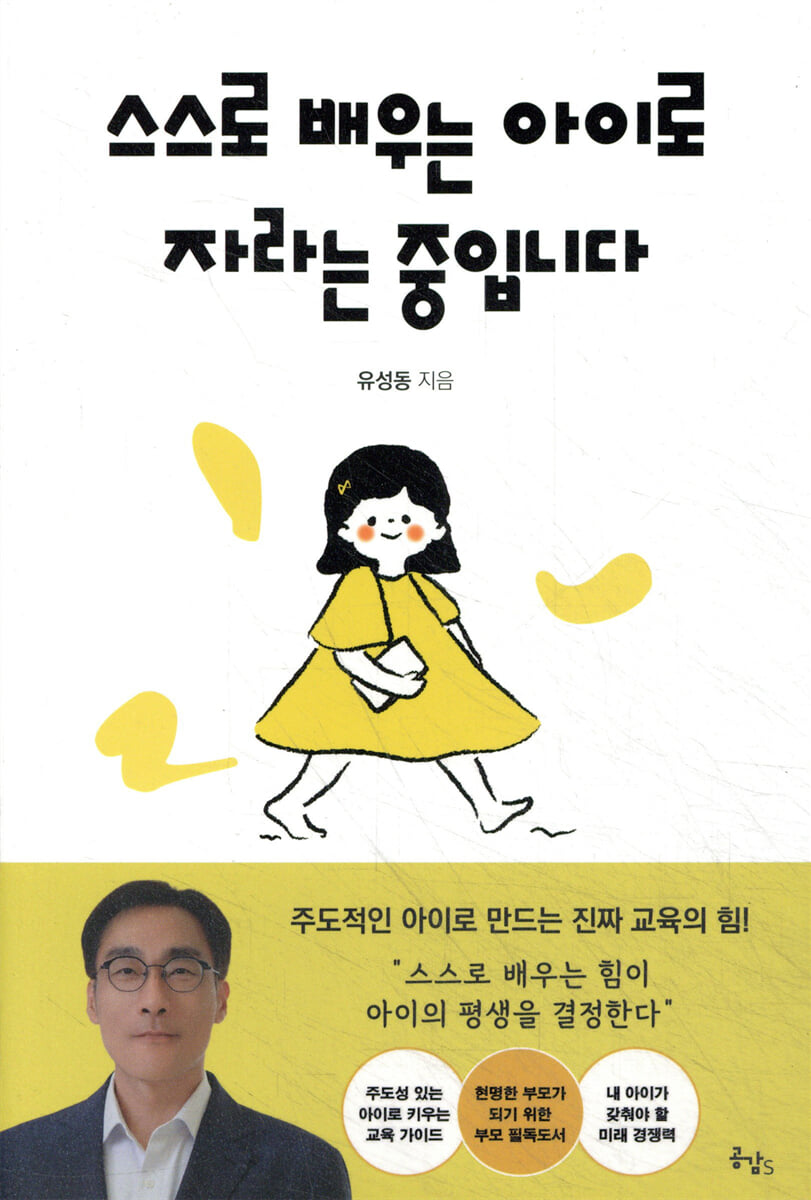
I am growing up to be a self-learning child.
 |
Description
Book Introduction
A true educational environment for children is
It is created from the life that parents live!
“The ability to learn on one’s own determines a child’s entire life.”
Korean parents are world-renowned for their passion for their children's education.
To put this more realistically, Korean parents' education of their children is almost a national obsession.
It has become commonplace for parents to invest generously in their children's education and future, making sacrifices for the entire family.
In terms of educational enthusiasm alone, spending on private education is at an all-time high every year, making it the world's highest.
Parents send their children into endless competition, hoping that they will go to better schools, get better jobs, and live stable lives.
Amidst this fierce educational competition, are our children happy? According to the "National Quality of Life 2024 Report" published by Statistics Korea, the life satisfaction of Korean youth is significantly lower than the OECD average.
In particular, the happiness index of teenagers remains at the bottom among the 38 OECD countries.
Korean youth study harder than anyone else, recording the longest study hours in the world, yet they live with a serious contradiction: they are dissatisfied with their own lives.
This book shows what parents should do to help their children choose, think, and act on their own.
Rather than simply teaching children to study well, it specifically guides parents on how to help their children find their own path, feel happy, and grow.
Parents' example, patience, and small actions can all contribute to fostering children's autonomy and initiative, and the ability to grow on their own through failure and challenge.
As small habits like praise and recognition, giving choices, and experiencing failure accumulate, children will be able to find solutions and take on challenges on their own, and learning, growth, and happiness will naturally be connected.
This book presents concrete methods for maintaining children's happiness and initiative even amidst the fiercely competitive Korean education landscape, serving as a reliable guide for parents and children on their journey of growth together.
If you want to find a realistic educational path that satisfies both children and parents, "Growing Up as a Self-Learning Child" will be a good companion.
It is created from the life that parents live!
“The ability to learn on one’s own determines a child’s entire life.”
Korean parents are world-renowned for their passion for their children's education.
To put this more realistically, Korean parents' education of their children is almost a national obsession.
It has become commonplace for parents to invest generously in their children's education and future, making sacrifices for the entire family.
In terms of educational enthusiasm alone, spending on private education is at an all-time high every year, making it the world's highest.
Parents send their children into endless competition, hoping that they will go to better schools, get better jobs, and live stable lives.
Amidst this fierce educational competition, are our children happy? According to the "National Quality of Life 2024 Report" published by Statistics Korea, the life satisfaction of Korean youth is significantly lower than the OECD average.
In particular, the happiness index of teenagers remains at the bottom among the 38 OECD countries.
Korean youth study harder than anyone else, recording the longest study hours in the world, yet they live with a serious contradiction: they are dissatisfied with their own lives.
This book shows what parents should do to help their children choose, think, and act on their own.
Rather than simply teaching children to study well, it specifically guides parents on how to help their children find their own path, feel happy, and grow.
Parents' example, patience, and small actions can all contribute to fostering children's autonomy and initiative, and the ability to grow on their own through failure and challenge.
As small habits like praise and recognition, giving choices, and experiencing failure accumulate, children will be able to find solutions and take on challenges on their own, and learning, growth, and happiness will naturally be connected.
This book presents concrete methods for maintaining children's happiness and initiative even amidst the fiercely competitive Korean education landscape, serving as a reliable guide for parents and children on their journey of growth together.
If you want to find a realistic educational path that satisfies both children and parents, "Growing Up as a Self-Learning Child" will be a good companion.
- You can preview some of the book's contents.
Preview
index
Growing up as a self-learning child
Recommendation
Prologue: Parents and Children Grow Together
Chapter 1: This is how children who learn on their own grow up.
- 6 Ways to Get Your Child to Act on Their Own
- The teachings of Mencius and the mountains and the earth are still valid today.
- Total selection system, children choose for themselves
- Parents who limit their children's potential
- I was really wrong.
- Happiness Total Amount System: Happiness is available to everyone.
- Failure total system, patience and wisdom to believe and wait
Reading, a wise journey to find the treasures of life
Chapter 2: Breaking the 'frame' of studying
- If you do it differently, will it really be different?
- Study like a picture and a story
- Organizing your mind and studying starts here
- Even difficult things can be done if you break them down into four parts.
- Vocabulary is competitiveness.
- If math could be fun
- The correlation between reverse thinking and creativity
- The hidden fun of mathematics, multiplication compensation
Chapter 3: Ultimately, it's the parents' attitude that changes the child.
- The first teacher in a child's life
- Practice changing perspectives
- That's just how he is.
- The power of questions that guide a child's growth
- Seeds of positivity, affirmations often
- Life's most precious asset
- Parenting tips for raising communicative children
Chapter 4: Parents Grow Together with Their Children
- I just changed the order.
- Tidying up is a parting, and organizing is an invitation.
- If you divide it into four parts, you can see life little by little.
- Money, a means of buying time
- You said you couldn't do it because you didn't have time?
- The brick-laying game of failure
- Possess the wisdom of prediction rather than the speed of reaction.
Chapter 5: Why Children's Education Was So Difficult for Me
An education focused solely on grades misses out on children's happiness.
- The changing educational paradigm
- When parents change, children change.
Why economic education is necessary starting from elementary school
- Find your own color, go beyond the hardened preconceptions.
Epilogue: The Journey of Parents and Children Growing Together
Recommendation
Prologue: Parents and Children Grow Together
Chapter 1: This is how children who learn on their own grow up.
- 6 Ways to Get Your Child to Act on Their Own
- The teachings of Mencius and the mountains and the earth are still valid today.
- Total selection system, children choose for themselves
- Parents who limit their children's potential
- I was really wrong.
- Happiness Total Amount System: Happiness is available to everyone.
- Failure total system, patience and wisdom to believe and wait
Reading, a wise journey to find the treasures of life
Chapter 2: Breaking the 'frame' of studying
- If you do it differently, will it really be different?
- Study like a picture and a story
- Organizing your mind and studying starts here
- Even difficult things can be done if you break them down into four parts.
- Vocabulary is competitiveness.
- If math could be fun
- The correlation between reverse thinking and creativity
- The hidden fun of mathematics, multiplication compensation
Chapter 3: Ultimately, it's the parents' attitude that changes the child.
- The first teacher in a child's life
- Practice changing perspectives
- That's just how he is.
- The power of questions that guide a child's growth
- Seeds of positivity, affirmations often
- Life's most precious asset
- Parenting tips for raising communicative children
Chapter 4: Parents Grow Together with Their Children
- I just changed the order.
- Tidying up is a parting, and organizing is an invitation.
- If you divide it into four parts, you can see life little by little.
- Money, a means of buying time
- You said you couldn't do it because you didn't have time?
- The brick-laying game of failure
- Possess the wisdom of prediction rather than the speed of reaction.
Chapter 5: Why Children's Education Was So Difficult for Me
An education focused solely on grades misses out on children's happiness.
- The changing educational paradigm
- When parents change, children change.
Why economic education is necessary starting from elementary school
- Find your own color, go beyond the hardened preconceptions.
Epilogue: The Journey of Parents and Children Growing Together
Detailed image

Into the book
Let's not take away their right to choose because they are young, because they can't do it alone, because I am an adult, because it is a rule, etc.
Even if you give them 'limited choices' - what to eat (from a prepared menu), which subject to study first, whether to receive a reward (a tasty snack or a game) after studying, or whether to receive a reward first and then study - they feel respected, happy, and work hard.
Rewards are not necessarily given upon completion.
If you get a good reward, you tend to do things you don't like.
--- p.22, from “6 Ways to Get Children to Act on Their Own”
Whenever your child admits a mistake, be generous with praise and appreciate their honesty.
Let's definitely praise honesty and comfort the heart of a child who has done something wrong.
--- p.36, from "I Was Really Wrong"
“Why do you take notes?” Many people answer this question like this.
“I don’t want to forget.” That’s not a wrong answer.
But I think a little differently.
I take notes 'to forget'.
To leave it in the notebook without filling my head.
This is a 20 point answer.
--- p.53, from “If you do it differently, will it really be different?”
What makes it look difficult is its size.
The reason it feels difficult is because you are trying to see everything at once.
If you divide it into four parts, it becomes worth trying, it becomes fun, and you get used to it before you know it.
Studying, planning, and life all become easier when divided into four parts.
--- p.66, from “Difficult things become achievable if you divide them into four pieces”
When asked what you do best, can you immediately and clearly answer? Many people readily discuss their weaknesses and shortcomings, but hesitate to discuss their strengths and strengths.
This is because we usually do not have enough time to think deeply about our inner selves.
--- p.107, from “The Power of Questions That Lead to a Child’s Growth”
As language habits, attitudes, and conversation styles build up, children learn to manage their emotions in a healthy way.
What is most important is that parents are willing to learn and practice new communication methods.
Communication skills are not just a simple speaking skill; they are an important attitude toward life, and they serve as a solid foundation for a child's healthy growth in our society.
--- p.124, from “Parents’ Conversation Methods for Raising Communicative Children”
More important than evaluating the value of life by how much or how little money you have is how you understand and handle money.
Living a life that 'knows' money means greater freedom in itself.
Knowing your money allows you to use your time and resources more efficiently.
--- p.140, from “Money, a Means of Buying Time”
It's not wise to look at the stunning work of a famous photographer and ask, "What camera do you use? If I bought that camera, would I be able to take pictures like that?"
Perhaps we ourselves are asking similar questions in various areas of our lives.
Are we focusing only on the tools for success, while overlooking the capabilities and efforts of the individual who actually uses those tools?
Even if you give them 'limited choices' - what to eat (from a prepared menu), which subject to study first, whether to receive a reward (a tasty snack or a game) after studying, or whether to receive a reward first and then study - they feel respected, happy, and work hard.
Rewards are not necessarily given upon completion.
If you get a good reward, you tend to do things you don't like.
--- p.22, from “6 Ways to Get Children to Act on Their Own”
Whenever your child admits a mistake, be generous with praise and appreciate their honesty.
Let's definitely praise honesty and comfort the heart of a child who has done something wrong.
--- p.36, from "I Was Really Wrong"
“Why do you take notes?” Many people answer this question like this.
“I don’t want to forget.” That’s not a wrong answer.
But I think a little differently.
I take notes 'to forget'.
To leave it in the notebook without filling my head.
This is a 20 point answer.
--- p.53, from “If you do it differently, will it really be different?”
What makes it look difficult is its size.
The reason it feels difficult is because you are trying to see everything at once.
If you divide it into four parts, it becomes worth trying, it becomes fun, and you get used to it before you know it.
Studying, planning, and life all become easier when divided into four parts.
--- p.66, from “Difficult things become achievable if you divide them into four pieces”
When asked what you do best, can you immediately and clearly answer? Many people readily discuss their weaknesses and shortcomings, but hesitate to discuss their strengths and strengths.
This is because we usually do not have enough time to think deeply about our inner selves.
--- p.107, from “The Power of Questions That Lead to a Child’s Growth”
As language habits, attitudes, and conversation styles build up, children learn to manage their emotions in a healthy way.
What is most important is that parents are willing to learn and practice new communication methods.
Communication skills are not just a simple speaking skill; they are an important attitude toward life, and they serve as a solid foundation for a child's healthy growth in our society.
--- p.124, from “Parents’ Conversation Methods for Raising Communicative Children”
More important than evaluating the value of life by how much or how little money you have is how you understand and handle money.
Living a life that 'knows' money means greater freedom in itself.
Knowing your money allows you to use your time and resources more efficiently.
--- p.140, from “Money, a Means of Buying Time”
It's not wise to look at the stunning work of a famous photographer and ask, "What camera do you use? If I bought that camera, would I be able to take pictures like that?"
Perhaps we ourselves are asking similar questions in various areas of our lives.
Are we focusing only on the tools for success, while overlooking the capabilities and efforts of the individual who actually uses those tools?
--- p.177, from “Find your own color, overcome hardened preconceptions”
Publisher's Review
“How should we raise children who learn on their own?”
This question makes us pause for a moment.
In an age where children are evaluated solely on grades and competition, we need to reflect on how much we value the hearts, growth, and happiness of children.
This book is not simply a teaching guide.
This is a story filled with reflections and insights gleaned from the hearts and attitudes of parents and the small moments of everyday life.
Practical methods are presented calmly but firmly to help children think and choose for themselves and gain the strength to bounce back from failure.
When parents change and grow first, those changes are naturally passed on to their children.
As you read the book, you realize that parents and children are inevitably companions who grow together.
When parents change first and consistently take small steps, children naturally accept the change and learn and challenge themselves.
Concepts like 'reverse thinking', 'choice quota system', and 'failure quota system' are not simply educational techniques.
It is a principle that parents and children practice and realize together in their lives.
This book poses questions to parents.
“What are you showing your child today?” The point is that you should not just teach, but also show them how to live.
When parents demonstrate their own transformation through their lives, children find their own path and experience their own fulfillment and happiness.
The journey of growth that parents and children walk together is sometimes difficult.
But in the process, the child discovers his or her own path, and the parents also gain new insight and happiness.
If you consistently make small changes, big changes will come to your child's life.
When parents grow first and walk that path with their children, the children gain confidence and initiative and build better lives.
Starting today, you must make small changes and join your child on a journey of self-learning and growth.
The moment you open this book, the path has already begun.
For those seeking a path for parents and children to grow together and create happiness, this book serves as a solid guide.
This question makes us pause for a moment.
In an age where children are evaluated solely on grades and competition, we need to reflect on how much we value the hearts, growth, and happiness of children.
This book is not simply a teaching guide.
This is a story filled with reflections and insights gleaned from the hearts and attitudes of parents and the small moments of everyday life.
Practical methods are presented calmly but firmly to help children think and choose for themselves and gain the strength to bounce back from failure.
When parents change and grow first, those changes are naturally passed on to their children.
As you read the book, you realize that parents and children are inevitably companions who grow together.
When parents change first and consistently take small steps, children naturally accept the change and learn and challenge themselves.
Concepts like 'reverse thinking', 'choice quota system', and 'failure quota system' are not simply educational techniques.
It is a principle that parents and children practice and realize together in their lives.
This book poses questions to parents.
“What are you showing your child today?” The point is that you should not just teach, but also show them how to live.
When parents demonstrate their own transformation through their lives, children find their own path and experience their own fulfillment and happiness.
The journey of growth that parents and children walk together is sometimes difficult.
But in the process, the child discovers his or her own path, and the parents also gain new insight and happiness.
If you consistently make small changes, big changes will come to your child's life.
When parents grow first and walk that path with their children, the children gain confidence and initiative and build better lives.
Starting today, you must make small changes and join your child on a journey of self-learning and growth.
The moment you open this book, the path has already begun.
For those seeking a path for parents and children to grow together and create happiness, this book serves as a solid guide.
GOODS SPECIFICS
- Date of issue: September 5, 2025
- Page count, weight, size: 184 pages | 140*205*20mm
- ISBN13: 9791193737354
You may also like
카테고리
korean


korean

![GQ KOREA Mark (Monthly): December [2025]](http://librairie.coreenne.fr/cdn/shop/files/8ef265dbbfbf186523ed75ba7319009d.jpg?v=1765340328&width=3840)


