

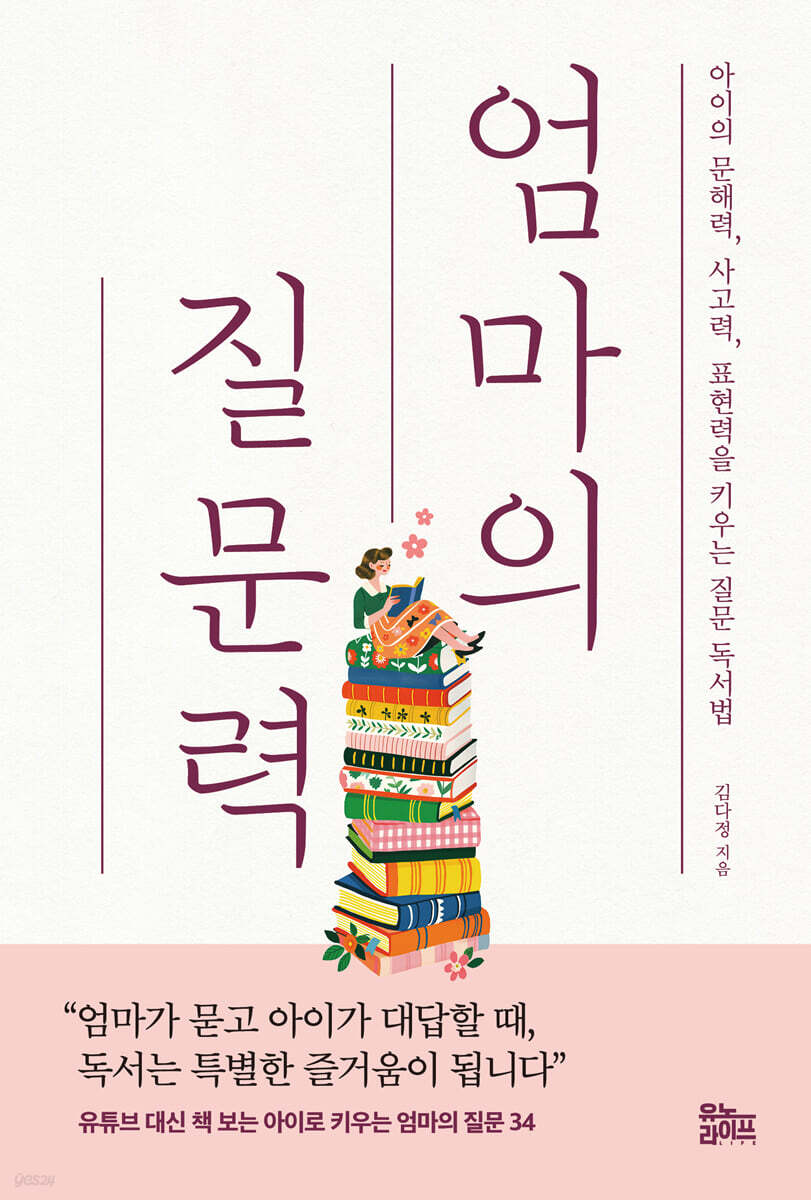
Mom's questioning skills
 |
Description
Book Introduction
“A mother’s ability to ask questions becomes her child’s ability to read!”
An elementary reading instructor tells
10 Minutes a Day: The Question Reading Method That Changes Your Child
As a former journalist, the author knows better than anyone the importance of reading and comprehension skills. He is an elementary reading education expert who has taught thousands of children in Gangnam and Pyeongchon.
This book contains practical methods to develop children's reading skills based on extensive experience and proven know-how accumulated in the field.
We also provide examples of various questions that are good to ask your child in different situations so that even new parents can easily follow along.
The phenomenon of 'declining reading ability' is becoming increasingly evident among children these days.
Even when reading a book, you may not be able to fully understand the content or have difficulty expanding your thoughts based on what you have read.
Especially for children accustomed to short, provocative content like YouTube shorts, they have difficulty calmly reading and absorbing long texts.
Many mothers want to help their children develop the ability to read, understand, think, and express themselves, but they often feel at a loss as to how to actually help.
Eight-year-old Jimin was always complaining that “it’s not fun” whenever he read a book.
Then one day, my mother asked me, “How would the main character feel?” and “What would you have done?”
I listened attentively to Jimin's answer and continued the conversation happily by talking about it together.
From that day on, Jimin began to speak his mind, and his attitude toward books also changed.
In this way, the author emphasizes 'mother's questions' as the best way to develop effective reading habits in children.
For example, you can help a child who has read a book think for himself by asking questions such as, “Why did the main character act that way in this scene?” or “What do you think you would have done?”
As these conversations pile up, the child will naturally recall the contents of the book and freely express his or her own thoughts.
It only takes 10 minutes a day to read and talk with your child.
What's important is not spending a lot of time, but having a warm attitude to listen to your child and share your thoughts.
This book will serve as a valuable link between the thoughts and hearts of mothers and children.
An elementary reading instructor tells
10 Minutes a Day: The Question Reading Method That Changes Your Child
As a former journalist, the author knows better than anyone the importance of reading and comprehension skills. He is an elementary reading education expert who has taught thousands of children in Gangnam and Pyeongchon.
This book contains practical methods to develop children's reading skills based on extensive experience and proven know-how accumulated in the field.
We also provide examples of various questions that are good to ask your child in different situations so that even new parents can easily follow along.
The phenomenon of 'declining reading ability' is becoming increasingly evident among children these days.
Even when reading a book, you may not be able to fully understand the content or have difficulty expanding your thoughts based on what you have read.
Especially for children accustomed to short, provocative content like YouTube shorts, they have difficulty calmly reading and absorbing long texts.
Many mothers want to help their children develop the ability to read, understand, think, and express themselves, but they often feel at a loss as to how to actually help.
Eight-year-old Jimin was always complaining that “it’s not fun” whenever he read a book.
Then one day, my mother asked me, “How would the main character feel?” and “What would you have done?”
I listened attentively to Jimin's answer and continued the conversation happily by talking about it together.
From that day on, Jimin began to speak his mind, and his attitude toward books also changed.
In this way, the author emphasizes 'mother's questions' as the best way to develop effective reading habits in children.
For example, you can help a child who has read a book think for himself by asking questions such as, “Why did the main character act that way in this scene?” or “What do you think you would have done?”
As these conversations pile up, the child will naturally recall the contents of the book and freely express his or her own thoughts.
It only takes 10 minutes a day to read and talk with your child.
What's important is not spending a lot of time, but having a warm attitude to listen to your child and share your thoughts.
This book will serve as a valuable link between the thoughts and hearts of mothers and children.
- You can preview some of the book's contents.
Preview
index
Prologue: A mother's questions shape her child's reading habits.
Chapter 1: When Your Child Sighs After Reading a Book | A Moment When Your Mother's Questioning Ability Is Needed
Mom's Questions That Make Books Fun
“I don’t know where to start.”
Time to ask questions and wait
How to Instill Positive Energy in Your Questions
A miracle that led to the question 'what if'
The inner thoughts of a child who is burdened by questions
Enjoy your child's absurd answers as they are.
Chapter 2: The Child Who Only Asked for the Meaning of Words Has Changed | Mom's One-Word Question Method
The trap of 'this, that, that'
The meaning of 'exclamation' expressed in weather
Putting together a vocabulary puzzle in your child's head
Asking your child questions in your own language
Korean Dictionary, Today's Word: Nutritional Supplement
From 'Sacrifice' to 'Service': Additive Questions
Chapter 3: How to Make a Scene from a Book Remain in Your Child's Heart | Mom's One Scene Question
Memories remain as scenes, not sentences.
The moment you become friends with the characters
The sounds and smells felt in the text
A gloomy mind is gray, a calm mind is green.
'What would I do if I were the main character?'
The story continues even after the book ends.
Chapter 4: The Moment a Mother's Question Becomes a Child's Sentence | How to Ask a Mother's Sentence
Reading method that opens with a question and closes with writing
The beginning of writing is 'one easy line'
Mom is not a grader
Fun questions lead to fun sentences
Ask questions with a different routine every day
The power of quiet but steady work
?
Chapter 5: A Waiting Mom, a Reading Child | How to Develop a Mother's Questioning Ability
Curiosity still exists in the child.
“My mom is a doppelganger.”
Let go of comparison and impatience
Our home reading method that suits your child's pace
Reading Skills for Upper Elementary School Students
A mother's emotions are stored in her child's ears.
Recommended books, not important
There is no such thing as a 'book read by the number one person'.
A time to face your child's true feelings
Epilogue: Give the child a kind word.
reference book
Chapter 1: When Your Child Sighs After Reading a Book | A Moment When Your Mother's Questioning Ability Is Needed
Mom's Questions That Make Books Fun
“I don’t know where to start.”
Time to ask questions and wait
How to Instill Positive Energy in Your Questions
A miracle that led to the question 'what if'
The inner thoughts of a child who is burdened by questions
Enjoy your child's absurd answers as they are.
Chapter 2: The Child Who Only Asked for the Meaning of Words Has Changed | Mom's One-Word Question Method
The trap of 'this, that, that'
The meaning of 'exclamation' expressed in weather
Putting together a vocabulary puzzle in your child's head
Asking your child questions in your own language
Korean Dictionary, Today's Word: Nutritional Supplement
From 'Sacrifice' to 'Service': Additive Questions
Chapter 3: How to Make a Scene from a Book Remain in Your Child's Heart | Mom's One Scene Question
Memories remain as scenes, not sentences.
The moment you become friends with the characters
The sounds and smells felt in the text
A gloomy mind is gray, a calm mind is green.
'What would I do if I were the main character?'
The story continues even after the book ends.
Chapter 4: The Moment a Mother's Question Becomes a Child's Sentence | How to Ask a Mother's Sentence
Reading method that opens with a question and closes with writing
The beginning of writing is 'one easy line'
Mom is not a grader
Fun questions lead to fun sentences
Ask questions with a different routine every day
The power of quiet but steady work
?
Chapter 5: A Waiting Mom, a Reading Child | How to Develop a Mother's Questioning Ability
Curiosity still exists in the child.
“My mom is a doppelganger.”
Let go of comparison and impatience
Our home reading method that suits your child's pace
Reading Skills for Upper Elementary School Students
A mother's emotions are stored in her child's ears.
Recommended books, not important
There is no such thing as a 'book read by the number one person'.
A time to face your child's true feelings
Epilogue: Give the child a kind word.
reference book
Detailed image
Into the book
A mother's questions become the foundation of a child's mind's interpretation of the world.
If you don't understand the meaning behind the words in the book, you won't be able to understand the world.
No matter how many books you read, if you don't know how to enjoy their meaning, the world will just look gray.
--- p.7, from “A mother’s questions determine her child’s reading habits”
If you're unsure what question to ask first, try adding "why" and "how" before your question.
These are questions that cannot be answered with a simple 'yes' or 'no', which is what we mean by 'open questions'.
These questions allow for a wide range of possible answers, giving children the opportunity to organize and express their thoughts independently.
--- p.25, from “I don’t know what to say first”
These days, children are exposed to new words every day not only through books but also through various media such as YouTube and the Internet.
But just seeing a word doesn't mean you immediately understand its meaning.
For example, even if you read the expression 'in a quiet forest' in a book, to a child who has not actually experienced an environment that feels quiet, that is just an unfamiliar combination.
--- p.71, from “The Trap of This, That, and That”
Children understand books more deeply when they are not only able to visualize scenes from the book but also add sounds and smells.
At that moment, the book is no longer a list of information.
It becomes a living, moving sensory experience and a memory that stays in the child's mind for a long time.
--- p.127, from “Sounds and Smells Felt in Writing”
A mother's grading closes off a child's ability to express himself.
The moment the mother's grading begins, the child will think about sentences that are closer to the mother's correct answer rather than expressions that are diverse and expand creativity.
I try to write perfectly correct sentences with correct spelling and expressions, not just the first line I feel like writing.
--- p.169, from “Mom is not a grader”
Even if a mother and child read the same book together, the mother's perspective and the child's perspective are different.
Avoid questions that lead to conclusions like, “What is the moral of this story?”
This question is asked with the understanding that the book must already have a moral.
--- p.205, from “My mother is a fool”
If we stop at just reading a book and finishing it, we lose the positive function of reading that we are aiming for.
We need learning and education that focuses on the process of reading a book and having the child 'reflect' on it on his own several times.
But we're still trying to achieve results-oriented goals that focus more on how many books a child has read, which is difficult for both children and mothers.
--- p.216, from “Reading Methods at Home That Suit Your Child’s Speed”
Reading ability is the power to understand and live in the world in one's own language.
The early elementary years are the time to plant the seeds of that strength.
The power of a child to grow by talking with their parents and teachers rather than worrying alone.
I am confident that this can be the beginning of developing real reading power.
If you don't understand the meaning behind the words in the book, you won't be able to understand the world.
No matter how many books you read, if you don't know how to enjoy their meaning, the world will just look gray.
--- p.7, from “A mother’s questions determine her child’s reading habits”
If you're unsure what question to ask first, try adding "why" and "how" before your question.
These are questions that cannot be answered with a simple 'yes' or 'no', which is what we mean by 'open questions'.
These questions allow for a wide range of possible answers, giving children the opportunity to organize and express their thoughts independently.
--- p.25, from “I don’t know what to say first”
These days, children are exposed to new words every day not only through books but also through various media such as YouTube and the Internet.
But just seeing a word doesn't mean you immediately understand its meaning.
For example, even if you read the expression 'in a quiet forest' in a book, to a child who has not actually experienced an environment that feels quiet, that is just an unfamiliar combination.
--- p.71, from “The Trap of This, That, and That”
Children understand books more deeply when they are not only able to visualize scenes from the book but also add sounds and smells.
At that moment, the book is no longer a list of information.
It becomes a living, moving sensory experience and a memory that stays in the child's mind for a long time.
--- p.127, from “Sounds and Smells Felt in Writing”
A mother's grading closes off a child's ability to express himself.
The moment the mother's grading begins, the child will think about sentences that are closer to the mother's correct answer rather than expressions that are diverse and expand creativity.
I try to write perfectly correct sentences with correct spelling and expressions, not just the first line I feel like writing.
--- p.169, from “Mom is not a grader”
Even if a mother and child read the same book together, the mother's perspective and the child's perspective are different.
Avoid questions that lead to conclusions like, “What is the moral of this story?”
This question is asked with the understanding that the book must already have a moral.
--- p.205, from “My mother is a fool”
If we stop at just reading a book and finishing it, we lose the positive function of reading that we are aiming for.
We need learning and education that focuses on the process of reading a book and having the child 'reflect' on it on his own several times.
But we're still trying to achieve results-oriented goals that focus more on how many books a child has read, which is difficult for both children and mothers.
--- p.216, from “Reading Methods at Home That Suit Your Child’s Speed”
Reading ability is the power to understand and live in the world in one's own language.
The early elementary years are the time to plant the seeds of that strength.
The power of a child to grow by talking with their parents and teachers rather than worrying alone.
I am confident that this can be the beginning of developing real reading power.
--- p.258, from “Please say a kind word to your child”
Publisher's Review
When reading a book with a child, what should I say first?
From the 'what if' question to the 'what's your emotional color today' expression,
The Secret to Raising Children Who Read, Understand, and Think on Their Own
Mothers know that it is important to get their children reading.
This is because reading a book is more than just reading words; it is about developing the ability to read, understand, think, and express oneself.
But, there are many cases where it is unclear 'how' to get children to read books.
When I try to get my child to read a book, but he quickly loses interest, my heart becomes heavy.
This book is a friendly guide that listens to mothers' concerns and turns vague worries into concrete actions.
The author, while teaching reading to children in Gangnam and Pyeongchon, experienced firsthand that reading ability is an important skill that encompasses various abilities such as comprehension, thinking, expression, and writing skills.
So, rather than simply reading a lot of books, I researched how to read even just one book properly, and put all that know-how into this book.
Understand the 'word' correctly
Questions that develop the power of utilization
The author found that children were unable to properly express what they wanted to say in class because they did not know the words.
Also, when reading a book, I often witnessed the flow of reading being interrupted by unfamiliar words.
A lack of vocabulary like this affects not only your reading skills but also your communication skills.
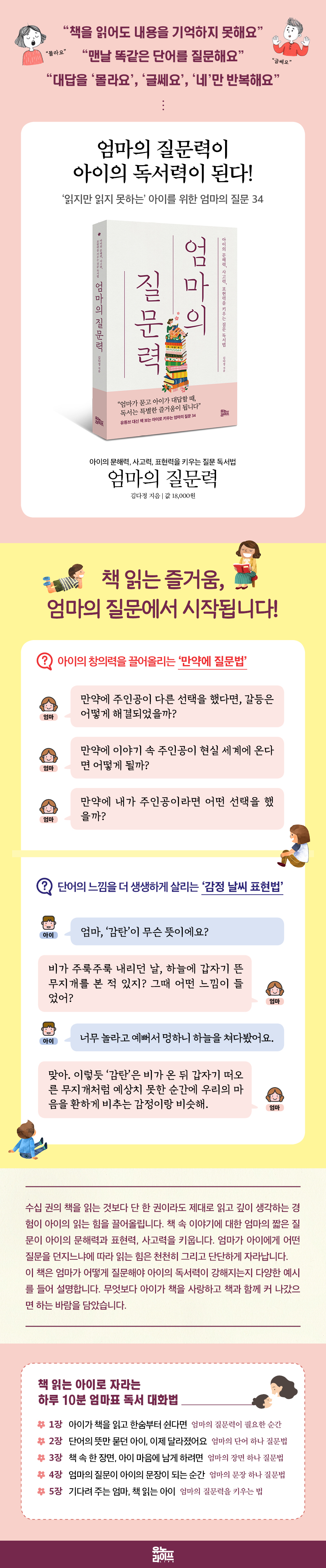
If your child only repeats phrases like “this, that, that,” you should gently ask, “What are you talking about?” to help your child slowly recall the words.
However, when a child cannot find the word, it is effective to repeat the correct word, such as, “Oh, you mean the game of tug-of-war.”
Writing as a 'scene'
Questions to help you remember
The author suggests that we remember the scenes in the book vividly as if we were traveling.
Most writing tends to fade over time, but specific and vivid scenes remain in the mind for a long time.
For example, the sentence “The child was sad” is easily forgotten, but the specific scene “The child was in a dark room with his head down” remains in the memory for a long time.
To make reading a special experience for your child, stimulate their imagination by asking them a variety of questions.
Specific and vivid questions like, “Which character in the book would you like to be friends with?”, “What would it smell like when you enter that scene?”, or “What would you hear?” deepen a child’s memories and thoughts.
Write a 'sentence'
Leading questions
If children practice 'writing one line' after reading a book, their ability to summarize will be developed.
You can start with short, simple sentences like, “The main character looks amazing” or “I need to be brave too.”
To avoid overwhelming your child, start by asking questions about sentences found in the book, such as, “What sentence stood out to you most as you read?”
Next, you can gradually increase the difficulty of the questions, such as, “Was there a moment when your mood changed while reading?” or “What is a sentence you would like to introduce to a friend?”
If a child writes even one line, you must give him a positive response.
As children gain confidence, they gradually begin to express their thoughts freely and without fear.
You will feel less reluctant to write and feel the joy of freely writing down your thoughts.
Conversations with children are always unpredictable, awkward, and sometimes off-track.
But what's important is the time you spend looking at your child with affection and waiting after asking them a question.
A child's reading ability develops more deeply in conversations that do not only demand correct answers, but also in an attitude that warmly embraces even incorrect information.
From the 'what if' question to the 'what's your emotional color today' expression,
The Secret to Raising Children Who Read, Understand, and Think on Their Own
Mothers know that it is important to get their children reading.
This is because reading a book is more than just reading words; it is about developing the ability to read, understand, think, and express oneself.
But, there are many cases where it is unclear 'how' to get children to read books.
When I try to get my child to read a book, but he quickly loses interest, my heart becomes heavy.
This book is a friendly guide that listens to mothers' concerns and turns vague worries into concrete actions.
The author, while teaching reading to children in Gangnam and Pyeongchon, experienced firsthand that reading ability is an important skill that encompasses various abilities such as comprehension, thinking, expression, and writing skills.
So, rather than simply reading a lot of books, I researched how to read even just one book properly, and put all that know-how into this book.
Understand the 'word' correctly
Questions that develop the power of utilization
The author found that children were unable to properly express what they wanted to say in class because they did not know the words.
Also, when reading a book, I often witnessed the flow of reading being interrupted by unfamiliar words.
A lack of vocabulary like this affects not only your reading skills but also your communication skills.
If your child only repeats phrases like “this, that, that,” you should gently ask, “What are you talking about?” to help your child slowly recall the words.
However, when a child cannot find the word, it is effective to repeat the correct word, such as, “Oh, you mean the game of tug-of-war.”
Writing as a 'scene'
Questions to help you remember
The author suggests that we remember the scenes in the book vividly as if we were traveling.
Most writing tends to fade over time, but specific and vivid scenes remain in the mind for a long time.
For example, the sentence “The child was sad” is easily forgotten, but the specific scene “The child was in a dark room with his head down” remains in the memory for a long time.
To make reading a special experience for your child, stimulate their imagination by asking them a variety of questions.
Specific and vivid questions like, “Which character in the book would you like to be friends with?”, “What would it smell like when you enter that scene?”, or “What would you hear?” deepen a child’s memories and thoughts.
Write a 'sentence'
Leading questions
If children practice 'writing one line' after reading a book, their ability to summarize will be developed.
You can start with short, simple sentences like, “The main character looks amazing” or “I need to be brave too.”
To avoid overwhelming your child, start by asking questions about sentences found in the book, such as, “What sentence stood out to you most as you read?”
Next, you can gradually increase the difficulty of the questions, such as, “Was there a moment when your mood changed while reading?” or “What is a sentence you would like to introduce to a friend?”
If a child writes even one line, you must give him a positive response.
As children gain confidence, they gradually begin to express their thoughts freely and without fear.
You will feel less reluctant to write and feel the joy of freely writing down your thoughts.
Conversations with children are always unpredictable, awkward, and sometimes off-track.
But what's important is the time you spend looking at your child with affection and waiting after asking them a question.
A child's reading ability develops more deeply in conversations that do not only demand correct answers, but also in an attitude that warmly embraces even incorrect information.
GOODS SPECIFICS
- Date of issue: August 5, 2025
- Page count, weight, size: 260 pages | 358g | 142*210*17mm
- ISBN13: 9791194357209
- ISBN10: 1194357202
You may also like
카테고리
korean


korean

![GQ KOREA Mark (Monthly): December [2025]](http://librairie.coreenne.fr/cdn/shop/files/8ef265dbbfbf186523ed75ba7319009d.jpg?v=1765340328&width=3840)


