

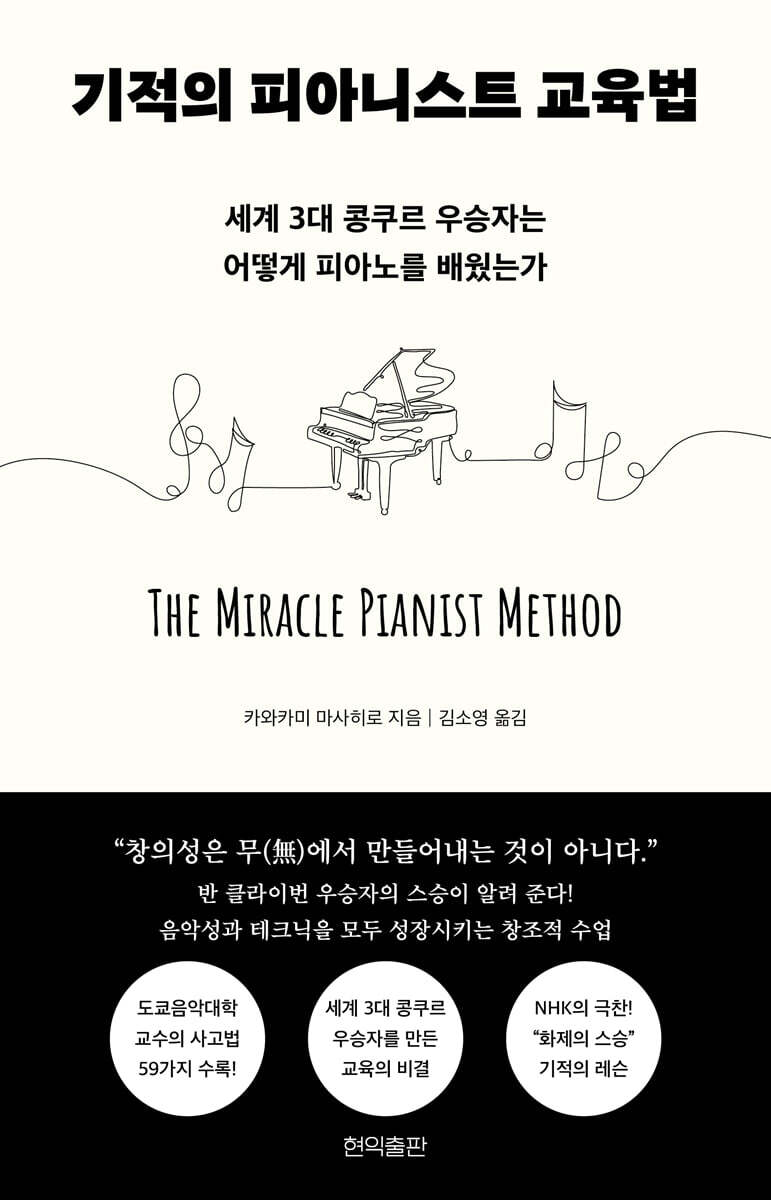
Miracle Pianist Training Method
 |
Description
Book Introduction
The music education method that created the winners of the world's top three competitions is revealed!
NHK documentary The Pianist in the spotlight.
The know-how of a veteran music professor!
Creative learning methods that improve skills, interpretation, and expression.
The ultimate guide to nurturing talent, as told by the leading experts in Kapustin and Medtner music!
'How should I guide students?'
'What kind of mindset is needed to continue studying music?'
How can we bring out students' talents and lead them to success?
Lim Yoon-chan and Tsujii Nobuyuki.
In recent international competitions, the two pianists have demonstrated the depth of their music in different ways.
One moves the audience's emotions with his wondrous interpretive power, the other with his delicate expressiveness.
But they have something in common.
From a young age, he has built up his skills based on his outstanding absorption and interpretation skills, and behind this, there was the strategic teaching method of a good teacher who thought deeply about 'how to teach'.
"The Miracle Pianist's Teaching Method" is a book that compiles the actual teaching methods of Masahiro Kawakami, who taught Nobuyuki Tsujii, the winner of the 13th Van Cliburn International Piano Competition, for 12 years from the age of 6.
Nobuyuki's creativity and autonomy, which enabled him to win the most prestigious piano competition in the United States, beating out 29 competitors who had passed the preliminary rounds in six cities around the world, were the result of a good education.
The author, Masahiro Kawakami, who taught Nobuyuki, graduated at the top of his class from the Vienna University of Music and Performing Arts, and is a pianist and professor who has trained numerous performers and teachers while traveling between Europe and Japan.
The author, who has practiced a new teaching method that shifts away from technique-centered or rote learning and places a focus on musical autonomy and expressiveness, presents this book as a way to stimulate thinking and enable students to interpret and express music on their own.
NHK documentary The Pianist in the spotlight.
The know-how of a veteran music professor!
Creative learning methods that improve skills, interpretation, and expression.
The ultimate guide to nurturing talent, as told by the leading experts in Kapustin and Medtner music!
'How should I guide students?'
'What kind of mindset is needed to continue studying music?'
How can we bring out students' talents and lead them to success?
Lim Yoon-chan and Tsujii Nobuyuki.
In recent international competitions, the two pianists have demonstrated the depth of their music in different ways.
One moves the audience's emotions with his wondrous interpretive power, the other with his delicate expressiveness.
But they have something in common.
From a young age, he has built up his skills based on his outstanding absorption and interpretation skills, and behind this, there was the strategic teaching method of a good teacher who thought deeply about 'how to teach'.
"The Miracle Pianist's Teaching Method" is a book that compiles the actual teaching methods of Masahiro Kawakami, who taught Nobuyuki Tsujii, the winner of the 13th Van Cliburn International Piano Competition, for 12 years from the age of 6.
Nobuyuki's creativity and autonomy, which enabled him to win the most prestigious piano competition in the United States, beating out 29 competitors who had passed the preliminary rounds in six cities around the world, were the result of a good education.
The author, Masahiro Kawakami, who taught Nobuyuki, graduated at the top of his class from the Vienna University of Music and Performing Arts, and is a pianist and professor who has trained numerous performers and teachers while traveling between Europe and Japan.
The author, who has practiced a new teaching method that shifts away from technique-centered or rote learning and places a focus on musical autonomy and expressiveness, presents this book as a way to stimulate thinking and enable students to interpret and express music on their own.
- You can preview some of the book's contents.
Preview
index
Introduction: The Increasing Importance of Autonomy and Creativity
Entering
Chapter 1: 10 Tips for Becoming a Musician
east longitude
learning
Consistency
comparison
quest
exploitation
job
creation
flapping wings
growth
Chapter 2: Developing Your Piano Talent
Why Nobuyuki succeeded
Sheet music is just data
Mother's action
Creating opportunities on the main stage
Practice while having fun
Gain experience in improvisation
An attitude of not sparing praise
Professional consciousness that made a live performance a success in one go
Are Hanon and Czerny really necessary?
Everyone has a different way of expressing themselves.
Chapter 3: Education to Enhance Music Interpretation Skills
How to determine a child's abilities?
How should I choose a textbook?
The Role of a Piano Teacher ① Raising Professionalism
The Role of a Piano Teacher ② As a Good Coach
When drawing a map, do not color it.
Grab the stem, not the branches and leaves.
Study the composer's background
Helps you select good information
Growing joy
Establishing Originality as a Leader
Chapter 4: Learning Abroad
Enjoy!
Western way of thinking
When the sound changes, the ears change too.
Articulation and rhythm of language
Let's loosen up in a good way
A sense of tempo reflected in the performance
The importance of comfort and leisure
The importance of communication
Establish a universal language
Enjoy the crisis
Chapter 5: Life as a Pianist
Educational and performance activities
Planning Efficiently
Increase your practical experience
Have professional pride
How do I secure practice time?
Balance between input and output
What you gain from standing in front of people
Become an expert
What should I study in piano department?
Chapter 6: Opening Up Infinite Possibilities
Work is what you make it
Be proactive in whatever you do
Action that leads to change
Creativity doesn't start from zero.
Something only you can do
Expertise and Complexity
How to overcome limitations
Goal Note to Make Your Dreams Come True
Don't lose your sensitivity
The moment the bowl grows bigger
In conclusion
Entering
Chapter 1: 10 Tips for Becoming a Musician
east longitude
learning
Consistency
comparison
quest
exploitation
job
creation
flapping wings
growth
Chapter 2: Developing Your Piano Talent
Why Nobuyuki succeeded
Sheet music is just data
Mother's action
Creating opportunities on the main stage
Practice while having fun
Gain experience in improvisation
An attitude of not sparing praise
Professional consciousness that made a live performance a success in one go
Are Hanon and Czerny really necessary?
Everyone has a different way of expressing themselves.
Chapter 3: Education to Enhance Music Interpretation Skills
How to determine a child's abilities?
How should I choose a textbook?
The Role of a Piano Teacher ① Raising Professionalism
The Role of a Piano Teacher ② As a Good Coach
When drawing a map, do not color it.
Grab the stem, not the branches and leaves.
Study the composer's background
Helps you select good information
Growing joy
Establishing Originality as a Leader
Chapter 4: Learning Abroad
Enjoy!
Western way of thinking
When the sound changes, the ears change too.
Articulation and rhythm of language
Let's loosen up in a good way
A sense of tempo reflected in the performance
The importance of comfort and leisure
The importance of communication
Establish a universal language
Enjoy the crisis
Chapter 5: Life as a Pianist
Educational and performance activities
Planning Efficiently
Increase your practical experience
Have professional pride
How do I secure practice time?
Balance between input and output
What you gain from standing in front of people
Become an expert
What should I study in piano department?
Chapter 6: Opening Up Infinite Possibilities
Work is what you make it
Be proactive in whatever you do
Action that leads to change
Creativity doesn't start from zero.
Something only you can do
Expertise and Complexity
How to overcome limitations
Goal Note to Make Your Dreams Come True
Don't lose your sensitivity
The moment the bowl grows bigger
In conclusion
Detailed image

Into the book
There are various methods for improving piano skills, but there is no one-size-fits-all way to play the piano.
Nowadays, access to information has become easier, making self-study possible without difficulty, and things that were vaguely difficult in the past can now be attempted with ease.
Just by searching the Internet, you can access a lot of content, and many people choose to learn and master only the parts that are relevant to them.
---From "Independence and Creativity"
First, I thought about how to teach Nobuyuki what was written in the music score.
The first method that came to mind was to play the notes at a certain tempo, record them, and then play them back.
But soon I realized.
The fact that simply converting the notes written on the sheet music into sounds cannot convey the information contained therein with 100% accuracy.
Sheet music is full of complex and rich information.
---From "Musical scores are just data."
It was a sound I had never heard before in a Japanese music hall.
Was it because it was a stone building? Or was it the air and humidity? What was most surprising was that for the first time, I was able to seriously focus on my own voice.
In European halls, the sound resonates relatively long wherever you go, and in particularly good halls, the sound spreads out even more magnificently.
Because I only played in Japan, I had developed ears that couldn't hear the reverberation.
---From "When the sound changes, the ears also change"
Creativity is not the exclusive domain of inventors.
Any task requires creativity, and the joy gained through creation is great.
Humans are creatures who instinctively want to create something.
But creating something out of nothing is never easy.
The same goes for writing songs.
It's not something that everyone can do.
It must be based on sufficient knowledge and experience.
Nowadays, access to information has become easier, making self-study possible without difficulty, and things that were vaguely difficult in the past can now be attempted with ease.
Just by searching the Internet, you can access a lot of content, and many people choose to learn and master only the parts that are relevant to them.
---From "Independence and Creativity"
First, I thought about how to teach Nobuyuki what was written in the music score.
The first method that came to mind was to play the notes at a certain tempo, record them, and then play them back.
But soon I realized.
The fact that simply converting the notes written on the sheet music into sounds cannot convey the information contained therein with 100% accuracy.
Sheet music is full of complex and rich information.
---From "Musical scores are just data."
It was a sound I had never heard before in a Japanese music hall.
Was it because it was a stone building? Or was it the air and humidity? What was most surprising was that for the first time, I was able to seriously focus on my own voice.
In European halls, the sound resonates relatively long wherever you go, and in particularly good halls, the sound spreads out even more magnificently.
Because I only played in Japan, I had developed ears that couldn't hear the reverberation.
---From "When the sound changes, the ears also change"
Creativity is not the exclusive domain of inventors.
Any task requires creativity, and the joy gained through creation is great.
Humans are creatures who instinctively want to create something.
But creating something out of nothing is never easy.
The same goes for writing songs.
It's not something that everyone can do.
It must be based on sufficient knowledge and experience.
---From "Creativity doesn't start from zero."
Publisher's Review
The world-renowned performance skills have their roots in thought and expression.
The secret to expressive training that produced Van Cliburn winners!
Even in an age overflowing with technology and content, good performances still hinge on 'feeling' and 'expression.'
How will the song make you feel?
How to express the emotions you want to express.
Few books clearly answer this question.
"The Miracle Pianist Education Method" is a practical guide that presents specific methods for developing piano talent.
Author Masahiro Kawakami is a leading authority on Medtner and a piano professor at Tokyo University of Music to whom composer Nikolai Kapustin dedicated a piece. He has practiced a teaching method that allows students to 'discover and interpret music for themselves' rather than giving them the right answers.
His training method, which allows students to digest and compose music on their own, goes beyond simply improving their skills and empowers them to become independent musicians.
This book will fill the gaps left by existing textbooks and lesson methods, including observation techniques that don't miss a child's reactions, questions that elicit interpretive and expressive powers, techniques that expand the performer's thinking, and sensory training that breathes life into each note.
"The Miracle Pianist's Teaching Method" covers the teaching method that discovered and nurtured the talent of Nobuyuki Tsujii, a genius known for his "miraculous tone" at the 13th Van Cliburn International Piano Competition, and the story behind its creation.
Beyond a simple music guide, this book revives the teacher's sense for accurately reading students' potential and knowing when and how to provide a stepping stone for growth.
Drawing on the author's extensive experience as a pianist and educator, this book offers know-how applicable to all musical fields, including methods for effectively acquiring a sense of tempo and verbal rhythm.
Teachers who want to help music-loving children develop into accomplished performers will surely find clues in this book, including how to develop improvisational skills in live performances, strategies for building recognition, and interpretations and attitudes that are difficult to obtain from sheet music alone.
From piano teaching methods for each age group to learning how to listen, interpret, and resonate with music!
A performance mindset that both piano teachers and students should learn
"The Miracle Pianist's Teaching Method" reveals the author's special teaching method, which he has been using since childhood, to educate Nobuyuki Tsujii, a pianist born with congenital visual impairment who won first place in the Japan Blind Students' Competition at the age of 7, the youngest-ever Critics' Award winner at the International Chopin Competition at 17, and finally first place in the Van Cliburn Competition.
The author, who taught him for 12 years from the age of 6, explains step-by-step everything from the musical play method that establishes musical concepts and fosters creative sensibility, to how to use beginner-level textbooks, to interpretation guidance that helps understand musical pieces, to the role of the teacher in guiding children to digest difficult pieces.
It is not simply a case study tailored to Nobuyuki's characteristics, but is characterized by being developed as an educational strategy applicable to a variety of students.
This book, based on the author's experience as a veteran pianist and educator with 20 years of experience, introduces a teaching method that gradually develops the potential within a performer.
In particular, it provides detailed guidance on coping strategies when students fall into a slump or their growth stagnates, the balance of input and output that immediately connects what they have learned to performance, a complex thinking structure that goes beyond simple technique and integrates emotion, interpretation, and expression, and a step-by-step growth guide accordingly.
The role of a piano teacher is explained in terms of technical and mental aspects, and the method of establishing originality, mindset, and specific teaching methods to become an ideal leader are provided.
Although the methods of education have diversified, the essence of music education has not changed.
This book presents an educational direction that adapts to the changing times while maintaining a true sense of essence. It will help teachers regain a sense of accomplishment, a positive attitude, and sustainable job motivation.
A piano teacher's thought tool that will bring out your creativity and independence!
The most practical and systematic principles of piano teaching
'It's like an angel dancing on the piano keys.'
'A place where I always find comfort and courage.'
Musicians who demonstrated outstanding creativity, such as Bach, Beethoven, Mozart, and Vladimir Horowitz, all engaged in arranging or composing, regardless of the instrument they primarily played.
This comes from having the ‘autonomy’ to explore and interpret music on one’s own.
So how can such autonomy be fostered? "The Miracle Pianist's Teaching Method" presents a step-by-step overview of the thought processes and conceptualizations employed by world-renowned pianists, introducing a teaching method that fosters creative piano playing.
While discussing how some of the most prodigies in music learned and thought, Nobuyuki concretely unfolds his own philosophy that reflects his individuality.
The author says that it is difficult to express everything about music using only the information contained in the score.
It logically and practically explains how to listen to the resonance of sound, how to give appropriate advice, and how to understand the structure and background of a song. It also provides methods to stimulate imagination and creativity, and vivid examples from the educational field.
This book introduces teaching methods that help students develop solid skills that will not easily crumble, based on my experience teaching first-class pianists and giving over 100 public lectures throughout Japan since 2005.
The author meticulously organizes the artistry of the piano, the mindset for teaching technique, and even the lifestyle of a pianist.
Above all, this book is based on a "self-directed music learning method" in which students absorb and internalize music on their own, and provides profound insight to piano teachers concerned about growth.
In addition, you can acquire know-how on piano education for gifted pianists by covering guidelines for discovering the talents of genius pianists and developing those talents in detail.
This book will serve as a valuable guide for music teachers who wish to advance to a higher level.
The secret to expressive training that produced Van Cliburn winners!
Even in an age overflowing with technology and content, good performances still hinge on 'feeling' and 'expression.'
How will the song make you feel?
How to express the emotions you want to express.
Few books clearly answer this question.
"The Miracle Pianist Education Method" is a practical guide that presents specific methods for developing piano talent.
Author Masahiro Kawakami is a leading authority on Medtner and a piano professor at Tokyo University of Music to whom composer Nikolai Kapustin dedicated a piece. He has practiced a teaching method that allows students to 'discover and interpret music for themselves' rather than giving them the right answers.
His training method, which allows students to digest and compose music on their own, goes beyond simply improving their skills and empowers them to become independent musicians.
This book will fill the gaps left by existing textbooks and lesson methods, including observation techniques that don't miss a child's reactions, questions that elicit interpretive and expressive powers, techniques that expand the performer's thinking, and sensory training that breathes life into each note.
"The Miracle Pianist's Teaching Method" covers the teaching method that discovered and nurtured the talent of Nobuyuki Tsujii, a genius known for his "miraculous tone" at the 13th Van Cliburn International Piano Competition, and the story behind its creation.
Beyond a simple music guide, this book revives the teacher's sense for accurately reading students' potential and knowing when and how to provide a stepping stone for growth.
Drawing on the author's extensive experience as a pianist and educator, this book offers know-how applicable to all musical fields, including methods for effectively acquiring a sense of tempo and verbal rhythm.
Teachers who want to help music-loving children develop into accomplished performers will surely find clues in this book, including how to develop improvisational skills in live performances, strategies for building recognition, and interpretations and attitudes that are difficult to obtain from sheet music alone.
From piano teaching methods for each age group to learning how to listen, interpret, and resonate with music!
A performance mindset that both piano teachers and students should learn
"The Miracle Pianist's Teaching Method" reveals the author's special teaching method, which he has been using since childhood, to educate Nobuyuki Tsujii, a pianist born with congenital visual impairment who won first place in the Japan Blind Students' Competition at the age of 7, the youngest-ever Critics' Award winner at the International Chopin Competition at 17, and finally first place in the Van Cliburn Competition.
The author, who taught him for 12 years from the age of 6, explains step-by-step everything from the musical play method that establishes musical concepts and fosters creative sensibility, to how to use beginner-level textbooks, to interpretation guidance that helps understand musical pieces, to the role of the teacher in guiding children to digest difficult pieces.
It is not simply a case study tailored to Nobuyuki's characteristics, but is characterized by being developed as an educational strategy applicable to a variety of students.
This book, based on the author's experience as a veteran pianist and educator with 20 years of experience, introduces a teaching method that gradually develops the potential within a performer.
In particular, it provides detailed guidance on coping strategies when students fall into a slump or their growth stagnates, the balance of input and output that immediately connects what they have learned to performance, a complex thinking structure that goes beyond simple technique and integrates emotion, interpretation, and expression, and a step-by-step growth guide accordingly.
The role of a piano teacher is explained in terms of technical and mental aspects, and the method of establishing originality, mindset, and specific teaching methods to become an ideal leader are provided.
Although the methods of education have diversified, the essence of music education has not changed.
This book presents an educational direction that adapts to the changing times while maintaining a true sense of essence. It will help teachers regain a sense of accomplishment, a positive attitude, and sustainable job motivation.
A piano teacher's thought tool that will bring out your creativity and independence!
The most practical and systematic principles of piano teaching
'It's like an angel dancing on the piano keys.'
'A place where I always find comfort and courage.'
Musicians who demonstrated outstanding creativity, such as Bach, Beethoven, Mozart, and Vladimir Horowitz, all engaged in arranging or composing, regardless of the instrument they primarily played.
This comes from having the ‘autonomy’ to explore and interpret music on one’s own.
So how can such autonomy be fostered? "The Miracle Pianist's Teaching Method" presents a step-by-step overview of the thought processes and conceptualizations employed by world-renowned pianists, introducing a teaching method that fosters creative piano playing.
While discussing how some of the most prodigies in music learned and thought, Nobuyuki concretely unfolds his own philosophy that reflects his individuality.
The author says that it is difficult to express everything about music using only the information contained in the score.
It logically and practically explains how to listen to the resonance of sound, how to give appropriate advice, and how to understand the structure and background of a song. It also provides methods to stimulate imagination and creativity, and vivid examples from the educational field.
This book introduces teaching methods that help students develop solid skills that will not easily crumble, based on my experience teaching first-class pianists and giving over 100 public lectures throughout Japan since 2005.
The author meticulously organizes the artistry of the piano, the mindset for teaching technique, and even the lifestyle of a pianist.
Above all, this book is based on a "self-directed music learning method" in which students absorb and internalize music on their own, and provides profound insight to piano teachers concerned about growth.
In addition, you can acquire know-how on piano education for gifted pianists by covering guidelines for discovering the talents of genius pianists and developing those talents in detail.
This book will serve as a valuable guide for music teachers who wish to advance to a higher level.
GOODS SPECIFICS
- Date of issue: July 29, 2025
- Page count, weight, size: 236 pages | 135*210*20mm
- ISBN13: 9791192143965
- ISBN10: 1192143965
You may also like
카테고리
korean


korean

![GQ KOREA Mark (Monthly): December [2025]](http://librairie.coreenne.fr/cdn/shop/files/8ef265dbbfbf186523ed75ba7319009d.jpg?v=1765340328&width=3840)


