

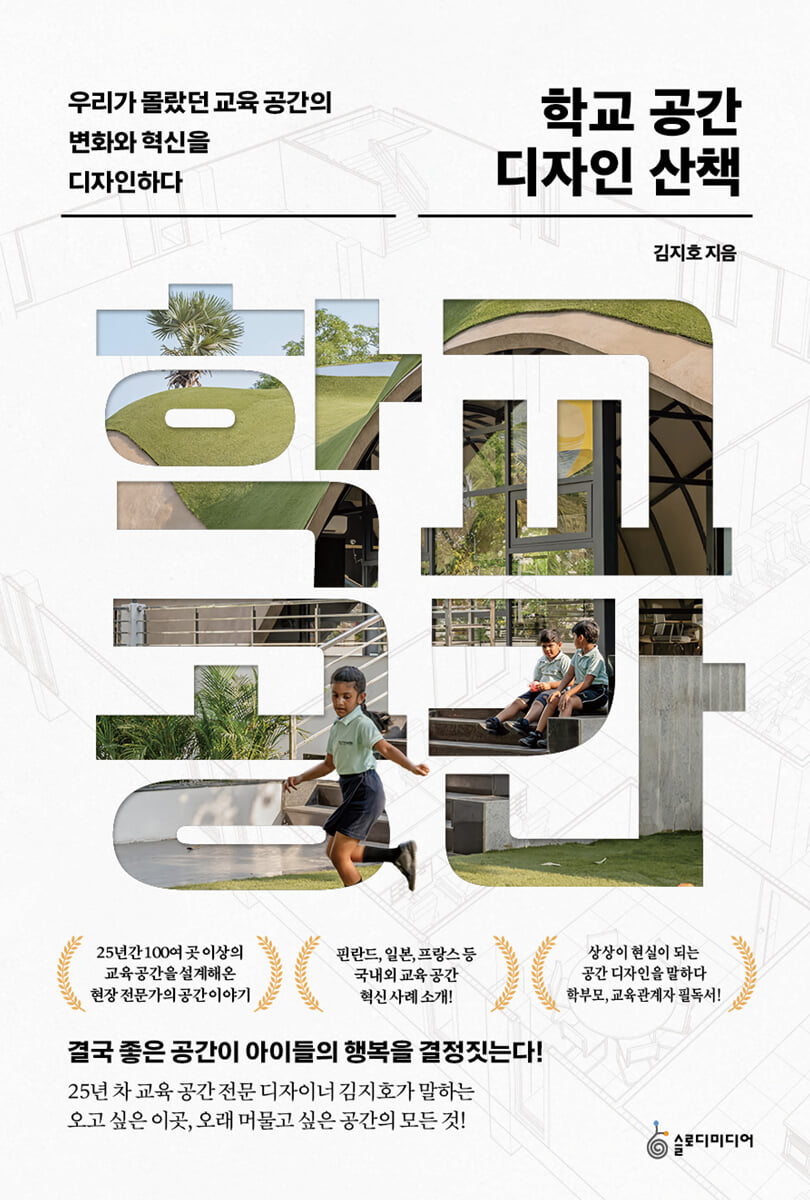
School Space Design Walk
 |
Description
Book Introduction
*** A space story from a field expert who has designed over 100 educational spaces over the past 25 years.
*** Introducing domestic and international examples of educational space innovation, including from Finland, Japan, and France!
*** A must-read for parents and educators!
From playgrounds to classrooms, every space becomes an educational space.
Everything about this place you want to come to, this space you want to stay in for a long time!
Designing a School Where Children Want to Stay
This book focuses on "educational space," one of the fundamental issues in our education system, from the perspective of a field expert who has designed over 100 educational spaces over the past 25 years.
It specifically presents how standardized school architecture stifles children's creativity and diversity, and how this can be transformed.
Chapter 1, "Schools in Korea," explores the history of the birth of schools and the development of standardized school spaces, and proposes a vision for future schools that effectively support students' academic achievement and character development.
Chapter 2, "Creating a Sensory-Inspired Educational Space," explores the impact of the school's physical environment—from basic sensory elements like air, temperature, light, and sound to hallways, doors, libraries, and restrooms—on children's emotions and learning. It also explores the potential of our own educational spaces, enriched with examples of spatial innovation from overseas.
Chapter 3, "Transcending the Boundaries of Educational Space," explores how educational space co-evolves with the curriculum and educational philosophy, and discusses designing educational spaces that fit the realities of our country.
I hope this book isn't just a guide to improving educational spaces; it's a suggestion for our children's future, and the beginning of small changes toward a better world.
*** Introducing domestic and international examples of educational space innovation, including from Finland, Japan, and France!
*** A must-read for parents and educators!
From playgrounds to classrooms, every space becomes an educational space.
Everything about this place you want to come to, this space you want to stay in for a long time!
Designing a School Where Children Want to Stay
This book focuses on "educational space," one of the fundamental issues in our education system, from the perspective of a field expert who has designed over 100 educational spaces over the past 25 years.
It specifically presents how standardized school architecture stifles children's creativity and diversity, and how this can be transformed.
Chapter 1, "Schools in Korea," explores the history of the birth of schools and the development of standardized school spaces, and proposes a vision for future schools that effectively support students' academic achievement and character development.
Chapter 2, "Creating a Sensory-Inspired Educational Space," explores the impact of the school's physical environment—from basic sensory elements like air, temperature, light, and sound to hallways, doors, libraries, and restrooms—on children's emotions and learning. It also explores the potential of our own educational spaces, enriched with examples of spatial innovation from overseas.
Chapter 3, "Transcending the Boundaries of Educational Space," explores how educational space co-evolves with the curriculum and educational philosophy, and discusses designing educational spaces that fit the realities of our country.
I hope this book isn't just a guide to improving educational spaces; it's a suggestion for our children's future, and the beginning of small changes toward a better world.
- You can preview some of the book's contents.
Preview
index
04 · Prologue: Better than Home, Creating a School Better than Home
Chapter 1 Schools in Korea
1.
Time travel into the educational space
13 · The Origin and Meaning of School Structure
14 · Michel Foucault's Surveillance Function
16 · Standard design drawings derived from Japanese barracks
17 · How was school routine created?
19 · Why are schools the same?
20 · A spatial journey from the Japanese colonial period to the future school
2.
School teaches
26 · Apartments and Schools: Lack of Relationships and Space
29 · Who builds schools?
31 · Problems with school construction
33 · The Third Space
37 · The educational environment in Northern Europe
39 · Why are wall-less classrooms important?
40 · The school building teaches
Chapter 2: Creating a Sensory-Inspired Educational Space
1.
Creating a Happy School
44 · Air and Temperature
49 · Light and Sound
61 · An educational space that blurs the lines between play and learning.
67 · Hallways and doors
77 · Doors and door frames
83 · A Library that Awakens Values
96 · The bathroom, where innovation begins
2.
Breaking the mold: Educational spaces for flexibility and diversity
103 · Fuji Kindergarten, Japan: A Donut-Shaped Open World
108 · Bloomingdale Cocoon Preschool in India: A Curved Space for Dancing
115 · Seoul German School: Renovating an Educational Space that Breaks Down Boundaries
122 · Seoul Samkwang Elementary School: User-Centered Space Design
128 · Breaking out of the mold
3.
A classroom where you can learn about nature
139 · Korea Ceramic High School: Rooftop Garden Project
142 · Vietnam Farm Kindergarten: An Ecological Alternative in an Era of Rapid Industrialization
150 · Raymond Kindergarten, Japan: A Children's World Filled with Light
154 · Japan KN Kindergarten: A Learning Space in Harmony with Nature
158 · An educational space steeped in nature and culture
4.
Designing the Classroom of the Future
162 · School Change, Slowly but Boldly
163 · Sweden's Vitra Telefonplan School: A Space Experiment for Personalized Classes
171 · The Rise and Fall of Alt Schools: Silicon Valley's IT Education Experiment
5.
Small actions to protect the Earth
176 Seoul Airport High School: Evolving into an Eco-Friendly Educational Space
181 · Boulogne-Biancrou Elementary School in France: A Learning Space that Respects the Community and the Environment
182 · Aalto University, Finland: A space that practices active eco-friendliness and regional connection.
6.
Children need a village
185 · The Need for School Complexation
190 · Policy to revitalize domestic school complex facilities
192 · School Complex Models Around the World
194 · The Future of School Complexes
Chapter 3: Transcending the Boundaries of Educational Spaces
1.
Global Trends and Korean Transformations in Educational Spaces
198 · Successful Education and Educational Spaces in Finland
201 · Education Innovation Spaces in Each Country
203 · Korean Transformation Beyond Constraints
205 · Co-evolution of Educational Space and Curriculum
208 · Curriculum Analysis for Educational Space Design
2.
The Real Challenge of Educational Innovation: The Gap Between Public and Private Education
212 · Why Private Education Institutions Need Spatial Innovation
213 · Successful Cases of Innovation in Private Education Spaces
3.
How Classrooms Differ Around the World
216 · Korea: How many classrooms will there be?
217 · Finland: Every window should face the forest.
218 · Denmark: Imagine a school without classrooms.
219 · Japan: School to Village, Village to School
220 · Singapore: A Laboratory for the Future
221 · Proposals for Improving Regulation of Educational Spaces in Korea
222 · Beyond Regulation to Culture
224 · References
Chapter 1 Schools in Korea
1.
Time travel into the educational space
13 · The Origin and Meaning of School Structure
14 · Michel Foucault's Surveillance Function
16 · Standard design drawings derived from Japanese barracks
17 · How was school routine created?
19 · Why are schools the same?
20 · A spatial journey from the Japanese colonial period to the future school
2.
School teaches
26 · Apartments and Schools: Lack of Relationships and Space
29 · Who builds schools?
31 · Problems with school construction
33 · The Third Space
37 · The educational environment in Northern Europe
39 · Why are wall-less classrooms important?
40 · The school building teaches
Chapter 2: Creating a Sensory-Inspired Educational Space
1.
Creating a Happy School
44 · Air and Temperature
49 · Light and Sound
61 · An educational space that blurs the lines between play and learning.
67 · Hallways and doors
77 · Doors and door frames
83 · A Library that Awakens Values
96 · The bathroom, where innovation begins
2.
Breaking the mold: Educational spaces for flexibility and diversity
103 · Fuji Kindergarten, Japan: A Donut-Shaped Open World
108 · Bloomingdale Cocoon Preschool in India: A Curved Space for Dancing
115 · Seoul German School: Renovating an Educational Space that Breaks Down Boundaries
122 · Seoul Samkwang Elementary School: User-Centered Space Design
128 · Breaking out of the mold
3.
A classroom where you can learn about nature
139 · Korea Ceramic High School: Rooftop Garden Project
142 · Vietnam Farm Kindergarten: An Ecological Alternative in an Era of Rapid Industrialization
150 · Raymond Kindergarten, Japan: A Children's World Filled with Light
154 · Japan KN Kindergarten: A Learning Space in Harmony with Nature
158 · An educational space steeped in nature and culture
4.
Designing the Classroom of the Future
162 · School Change, Slowly but Boldly
163 · Sweden's Vitra Telefonplan School: A Space Experiment for Personalized Classes
171 · The Rise and Fall of Alt Schools: Silicon Valley's IT Education Experiment
5.
Small actions to protect the Earth
176 Seoul Airport High School: Evolving into an Eco-Friendly Educational Space
181 · Boulogne-Biancrou Elementary School in France: A Learning Space that Respects the Community and the Environment
182 · Aalto University, Finland: A space that practices active eco-friendliness and regional connection.
6.
Children need a village
185 · The Need for School Complexation
190 · Policy to revitalize domestic school complex facilities
192 · School Complex Models Around the World
194 · The Future of School Complexes
Chapter 3: Transcending the Boundaries of Educational Spaces
1.
Global Trends and Korean Transformations in Educational Spaces
198 · Successful Education and Educational Spaces in Finland
201 · Education Innovation Spaces in Each Country
203 · Korean Transformation Beyond Constraints
205 · Co-evolution of Educational Space and Curriculum
208 · Curriculum Analysis for Educational Space Design
2.
The Real Challenge of Educational Innovation: The Gap Between Public and Private Education
212 · Why Private Education Institutions Need Spatial Innovation
213 · Successful Cases of Innovation in Private Education Spaces
3.
How Classrooms Differ Around the World
216 · Korea: How many classrooms will there be?
217 · Finland: Every window should face the forest.
218 · Denmark: Imagine a school without classrooms.
219 · Japan: School to Village, Village to School
220 · Singapore: A Laboratory for the Future
221 · Proposals for Improving Regulation of Educational Spaces in Korea
222 · Beyond Regulation to Culture
224 · References
Detailed image

Into the book
What kind of education do 21st-century children need? First, schools should be places that cultivate talent, not simply places that instill knowledge.
And education should not be about getting good grades, but about teaching people how to live harmoniously in society as intellectually and physically capable beings.
In the future, our society will move beyond one that prioritizes academic background and qualifications, to one that respects individuals with problem-solving skills and sound character.
And for this education to be realized, awareness of the educational space is most important.
This is because talents who think autonomously and proactively grow in educational spaces where they can demonstrate their creativity and individuality.
--- p.14
School is a place that everyone experiences, but it is also a place that we just pass through.
Students continue to advance from elementary school to middle school, and from middle school to high school.
Teachers also tend to be assigned to new schools every four or six years.
Therefore, school is a space that can never be mine, and a space I cannot return to once I graduate.
Perhaps that's why people care so much about their homes, but don't pay attention to the environment of their schools.
This may be the reason why we do not think deeply about the school environment and do not raise issues.
But there is something we are overlooking.
The fact is that school is the place where children spend most of their time during the day.
Elementary school students spend about 5 to 6 hours at school, and middle and high school students spend about 10 hours at school, meaning that the time spent at school is longer than the time spent at home.
--- p.19
In the 1950s and 1960s, restoring facilities destroyed during the Korean War was an urgent task, and educational facilities were no exception.
However, the real change in educational space began in 1969 when the Ministry of Education introduced the ‘standard design drawings.’
Standard design drawings enabled the rapid construction of identical school buildings anywhere in the country, and because the design prioritized efficiency and economy, it ultimately led to the uniformity of school spaces.
The four-story concrete buildings, green chalkboards, and rows of desks facing the podium that we are so familiar with are products of this period.
The rapid economic growth and urbanization of the 1970s and 1980s led to an explosive increase in demand for schools.
Whenever a new town was built, identical schools sprang up one after another.
While standard design drawings were certainly a reasonable choice at the time to save time and money, they ended up stifling diversity and creativity in the educational environment.
As an interesting anecdote, the schools built at that time were so similar that there was an incident where students who went to different schools could not find their classrooms.
--- p.21
In fact, the curriculum classroom system, which has been in full-scale pilot operation since 2009, has become an opportunity to inject diversity into educational spaces.
The science lab is a space equipped with experimental benches, the music room is a space equipped with stepped seating and musical instruments, and the art room is a space specialized for creative activities.
What is noteworthy is that interest in ‘public space’ increased from this period.
As students began to move to and from the classroom, the hallways, stairwells, and break rooms where they stayed began to be recognized as important educational environments.
Some innovative schools have even expanded hallways and installed sofas and tables to create "study spaces."
However, as a result, the classroom system was not able to spread due to practical constraints such as physical conditions, increased workload on teachers, and the burden of managing travel time.
Even today, most schools still adhere to a classroom-centered operating method.
--- p.23
Looking back at the history of our country's educational space, which spans over 100 years, we can learn several important lessons.
First, the educational space is not simply a physical environment, but a mirror that reflects the educational views and social values of the time.
The controlled spaces of the Japanese colonial era, the efficiency-focused standard design of the industrial era, the attempts at open spaces after democratization, and the demand for flexible and diverse spaces in the digital age must all be understood within the context of their respective eras.
Second, spatial innovation must be accompanied by innovation in educational content and methods.
As the limitations of open classrooms during the May 31st Education Reform demonstrate, simply changing the physical environment does not lead to meaningful change.
Teachers' perceptions and capabilities, curriculum flexibility, and school culture must all change together.
Third, innovation in educational spaces must be approached with a long-term perspective.
The lifespan of a school building is at least 30 to 50 years.
Spaces that only follow immediate needs and trends will soon fall behind the times.
We need flexible and sustainable designs that open up the possibility of future change.
--- p.25
Apartments, the representative residential area for Koreans today, form a village in themselves.
Seeing that villages are given romantic names like Moonlight Village and Sandeul Village, we can see that the desire to live in a village is latent in people's subconscious.
But even if there are hundreds or thousands of houses gathered together, the reason it doesn't become a village is because no one is putting down roots there.
Although it was built to be a village, no one actually took root and no one formed a community with their neighbors.
In other words, modern apartments are spaces that lack solidarity and pursue only efficiency and functionality.
In reality, apartment complexes also hold meetings, but their main concern is 'how to raise apartment prices.'
They are willing to change their name if it means they can increase their profits, and they are not afraid to move if it means they can increase their investment returns.
The number of moves per household is the highest in the world.
--- p.26
Recently, the government has been implementing the 'Green Smart Future School' project, a large-scale national project to remodel or rebuild schools that are over 40 years old.
The problem is that there is not enough consensus on the vision for the future school.
Will distributing tablet PCs to students, replacing textbooks with e-books, and replacing chalk-dusted blackboards with electronic whiteboards truly improve the quality of education? Even if you use cutting-edge technology in a classroom equipped with state-of-the-art facilities to provide smart classes, if children fail to thrive, it's just a show.
What students really need is time to just stare out the window and immerse themselves in something with their friends.
In other words, while innovation in space is necessary, what is more urgent is to give children back their time.
And the quality of education depends on people, not facilities.
The best place for children is not a place with high-tech facilities, but a place with like-minded friends and good teachers.
Then, children will be able to endure the difficult school life and will want to come to school on their own.
I think the schools of the future will be places where interaction takes place more actively.
The total amount of interaction will undoubtedly increase dramatically, although in a different way than it does now.
The curriculum and uniform spaces that were previously separated by region and class will also change based on the principle of communication.
Additionally, communication will occur not only between teachers and students, but also with the local community.
Just as the Industrial Revolution created the modern school system, the information revolution, the climate crisis, and the COVID-19 pandemic are creating a new education system.
--- p.28
Who actually designs schools? And how are designers selected? First, schools are built through planning, design, commissioning, and construction by the local community.
However, rather than emphasizing the characteristics of each region and school, they are still being built with the policy of 'schools being equal' and focusing only on equity and economic efficiency.
You can tell just by looking at the colors of the school's exterior.
Although paint prices don't vary by color, most schools wear monotonous colors in the white or pale yellow range.
Even though you can use any other color.
Of course, I also did my own research on color and design at school.
However, there is no system that can reflect this, and we are still stuck in the standard design method.
This is because standard design methods have influenced school design for too long.
Because it can be constructed efficiently with inexpensive materials, there is no need to change it, and in the name of administrative convenience and cost reduction, the educational environment for children has been treated as a secondary issue.
--- p.29~30
In my view, the root cause of this problem lies in our society's lack of awareness of educational spaces.
A bureaucratic mindset that only considers cost and efficiency reduces schools to “places of management and control” rather than “places of teaching and learning.”
Of course, it is clear that a price-based bidding method is a fair and transparent method that eradicates corruption.
However, there is a clear distance between selecting a capable designer or construction company and ensuring the quality of the space.
This is especially true these days, when we see the emergence of brokers who specialize in only handling bid applications.
Public facilities built with citizens' taxes are not spaces that exist only for a select few.
Buildings that bear the name of public do not mean that there is no owner to take responsibility, but rather that they should become cultural assets and cultural content that accompany citizens' daily lives.
The same goes for school.
In order to achieve public good through architecture, an extremely meticulous review must be conducted from the design stage.
In addition, we must not forget that school construction is more developed than other types of construction because the Office of Education is in charge of everything from design and construction to permitting and supervision without any particular checks and balances.
--- p.33
A child's space should be different from an adult's space.
While adults find psychological stability and focus in simple, restrained, and open spaces, children prefer places that are a bit secluded and tucked away, where they can feel like their own space.
The more secret spaces like these there are at school and at home, the more secure a child will feel and the more his or her imagination will develop.
So, how much do school designers reflect these psychological characteristics and lives of students? Most designers likely prioritize classrooms, extracurricular activities rooms, bathrooms, hallways, and entrances, then allocate the remaining space to relaxation areas.
So, in reality, it is called a rest area, but it will be a formal or minimal space.
If there is no room for that, it may not even be included in the design.
Why can't children experience the spaciousness adults experience when they spend a fortune on coffee at Starbucks? Why are they forced to be confined to dark, cold, gray concrete all day? Spaces for children should be planned from the very beginning of school design.
After construction, it is realistically impossible to remodel the building or create new space.
--- p.36
One of the most striking spaces in a Nordic school is the 'central square'.
This space served as the heart of the school, like the town's central square.
Children could freely converse here, hold small performances, and sometimes use it as a meeting place for the entire school.
Such spaces help children understand that school is not simply a place to study, but a place to experience life and enjoy culture, and help them practice 'living together.'
Their education emphasizes emotional connection and communication rather than strict control, thereby fostering children's autonomy and creativity.
In addition, rather than providing a uniform education, we strive to discover each child's innate talents and abilities, and teach development through cooperation rather than competition.
In our country, we do not even require pre-learning, which has become mandatory.
Rather, I would rather spend that time taking a walk, tending to the garden, and learning from nature.
Libraries are also quite different.
While libraries in Korea are places to quietly read books, libraries in Northern European schools are called 'mediatheques' and are complex cultural spaces where students can access various media, find information, and discuss.
--- p.38
In the late 1960s, a new school architecture and educational method called the open school (called 'open education' in Korea) was popularized, mainly in the UK and the US.
The most significant characteristic of the learning space that embodies the open school is that it is open without doors or walls.
Here, children learn by moving naturally through space, as if they were going back and forth between the living room and kitchen at home.
Each classroom also features spaces for exploring subjects like math, nature, and reading, allowing students to freely explore areas of interest. This type of education stems from the idea that "learning should respect learners' autonomy and involve them in interactive learning based on the content."
It has the advantage of allowing each student to demonstrate individuality and autonomy in a flexible learning space, rather than having the teacher take the lead and guide.
--- p.39
As Italian architect Giorgio Ponti said, “School buildings teach,” well-designed buildings themselves become educational.
Decorating a learning space well is not only about decorative effects, but also about the ability to apply living knowledge and the wisdom of experience. It is also the starting point for learning through experience.
I believe that the most important role of school architecture is that the school space serves as a 'silent teacher'.
Children learn not only through textbooks and teachers, but also through all the architectural elements of the school space they encounter every day, including design, color, light, movement lines, and sound, and this forms their emotions and way of thinking.
--- p.40
In this chapter, we will examine how various elements of educational spaces influence children's learning and emotional development.
We explore the impact of air, temperature, light, and sound on children's concentration and emotions, the possibilities for interaction and communication created by hallways and doors, the importance of reading and play spaces, and the educational value of everyday spaces such as bathrooms.
Let us keep in mind that the educational space is not just a background, but is ‘another teacher’ that directly influences children’s growth.
Only when we understand how the physical environment impacts children's bodies, minds, and learning can we truly begin to transform education.
--- p.43
The acoustic environment of a classroom is important not only in terms of noise level, but also in terms of sound quality.
Acoustic quality determines how sound is transmitted and reflected within a space and how clearly the teacher's voice is conveyed to students.
A key indicator of classroom acoustics is ‘Reverberation Time’.
Reverberation time is the time it takes for a sound to decay to 60 dB after it is generated.
The optimal classroom reverberation time is 0.4 to 0.6 seconds. If it is shorter than this, the sound will fade away too quickly and feel stuffy, and if it is longer, the sound will echo and speech will become unclear.
In fact, students in classrooms with adequate reverberation time scored an average of 33% higher on listening tests than those in classrooms without, and for students taking classes in a language other than their native language, this difference was as high as 55%.
One school replaced old classroom ceilings with acoustic tiles and installed sound-absorbing panels on the walls, reducing the reverberation time from 1.2 seconds to 0.5 seconds.
The school saw an average 26% improvement in students' language comprehension tests, and nearly doubled the attention span of students with attention deficit disorder.
Teachers also said it was good that they were able to raise their voices less.
--- p.56
The classrooms of the future will likely feature more intelligent and responsive light and sound environments.
Artificial intelligence and Internet of Things technologies will create spaces that automatically provide an environment tailored to each student's characteristics and needs.
Some advanced schools are already experimenting with systems that monitor students' concentration, activity patterns, and biosignals to provide optimal light and sound environments in real time.
But even amidst these technological advances, there is something we must not forget.
Light and sound are just tools, and their purpose should always be the learning and health of students.
The most effective learning environments are those where cutting-edge technology and human-centered design philosophies come together.
--- p.60
Architect Aldo Rossi said, “Doors are the expression of a building, the first impression we get.”
In fact, many historical buildings in Europe reveal their identity and purpose through their doors.
The grand doors of a Gothic cathedral symbolize awe, the wide doors of a civic center symbolize embrace, and the narrow, thick doors of a fortress symbolize defense and vigilance.
The same goes for the doors to the educational space.
It must perform the basic function of separating spaces when closed and connecting spaces when open, reflecting the activities taking place within it and the characteristics of the user.
In reality, in educational spaces, if the door is closed, it is class time, and if the door is open, it is break time.
If you close the door during break time, that is, if the door is closed when the teacher is not present, you will most likely get scolded.
Also, children play with doors.
They sometimes hang around swaying, and sometimes they take sides and fight to push the door open.
I remember making a classroom door that looked like a house door, but the hinges broke after only a few months, which was a huge hassle.
Since then, I have been paying attention to making the door as strong as possible.
Meanwhile, when designing kindergarten doors, the behavioral characteristics of these children must be reflected.
We added small doorways at the bottom of the door, suitable for the size of children, so that children could come and go naturally. This gave children autonomy and fun, while reducing damage to regular doors.
--- p.78
A good educational space is like a language with a rich vocabulary (variety) based on a solid grammar (ratio).
Educational spaces should strictly adhere to a proportional system while providing students with a rich sensory experience every day through a variety of variations in color, texture, and shape in hallways, classroom entrances, windows, and finishing materials.
Balanced proportions give a sense of stability to the space, while creative design elements break up monotony and stimulate curiosity.
Peter Barrett, a British educational environment researcher, selected 'appropriate stimulation' as the environmental factor that has the greatest impact on students' academic achievement through 12 years of research.
An environment that is too monotonous can cause apathy and boredom, while an environment that is too crowded can cause a lack of concentration and stress.
Ultimately, educational space designers must find a balance between the two.
Educational space designers must balance diverse elements with invisible proportions to continuously stimulate students' curiosity and desire to learn.
--- p.82
The feasible elements suggested by the children are strikingly similar to what education experts envision for the classroom of the future.
An environment rich in diverse learning resources, such as books, music, and digital devices; the presence of teachers who provide appropriate assistance; and a free atmosphere where children can choose how and where they learn.
Here, there are floors with different heights, furniture that can be moved freely, private spaces, windows that let in plenty of sunlight, walls that can be shaped, and even an open structure that connects the floors.
All of this already existed in the children's imagination.
This experience brought us the valuable realization that we need to rethink the entire school, beyond just the library as a single space, with children at the center.
When changing school spaces, there is a shift in perspective that requires considering the flow and connectivity of the entire school, rather than just looking at a single room.
--- p.87
Many people think of libraries as places to sit upright, read books quietly, and study.
If you see a child lying down reading a book in the school library, you'll probably get a scolding to sit up straight.
But here it's the opposite.
There is no teacher who scolds or says anything even if you lie down and read a book or chatter away.
Rather, I tell them to just relax as much as they want in the library.
The librarian said, “The number of children visiting the library has increased by about a third because we allow them to read books freely.
Also, as I started visiting the library more often, my aversion to books has also decreased a lot.
“I think it’s really important to create a space that kids want to come to,” he said.
Now, whenever children have a little free time, they stop by the library to read a page or two, and sit by the glass windows to look out at the ocean.
I enjoy contemplating the view outside the blue window and find emotional stability.
It seems that the healing effect is very noticeable.
--- p.94
Some schools hold a 'toilet design contest' every year.
Students work in teams to propose ideas for improving restrooms, and the selected ideas are put into practice.
In this process, students increase their understanding of architecture and design and develop a stronger attachment to the school space.
The key is for students to develop a sense of attachment and ownership of the space.
One student said, “In the past, the bathrooms were so smelly and dirty that I was reluctant to brush my teeth even when I wanted to.
But now, brushing my teeth and washing my hands has become really convenient.
When the bathroom door was dirty, I used to kick it open, but now I don't do that.
“In a neat and clean space, you become more careful about your actions,” he said.
--- p.99
The fact that the traditional classroom structure, which has been maintained for over 100 years, cannot support the diverse learning needs and methods of 21st century children has been a persistent problem.
Modern educational theories emphasize that children learn in a variety of ways, at their own pace and along their own path.
Additionally, many educational philosophies, from Howard Gardner's theory of multiple intelligences to the Montessori and Reggio Emilia approaches, recognize the importance of children's individuality and self-directed learning.
So, what should the physical environment that supports this educational philosophy look like? The Italian Reggio Emilia educational philosophy considers space to be the "third teacher."
If teachers are the first teachers and peers are the second teachers, then the physical environment itself acts as a third teacher and directly influences children's learning and development.
Space is not simply a backdrop; it is an active element of the educational process, implicitly conveying certain values and expectations.
--- p.102
Fuji Kindergarten has been continuously evolving since its completion.
There are subtle differences between how it looked when it was first built and how it looks now.
Children's toys and pictures were added to the walls, the trees grew larger, and the space was gradually transformed to suit the users' needs.
Regarding this, Tezuka said, “We didn’t try to create a perfectly finished building.
I wanted to create an organic space that could naturally change and evolve over time.
“As if it were a living creature,” he said.
This approach is also consistent with educational philosophy.
Children do not simply acquire fixed knowledge; they learn to adapt and grow in a constantly changing environment.
Fuji Kindergarten is a living testament to how educational spaces support children's learning and development, and how architecture can physically embody educational philosophy, setting a new standard for educational design.
Many educational spaces are currently being built modeled after Fuji Kindergarten, and Tezuka's dream of a "one village" is becoming a reality around the world.
--- p.107
Cocoon Kindergarten naturally connects the indoor and outdoor spaces through its full-length glass windows.
And the floor-to-ceiling glass panels give children a constant sense of connection to nature.
This is the architect's consideration to ensure that children do not feel trapped in a box cut off from nature.
Through full-height glass windows, children can continuously view the outside world, observe the changes in nature, and experience the passage of seasons.
This design blurs the boundaries between inside and outside, creating a sense of expanded space.
Children can experience a sense of openness that feels like being outdoors even indoors, which promotes creative thinking and free expression.
Functionally, natural light coming through the windows reduces the need for artificial lighting and increases energy efficiency.
To reduce solar heat gain from the southern exterior wall, the roof edge was designed closer to the ground, and insulated glass was used to control heat gain.
--- p.110
The biggest change is the wall.
Two walls in each classroom were designed to rotate, allowing for a variety of space transformations.
Opening the walls creates a spacious classroom that includes part of the hallway, while closing them creates an environment for focused learning.
And children can experience firsthand how their actions change the environment by turning the door themselves.
This is the moment when walls change from being tools for separating space to being educational tools.
Rotating walls also solve problems that arise when activities and routes overlap in a confined space.
It is a system that finds a balance between private space and shared space.
Additionally, a circular cushion finished with fabric was attached to the wall.
You can also place the cushion on the floor and sit on it.
These fluid elements also teach children to freely reconfigure space.
--- p.117
The Seoul German School renovation project demonstrates creative solutions that embody educational values and philosophy even within limited space and structural constraints.
This case demonstrates that educational spaces can be more than just physical locations where classes take place; they can be tools that embody educational philosophy and actively contribute to the learning process.
Daniel Valle explains the significance of this project: “The traditional classroom model is a legacy of the industrial age.
But modern education demands a more flexible and collaborative environment.
“Our design was intended to reflect this changing educational paradigm,” he summarizes.
Moreover, this project demonstrates the potential of educational spaces that break down boundaries.
By creatively overcoming the limitations of physical space and expressing educational philosophy through architectural language, we have created an environment where children can have richer and more meaningful learning experiences.
This provides important inspiration and direction for future educational space design.
--- p.122
The architect in charge, Woojong Kim, said, “When I asked the children, they said that one of their favorite activities at school was hide-and-seek.
But in a typical classroom, there's no place to hide.
So I thought.
“What if we created a space in the classroom where we could hide?” he said.
An attic was created at the back of the classroom, accessible by stairs.
Children can read books, chat with friends, or spend time alone here.
It has become a space where you can play comfortably as if you were at home.
Regarding this, the third grade homeroom teacher said, “When you go up to the attic, you can see the entire classroom at a glance.
And since you can see out into the hallway, it feels like a secret base for the kids.
And first, we had to establish rules for using the attic.
Too many kids were trying to get on at once.
“Now, the children are taking care of each other and using this space,” he says.
--- p.123
A concern that often comes up in discussions about innovative educational spaces is 'cost.'
Many schools say they want special spaces but lack the budget.
But innovation in educational spaces doesn't necessarily have to be expensive.
Bloomingdale's Cocoon Preschool utilizes cutting-edge technology to create a curved structure, yet manages to fit a limited budget by using readily available materials locally.
This case demonstrates the importance of creatively utilizing local context and resources.
And the Seoul German School maximized the use of space with a simple element: a rotating wall.
--- p.136
The Farm Kindergarten project also offers important insights into the sustainability debate sparked by the global environmental crisis and climate change.
This is because it is an example that shows that eco-friendly projects that rely on expensive, cutting-edge technologies can be solved at low cost.
Indeed, the Farm Kindergarten project achieved environmental, social, and economic sustainability simultaneously through a deep understanding of the local climate and culture, a contemporary reinterpretation of traditional knowledge, and a creative approach.
Furthermore, this project demonstrates that educational facilities can influence the content and methodology of education.
The architectural features of the farm kindergarten itself provide children with an education about sustainability.
The goal is to redefine educational spaces not only as something that meets functional needs, but as something that actively contributes to the educational process.
The Farm Kindergarten won the Best School Architecture Award at the 2014 World Architecture Festival, the 2015 Architizer A+ Award, and the 2016 AIA International Architecture Awards.
This international recognition demonstrates that the project has universal value and innovation beyond its local context.
--- p.150
Another unique feature of KN Kindergarten is that it has strengthened its play area to increase children's opportunities for physical activity and create an environment where they can learn through hands-on experience.
This approach is tailored to children in rural areas, where smart device usage is increasing and physical activity is decreasing due to transportation, mainly by car.
First of all, the multipurpose hall has a flat and wide facade and a high staircase that creates a contrast. On one side is a slide, and on the other side is a net play area, so it functions as both an auditorium and a play area.
Among them, the net play area that spreads out in all directions like an anthill shows children's activities in cross-section, allowing guardians to easily observe the children, and provides children with a sense of accomplishment from climbing to a high place.
This design also provides a space where children can freely explore in all directions.
--- p.156
The Future School is called the ‘School in the Clouds.’
This is partly because it is expected that the school will be based on cloud technology, but also because the specific methods and form have not yet been clearly predicted.
Like an ungraspable cloud, its true nature remains vague.
I did a lot of research and investigation to write this piece.
And I found that perceptions of school vary greatly across countries and generations.
First of all, when I think of schools in the 1980s and 1990s that begin with “When I was in school,” I think of ‘foreign language classes where we learned according to the teacher’s pronunciation’ and ‘foreign language tapes that were played endlessly.’
Next, I remember 'the video I watched in the audiovisual education room' and the answer sheets that were marked with a red pen being replaced with 'OMR cards'.
However, looking back on these old memories, school was a place where (even if it was formal) there were cutting-edge devices and materials necessary for education.
Schools had computer labs before computers were common in every home, science labs stocked with human models and specimens rarely seen at home, and libraries stocked with encyclopedias containing all the world's knowledge.
In other words, the place that was ahead of the home by generations was school.
--- p.162
Lausanne Bosch emphasizes that “schools should be creative spaces where children can be respected as human beings.”
Thanks to this open structure without classrooms, Vitra Telephone Plan students study while moving around as much as possible.
To reach their learning goals, students study in the way they need, in the space they want.
You can go anywhere and come and go anywhere.
This is a result that reflects the view that ‘creativity comes from space.’
Student activities here are guided by five principles.
These include individual learning, collaborative work, group activities, playful learning, presentations, and performances.
And spaces have the characteristics of one or more of the five principles.
An important aspect of these spaces is that they are designed to take into account the learners' learning tendencies.
--- p.164~165
The layout of the building followed the shape of the land.
The site where Airport High School was to be relocated was in the shape of the letter 'ㄱ', which allowed for the arrangement of curved mall-type buildings.
Let's take a closer look.
First of all, the curved mall-type building was an effort to place classrooms where students spend most of their time facing south.
Initially, the head of the 'ㄱ' shaped site was blocked by the adjacent school building, which resulted in poor lighting and openness, so it was planned to place 30 classrooms and a playground on the site excluding the head.
However, the width was too narrow to place all classrooms facing south, and it was burdensome to build the building to five stories.
So, the final result was a 'Z' shaped classroom layout with the playground on the left.
As a village-integrated school, it was also a way to satisfy the somewhat conflicting characteristics of the school, such as openness and fostering a learning atmosphere.
--- p.177
The reason why eco-friendly educational spaces are important is because they allow people to get closer to nature in urbanized spaces and increase opportunities for children to experience nature from an early age.
Eco-friendly educational spaces in the city provide children with valuable opportunities to connect with nature.
The best way is for schools, where children spend most of their time, to become more environmentally friendly.
Ecological gardens, rooftop greening, and indoor gardens within schools provide spaces where students can connect with nature.
The more space there is to discover and explore nature, the better.
And installing solar panels on roofs and walls, rainwater recycling systems, natural ventilation systems, and geothermal heating and cooling systems not only helps save energy, but also allows people to experience a sustainable lifestyle and understand the importance of protecting nature.
Additionally, educational spaces that are integrated with local communities serve as vivid textbooks for learning social responsibility.
Through shared spaces with local residents, students learn the value of sharing and develop a sense of responsibility as members of the community.
When schools are designed to connect with the community and be environmentally conscious, students naturally learn how to live in harmony with nature, even in the city.
--- p.184
"What if we replaced one wall of the classroom with glass?", "How would children's learning change if we removed all the desks and chairs and laid down soft carpet on the floor?", "How would school culture change if we broke down the wall between the hallway and the classroom, blurring the line?" These questions aren't simply architectural curiosity, but stem from a deep reflection on the essence of education.
The space of school itself conveys a strong educational message.
The square classroom, the rows of desks, the front with the podium and blackboard, the enclosed space lining the hallways—all these elements quietly teach students certain behaviors and thought patterns.
That is why the educational space is called the 'silent teacher' because it influences the learner's experience and development.
Children learn more from the space around them than from what their teachers say.
The layout of desks in the classroom, the width of the hallway, the height of the ceiling, the angle of the light, the material of the floor—all these elements tell children, “This is how you should behave here,” “This is a quiet place,” and “You can run around freely here.”
--- p.197
Specifically, 86% of the 38 unaccredited alternative schools in Seoul in 2023 maintain traditional classroom structures.
Why? First, it focuses on profitability and efficiency.
Most private education institution operators have to cut direct costs such as rent and instructor fees, so they cannot afford to invest in space innovation.
There tends to be minimal investment in improving educational spaces.
Second, private education institution operators are often subject matter experts or business managers, so they often lack knowledge about educational environment design.
Third, according to the Act on the Establishment and Operation of Private Educational Institutions and Private Tutoring, private educational institutions must have facilities and equipment appropriate to the purpose of instruction. However, the standards are centered on area, safety, and hygiene, and there are no standards that take educational effectiveness into account.
Furthermore, various regulations and licensing procedures can make spatial transformation and innovative attempts difficult.
--- p.212
Creating spaces where students can have unforgettable learning experiences, where teachers can teach with passion, and where the community can use and nurture open educational spaces together is not simply a matter of regulation; it is a matter of demonstrating how much our society truly values education and the future of our children.
Warren Buffett said, “Price is what you pay, value is what you get.”
The same goes for investment and regulation in educational spaces.
Rather than focusing solely on immediate cost savings and efficiency, we need an approach that prioritizes the educational value and quality of experience our children will gain in that space.
And education should not be about getting good grades, but about teaching people how to live harmoniously in society as intellectually and physically capable beings.
In the future, our society will move beyond one that prioritizes academic background and qualifications, to one that respects individuals with problem-solving skills and sound character.
And for this education to be realized, awareness of the educational space is most important.
This is because talents who think autonomously and proactively grow in educational spaces where they can demonstrate their creativity and individuality.
--- p.14
School is a place that everyone experiences, but it is also a place that we just pass through.
Students continue to advance from elementary school to middle school, and from middle school to high school.
Teachers also tend to be assigned to new schools every four or six years.
Therefore, school is a space that can never be mine, and a space I cannot return to once I graduate.
Perhaps that's why people care so much about their homes, but don't pay attention to the environment of their schools.
This may be the reason why we do not think deeply about the school environment and do not raise issues.
But there is something we are overlooking.
The fact is that school is the place where children spend most of their time during the day.
Elementary school students spend about 5 to 6 hours at school, and middle and high school students spend about 10 hours at school, meaning that the time spent at school is longer than the time spent at home.
--- p.19
In the 1950s and 1960s, restoring facilities destroyed during the Korean War was an urgent task, and educational facilities were no exception.
However, the real change in educational space began in 1969 when the Ministry of Education introduced the ‘standard design drawings.’
Standard design drawings enabled the rapid construction of identical school buildings anywhere in the country, and because the design prioritized efficiency and economy, it ultimately led to the uniformity of school spaces.
The four-story concrete buildings, green chalkboards, and rows of desks facing the podium that we are so familiar with are products of this period.
The rapid economic growth and urbanization of the 1970s and 1980s led to an explosive increase in demand for schools.
Whenever a new town was built, identical schools sprang up one after another.
While standard design drawings were certainly a reasonable choice at the time to save time and money, they ended up stifling diversity and creativity in the educational environment.
As an interesting anecdote, the schools built at that time were so similar that there was an incident where students who went to different schools could not find their classrooms.
--- p.21
In fact, the curriculum classroom system, which has been in full-scale pilot operation since 2009, has become an opportunity to inject diversity into educational spaces.
The science lab is a space equipped with experimental benches, the music room is a space equipped with stepped seating and musical instruments, and the art room is a space specialized for creative activities.
What is noteworthy is that interest in ‘public space’ increased from this period.
As students began to move to and from the classroom, the hallways, stairwells, and break rooms where they stayed began to be recognized as important educational environments.
Some innovative schools have even expanded hallways and installed sofas and tables to create "study spaces."
However, as a result, the classroom system was not able to spread due to practical constraints such as physical conditions, increased workload on teachers, and the burden of managing travel time.
Even today, most schools still adhere to a classroom-centered operating method.
--- p.23
Looking back at the history of our country's educational space, which spans over 100 years, we can learn several important lessons.
First, the educational space is not simply a physical environment, but a mirror that reflects the educational views and social values of the time.
The controlled spaces of the Japanese colonial era, the efficiency-focused standard design of the industrial era, the attempts at open spaces after democratization, and the demand for flexible and diverse spaces in the digital age must all be understood within the context of their respective eras.
Second, spatial innovation must be accompanied by innovation in educational content and methods.
As the limitations of open classrooms during the May 31st Education Reform demonstrate, simply changing the physical environment does not lead to meaningful change.
Teachers' perceptions and capabilities, curriculum flexibility, and school culture must all change together.
Third, innovation in educational spaces must be approached with a long-term perspective.
The lifespan of a school building is at least 30 to 50 years.
Spaces that only follow immediate needs and trends will soon fall behind the times.
We need flexible and sustainable designs that open up the possibility of future change.
--- p.25
Apartments, the representative residential area for Koreans today, form a village in themselves.
Seeing that villages are given romantic names like Moonlight Village and Sandeul Village, we can see that the desire to live in a village is latent in people's subconscious.
But even if there are hundreds or thousands of houses gathered together, the reason it doesn't become a village is because no one is putting down roots there.
Although it was built to be a village, no one actually took root and no one formed a community with their neighbors.
In other words, modern apartments are spaces that lack solidarity and pursue only efficiency and functionality.
In reality, apartment complexes also hold meetings, but their main concern is 'how to raise apartment prices.'
They are willing to change their name if it means they can increase their profits, and they are not afraid to move if it means they can increase their investment returns.
The number of moves per household is the highest in the world.
--- p.26
Recently, the government has been implementing the 'Green Smart Future School' project, a large-scale national project to remodel or rebuild schools that are over 40 years old.
The problem is that there is not enough consensus on the vision for the future school.
Will distributing tablet PCs to students, replacing textbooks with e-books, and replacing chalk-dusted blackboards with electronic whiteboards truly improve the quality of education? Even if you use cutting-edge technology in a classroom equipped with state-of-the-art facilities to provide smart classes, if children fail to thrive, it's just a show.
What students really need is time to just stare out the window and immerse themselves in something with their friends.
In other words, while innovation in space is necessary, what is more urgent is to give children back their time.
And the quality of education depends on people, not facilities.
The best place for children is not a place with high-tech facilities, but a place with like-minded friends and good teachers.
Then, children will be able to endure the difficult school life and will want to come to school on their own.
I think the schools of the future will be places where interaction takes place more actively.
The total amount of interaction will undoubtedly increase dramatically, although in a different way than it does now.
The curriculum and uniform spaces that were previously separated by region and class will also change based on the principle of communication.
Additionally, communication will occur not only between teachers and students, but also with the local community.
Just as the Industrial Revolution created the modern school system, the information revolution, the climate crisis, and the COVID-19 pandemic are creating a new education system.
--- p.28
Who actually designs schools? And how are designers selected? First, schools are built through planning, design, commissioning, and construction by the local community.
However, rather than emphasizing the characteristics of each region and school, they are still being built with the policy of 'schools being equal' and focusing only on equity and economic efficiency.
You can tell just by looking at the colors of the school's exterior.
Although paint prices don't vary by color, most schools wear monotonous colors in the white or pale yellow range.
Even though you can use any other color.
Of course, I also did my own research on color and design at school.
However, there is no system that can reflect this, and we are still stuck in the standard design method.
This is because standard design methods have influenced school design for too long.
Because it can be constructed efficiently with inexpensive materials, there is no need to change it, and in the name of administrative convenience and cost reduction, the educational environment for children has been treated as a secondary issue.
--- p.29~30
In my view, the root cause of this problem lies in our society's lack of awareness of educational spaces.
A bureaucratic mindset that only considers cost and efficiency reduces schools to “places of management and control” rather than “places of teaching and learning.”
Of course, it is clear that a price-based bidding method is a fair and transparent method that eradicates corruption.
However, there is a clear distance between selecting a capable designer or construction company and ensuring the quality of the space.
This is especially true these days, when we see the emergence of brokers who specialize in only handling bid applications.
Public facilities built with citizens' taxes are not spaces that exist only for a select few.
Buildings that bear the name of public do not mean that there is no owner to take responsibility, but rather that they should become cultural assets and cultural content that accompany citizens' daily lives.
The same goes for school.
In order to achieve public good through architecture, an extremely meticulous review must be conducted from the design stage.
In addition, we must not forget that school construction is more developed than other types of construction because the Office of Education is in charge of everything from design and construction to permitting and supervision without any particular checks and balances.
--- p.33
A child's space should be different from an adult's space.
While adults find psychological stability and focus in simple, restrained, and open spaces, children prefer places that are a bit secluded and tucked away, where they can feel like their own space.
The more secret spaces like these there are at school and at home, the more secure a child will feel and the more his or her imagination will develop.
So, how much do school designers reflect these psychological characteristics and lives of students? Most designers likely prioritize classrooms, extracurricular activities rooms, bathrooms, hallways, and entrances, then allocate the remaining space to relaxation areas.
So, in reality, it is called a rest area, but it will be a formal or minimal space.
If there is no room for that, it may not even be included in the design.
Why can't children experience the spaciousness adults experience when they spend a fortune on coffee at Starbucks? Why are they forced to be confined to dark, cold, gray concrete all day? Spaces for children should be planned from the very beginning of school design.
After construction, it is realistically impossible to remodel the building or create new space.
--- p.36
One of the most striking spaces in a Nordic school is the 'central square'.
This space served as the heart of the school, like the town's central square.
Children could freely converse here, hold small performances, and sometimes use it as a meeting place for the entire school.
Such spaces help children understand that school is not simply a place to study, but a place to experience life and enjoy culture, and help them practice 'living together.'
Their education emphasizes emotional connection and communication rather than strict control, thereby fostering children's autonomy and creativity.
In addition, rather than providing a uniform education, we strive to discover each child's innate talents and abilities, and teach development through cooperation rather than competition.
In our country, we do not even require pre-learning, which has become mandatory.
Rather, I would rather spend that time taking a walk, tending to the garden, and learning from nature.
Libraries are also quite different.
While libraries in Korea are places to quietly read books, libraries in Northern European schools are called 'mediatheques' and are complex cultural spaces where students can access various media, find information, and discuss.
--- p.38
In the late 1960s, a new school architecture and educational method called the open school (called 'open education' in Korea) was popularized, mainly in the UK and the US.
The most significant characteristic of the learning space that embodies the open school is that it is open without doors or walls.
Here, children learn by moving naturally through space, as if they were going back and forth between the living room and kitchen at home.
Each classroom also features spaces for exploring subjects like math, nature, and reading, allowing students to freely explore areas of interest. This type of education stems from the idea that "learning should respect learners' autonomy and involve them in interactive learning based on the content."
It has the advantage of allowing each student to demonstrate individuality and autonomy in a flexible learning space, rather than having the teacher take the lead and guide.
--- p.39
As Italian architect Giorgio Ponti said, “School buildings teach,” well-designed buildings themselves become educational.
Decorating a learning space well is not only about decorative effects, but also about the ability to apply living knowledge and the wisdom of experience. It is also the starting point for learning through experience.
I believe that the most important role of school architecture is that the school space serves as a 'silent teacher'.
Children learn not only through textbooks and teachers, but also through all the architectural elements of the school space they encounter every day, including design, color, light, movement lines, and sound, and this forms their emotions and way of thinking.
--- p.40
In this chapter, we will examine how various elements of educational spaces influence children's learning and emotional development.
We explore the impact of air, temperature, light, and sound on children's concentration and emotions, the possibilities for interaction and communication created by hallways and doors, the importance of reading and play spaces, and the educational value of everyday spaces such as bathrooms.
Let us keep in mind that the educational space is not just a background, but is ‘another teacher’ that directly influences children’s growth.
Only when we understand how the physical environment impacts children's bodies, minds, and learning can we truly begin to transform education.
--- p.43
The acoustic environment of a classroom is important not only in terms of noise level, but also in terms of sound quality.
Acoustic quality determines how sound is transmitted and reflected within a space and how clearly the teacher's voice is conveyed to students.
A key indicator of classroom acoustics is ‘Reverberation Time’.
Reverberation time is the time it takes for a sound to decay to 60 dB after it is generated.
The optimal classroom reverberation time is 0.4 to 0.6 seconds. If it is shorter than this, the sound will fade away too quickly and feel stuffy, and if it is longer, the sound will echo and speech will become unclear.
In fact, students in classrooms with adequate reverberation time scored an average of 33% higher on listening tests than those in classrooms without, and for students taking classes in a language other than their native language, this difference was as high as 55%.
One school replaced old classroom ceilings with acoustic tiles and installed sound-absorbing panels on the walls, reducing the reverberation time from 1.2 seconds to 0.5 seconds.
The school saw an average 26% improvement in students' language comprehension tests, and nearly doubled the attention span of students with attention deficit disorder.
Teachers also said it was good that they were able to raise their voices less.
--- p.56
The classrooms of the future will likely feature more intelligent and responsive light and sound environments.
Artificial intelligence and Internet of Things technologies will create spaces that automatically provide an environment tailored to each student's characteristics and needs.
Some advanced schools are already experimenting with systems that monitor students' concentration, activity patterns, and biosignals to provide optimal light and sound environments in real time.
But even amidst these technological advances, there is something we must not forget.
Light and sound are just tools, and their purpose should always be the learning and health of students.
The most effective learning environments are those where cutting-edge technology and human-centered design philosophies come together.
--- p.60
Architect Aldo Rossi said, “Doors are the expression of a building, the first impression we get.”
In fact, many historical buildings in Europe reveal their identity and purpose through their doors.
The grand doors of a Gothic cathedral symbolize awe, the wide doors of a civic center symbolize embrace, and the narrow, thick doors of a fortress symbolize defense and vigilance.
The same goes for the doors to the educational space.
It must perform the basic function of separating spaces when closed and connecting spaces when open, reflecting the activities taking place within it and the characteristics of the user.
In reality, in educational spaces, if the door is closed, it is class time, and if the door is open, it is break time.
If you close the door during break time, that is, if the door is closed when the teacher is not present, you will most likely get scolded.
Also, children play with doors.
They sometimes hang around swaying, and sometimes they take sides and fight to push the door open.
I remember making a classroom door that looked like a house door, but the hinges broke after only a few months, which was a huge hassle.
Since then, I have been paying attention to making the door as strong as possible.
Meanwhile, when designing kindergarten doors, the behavioral characteristics of these children must be reflected.
We added small doorways at the bottom of the door, suitable for the size of children, so that children could come and go naturally. This gave children autonomy and fun, while reducing damage to regular doors.
--- p.78
A good educational space is like a language with a rich vocabulary (variety) based on a solid grammar (ratio).
Educational spaces should strictly adhere to a proportional system while providing students with a rich sensory experience every day through a variety of variations in color, texture, and shape in hallways, classroom entrances, windows, and finishing materials.
Balanced proportions give a sense of stability to the space, while creative design elements break up monotony and stimulate curiosity.
Peter Barrett, a British educational environment researcher, selected 'appropriate stimulation' as the environmental factor that has the greatest impact on students' academic achievement through 12 years of research.
An environment that is too monotonous can cause apathy and boredom, while an environment that is too crowded can cause a lack of concentration and stress.
Ultimately, educational space designers must find a balance between the two.
Educational space designers must balance diverse elements with invisible proportions to continuously stimulate students' curiosity and desire to learn.
--- p.82
The feasible elements suggested by the children are strikingly similar to what education experts envision for the classroom of the future.
An environment rich in diverse learning resources, such as books, music, and digital devices; the presence of teachers who provide appropriate assistance; and a free atmosphere where children can choose how and where they learn.
Here, there are floors with different heights, furniture that can be moved freely, private spaces, windows that let in plenty of sunlight, walls that can be shaped, and even an open structure that connects the floors.
All of this already existed in the children's imagination.
This experience brought us the valuable realization that we need to rethink the entire school, beyond just the library as a single space, with children at the center.
When changing school spaces, there is a shift in perspective that requires considering the flow and connectivity of the entire school, rather than just looking at a single room.
--- p.87
Many people think of libraries as places to sit upright, read books quietly, and study.
If you see a child lying down reading a book in the school library, you'll probably get a scolding to sit up straight.
But here it's the opposite.
There is no teacher who scolds or says anything even if you lie down and read a book or chatter away.
Rather, I tell them to just relax as much as they want in the library.
The librarian said, “The number of children visiting the library has increased by about a third because we allow them to read books freely.
Also, as I started visiting the library more often, my aversion to books has also decreased a lot.
“I think it’s really important to create a space that kids want to come to,” he said.
Now, whenever children have a little free time, they stop by the library to read a page or two, and sit by the glass windows to look out at the ocean.
I enjoy contemplating the view outside the blue window and find emotional stability.
It seems that the healing effect is very noticeable.
--- p.94
Some schools hold a 'toilet design contest' every year.
Students work in teams to propose ideas for improving restrooms, and the selected ideas are put into practice.
In this process, students increase their understanding of architecture and design and develop a stronger attachment to the school space.
The key is for students to develop a sense of attachment and ownership of the space.
One student said, “In the past, the bathrooms were so smelly and dirty that I was reluctant to brush my teeth even when I wanted to.
But now, brushing my teeth and washing my hands has become really convenient.
When the bathroom door was dirty, I used to kick it open, but now I don't do that.
“In a neat and clean space, you become more careful about your actions,” he said.
--- p.99
The fact that the traditional classroom structure, which has been maintained for over 100 years, cannot support the diverse learning needs and methods of 21st century children has been a persistent problem.
Modern educational theories emphasize that children learn in a variety of ways, at their own pace and along their own path.
Additionally, many educational philosophies, from Howard Gardner's theory of multiple intelligences to the Montessori and Reggio Emilia approaches, recognize the importance of children's individuality and self-directed learning.
So, what should the physical environment that supports this educational philosophy look like? The Italian Reggio Emilia educational philosophy considers space to be the "third teacher."
If teachers are the first teachers and peers are the second teachers, then the physical environment itself acts as a third teacher and directly influences children's learning and development.
Space is not simply a backdrop; it is an active element of the educational process, implicitly conveying certain values and expectations.
--- p.102
Fuji Kindergarten has been continuously evolving since its completion.
There are subtle differences between how it looked when it was first built and how it looks now.
Children's toys and pictures were added to the walls, the trees grew larger, and the space was gradually transformed to suit the users' needs.
Regarding this, Tezuka said, “We didn’t try to create a perfectly finished building.
I wanted to create an organic space that could naturally change and evolve over time.
“As if it were a living creature,” he said.
This approach is also consistent with educational philosophy.
Children do not simply acquire fixed knowledge; they learn to adapt and grow in a constantly changing environment.
Fuji Kindergarten is a living testament to how educational spaces support children's learning and development, and how architecture can physically embody educational philosophy, setting a new standard for educational design.
Many educational spaces are currently being built modeled after Fuji Kindergarten, and Tezuka's dream of a "one village" is becoming a reality around the world.
--- p.107
Cocoon Kindergarten naturally connects the indoor and outdoor spaces through its full-length glass windows.
And the floor-to-ceiling glass panels give children a constant sense of connection to nature.
This is the architect's consideration to ensure that children do not feel trapped in a box cut off from nature.
Through full-height glass windows, children can continuously view the outside world, observe the changes in nature, and experience the passage of seasons.
This design blurs the boundaries between inside and outside, creating a sense of expanded space.
Children can experience a sense of openness that feels like being outdoors even indoors, which promotes creative thinking and free expression.
Functionally, natural light coming through the windows reduces the need for artificial lighting and increases energy efficiency.
To reduce solar heat gain from the southern exterior wall, the roof edge was designed closer to the ground, and insulated glass was used to control heat gain.
--- p.110
The biggest change is the wall.
Two walls in each classroom were designed to rotate, allowing for a variety of space transformations.
Opening the walls creates a spacious classroom that includes part of the hallway, while closing them creates an environment for focused learning.
And children can experience firsthand how their actions change the environment by turning the door themselves.
This is the moment when walls change from being tools for separating space to being educational tools.
Rotating walls also solve problems that arise when activities and routes overlap in a confined space.
It is a system that finds a balance between private space and shared space.
Additionally, a circular cushion finished with fabric was attached to the wall.
You can also place the cushion on the floor and sit on it.
These fluid elements also teach children to freely reconfigure space.
--- p.117
The Seoul German School renovation project demonstrates creative solutions that embody educational values and philosophy even within limited space and structural constraints.
This case demonstrates that educational spaces can be more than just physical locations where classes take place; they can be tools that embody educational philosophy and actively contribute to the learning process.
Daniel Valle explains the significance of this project: “The traditional classroom model is a legacy of the industrial age.
But modern education demands a more flexible and collaborative environment.
“Our design was intended to reflect this changing educational paradigm,” he summarizes.
Moreover, this project demonstrates the potential of educational spaces that break down boundaries.
By creatively overcoming the limitations of physical space and expressing educational philosophy through architectural language, we have created an environment where children can have richer and more meaningful learning experiences.
This provides important inspiration and direction for future educational space design.
--- p.122
The architect in charge, Woojong Kim, said, “When I asked the children, they said that one of their favorite activities at school was hide-and-seek.
But in a typical classroom, there's no place to hide.
So I thought.
“What if we created a space in the classroom where we could hide?” he said.
An attic was created at the back of the classroom, accessible by stairs.
Children can read books, chat with friends, or spend time alone here.
It has become a space where you can play comfortably as if you were at home.
Regarding this, the third grade homeroom teacher said, “When you go up to the attic, you can see the entire classroom at a glance.
And since you can see out into the hallway, it feels like a secret base for the kids.
And first, we had to establish rules for using the attic.
Too many kids were trying to get on at once.
“Now, the children are taking care of each other and using this space,” he says.
--- p.123
A concern that often comes up in discussions about innovative educational spaces is 'cost.'
Many schools say they want special spaces but lack the budget.
But innovation in educational spaces doesn't necessarily have to be expensive.
Bloomingdale's Cocoon Preschool utilizes cutting-edge technology to create a curved structure, yet manages to fit a limited budget by using readily available materials locally.
This case demonstrates the importance of creatively utilizing local context and resources.
And the Seoul German School maximized the use of space with a simple element: a rotating wall.
--- p.136
The Farm Kindergarten project also offers important insights into the sustainability debate sparked by the global environmental crisis and climate change.
This is because it is an example that shows that eco-friendly projects that rely on expensive, cutting-edge technologies can be solved at low cost.
Indeed, the Farm Kindergarten project achieved environmental, social, and economic sustainability simultaneously through a deep understanding of the local climate and culture, a contemporary reinterpretation of traditional knowledge, and a creative approach.
Furthermore, this project demonstrates that educational facilities can influence the content and methodology of education.
The architectural features of the farm kindergarten itself provide children with an education about sustainability.
The goal is to redefine educational spaces not only as something that meets functional needs, but as something that actively contributes to the educational process.
The Farm Kindergarten won the Best School Architecture Award at the 2014 World Architecture Festival, the 2015 Architizer A+ Award, and the 2016 AIA International Architecture Awards.
This international recognition demonstrates that the project has universal value and innovation beyond its local context.
--- p.150
Another unique feature of KN Kindergarten is that it has strengthened its play area to increase children's opportunities for physical activity and create an environment where they can learn through hands-on experience.
This approach is tailored to children in rural areas, where smart device usage is increasing and physical activity is decreasing due to transportation, mainly by car.
First of all, the multipurpose hall has a flat and wide facade and a high staircase that creates a contrast. On one side is a slide, and on the other side is a net play area, so it functions as both an auditorium and a play area.
Among them, the net play area that spreads out in all directions like an anthill shows children's activities in cross-section, allowing guardians to easily observe the children, and provides children with a sense of accomplishment from climbing to a high place.
This design also provides a space where children can freely explore in all directions.
--- p.156
The Future School is called the ‘School in the Clouds.’
This is partly because it is expected that the school will be based on cloud technology, but also because the specific methods and form have not yet been clearly predicted.
Like an ungraspable cloud, its true nature remains vague.
I did a lot of research and investigation to write this piece.
And I found that perceptions of school vary greatly across countries and generations.
First of all, when I think of schools in the 1980s and 1990s that begin with “When I was in school,” I think of ‘foreign language classes where we learned according to the teacher’s pronunciation’ and ‘foreign language tapes that were played endlessly.’
Next, I remember 'the video I watched in the audiovisual education room' and the answer sheets that were marked with a red pen being replaced with 'OMR cards'.
However, looking back on these old memories, school was a place where (even if it was formal) there were cutting-edge devices and materials necessary for education.
Schools had computer labs before computers were common in every home, science labs stocked with human models and specimens rarely seen at home, and libraries stocked with encyclopedias containing all the world's knowledge.
In other words, the place that was ahead of the home by generations was school.
--- p.162
Lausanne Bosch emphasizes that “schools should be creative spaces where children can be respected as human beings.”
Thanks to this open structure without classrooms, Vitra Telephone Plan students study while moving around as much as possible.
To reach their learning goals, students study in the way they need, in the space they want.
You can go anywhere and come and go anywhere.
This is a result that reflects the view that ‘creativity comes from space.’
Student activities here are guided by five principles.
These include individual learning, collaborative work, group activities, playful learning, presentations, and performances.
And spaces have the characteristics of one or more of the five principles.
An important aspect of these spaces is that they are designed to take into account the learners' learning tendencies.
--- p.164~165
The layout of the building followed the shape of the land.
The site where Airport High School was to be relocated was in the shape of the letter 'ㄱ', which allowed for the arrangement of curved mall-type buildings.
Let's take a closer look.
First of all, the curved mall-type building was an effort to place classrooms where students spend most of their time facing south.
Initially, the head of the 'ㄱ' shaped site was blocked by the adjacent school building, which resulted in poor lighting and openness, so it was planned to place 30 classrooms and a playground on the site excluding the head.
However, the width was too narrow to place all classrooms facing south, and it was burdensome to build the building to five stories.
So, the final result was a 'Z' shaped classroom layout with the playground on the left.
As a village-integrated school, it was also a way to satisfy the somewhat conflicting characteristics of the school, such as openness and fostering a learning atmosphere.
--- p.177
The reason why eco-friendly educational spaces are important is because they allow people to get closer to nature in urbanized spaces and increase opportunities for children to experience nature from an early age.
Eco-friendly educational spaces in the city provide children with valuable opportunities to connect with nature.
The best way is for schools, where children spend most of their time, to become more environmentally friendly.
Ecological gardens, rooftop greening, and indoor gardens within schools provide spaces where students can connect with nature.
The more space there is to discover and explore nature, the better.
And installing solar panels on roofs and walls, rainwater recycling systems, natural ventilation systems, and geothermal heating and cooling systems not only helps save energy, but also allows people to experience a sustainable lifestyle and understand the importance of protecting nature.
Additionally, educational spaces that are integrated with local communities serve as vivid textbooks for learning social responsibility.
Through shared spaces with local residents, students learn the value of sharing and develop a sense of responsibility as members of the community.
When schools are designed to connect with the community and be environmentally conscious, students naturally learn how to live in harmony with nature, even in the city.
--- p.184
"What if we replaced one wall of the classroom with glass?", "How would children's learning change if we removed all the desks and chairs and laid down soft carpet on the floor?", "How would school culture change if we broke down the wall between the hallway and the classroom, blurring the line?" These questions aren't simply architectural curiosity, but stem from a deep reflection on the essence of education.
The space of school itself conveys a strong educational message.
The square classroom, the rows of desks, the front with the podium and blackboard, the enclosed space lining the hallways—all these elements quietly teach students certain behaviors and thought patterns.
That is why the educational space is called the 'silent teacher' because it influences the learner's experience and development.
Children learn more from the space around them than from what their teachers say.
The layout of desks in the classroom, the width of the hallway, the height of the ceiling, the angle of the light, the material of the floor—all these elements tell children, “This is how you should behave here,” “This is a quiet place,” and “You can run around freely here.”
--- p.197
Specifically, 86% of the 38 unaccredited alternative schools in Seoul in 2023 maintain traditional classroom structures.
Why? First, it focuses on profitability and efficiency.
Most private education institution operators have to cut direct costs such as rent and instructor fees, so they cannot afford to invest in space innovation.
There tends to be minimal investment in improving educational spaces.
Second, private education institution operators are often subject matter experts or business managers, so they often lack knowledge about educational environment design.
Third, according to the Act on the Establishment and Operation of Private Educational Institutions and Private Tutoring, private educational institutions must have facilities and equipment appropriate to the purpose of instruction. However, the standards are centered on area, safety, and hygiene, and there are no standards that take educational effectiveness into account.
Furthermore, various regulations and licensing procedures can make spatial transformation and innovative attempts difficult.
--- p.212
Creating spaces where students can have unforgettable learning experiences, where teachers can teach with passion, and where the community can use and nurture open educational spaces together is not simply a matter of regulation; it is a matter of demonstrating how much our society truly values education and the future of our children.
Warren Buffett said, “Price is what you pay, value is what you get.”
The same goes for investment and regulation in educational spaces.
Rather than focusing solely on immediate cost savings and efficiency, we need an approach that prioritizes the educational value and quality of experience our children will gain in that space.
--- p.223
Publisher's Review
A special perspective from an educational space architect and iStoryman!
Ultimately, a good space determines children's happiness!
This book is not simply a guide to improving educational spaces.
This is a desperate proposal for the future of our children and the beginning of a small revolution toward a better world.
In particular, I hope that those involved in private education—private academy directors, alternative school operators, and educational center founders—will view educational space not as a simple “cost,” but as an “investment.”
Although it may be costly initially, in the long run it will not only improve the effectiveness of education but also increase brand value.
In fact, some leading private educational institutions that have introduced the educational spaces I proposed are already proving their effectiveness.
A space where curiosity blossoms in every corner of the classroom, new discoveries are made with every walk down the hallway, and the light streaming through the windows brightens the spark of knowledge.
Beyond short-term profitability, if more schools and academies create educational value and introduce successful business models, the future of our education will also change.
Ultimately, a good space determines children's happiness!
This book is not simply a guide to improving educational spaces.
This is a desperate proposal for the future of our children and the beginning of a small revolution toward a better world.
In particular, I hope that those involved in private education—private academy directors, alternative school operators, and educational center founders—will view educational space not as a simple “cost,” but as an “investment.”
Although it may be costly initially, in the long run it will not only improve the effectiveness of education but also increase brand value.
In fact, some leading private educational institutions that have introduced the educational spaces I proposed are already proving their effectiveness.
A space where curiosity blossoms in every corner of the classroom, new discoveries are made with every walk down the hallway, and the light streaming through the windows brightens the spark of knowledge.
Beyond short-term profitability, if more schools and academies create educational value and introduce successful business models, the future of our education will also change.
GOODS SPECIFICS
- Date of issue: August 1, 2025
- Page count, weight, size: 228 pages | 152*225*20mm
- ISBN13: 9791167852717
- ISBN10: 1167852710
You may also like
카테고리
korean


korean

![GQ KOREA Mark (Monthly): December [2025]](http://librairie.coreenne.fr/cdn/shop/files/8ef265dbbfbf186523ed75ba7319009d.jpg?v=1765340328&width=3840)


