

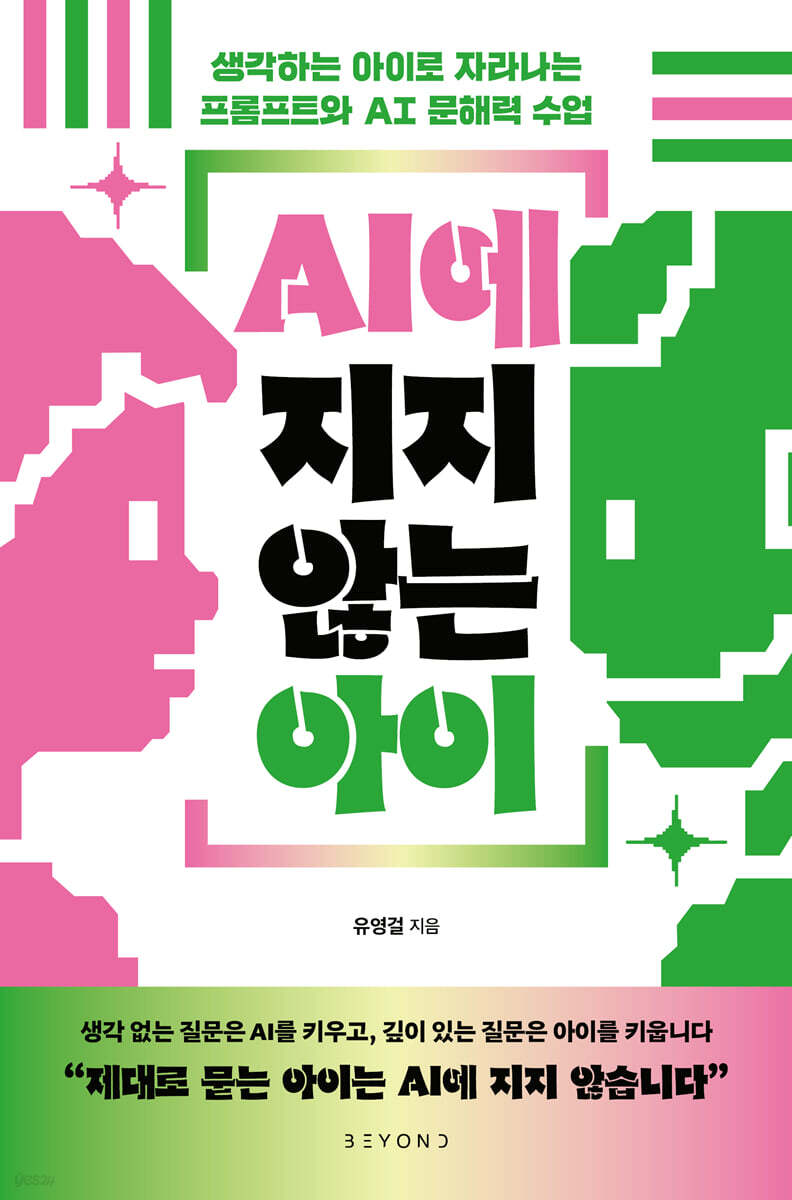
A child who cannot be defeated by AI
 |
Description
Book Introduction
How to Stay Ahead of AI: A Kakao-Forward AI Service Planner's Dad Explains
"In the AI era, children who ask the right questions will win, not those who speak well."
★★★★★ 7 AI-Recommended Prompts to Boost Literacy
★★★★★ Includes a practical guidebook to prepare for the digital textbook era.
The era has arrived where AI becomes our friend and teacher.
In the future, our children will become a generation that learns and grows with AI.
But no matter how smart the technology is, AI cannot expand a child's thinking on its own.
We also don't teach children how to ask "proper" questions. In the age of AI, without deep questions, children will unquestioningly accept AI's answers, losing their ability to think and their sense of agency.
The AI literacy discussed in this book begins with the very root of that question.
Only when a child has the ability to read, interpret words and sentences, and think critically can they develop the logic to verify AI's answers.
Furthermore, as children develop the ability to question and command AI, they will become masters who can control the flow of information and utilize AI as a tool.
The author, a former Kakao employee and AI service planner for AXZ, is a father of two. Drawing on his extensive experience in the IT industry, he provides children with precise and pointed guidance on the risks of AI, both those that should be considered AI-friendly and those that should be avoided.
The author says:
Even just practicing one prompt a day can help children expand their thinking and take the lead in conversations with AI. In an era where AI monopolizes answers, children's prompting skills will become the driving force behind shaping the future.
Ultimately, children will grow up leading AI, rather than following it with a single question.
"In the AI era, children who ask the right questions will win, not those who speak well."
★★★★★ 7 AI-Recommended Prompts to Boost Literacy
★★★★★ Includes a practical guidebook to prepare for the digital textbook era.
The era has arrived where AI becomes our friend and teacher.
In the future, our children will become a generation that learns and grows with AI.
But no matter how smart the technology is, AI cannot expand a child's thinking on its own.
We also don't teach children how to ask "proper" questions. In the age of AI, without deep questions, children will unquestioningly accept AI's answers, losing their ability to think and their sense of agency.
The AI literacy discussed in this book begins with the very root of that question.
Only when a child has the ability to read, interpret words and sentences, and think critically can they develop the logic to verify AI's answers.
Furthermore, as children develop the ability to question and command AI, they will become masters who can control the flow of information and utilize AI as a tool.
The author, a former Kakao employee and AI service planner for AXZ, is a father of two. Drawing on his extensive experience in the IT industry, he provides children with precise and pointed guidance on the risks of AI, both those that should be considered AI-friendly and those that should be avoided.
The author says:
Even just practicing one prompt a day can help children expand their thinking and take the lead in conversations with AI. In an era where AI monopolizes answers, children's prompting skills will become the driving force behind shaping the future.
Ultimately, children will grow up leading AI, rather than following it with a single question.
- You can preview some of the book's contents.
Preview
index
Prologue | We're already using 'prompt'
Part 1 | AI Literacy and Prompts: How Can We Teach Them Without Learning Them?
An era that requires new literacy
Core literacy skills needed in the AI era
Prompt Engineering: A Technique for Disciplining Disobedient AI
Part 2 | Why You Should Never Blindly Trust AI
Between Blind Faith and Distrust in AI
How to be wary of AI exposed to discrimination and bias
The Reality of AI Ethics Education
AI technology that can be criminal if misused
Part 3 | AI Play with Elementary School Children
My child has become a content creator.
Exploratory play using AI speakers
Play a conversation game with AI using your smartphone
AI role-playing where parents and children directly act out actions
Part 4 | How to Play with AI to Get Mom and Dad Even More Involved
AI drawing game that adds imagination and prompts
AI animation game that makes pictures come to life
AI Storybook Creation Game: Turning Children's Imaginations into Reality
Part 5 | How to Prepare for the Era of Digital Textbooks and AI
The emergence of AI digital textbooks
The Future Arrives in the Classroom: AI Education Connecting Home and Classroom
7 Practical Guides to AI Play That Grows with Your Child
Appendix | Recommended Prompts to Create with Your Child
Epilogue
Part 1 | AI Literacy and Prompts: How Can We Teach Them Without Learning Them?
An era that requires new literacy
Core literacy skills needed in the AI era
Prompt Engineering: A Technique for Disciplining Disobedient AI
Part 2 | Why You Should Never Blindly Trust AI
Between Blind Faith and Distrust in AI
How to be wary of AI exposed to discrimination and bias
The Reality of AI Ethics Education
AI technology that can be criminal if misused
Part 3 | AI Play with Elementary School Children
My child has become a content creator.
Exploratory play using AI speakers
Play a conversation game with AI using your smartphone
AI role-playing where parents and children directly act out actions
Part 4 | How to Play with AI to Get Mom and Dad Even More Involved
AI drawing game that adds imagination and prompts
AI animation game that makes pictures come to life
AI Storybook Creation Game: Turning Children's Imaginations into Reality
Part 5 | How to Prepare for the Era of Digital Textbooks and AI
The emergence of AI digital textbooks
The Future Arrives in the Classroom: AI Education Connecting Home and Classroom
7 Practical Guides to AI Play That Grows with Your Child
Appendix | Recommended Prompts to Create with Your Child
Epilogue
Detailed image

Into the book
Our goal is to help our children, parents, and teachers better understand and utilize AI in the AI era.
The key is to use better prompts to accurately obtain the information you want, understand the need for AI literacy, and develop the ability to critically and ethically evaluate the information provided by AI. Children who lack AI literacy are likely to be exposed to unfiltered answers from indiscriminate AI services.
But children who know what to ask and how to ask it will be able to find the answers they need quickly and accurately in a safer environment.
_Page 7, from “Prologue”
AI literacy applies equally to children, as well as parents and educators who have a responsibility to guide them in the proper use of AI.
To be precise, these are the things that adults must first be aware of in order to spread AI literacy to children.
Children who understand and become familiar with AI literacy, such as the above, will not blindly rely on the AI they encounter as they grow up.
Rather, we can recognize the limitations and biases of AI and develop the ability to compensate for them, and further connect them to the ability to leverage AI to generate new ideas and solve problems.
--- p.19, from “AI Literacy and Prompts: How Can I Teach Them Without Learning Them?”
In the future, AI literacy and the concepts of prompt engineering will be necessary in all academic and everyday settings.
This is because it requires the ability to go beyond simply conversing with AI and critically evaluate the information provided by AI, identify hallucinations, and select accurate information.
Parents and educators should teach AI literacy in a natural way, at children's level, and this can be done through everyday conversations and play.
--- p.31, from “AI Literacy and Prompts: How Can I Teach Them Without Learning Them?”
The existence of AI digital textbooks can never replace the role of teachers or parents. As the world our children will encounter increasingly evolves into an increasingly advanced AI environment, the roles of parents and teachers will become even more important.
Because children need warm communication and interaction with their parents just as much as they need interaction with AI.
It's necessary to experience AI with your child, share the joys and challenges along the way, and sometimes learn through mistakes and trial and error.
--- p.124, from “How to Prepare for the Digital Textbook and AI Era”
Rather than fearing or rejecting AI, we need to learn and grow together.
Parents should first let go of their vague anxieties about AI and become companions who explore new technologies with their children. If there's something they don't know about AI, that's understandable.
Rather, it is important to enjoy the process of learning together with your child.
The key is to use better prompts to accurately obtain the information you want, understand the need for AI literacy, and develop the ability to critically and ethically evaluate the information provided by AI. Children who lack AI literacy are likely to be exposed to unfiltered answers from indiscriminate AI services.
But children who know what to ask and how to ask it will be able to find the answers they need quickly and accurately in a safer environment.
_Page 7, from “Prologue”
AI literacy applies equally to children, as well as parents and educators who have a responsibility to guide them in the proper use of AI.
To be precise, these are the things that adults must first be aware of in order to spread AI literacy to children.
Children who understand and become familiar with AI literacy, such as the above, will not blindly rely on the AI they encounter as they grow up.
Rather, we can recognize the limitations and biases of AI and develop the ability to compensate for them, and further connect them to the ability to leverage AI to generate new ideas and solve problems.
--- p.19, from “AI Literacy and Prompts: How Can I Teach Them Without Learning Them?”
In the future, AI literacy and the concepts of prompt engineering will be necessary in all academic and everyday settings.
This is because it requires the ability to go beyond simply conversing with AI and critically evaluate the information provided by AI, identify hallucinations, and select accurate information.
Parents and educators should teach AI literacy in a natural way, at children's level, and this can be done through everyday conversations and play.
--- p.31, from “AI Literacy and Prompts: How Can I Teach Them Without Learning Them?”
The existence of AI digital textbooks can never replace the role of teachers or parents. As the world our children will encounter increasingly evolves into an increasingly advanced AI environment, the roles of parents and teachers will become even more important.
Because children need warm communication and interaction with their parents just as much as they need interaction with AI.
It's necessary to experience AI with your child, share the joys and challenges along the way, and sometimes learn through mistakes and trial and error.
--- p.124, from “How to Prepare for the Digital Textbook and AI Era”
Rather than fearing or rejecting AI, we need to learn and grow together.
Parents should first let go of their vague anxieties about AI and become companions who explore new technologies with their children. If there's something they don't know about AI, that's understandable.
Rather, it is important to enjoy the process of learning together with your child.
--- p.134, from “How to Prepare for the Digital Textbook and AI Era”
Publisher's Review
Is our child talking to AI or following it?
We live in an era where AI becomes a child's friend, teacher, and sometimes even playmate.
From smartphones to AI speakers, to generative AI that can even draw pictures.
Children are already growing up in a digital environment, experiencing technology as if it were their own breath.
But no matter how convenient and clever the technology may seem, it can never replace a child's thinking.
That is, a child who does not ask deep questions simply accepts the AI's answers and stops thinking.
On the other hand, children who ask deep questions based on literacy can look at the world from their own perspective and take the initiative beyond AI's answers.
The power of the 'one-line prompt' mentioned in this book lies right there.
AI is so vast that it pushes the boundaries of knowledge, but at the same time, it mixes in falsehoods and errors.
In 2023, in New York, USA, a lawyer created a fake precedent using ChatGPT and submitted it to the court without verification.
The court has a case where the lawyer was fined $5,000.
It was a shameful result of trusting the wrong AI's answers without verifying them.
In Korea, too, there has been constant controversy over AI chatbots learning and repeating biased or hateful statements.
If children accept AI's hallucinations without literacy and critical thinking skills and are unable to judge them, they will mistake the answers for their own thoughts and face the disaster of becoming subordinate to AI's logic.
“Children who cannot read do not use AI, they are used by AI.”
Children need to be able to question not only how to utilize AI, but also how to 'converse' with it, 'verify' it, and 'coordinate' it.
The root of that questioning power comes from literacy.
Children with poor literacy skills are at a loss even when asking questions.
Because I don't even know what words to use, what prompts to enter, and in what context.
So, this book explains how to craft questions tailored to a child's level. Rather than simply asking AI to answer questions without thinking or reasoning, it guides children through a process of asking each sentence individually, checking the results, revising, and then expanding the question in new ways.
Part 1 of this book explains why parents should also learn AI literacy with their children and how to easily guide them through prompts.
Part 2 warns of the dangers of blind faith and uncritical acceptance of AI, using real-life examples, and lays the foundation for AI ethics education.
Part 3 explores playful AI class ideas that can help children grow into creators and questioners.
Parts 4 and 5 teach prompt-based play methods that can be put into practice right at home, such as creating AI storybooks, linking with digital textbooks, and utilizing drawing play and animation.
In particular, the final appendix, like a collection of prompts, encourages parents to experiment with AI one line at a time in their daily lives, rather than vaguely feeling uneasy or wary about it.
“A child who asks the right questions will never be defeated by AI.”
Prompts are not technical terms, but language that guides a child's thinking.
A child who knows how to ask questions won't blindly accept AI's answers. As AI becomes smarter, the ability for children to think and ask questions on their own will inevitably become more valuable.
The book emphasizes the message that “children who do not ask questions are dependent on AI, but children who ask questions use AI as a tool.”
If you are a parent with children, this is something you must keep in mind as a human being living in the digital age.
If you believe in the power of children's growth, which begins with literacy and culminates in questions, this book will help you take that first step. What children who will live alongside AI need most is not simply the ability to acquire knowledge, but a questioning attitude that allows them to question, re-examine, and develop their own thinking.
Parents who want to allow their children to use AI but raise them to be resilient to it will find practical solutions in this book.
We live in an era where AI becomes a child's friend, teacher, and sometimes even playmate.
From smartphones to AI speakers, to generative AI that can even draw pictures.
Children are already growing up in a digital environment, experiencing technology as if it were their own breath.
But no matter how convenient and clever the technology may seem, it can never replace a child's thinking.
That is, a child who does not ask deep questions simply accepts the AI's answers and stops thinking.
On the other hand, children who ask deep questions based on literacy can look at the world from their own perspective and take the initiative beyond AI's answers.
The power of the 'one-line prompt' mentioned in this book lies right there.
AI is so vast that it pushes the boundaries of knowledge, but at the same time, it mixes in falsehoods and errors.
In 2023, in New York, USA, a lawyer created a fake precedent using ChatGPT and submitted it to the court without verification.
The court has a case where the lawyer was fined $5,000.
It was a shameful result of trusting the wrong AI's answers without verifying them.
In Korea, too, there has been constant controversy over AI chatbots learning and repeating biased or hateful statements.
If children accept AI's hallucinations without literacy and critical thinking skills and are unable to judge them, they will mistake the answers for their own thoughts and face the disaster of becoming subordinate to AI's logic.
“Children who cannot read do not use AI, they are used by AI.”
Children need to be able to question not only how to utilize AI, but also how to 'converse' with it, 'verify' it, and 'coordinate' it.
The root of that questioning power comes from literacy.
Children with poor literacy skills are at a loss even when asking questions.
Because I don't even know what words to use, what prompts to enter, and in what context.
So, this book explains how to craft questions tailored to a child's level. Rather than simply asking AI to answer questions without thinking or reasoning, it guides children through a process of asking each sentence individually, checking the results, revising, and then expanding the question in new ways.
Part 1 of this book explains why parents should also learn AI literacy with their children and how to easily guide them through prompts.
Part 2 warns of the dangers of blind faith and uncritical acceptance of AI, using real-life examples, and lays the foundation for AI ethics education.
Part 3 explores playful AI class ideas that can help children grow into creators and questioners.
Parts 4 and 5 teach prompt-based play methods that can be put into practice right at home, such as creating AI storybooks, linking with digital textbooks, and utilizing drawing play and animation.
In particular, the final appendix, like a collection of prompts, encourages parents to experiment with AI one line at a time in their daily lives, rather than vaguely feeling uneasy or wary about it.
“A child who asks the right questions will never be defeated by AI.”
Prompts are not technical terms, but language that guides a child's thinking.
A child who knows how to ask questions won't blindly accept AI's answers. As AI becomes smarter, the ability for children to think and ask questions on their own will inevitably become more valuable.
The book emphasizes the message that “children who do not ask questions are dependent on AI, but children who ask questions use AI as a tool.”
If you are a parent with children, this is something you must keep in mind as a human being living in the digital age.
If you believe in the power of children's growth, which begins with literacy and culminates in questions, this book will help you take that first step. What children who will live alongside AI need most is not simply the ability to acquire knowledge, but a questioning attitude that allows them to question, re-examine, and develop their own thinking.
Parents who want to allow their children to use AI but raise them to be resilient to it will find practical solutions in this book.
GOODS SPECIFICS
- Date of issue: July 29, 2025
- Page count, weight, size: 168 pages | 272g | 148*224*11mm
- ISBN13: 9791199184084
- ISBN10: 119918408X
You may also like
카테고리
korean


korean

![GQ KOREA Mark (Monthly): December [2025]](http://librairie.coreenne.fr/cdn/shop/files/8ef265dbbfbf186523ed75ba7319009d.jpg?v=1765340328&width=3840)


