

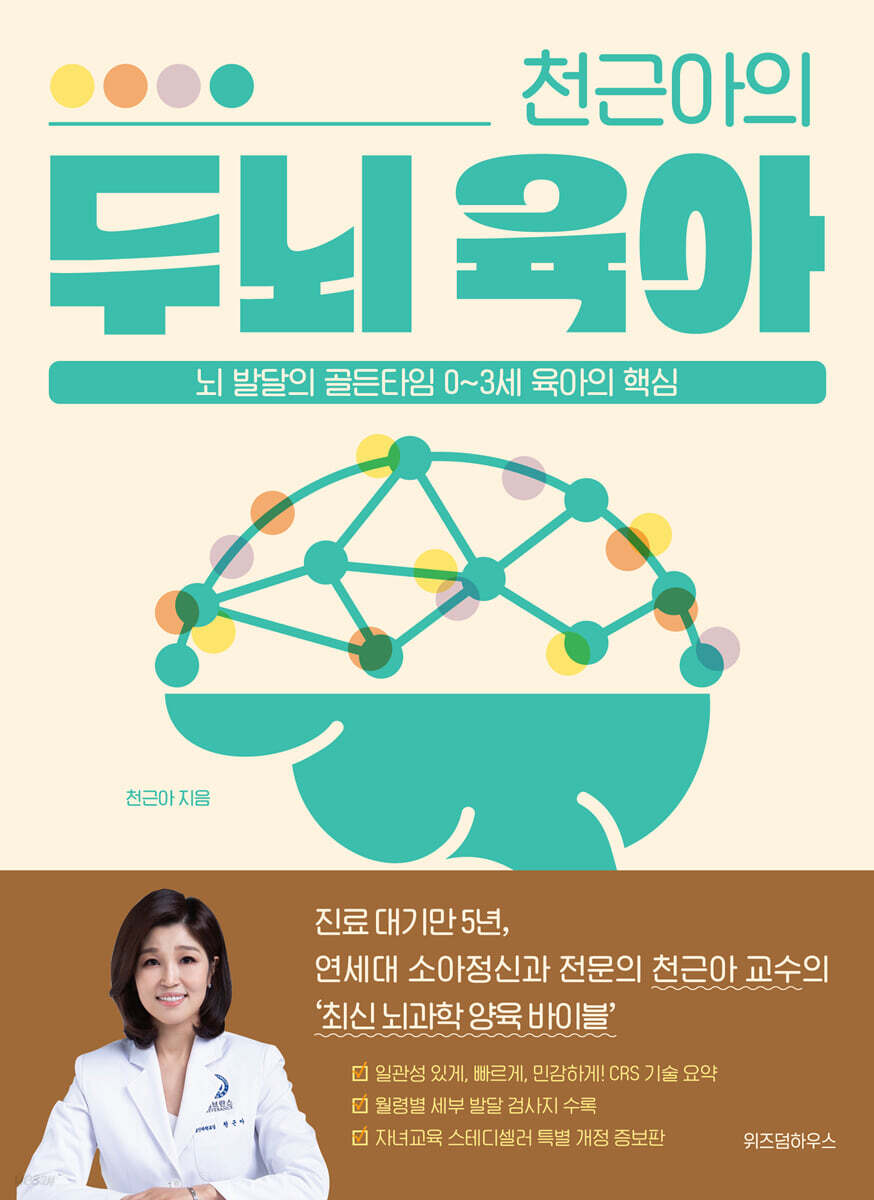
Cheon Geun-ah's Brain Parenting
 |
Description
Book Introduction
Five years of waiting for treatment, Professor Cheon Geun-ah of Severance Hospital
The Latest Brain Science Parenting Bible
“Understanding your child’s brain makes parenting easier!”
The latest brain science parenting bible, "Chun Geun-ah's Brain Parenting," by Professor Cheon Geun-ah, the nation's leading authority on child psychiatry, has been published by Wisdom House.
This book is a specially revised and expanded edition of the best-selling child education book, “Mom, I’m Getting Smarter,” and contains the child-rearing solutions that I have shared with countless parents and children in and out of the clinic for over 30 years.
Parents have given favorable reviews to existing books that detail the brain development process and play methods for each stage, saying they are “easy to understand and practical.”
In addition, this revised edition has added more precise guides such as ‘Detailed Developmental Test Indicators by Month’ to further enhance practicality.
In addition, it provides essential information on brain development for parents raising infants and toddlers, as well as insights into how the brain of infants and toddlers grows and changes, based on accumulated clinical experience and advances in brain science research.
This will serve as a practical guide on 'how to raise a child' through a customized approach based on the stimulation and response required at each stage of parenting and the child's temperament.
The Latest Brain Science Parenting Bible
“Understanding your child’s brain makes parenting easier!”
The latest brain science parenting bible, "Chun Geun-ah's Brain Parenting," by Professor Cheon Geun-ah, the nation's leading authority on child psychiatry, has been published by Wisdom House.
This book is a specially revised and expanded edition of the best-selling child education book, “Mom, I’m Getting Smarter,” and contains the child-rearing solutions that I have shared with countless parents and children in and out of the clinic for over 30 years.
Parents have given favorable reviews to existing books that detail the brain development process and play methods for each stage, saying they are “easy to understand and practical.”
In addition, this revised edition has added more precise guides such as ‘Detailed Developmental Test Indicators by Month’ to further enhance practicality.
In addition, it provides essential information on brain development for parents raising infants and toddlers, as well as insights into how the brain of infants and toddlers grows and changes, based on accumulated clinical experience and advances in brain science research.
This will serve as a practical guide on 'how to raise a child' through a customized approach based on the stimulation and response required at each stage of parenting and the child's temperament.
- You can preview some of the book's contents.
Preview
index
Prologue | Every child in the world is special, but parenting should be ordinary.
PART 1.
A personalized parenting guide for children ages 0-3: Understanding your child's development makes parenting easier.
Is my child the only one who is this unusual?
Good parents think about "why," not "how."
The brain, a small but mighty command tower
Being smart
Our child's first steps at 3 years old
Childhood experiences determine a child's abilities.
Playing is the most important thing
PART 2.
Your child is growing up today: Brain-tailored parenting methods for each month of life
0-5 months: Senses begin to open
[0~1 month] Shows reflexes|[1~2 months] Responds to external stimuli|[2~3 months] Begins to respond to sounds|[3~4 months] Gradually distinguishes between day and night|[4~5 months] Fully supports the neck|0~5 months Brain-boosting play|Situational parenting Q&A
5-9 months: Begins to move and explore on their own.
[5-6 months] I can use my strength little by little|[6-7 months] There are so many new things|[7-8 months] I am becoming more shy|[8-9 months] I am actively exploring|5-9 months: Brain-boosting play|Parenting Q&A by situation
9-12 months: So much fun
[9-10 months] Separation anxiety begins | [10-12 months] Can wander around | 9-12 months: Brain-boosting play | Parenting Q&A by situation
12-18 months: Discovering a new world
Overall Developmental Characteristics | [12-15 months] Begins to Speak Words | [15-18 months] Walks Freely | 12-18 months: Brain-boosting Play | Parenting Q&A by Situation
18-24 months: Increasing autonomy and speaking skills
A variety of emotions and self-concepts are developed.|[Discipline] Please nurture your stubborn two-year-old with warm discipline.|[Potty training] You must not rush to wean your child off diapers.|[Language development] Children who form stable attachments learn to speak quickly.|18-24 months: Brain-boosting play.|Situational parenting Q&A
24-31 months: Develop good habits that last a lifetime.
Motor and language skills develop rapidly. | [Eating Habits] A child's lifelong health and brain development depend on good eating habits. | [Sleep] The brain booster is sleep, not books. | [Smartphone] Don't let your child's brain development be ruined. | Brain-boosting play for 24-31 month olds. | Parenting Q&A by situation.
31-36 months: Self-regulation begins to develop.
Cognitive abilities develop|[Self-regulation] Focus on self-regulation to raise a smart child|What are the differences between sons and daughters|Check attachment and temperament before sending your child to daycare|31-36 months brain-boosting play|Situational parenting Q&A
PART 3.
Is my child growing well?: Infant and toddler development indicators by month (0-18 months)
PART 1.
A personalized parenting guide for children ages 0-3: Understanding your child's development makes parenting easier.
Is my child the only one who is this unusual?
Good parents think about "why," not "how."
The brain, a small but mighty command tower
Being smart
Our child's first steps at 3 years old
Childhood experiences determine a child's abilities.
Playing is the most important thing
PART 2.
Your child is growing up today: Brain-tailored parenting methods for each month of life
0-5 months: Senses begin to open
[0~1 month] Shows reflexes|[1~2 months] Responds to external stimuli|[2~3 months] Begins to respond to sounds|[3~4 months] Gradually distinguishes between day and night|[4~5 months] Fully supports the neck|0~5 months Brain-boosting play|Situational parenting Q&A
5-9 months: Begins to move and explore on their own.
[5-6 months] I can use my strength little by little|[6-7 months] There are so many new things|[7-8 months] I am becoming more shy|[8-9 months] I am actively exploring|5-9 months: Brain-boosting play|Parenting Q&A by situation
9-12 months: So much fun
[9-10 months] Separation anxiety begins | [10-12 months] Can wander around | 9-12 months: Brain-boosting play | Parenting Q&A by situation
12-18 months: Discovering a new world
Overall Developmental Characteristics | [12-15 months] Begins to Speak Words | [15-18 months] Walks Freely | 12-18 months: Brain-boosting Play | Parenting Q&A by Situation
18-24 months: Increasing autonomy and speaking skills
A variety of emotions and self-concepts are developed.|[Discipline] Please nurture your stubborn two-year-old with warm discipline.|[Potty training] You must not rush to wean your child off diapers.|[Language development] Children who form stable attachments learn to speak quickly.|18-24 months: Brain-boosting play.|Situational parenting Q&A
24-31 months: Develop good habits that last a lifetime.
Motor and language skills develop rapidly. | [Eating Habits] A child's lifelong health and brain development depend on good eating habits. | [Sleep] The brain booster is sleep, not books. | [Smartphone] Don't let your child's brain development be ruined. | Brain-boosting play for 24-31 month olds. | Parenting Q&A by situation.
31-36 months: Self-regulation begins to develop.
Cognitive abilities develop|[Self-regulation] Focus on self-regulation to raise a smart child|What are the differences between sons and daughters|Check attachment and temperament before sending your child to daycare|31-36 months brain-boosting play|Situational parenting Q&A
PART 3.
Is my child growing well?: Infant and toddler development indicators by month (0-18 months)
Detailed image
.jpg)
Into the book
Once you know exactly what's going on in your child's brain, you can look at their behavior objectively.
When dealing with children, the most important thing to avoid as a parent is 'emotional response', such as anger or outbursts of rage.
You can also overcome the guilt of not being a good parent.
Furthermore, it becomes possible to provide customized parenting tailored to the brain development of our children.
---p.19
In particular, since the brain develops differently at different times, there are 'critical' or 'sensitive' periods that should not be missed.
Therefore, it is very important to provide abundant and appropriate stimulation and interaction appropriate to the developmental stage.
The brain develops from the inside out.
The area that controls instincts such as sleep, appetite, and sexual desire, and the area inside the brain that controls emotions and memories must be properly constructed so that the frontal lobe, especially the prefrontal lobe, which is responsible for emotions, impulse control, planning, and execution, can develop strongly.
---p.24
You need to respond to your baby consistently, quickly, and sensitively.
Among these, consistency is especially important.
You need to make sure your baby can anticipate your reactions.
Babies learn how to behave and navigate the world by observing their mothers' reactions.
However, if each mother reacts differently to the same behavior or event, the baby will feel extremely confused.
If a mother pats her baby on the bottom when she is in a good mood and yells at her baby when she is in a bad mood, the baby will not know what to do.
You can't learn proper behavioral strategies.
---p.40
Help your baby gain lots of positive experiences from birth.
Constant conversation and play with your child strengthens their memory and enhances their language, emotional, and social skills.
To activate memory circuits and reinforce important memories from life, conversations and play that engage the five senses are essential.
This is also why experts advise parents to constantly communicate, exchange glances, and play with their children before disciplining them.
.
When dealing with children, the most important thing to avoid as a parent is 'emotional response', such as anger or outbursts of rage.
You can also overcome the guilt of not being a good parent.
Furthermore, it becomes possible to provide customized parenting tailored to the brain development of our children.
---p.19
In particular, since the brain develops differently at different times, there are 'critical' or 'sensitive' periods that should not be missed.
Therefore, it is very important to provide abundant and appropriate stimulation and interaction appropriate to the developmental stage.
The brain develops from the inside out.
The area that controls instincts such as sleep, appetite, and sexual desire, and the area inside the brain that controls emotions and memories must be properly constructed so that the frontal lobe, especially the prefrontal lobe, which is responsible for emotions, impulse control, planning, and execution, can develop strongly.
---p.24
You need to respond to your baby consistently, quickly, and sensitively.
Among these, consistency is especially important.
You need to make sure your baby can anticipate your reactions.
Babies learn how to behave and navigate the world by observing their mothers' reactions.
However, if each mother reacts differently to the same behavior or event, the baby will feel extremely confused.
If a mother pats her baby on the bottom when she is in a good mood and yells at her baby when she is in a bad mood, the baby will not know what to do.
You can't learn proper behavioral strategies.
---p.40
Help your baby gain lots of positive experiences from birth.
Constant conversation and play with your child strengthens their memory and enhances their language, emotional, and social skills.
To activate memory circuits and reinforce important memories from life, conversations and play that engage the five senses are essential.
This is also why experts advise parents to constantly communicate, exchange glances, and play with their children before disciplining them.
.
---p.45
Publisher's Review
What's important in children's education is not 'early' but 'right time'!
Professor Chun Geun-ah, the highest authority on child psychiatry in Korea
A scientific and practical guide to brain development
The introduction of the '4-year-old and 7-year-old exam', a test that preschool children take to enter prestigious academies, has become a hot topic.
This reality, which is breathtaking just to hear, clearly shows how excessive the craze for early education is in our society.
Experts also express concern that it is not desirable to demand excessive good deeds and achievements from infants and toddlers, swayed by the social atmosphere that says you have to do everything faster than others to avoid falling behind.
Professor Chun Geun-ah of Severance Hospital, the highest authority on child psychiatry in Korea, said about this state of affairs, “Excessive prior learning that has been passed down to infancy is like building a high-rise building when the brain’s foundation should be laid,” and pointed out that stress in infancy “can reduce the number of new nerve cells, negatively affecting long-term memory, learning ability, and emotional regulation, and weakening stress coping skills and resilience, which can lead to depression and anxiety disorders.”
Of course, I am not denying the desire of parents to give their children only the best from start to finish.
But there is a time for everything.
Just as a bicycle is useless to a child who can't even walk yet, the same goes for education.
Just because something is fast doesn't mean it's necessarily good.
In children's education, the important thing is not early, but right time.
"Chun Geun-ah's Brain Parenting" is a book written for everyone from expectant parents welcoming their first child to those who are already deeply concerned about parenting.
It contains detailed brain development guidelines written with sincerity based on the latest brain science.
In particular, we deeply sympathize with the anxieties and concerns of parents raising children in this day and age, and we provide practical methods to help children develop, focusing on the 36 months after birth, which is called the golden time for brain development.
Just like receiving counseling in a clinic, the child's developmental process is explained in detail at eye level, and parenting principles are established based on knowledge of brain science.
It is also practical as it contains detailed monthly guides, development checklists, and play methods that parents need most in the field of childcare.
Reading the book feels like receiving one-on-one coaching, as it includes developmental testing data that the author uses in actual clinical settings and situational parenting Q&A.
The first three years of life are the foundation for our children's lifelong brain development!
"When parents read their children's brains, the children grow a little taller."
The author says that "in parenting, brain science is not simply information, but a powerful guide that protects the hearts of both children and parents."
For new parents, parenting is an unknown world they have never experienced before.
Nothing is easy, from feeding, toileting, sleeping, playing, to development.
I searched the internet, browsed parent communities, and various YouTube channels, but it wasn't easy to get a clear answer.
There is so much information out there, but it's easy to get lost.
What is most needed in times like these is a guidebook that can read the child's inner thoughts and ease the parent's anxiety.
《Cheongeun-ah's Brain Parenting》 is not a book that simply provides information on parenting.
It explains the essential values of parenting from a parent's perspective, from how to respond sensitively to a child's signals to how to form a stable attachment and the importance of consistent parenting.
Parents' perfectionism, anxiety, and comparison mentality only hinder the formation of a relationship with their children.
The author relieves this burden and provides scientifically-based guidance to help children develop naturally and healthily.
It fills the world of parenting, which is new to everyone, with trust and warmth, not anxiety.
The best gift for a child is not early education, but a parent's heart that sees and loves them as they are.
I recommend that you keep this book by your side as a companion for parenting, as it cares not only for the child's growth but also for the parents' hearts.
Professor Chun Geun-ah, the highest authority on child psychiatry in Korea
A scientific and practical guide to brain development
The introduction of the '4-year-old and 7-year-old exam', a test that preschool children take to enter prestigious academies, has become a hot topic.
This reality, which is breathtaking just to hear, clearly shows how excessive the craze for early education is in our society.
Experts also express concern that it is not desirable to demand excessive good deeds and achievements from infants and toddlers, swayed by the social atmosphere that says you have to do everything faster than others to avoid falling behind.
Professor Chun Geun-ah of Severance Hospital, the highest authority on child psychiatry in Korea, said about this state of affairs, “Excessive prior learning that has been passed down to infancy is like building a high-rise building when the brain’s foundation should be laid,” and pointed out that stress in infancy “can reduce the number of new nerve cells, negatively affecting long-term memory, learning ability, and emotional regulation, and weakening stress coping skills and resilience, which can lead to depression and anxiety disorders.”
Of course, I am not denying the desire of parents to give their children only the best from start to finish.
But there is a time for everything.
Just as a bicycle is useless to a child who can't even walk yet, the same goes for education.
Just because something is fast doesn't mean it's necessarily good.
In children's education, the important thing is not early, but right time.
"Chun Geun-ah's Brain Parenting" is a book written for everyone from expectant parents welcoming their first child to those who are already deeply concerned about parenting.
It contains detailed brain development guidelines written with sincerity based on the latest brain science.
In particular, we deeply sympathize with the anxieties and concerns of parents raising children in this day and age, and we provide practical methods to help children develop, focusing on the 36 months after birth, which is called the golden time for brain development.
Just like receiving counseling in a clinic, the child's developmental process is explained in detail at eye level, and parenting principles are established based on knowledge of brain science.
It is also practical as it contains detailed monthly guides, development checklists, and play methods that parents need most in the field of childcare.
Reading the book feels like receiving one-on-one coaching, as it includes developmental testing data that the author uses in actual clinical settings and situational parenting Q&A.
The first three years of life are the foundation for our children's lifelong brain development!
"When parents read their children's brains, the children grow a little taller."
The author says that "in parenting, brain science is not simply information, but a powerful guide that protects the hearts of both children and parents."
For new parents, parenting is an unknown world they have never experienced before.
Nothing is easy, from feeding, toileting, sleeping, playing, to development.
I searched the internet, browsed parent communities, and various YouTube channels, but it wasn't easy to get a clear answer.
There is so much information out there, but it's easy to get lost.
What is most needed in times like these is a guidebook that can read the child's inner thoughts and ease the parent's anxiety.
《Cheongeun-ah's Brain Parenting》 is not a book that simply provides information on parenting.
It explains the essential values of parenting from a parent's perspective, from how to respond sensitively to a child's signals to how to form a stable attachment and the importance of consistent parenting.
Parents' perfectionism, anxiety, and comparison mentality only hinder the formation of a relationship with their children.
The author relieves this burden and provides scientifically-based guidance to help children develop naturally and healthily.
It fills the world of parenting, which is new to everyone, with trust and warmth, not anxiety.
The best gift for a child is not early education, but a parent's heart that sees and loves them as they are.
I recommend that you keep this book by your side as a companion for parenting, as it cares not only for the child's growth but also for the parents' hearts.
GOODS SPECIFICS
- Date of issue: June 11, 2025
- Page count, weight, size: 256 pages | 164*225*20mm
- ISBN13: 9791171714230
- ISBN10: 1171714238
You may also like
카테고리
korean


korean

![GQ KOREA Mark (Monthly): December [2025]](http://librairie.coreenne.fr/cdn/shop/files/8ef265dbbfbf186523ed75ba7319009d.jpg?v=1765340328&width=3840)


