

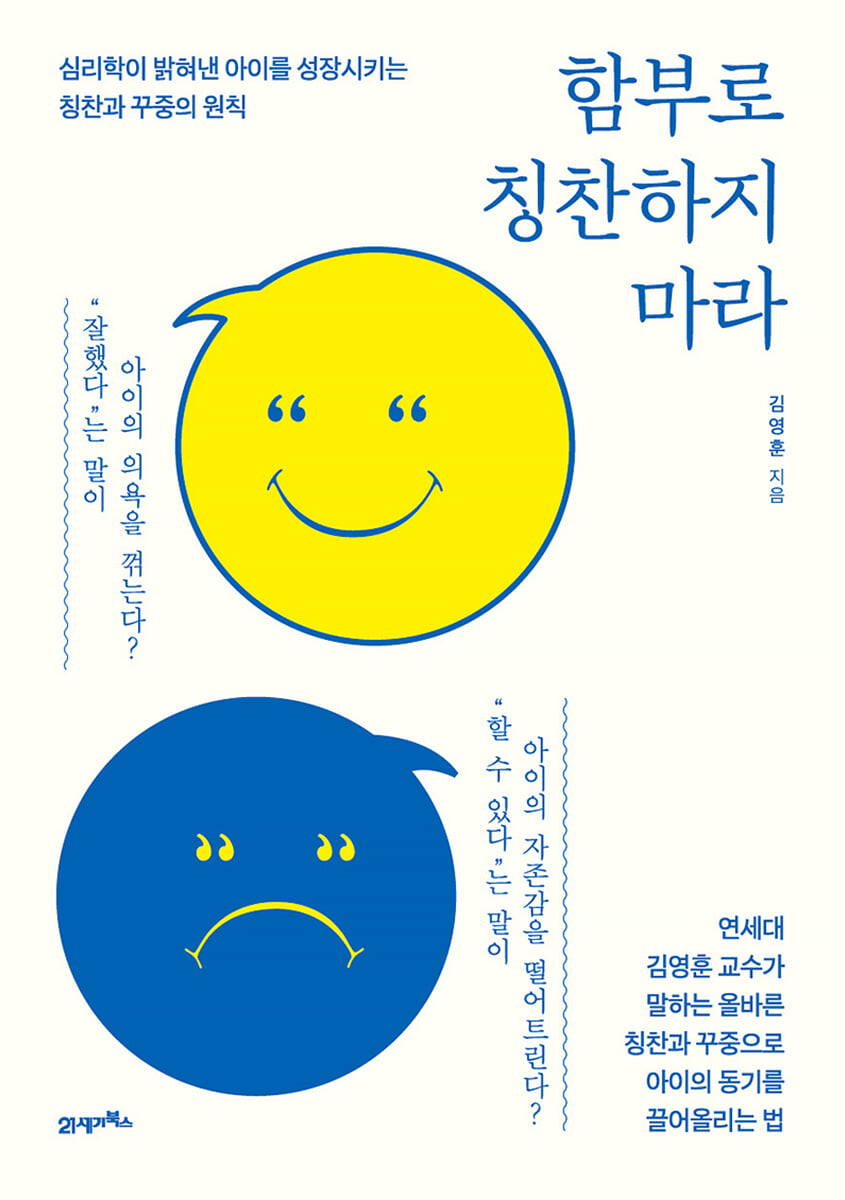
Don't praise carelessly
 |
Description
Book Introduction
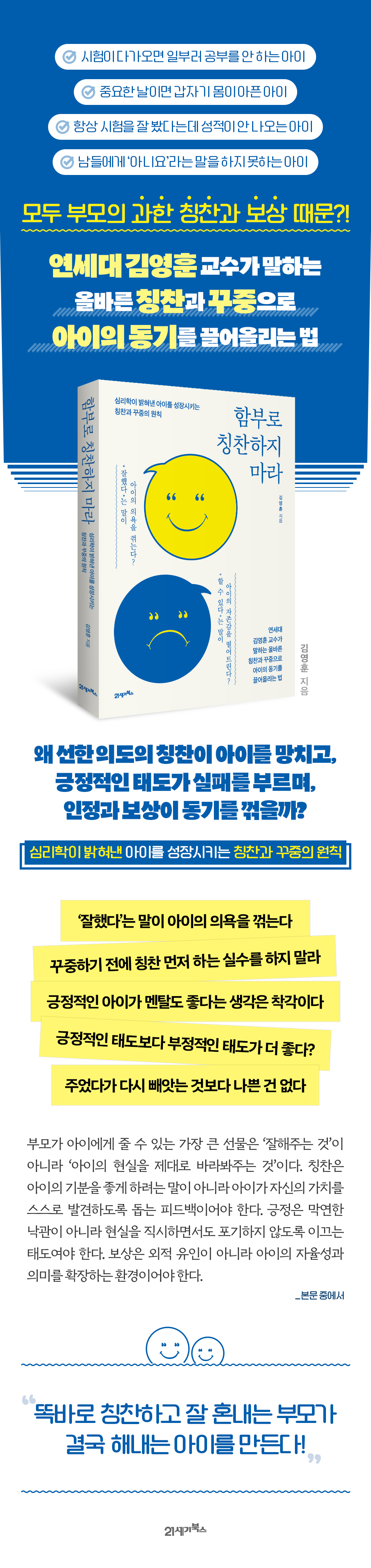
Does saying “good job” dampen a child’s motivation?
Does the phrase “I can do it” lower a child’s self-esteem?
Professor Kim Young-hoon of Yonsei University says
How to Motivate Your Child with Appropriate Praise and Reprimand
There are things that parents often consider common sense when disciplining their children.
A prime example is the belief that children can be encouraged and motivated through praise, positive thinking, and rewards.
Actively praise your child for even the smallest accomplishments and build their confidence. Encourage them to keep trying by instilling a positive attitude that they can do even seemingly impossible tasks. Reward them for good work and encourage them to work harder.
But are these things we believe to be common sense really effective in disciplining children?
In his book, “Don’t Praise Carelessly,” Professor Kim Young-hoon of Yonsei University’s Department of Psychology questions the effectiveness of praise, positive thinking, and rewards, which we have long considered effective disciplinary tools.
Through experiments conducted on students, the effects of praise and scolding, positive and negative thinking, and rewards on children's performance are scientifically analyzed.
And within it, we share wise and effective ways to motivate children while protecting their hearts.
How should we praise and scold our children? What types of praise and scolding can boost their motivation to study? Is positive thinking truly beneficial for children's mental health? What kind of rewards make children study harder? This book will help you find answers to these questions and consider how to apply them to your own life.
Does the phrase “I can do it” lower a child’s self-esteem?
Professor Kim Young-hoon of Yonsei University says
How to Motivate Your Child with Appropriate Praise and Reprimand
There are things that parents often consider common sense when disciplining their children.
A prime example is the belief that children can be encouraged and motivated through praise, positive thinking, and rewards.
Actively praise your child for even the smallest accomplishments and build their confidence. Encourage them to keep trying by instilling a positive attitude that they can do even seemingly impossible tasks. Reward them for good work and encourage them to work harder.
But are these things we believe to be common sense really effective in disciplining children?
In his book, “Don’t Praise Carelessly,” Professor Kim Young-hoon of Yonsei University’s Department of Psychology questions the effectiveness of praise, positive thinking, and rewards, which we have long considered effective disciplinary tools.
Through experiments conducted on students, the effects of praise and scolding, positive and negative thinking, and rewards on children's performance are scientifically analyzed.
And within it, we share wise and effective ways to motivate children while protecting their hearts.
How should we praise and scold our children? What types of praise and scolding can boost their motivation to study? Is positive thinking truly beneficial for children's mental health? What kind of rewards make children study harder? This book will help you find answers to these questions and consider how to apply them to your own life.
- You can preview some of the book's contents.
Preview
index
Why Saying "Good Job" Destroys a Child's Motivation
PART 1: The Trap of Praise Thought to Encourage Children
01 Parents' beliefs about praise are wrong.
A child who creates his own failures
The Effects of Unconditional Praise on Children
When an exam is coming up, why don't you study on purpose?
02 Know when to praise and when to scold
America believed in the power of praise, while Korea believed in the power of scolding.
Praise or Scolding: Which Improves Grades More?
Which child will work harder, the one who is praised or scolded?
Be complacent with excessive praise and give up with excessive scolding.
Will giving lots of praise make my child happy?
03 You need the skill to 'discipline your child well'.
Conditions for scolding children to grow up
Won't scolding make the relationship uncomfortable?
Don't make the mistake of praising before scolding.
Why You Should Keep Talking to a Child Who Doesn't Listen
PART 2: The Power of Self-Objectification That's Neither Too Positive nor Too Negative
01 Children living in a positive era
A child who always did well on tests and a child who always did poorly
Being too positive or too negative can hinder your studies.
Children who are good at metacognition also do well in school.
Is it better to have a negative attitude than a positive one?
02 A child's self-esteem hidden by the words "I can do it!"
It's a misconception that positive children have good mental health.
We need 'transparent glasses' that reflect ourselves as we are.
Saying 'don't worry' doesn't help.
PART 3: The Art of Proper Reward for Raising Children
01 Reinterpreting the educational principle of rewarding good performance
Rewards rob children of their joy.
The trap of saying you can play if you finish your homework first
If games were a college entrance exam subject, would you enjoy studying?
02 Don't obscure the essence of what you love to do.
What You Like vs. What You Are Good at: Criteria for Choosing a Child's Career
The blind spot of compensation that turns voluntary into involuntary
There's nothing worse than giving and then having it taken away.
Just two ways to use rewards effectively
03 The power to make children independent
A mother's praise reduces a child's motivation.
Why Can't My Child Say "No"?
The power of autonomy to determine a child's life
How to Raise a Child Who Makes Their Own Decisions
Conclusion: Three Disciplinary Principles: Praise, Affirmation, and Rewards to Boost Achievement Motivation
annotation
PART 1: The Trap of Praise Thought to Encourage Children
01 Parents' beliefs about praise are wrong.
A child who creates his own failures
The Effects of Unconditional Praise on Children
When an exam is coming up, why don't you study on purpose?
02 Know when to praise and when to scold
America believed in the power of praise, while Korea believed in the power of scolding.
Praise or Scolding: Which Improves Grades More?
Which child will work harder, the one who is praised or scolded?
Be complacent with excessive praise and give up with excessive scolding.
Will giving lots of praise make my child happy?
03 You need the skill to 'discipline your child well'.
Conditions for scolding children to grow up
Won't scolding make the relationship uncomfortable?
Don't make the mistake of praising before scolding.
Why You Should Keep Talking to a Child Who Doesn't Listen
PART 2: The Power of Self-Objectification That's Neither Too Positive nor Too Negative
01 Children living in a positive era
A child who always did well on tests and a child who always did poorly
Being too positive or too negative can hinder your studies.
Children who are good at metacognition also do well in school.
Is it better to have a negative attitude than a positive one?
02 A child's self-esteem hidden by the words "I can do it!"
It's a misconception that positive children have good mental health.
We need 'transparent glasses' that reflect ourselves as we are.
Saying 'don't worry' doesn't help.
PART 3: The Art of Proper Reward for Raising Children
01 Reinterpreting the educational principle of rewarding good performance
Rewards rob children of their joy.
The trap of saying you can play if you finish your homework first
If games were a college entrance exam subject, would you enjoy studying?
02 Don't obscure the essence of what you love to do.
What You Like vs. What You Are Good at: Criteria for Choosing a Child's Career
The blind spot of compensation that turns voluntary into involuntary
There's nothing worse than giving and then having it taken away.
Just two ways to use rewards effectively
03 The power to make children independent
A mother's praise reduces a child's motivation.
Why Can't My Child Say "No"?
The power of autonomy to determine a child's life
How to Raise a Child Who Makes Their Own Decisions
Conclusion: Three Disciplinary Principles: Praise, Affirmation, and Rewards to Boost Achievement Motivation
annotation
Detailed image
Into the book
Originally, Dayeon really liked playing the piano and going to piano academy.
However, Dayeon decided to stop going to the academy on her own to create an excuse.
No one forced him to do it, he wanted to quit of his own accord.
I couldn't actually quit the academy due to pressure from my mother, but what would have happened if I had? Would I have gotten better at piano, or worse? Of course, I would have gotten worse.
Because I ended up not playing the piano at all.
In the end, you will fail in the piano field.
The core of self-crippling is that the excuses you create for yourself lead to failure.
--- p.22, from “The Child Who Creates His Own Failure”
There are children who say that studying is not fun since elementary school.
There are many children who actively express that they are not very interested in studying.
It could be because they really hate it, but that's rare.
Why would children particularly dislike studying from elementary school onward? Excessive expectations and praise can make them do this.
There are parents who get excited and excessively praise their children when they do something well, even if it is nothing special.
Of course, it could be praise given in the hope that the child will work harder.
But children find the praise both pleasurable and burdensome.
Because I have to live up to that praise.
In fact, that may be the real goal of parents.
--- p.34, from “Why Don’t You Study When an Exam Is Coming?”
If our ultimate goal is to increase a child's intrinsic motivation to study, we must use appropriate praise and criticism.
Children who do well should be praised, and children who do wrong should be scolded.
This isn't just for children.
It doesn't matter whether it's your child, coworker, friend, husband, or wife.
Correct and accurate feedback is the only way to increase intrinsic motivation.
The American attitude of trying to increase intrinsic motivation in a child who is not doing well through praise, and the traditional Korean attitude of trying to increase intrinsic motivation in a child who is doing well through scolding, are both wrong.
What we need is genuine praise and genuine rebuke.
--- p.60, from “Who will work harder, a child who is praised or scolded?”
Praise can manipulate children for a moment, but that manipulation doesn't last long.
Since it has no substance, it will eventually collapse at some point.
Realistic scolding can feel too dry and impersonal.
But unjustified praise is nothing more than a more inhumane and petty manipulation.
I don't know if we can manipulate it for the rest of our lives, but we have to live against a wall with the huge market called reality.
There is no manipulation that can withstand that barrier.
The more it is exaggerated and the more it is unjustified, the greater the pain and suffering our children will have to endure.
--- p.102, from “Why You Should Keep Talking to a Child Who Doesn’t Listen”
There are many children who said they liked reading books before entering elementary school.
Some children said they liked math.
My son also liked math until the third grade of elementary school.
There are many children who like science.
But strangely enough, as time goes by, you start to hate all the subjects you used to like.
Because they think they study for the rewards, to get into college.
The moment there is a reward, this kind of reasoning becomes difficult to avoid.
Even if they previously enjoyed studying, when a reward is given, children cannot help but perceive that they are studying because of it.
At that moment, studying becomes something you don't want to do.
--- p.183, from “The Trap of Saying You Can Play If You Finish Your Homework First”
People call rewards motivation.
That's a great expression.
But strictly speaking, the reward is manipulation.
It is about forcing children and adults to do something by bribing them with rewards such as grades, college, money, fame, and status.
When given a reward, most children and adults will do their best for it.
It is rare to find someone who is free from the pressure of reward.
At first glance, it may seem like you are working hard out of free will, but in reality, that is not the case at all.
It's something you have to do because you can't help but work hard, and you're forced into a situation where you have to work hard in exchange for a reward.
This is not motivation, it is crude behavioral manipulation.
However, Dayeon decided to stop going to the academy on her own to create an excuse.
No one forced him to do it, he wanted to quit of his own accord.
I couldn't actually quit the academy due to pressure from my mother, but what would have happened if I had? Would I have gotten better at piano, or worse? Of course, I would have gotten worse.
Because I ended up not playing the piano at all.
In the end, you will fail in the piano field.
The core of self-crippling is that the excuses you create for yourself lead to failure.
--- p.22, from “The Child Who Creates His Own Failure”
There are children who say that studying is not fun since elementary school.
There are many children who actively express that they are not very interested in studying.
It could be because they really hate it, but that's rare.
Why would children particularly dislike studying from elementary school onward? Excessive expectations and praise can make them do this.
There are parents who get excited and excessively praise their children when they do something well, even if it is nothing special.
Of course, it could be praise given in the hope that the child will work harder.
But children find the praise both pleasurable and burdensome.
Because I have to live up to that praise.
In fact, that may be the real goal of parents.
--- p.34, from “Why Don’t You Study When an Exam Is Coming?”
If our ultimate goal is to increase a child's intrinsic motivation to study, we must use appropriate praise and criticism.
Children who do well should be praised, and children who do wrong should be scolded.
This isn't just for children.
It doesn't matter whether it's your child, coworker, friend, husband, or wife.
Correct and accurate feedback is the only way to increase intrinsic motivation.
The American attitude of trying to increase intrinsic motivation in a child who is not doing well through praise, and the traditional Korean attitude of trying to increase intrinsic motivation in a child who is doing well through scolding, are both wrong.
What we need is genuine praise and genuine rebuke.
--- p.60, from “Who will work harder, a child who is praised or scolded?”
Praise can manipulate children for a moment, but that manipulation doesn't last long.
Since it has no substance, it will eventually collapse at some point.
Realistic scolding can feel too dry and impersonal.
But unjustified praise is nothing more than a more inhumane and petty manipulation.
I don't know if we can manipulate it for the rest of our lives, but we have to live against a wall with the huge market called reality.
There is no manipulation that can withstand that barrier.
The more it is exaggerated and the more it is unjustified, the greater the pain and suffering our children will have to endure.
--- p.102, from “Why You Should Keep Talking to a Child Who Doesn’t Listen”
There are many children who said they liked reading books before entering elementary school.
Some children said they liked math.
My son also liked math until the third grade of elementary school.
There are many children who like science.
But strangely enough, as time goes by, you start to hate all the subjects you used to like.
Because they think they study for the rewards, to get into college.
The moment there is a reward, this kind of reasoning becomes difficult to avoid.
Even if they previously enjoyed studying, when a reward is given, children cannot help but perceive that they are studying because of it.
At that moment, studying becomes something you don't want to do.
--- p.183, from “The Trap of Saying You Can Play If You Finish Your Homework First”
People call rewards motivation.
That's a great expression.
But strictly speaking, the reward is manipulation.
It is about forcing children and adults to do something by bribing them with rewards such as grades, college, money, fame, and status.
When given a reward, most children and adults will do their best for it.
It is rare to find someone who is free from the pressure of reward.
At first glance, it may seem like you are working hard out of free will, but in reality, that is not the case at all.
It's something you have to do because you can't help but work hard, and you're forced into a situation where you have to work hard in exchange for a reward.
This is not motivation, it is crude behavioral manipulation.
--- p.199, from “What You Like vs. What You Are Good at: Criteria for Choosing a Child’s Career”
Publisher's Review
Why well-intentioned praise ruins children,
A positive attitude invites failure,
Do recognition and rewards dampen motivation?
There is no Korean who does not know the saying, “Praise makes even a whale dance.”
There was a time when Korean society practiced praising each other at school and at work under the slogan, "Let's praise each other."
In particular, praise is considered a very good means of disciplining children.
We actively praise our children as a means of encouragement and motivation, and try to instill confidence in them.
But would you believe that this kind of praise actually discourages children?
Professor Kim Young-hoon of Yonsei University's Department of Psychology, author of "Don't Praise Carelessly," says that active praise, which is generally considered an effective disciplinary tool, actually discourages children's motivation and creates failure.
It's not just praise.
With the popularity of positive psychology, positive thinking, which has been believed to be true, is also said to not be helpful for children's growth, and the basic principle of rewarding children for doing well is also said to not be helpful for discipline.
Why is that?
The long-held belief that praise encourages children is wrong!
The Principles of Praise and Scolding for Child Development Revealed by Psychology
There are children who say that studying is not fun from a young age.
It could be because they really hate it, but it's rare for that to happen from the beginning.
Excessive expectations and praise are what made children like that.
If praise is deemed excessive or unsustainable, the child feels pressured and seeks ways to avoid disappointing the parent without damaging their self-esteem.
The first thing to do is to say that studying is not fun and that you are not interested.
In psychology, this is called 'self-handicapping'.
It is a defensive action taken preemptively when the probability of failure is high.
This book shows through several experiments that excessive praise can weaken a child's intrinsic motivation, and that incorrect scolding can actually lead to helplessness and giving up.
Based on the research results, we will look at the pitfalls of praise and misunderstandings about scolding that parents easily fall into.
It also talks about wiser and more effective ways to keep a child's mind motivated while protecting it.
Parents who praise and scold well eventually create children who achieve.
The Three Principles of Discipline: Praise, Affirmation, and Rewards to Boost Your Child's Achievement Motivation
The author says that what's most important is not false comfort or exaggerated praise that makes people ignore reality, but truthful, fact-based feedback that makes them reflect on their actions.
Insincere praise can lead children to rationalize, prevent them from facing reality, and ultimately lead to poor performance and even mental health.
Parents should not be afraid of honest reprimands.
Telling the truth when something is wrong is the true support that protects a child and is a responsible parental love.
Why do well-intentioned praise ruin children, positive attitudes lead to failure, and rewards destroy motivation? The author argues that it's because love is sufficient, but the way that love is expressed is flawed.
And that wrong approach quietly but deeply destroys the child's autonomy and growth.
The greatest gift parents can give their children is not to be nice to them, but to look at their child's reality properly.
Through this book, let's find answers to how to praise and scold children, and how to foster the strength to see reality clearly and solve problems on their own.
A positive attitude invites failure,
Do recognition and rewards dampen motivation?
There is no Korean who does not know the saying, “Praise makes even a whale dance.”
There was a time when Korean society practiced praising each other at school and at work under the slogan, "Let's praise each other."
In particular, praise is considered a very good means of disciplining children.
We actively praise our children as a means of encouragement and motivation, and try to instill confidence in them.
But would you believe that this kind of praise actually discourages children?
Professor Kim Young-hoon of Yonsei University's Department of Psychology, author of "Don't Praise Carelessly," says that active praise, which is generally considered an effective disciplinary tool, actually discourages children's motivation and creates failure.
It's not just praise.
With the popularity of positive psychology, positive thinking, which has been believed to be true, is also said to not be helpful for children's growth, and the basic principle of rewarding children for doing well is also said to not be helpful for discipline.
Why is that?
The long-held belief that praise encourages children is wrong!
The Principles of Praise and Scolding for Child Development Revealed by Psychology
There are children who say that studying is not fun from a young age.
It could be because they really hate it, but it's rare for that to happen from the beginning.
Excessive expectations and praise are what made children like that.
If praise is deemed excessive or unsustainable, the child feels pressured and seeks ways to avoid disappointing the parent without damaging their self-esteem.
The first thing to do is to say that studying is not fun and that you are not interested.
In psychology, this is called 'self-handicapping'.
It is a defensive action taken preemptively when the probability of failure is high.
This book shows through several experiments that excessive praise can weaken a child's intrinsic motivation, and that incorrect scolding can actually lead to helplessness and giving up.
Based on the research results, we will look at the pitfalls of praise and misunderstandings about scolding that parents easily fall into.
It also talks about wiser and more effective ways to keep a child's mind motivated while protecting it.
Parents who praise and scold well eventually create children who achieve.
The Three Principles of Discipline: Praise, Affirmation, and Rewards to Boost Your Child's Achievement Motivation
The author says that what's most important is not false comfort or exaggerated praise that makes people ignore reality, but truthful, fact-based feedback that makes them reflect on their actions.
Insincere praise can lead children to rationalize, prevent them from facing reality, and ultimately lead to poor performance and even mental health.
Parents should not be afraid of honest reprimands.
Telling the truth when something is wrong is the true support that protects a child and is a responsible parental love.
Why do well-intentioned praise ruin children, positive attitudes lead to failure, and rewards destroy motivation? The author argues that it's because love is sufficient, but the way that love is expressed is flawed.
And that wrong approach quietly but deeply destroys the child's autonomy and growth.
The greatest gift parents can give their children is not to be nice to them, but to look at their child's reality properly.
Through this book, let's find answers to how to praise and scold children, and how to foster the strength to see reality clearly and solve problems on their own.
GOODS SPECIFICS
- Date of issue: June 4, 2025
- Page count, weight, size: 256 pages | 148*210*20mm
- ISBN13: 9791173572951
- ISBN10: 1173572953
You may also like
카테고리
korean


korean

![GQ KOREA Mark (Monthly): December [2025]](http://librairie.coreenne.fr/cdn/shop/files/8ef265dbbfbf186523ed75ba7319009d.jpg?v=1765340328&width=3840)


