

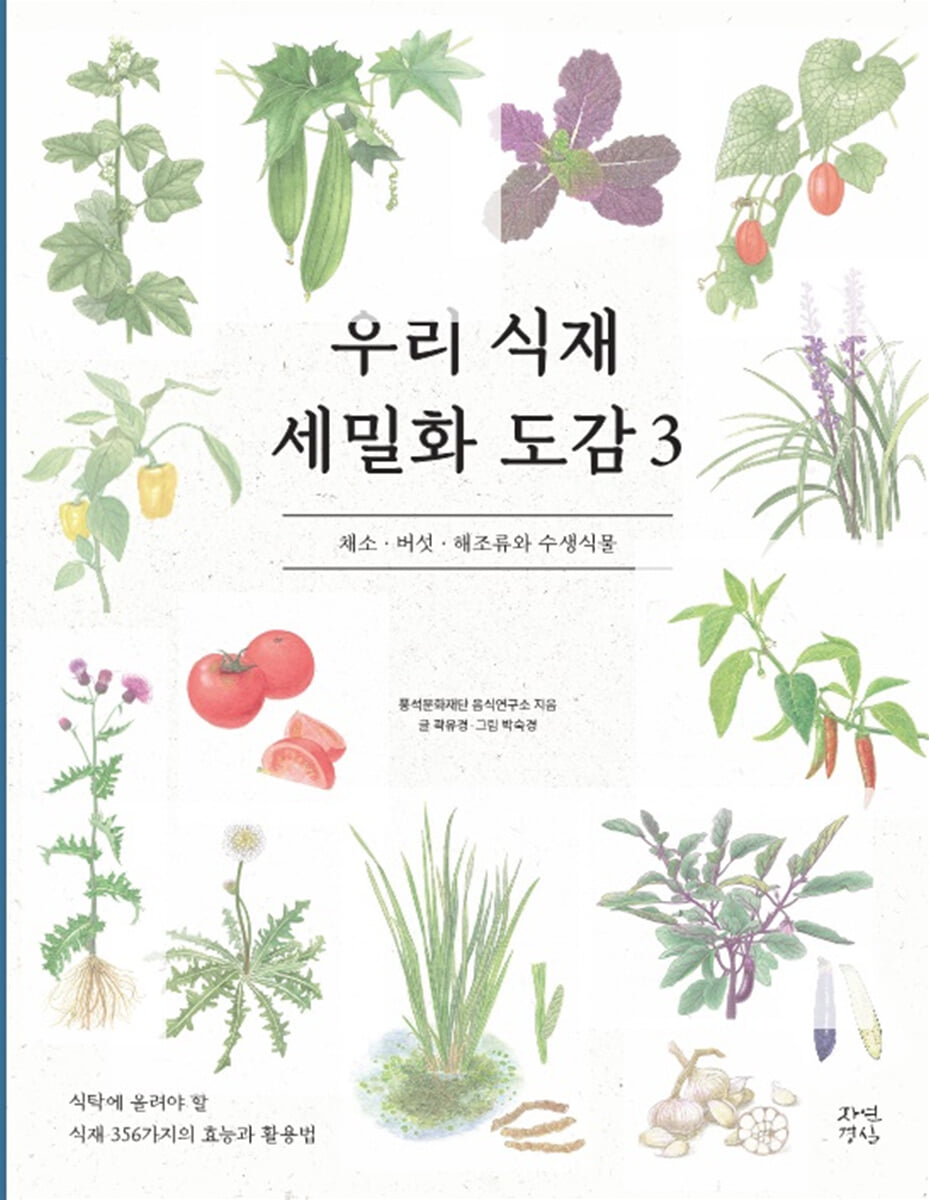
Our Food Detailed Guide 3
 |
Description
Book Introduction
The complete guide to Korean food grown on the Korean Peninsula
《Our Food Ingredients Illustrated Guide》 was planned based on the Food Overview (食鑑撮要) in Volume 1 of the Jeongjoji (食鑑撮要) in the 《Imwon Gyeongjeji》, an encyclopedia that compiles our food culture.
In the 〈Jeongjoji〉 food coloring book, a total of 234 kinds of Korean food ingredients are organized by the teacher Seo Yu-gu of Pungseok according to the system of water (8 kinds), grains (37 kinds), vegetables (74 kinds), fruits (48 kinds), animals (11 kinds), birds (13 kinds), fish (35 kinds), and seasonings (8 kinds).
This book contains all the contents of the Sikgamchalyo, but the meaning of 'Bongchomi' in the Grain section was not clear, so it was excluded, and in the Animal section, cattle were subdivided into six types.
So, the total number of food ingredients covered in this book is 238.
In addition, 122 types of food ingredients were added, including those that are not included in the Sikgamchalyo but are used in ancient cookbooks such as Jeongjoji and local cuisine, ‘flower’ food ingredients that were not included in the food ingredients by Seo Yu-gu but were used as ingredients in our food, and food ingredients that did not exist in Seo Yu-gu’s time but later became major ingredients in our food.
The 122 additional ingredients were classified according to the system of Seo Yu-gu's Sikgamchalyo.
《Our Food Ingredients Detailed Illustrated Guide》 is published in three volumes.
Volume 1 contains the prologue corresponding to the explanation of the “Detailed Guide to Our Food Ingredients” and contains information on water, beasts, birds, aquatic fish, and seasonings.
Volume 2 contains grains, fruits, and flowers. Considering that flowers are a characteristic texture of our food and not included in the food catalog, the Food Research Institute of the Pungseok Cultural Foundation selected and included flowers used in ancient cookbooks and modern cuisine.
Volume 3 is divided into four categories: vegetables, mushrooms, seaweed, and aquatic plants.
In the food photography section, it is integrated into vegetables [菜類], but it is divided into categories considering the quantity and the convenience of readers.
The commentary and translation of the texture and color of the 〈Jeongjoji〉, as well as the original text, have been registered as e-books on the Pungseok Cultural Foundation website and the Smart Store Natural Science Room.
《Our Food Ingredients Illustrated Guide》 was planned based on the Food Overview (食鑑撮要) in Volume 1 of the Jeongjoji (食鑑撮要) in the 《Imwon Gyeongjeji》, an encyclopedia that compiles our food culture.
In the 〈Jeongjoji〉 food coloring book, a total of 234 kinds of Korean food ingredients are organized by the teacher Seo Yu-gu of Pungseok according to the system of water (8 kinds), grains (37 kinds), vegetables (74 kinds), fruits (48 kinds), animals (11 kinds), birds (13 kinds), fish (35 kinds), and seasonings (8 kinds).
This book contains all the contents of the Sikgamchalyo, but the meaning of 'Bongchomi' in the Grain section was not clear, so it was excluded, and in the Animal section, cattle were subdivided into six types.
So, the total number of food ingredients covered in this book is 238.
In addition, 122 types of food ingredients were added, including those that are not included in the Sikgamchalyo but are used in ancient cookbooks such as Jeongjoji and local cuisine, ‘flower’ food ingredients that were not included in the food ingredients by Seo Yu-gu but were used as ingredients in our food, and food ingredients that did not exist in Seo Yu-gu’s time but later became major ingredients in our food.
The 122 additional ingredients were classified according to the system of Seo Yu-gu's Sikgamchalyo.
《Our Food Ingredients Detailed Illustrated Guide》 is published in three volumes.
Volume 1 contains the prologue corresponding to the explanation of the “Detailed Guide to Our Food Ingredients” and contains information on water, beasts, birds, aquatic fish, and seasonings.
Volume 2 contains grains, fruits, and flowers. Considering that flowers are a characteristic texture of our food and not included in the food catalog, the Food Research Institute of the Pungseok Cultural Foundation selected and included flowers used in ancient cookbooks and modern cuisine.
Volume 3 is divided into four categories: vegetables, mushrooms, seaweed, and aquatic plants.
In the food photography section, it is integrated into vegetables [菜類], but it is divided into categories considering the quantity and the convenience of readers.
The commentary and translation of the texture and color of the 〈Jeongjoji〉, as well as the original text, have been registered as e-books on the Pungseok Cultural Foundation website and the Smart Store Natural Science Room.
index
Storytelling Life Through Food Ingredients (Kwak Yu-kyung) 4
Looking at Plants as Food Ingredients (Park Sook-kyung) 6
Publishing a Detailed Guide to Our Food (by Kwak Mi-kyung) 8
9.
vegetable
Welsh onion 16
Wild garlic 18
Garlic 大蒜 Garlic 20
Chives? Chinese chives 24
Shallot? Allium chinese 26
Rapeseed 28
Ginger 薑 Ginger 30
Mustard 34
Chili pepper 蕃椒 Chili pepper 36
Cabbage? Kimchi cabbage 38
Turnip 42
Radish Radish 44
Garland chrysanthemum 46
Coriander 胡? Coriander 48
Mugwort 50
Fennel 52
Basil 54
Mountain mustard? Asian bittercress 56
Spinach ?? Spinach 58
Ongchae ?菜 Water morning glory 60
Modern ?? Swiss chard 62
Sheperd's purse 64
Field pennycress 66
Stellaria media villars 68
Rooster's grass 70
Giant tree ?? Alfalfa 72
Amaranthus 74
Purslane 馬齒? Purslane 76
Gogeo 苦? Lettuce 78
Fart Adi White? Lettuce 80
Lettuce ?? Lettuce 82
Sambaekcho? Asian lizard's tail 84
Bracken 86
Gobi Royal fern 88
Kuz u vine 90
Chinese milk vetch 92
Small-goosefoot 94
Ming-Aju Goosefoot 96
Taro Eddoe 98
Aritichoke betony 100
Bamboo shoot 102
Curled dock 104
Whorled mallow 106
Daylily Golden needle 108
Edible burdock 110
Eggplant 茄 Eggplant 112
Calabash gourd 114
Dong-A Winter Melon White Gourd 116
Pumpkin 118
Cucumber 120
Sponge-gourd 122
Mouse Melon (Thladiantha dubia Bunge 124)
Cucumis melo, var.
conomon 126
Water dropwort 128
Yangha 襄荷 Myoga 132
Yeolmu Young summer radish 134
Angelica 136
Water pepper 138
Windproof 防風 Beach silvertop 142
Butterbur 144
Ramie 146
Dandelion 蒲公英 Dandelion 148
Ussuri thistle 150
Lettuce 152
Castor oil plant 154
Acanthopanax sessiliflorum bark 156
Shishito pepper 158
Japanese banana 160
Plantain (車前草) 162
Hanultari Mongolian snake gourd 164
Gromwell 166
Asparagus 蘆荀 Asparagus 168
Broccoli 170
Beetroot 172
Tomato 蕃茄 Tomato 174
Paprika 176
Bell pepper 178
Potato 馬鈴薯 Potato 180
Deodeok Bonnet bellflower root 184
Balloon flower root 188
Carrot 190
Ophiopogon japonicus Big blue lily-truf 192
Poria? Hoelen 194
Common reed rhizome 196
Peanut 落花生 Peanut 198
Onion 玉? Onion 202
10.
mushroom
Wood ear mushroom 木耳 Wood ear 206
Redwood mushroom 208
Shiitake mushrooms 香? Shiitake 210
Matsutake 212
Galhwachae Balanophora japonia Mak.
214
Mago ?菰 Shiitake 216
Clustered coral 218
Shiitake mushroom 石耳 Iwatake 220
Russula cyanoxantha var.
cyanoxantha (schaeff) Fr.
222
Enokitake 224: Winter?
Oyster mushroom 226
Lion's mane mushroom 228
Champignon 230
King oyster mushroom 232
11.
seaweed and aquatic plants
Vegetable Laver 236
Green fleece 238
Hijiki Fusiformes 240
Green laver 242
Kelp 244
Packaging Kelp 246
Kim Laver 248
Sunchae Water-shield 250
Aquatic algae Trapa japonica 252
Yellow floating heart 254
Four-leaf clover 256
Nuphar japonicum 258
Iris Sweet flag 260
Seaweed fulvescens 262
Agar 264
Glasswort 266
Salt sandspurry 268
Index 270
Looking at Plants as Food Ingredients (Park Sook-kyung) 6
Publishing a Detailed Guide to Our Food (by Kwak Mi-kyung) 8
9.
vegetable
Welsh onion 16
Wild garlic 18
Garlic 大蒜 Garlic 20
Chives? Chinese chives 24
Shallot? Allium chinese 26
Rapeseed 28
Ginger 薑 Ginger 30
Mustard 34
Chili pepper 蕃椒 Chili pepper 36
Cabbage? Kimchi cabbage 38
Turnip 42
Radish Radish 44
Garland chrysanthemum 46
Coriander 胡? Coriander 48
Mugwort 50
Fennel 52
Basil 54
Mountain mustard? Asian bittercress 56
Spinach ?? Spinach 58
Ongchae ?菜 Water morning glory 60
Modern ?? Swiss chard 62
Sheperd's purse 64
Field pennycress 66
Stellaria media villars 68
Rooster's grass 70
Giant tree ?? Alfalfa 72
Amaranthus 74
Purslane 馬齒? Purslane 76
Gogeo 苦? Lettuce 78
Fart Adi White? Lettuce 80
Lettuce ?? Lettuce 82
Sambaekcho? Asian lizard's tail 84
Bracken 86
Gobi Royal fern 88
Kuz u vine 90
Chinese milk vetch 92
Small-goosefoot 94
Ming-Aju Goosefoot 96
Taro Eddoe 98
Aritichoke betony 100
Bamboo shoot 102
Curled dock 104
Whorled mallow 106
Daylily Golden needle 108
Edible burdock 110
Eggplant 茄 Eggplant 112
Calabash gourd 114
Dong-A Winter Melon White Gourd 116
Pumpkin 118
Cucumber 120
Sponge-gourd 122
Mouse Melon (Thladiantha dubia Bunge 124)
Cucumis melo, var.
conomon 126
Water dropwort 128
Yangha 襄荷 Myoga 132
Yeolmu Young summer radish 134
Angelica 136
Water pepper 138
Windproof 防風 Beach silvertop 142
Butterbur 144
Ramie 146
Dandelion 蒲公英 Dandelion 148
Ussuri thistle 150
Lettuce 152
Castor oil plant 154
Acanthopanax sessiliflorum bark 156
Shishito pepper 158
Japanese banana 160
Plantain (車前草) 162
Hanultari Mongolian snake gourd 164
Gromwell 166
Asparagus 蘆荀 Asparagus 168
Broccoli 170
Beetroot 172
Tomato 蕃茄 Tomato 174
Paprika 176
Bell pepper 178
Potato 馬鈴薯 Potato 180
Deodeok Bonnet bellflower root 184
Balloon flower root 188
Carrot 190
Ophiopogon japonicus Big blue lily-truf 192
Poria? Hoelen 194
Common reed rhizome 196
Peanut 落花生 Peanut 198
Onion 玉? Onion 202
10.
mushroom
Wood ear mushroom 木耳 Wood ear 206
Redwood mushroom 208
Shiitake mushrooms 香? Shiitake 210
Matsutake 212
Galhwachae Balanophora japonia Mak.
214
Mago ?菰 Shiitake 216
Clustered coral 218
Shiitake mushroom 石耳 Iwatake 220
Russula cyanoxantha var.
cyanoxantha (schaeff) Fr.
222
Enokitake 224: Winter?
Oyster mushroom 226
Lion's mane mushroom 228
Champignon 230
King oyster mushroom 232
11.
seaweed and aquatic plants
Vegetable Laver 236
Green fleece 238
Hijiki Fusiformes 240
Green laver 242
Kelp 244
Packaging Kelp 246
Kim Laver 248
Sunchae Water-shield 250
Aquatic algae Trapa japonica 252
Yellow floating heart 254
Four-leaf clover 256
Nuphar japonicum 258
Iris Sweet flag 260
Seaweed fulvescens 262
Agar 264
Glasswort 266
Salt sandspurry 268
Index 270
Publisher's Review
The following is a portion of the author's preface in lieu of a book review.
From the preface by author Kwak Yu-kyung
Since 2016, I have been studying the restoration and modernization of our traditional food and have come into contact with various ingredients.
Since 2021, we have been restoring the sweets in Jeongjoji and conducting research on the ingredients used in the texture and flavor photos of Jeongjoji.
I wanted to know and share how grains, vegetables, fruits, animals, birds, and fish have been related to us for a long time.
The rapid environmental changes make the saying, “a mulberry field and a blue sea” come to life.
It is becoming increasingly clear that not only should our flora and fauna disappear, but that we must not forget the unique emotions, philosophy, and culture of our people contained in our food.
By learning about the ingredients of the 〈Jeongjoji〉 texture and flavor photos, we confirmed the time gap of about 200 years from the 19th century to the 21st century.
Although not included in ‘Sikgamchalyo’, we investigated and studied various ingredients used in our current cuisine.
Flowers, oils and oils, insects, and foods used as famine relief were added.
After going through many trials and errors, I realized that it was truly not an easy task.
I searched all over the country for missing ingredients and met countless people.
I am grateful to the land and the people.
We felt the changing nature of the four seasons, looked at the various ingredients obtained at the right time, and included what kind of food we make with these.
When necessary, we included illustrations of stories and customs related to food so that readers can experience the emotions of our food culture.
Rather than simply providing information about the ingredients, we tried to make the ingredients the main characters and let them know how they breathe and communicate with us.
From the preface by artist Park Sook-kyung
My job was to draw the ingredients introduced in Jeongjoji.
I thought that detailing was appropriate for modernizing the content of old books and expressing it with warm emotions.
Three years have passed since it started like that.
In addition to plants, he encountered and drew various subjects such as animals, birds, and fish.
Since detailing requires the artist's aesthetic eye and accurate information about the subject, it was difficult to grasp information about a subject encountered for the first time.
The best way to draw is to meet the subject in person, empathize with it, and take a photo.
I drew by referring to photos of plants I encountered while working on personal projects and also visited related organizations.
It would be best to observe and draw all the materials directly, but for materials that were not suitable for the season or circumstances, I referred to photos provided by detailed artists, acquaintances, and the Pungseok Cultural Foundation, and also referred to photos on the Internet (Moyamo, Nature Ring, blogs).
Theoretical information about the subject was referenced from the atlas and the National Arboretum (homepage), and illustrations depicting the situation were included to enhance understanding of the material.
There were times when I was overwhelmed and faced several difficult times due to personal reasons, but each time, Director Kwak Yu-gyeong would remind me of the meaning of this work.
When drawing various plants and animals, he gave me advice on how to draw them while taking into account the characteristics of the subject.
While working on restoring old dishes, you traveled a long way to find ingredients that were hard to find, and even when choosing a single dish, you put in every effort to preserve the taste and color of the food. Just seeing and hearing the harmonious plating of the native ingredients and cooked food you encountered on that journey allowed me to feel the essential depth of this work.
While drawing various food ingredients for about three years, I became fascinated by the unique beauty of each ingredient.
There were also small changes in eating habits.
I tried to eat food cooked in a way that did not change the original state of the ingredients as much as possible.
I also naturally became interested in native plants.
Native species are like roots that have adapted well to our region and survived.
From the preface by author Kwak Yu-kyung
Since 2016, I have been studying the restoration and modernization of our traditional food and have come into contact with various ingredients.
Since 2021, we have been restoring the sweets in Jeongjoji and conducting research on the ingredients used in the texture and flavor photos of Jeongjoji.
I wanted to know and share how grains, vegetables, fruits, animals, birds, and fish have been related to us for a long time.
The rapid environmental changes make the saying, “a mulberry field and a blue sea” come to life.
It is becoming increasingly clear that not only should our flora and fauna disappear, but that we must not forget the unique emotions, philosophy, and culture of our people contained in our food.
By learning about the ingredients of the 〈Jeongjoji〉 texture and flavor photos, we confirmed the time gap of about 200 years from the 19th century to the 21st century.
Although not included in ‘Sikgamchalyo’, we investigated and studied various ingredients used in our current cuisine.
Flowers, oils and oils, insects, and foods used as famine relief were added.
After going through many trials and errors, I realized that it was truly not an easy task.
I searched all over the country for missing ingredients and met countless people.
I am grateful to the land and the people.
We felt the changing nature of the four seasons, looked at the various ingredients obtained at the right time, and included what kind of food we make with these.
When necessary, we included illustrations of stories and customs related to food so that readers can experience the emotions of our food culture.
Rather than simply providing information about the ingredients, we tried to make the ingredients the main characters and let them know how they breathe and communicate with us.
From the preface by artist Park Sook-kyung
My job was to draw the ingredients introduced in Jeongjoji.
I thought that detailing was appropriate for modernizing the content of old books and expressing it with warm emotions.
Three years have passed since it started like that.
In addition to plants, he encountered and drew various subjects such as animals, birds, and fish.
Since detailing requires the artist's aesthetic eye and accurate information about the subject, it was difficult to grasp information about a subject encountered for the first time.
The best way to draw is to meet the subject in person, empathize with it, and take a photo.
I drew by referring to photos of plants I encountered while working on personal projects and also visited related organizations.
It would be best to observe and draw all the materials directly, but for materials that were not suitable for the season or circumstances, I referred to photos provided by detailed artists, acquaintances, and the Pungseok Cultural Foundation, and also referred to photos on the Internet (Moyamo, Nature Ring, blogs).
Theoretical information about the subject was referenced from the atlas and the National Arboretum (homepage), and illustrations depicting the situation were included to enhance understanding of the material.
There were times when I was overwhelmed and faced several difficult times due to personal reasons, but each time, Director Kwak Yu-gyeong would remind me of the meaning of this work.
When drawing various plants and animals, he gave me advice on how to draw them while taking into account the characteristics of the subject.
While working on restoring old dishes, you traveled a long way to find ingredients that were hard to find, and even when choosing a single dish, you put in every effort to preserve the taste and color of the food. Just seeing and hearing the harmonious plating of the native ingredients and cooked food you encountered on that journey allowed me to feel the essential depth of this work.
While drawing various food ingredients for about three years, I became fascinated by the unique beauty of each ingredient.
There were also small changes in eating habits.
I tried to eat food cooked in a way that did not change the original state of the ingredients as much as possible.
I also naturally became interested in native plants.
Native species are like roots that have adapted well to our region and survived.
GOODS SPECIFICS
- Date of issue: May 9, 2025
- Format: Hardcover book binding method guide
- Page count, weight, size: 289 pages | 192*250*20mm
- ISBN13: 9791189801731
- ISBN10: 1189801736
You may also like
카테고리
korean


korean

![GQ KOREA Mark (Monthly): December [2025]](http://librairie.coreenne.fr/cdn/shop/files/8ef265dbbfbf186523ed75ba7319009d.jpg?v=1765340328&width=3840)


