

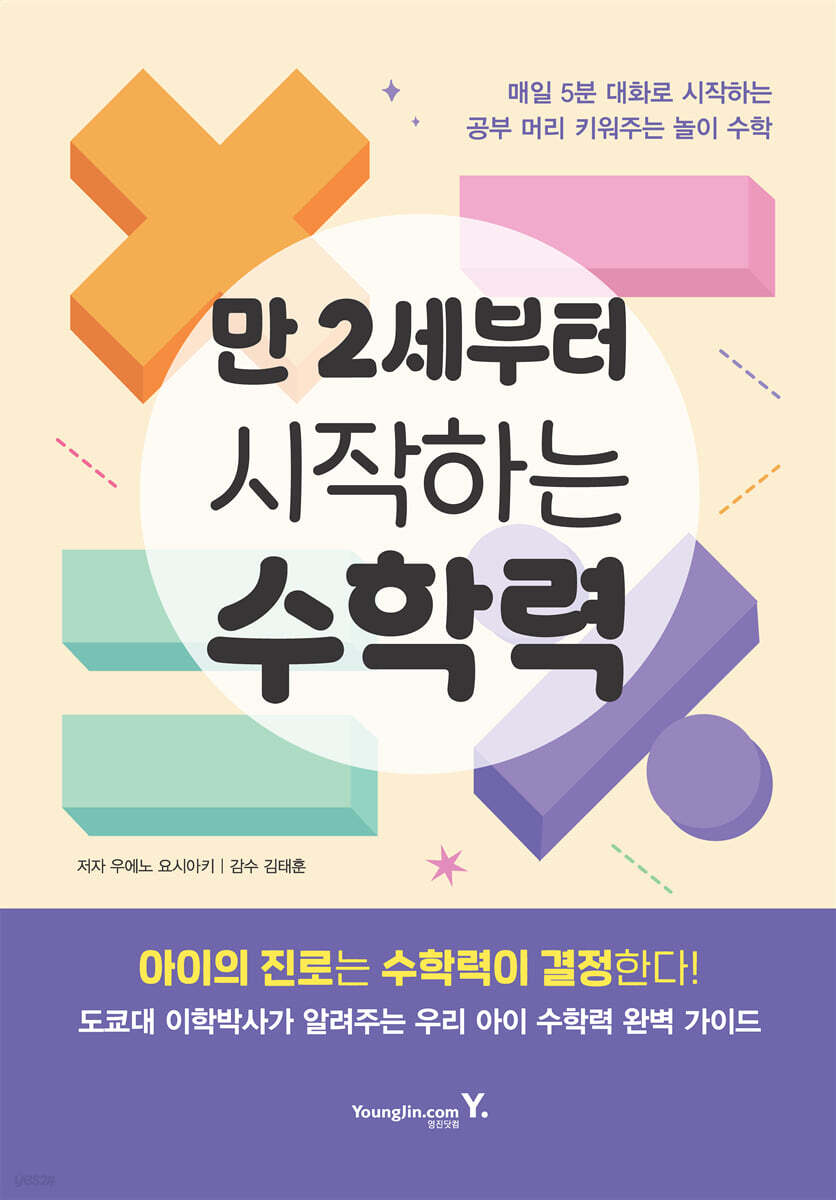
Math skills starting at age 2
 |
Description
Book Introduction
If a two-year-old child knows 1+1 but not 1-1, it means that their math skills are lacking.
Math skills are not about whether you are good or bad at arithmetic operations.
Mathematical skills are developed through the 'process of inquiry' of seeing with one's eyes, touching with one's hands, and experiencing.
Children from two years of age to preschool age are in the midst of a mathematical exploration process.
By making good use of that time and experiencing math as 'play' rather than knowledge, children can grow into children who are truly good at math and have mathematical ability.
"Math Skills Starting at Age 2" is a complete guide to math skills for parents of children aged 2 to 6, compiled by the author, who holds a Ph.D. in Science from the University of Tokyo, based on his 35 years of experience in math education.
The mathematical ability the author speaks of does not lie in repetitive calculations or simple memorization.
They say that you can discover your child's potential in very everyday situations, such as during a meal or a short five-minute conversation before bed.
If you're having fried rice for lunch, you might ask, "How many ingredients are in the fried rice?" or, before going to bed, ask, "What's the biggest toy in the house?"
When these kinds of conversations that instill mathematical concepts become a regular part of children's lives, they will naturally develop the mathematical ability to distinguish between numbers and the sizes of objects.
Chapter 1 introduces games that foster interest in numbers, such as finding numbers or saying your favorite number. Chapter 2 develops a three-dimensional sense by finding various shapes such as circles, triangles, and squares and feeling lines and shapes.
Furthermore, in Chapter 3, you will learn how to discover patterns in continuous patterns, and in Chapter 4, you will learn how to think more deeply and predict based on these patterns, thus completing the final stage of strengthening your mathematical skills.
Math skills are not about whether you are good or bad at arithmetic operations.
Mathematical skills are developed through the 'process of inquiry' of seeing with one's eyes, touching with one's hands, and experiencing.
Children from two years of age to preschool age are in the midst of a mathematical exploration process.
By making good use of that time and experiencing math as 'play' rather than knowledge, children can grow into children who are truly good at math and have mathematical ability.
"Math Skills Starting at Age 2" is a complete guide to math skills for parents of children aged 2 to 6, compiled by the author, who holds a Ph.D. in Science from the University of Tokyo, based on his 35 years of experience in math education.
The mathematical ability the author speaks of does not lie in repetitive calculations or simple memorization.
They say that you can discover your child's potential in very everyday situations, such as during a meal or a short five-minute conversation before bed.
If you're having fried rice for lunch, you might ask, "How many ingredients are in the fried rice?" or, before going to bed, ask, "What's the biggest toy in the house?"
When these kinds of conversations that instill mathematical concepts become a regular part of children's lives, they will naturally develop the mathematical ability to distinguish between numbers and the sizes of objects.
Chapter 1 introduces games that foster interest in numbers, such as finding numbers or saying your favorite number. Chapter 2 develops a three-dimensional sense by finding various shapes such as circles, triangles, and squares and feeling lines and shapes.
Furthermore, in Chapter 3, you will learn how to discover patterns in continuous patterns, and in Chapter 4, you will learn how to think more deeply and predict based on these patterns, thus completing the final stage of strengthening your mathematical skills.
- You can preview some of the book's contents.
Preview
index
Chapter 1.
Words that foster 'interest in numbers'
01 Numbers overflowing in everyday life
● Try the number finding game
“Look, there’s a 4 over there.”
02 Get familiar with numbers
● Create opportunities to count numbers
“How many ingredients go into fried rice?
03 Shall we experiment with a scale today?
● Anticipate and experiment
“If I grow taller, will I gain weight?”
04 Number indicating order
● Ask about the order
“Shall I tell you my favorite number?”
05 From addition to subtraction
● Let's think together
“How many will there be if we combine them?”
“How many times can 5 and 2 be divided?”
06 '1+1=2' might not be the case, right?
● Listen to the children's stories
“Oh my, could it be '1'?”
07 Studying How to Converse
● Have fun playing
“So, what should we do?”
08 What is '1/2'?
● Talk about sharing
“Half is also called ‘1/2.’”
09 How many invisible blocks are there?
● Imagine an invisible place
“There’s another one down here.”
10 Which hand is it in?
● Learn to distinguish numbers
“How many are there in this one?”
Chapter 2.
Words that foster 'interest in form'
01 Drawing a line
● Draw more lines
“What kind of picture is this?”
02 Remember the shape names
● Find various shapes
“Shall we find something round and bring it to you?”
03 Connect the dots game
● Draw a shape
“What would it look like if we connected the dots?”
04 Decrypting the Password
● Play with the map
“How should I go?”
05 Developing three-dimensional sense
● Hold it in your hand and play with it
“What does it look like from the front?” “What does it look like from above?”
06 Developing spatial perception skills
● Walk around inside the 3D space
“Which way is there an elevator?”
07 Find repeating shapes
● Find the rhythm
“It looks interesting.
“What name would be good?”
08 Symmetrical Shape ①
● Fold and cut the paper
“What will it look like? I’m looking forward to it.”
09 Symmetrical Shape ②
● Fold, fold, and cut the paper.
“If you unfold it, it might take on a completely different shape.”
10 Feel the lines and shapes
● Describe the shape in words
“What does this look like?”
Chapter 3.
Words that find 'regularity'
01 Play for observation and discovery
● Discover something new
“It’s the same hydrangea, but the flower colors are different.”
02 Developing pattern recognition skills
● Find the pattern
“What color will come out next?”
03 Developing Creativity
● Change the rules
“How about changing the method a little?”
04 Adding the experience of feeling “I see!”
● Find hidden perspectives
“How many were there just now?”
05 Creating something new
● Create fun patterns
“What kind of patterns can I make?”
06 Knowing the order of queuing
● Find the rules
“Okay, what will be the next shape?”
07 Creating various shapes
● Play with blocks
“Can you make a shape like this?”
08 Finding the Out of the Crowd
● Find something unique
“Is there just one thing different?”
Chapter 4: Words that Develop the Power of Thinking
01 Leading to thinking
● Let's think together
“What should I do?”
02 Failure is the driving force behind success
● Praise them even when they fail
“You thought about it again.”
03 There are several ways
● Find another answer
“Isn’t there another way?”
04 Don't give up even if you don't know
● Think for yourself
“You can do it if you think about it carefully, even if you don’t learn.”
05 There is value in wrong predictions
● Think again
“Shall we take a guess?”
Words that foster 'interest in numbers'
01 Numbers overflowing in everyday life
● Try the number finding game
“Look, there’s a 4 over there.”
02 Get familiar with numbers
● Create opportunities to count numbers
“How many ingredients go into fried rice?
03 Shall we experiment with a scale today?
● Anticipate and experiment
“If I grow taller, will I gain weight?”
04 Number indicating order
● Ask about the order
“Shall I tell you my favorite number?”
05 From addition to subtraction
● Let's think together
“How many will there be if we combine them?”
“How many times can 5 and 2 be divided?”
06 '1+1=2' might not be the case, right?
● Listen to the children's stories
“Oh my, could it be '1'?”
07 Studying How to Converse
● Have fun playing
“So, what should we do?”
08 What is '1/2'?
● Talk about sharing
“Half is also called ‘1/2.’”
09 How many invisible blocks are there?
● Imagine an invisible place
“There’s another one down here.”
10 Which hand is it in?
● Learn to distinguish numbers
“How many are there in this one?”
Chapter 2.
Words that foster 'interest in form'
01 Drawing a line
● Draw more lines
“What kind of picture is this?”
02 Remember the shape names
● Find various shapes
“Shall we find something round and bring it to you?”
03 Connect the dots game
● Draw a shape
“What would it look like if we connected the dots?”
04 Decrypting the Password
● Play with the map
“How should I go?”
05 Developing three-dimensional sense
● Hold it in your hand and play with it
“What does it look like from the front?” “What does it look like from above?”
06 Developing spatial perception skills
● Walk around inside the 3D space
“Which way is there an elevator?”
07 Find repeating shapes
● Find the rhythm
“It looks interesting.
“What name would be good?”
08 Symmetrical Shape ①
● Fold and cut the paper
“What will it look like? I’m looking forward to it.”
09 Symmetrical Shape ②
● Fold, fold, and cut the paper.
“If you unfold it, it might take on a completely different shape.”
10 Feel the lines and shapes
● Describe the shape in words
“What does this look like?”
Chapter 3.
Words that find 'regularity'
01 Play for observation and discovery
● Discover something new
“It’s the same hydrangea, but the flower colors are different.”
02 Developing pattern recognition skills
● Find the pattern
“What color will come out next?”
03 Developing Creativity
● Change the rules
“How about changing the method a little?”
04 Adding the experience of feeling “I see!”
● Find hidden perspectives
“How many were there just now?”
05 Creating something new
● Create fun patterns
“What kind of patterns can I make?”
06 Knowing the order of queuing
● Find the rules
“Okay, what will be the next shape?”
07 Creating various shapes
● Play with blocks
“Can you make a shape like this?”
08 Finding the Out of the Crowd
● Find something unique
“Is there just one thing different?”
Chapter 4: Words that Develop the Power of Thinking
01 Leading to thinking
● Let's think together
“What should I do?”
02 Failure is the driving force behind success
● Praise them even when they fail
“You thought about it again.”
03 There are several ways
● Find another answer
“Isn’t there another way?”
04 Don't give up even if you don't know
● Think for yourself
“You can do it if you think about it carefully, even if you don’t learn.”
05 There is value in wrong predictions
● Think again
“Shall we take a guess?”
Detailed image

Publisher's Review
How should I talk to my child?
It should be a question that fosters the 'bud' of the power to think and the power to seek!
“How many are in this?”
“If you connect the dots, what will it look like?”
“Can you make a shape exactly like this?”
"Mathematics Skills Starting at Age 2" focuses on the fact that parents should read to their children and continuously speak to them in a way that can nurture their children's mathematical skills.
Above all, it is important to remember that a child's mathematical potential is limitless.
Children are born curious about mathematics.
I am interested in 'shapes' such as circles, triangles, and squares, as well as 'directions' such as front-back-left-right, and the 'number' of pieces of cake or apples on a plate.
In this case, the author says, “Let’s do some subtraction.
We advise against asking questions like, “If Mom takes one from here, how many will be left?” or “Is Dad on the right or the left now?”
He also emphasizes that in mathematics, there are countless correct answers, and that it is important to remember that the 'process' of finding the correct answer is more important than getting the right answer.
Phrases like “What should we do?” and “Let’s think about it together?” will be a stimulus that will nurture your child’s thinking and reasoning skills.
Through "Math Skills Starting at Age 2," I hope that children will experience the power of developing critical thinking and literacy skills, rather than math education focused on entrance exams, and the power to overcome obstacles when faced with them.
It should be a question that fosters the 'bud' of the power to think and the power to seek!
“How many are in this?”
“If you connect the dots, what will it look like?”
“Can you make a shape exactly like this?”
"Mathematics Skills Starting at Age 2" focuses on the fact that parents should read to their children and continuously speak to them in a way that can nurture their children's mathematical skills.
Above all, it is important to remember that a child's mathematical potential is limitless.
Children are born curious about mathematics.
I am interested in 'shapes' such as circles, triangles, and squares, as well as 'directions' such as front-back-left-right, and the 'number' of pieces of cake or apples on a plate.
In this case, the author says, “Let’s do some subtraction.
We advise against asking questions like, “If Mom takes one from here, how many will be left?” or “Is Dad on the right or the left now?”
He also emphasizes that in mathematics, there are countless correct answers, and that it is important to remember that the 'process' of finding the correct answer is more important than getting the right answer.
Phrases like “What should we do?” and “Let’s think about it together?” will be a stimulus that will nurture your child’s thinking and reasoning skills.
Through "Math Skills Starting at Age 2," I hope that children will experience the power of developing critical thinking and literacy skills, rather than math education focused on entrance exams, and the power to overcome obstacles when faced with them.
GOODS SPECIFICS
- Date of issue: May 30, 2025
- Page count, weight, size: 176 pages | 150*210*10mm
- ISBN13: 9788931478211
You may also like
카테고리
korean


korean

![GQ KOREA Mark (Monthly): December [2025]](http://librairie.coreenne.fr/cdn/shop/files/8ef265dbbfbf186523ed75ba7319009d.jpg?v=1765340328&width=3840)


