

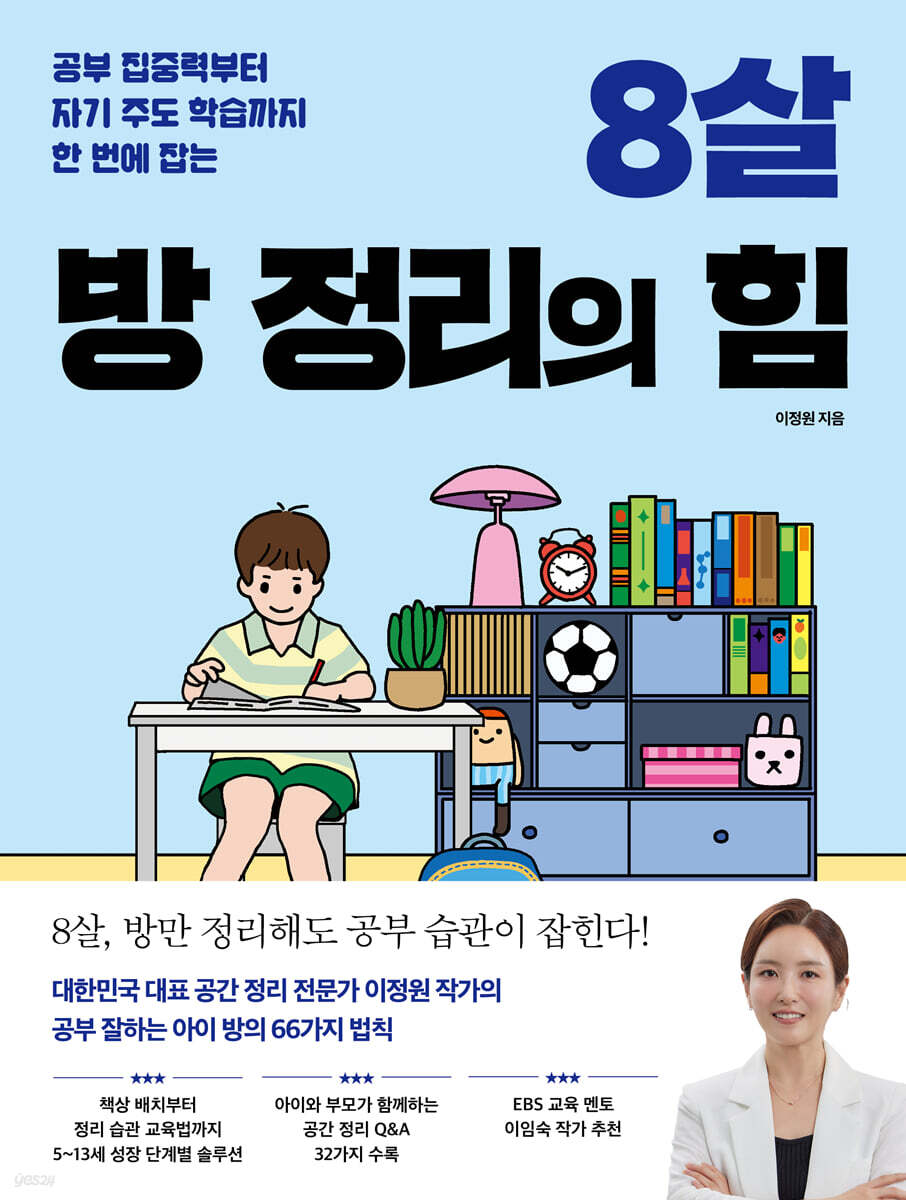
The Power of Organizing an 8-Year-Old's Room
 |
Description
Book Introduction
“If you just keep your room tidy, your child will start studying on his own.”
***Korea's leading space management expert
***The Hot Topic: Wadiz Funding Reached 2,590%
***Highly recommended by EBS parenting mentor, author Im Sook Lee!
Organizing a child's room is a difficult problem for parents in Korea.
No matter how much you nag your child to “clean up!”, he or she will not budge, and the room you barely manage to clean up will become a mess again in just one day.
Eventually, the parents, unable to bear it any longer, clean it up for the child, but the child does not change at all.
'Will my child be able to concentrate in an unorganized space? What if his grades drop?' Parents' worries only deepen.
《8 Year Old, The Power of Tidying Up》 presents a solution to break the vicious cycle of tidying up and nagging.
The saying, “Organizing is the beginning of studying” may sound a bit unfamiliar.
But this book persuasively proves its point through solid practice and numerous real-life examples.
The author, a leading space expert in Korea who has transformed the daily lives of 5,000 households and who garnered attention by achieving 2,590% of the funding goal on Wadiz, introduces 66 organizing principles for creating a "children's room where they can study well" in this book.
The author emphasizes that elementary school children, especially those aged 8, are the "golden time" for developing both organizational and study habits.
This is the time when children first have their own room and desk and begin to take some initiative in their lives, and it is also a time when the desire to manage their own belongings naturally grows.
If you develop the habit of organizing during this period, you will be able to plan your studies on your own and take initiative.
This book introduces specific methods to develop just such organizing habits.
It's packed with practical strategies for perfecting your child's study environment, from arranging a playroom to foster creativity, to arranging bookshelves to keep books close by, to making organizing fun, to organizing a desk to improve concentration.
Above all, its greatest strength is that it contains practical organizing methods that anyone can easily follow without expensive interior design.
It also includes a self-diagnosis checklist for parents on organizing habits, a list of our home inventory, and a family organizing routine chart to help expand organizing habits into the daily lives of the entire family.
Let's use this book as a guide to start making small changes in your child's room.
Before you know it, your child will be sitting at a neat desk and immersed in his or her studies.
***Korea's leading space management expert
***The Hot Topic: Wadiz Funding Reached 2,590%
***Highly recommended by EBS parenting mentor, author Im Sook Lee!
Organizing a child's room is a difficult problem for parents in Korea.
No matter how much you nag your child to “clean up!”, he or she will not budge, and the room you barely manage to clean up will become a mess again in just one day.
Eventually, the parents, unable to bear it any longer, clean it up for the child, but the child does not change at all.
'Will my child be able to concentrate in an unorganized space? What if his grades drop?' Parents' worries only deepen.
《8 Year Old, The Power of Tidying Up》 presents a solution to break the vicious cycle of tidying up and nagging.
The saying, “Organizing is the beginning of studying” may sound a bit unfamiliar.
But this book persuasively proves its point through solid practice and numerous real-life examples.
The author, a leading space expert in Korea who has transformed the daily lives of 5,000 households and who garnered attention by achieving 2,590% of the funding goal on Wadiz, introduces 66 organizing principles for creating a "children's room where they can study well" in this book.
The author emphasizes that elementary school children, especially those aged 8, are the "golden time" for developing both organizational and study habits.
This is the time when children first have their own room and desk and begin to take some initiative in their lives, and it is also a time when the desire to manage their own belongings naturally grows.
If you develop the habit of organizing during this period, you will be able to plan your studies on your own and take initiative.
This book introduces specific methods to develop just such organizing habits.
It's packed with practical strategies for perfecting your child's study environment, from arranging a playroom to foster creativity, to arranging bookshelves to keep books close by, to making organizing fun, to organizing a desk to improve concentration.
Above all, its greatest strength is that it contains practical organizing methods that anyone can easily follow without expensive interior design.
It also includes a self-diagnosis checklist for parents on organizing habits, a list of our home inventory, and a family organizing routine chart to help expand organizing habits into the daily lives of the entire family.
Let's use this book as a guide to start making small changes in your child's room.
Before you know it, your child will be sitting at a neat desk and immersed in his or her studies.
- You can preview some of the book's contents.
Preview
index
· To the readers of this book | 8 years old, studying becomes easier just by tidying up the room?
· Prologue | When Space Changes, So Does the Child
Part 1.
Looking at the home landscape reveals the child's future.
Space shapes a child's study habits.
A good memory begins with organization.
Why Children Don't Develop Neatness
At what age do you start to get the habit of organizing?
Your surroundings shape your personality.
A child studying in the living room vs.
What's the best environment for a child studying at home?
★Space Wizard's Core TIP ① 25 Pyeong Eunho's: Would you be happy if your living room became a reading room?
★Space Wizard's Core Tip ② 19-Pyeong Jaein's: Space Layout Solutions Based on Your Child's Personality
★Space Wizard's Key Tip ③ Parents' Tidying Habits Self-Diagnosis Checklist
★Q&A on Organizing Spaces for Kids and Parents: Organizing Habits
Tidying Up Habits | What's the Key to Getting Your Child to Tidy Up?
Overcoming Organizing Disturbances | How to Get Your Child to Dislike Organizing
The habit of hoarding | How to organize a child who collects rather than throws away things?
Maintaining a Tidy Habit | What's the Key to Keeping Your Space Organized for Longer?
Kids' Room Interior | How to Arrange Furniture to Help You Get Organized
Organizing Kids' Shoes | How to Keep Shoes From Getting Scattered Around
Bed Making | How to Help Your Child Make Their Own Bed
Family Practice | What are some organizing habits that the whole family can practice together?
Part 2.
Ages 5-13: The Secret to Organizing Your Room by Age
The Establishment Period | Ages 5-6: There's a Reason for the Playroom's Structure
Challenges of Change | 7-9 Year Olds: A Successful Transformation into a Study Room
Self-Leaping Stage | The Secret of Study Rooms That Boost Study Ability for 9-11 Year Olds
Concentration Sustainment Period | Ages 12-13: There's a study environment tailored to your child's personality.
★Space Wizard's Core TIP ④ 40 Pyeong Jeongju: I want to make a room for my twin brothers.
★Space Wizard's Core TIP ⑤ 35 Pyeong Same: Should I pass on my middle school child's belongings to his younger sibling?
★Q&A on Organizing Spaces for Parents and Children: Children's Rooms
Kids' Room Design | How to Effectively Separate Study and Play Spaces
Organizing Your Play Space | How to Get Your Child to Organize Their Blocks and Puzzles
Toy Organization | How to Stop Toy Pileup and Develop Organizing Habits
Organizing Clothes | How to Efficiently Manage Kids' Clothes, Which Outgrow Them Quickly?
Tips for efficiently organizing frequently used items for children | school supplies, toys, and books
Organizing Hobby Supplies | Do you have a lot of hobby items like art supplies, Legos, and piano sheet music?
Organizing Art Supplies | How to Keep Your Child's Art Supplies Neat and Organized
Supplies | How can I help my child prepare his or her own school supplies?
Part 3.
The art of organizing your home to improve your grades
Skill 1: When children decorate their own rooms, they spend more time studying.
Skill 2: A "hard chair" is effective for developing self-control.
Skill 3 | If you want to foster creativity, don't put a bookshelf at the head of the bed.
★Space Wizard's Core Tip ⑥ Four Sisters in a 30-Pyeong House: Understanding Their Personalities Reduces Conflicts
★Space Wizard's Key Tip ⑦ Duplex Undecided Cine: Why the Dressing Room is on the Second Floor
★Q&A on Organizing Spaces for Children and Parents: Systematic Management
Sibling Space | How to Organize a Shared Space Without Conflict
Shared Bathroom Supplies | How to Organize Bathroom Supplies Shared with Siblings
Organizing Study Materials | How to Keep Printouts and Notes Organized?
Digital File Organization | How to Organize Your Child's Online Learning Materials and Photos
Study Concentration | How to Organize Your Desk to Improve Concentration
Organizing Books | My books just keep piling up. How can I organize them effectively?
Schoolbag Storage | How to Keep Your Child from Leaving His Bag Behind
Organizing | When your child has too much stuff, how can you effectively reduce it?
Part 4.
The art of interior design that makes children happy
My house is so cluttered, what should I do first?
4 Steps to Organizing with Your Family
Tidying Up Day for the Whole Family
The rule of thumb for luggage size that fits your family size
When it comes to parting with things, let your child decide first.
How to teach your child tidying habits
Interior management methods that reduce movement lines
Real home decorating techniques, from playrooms to relaxation spaces
★Space Wizard's Core TIP ⑧ 10 Ways to Develop Your Child's Habit of Tidying Up
★Q&A on Organizing Spaces for Kids and Parents: Family Routines
Family Space | How to Keep Your Living Room Tidy
Bathroom Organization | How to Organize Your Child's Toiletries and Toys Efficiently
Table Setting | What are some good ways to organize your dining area with your child?
Organizing Your Refrigerator | How to Organize Your Kids' Snacks for Easy Access at a Glance
Organizing Seasonal Items | How to Store Winter and Summer Clothes Neatly
Organizing Home Documents | How to Organize Family Newsletters, Your Child's Report Cards, and Hospital Records
Car Organization | How to Keep Your Car from Getting Clogged with Toys and Snacks
Travel Luggage Packing | How to Pack Effectively for Travel with Kids
Epilogue | Children learn about life by organizing their belongings.
· Prologue | When Space Changes, So Does the Child
Part 1.
Looking at the home landscape reveals the child's future.
Space shapes a child's study habits.
A good memory begins with organization.
Why Children Don't Develop Neatness
At what age do you start to get the habit of organizing?
Your surroundings shape your personality.
A child studying in the living room vs.
What's the best environment for a child studying at home?
★Space Wizard's Core TIP ① 25 Pyeong Eunho's: Would you be happy if your living room became a reading room?
★Space Wizard's Core Tip ② 19-Pyeong Jaein's: Space Layout Solutions Based on Your Child's Personality
★Space Wizard's Key Tip ③ Parents' Tidying Habits Self-Diagnosis Checklist
★Q&A on Organizing Spaces for Kids and Parents: Organizing Habits
Tidying Up Habits | What's the Key to Getting Your Child to Tidy Up?
Overcoming Organizing Disturbances | How to Get Your Child to Dislike Organizing
The habit of hoarding | How to organize a child who collects rather than throws away things?
Maintaining a Tidy Habit | What's the Key to Keeping Your Space Organized for Longer?
Kids' Room Interior | How to Arrange Furniture to Help You Get Organized
Organizing Kids' Shoes | How to Keep Shoes From Getting Scattered Around
Bed Making | How to Help Your Child Make Their Own Bed
Family Practice | What are some organizing habits that the whole family can practice together?
Part 2.
Ages 5-13: The Secret to Organizing Your Room by Age
The Establishment Period | Ages 5-6: There's a Reason for the Playroom's Structure
Challenges of Change | 7-9 Year Olds: A Successful Transformation into a Study Room
Self-Leaping Stage | The Secret of Study Rooms That Boost Study Ability for 9-11 Year Olds
Concentration Sustainment Period | Ages 12-13: There's a study environment tailored to your child's personality.
★Space Wizard's Core TIP ④ 40 Pyeong Jeongju: I want to make a room for my twin brothers.
★Space Wizard's Core TIP ⑤ 35 Pyeong Same: Should I pass on my middle school child's belongings to his younger sibling?
★Q&A on Organizing Spaces for Parents and Children: Children's Rooms
Kids' Room Design | How to Effectively Separate Study and Play Spaces
Organizing Your Play Space | How to Get Your Child to Organize Their Blocks and Puzzles
Toy Organization | How to Stop Toy Pileup and Develop Organizing Habits
Organizing Clothes | How to Efficiently Manage Kids' Clothes, Which Outgrow Them Quickly?
Tips for efficiently organizing frequently used items for children | school supplies, toys, and books
Organizing Hobby Supplies | Do you have a lot of hobby items like art supplies, Legos, and piano sheet music?
Organizing Art Supplies | How to Keep Your Child's Art Supplies Neat and Organized
Supplies | How can I help my child prepare his or her own school supplies?
Part 3.
The art of organizing your home to improve your grades
Skill 1: When children decorate their own rooms, they spend more time studying.
Skill 2: A "hard chair" is effective for developing self-control.
Skill 3 | If you want to foster creativity, don't put a bookshelf at the head of the bed.
★Space Wizard's Core Tip ⑥ Four Sisters in a 30-Pyeong House: Understanding Their Personalities Reduces Conflicts
★Space Wizard's Key Tip ⑦ Duplex Undecided Cine: Why the Dressing Room is on the Second Floor
★Q&A on Organizing Spaces for Children and Parents: Systematic Management
Sibling Space | How to Organize a Shared Space Without Conflict
Shared Bathroom Supplies | How to Organize Bathroom Supplies Shared with Siblings
Organizing Study Materials | How to Keep Printouts and Notes Organized?
Digital File Organization | How to Organize Your Child's Online Learning Materials and Photos
Study Concentration | How to Organize Your Desk to Improve Concentration
Organizing Books | My books just keep piling up. How can I organize them effectively?
Schoolbag Storage | How to Keep Your Child from Leaving His Bag Behind
Organizing | When your child has too much stuff, how can you effectively reduce it?
Part 4.
The art of interior design that makes children happy
My house is so cluttered, what should I do first?
4 Steps to Organizing with Your Family
Tidying Up Day for the Whole Family
The rule of thumb for luggage size that fits your family size
When it comes to parting with things, let your child decide first.
How to teach your child tidying habits
Interior management methods that reduce movement lines
Real home decorating techniques, from playrooms to relaxation spaces
★Space Wizard's Core TIP ⑧ 10 Ways to Develop Your Child's Habit of Tidying Up
★Q&A on Organizing Spaces for Kids and Parents: Family Routines
Family Space | How to Keep Your Living Room Tidy
Bathroom Organization | How to Organize Your Child's Toiletries and Toys Efficiently
Table Setting | What are some good ways to organize your dining area with your child?
Organizing Your Refrigerator | How to Organize Your Kids' Snacks for Easy Access at a Glance
Organizing Seasonal Items | How to Store Winter and Summer Clothes Neatly
Organizing Home Documents | How to Organize Family Newsletters, Your Child's Report Cards, and Hospital Records
Car Organization | How to Keep Your Car from Getting Clogged with Toys and Snacks
Travel Luggage Packing | How to Pack Effectively for Travel with Kids
Epilogue | Children learn about life by organizing their belongings.
Detailed image

Into the book
A child knows that he or she cannot have everything, and he or she knows what is more precious to him or her.
It is not easy for growing children to know their own minds.
Tidying up creates moments of 'choice' in a child's daily life.
It's about instilling in children a sense of responsibility for their belongings and developing the ability to prioritize.
--- p.16
In order to foster the habit of organizing children's spaces, the role of parents is most important.
Simply nagging someone to “clean up your room!” won’t help them develop the habit of tidying up.
Instead, parents need to show their children how to organize their space together and make an effort to help them understand the necessity and importance of organization.
During this process of organizing, it is important for parents and children to talk together and encourage children to manage their own space.
--- p.29
Books, unlike toys, should be displayed throughout the home.
The key is to use several small bookshelves to give your child the experience of "taking a book off the shelf and reading it."
We recommend front-facing bookshelves and rotating bookshelves that display book covers well.
The reason I recommend a revolving bookshelf is because your child will have fun turning the bookshelf to select books.
For children who hate reading, placing a rotating bookshelf in the living room can be a good way to make reading more like play.
--- p.65
“Let’s just keep it to ten of us.
It's up to you to decide which pieces to keep.
But let's promise not to exceed 10." If you set specific criteria and let your child choose, he or she will use his or her own judgment to decide which items to keep.
You can approach tidying up with a much more positive attitude than simply saying, “Throw it away!”
Children who have decision-making power are surprisingly proactive in organizing.
--- p.116
Many parents believe that the larger the play space, the better, but in reality, the smaller the play space, the easier it is for children to manage on their own.
In a small space, children can easily develop the habit of putting their toys away after playing, and the burden on parents to manage them is also reduced.
Conversely, if the play area is too large, it will take children a long time to recognize and become familiar with the space, and both parents and children may tire easily.
It is not easy for growing children to know their own minds.
Tidying up creates moments of 'choice' in a child's daily life.
It's about instilling in children a sense of responsibility for their belongings and developing the ability to prioritize.
--- p.16
In order to foster the habit of organizing children's spaces, the role of parents is most important.
Simply nagging someone to “clean up your room!” won’t help them develop the habit of tidying up.
Instead, parents need to show their children how to organize their space together and make an effort to help them understand the necessity and importance of organization.
During this process of organizing, it is important for parents and children to talk together and encourage children to manage their own space.
--- p.29
Books, unlike toys, should be displayed throughout the home.
The key is to use several small bookshelves to give your child the experience of "taking a book off the shelf and reading it."
We recommend front-facing bookshelves and rotating bookshelves that display book covers well.
The reason I recommend a revolving bookshelf is because your child will have fun turning the bookshelf to select books.
For children who hate reading, placing a rotating bookshelf in the living room can be a good way to make reading more like play.
--- p.65
“Let’s just keep it to ten of us.
It's up to you to decide which pieces to keep.
But let's promise not to exceed 10." If you set specific criteria and let your child choose, he or she will use his or her own judgment to decide which items to keep.
You can approach tidying up with a much more positive attitude than simply saying, “Throw it away!”
Children who have decision-making power are surprisingly proactive in organizing.
--- p.116
Many parents believe that the larger the play space, the better, but in reality, the smaller the play space, the easier it is for children to manage on their own.
In a small space, children can easily develop the habit of putting their toys away after playing, and the burden on parents to manage them is also reduced.
Conversely, if the play area is too large, it will take children a long time to recognize and become familiar with the space, and both parents and children may tire easily.
--- p.216
Publisher's Review
“My daughter, who never sat down at her desk, reads books every day.”
The power of organization leads to essential learning skills, from focus to creativity.
“I just cleaned up my child’s room, and he changed.” This is a common story shared by parents who have tried “The Power of Tidying Up an 8-Year-Old’s Room” first.
So what changes does organizing make to a child's learning ability?
First, organizing fosters children's 'initiative for learning.'
Self-directed learning requires the ability to act and regulate one's own motivation, and the experience of organizing things oneself provides children with a small opportunity to "solve problems."
Deciding what to put where and managing your own space empowers you to design your own daily life.
Especially around the age of 8, children first begin to recognize and manage their own space. If they develop organizational habits during this period, they will be less distracted and will naturally develop an attitude of immersion in their studies.
Second, an organized environment creates ‘appropriate tension.’
A good study space isn't just a quiet place.
We need an atmosphere that maintains a sense of tension that promotes concentration, like a library or reading room.
Even at home, if the desk is tidy, the child will naturally recognize that now is the time to focus.
In fact, many studies report that a short decluttering session before starting to study is effective in increasing attention and helping with concentration.
Third, organization becomes a tool to foster creativity.
The process of children deciding on the location of books, toys, and furniture and arranging their space is a valuable opportunity that goes beyond simple organization and fosters spatial perception, combination skills, and judgment.
The experience of classifying objects according to one's own standards and organizing space in one's own way provides important foundations for creative thinking in children.
Organization isn't just about being neat and tidy.
It's a surprisingly simple yet powerful starting point for developing your child's ability to focus, plan independently, and think creatively.
Let's develop children's essential learning skills through the everyday act of organizing and create an environment where children can immerse themselves in their studies.
This book will be the most realistic guide to that change.
“I can control my child’s concentration by organizing his/her room!”
An elementary school study room solution developed through analysis of 5,000 households and real-world case studies.
The early elementary school years are an important time when the first habits learned become lifelong attitudes.
Just as the integrated curriculum for first grade elementary school emphasizes the rules and promises to be kept for organization, organization is not just a life skill; it is also the starting point of education.
Helping children manage their own space is an important foundation for developing self-direction and a sense of rhythm, but simply telling them to "clean up" rarely changes a child's behavior.
You need to teach them what to organize and how to organize it, why they should do it themselves, and help them practice it at their level.
"8 Year Old, The Power of Organizing Your Room" is a book that contains the principles and methods of organizing a study room, along with specific examples, photos, structural diagrams, and practical tips, based on the know-how of a space expert who analyzed the actual organizing cases of 5,000 households.
From a cramped study room shared by middle school brothers in a 25-pyeong apartment to a complex playroom for twin brothers in a 40-pyeong apartment, the book introduces the transformation of various household spaces with before-and-after comparison photos, and suggests organizing solutions that can be implemented even without interior design.
The author, who also teaches specialized organizing courses, has included 66 customized organizing strategies in the book that take into account not only the skills of organizing items but also the child's lifestyle and tendencies, space structure, and even the family's lifestyle patterns.
Additionally, the 36 'Tidying Up Q&As with Children and Parents' included in each chapter provide clear answers to practical concerns such as, "How do I persuade a child who hates organizing?" and "How do I help a child who keeps collecting things?"
If you want to foster your child's concentration and autonomy, reduce parental nagging, and create a learning environment where the whole family can breathe comfortably, "The Power of Organizing an 8-Year-Old's Room" has the answer.
From desk arrangement to study room storage,
The Best Study Room Roadmap for Ages 5-13
This book goes beyond simple organizing methods and presents specific standards for organizing a study room tailored to a child's developmental stage.
Focusing on the age of 8, which is a good time to establish the habit of organizing, we introduce space organization and organizing methods according to the child's developmental stage from 5 to 13 years old, helping parents put these methods into practice without missing out on their child's growth.
The 'Stability Formation Period (ages 5-6)' is when children begin to naturally acquire organizational habits through play.
At this age, it is important to organize the room by choosing storage units that are at the child's eye level and take safety into consideration.
During the 'Change Challenge Period (ages 7-9),' encourage your child to do activities they like at the desk and help them slowly get used to the desk.
When children enter the 'self-leap period (ages 9-11),' they can develop autonomy and responsibility by reducing unnecessary items and having them sort and store their precious items themselves.
The key to sustained attention span (ages 12-13) is respecting the child's privacy and preferences.
Forcing children to clean their rooms or taking control of them during this period can weaken their motivation and self-directed learning skills that they will later develop.
The author presents specific strategies for organizing and organizing study rooms by age based on organizing principles that take into account the child's developmental stage, emotions, and daily rhythm.
This book contains a study room roadmap tailored to your child's growth, from desk layout to storage and space utilization.
As you follow the process, you will realize that organizing is the most concrete practice that helps children understand their daily lives and grow on their own.
The power of organization leads to essential learning skills, from focus to creativity.
“I just cleaned up my child’s room, and he changed.” This is a common story shared by parents who have tried “The Power of Tidying Up an 8-Year-Old’s Room” first.
So what changes does organizing make to a child's learning ability?
First, organizing fosters children's 'initiative for learning.'
Self-directed learning requires the ability to act and regulate one's own motivation, and the experience of organizing things oneself provides children with a small opportunity to "solve problems."
Deciding what to put where and managing your own space empowers you to design your own daily life.
Especially around the age of 8, children first begin to recognize and manage their own space. If they develop organizational habits during this period, they will be less distracted and will naturally develop an attitude of immersion in their studies.
Second, an organized environment creates ‘appropriate tension.’
A good study space isn't just a quiet place.
We need an atmosphere that maintains a sense of tension that promotes concentration, like a library or reading room.
Even at home, if the desk is tidy, the child will naturally recognize that now is the time to focus.
In fact, many studies report that a short decluttering session before starting to study is effective in increasing attention and helping with concentration.
Third, organization becomes a tool to foster creativity.
The process of children deciding on the location of books, toys, and furniture and arranging their space is a valuable opportunity that goes beyond simple organization and fosters spatial perception, combination skills, and judgment.
The experience of classifying objects according to one's own standards and organizing space in one's own way provides important foundations for creative thinking in children.
Organization isn't just about being neat and tidy.
It's a surprisingly simple yet powerful starting point for developing your child's ability to focus, plan independently, and think creatively.
Let's develop children's essential learning skills through the everyday act of organizing and create an environment where children can immerse themselves in their studies.
This book will be the most realistic guide to that change.
“I can control my child’s concentration by organizing his/her room!”
An elementary school study room solution developed through analysis of 5,000 households and real-world case studies.
The early elementary school years are an important time when the first habits learned become lifelong attitudes.
Just as the integrated curriculum for first grade elementary school emphasizes the rules and promises to be kept for organization, organization is not just a life skill; it is also the starting point of education.
Helping children manage their own space is an important foundation for developing self-direction and a sense of rhythm, but simply telling them to "clean up" rarely changes a child's behavior.
You need to teach them what to organize and how to organize it, why they should do it themselves, and help them practice it at their level.
"8 Year Old, The Power of Organizing Your Room" is a book that contains the principles and methods of organizing a study room, along with specific examples, photos, structural diagrams, and practical tips, based on the know-how of a space expert who analyzed the actual organizing cases of 5,000 households.
From a cramped study room shared by middle school brothers in a 25-pyeong apartment to a complex playroom for twin brothers in a 40-pyeong apartment, the book introduces the transformation of various household spaces with before-and-after comparison photos, and suggests organizing solutions that can be implemented even without interior design.
The author, who also teaches specialized organizing courses, has included 66 customized organizing strategies in the book that take into account not only the skills of organizing items but also the child's lifestyle and tendencies, space structure, and even the family's lifestyle patterns.
Additionally, the 36 'Tidying Up Q&As with Children and Parents' included in each chapter provide clear answers to practical concerns such as, "How do I persuade a child who hates organizing?" and "How do I help a child who keeps collecting things?"
If you want to foster your child's concentration and autonomy, reduce parental nagging, and create a learning environment where the whole family can breathe comfortably, "The Power of Organizing an 8-Year-Old's Room" has the answer.
From desk arrangement to study room storage,
The Best Study Room Roadmap for Ages 5-13
This book goes beyond simple organizing methods and presents specific standards for organizing a study room tailored to a child's developmental stage.
Focusing on the age of 8, which is a good time to establish the habit of organizing, we introduce space organization and organizing methods according to the child's developmental stage from 5 to 13 years old, helping parents put these methods into practice without missing out on their child's growth.
The 'Stability Formation Period (ages 5-6)' is when children begin to naturally acquire organizational habits through play.
At this age, it is important to organize the room by choosing storage units that are at the child's eye level and take safety into consideration.
During the 'Change Challenge Period (ages 7-9),' encourage your child to do activities they like at the desk and help them slowly get used to the desk.
When children enter the 'self-leap period (ages 9-11),' they can develop autonomy and responsibility by reducing unnecessary items and having them sort and store their precious items themselves.
The key to sustained attention span (ages 12-13) is respecting the child's privacy and preferences.
Forcing children to clean their rooms or taking control of them during this period can weaken their motivation and self-directed learning skills that they will later develop.
The author presents specific strategies for organizing and organizing study rooms by age based on organizing principles that take into account the child's developmental stage, emotions, and daily rhythm.
This book contains a study room roadmap tailored to your child's growth, from desk layout to storage and space utilization.
As you follow the process, you will realize that organizing is the most concrete practice that helps children understand their daily lives and grow on their own.
GOODS SPECIFICS
- Date of issue: May 20, 2025
- Page count, weight, size: 288 pages | 170*225*20mm
- ISBN13: 9791168272927
- ISBN10: 1168272920
You may also like
카테고리
korean


korean

![GQ KOREA Mark (Monthly): December [2025]](http://librairie.coreenne.fr/cdn/shop/files/8ef265dbbfbf186523ed75ba7319009d.jpg?v=1765340328&width=3840)


