

The power to survive in the world
 |
Description
Book Introduction
In-depth learning strategies from Korea's top competency education experts.
A complete summary of the curriculum and student evaluations that have completely changed in 70 years!
For the first time in 70 years in the history of Korean education, an educational Big Bang is taking place.
However, not only parents but even teachers working in the education field are not fully aware of the contents of the curriculum innovation that is currently taking place.
If the industrial society of the past was a world where teaching and evaluation were based on 'what and how much one knew,' the current knowledge-information society is a world where teaching and evaluation are based on 'what one can do (capability).'
Companies have already recognized the importance of competency and are making it a key criterion for hiring new employees and promoting them. The Ministry of Education is also adapting to these changing circumstances by innovating its teaching and evaluation methods, from the Nuri Curriculum for kindergartens to the curriculum for elementary, middle, and high schools, to focus on competency.
This book is a helpful and detailed guide that explains in detail how competency-based curriculum, a key topic in the education world, was created in advanced countries, what its development process was like, and how it is being introduced and reflected in domestic curricula and student evaluations.
Parents who are still unfamiliar with competency-based education will gain concrete knowledge about the core concepts and content of competencies through this book. Based on this knowledge, they will understand what they need to prepare and prepare for their children's future.
A complete summary of the curriculum and student evaluations that have completely changed in 70 years!
For the first time in 70 years in the history of Korean education, an educational Big Bang is taking place.
However, not only parents but even teachers working in the education field are not fully aware of the contents of the curriculum innovation that is currently taking place.
If the industrial society of the past was a world where teaching and evaluation were based on 'what and how much one knew,' the current knowledge-information society is a world where teaching and evaluation are based on 'what one can do (capability).'
Companies have already recognized the importance of competency and are making it a key criterion for hiring new employees and promoting them. The Ministry of Education is also adapting to these changing circumstances by innovating its teaching and evaluation methods, from the Nuri Curriculum for kindergartens to the curriculum for elementary, middle, and high schools, to focus on competency.
This book is a helpful and detailed guide that explains in detail how competency-based curriculum, a key topic in the education world, was created in advanced countries, what its development process was like, and how it is being introduced and reflected in domestic curricula and student evaluations.
Parents who are still unfamiliar with competency-based education will gain concrete knowledge about the core concepts and content of competencies through this book. Based on this knowledge, they will understand what they need to prepare and prepare for their children's future.
- You can preview some of the book's contents.
Preview
index
Entering
PART 1: Looking back on myself as an adult, I see myself as a fake talent.
Looking back at myself as an adult, I see myself as a fake talent.
Dad graduated from Seoul National University, so why can't he live like this?
The era where grades and academic background guaranteed employment is over.
There is no need for students who only memorize textbook knowledge and do well on tests.
Knowledge of math and English is just a tool.
Education in advanced countries that teaches competency rather than knowledge
New curriculum in advanced country South Korea
Competency education for students from infants to elementary, middle, and high school students
Essay-based assessment that evaluates knowledge, attitude, and skills
Intelligent Information Society Education Utilizing Artificial Intelligence (AI)
Educational goals of developed countries among 8.2 billion people
PART 2: In-depth education for children in developed countries
Competency education in major advanced OECD countries
Competency Education in the 2022 Revised Curriculum
Character education that determines knowledge receptivity and life direction
Advanced educational institutions that teach competencies
How to develop six core competencies
Character education methods for developing competencies
Advanced countries' child education methods that teach competency
PART 3: The Big Map Project for In-Depth Education
Big Map Project for In-Depth Education
Infants need to receive basic character-based competency education.
Elementary school students develop their capabilities through academic classes and creative activities.
Middle school students need in-depth knowledge education and the completion of attitudes and skills.
High school students are in a period where they develop their cultivated abilities at school.
College students develop the job skills necessary for their careers.
How to Manage Your Child's Abilities Using Big Map
Let's teach children in developed countries how to live a successful life.
In conclusion
PART 1: Looking back on myself as an adult, I see myself as a fake talent.
Looking back at myself as an adult, I see myself as a fake talent.
Dad graduated from Seoul National University, so why can't he live like this?
The era where grades and academic background guaranteed employment is over.
There is no need for students who only memorize textbook knowledge and do well on tests.
Knowledge of math and English is just a tool.
Education in advanced countries that teaches competency rather than knowledge
New curriculum in advanced country South Korea
Competency education for students from infants to elementary, middle, and high school students
Essay-based assessment that evaluates knowledge, attitude, and skills
Intelligent Information Society Education Utilizing Artificial Intelligence (AI)
Educational goals of developed countries among 8.2 billion people
PART 2: In-depth education for children in developed countries
Competency education in major advanced OECD countries
Competency Education in the 2022 Revised Curriculum
Character education that determines knowledge receptivity and life direction
Advanced educational institutions that teach competencies
How to develop six core competencies
Character education methods for developing competencies
Advanced countries' child education methods that teach competency
PART 3: The Big Map Project for In-Depth Education
Big Map Project for In-Depth Education
Infants need to receive basic character-based competency education.
Elementary school students develop their capabilities through academic classes and creative activities.
Middle school students need in-depth knowledge education and the completion of attitudes and skills.
High school students are in a period where they develop their cultivated abilities at school.
College students develop the job skills necessary for their careers.
How to Manage Your Child's Abilities Using Big Map
Let's teach children in developed countries how to live a successful life.
In conclusion
Into the book
Students graduate from school and can live independent lives, no longer dependent on their parents and teachers.
As students go through school, they must understand and prepare for who they are, what kind of world they are entering and living in, and what they need to survive in that world.
School years are a time to develop the skills to survive in the world, and only by graduating from school with these skills can you experience a successful and happy life and career.
--- p.8~9
The biggest reason why people are evaluated as fake talents is because, although they were good at understanding and memorizing academic knowledge such as Korean, English, and math during their school days, they were unable to learn the skills necessary for real life and work.
For example, because they lack attitudes, values, and functions (abilities) such as the ability to understand and empathize with others, logical thinking, problem-solving, reasoning, conflict resolution, and presentation skills, they are evaluated as adults who cannot do anything, and as a result, they experience many difficulties in their careers and work life.
From the perspective of superiors or colleagues, you will inevitably be evaluated as an incompetent employee or colleague, even though you have a good personality and are smart.
--- p.20
In a society where exams dominate, students who dream of success have no choice but to focus on studying for exams.
However, as the number of students who are obsessed with studying to obtain good academic qualifications increases, high-education inflation has become a social problem, and the overflow of doctoral-level human resources has reached a point where society can no longer handle it.
To address the problem of high-education inflation, the country began shifting its education policy toward favoring highly capable students.
--- p.37
The country has set six core competencies that students must develop during their school years as educational goals, and the achievement assessment system is used to evaluate whether or not students have developed these core competencies.
The current college entrance examination system, which evaluates academic ability based on school grades, consists of the comprehensive student record screening and the academic student record screening for regular admissions.
Now, children in developed countries are learning and being evaluated on core competencies in the curriculum from early childhood through elementary, middle, and high school, and are entering university and getting a job based on these core competencies.
--- p.68
In a lecture titled “Educational Policy in the Creative Era,” the Korea Educational Development Institute emphasized the importance of creative talent and creative talent education, explaining that future society’s new talents are “those who possess character, knowledge, and core competencies and have the ability to create new and valuable ideas or products.”
--- p.98
Let's learn how to cultivate competency.
Before that, we must first understand the related terms accurately.
First, competence is defined as the power to survive in the world, that is, the power to accomplish something, and the internal characteristics of successful people. Its components are knowledge, personality (attitude, values), and function (ability).
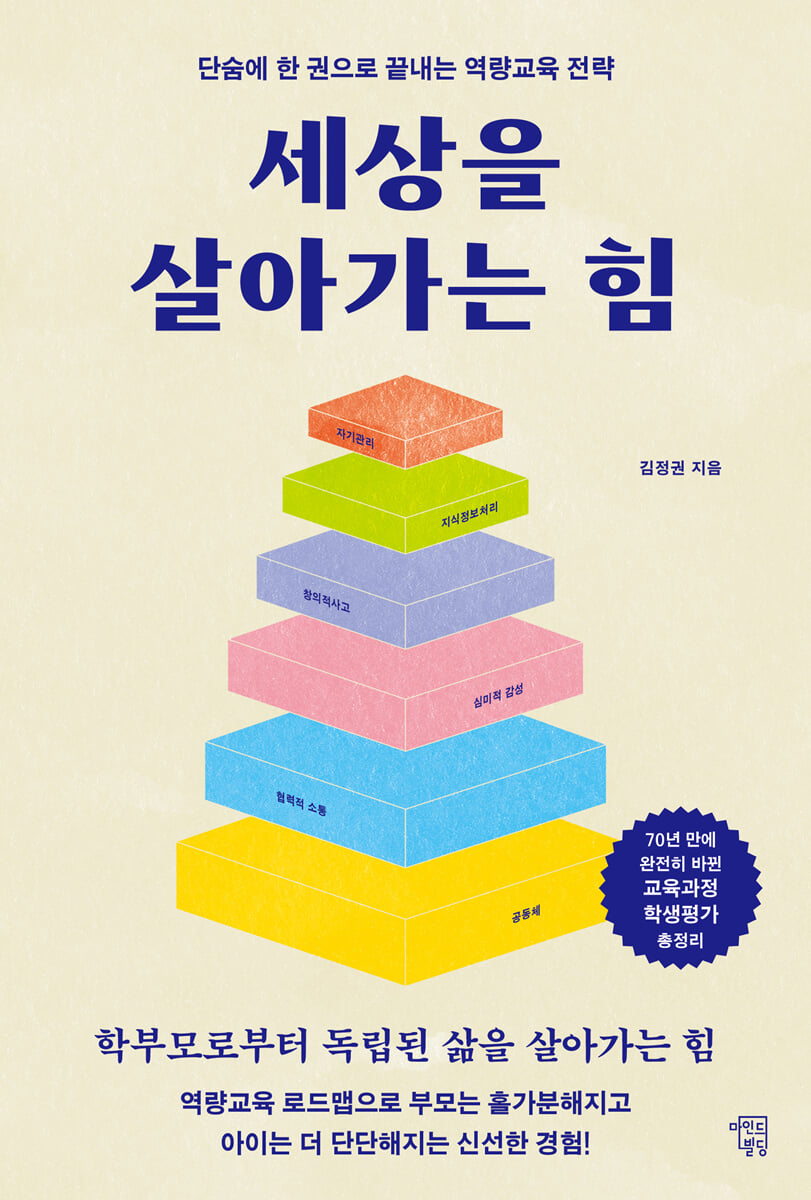
Second, core competencies are educational goals that must be cultivated through the elementary, middle, and high school curriculum. The Ministry of Education defined six core competencies (self-management competencies, knowledge and information processing competencies, creative thinking competencies, aesthetic and emotional competencies, cooperative communication competencies, and community competencies).
--- p.158
If a child did not receive proper character education in early childhood, it is unlikely that character education will develop in middle school children.
For this reason, in a time like the present when social structure and education are changing rapidly, parents' efforts are more important than anything else.
Keep in mind that it is difficult to raise children into the intelligent information society and the society of dreams with the educational methods developed in the industrial society. Therefore, it is important to select an educational institution or teacher who can accurately understand the achievement assessment system and the free semester system and teach them properly during middle school.
All evaluations in high school determine whether or not a student will advance to college.
Therefore, all preparations before the full-scale evaluation begins in high school are finalized in middle school.
--- p.293
I believe that we should never pass on the education of the older generation in developing countries to our sons and daughters who will live in the next generation.
The next generation must grow up receiving an education from an advanced country, and we must also teach the children of the next generation the same education that major advanced countries teach.
As students go through school, they must understand and prepare for who they are, what kind of world they are entering and living in, and what they need to survive in that world.
School years are a time to develop the skills to survive in the world, and only by graduating from school with these skills can you experience a successful and happy life and career.
--- p.8~9
The biggest reason why people are evaluated as fake talents is because, although they were good at understanding and memorizing academic knowledge such as Korean, English, and math during their school days, they were unable to learn the skills necessary for real life and work.
For example, because they lack attitudes, values, and functions (abilities) such as the ability to understand and empathize with others, logical thinking, problem-solving, reasoning, conflict resolution, and presentation skills, they are evaluated as adults who cannot do anything, and as a result, they experience many difficulties in their careers and work life.
From the perspective of superiors or colleagues, you will inevitably be evaluated as an incompetent employee or colleague, even though you have a good personality and are smart.
--- p.20
In a society where exams dominate, students who dream of success have no choice but to focus on studying for exams.
However, as the number of students who are obsessed with studying to obtain good academic qualifications increases, high-education inflation has become a social problem, and the overflow of doctoral-level human resources has reached a point where society can no longer handle it.
To address the problem of high-education inflation, the country began shifting its education policy toward favoring highly capable students.
--- p.37
The country has set six core competencies that students must develop during their school years as educational goals, and the achievement assessment system is used to evaluate whether or not students have developed these core competencies.
The current college entrance examination system, which evaluates academic ability based on school grades, consists of the comprehensive student record screening and the academic student record screening for regular admissions.
Now, children in developed countries are learning and being evaluated on core competencies in the curriculum from early childhood through elementary, middle, and high school, and are entering university and getting a job based on these core competencies.
--- p.68
In a lecture titled “Educational Policy in the Creative Era,” the Korea Educational Development Institute emphasized the importance of creative talent and creative talent education, explaining that future society’s new talents are “those who possess character, knowledge, and core competencies and have the ability to create new and valuable ideas or products.”
--- p.98
Let's learn how to cultivate competency.
Before that, we must first understand the related terms accurately.
First, competence is defined as the power to survive in the world, that is, the power to accomplish something, and the internal characteristics of successful people. Its components are knowledge, personality (attitude, values), and function (ability).
Second, core competencies are educational goals that must be cultivated through the elementary, middle, and high school curriculum. The Ministry of Education defined six core competencies (self-management competencies, knowledge and information processing competencies, creative thinking competencies, aesthetic and emotional competencies, cooperative communication competencies, and community competencies).
--- p.158
If a child did not receive proper character education in early childhood, it is unlikely that character education will develop in middle school children.
For this reason, in a time like the present when social structure and education are changing rapidly, parents' efforts are more important than anything else.
Keep in mind that it is difficult to raise children into the intelligent information society and the society of dreams with the educational methods developed in the industrial society. Therefore, it is important to select an educational institution or teacher who can accurately understand the achievement assessment system and the free semester system and teach them properly during middle school.
All evaluations in high school determine whether or not a student will advance to college.
Therefore, all preparations before the full-scale evaluation begins in high school are finalized in middle school.
--- p.293
I believe that we should never pass on the education of the older generation in developing countries to our sons and daughters who will live in the next generation.
The next generation must grow up receiving an education from an advanced country, and we must also teach the children of the next generation the same education that major advanced countries teach.
--- p.317
Publisher's Review
In-depth learning strategies from Korea's top competency education experts.
The Big Bang in Education Brought About by Competency-Based Curriculum!
Seoul National University prepares to transition to a competency-based evaluation system.
A complete summary of the curriculum and student evaluations that have completely changed in 70 years!
For the first time in 70 years in the history of Korean education, an educational Big Bang is taking place.
However, not only parents but even teachers working in the education field are not fully aware of the contents of the curriculum innovation that is currently taking place.
If the industrial society of the past was a world where teaching and evaluation were based on 'what and how much one knew,' the current knowledge-information society is a world where teaching and evaluation are based on 'what one can do (capability).'
Companies have already recognized the importance of competency and are making it a key criterion for hiring new employees and promoting them. The Ministry of Education is also adapting to these changing circumstances by innovating its teaching and evaluation methods, from the Nuri Curriculum for kindergartens to the curriculum for elementary, middle, and high schools, to focus on competency.
This book is a helpful and detailed guide that explains in detail how competency-based curriculum, a key topic in the education world, was created in advanced countries, what its development process was like, and how it is being introduced and reflected in domestic curricula and student evaluations.
Parents who are still unfamiliar with competency-based education will gain concrete knowledge about the core concepts and content of competencies through this book. Based on this knowledge, they will understand what they need to prepare and prepare for their children's future.
The nation's top competency education expert shares tips on how to educate your children for the future.
The competency-based curriculum, which focuses on teaching and evaluating competencies, began in earnest in Korea with the Nuri Curriculum in 2012.
After the 2015 and 2022 revised curriculums were introduced, elementary, middle, and high school students began to move beyond simple memorization and evaluation of subject knowledge and began to learn and be evaluated on attitudes, values, and various functions by utilizing that knowledge.
The early childhood education curriculum is scheduled to be announced in 2025, and the future competencies that young children should develop are set as educational goals in the curriculum.
In addition, Seoul National University announced a plan to select new students through competency assessment in 2024, and the National Education Commission is also announcing a plan to reform the university entrance system in 2025 to focus on written and essay-based assessments, so the domestic competency-based curriculum is being applied to students from infants to elementary, middle, and high school students.
The author of this book, Kim Jeong-kwon, is the director of the Competency Education Research Institute and a consultant to domestic and international educational companies, universities, and educational institutions.
Since 2008, we have been conducting pioneering research on competency, an educational goal of major advanced countries.
The author's motivation for researching competency-based curriculum stemmed from his conviction that the industrial society curriculum, which focused on memorization of intelligence and subject knowledge, would be phased out, and that a competency-based curriculum, which focuses on competencies comprised of knowledge, attitudes, values, and skills, would become a new educational trend in Korea.
3 Reasons Parents and Teachers Should Read "The Power to Survive"
First, Korean students need an education from an advanced country.
For students in South Korea, which became the 32nd most developed country in July 2021, the education system of an industrialized developing country is no longer suitable.
Education in developing countries in industrial societies has focused on teaching subject knowledge that is not widely used in real life and work, and has been geared towards assessing understanding and memorization through multiple-choice tests.
Teachers grew up learning and being evaluated based on subject knowledge during their school days, but they should no longer teach and evaluate students in advanced countries solely on subject knowledge.
Second, we must teach what is necessary for real life and work.
The biggest change in textbooks taught to elementary, middle, and high school students starting in 2025 is the change in content structure.
While textbooks for industrial societies focus on teaching and evaluating subject knowledge, textbooks for advanced countries in the intelligent information society teach and evaluate subject knowledge, attitudes, values, and skills.
To achieve these changes, the 2022 revised curriculum, AI digital textbooks, and high school achievement assessment systems were introduced, and Seoul National University's competency assessment is gearing up for the introduction of the essay-based CSAT in 2028.
Third, in order to prepare for school grades and the college entrance exam, subject competency must be taught.
In 2017, multiple-choice tests were abolished in elementary schools, and in 2024, essay-based assessments were strengthened to evaluate students' abilities in middle and high schools. In the future, all school exams will be based on essay-based assessments.
In order to accurately prepare for school grades and the college entrance exam, it is necessary to be able to teach and evaluate subject competencies (attitudes and skills) in addition to subject knowledge.
The power to live independently from parents
This book is a guide to teaching Korean students the competencies they need to live independently and work from their parents and teachers upon graduation.
It is also a guide on how to teach students so that they can accurately prepare for the 2022 revised curriculum and the 2028 CSAT.
The Big Bang in Education Brought About by Competency-Based Curriculum!
Seoul National University prepares to transition to a competency-based evaluation system.
A complete summary of the curriculum and student evaluations that have completely changed in 70 years!
For the first time in 70 years in the history of Korean education, an educational Big Bang is taking place.
However, not only parents but even teachers working in the education field are not fully aware of the contents of the curriculum innovation that is currently taking place.
If the industrial society of the past was a world where teaching and evaluation were based on 'what and how much one knew,' the current knowledge-information society is a world where teaching and evaluation are based on 'what one can do (capability).'
Companies have already recognized the importance of competency and are making it a key criterion for hiring new employees and promoting them. The Ministry of Education is also adapting to these changing circumstances by innovating its teaching and evaluation methods, from the Nuri Curriculum for kindergartens to the curriculum for elementary, middle, and high schools, to focus on competency.
This book is a helpful and detailed guide that explains in detail how competency-based curriculum, a key topic in the education world, was created in advanced countries, what its development process was like, and how it is being introduced and reflected in domestic curricula and student evaluations.
Parents who are still unfamiliar with competency-based education will gain concrete knowledge about the core concepts and content of competencies through this book. Based on this knowledge, they will understand what they need to prepare and prepare for their children's future.
The nation's top competency education expert shares tips on how to educate your children for the future.
The competency-based curriculum, which focuses on teaching and evaluating competencies, began in earnest in Korea with the Nuri Curriculum in 2012.
After the 2015 and 2022 revised curriculums were introduced, elementary, middle, and high school students began to move beyond simple memorization and evaluation of subject knowledge and began to learn and be evaluated on attitudes, values, and various functions by utilizing that knowledge.
The early childhood education curriculum is scheduled to be announced in 2025, and the future competencies that young children should develop are set as educational goals in the curriculum.
In addition, Seoul National University announced a plan to select new students through competency assessment in 2024, and the National Education Commission is also announcing a plan to reform the university entrance system in 2025 to focus on written and essay-based assessments, so the domestic competency-based curriculum is being applied to students from infants to elementary, middle, and high school students.
The author of this book, Kim Jeong-kwon, is the director of the Competency Education Research Institute and a consultant to domestic and international educational companies, universities, and educational institutions.
Since 2008, we have been conducting pioneering research on competency, an educational goal of major advanced countries.
The author's motivation for researching competency-based curriculum stemmed from his conviction that the industrial society curriculum, which focused on memorization of intelligence and subject knowledge, would be phased out, and that a competency-based curriculum, which focuses on competencies comprised of knowledge, attitudes, values, and skills, would become a new educational trend in Korea.
3 Reasons Parents and Teachers Should Read "The Power to Survive"
First, Korean students need an education from an advanced country.
For students in South Korea, which became the 32nd most developed country in July 2021, the education system of an industrialized developing country is no longer suitable.
Education in developing countries in industrial societies has focused on teaching subject knowledge that is not widely used in real life and work, and has been geared towards assessing understanding and memorization through multiple-choice tests.
Teachers grew up learning and being evaluated based on subject knowledge during their school days, but they should no longer teach and evaluate students in advanced countries solely on subject knowledge.
Second, we must teach what is necessary for real life and work.
The biggest change in textbooks taught to elementary, middle, and high school students starting in 2025 is the change in content structure.
While textbooks for industrial societies focus on teaching and evaluating subject knowledge, textbooks for advanced countries in the intelligent information society teach and evaluate subject knowledge, attitudes, values, and skills.
To achieve these changes, the 2022 revised curriculum, AI digital textbooks, and high school achievement assessment systems were introduced, and Seoul National University's competency assessment is gearing up for the introduction of the essay-based CSAT in 2028.
Third, in order to prepare for school grades and the college entrance exam, subject competency must be taught.
In 2017, multiple-choice tests were abolished in elementary schools, and in 2024, essay-based assessments were strengthened to evaluate students' abilities in middle and high schools. In the future, all school exams will be based on essay-based assessments.
In order to accurately prepare for school grades and the college entrance exam, it is necessary to be able to teach and evaluate subject competencies (attitudes and skills) in addition to subject knowledge.
The power to live independently from parents
This book is a guide to teaching Korean students the competencies they need to live independently and work from their parents and teachers upon graduation.
It is also a guide on how to teach students so that they can accurately prepare for the 2022 revised curriculum and the 2028 CSAT.
GOODS SPECIFICS
- Date of issue: April 25, 2025
- Page count, weight, size: 320 pages | 254g | 142*210*30mm
- ISBN13: 9791192886855
- ISBN10: 1192886852
You may also like
카테고리
korean


korean

![GQ KOREA Mark (Monthly): December [2025]](http://librairie.coreenne.fr/cdn/shop/files/8ef265dbbfbf186523ed75ba7319009d.jpg?v=1765340328&width=3840)


