

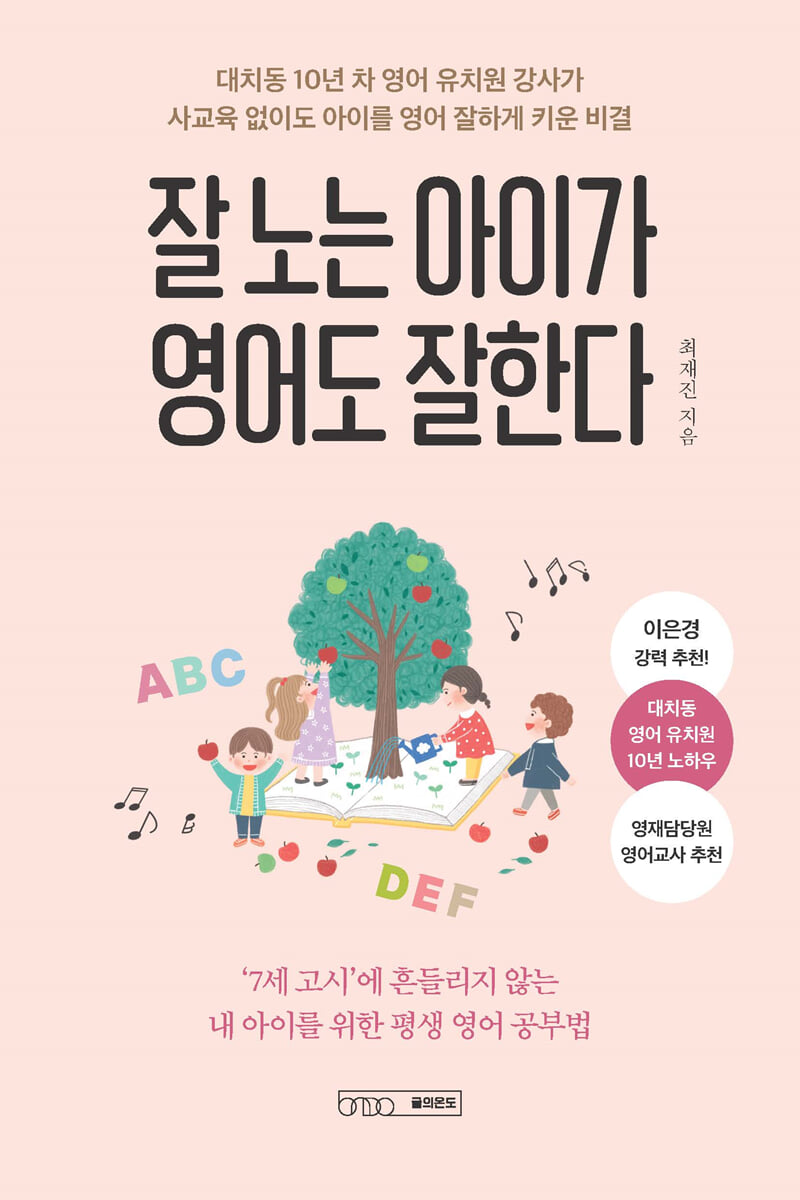
A child who plays well is also good at English.
 |
Description
Book Introduction
“Is my child the only one falling behind?”
Put that anxiety down now!
What countless children have experienced over the past 10 years
A stress-free English growth story
Not shaken by the '7-year-old exam'
Lifelong English Study for My Child
Have you ever felt your heart sink when you see an advertisement like, "English kindergarten application deadline: Two weeks away! Is my child ready?" These days, parents' daily lives are nothing short of a battlefield for early English education.
The English kindergarten competition, dubbed the "7-year-old exam," is a stress bomb for toddlers and a black hole-like burden on parents' wallets.
The author, who has taught children with sweat and tears for 10 years at Daechi-dong English Kindergarten, deeply sympathizes with this painful reality for Korean parents.
In doing so, the author presents a new way of learning English that will make children happy and parents feel secure.
It contains the surprising truths discovered while guiding children to college students on the front lines in Daechi-dong.
While studying abroad in the United States, the author was struck by how upper-class local families placed far more value on self-care and self-direction than on academic performance.
Furthermore, the author discovered a surprising commonality while teaching children of chaebol families, second-generation celebrities, and top students in Korea.
It wasn't the number of English words memorized or the grammar knowledge, but the problem-solving skills and self-directed learning attitude—in other words, "non-cognitive abilities"—that were the key to long-term success!
Put that anxiety down now!
What countless children have experienced over the past 10 years
A stress-free English growth story
Not shaken by the '7-year-old exam'
Lifelong English Study for My Child
Have you ever felt your heart sink when you see an advertisement like, "English kindergarten application deadline: Two weeks away! Is my child ready?" These days, parents' daily lives are nothing short of a battlefield for early English education.
The English kindergarten competition, dubbed the "7-year-old exam," is a stress bomb for toddlers and a black hole-like burden on parents' wallets.
The author, who has taught children with sweat and tears for 10 years at Daechi-dong English Kindergarten, deeply sympathizes with this painful reality for Korean parents.
In doing so, the author presents a new way of learning English that will make children happy and parents feel secure.
It contains the surprising truths discovered while guiding children to college students on the front lines in Daechi-dong.
While studying abroad in the United States, the author was struck by how upper-class local families placed far more value on self-care and self-direction than on academic performance.
Furthermore, the author discovered a surprising commonality while teaching children of chaebol families, second-generation celebrities, and top students in Korea.
It wasn't the number of English words memorized or the grammar knowledge, but the problem-solving skills and self-directed learning attitude—in other words, "non-cognitive abilities"—that were the key to long-term success!
- You can preview some of the book's contents.
Preview
index
Recommendation
Prologue | Is My Child's English Okay?
Chapter 1.
Things to Develop Before English: Basic Physical Strength for Lifelong English Skills
1.
Real English education to raise smart and confident children
2.
Children who learn while playing are also good at English.
3.
The Secret to Zeroing Your English Stress
4.
Finding the Right English Education Method for Your Child
Chapter 2. Playing English, Playing English
1.
Magical moments when everyday life becomes English
2.
English that you learn with your hands and body
3.
An English playground where imagination grows
4.
Fun English playtime with parents
Chapter 3.
English Learning Roadmap by Age: Where is My Child Now?
1.
Ages 3-4: Curiosity is Enough for Your First English Journey
2.
Age 5: The Power of Learning English with Friends
Chapter 4.
Choosing an English Kindergarten Wisely
1.
English Kindergarten: Should I Send My Child to It or Not?
2.
How to Choose an English Kindergarten Without Regrets
3.
Protecting Your Child's Mental Health: Everything You Need to Know About Stress Management
Chapter 5.
English Alone Isn't Enough: The Secret to Holistic Growth
1.
Lifelong Confidence Builds Through Exercise
2.
English Songs: The Amazing Effects of a Simple Song
3.
If you have a solid Korean, your English will take off.
Chapter 6.
Tailored Learning by Domain: Developing Four Skills
1.
Listen before you read! English independence begins with your ears.
2.
The Amazing Moments Your Child Begins to Speak English
3.
A special journey to discover the joy of reading
4.
Step-by-step writing lessons starting with a picture diary
Chapter 7.
English education for elementary school and beyond
1.
To make it naturally connected to elementary English
2.
The Secret to Making English a Lifelong Tool
3.
A child with a solid foundation will eventually smile.
4. A child who is thriving even in the AI era
Chapter 8.
The Role of Parents: The Unsung Heroes of English Education
1.
How should 'Mom's English' change?
2.
Personalized learning that respects your child's pace
3.
Raising a child who loves English
4.
Developing the courage to not fear failure
Prologue | Is My Child's English Okay?
Chapter 1.
Things to Develop Before English: Basic Physical Strength for Lifelong English Skills
1.
Real English education to raise smart and confident children
2.
Children who learn while playing are also good at English.
3.
The Secret to Zeroing Your English Stress
4.
Finding the Right English Education Method for Your Child
Chapter 2. Playing English, Playing English
1.
Magical moments when everyday life becomes English
2.
English that you learn with your hands and body
3.
An English playground where imagination grows
4.
Fun English playtime with parents
Chapter 3.
English Learning Roadmap by Age: Where is My Child Now?
1.
Ages 3-4: Curiosity is Enough for Your First English Journey
2.
Age 5: The Power of Learning English with Friends
Chapter 4.
Choosing an English Kindergarten Wisely
1.
English Kindergarten: Should I Send My Child to It or Not?
2.
How to Choose an English Kindergarten Without Regrets
3.
Protecting Your Child's Mental Health: Everything You Need to Know About Stress Management
Chapter 5.
English Alone Isn't Enough: The Secret to Holistic Growth
1.
Lifelong Confidence Builds Through Exercise
2.
English Songs: The Amazing Effects of a Simple Song
3.
If you have a solid Korean, your English will take off.
Chapter 6.
Tailored Learning by Domain: Developing Four Skills
1.
Listen before you read! English independence begins with your ears.
2.
The Amazing Moments Your Child Begins to Speak English
3.
A special journey to discover the joy of reading
4.
Step-by-step writing lessons starting with a picture diary
Chapter 7.
English education for elementary school and beyond
1.
To make it naturally connected to elementary English
2.
The Secret to Making English a Lifelong Tool
3.
A child with a solid foundation will eventually smile.
4. A child who is thriving even in the AI era
Chapter 8.
The Role of Parents: The Unsung Heroes of English Education
1.
How should 'Mom's English' change?
2.
Personalized learning that respects your child's pace
3.
Raising a child who loves English
4.
Developing the courage to not fear failure
Detailed image

Into the book
At that time, the students preparing for foreign language high schools were female students who consistently ranked within the top 5 in the entire school.
It is impossible to be in the top 5 in the entire school just by being good at English.
It is possible only if you consistently do well in Korean, English, and math as well as various performance assessments.
In other words, it was not important whether the children were from an English kindergarten, but rather that children with strong self-regulation (non-cognitive development) had an advantage in school studies.
Meanwhile, among students preparing for the English section of the CSAT, a significant number had studied abroad early in elementary school.
Some academies advertise that immersing children in English from an early age is the shortcut to success in the English section of the CSAT, but the reality is quite different.
These students who had early study abroad experiences struggled to keep up with their math class, and when they entered high school, they had to devote a lot of time to improving their Korean language grades.
---From the "Prologue"
Having worked in the early childhood education field for over 10 years, I too have become impatient and feel the need to do something for my child.
However, I was able to control my impatience to some extent because I personally witnessed the reality that the ultimate winner of the entrance exam race that starts in the first grade of elementary school is the “academy director.”
After getting married and raising two children, I finally had the opportunity to experiment with my educational philosophy.
As an early childhood education major in the United States and based on my field experience in key school districts in Seoul, including Cheongdam-dong, Mok-dong, and Banpo, I have established three firm principles.
1) Mother tongue comes first: The foundation for deep thinking and rich expression begins with the mother tongue.
2) Learn English sounds naturally from a young age: without force, like play, in everyday life.
3) Non-cognitive development is more important than cognitive development: self-regulation, persistence, and social skills determine future success.
I approached it by establishing these three principles.
Of course, I am not a naive mother who says, “I don’t make my child do anything,” and taboos all pre-school education.
If playing in nature were the best education, shouldn't all rural children be happy and going to prestigious universities? But the reality is that Daechi-dong produces the most SKY graduates.
What matters is not “what to do and when to do it,” but “how to do it.”
This book contains insights gained from teaching English for ten years, from infants to college students, as well as the honest concerns of an ordinary salaried worker raising two children.
Based on extensive early childhood education theory and practical experience, this book presents a method for children exhausted by excessive study schedules to naturally develop their potential through a balanced use of private education and home activities.
In particular, I aim to convey a realistic and balanced perspective on early childhood English education through vivid examples I have seen and heard while teaching children for over 10 years in Daechi-dong, the number one private education center.
Furthermore, with the insight of an English instructor who has taught all age groups, from kindergarten to college entrance, we boldly eliminate unnecessary content and present an efficient and sustainable English education roadmap.
---From the "Prologue"
Thanks to my background in early childhood education (K-3) in the United States, I was able to observe their home environments and parenting styles while working as a babysitter for various upper-class families, including Supreme Court justices, doctors, bank presidents, and vice presidents of multinational corporations.
Were there as many books in their homes as there are in ours? There were, but most of them belonged to their parents.
In the children's room, there were only a few books on a bookshelf with about six boxes of space.
If the passionate mothers in our country saw this, they would say, “You shouldn’t neglect your child like that.”
The daily routine of the children I cared for was far removed from the parenting books and parish activities that are currently popular in our country.
These children's schedules were largely filled with exercise.
After school, I did intense exercise every day, including gymnastics, lacrosse, tennis, swimming, and soccer.
From the time he was of school age (5 years old), he began learning instruments such as piano, violin, and cello at school.
I came home around 4pm and played some more in the backyard, took a shower, watched TV, and did some homework or crafts.
And all I did was read a book for about 20 to 30 minutes before going to bed.
Let's look back on our childhood.
Have you ever seen a house where the living room was crammed full of books? Most had a TV on, and the books were limited to a few famous collections like "Greek and Roman Mythology," "Faraway Neighbors," and a collection of world literature.
It wasn't as suffocating as it is now with books.
Libraries were only available in elementary and middle schools, and there were no libraries specifically for infants or toddlers.
At that time, you could learn Korean and go to elementary school to start reading books.
Does that mean our generation has a major problem with literacy or reading comprehension?
---「Chapter 1.
Among the things that should be developed before English,
When it comes to learning English, consistency is more important than anything else.
At home, review is key, but it doesn't necessarily have to be a writing activity.
It is sufficient for parents to lightly check their child's learning and provide appropriate hints when necessary.
You can check your child's understanding by asking questions like “Universe means…”, “Mars is…”
If the child cannot answer, fill in the background information or provide direct experience.
For example, when learning about farm animals, we go to a farm, and when learning about space, we visit a planetarium.
These experiences help children understand and motivate them to learn.
Most English kindergartens focus on writing skills starting at age 7.
The classes are centered around writing workshops, and when it comes to “show and tell” or project presentations, we check and support the child’s ability to write scripts independently.
Although academies only provide topics and let students compose the content, most students struggle with independent writing.
You can get an idea of the level of teacher involvement by looking at the writings displayed in the hallways of English academies.
Most of it is just filling in a given template, and it's hard to find truly creative writing.
This is a result of the increased focus on writing education in English kindergartens as the writing section becomes more important in the 7-year-old level test.
As a result, the number of children who feel burdened by reading and writing from the age of 7 has increased, and the number of cases of transferring to regular kindergartens or play-based English kindergartens has also increased.
Here is a list of questions to ask your English kindergarten:
It is impossible to be in the top 5 in the entire school just by being good at English.
It is possible only if you consistently do well in Korean, English, and math as well as various performance assessments.
In other words, it was not important whether the children were from an English kindergarten, but rather that children with strong self-regulation (non-cognitive development) had an advantage in school studies.
Meanwhile, among students preparing for the English section of the CSAT, a significant number had studied abroad early in elementary school.
Some academies advertise that immersing children in English from an early age is the shortcut to success in the English section of the CSAT, but the reality is quite different.
These students who had early study abroad experiences struggled to keep up with their math class, and when they entered high school, they had to devote a lot of time to improving their Korean language grades.
---From the "Prologue"
Having worked in the early childhood education field for over 10 years, I too have become impatient and feel the need to do something for my child.
However, I was able to control my impatience to some extent because I personally witnessed the reality that the ultimate winner of the entrance exam race that starts in the first grade of elementary school is the “academy director.”
After getting married and raising two children, I finally had the opportunity to experiment with my educational philosophy.
As an early childhood education major in the United States and based on my field experience in key school districts in Seoul, including Cheongdam-dong, Mok-dong, and Banpo, I have established three firm principles.
1) Mother tongue comes first: The foundation for deep thinking and rich expression begins with the mother tongue.
2) Learn English sounds naturally from a young age: without force, like play, in everyday life.
3) Non-cognitive development is more important than cognitive development: self-regulation, persistence, and social skills determine future success.
I approached it by establishing these three principles.
Of course, I am not a naive mother who says, “I don’t make my child do anything,” and taboos all pre-school education.
If playing in nature were the best education, shouldn't all rural children be happy and going to prestigious universities? But the reality is that Daechi-dong produces the most SKY graduates.
What matters is not “what to do and when to do it,” but “how to do it.”
This book contains insights gained from teaching English for ten years, from infants to college students, as well as the honest concerns of an ordinary salaried worker raising two children.
Based on extensive early childhood education theory and practical experience, this book presents a method for children exhausted by excessive study schedules to naturally develop their potential through a balanced use of private education and home activities.
In particular, I aim to convey a realistic and balanced perspective on early childhood English education through vivid examples I have seen and heard while teaching children for over 10 years in Daechi-dong, the number one private education center.
Furthermore, with the insight of an English instructor who has taught all age groups, from kindergarten to college entrance, we boldly eliminate unnecessary content and present an efficient and sustainable English education roadmap.
---From the "Prologue"
Thanks to my background in early childhood education (K-3) in the United States, I was able to observe their home environments and parenting styles while working as a babysitter for various upper-class families, including Supreme Court justices, doctors, bank presidents, and vice presidents of multinational corporations.
Were there as many books in their homes as there are in ours? There were, but most of them belonged to their parents.
In the children's room, there were only a few books on a bookshelf with about six boxes of space.
If the passionate mothers in our country saw this, they would say, “You shouldn’t neglect your child like that.”
The daily routine of the children I cared for was far removed from the parenting books and parish activities that are currently popular in our country.
These children's schedules were largely filled with exercise.
After school, I did intense exercise every day, including gymnastics, lacrosse, tennis, swimming, and soccer.
From the time he was of school age (5 years old), he began learning instruments such as piano, violin, and cello at school.
I came home around 4pm and played some more in the backyard, took a shower, watched TV, and did some homework or crafts.
And all I did was read a book for about 20 to 30 minutes before going to bed.
Let's look back on our childhood.
Have you ever seen a house where the living room was crammed full of books? Most had a TV on, and the books were limited to a few famous collections like "Greek and Roman Mythology," "Faraway Neighbors," and a collection of world literature.
It wasn't as suffocating as it is now with books.
Libraries were only available in elementary and middle schools, and there were no libraries specifically for infants or toddlers.
At that time, you could learn Korean and go to elementary school to start reading books.
Does that mean our generation has a major problem with literacy or reading comprehension?
---「Chapter 1.
Among the things that should be developed before English,
When it comes to learning English, consistency is more important than anything else.
At home, review is key, but it doesn't necessarily have to be a writing activity.
It is sufficient for parents to lightly check their child's learning and provide appropriate hints when necessary.
You can check your child's understanding by asking questions like “Universe means…”, “Mars is…”
If the child cannot answer, fill in the background information or provide direct experience.
For example, when learning about farm animals, we go to a farm, and when learning about space, we visit a planetarium.
These experiences help children understand and motivate them to learn.
Most English kindergartens focus on writing skills starting at age 7.
The classes are centered around writing workshops, and when it comes to “show and tell” or project presentations, we check and support the child’s ability to write scripts independently.
Although academies only provide topics and let students compose the content, most students struggle with independent writing.
You can get an idea of the level of teacher involvement by looking at the writings displayed in the hallways of English academies.
Most of it is just filling in a given template, and it's hard to find truly creative writing.
This is a result of the increased focus on writing education in English kindergartens as the writing section becomes more important in the 7-year-old level test.
As a result, the number of children who feel burdened by reading and writing from the age of 7 has increased, and the number of cases of transferring to regular kindergartens or play-based English kindergartens has also increased.
Here is a list of questions to ask your English kindergarten:
---「Chapter 4.
From “Choosing an English Kindergarten Wisely”
From “Choosing an English Kindergarten Wisely”
Publisher's Review
“My child can’t speak English.” That day, a mother burst into tears in Daechi-dong.
Asking about the secret to lifelong English study
“I told my child to memorize 50 English words, but he could only memorize 3.”
This is a tearful confession from a mother I met at an English class in Daechi-dong.
Having witnessed countless scenes like this over the past decade, the author has come face to face with the deep-rooted problems of English education in Korea.
"Children who play well are also good at English" contains a revolutionary approach that listens to the "child's heart" first, rather than the "English report card."
While numerous English education books have focused on 'how' to teach, this book offers fundamental reflection on 'why' English should be taught and what is most important in the process.
As a mother of two children and a teacher in Daechi-dong for over a decade, the author examines the current state of Korean English education, which is obsessed with short-term results, and proposes a path to long-term English study.
The values of “respecting the child’s pace” and “raising a child who likes to do something rather than a child who is good at it” are persuasively conveyed through concrete experiences and deep insights.
Respect your child's pace and learn English because you enjoy it, and it will last a lifetime!
“Please put down your worksheets and come play with me!”
English is not something to be taught, it is something to be experienced.
This book offers a fresh perspective on motherly English, emphasizing an "exposure"-centered approach tailored to a child's natural growth and development, rather than blindly guiding learning.
The author advises that it is important for mothers to show their children how to enjoy English together rather than teaching them like a teacher, and to create an environment where they can naturally encounter English in everyday life.
Instead of forcing children to read, it is said that it is effective to sing English nursery rhymes together, show videos that suit the child's interests, and read original books to develop language skills.
The book is full of vivid, actionable strategies that even parents with limited English skills can start using right away.
Instead of doing an English vocabulary test at the dinner table, 15 minutes of magic where you hum English nursery rhymes and dance together.
The wisdom of connecting a child's love of dinosaurs with English dinosaur books.
Just by reading original texts for 5 minutes every day, your child's English sense will grow explosively.
In addition, it emphasizes the importance of reading independence, provides tips for selecting early readers, and guides students on how to improve reading fluency. It also helps students systematically develop their English expression skills through a step-by-step writing learning method starting with a picture diary.
The author expresses concern about early literacy education, emphasizing that before the age of three, the focus should be on listening and speaking, and that fine motor development should be prioritized through play and activities rather than excessive writing.
Roadmap for Sustainable English Education,
Balanced growth design that looks beyond elementary school
"If I don't send my child to an English kindergarten, will my child fall behind?" For parents struggling to find an answer to this question, the author reveals a surprising truth.
The common thread among Daechi-dong's top students wasn't "English kindergarten experience," but "excellent non-cognitive skills." This "English Kindergarten Checklist" comprehensively considers a child's Korean language proficiency, social skills, and stress tolerance, and even details tips for maintaining English proficiency after kindergarten.
Furthermore, we analyze the hidden characteristics of the English language in the CSAT and school grades, and sharply point out what English skills are truly needed in a future dominated by AI.
This book is not just a simple educational guide, but a solid guide for a 20-year English journey with your child.
Filled with vivid real-world examples and practical strategies, this book will completely transform your English education at home!
Key Insights
· When a child cries, English cries too.
Excessive early English exposure stifles a child's curiosity and exploratory power.
Instead of the meaningless competition of the '7-year-old English exam', develop real English skills through natural exposure through play.
English kindergartens are not a panacea.
Rather, it is more effective for children who have a basic understanding of English.
· The importance of non-cognitive skills and play
What determines future success is not your TOEIC score, but your self-control, perseverance, and social skills.
In early childhood, focus on developing these non-cognitive skills rather than English.
Child-led play is the golden key to all these abilities!
· There is a separate English language for children's age.
At ages 3 and 4, focus on nursery rhymes and rhythms rather than memorizing English words.
For lower elementary school students, listening and speaking will spark their interest in English, and reading and writing can be started when they are ready.
We introduce the optimal learning method for each age group with real-life examples.
· If mom enjoys it, the child will enjoy it too.
Become a partner who enjoys learning English together, not a police officer who monitors your English studies.
Approach English content with conversations instead of worksheets, and with laugh-out-loud English content instead of grammar explanations.
Even working moms can experience amazing changes by investing just 10 minutes a day!
Asking about the secret to lifelong English study
“I told my child to memorize 50 English words, but he could only memorize 3.”
This is a tearful confession from a mother I met at an English class in Daechi-dong.
Having witnessed countless scenes like this over the past decade, the author has come face to face with the deep-rooted problems of English education in Korea.
"Children who play well are also good at English" contains a revolutionary approach that listens to the "child's heart" first, rather than the "English report card."
While numerous English education books have focused on 'how' to teach, this book offers fundamental reflection on 'why' English should be taught and what is most important in the process.
As a mother of two children and a teacher in Daechi-dong for over a decade, the author examines the current state of Korean English education, which is obsessed with short-term results, and proposes a path to long-term English study.
The values of “respecting the child’s pace” and “raising a child who likes to do something rather than a child who is good at it” are persuasively conveyed through concrete experiences and deep insights.
Respect your child's pace and learn English because you enjoy it, and it will last a lifetime!
“Please put down your worksheets and come play with me!”
English is not something to be taught, it is something to be experienced.
This book offers a fresh perspective on motherly English, emphasizing an "exposure"-centered approach tailored to a child's natural growth and development, rather than blindly guiding learning.
The author advises that it is important for mothers to show their children how to enjoy English together rather than teaching them like a teacher, and to create an environment where they can naturally encounter English in everyday life.
Instead of forcing children to read, it is said that it is effective to sing English nursery rhymes together, show videos that suit the child's interests, and read original books to develop language skills.
The book is full of vivid, actionable strategies that even parents with limited English skills can start using right away.
Instead of doing an English vocabulary test at the dinner table, 15 minutes of magic where you hum English nursery rhymes and dance together.
The wisdom of connecting a child's love of dinosaurs with English dinosaur books.
Just by reading original texts for 5 minutes every day, your child's English sense will grow explosively.
In addition, it emphasizes the importance of reading independence, provides tips for selecting early readers, and guides students on how to improve reading fluency. It also helps students systematically develop their English expression skills through a step-by-step writing learning method starting with a picture diary.
The author expresses concern about early literacy education, emphasizing that before the age of three, the focus should be on listening and speaking, and that fine motor development should be prioritized through play and activities rather than excessive writing.
Roadmap for Sustainable English Education,
Balanced growth design that looks beyond elementary school
"If I don't send my child to an English kindergarten, will my child fall behind?" For parents struggling to find an answer to this question, the author reveals a surprising truth.
The common thread among Daechi-dong's top students wasn't "English kindergarten experience," but "excellent non-cognitive skills." This "English Kindergarten Checklist" comprehensively considers a child's Korean language proficiency, social skills, and stress tolerance, and even details tips for maintaining English proficiency after kindergarten.
Furthermore, we analyze the hidden characteristics of the English language in the CSAT and school grades, and sharply point out what English skills are truly needed in a future dominated by AI.
This book is not just a simple educational guide, but a solid guide for a 20-year English journey with your child.
Filled with vivid real-world examples and practical strategies, this book will completely transform your English education at home!
Key Insights
· When a child cries, English cries too.
Excessive early English exposure stifles a child's curiosity and exploratory power.
Instead of the meaningless competition of the '7-year-old English exam', develop real English skills through natural exposure through play.
English kindergartens are not a panacea.
Rather, it is more effective for children who have a basic understanding of English.
· The importance of non-cognitive skills and play
What determines future success is not your TOEIC score, but your self-control, perseverance, and social skills.
In early childhood, focus on developing these non-cognitive skills rather than English.
Child-led play is the golden key to all these abilities!
· There is a separate English language for children's age.
At ages 3 and 4, focus on nursery rhymes and rhythms rather than memorizing English words.
For lower elementary school students, listening and speaking will spark their interest in English, and reading and writing can be started when they are ready.
We introduce the optimal learning method for each age group with real-life examples.
· If mom enjoys it, the child will enjoy it too.
Become a partner who enjoys learning English together, not a police officer who monitors your English studies.
Approach English content with conversations instead of worksheets, and with laugh-out-loud English content instead of grammar explanations.
Even working moms can experience amazing changes by investing just 10 minutes a day!
GOODS SPECIFICS
- Date of issue: April 11, 2025
- Page count, weight, size: 288 pages | 140*210*20mm
- ISBN13: 9791192005645
- ISBN10: 1192005643
You may also like
카테고리
korean


korean

![GQ KOREA Mark (Monthly): December [2025]](http://librairie.coreenne.fr/cdn/shop/files/8ef265dbbfbf186523ed75ba7319009d.jpg?v=1765340328&width=3840)


