

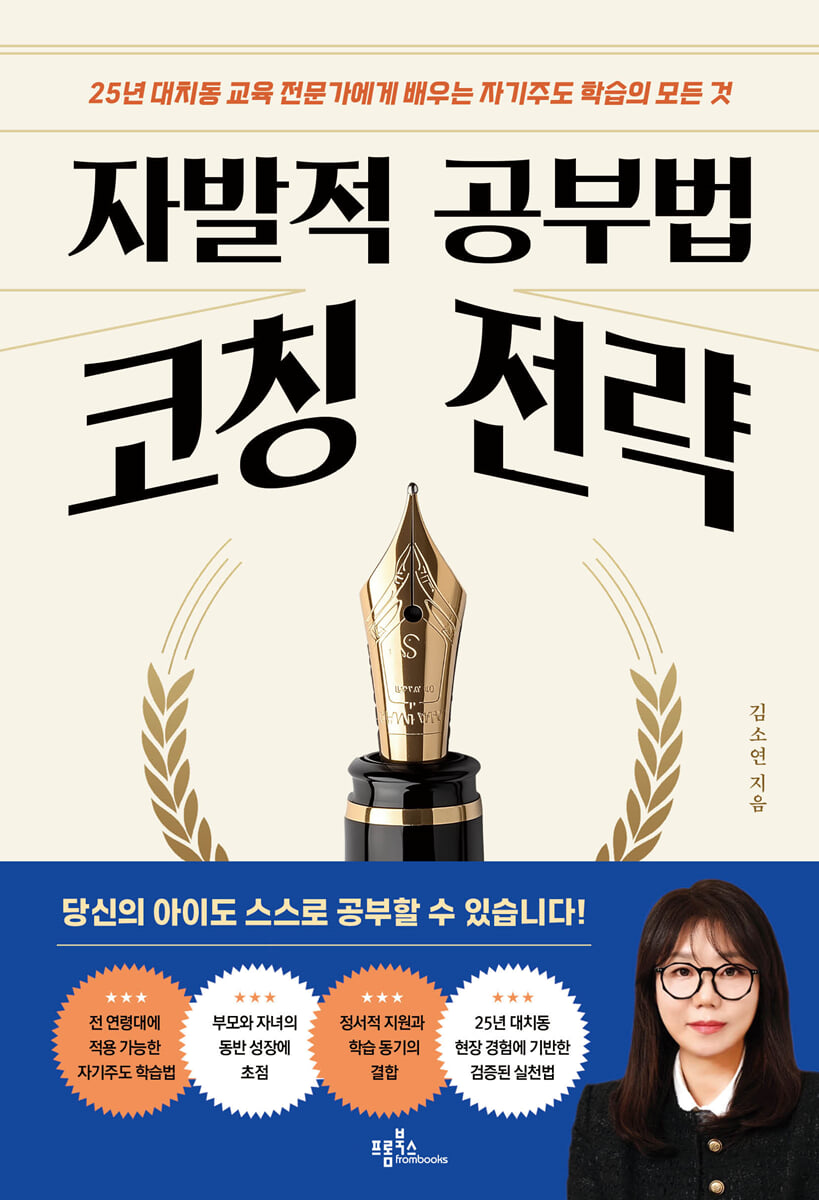
Self-directed study coaching strategy
 |
Description
Book Introduction
"Sponsored Study Coaching Strategies" introduces concrete, practical principles and examples for students, parents, and educational professionals who recognize the importance of self-directed learning—studying through self-planning and self-executing—but struggle with how to implement it.
The author, who has been coaching elementary, middle, and high school students for 25 years in Daechi-dong, the mecca of education, suggests ways for elementary, middle, and high school students to gain confidence through study, rebuild relationships with their parents, and continue to grow.
Rather than simply focusing on improving grades, the focus is on learning methods that foster students' ability to study independently.
He proposed a 'personalized learning method' that discovers each student's learning style and strengths, and especially emphasized the importance of 'joint learning' where parents and children grow together, rather than having children study alone through self-directed learning.
Additionally, he emphasized that a child's growth should not be judged solely on the results of their studies, but rather as a process of finding direction in life.
The author, who has been coaching elementary, middle, and high school students for 25 years in Daechi-dong, the mecca of education, suggests ways for elementary, middle, and high school students to gain confidence through study, rebuild relationships with their parents, and continue to grow.
Rather than simply focusing on improving grades, the focus is on learning methods that foster students' ability to study independently.
He proposed a 'personalized learning method' that discovers each student's learning style and strengths, and especially emphasized the importance of 'joint learning' where parents and children grow together, rather than having children study alone through self-directed learning.
Additionally, he emphasized that a child's growth should not be judged solely on the results of their studies, but rather as a process of finding direction in life.
- You can preview some of the book's contents.
Preview
index
preface
Chapter 1: Why don't my grades improve even though I work hard?
1.
Why your grades don't improve even though you work hard
2.
Improvement in grades is not proportional to time and effort.
3.
What is my child studying?
4.
Quantitative vs. Qualitative Study
5.
100 students, 100 study styles
6.
Find out how to relieve study stress.
7.
Studying without learning goals has its limitations.
Chapter 2: Why Studying Alone is Difficult
1.
Students don't know how to study alone.
2.
Lack of intrinsic motivation to study
3.
Lack of confidence that you can do it yourself
4.
Bad study habits are the problem.
5.
Unable to distinguish between parental expectations and autonomy
6.
I think studying is an area that doesn't tolerate failure.
Chapter 3: Warm up first for successful study
1.
The first step to studying is motivation.
2.
Find the learning conditions that suit you
3.
Create a routine for consistency
4.
Set goals and record your achievements.
5.
Arm yourself with a positive mindset toward learning.
6.
Create your own feedback routine
7.
Develop the ability to balance extracurricular activities.
Chapter 4: Seven Key Principles for Self-Studying Children
1.
Laying the foundation for learning through self-understanding
2.
Find a study method that suits you
3.
Set specific and realistic goals
4.
Maintaining learning patterns while managing emotions
5.
Analyze your strengths and weaknesses to develop a learning strategy.
6.
Enjoy the process more than the outcome
7.
Embrace failure as an opportunity to challenge and learn.
Chapter 5: Self-Directed Learning Practices You Can Start Right Now
1.
Manage your schedule and manage yourself at the same time.
2.
Study to complement your weaknesses and build on your strengths.
3.
Study and apply as if explaining to someone else.
4.
Understand the learning content in your own language
5.
Motivate yourself by building small successes.
6.
Distinguishing between what you know and what you don't know is skill.
Chapter 6: A Self-directed Study Mindset That Takes You to the Next Level
1.
Small goals become great motivators.
2.
Accept failure as part of success.
3.
Let's create our own sustainable learning motivation.
4.
How to maintain a consistent sense of accomplishment
5.
The power of confidence brought by small achievements
6.
Create a foundation for growth with step-by-step goal setting.
Chapter 7.
Children who study on their own create the future.
1.
Voluntary study that teaches you the power of lifelong learning
2.
The process of finding the answers yourself is the real study.
3.
The power to plan for the future is determined by study habits.
4.
Autonomous students also develop creativity.
5.
The power to catch two birds with one stone: autonomy and responsibility
6.
The greatest achievement of voluntary learning is self-confidence
7.
A child who studies on his own designs the future.
Chapter 1: Why don't my grades improve even though I work hard?
1.
Why your grades don't improve even though you work hard
2.
Improvement in grades is not proportional to time and effort.
3.
What is my child studying?
4.
Quantitative vs. Qualitative Study
5.
100 students, 100 study styles
6.
Find out how to relieve study stress.
7.
Studying without learning goals has its limitations.
Chapter 2: Why Studying Alone is Difficult
1.
Students don't know how to study alone.
2.
Lack of intrinsic motivation to study
3.
Lack of confidence that you can do it yourself
4.
Bad study habits are the problem.
5.
Unable to distinguish between parental expectations and autonomy
6.
I think studying is an area that doesn't tolerate failure.
Chapter 3: Warm up first for successful study
1.
The first step to studying is motivation.
2.
Find the learning conditions that suit you
3.
Create a routine for consistency
4.
Set goals and record your achievements.
5.
Arm yourself with a positive mindset toward learning.
6.
Create your own feedback routine
7.
Develop the ability to balance extracurricular activities.
Chapter 4: Seven Key Principles for Self-Studying Children
1.
Laying the foundation for learning through self-understanding
2.
Find a study method that suits you
3.
Set specific and realistic goals
4.
Maintaining learning patterns while managing emotions
5.
Analyze your strengths and weaknesses to develop a learning strategy.
6.
Enjoy the process more than the outcome
7.
Embrace failure as an opportunity to challenge and learn.
Chapter 5: Self-Directed Learning Practices You Can Start Right Now
1.
Manage your schedule and manage yourself at the same time.
2.
Study to complement your weaknesses and build on your strengths.
3.
Study and apply as if explaining to someone else.
4.
Understand the learning content in your own language
5.
Motivate yourself by building small successes.
6.
Distinguishing between what you know and what you don't know is skill.
Chapter 6: A Self-directed Study Mindset That Takes You to the Next Level
1.
Small goals become great motivators.
2.
Accept failure as part of success.
3.
Let's create our own sustainable learning motivation.
4.
How to maintain a consistent sense of accomplishment
5.
The power of confidence brought by small achievements
6.
Create a foundation for growth with step-by-step goal setting.
Chapter 7.
Children who study on their own create the future.
1.
Voluntary study that teaches you the power of lifelong learning
2.
The process of finding the answers yourself is the real study.
3.
The power to plan for the future is determined by study habits.
4.
Autonomous students also develop creativity.
5.
The power to catch two birds with one stone: autonomy and responsibility
6.
The greatest achievement of voluntary learning is self-confidence
7.
A child who studies on his own designs the future.
Detailed image

Into the book
The difference between quantitative and qualitative study is clearly evident in the learning outcomes.
Quantitative study forces students to focus on problem solving and memorization, whereas qualitative study provides students with opportunities to understand concepts, explain them in their own words, and apply them.
Research in the psychology of learning has shown that “students who learn through qualitative learning show significantly improved long-term academic performance and applied skills compared to those who rely on memorization.”
This demonstrates that qualitative learning is essential not only for short-term test preparation but also for developing critical thinking and problem-solving skills.
--- p.33
“I’m not good at studying.
“I think I’m just not good at studying,” said Yoonji (pseudonym), a first-year high school student who came for coaching.
I thought there was something wrong with my abilities because I spent a lot of time at my desk and my grades didn't improve.
But the problem that came to light as we talked wasn't Yoonji herself.
The problem was that I was just increasing my study time without finding a learning environment and conditions that suited me.
--- p.91
In this process, parents have a role to play in helping their children break free from the obsession with perfection.
It's important to encourage your children to set goals and enjoy the process of achieving them.
For example, helping Sooyoung enjoy small successes is a role that parents can play.
Ask your child questions like, “What was your favorite part of today?” to naturally encourage them to reflect on their accomplishments throughout the process.
--- p.157
The ability to study independently goes beyond academic achievement; it provides children with the core skills they need to find their place in a changing society. In an era where AI and technological advancements are eliminating many jobs and creating new ones, the ability to study independently becomes a tool for forging one's own path in an uncertain future.
This strength, which cannot be measured by the numbers on a report card alone, fosters the ability to chart a new path based on one's strengths and goals, even as the world changes.
Quantitative study forces students to focus on problem solving and memorization, whereas qualitative study provides students with opportunities to understand concepts, explain them in their own words, and apply them.
Research in the psychology of learning has shown that “students who learn through qualitative learning show significantly improved long-term academic performance and applied skills compared to those who rely on memorization.”
This demonstrates that qualitative learning is essential not only for short-term test preparation but also for developing critical thinking and problem-solving skills.
--- p.33
“I’m not good at studying.
“I think I’m just not good at studying,” said Yoonji (pseudonym), a first-year high school student who came for coaching.
I thought there was something wrong with my abilities because I spent a lot of time at my desk and my grades didn't improve.
But the problem that came to light as we talked wasn't Yoonji herself.
The problem was that I was just increasing my study time without finding a learning environment and conditions that suited me.
--- p.91
In this process, parents have a role to play in helping their children break free from the obsession with perfection.
It's important to encourage your children to set goals and enjoy the process of achieving them.
For example, helping Sooyoung enjoy small successes is a role that parents can play.
Ask your child questions like, “What was your favorite part of today?” to naturally encourage them to reflect on their accomplishments throughout the process.
--- p.157
The ability to study independently goes beyond academic achievement; it provides children with the core skills they need to find their place in a changing society. In an era where AI and technological advancements are eliminating many jobs and creating new ones, the ability to study independently becomes a tool for forging one's own path in an uncertain future.
This strength, which cannot be measured by the numbers on a report card alone, fosters the ability to chart a new path based on one's strengths and goals, even as the world changes.
--- p.270~271
Publisher's Review
Your child can study on his own too!
The children of Daechi-dong, the mecca of education, are in first class.
How do I manage my studies, schedule, and mental health?
* Self-directed learning method applicable to all ages
* Focus on the joint growth of parents and children
* Proven practices based on 25 years of experience in Daechi-dong
* Combination of emotional support and learning motivation
Change from quantitative learning to qualitative learning!
"Sponsored Study Coaching Strategies" introduces concrete, practical principles and examples for students, parents, and educational professionals who recognize the importance of self-directed learning—studying through self-planning and self-executing—but struggle with how to implement it.
The author, who has been coaching elementary, middle, and high school students for 25 years in Daechi-dong, the mecca of education, suggests ways for elementary, middle, and high school students to gain confidence through study, rebuild relationships with their parents, and continue to grow.
Rather than simply focusing on improving grades, the focus is on learning methods that foster students' ability to study independently.
He proposed a 'personalized learning method' that discovers each student's learning style and strengths, and especially emphasized the importance of 'joint learning' in which parents and children grow together, rather than having children study alone through self-directed learning.
Additionally, he emphasized that a child's growth should not be judged solely on the results of their studies, but rather as a process of finding direction in life.
Learning becomes enjoyable when you find a study method that works for you.
"Spontaneous Study Coaching Strategy" states that there is no right way to study, and that each student must find their own way.
But what is the reality?
Most students are at a loss as to where and how to start, simply doing what their school, academy, and parents tell them to do.
Because it doesn't suit you, you lose motivation to study and develop negative feelings about studying.
The author, who has been providing learning coaching in Daechi-dong, guides parents on why, how, and what they should do to help their children find their own reasons for studying, make their own plans, and put them into practice.
This article explains the coaching strategy that fosters the self-motivation that allows students to immerse themselves in their studies without having to be pressured to "study." It also understands that each student has different tendencies, interests, and learning styles, and introduces methods to help students find their own path.
It contains things I've realized while working with students and practical advice from my experience as a mother of two children.
What Should Parents Do to Encourage Self-Study?
What parents worry about most is their children's future.
Faced with the enormous goal of college entrance, children often feel anxious about which direction to take and what to prepare for.
Especially in these times when technology and jobs are changing so rapidly, it is inevitable that concerns about not only academics but also career paths will deepen.
Middle and high school are not just a time to accumulate knowledge.
During this period, you need to ask yourself questions like, “Why should I study?”, “What am I good at and what do I like to do?”, and “What are the goals I want to achieve?” and experience finding the answers.
But realistically, it is not easy for students to design their own future.
In Korea's educational environment, it is difficult for students to clearly define their goals and direction amidst the vast amount of learning and fierce competition.
Parents and teachers often focus their advice on grades, so students often end up following the path their parents or school wants them to follow rather than finding their own goals.
However, children who study on their own go beyond simply taking charge of their learning; they prepare themselves to design their own lives.
You will lead your own learning without being swayed by external pressures, and in the process, you will clearly establish your own goals and dreams.
At this time, voluntary study is the student's choice, but it is the parents' responsibility to respect and support that choice.
The author also emphasizes that parents' trust and patience are more important than anything else for a student to become a self-directed student.
Because sometimes, the process of failure and frustration is necessary.
At times like these, parents' warm encouragement gives students the courage to stand up again.
The power to study on your own, the power to live on your own
“Voluntary study” is not simply a means to improve grades.
It is a process that develops the ability to solve problems on one's own, think, and enjoy learning.
And that strength becomes the foundation for taking charge of your own life even as an adult.
The ability to self-study provides a core competency necessary for finding one's place in a changing society. In an era where AI and technological advancements are eliminating many jobs and creating new ones, self-study becomes a tool for forging one's own path even in an uncertain future.
This strength, which cannot be measured by the numbers on a report card alone, fosters the ability to design new paths based on one's strengths and goals, even as the world changes.
What parents today want most from their children's education is the strength to find their own path without wavering even after the college entrance exam.
The power of self-study is what makes that wish a reality.
Planning your future isn't just about where to go to college or what career to choose.
It's a process of exploring who you are, what you're good at and what you like, and through that, finding your own path.
This process is not simple and takes time, but through self-study, students will gradually find their way.
"Spontaneous Study Coaching Strategies" will motivate and provide a new approach to studying for all parents who support their children's dreams but don't know how to help, as well as for students who want to learn how to study independently.
Starting today, let's encourage our children to set their own goals and build small experiences toward achieving them.
The children of Daechi-dong, the mecca of education, are in first class.
How do I manage my studies, schedule, and mental health?
* Self-directed learning method applicable to all ages
* Focus on the joint growth of parents and children
* Proven practices based on 25 years of experience in Daechi-dong
* Combination of emotional support and learning motivation
Change from quantitative learning to qualitative learning!
"Sponsored Study Coaching Strategies" introduces concrete, practical principles and examples for students, parents, and educational professionals who recognize the importance of self-directed learning—studying through self-planning and self-executing—but struggle with how to implement it.
The author, who has been coaching elementary, middle, and high school students for 25 years in Daechi-dong, the mecca of education, suggests ways for elementary, middle, and high school students to gain confidence through study, rebuild relationships with their parents, and continue to grow.
Rather than simply focusing on improving grades, the focus is on learning methods that foster students' ability to study independently.
He proposed a 'personalized learning method' that discovers each student's learning style and strengths, and especially emphasized the importance of 'joint learning' in which parents and children grow together, rather than having children study alone through self-directed learning.
Additionally, he emphasized that a child's growth should not be judged solely on the results of their studies, but rather as a process of finding direction in life.
Learning becomes enjoyable when you find a study method that works for you.
"Spontaneous Study Coaching Strategy" states that there is no right way to study, and that each student must find their own way.
But what is the reality?
Most students are at a loss as to where and how to start, simply doing what their school, academy, and parents tell them to do.
Because it doesn't suit you, you lose motivation to study and develop negative feelings about studying.
The author, who has been providing learning coaching in Daechi-dong, guides parents on why, how, and what they should do to help their children find their own reasons for studying, make their own plans, and put them into practice.
This article explains the coaching strategy that fosters the self-motivation that allows students to immerse themselves in their studies without having to be pressured to "study." It also understands that each student has different tendencies, interests, and learning styles, and introduces methods to help students find their own path.
It contains things I've realized while working with students and practical advice from my experience as a mother of two children.
What Should Parents Do to Encourage Self-Study?
What parents worry about most is their children's future.
Faced with the enormous goal of college entrance, children often feel anxious about which direction to take and what to prepare for.
Especially in these times when technology and jobs are changing so rapidly, it is inevitable that concerns about not only academics but also career paths will deepen.
Middle and high school are not just a time to accumulate knowledge.
During this period, you need to ask yourself questions like, “Why should I study?”, “What am I good at and what do I like to do?”, and “What are the goals I want to achieve?” and experience finding the answers.
But realistically, it is not easy for students to design their own future.
In Korea's educational environment, it is difficult for students to clearly define their goals and direction amidst the vast amount of learning and fierce competition.
Parents and teachers often focus their advice on grades, so students often end up following the path their parents or school wants them to follow rather than finding their own goals.
However, children who study on their own go beyond simply taking charge of their learning; they prepare themselves to design their own lives.
You will lead your own learning without being swayed by external pressures, and in the process, you will clearly establish your own goals and dreams.
At this time, voluntary study is the student's choice, but it is the parents' responsibility to respect and support that choice.
The author also emphasizes that parents' trust and patience are more important than anything else for a student to become a self-directed student.
Because sometimes, the process of failure and frustration is necessary.
At times like these, parents' warm encouragement gives students the courage to stand up again.
The power to study on your own, the power to live on your own
“Voluntary study” is not simply a means to improve grades.
It is a process that develops the ability to solve problems on one's own, think, and enjoy learning.
And that strength becomes the foundation for taking charge of your own life even as an adult.
The ability to self-study provides a core competency necessary for finding one's place in a changing society. In an era where AI and technological advancements are eliminating many jobs and creating new ones, self-study becomes a tool for forging one's own path even in an uncertain future.
This strength, which cannot be measured by the numbers on a report card alone, fosters the ability to design new paths based on one's strengths and goals, even as the world changes.
What parents today want most from their children's education is the strength to find their own path without wavering even after the college entrance exam.
The power of self-study is what makes that wish a reality.
Planning your future isn't just about where to go to college or what career to choose.
It's a process of exploring who you are, what you're good at and what you like, and through that, finding your own path.
This process is not simple and takes time, but through self-study, students will gradually find their way.
"Spontaneous Study Coaching Strategies" will motivate and provide a new approach to studying for all parents who support their children's dreams but don't know how to help, as well as for students who want to learn how to study independently.
Starting today, let's encourage our children to set their own goals and build small experiences toward achieving them.
GOODS SPECIFICS
- Date of issue: March 18, 2025
- Page count, weight, size: 272 pages | 354g | 140*205*20mm
- ISBN13: 9791194550037
- ISBN10: 1194550037
You may also like
카테고리
korean


korean

![GQ KOREA Mark (Monthly): December [2025]](http://librairie.coreenne.fr/cdn/shop/files/8ef265dbbfbf186523ed75ba7319009d.jpg?v=1765340328&width=3840)


