

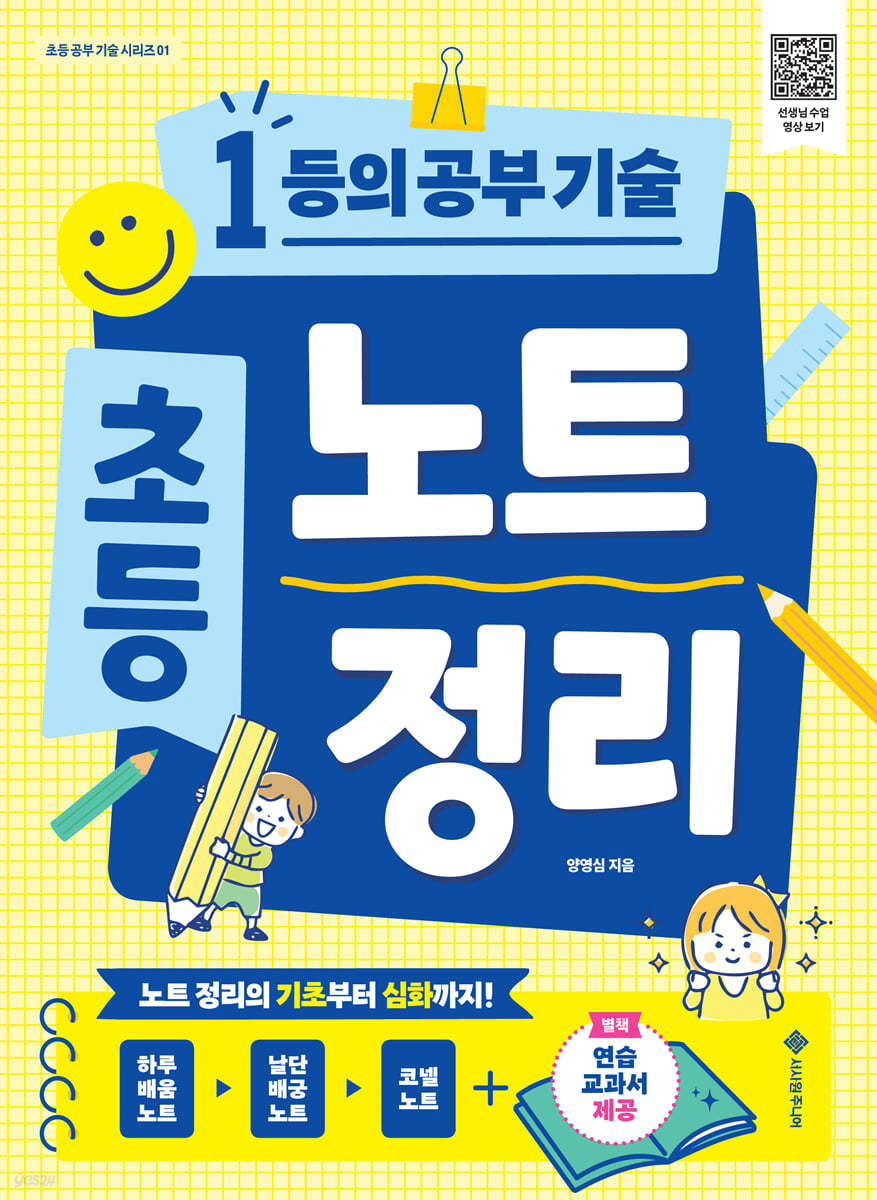
Elementary Note Organization
 |
Description
Book Introduction
The A to Z of Note-taking from a Current Elementary School Teacher
Solid basics, smart application
Everything you need to know about organizing elementary school notes in one book!
Note-taking is a tool that helps you study properly, and at the same time, it serves to show the results of proper learning.
By organizing what you've learned into notes in your own words, you'll remember it better and be able to participate more actively in class.
_From the author's note
This book was written by Yang Young-sim, a teacher who has been teaching at an elementary school in Seoul for 17 years, and contains the importance of organizing notes that she realized while teaching children in the field.
This course is for 3rd and 4th graders and teaches them how to organize what they have learned into notes before they begin their full-fledged studies.
First, you will learn the basics of note-taking and the '7 strategies for reading textbooks properly' that contain a lot of text.
Next, we will learn how to organize your learning content step by step using the most commonly used note-taking types in schools.
We've made it so you can fully master it with the practice textbook and the teacher's lectures, so get started right away.
Solid basics, smart application
Everything you need to know about organizing elementary school notes in one book!
Note-taking is a tool that helps you study properly, and at the same time, it serves to show the results of proper learning.
By organizing what you've learned into notes in your own words, you'll remember it better and be able to participate more actively in class.
_From the author's note
This book was written by Yang Young-sim, a teacher who has been teaching at an elementary school in Seoul for 17 years, and contains the importance of organizing notes that she realized while teaching children in the field.
This course is for 3rd and 4th graders and teaches them how to organize what they have learned into notes before they begin their full-fledged studies.
First, you will learn the basics of note-taking and the '7 strategies for reading textbooks properly' that contain a lot of text.
Next, we will learn how to organize your learning content step by step using the most commonly used note-taking types in schools.
We've made it so you can fully master it with the practice textbook and the teacher's lectures, so get started right away.
- You can preview some of the book's contents.
Preview
index
[Main book]
Chapter 1: Organizing Notes
1.
What is note organization?
2.
Why do I need to organize my notes?
3.
What do I need to prepare?
4.
What visualization techniques are needed to organize notes?
Chapter 2 Textbook Reading Strategies
Textbook Reading Strategies at a Glance
A Closer Look at Textbook Reading Strategies
Reading textbooks properly by doing it yourself
Reading textbooks properly by comparing them
Chapter 3 Daily Learning Notes
1.
What are the daily learning notes?
2.
How do I write my daily study notes?
3.
A daily learning notebook written by yourself
Chapter 4: Naldanbae Archery Notes
1.
What are the notes for the Naldanbae Archery?
2.
How do I use the Naldanbae Archery Notes?
3.
A self-written note on the Naldanbae Archery
Chapter 5 Cornell Notes
1.
What are Cornell notes?
2.
How do I use Cornell notes?
3.
How do you use Cornell Notes?
4.
Cornell Notes: Writing and Using Yourself
Chapter 6: Putting Notes into Practice
My daily learning notes
My daily bow notes
Cornell Notes I Write
[Book within a Book] Practice Textbook
"society"
5-1 Geography Area
Ⅰ.
Our country and our lives
2.
Our country's natural environment
(1) Let’s explain the various types of terrain that can be seen in our country.
(2) Let’s learn about the characteristics of our country’s mountains, rivers, plains, and coasts.
(3) Could you explain the characteristics of our country’s climate?
5-2 History Area
Ⅰ.
The life and culture of ancient people
1.
The emergence and development of the country
(1) Let’s learn about the founding and development process of Gojoseon.
(2) Let’s learn about the establishment and development process of the Three Kingdoms and Gaya.
(3) Let’s learn about the process of Silla’s unification of the three kingdoms and the development process of Balhae.
"science"
4-2 Earth and Space Area
Ⅳ.
Volcanoes and earthquakes
1.
What substances are released when volcanic activity occurs?
2.
What are the characteristics of granite and basalt formed by volcanic activity?
6-2 《Movement and Energy》 Area
Ⅰ.
Use of electricity
1.
How do I turn on a light bulb?
2.
How does the brightness of a bulb change depending on the number of cells?
6-2 Life Area
Ⅳ.
The structure and function of our body
2.
Let's learn about the shape and function of the digestive system.
3.
Let's learn about the shape and function of the respiratory system.
Chapter 1: Organizing Notes
1.
What is note organization?
2.
Why do I need to organize my notes?
3.
What do I need to prepare?
4.
What visualization techniques are needed to organize notes?
Chapter 2 Textbook Reading Strategies
Textbook Reading Strategies at a Glance
A Closer Look at Textbook Reading Strategies
Reading textbooks properly by doing it yourself
Reading textbooks properly by comparing them
Chapter 3 Daily Learning Notes
1.
What are the daily learning notes?
2.
How do I write my daily study notes?
3.
A daily learning notebook written by yourself
Chapter 4: Naldanbae Archery Notes
1.
What are the notes for the Naldanbae Archery?
2.
How do I use the Naldanbae Archery Notes?
3.
A self-written note on the Naldanbae Archery
Chapter 5 Cornell Notes
1.
What are Cornell notes?
2.
How do I use Cornell notes?
3.
How do you use Cornell Notes?
4.
Cornell Notes: Writing and Using Yourself
Chapter 6: Putting Notes into Practice
My daily learning notes
My daily bow notes
Cornell Notes I Write
[Book within a Book] Practice Textbook
"society"
5-1 Geography Area
Ⅰ.
Our country and our lives
2.
Our country's natural environment
(1) Let’s explain the various types of terrain that can be seen in our country.
(2) Let’s learn about the characteristics of our country’s mountains, rivers, plains, and coasts.
(3) Could you explain the characteristics of our country’s climate?
5-2 History Area
Ⅰ.
The life and culture of ancient people
1.
The emergence and development of the country
(1) Let’s learn about the founding and development process of Gojoseon.
(2) Let’s learn about the establishment and development process of the Three Kingdoms and Gaya.
(3) Let’s learn about the process of Silla’s unification of the three kingdoms and the development process of Balhae.
"science"
4-2 Earth and Space Area
Ⅳ.
Volcanoes and earthquakes
1.
What substances are released when volcanic activity occurs?
2.
What are the characteristics of granite and basalt formed by volcanic activity?
6-2 《Movement and Energy》 Area
Ⅰ.
Use of electricity
1.
How do I turn on a light bulb?
2.
How does the brightness of a bulb change depending on the number of cells?
6-2 Life Area
Ⅳ.
The structure and function of our body
2.
Let's learn about the shape and function of the digestive system.
3.
Let's learn about the shape and function of the respiratory system.
Detailed image

Publisher's Review
Self-directed learning begins with organizing notes.
Cornell notes highlighting the Ivy League, Seoul National University, and even the Ministry of Education.
The secret to organizing elementary school notes that can be started in 3rd or 4th grade is revealed!
The study secrets of self-proclaimed and other-proclaimed "study gods," regardless of generation or nationality!
The Ivy League, Seoul National University, and the Ministry of Education, all of Korea's renowned study gods, emphasize note-taking.
Why is that? Note-taking is different from simply listening to and writing down what you hear.
True note-taking involves listening to the teacher's words in class, reading the textbook text, and then systematically organizing the key words and sentences in your notes.
In this process, you will naturally develop the ability to grasp the core content and also improve your ability to create your own sentences.
That is, self-directed learning ability is developed.
This is why all the study gods emphasize note organization.
Build a solid foundation in 3 steps!
You should start to learn the basics of note-taking from the 3rd or 4th grade of elementary school, when you will be exposed to texts with a lot of text.
First, understand the main content of the class that day and practice finding key words and sentences from the teacher's words and textbook text.
The key words found in each subject are organized into a ‘Daily Learning Note.’
Once you get used to this method, write down the key words and sentences you found in your own words in your 'Naldanbaegu Notebook'.
The Daily Study Notes, where you write down dates, units, what you learned, and any questions you have, help you think about not only the core content of each subject, but also your own thoughts and questions derived from it.
Once you have solidified your training in these basic stages, you can move on to the most advanced note-taking format, the 'Cornell Notes'.
Get ready for the next year! Organize your notes now!
Cornell Notes is a notebook that organizes learning content into three areas: content organization, clues, and summary.
This is the note we are most familiar with.
If you organize your notes in Cornell notes, you can review them every day, week, or month. And right before the test, you can have the amazing experience of having everything you've learned in just a few sentences in your head just by looking at the clues or summary sections.
There is no royal road to learning.
But there is a strategy.
Rather than simply trying to cram everything into your head, you can learn more efficiently by building skills step by step and applying them through practical practice.
This book confidently introduces an effective learning method to third and fourth graders who must now begin studying a large amount of material little by little.
A study technique used by everyone regardless of nationality or generation: note organization.
Get started right now!
Cornell notes highlighting the Ivy League, Seoul National University, and even the Ministry of Education.
The secret to organizing elementary school notes that can be started in 3rd or 4th grade is revealed!
The study secrets of self-proclaimed and other-proclaimed "study gods," regardless of generation or nationality!
The Ivy League, Seoul National University, and the Ministry of Education, all of Korea's renowned study gods, emphasize note-taking.
Why is that? Note-taking is different from simply listening to and writing down what you hear.
True note-taking involves listening to the teacher's words in class, reading the textbook text, and then systematically organizing the key words and sentences in your notes.
In this process, you will naturally develop the ability to grasp the core content and also improve your ability to create your own sentences.
That is, self-directed learning ability is developed.
This is why all the study gods emphasize note organization.
Build a solid foundation in 3 steps!
You should start to learn the basics of note-taking from the 3rd or 4th grade of elementary school, when you will be exposed to texts with a lot of text.
First, understand the main content of the class that day and practice finding key words and sentences from the teacher's words and textbook text.
The key words found in each subject are organized into a ‘Daily Learning Note.’
Once you get used to this method, write down the key words and sentences you found in your own words in your 'Naldanbaegu Notebook'.
The Daily Study Notes, where you write down dates, units, what you learned, and any questions you have, help you think about not only the core content of each subject, but also your own thoughts and questions derived from it.
Once you have solidified your training in these basic stages, you can move on to the most advanced note-taking format, the 'Cornell Notes'.
Get ready for the next year! Organize your notes now!
Cornell Notes is a notebook that organizes learning content into three areas: content organization, clues, and summary.
This is the note we are most familiar with.
If you organize your notes in Cornell notes, you can review them every day, week, or month. And right before the test, you can have the amazing experience of having everything you've learned in just a few sentences in your head just by looking at the clues or summary sections.
There is no royal road to learning.
But there is a strategy.
Rather than simply trying to cram everything into your head, you can learn more efficiently by building skills step by step and applying them through practical practice.
This book confidently introduces an effective learning method to third and fourth graders who must now begin studying a large amount of material little by little.
A study technique used by everyone regardless of nationality or generation: note organization.
Get started right now!
GOODS SPECIFICS
- Date of issue: January 13, 2025
- Page count, weight, size: 144 pages | 188*257*20mm
- ISBN13: 9791168223653
- ISBN10: 1168223652
- KC Certification: Certification Type: Conformity Confirmation
You may also like
카테고리
korean


korean

![GQ KOREA Mark (Monthly): December [2025]](http://librairie.coreenne.fr/cdn/shop/files/8ef265dbbfbf186523ed75ba7319009d.jpg?v=1765340328&width=3840)


