

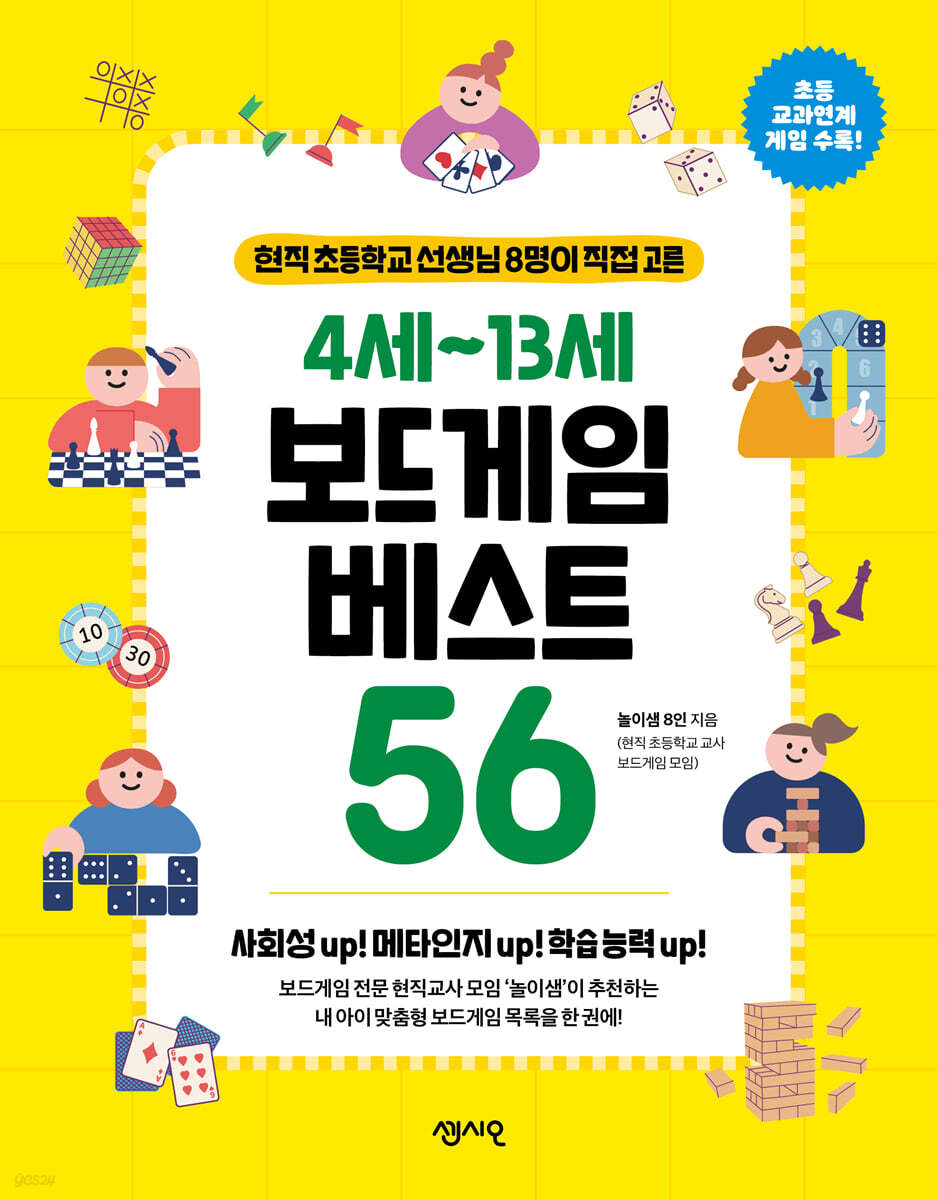
56 Best Board Games for Ages 4-13
 |
Description
Book Introduction
Carefully selected by 'Play Sam', a group of elementary school teachers specializing in board games
56 Best Board Games Tailored to Your Child's Age and Personality!
As the various benefits of board games become known, the number of parents who want to start playing board games with their children is increasing.
It is considered the best tool for brain activation and social development, perfectly replacing children's leisure time filled with YouTube videos, Nintendo, and online games.
However, even if you want to buy a game, it is difficult to find a game that is perfect for your child's age and interests just by looking at recommendations from people around you or searching the internet.
Also, when playing games with young children, I worry about how to explain the rules to them.
For these parents, 'Play Sam', a group of eight professional board gamers and current elementary school teachers, collected countless questions they had received and published '56 Best Board Games for Children Ages 4-13'.
This book is written by current teachers who have personally played most of the board games released in Korea with children, and among them, they have carefully selected 56 board games that are excellent in all aspects, including brain development, social skills, and giftedness development, and explained in detail how to use them.
After using board games in class for over a decade, they realized that the most important thing is to recommend board games that match the child's appropriate level and taste.
So, board games that develop children's hidden talents while being connected to the curriculum are categorized by the child's age (preschool, 1st-2nd grade, 3rd-4th grade, 5th-6th grade), preference (Top 7 studious, Top 7 guaranteed fun), and tendency (competitive child, child who likes to be alone, etc.), and are clearly organized in the book.
It also clearly explains solutions to various problems that arise when playing board games with children at home.
It is full of practical know-how that can be applied immediately in real life, such as how to coordinate opinions when there is a difference in level between siblings, what you should never say to your child during a board game, and how to resolve situations when your child is too obsessed with winning or losing.
It's clear why board games are considered a key activity in gifted education centers, science high schools, and Mensa tests.
This may be because children learn more easily and enjoyably when they play.
Why not open this book today and consider which board game to introduce your child to first? Today's delightful challenge will be the starting point for your family to become closer through board games.
56 Best Board Games Tailored to Your Child's Age and Personality!
As the various benefits of board games become known, the number of parents who want to start playing board games with their children is increasing.
It is considered the best tool for brain activation and social development, perfectly replacing children's leisure time filled with YouTube videos, Nintendo, and online games.
However, even if you want to buy a game, it is difficult to find a game that is perfect for your child's age and interests just by looking at recommendations from people around you or searching the internet.
Also, when playing games with young children, I worry about how to explain the rules to them.
For these parents, 'Play Sam', a group of eight professional board gamers and current elementary school teachers, collected countless questions they had received and published '56 Best Board Games for Children Ages 4-13'.
This book is written by current teachers who have personally played most of the board games released in Korea with children, and among them, they have carefully selected 56 board games that are excellent in all aspects, including brain development, social skills, and giftedness development, and explained in detail how to use them.
After using board games in class for over a decade, they realized that the most important thing is to recommend board games that match the child's appropriate level and taste.
So, board games that develop children's hidden talents while being connected to the curriculum are categorized by the child's age (preschool, 1st-2nd grade, 3rd-4th grade, 5th-6th grade), preference (Top 7 studious, Top 7 guaranteed fun), and tendency (competitive child, child who likes to be alone, etc.), and are clearly organized in the book.
It also clearly explains solutions to various problems that arise when playing board games with children at home.
It is full of practical know-how that can be applied immediately in real life, such as how to coordinate opinions when there is a difference in level between siblings, what you should never say to your child during a board game, and how to resolve situations when your child is too obsessed with winning or losing.
It's clear why board games are considered a key activity in gifted education centers, science high schools, and Mensa tests.
This may be because children learn more easily and enjoyably when they play.
Why not open this book today and consider which board game to introduce your child to first? Today's delightful challenge will be the starting point for your family to become closer through board games.
- You can preview some of the book's contents.
Preview
index
| Prologue | Brain-boosting, fun-filled! We invite you to a world of board games that everyone can enjoy.
Part 1.
Everything you need to know about board games that are fun for both kids and parents.
Chapter 1.
Why We Must Play Board Games
Can we develop metacognition and multiple intelligences?
What kind of board games do Mensa members play?
Time to meet real friends, not game characters
Parenting is a breeze! The best parenting item: board games.
I want to regain the concentration that was stolen by my smartphone!
Chapter 2.
A board game that kills two birds with one stone: brain development and fun.
You can develop the ability to think and solve problems on your own.
You can make good speech and attitude a habit.
You can develop social skills through the fun of playing together.
You can naturally build a bond through everyday conversation.
Chapter 3.
You should never say things like this while playing board games.
Words that create unnecessary competition
A word that is derogatory or mocking
Words that hinder strategic thinking
Words that are ignored or ignored
Chapter 4.
Play games like this with a child who has this type of personality.
When playing with a child who hates competition
When playing with a child who has difficulty concentrating
When playing with a child who is slow in learning and development
When playing a game with siblings of different levels
Chapter 5.
How to raise a child who enjoys being together rather than obsessing over winning or losing
3 Rules for Fair Play
3 Ways to Choose a Game That's Perfect for Your Child
5 Steps to Becoming a Master of Play
Chapter 6.
Minimum preparations to enjoy board games
Figure out the number of people, genre, and time
Parents should be the arbitrators of the game.
Information on compliance with and variations of the rules
| Column | Before buying a board game, I want to try it out myself to see if my child will like it.
Part 2.
56 Recommended Board Games for Learning and Fun
Chapter 1.
Ages 4-7, master Korean and numbers before starting school!
· Looping Louie, Agility/Coordination, Fly Airplane
· Frog candy eating, concept of quickness/number, frogs' candy battle
· Tumbling Monkey, Coordination, Do Monkeys Fall Out of Trees?
· Doble, quickness, the ultimate in quickness! Find the same picture.
· Rocking pirate ship, balance/coordination, who is the master of balance?
· Serpentine, water/art sense, making colorful snakes
Shark Island, the concept of numbers, and the dangers of adventure.
· Laon, Hangul Play, the greatness of Hangul!
· I see 10!, addition and subtraction, I see 10!
· Learn number games, number concepts, and basic arithmetic operations through games!
· Jingo, Korean/English/Agility and coordination, a meeting of bingo games and words
· Set Junior, Find the Rule of Numbers, and Mensa Selection Games at a kid-friendly level!
· More robots, a sense of speed and time. Slow? Fast? Imagine it at my own pace!
· Ubonggomini, shape concept, flip, rotate and fill!
| Column | Board game event, Board Game Festa? Board Game Con?
| Column | Exploring Pajuseuville: The Best Course for a Family Outing!
| Column | Board games you can enjoy both online and offline
| Column | Various versions of a single board game
Chapter 2.
1st and 2nd graders study arithmetic and develop quick thinking and memory.
· Halli Galli, a game that develops the concept of numbers/quick reflexes. If you see 5 of the same fruit, ring the bell!
· Friends Catch Catch, Develop Reflexes, Ryan is Mine!
· Forest Band, Developing/Expressing Reflexes, The Bustling Rabbit Band!
· Stick Stack, a game that develops balance and coordination, there is no simpler game than this!
· Uno, find the rules, when you have one card left, shout, Uno!
· Chicken Chacha, Memory, Catch Me If You Can!
· Cookie Box, find the rules, and get delicious cookies faster than anyone else!
· Shape Up, learning shapes, and conquering the land with plane figures
· Rivals, arithmetic operations, say the answer faster than your opponent!
· Semsem Pizza Shop, the four basic operations, find ingredients and make delicious pizza!
· Mahe, the four basic operations, and the turtles' funny racing game
· Sleeping Queens, Arithmetic, Wake Up the Sleeping Queen!
· Find the stack burger, coding, and hamburger ingredients in order!
· Gofish, a card game with infinite expandability and interdisciplinary links
| Column | Award-winning board games to keep an eye out for when choosing one
| Column | Games that are twice as effective when played with dad
Chapter 3.
A board game for 3rd and 4th graders to learn English vocabulary and economic concepts.
· Tumbling dice, arithmetic, roll it! Knock it out!
· Pillow fight on a moonlit night, quickness/coordination, throw and block pillows
· Taco Cat Goat Cheese Pizza, a game of quick reflexes/coordination, a noisy quick reflex game
· Halli Galli Cups, quickness/coordination, faster than anyone else, cards are the same
· You too? Me too? Party, speaking your thoughts and feelings/conversation and empathy, huh? You too, me too!
· Blitz, word association/reflex development, shout out when the same color appears!
· Eagle eye game, concept of numbers/average and probability, card game of eye
· Ubongo, shape, puzzle, shout out, Ubongo!
· Block blocks, shapes, and opponent blocks, and stack your blocks!
· Six Nimt, four basic operations/divisors and multiples, the sixth is not allowed!
English Train, learning English vocabulary, 3rd and 4th graders, Chugging English Vocabulary Train
· Double matching, conversation and empathy, what are other people thinking?
· Time's Up! Family, learn to speak and use metaphors, and have fun with your mouth and body!
· Miniville Deluxe, a town where you can make averages and probability/economic concepts, and dice.
| Column | Are you still just storing board games?
Chapter 4.
A learning brain development board game for 5th and 6th graders and middle school students.
· Splendor, Averages and Probabilities/Economic Concepts. Want to get rich? Come here!
· Dalmuti, History, Am I the Merchant Who Will Become King?
· 5-minute marble, discussion/quick thinking, 5-minute cut cooperative game!
· Lumicube, the rule-finding, sure-fire bestseller!
· Love letters, inferences, and a fierce game of wits toward the princess
Ticket to Ride, various countries around the world, travel around the world in a corner of your room!
· Da Vinci Code Plus, Finding the Rule/Average and Probability, What Hand Do You Have?
· Pharaoh Code, Mixed Calculation, Uncover the Secrets of the Code Hidden by the Pharaoh!
· Project L, a unique brain battle with shape and space puzzles
· Catan, Averages and Probabilities/Discussion/Economic Concepts, Bestselling Strategy Game!
· Let's learn about factors and multiples through the game Divisor and Multiple Train!
· Scrabble, English words, crossword puzzles
· Enter the world of modern art, masterpieces/economic concepts, and art collecting.
· Timeline Korean History, History/Politics and Economy, Time Travel to the Past, Learn History Through Games!
| Column | A series of instant games that even children can easily make.
Part 3.
How to Enjoy Board Games for Kids and Parents Together
Chapter 1.
Customized Games for Kids - Discover Your Child's Unique Talents
Board games for active kids
Board games for kids who enjoy conversation
A board game for kids who are confident in strategizing.
Board games for children who excel at memorization
Board games for kids that are fun even when played alone
Board games for imaginative kids
Board games for kids who love mystery
Chapter 2.
Situation-specific games - Family time
A board game that helps you realize the meaning of cooperation.
A board game that fosters economic awareness
A board game that develops an eye for art.
Escape room board games you can enjoy at home
Board games you can enjoy quietly even on the train
Portable board games that are great to take with you when you go camping
A great board game to play with the whole family
| Special Column | Board Games: The Ultimate Tool for Realistic Gifted Education
| Epilogue | What Doesn't Change with the Times
| Appendix | Curriculum-related information and major awards
| Appendix | Achasang and Recent New Releases
Part 1.
Everything you need to know about board games that are fun for both kids and parents.
Chapter 1.
Why We Must Play Board Games
Can we develop metacognition and multiple intelligences?
What kind of board games do Mensa members play?
Time to meet real friends, not game characters
Parenting is a breeze! The best parenting item: board games.
I want to regain the concentration that was stolen by my smartphone!
Chapter 2.
A board game that kills two birds with one stone: brain development and fun.
You can develop the ability to think and solve problems on your own.
You can make good speech and attitude a habit.
You can develop social skills through the fun of playing together.
You can naturally build a bond through everyday conversation.
Chapter 3.
You should never say things like this while playing board games.
Words that create unnecessary competition
A word that is derogatory or mocking
Words that hinder strategic thinking
Words that are ignored or ignored
Chapter 4.
Play games like this with a child who has this type of personality.
When playing with a child who hates competition
When playing with a child who has difficulty concentrating
When playing with a child who is slow in learning and development
When playing a game with siblings of different levels
Chapter 5.
How to raise a child who enjoys being together rather than obsessing over winning or losing
3 Rules for Fair Play
3 Ways to Choose a Game That's Perfect for Your Child
5 Steps to Becoming a Master of Play
Chapter 6.
Minimum preparations to enjoy board games
Figure out the number of people, genre, and time
Parents should be the arbitrators of the game.
Information on compliance with and variations of the rules
| Column | Before buying a board game, I want to try it out myself to see if my child will like it.
Part 2.
56 Recommended Board Games for Learning and Fun
Chapter 1.
Ages 4-7, master Korean and numbers before starting school!
· Looping Louie, Agility/Coordination, Fly Airplane
· Frog candy eating, concept of quickness/number, frogs' candy battle
· Tumbling Monkey, Coordination, Do Monkeys Fall Out of Trees?
· Doble, quickness, the ultimate in quickness! Find the same picture.
· Rocking pirate ship, balance/coordination, who is the master of balance?
· Serpentine, water/art sense, making colorful snakes
Shark Island, the concept of numbers, and the dangers of adventure.
· Laon, Hangul Play, the greatness of Hangul!
· I see 10!, addition and subtraction, I see 10!
· Learn number games, number concepts, and basic arithmetic operations through games!
· Jingo, Korean/English/Agility and coordination, a meeting of bingo games and words
· Set Junior, Find the Rule of Numbers, and Mensa Selection Games at a kid-friendly level!
· More robots, a sense of speed and time. Slow? Fast? Imagine it at my own pace!
· Ubonggomini, shape concept, flip, rotate and fill!
| Column | Board game event, Board Game Festa? Board Game Con?
| Column | Exploring Pajuseuville: The Best Course for a Family Outing!
| Column | Board games you can enjoy both online and offline
| Column | Various versions of a single board game
Chapter 2.
1st and 2nd graders study arithmetic and develop quick thinking and memory.
· Halli Galli, a game that develops the concept of numbers/quick reflexes. If you see 5 of the same fruit, ring the bell!
· Friends Catch Catch, Develop Reflexes, Ryan is Mine!
· Forest Band, Developing/Expressing Reflexes, The Bustling Rabbit Band!
· Stick Stack, a game that develops balance and coordination, there is no simpler game than this!
· Uno, find the rules, when you have one card left, shout, Uno!
· Chicken Chacha, Memory, Catch Me If You Can!
· Cookie Box, find the rules, and get delicious cookies faster than anyone else!
· Shape Up, learning shapes, and conquering the land with plane figures
· Rivals, arithmetic operations, say the answer faster than your opponent!
· Semsem Pizza Shop, the four basic operations, find ingredients and make delicious pizza!
· Mahe, the four basic operations, and the turtles' funny racing game
· Sleeping Queens, Arithmetic, Wake Up the Sleeping Queen!
· Find the stack burger, coding, and hamburger ingredients in order!
· Gofish, a card game with infinite expandability and interdisciplinary links
| Column | Award-winning board games to keep an eye out for when choosing one
| Column | Games that are twice as effective when played with dad
Chapter 3.
A board game for 3rd and 4th graders to learn English vocabulary and economic concepts.
· Tumbling dice, arithmetic, roll it! Knock it out!
· Pillow fight on a moonlit night, quickness/coordination, throw and block pillows
· Taco Cat Goat Cheese Pizza, a game of quick reflexes/coordination, a noisy quick reflex game
· Halli Galli Cups, quickness/coordination, faster than anyone else, cards are the same
· You too? Me too? Party, speaking your thoughts and feelings/conversation and empathy, huh? You too, me too!
· Blitz, word association/reflex development, shout out when the same color appears!
· Eagle eye game, concept of numbers/average and probability, card game of eye
· Ubongo, shape, puzzle, shout out, Ubongo!
· Block blocks, shapes, and opponent blocks, and stack your blocks!
· Six Nimt, four basic operations/divisors and multiples, the sixth is not allowed!
English Train, learning English vocabulary, 3rd and 4th graders, Chugging English Vocabulary Train
· Double matching, conversation and empathy, what are other people thinking?
· Time's Up! Family, learn to speak and use metaphors, and have fun with your mouth and body!
· Miniville Deluxe, a town where you can make averages and probability/economic concepts, and dice.
| Column | Are you still just storing board games?
Chapter 4.
A learning brain development board game for 5th and 6th graders and middle school students.
· Splendor, Averages and Probabilities/Economic Concepts. Want to get rich? Come here!
· Dalmuti, History, Am I the Merchant Who Will Become King?
· 5-minute marble, discussion/quick thinking, 5-minute cut cooperative game!
· Lumicube, the rule-finding, sure-fire bestseller!
· Love letters, inferences, and a fierce game of wits toward the princess
Ticket to Ride, various countries around the world, travel around the world in a corner of your room!
· Da Vinci Code Plus, Finding the Rule/Average and Probability, What Hand Do You Have?
· Pharaoh Code, Mixed Calculation, Uncover the Secrets of the Code Hidden by the Pharaoh!
· Project L, a unique brain battle with shape and space puzzles
· Catan, Averages and Probabilities/Discussion/Economic Concepts, Bestselling Strategy Game!
· Let's learn about factors and multiples through the game Divisor and Multiple Train!
· Scrabble, English words, crossword puzzles
· Enter the world of modern art, masterpieces/economic concepts, and art collecting.
· Timeline Korean History, History/Politics and Economy, Time Travel to the Past, Learn History Through Games!
| Column | A series of instant games that even children can easily make.
Part 3.
How to Enjoy Board Games for Kids and Parents Together
Chapter 1.
Customized Games for Kids - Discover Your Child's Unique Talents
Board games for active kids
Board games for kids who enjoy conversation
A board game for kids who are confident in strategizing.
Board games for children who excel at memorization
Board games for kids that are fun even when played alone
Board games for imaginative kids
Board games for kids who love mystery
Chapter 2.
Situation-specific games - Family time
A board game that helps you realize the meaning of cooperation.
A board game that fosters economic awareness
A board game that develops an eye for art.
Escape room board games you can enjoy at home
Board games you can enjoy quietly even on the train
Portable board games that are great to take with you when you go camping
A great board game to play with the whole family
| Special Column | Board Games: The Ultimate Tool for Realistic Gifted Education
| Epilogue | What Doesn't Change with the Times
| Appendix | Curriculum-related information and major awards
| Appendix | Achasang and Recent New Releases
Detailed image
.jpg)
Into the book
Play board games with your child.
I highly recommend board games as the best way to bring happiness to your family.
We all know that board games are fun and rewarding, but isn't it difficult to find a board game that suits your child's age, gender, and preferences based solely on recommendations from others or online searches? It's frustrating to see board games you buy only to find them abandoned after just one or two tries, taking up space on your shelf.
With so many board games on the market, which ones would my child enjoy? It would be great if someone could tell me which fun board games would best suit my child's personality.
---From the "Prologue"
Do you want to find a solution that allows your children to enjoy games together, rather than complaining or fighting with siblings every time they lose? Conversely, are you looking for a good way to help children avoid board games due to the stress of winning? As a professional board gamer and current teacher, I've carefully selected the questions I've heard countless times and will share some valuable board game tips for parents.
As a member of the Board Game Research Group, which has actively utilized board games in classes for over 10 years, I would like to introduce educationally beneficial board games and their educational applications.
Now all you have to do is enjoy the board game.
I hope that through this book, your child will be able to develop both academic skills and enjoy board games, and that the whole family will be able to enjoy board games happily.
---From the "Prologue"
Board games also provide opportunities for children to communicate with each other.
It opens up a space for communication by talking about the game with friends or sharing strategies.
In the process, you can naturally develop the ability to observe other people's facial expressions and develop various senses necessary for communication.
We also experience a process of coordinating opinions by discussing rules that we understand differently.
You can talk to friends you don't usually play with to play games, and you can become close to them by sharing similar emotions through winning and losing together.
Sometimes you can make your friends laugh by making ridiculous mistakes.
In this way, children can develop social skills by sharing opinions and adjusting to each other in various situations surrounding board games.
Let them bring to school the easy and fun board games they play at home.
You will be able to see yourself becoming friends with your friends through the game.
---「Part 1, Chapter 1.
From “Why We Must Play Board Games”
When playing a game, encourage your child to think about strategies rather than just playing.
Then, the child can also feel the fun of finding a strategy, and the more times he or she wins through strategy, the more he or she will enjoy the game.
If children recognize the need for strategy on their own, they will develop the habit of thinking about what strategies might be available whenever they encounter a new game.
These habits help children develop their thinking and problem-solving skills.
---「Part 1, Chapter 2.
From "Board games that kill two birds with one stone: brain development and fun"
Children who dislike competition may be upset when they lose or feel uncomfortable when their opponent loses, so they may choose to play with dolls or origami, which are not decisive, or play alone.
Rather, there are children who have such a strong desire to win that they cannot stand losing and so they do not play games.
However, there may be times when we all play games together during class time at school, or when we have to play games when hanging out at a friend's house.
Rather than avoiding competitive situations outright, consider the following tips to help your child expand their experiences and enjoy playing with friends.
---「Part 1 Chapter 4.
From "Play games like this with a child of this type"
The first chapter of Part 2 introduces best-selling board games suitable for preschoolers, divided into two categories: fun board games and study-oriented board games.
Fun-Guaranteed Board Games often feature tangible objects that children can see and touch.
We've selected popular board games that are literally fun to play, featuring interactive activities using cute components. Study-oriented board games share a common thread: winning is achieved through cognitive activities like learning Korean and English words, and learning and collecting numbers.
These are games that you can expect to have a natural learning effect.
For example, the Laon series helps with learning Korean by combining consonants and vowels, and I See 10! is effective for teaching math numbers, collecting, and learning addition.
Counting games are also effective in learning number concepts, including teaching and collecting, and Jingo is helpful in learning simple English words at a young age.
I highly recommend board games as the best way to bring happiness to your family.
We all know that board games are fun and rewarding, but isn't it difficult to find a board game that suits your child's age, gender, and preferences based solely on recommendations from others or online searches? It's frustrating to see board games you buy only to find them abandoned after just one or two tries, taking up space on your shelf.
With so many board games on the market, which ones would my child enjoy? It would be great if someone could tell me which fun board games would best suit my child's personality.
---From the "Prologue"
Do you want to find a solution that allows your children to enjoy games together, rather than complaining or fighting with siblings every time they lose? Conversely, are you looking for a good way to help children avoid board games due to the stress of winning? As a professional board gamer and current teacher, I've carefully selected the questions I've heard countless times and will share some valuable board game tips for parents.
As a member of the Board Game Research Group, which has actively utilized board games in classes for over 10 years, I would like to introduce educationally beneficial board games and their educational applications.
Now all you have to do is enjoy the board game.
I hope that through this book, your child will be able to develop both academic skills and enjoy board games, and that the whole family will be able to enjoy board games happily.
---From the "Prologue"
Board games also provide opportunities for children to communicate with each other.
It opens up a space for communication by talking about the game with friends or sharing strategies.
In the process, you can naturally develop the ability to observe other people's facial expressions and develop various senses necessary for communication.
We also experience a process of coordinating opinions by discussing rules that we understand differently.
You can talk to friends you don't usually play with to play games, and you can become close to them by sharing similar emotions through winning and losing together.
Sometimes you can make your friends laugh by making ridiculous mistakes.
In this way, children can develop social skills by sharing opinions and adjusting to each other in various situations surrounding board games.
Let them bring to school the easy and fun board games they play at home.
You will be able to see yourself becoming friends with your friends through the game.
---「Part 1, Chapter 1.
From “Why We Must Play Board Games”
When playing a game, encourage your child to think about strategies rather than just playing.
Then, the child can also feel the fun of finding a strategy, and the more times he or she wins through strategy, the more he or she will enjoy the game.
If children recognize the need for strategy on their own, they will develop the habit of thinking about what strategies might be available whenever they encounter a new game.
These habits help children develop their thinking and problem-solving skills.
---「Part 1, Chapter 2.
From "Board games that kill two birds with one stone: brain development and fun"
Children who dislike competition may be upset when they lose or feel uncomfortable when their opponent loses, so they may choose to play with dolls or origami, which are not decisive, or play alone.
Rather, there are children who have such a strong desire to win that they cannot stand losing and so they do not play games.
However, there may be times when we all play games together during class time at school, or when we have to play games when hanging out at a friend's house.
Rather than avoiding competitive situations outright, consider the following tips to help your child expand their experiences and enjoy playing with friends.
---「Part 1 Chapter 4.
From "Play games like this with a child of this type"
The first chapter of Part 2 introduces best-selling board games suitable for preschoolers, divided into two categories: fun board games and study-oriented board games.
Fun-Guaranteed Board Games often feature tangible objects that children can see and touch.
We've selected popular board games that are literally fun to play, featuring interactive activities using cute components. Study-oriented board games share a common thread: winning is achieved through cognitive activities like learning Korean and English words, and learning and collecting numbers.
These are games that you can expect to have a natural learning effect.
For example, the Laon series helps with learning Korean by combining consonants and vowels, and I See 10! is effective for teaching math numbers, collecting, and learning addition.
Counting games are also effective in learning number concepts, including teaching and collecting, and Jingo is helpful in learning simple English words at a young age.
---「Part 2 Chapter 1.
From "4~7 years old, master Korean and numbers before starting school"
From "4~7 years old, master Korean and numbers before starting school"
Publisher's Review
“We invite your family to the world of board games that have caught the attention of gifted education centers, Mensa, and science high schools!”
From personalized game recommendations based on age and preference to various tips you need to know when playing with children.
Everything you need to know about board games from "Play Sam," a group of board game experts and current elementary school teachers.
Recently, as the various advantages of board games have become known to the world, the board game market is growing rapidly.
Board game festivals are held every year at large exhibition centers such as COEX and SETEC, and various new board games are released.
Parents of children between the ages of 4 and 13 are also actively interested in board games that can be enjoyed by the whole family as well as developing their children's social skills and brains, instead of watching videos, playing Nintendo, or playing online games.
However, with over 3,000 different board games being released every year, parents are having a hard time figuring out which ones to recommend to their children.
Even if you want to buy a game, it is difficult to find a game that is perfect for your child's age and interests just by looking at recommendations from people around you or searching the internet.
For these parents, eight teachers from the board game group 'Play Sam', which is comprised of elementary school teachers, published '56 Best Board Games for Children Ages 4 to 13'.
This book was written by current teachers who personally played most of the board games released in Korea with children, and carefully selected 56 board games that were excellent in all aspects, including brain development, social skills, and giftedness development, and explained in detail how to use them.
Sociality up! Metacognition up! Learning ability up!
From preschool to 1st and 2nd grade, 3rd and 4th grade, and 5th and 6th grade
Recommended board games that are perfect for elementary school curriculum units!
This book contains everything parents need to know about board games, carefully selected from questions they have been asked countless times by eight professional board gamers and current elementary school teachers.
Part 1 details the effectiveness of various board games and situations that arise when playing games with children and how to deal with them.
If you just learn how to handle your child so that they keep winning and what parents should never say during a game, both parents and children can enjoy a happy game.
In Part 2, games carefully selected by current teachers based on curriculum connection are organized into preschool, 1st and 2nd grades, 3rd and 4th grades, and 5th and 6th grades for easy viewing.
We've selected the top 7 fun games for each age group and the top 7 games that are helpful for studying, so you can simply choose the game that suits your purpose.
Each game is guided through various ways to enjoy it with useful information such as simple game methods, rules, and QR codes.
In Part 3, games are suggested based on the child's personality and situation.
We've organized the books so you can check them out according to your needs and situation, including board games for active children, board games for children who like to play alone, and board games that can be enjoyed quietly even on the train.
In addition, board games play a huge role in awakening a child's giftedness.
We have also included a special column explaining what board games are used in Mensa, gifted high schools, and science high schools, and how they are utilized in class, so parents should not miss it.
“Read this book with your child and choose a board game!”
We invite you to the world of fun board games for both children and parents!
The author says that this book should be read differently depending on the reader's circumstances.
If you are a reader who is new to board games, it is recommended that you read carefully from the beginning to become familiar with the effectiveness and use of board games, as well as the various types of games.
However, if you are a reader who has already played board games with your child several times, you can check for yourself in Part 1 to see if your family is good at board games, and then skip straight to Part 2 to find out which board games are more fun.
Sometimes it's also recommended to show this book to your child and ask them what games they would like to play.
Since the child has chosen the board game, he or she will be more actively involved in the game.
This book is not something you read once and leave behind. If you keep it on your bookshelf and read it with your child over and over again, its effect will be 100 times greater.
So, how about starting today and embarking on a journey into the world of board games that both parents and children can enjoy?
From personalized game recommendations based on age and preference to various tips you need to know when playing with children.
Everything you need to know about board games from "Play Sam," a group of board game experts and current elementary school teachers.
Recently, as the various advantages of board games have become known to the world, the board game market is growing rapidly.
Board game festivals are held every year at large exhibition centers such as COEX and SETEC, and various new board games are released.
Parents of children between the ages of 4 and 13 are also actively interested in board games that can be enjoyed by the whole family as well as developing their children's social skills and brains, instead of watching videos, playing Nintendo, or playing online games.
However, with over 3,000 different board games being released every year, parents are having a hard time figuring out which ones to recommend to their children.
Even if you want to buy a game, it is difficult to find a game that is perfect for your child's age and interests just by looking at recommendations from people around you or searching the internet.
For these parents, eight teachers from the board game group 'Play Sam', which is comprised of elementary school teachers, published '56 Best Board Games for Children Ages 4 to 13'.
This book was written by current teachers who personally played most of the board games released in Korea with children, and carefully selected 56 board games that were excellent in all aspects, including brain development, social skills, and giftedness development, and explained in detail how to use them.
Sociality up! Metacognition up! Learning ability up!
From preschool to 1st and 2nd grade, 3rd and 4th grade, and 5th and 6th grade
Recommended board games that are perfect for elementary school curriculum units!
This book contains everything parents need to know about board games, carefully selected from questions they have been asked countless times by eight professional board gamers and current elementary school teachers.
Part 1 details the effectiveness of various board games and situations that arise when playing games with children and how to deal with them.
If you just learn how to handle your child so that they keep winning and what parents should never say during a game, both parents and children can enjoy a happy game.
In Part 2, games carefully selected by current teachers based on curriculum connection are organized into preschool, 1st and 2nd grades, 3rd and 4th grades, and 5th and 6th grades for easy viewing.
We've selected the top 7 fun games for each age group and the top 7 games that are helpful for studying, so you can simply choose the game that suits your purpose.
Each game is guided through various ways to enjoy it with useful information such as simple game methods, rules, and QR codes.
In Part 3, games are suggested based on the child's personality and situation.
We've organized the books so you can check them out according to your needs and situation, including board games for active children, board games for children who like to play alone, and board games that can be enjoyed quietly even on the train.
In addition, board games play a huge role in awakening a child's giftedness.
We have also included a special column explaining what board games are used in Mensa, gifted high schools, and science high schools, and how they are utilized in class, so parents should not miss it.
“Read this book with your child and choose a board game!”
We invite you to the world of fun board games for both children and parents!
The author says that this book should be read differently depending on the reader's circumstances.
If you are a reader who is new to board games, it is recommended that you read carefully from the beginning to become familiar with the effectiveness and use of board games, as well as the various types of games.
However, if you are a reader who has already played board games with your child several times, you can check for yourself in Part 1 to see if your family is good at board games, and then skip straight to Part 2 to find out which board games are more fun.
Sometimes it's also recommended to show this book to your child and ask them what games they would like to play.
Since the child has chosen the board game, he or she will be more actively involved in the game.
This book is not something you read once and leave behind. If you keep it on your bookshelf and read it with your child over and over again, its effect will be 100 times greater.
So, how about starting today and embarking on a journey into the world of board games that both parents and children can enjoy?
GOODS SPECIFICS
- Date of issue: November 21, 2024
- Page count, weight, size: 348 pages | 680g | 168*215*30mm
- ISBN13: 9791166571732
- ISBN10: 1166571734
You may also like
카테고리
korean


korean

![GQ KOREA Mark (Monthly): December [2025]](http://librairie.coreenne.fr/cdn/shop/files/8ef265dbbfbf186523ed75ba7319009d.jpg?v=1765340328&width=3840)


