

Talking to your child through picture books
 |
Description
Book Introduction
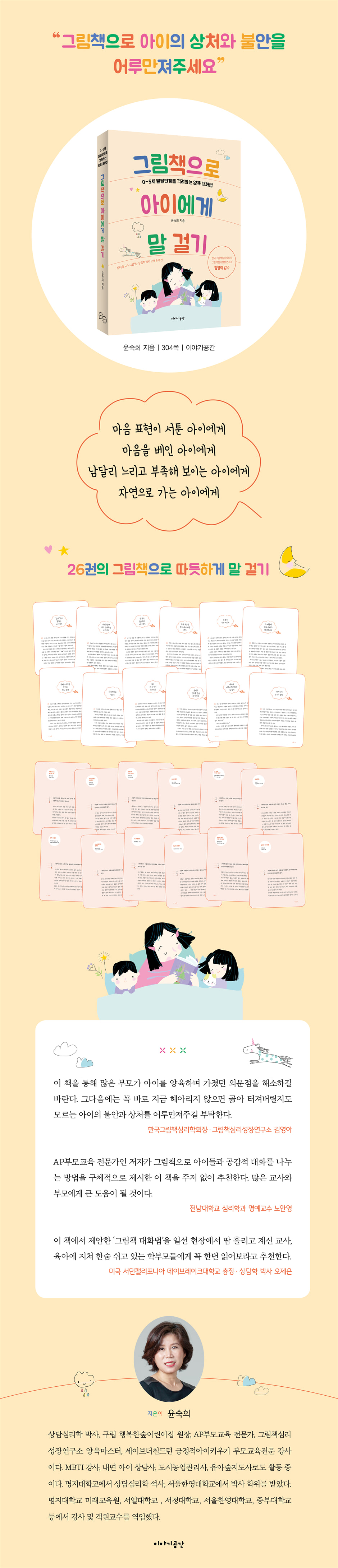
A child who is awkward at expressing his feelings, a child who has been hurt
A special child who is different from others, a child who goes to nature
How to Converse with 26 Picture Books
Professor Sookhee Yoon, who holds a doctorate in counseling psychology, is the director of the public Happy Forest Daycare Center, an AP parenting education expert, a parenting master at the Picture Book Psychology Growth Research Institute, a Save the Children Positive Child Raising Parenting Education specialist, an MBTI/Inner Child counselor, an urban agriculture manager, and a child forest instructor, has published a parenting conversation method that encourages the developmental stages of children aged 0 to 5, titled “Talking to Children with Picture Books.”
Professor Yoon Sook-hee has been studying children's developmental stages and providing parenting education by incorporating picture books into counseling psychology to listen more deeply to parents' concerns about child-rearing.
Thanks to this, the author, who has now become a natural picture book activist, says, “Picture books are a beneficial tool that allows parents to look into themselves, and at the same time, they purify my own mind.”
In 『Talking to Children with Picture Books』, the author introduces 26 different picture books that he used as guides when conducting parent picture book self-help groups, child counseling, and parent education.
These picture books teach children who struggle to express their feelings, children who have been hurt, children who are special because they are different from others, and children who are drawn to nature how to communicate sincerely.
Among these, the picture book story related to forest activities and garden activities in Chapter 4 is particularly trustworthy because it reflects the author's strong educational beliefs and expertise.
This is a child education book titled “Talking to Children through Picture Books,” which contains the hope that children and parents can heal their hearts and be happy together.
A special child who is different from others, a child who goes to nature
How to Converse with 26 Picture Books
Professor Sookhee Yoon, who holds a doctorate in counseling psychology, is the director of the public Happy Forest Daycare Center, an AP parenting education expert, a parenting master at the Picture Book Psychology Growth Research Institute, a Save the Children Positive Child Raising Parenting Education specialist, an MBTI/Inner Child counselor, an urban agriculture manager, and a child forest instructor, has published a parenting conversation method that encourages the developmental stages of children aged 0 to 5, titled “Talking to Children with Picture Books.”
Professor Yoon Sook-hee has been studying children's developmental stages and providing parenting education by incorporating picture books into counseling psychology to listen more deeply to parents' concerns about child-rearing.
Thanks to this, the author, who has now become a natural picture book activist, says, “Picture books are a beneficial tool that allows parents to look into themselves, and at the same time, they purify my own mind.”
In 『Talking to Children with Picture Books』, the author introduces 26 different picture books that he used as guides when conducting parent picture book self-help groups, child counseling, and parent education.
These picture books teach children who struggle to express their feelings, children who have been hurt, children who are special because they are different from others, and children who are drawn to nature how to communicate sincerely.
Among these, the picture book story related to forest activities and garden activities in Chapter 4 is particularly trustworthy because it reflects the author's strong educational beliefs and expertise.
This is a child education book titled “Talking to Children through Picture Books,” which contains the hope that children and parents can heal their hearts and be happy together.
- You can preview some of the book's contents.
Preview
index
Prologue: If you want to truly communicate with your child, talk to him or her through picture books.
Chapter 1.
Talking to a child who has difficulty expressing his feelings
For a child who is behaving aggressively
To the child who says “I don’t like it”
To a child who is stubborn about his taste in clothes
For children who don't want to go to daycare
To a greedy child
To a child who is throwing a tantrum
To a child who doesn't eat
For a child who hates to sleep
Picture books to share with your child in Chapter 1: "That's what I felt," "What do you say instead of "like" or "dislike?" "The first day I got dressed on my own," "We'll always meet again," "I'm too greedy!" "I did it because I was angry!" "Fantastic Side Dish Special Forces," "The Baby Bunny Who Doesn't Want to Sleep"
Chapter 2.
Talking to a child with a broken heart
I lack my mother's love
A fight between a couple is like cutting a child's heart with a knife.
Children who suffer from parental depression
I hate my younger brother so much
You want me to give in again?
My mom and dad broke up because of me.
I had a bad feeling in my heart.
Picture books to share with your child in Chapter 2: "I Really Like Mom", "Blown Away by the Wind", "Mom's Sad Day", "The Baby Has Arrived", "Mom, Who Do You Like More?", "Who Will I Live With Now?", "Emotional Hotel"
Chapter 3.
Talk to a special child who is different from others
To children whose flowers bloom at different times
To a child who tries to protect himself with incorrect communication methods
The moment I encountered autism spectrum disorder
Masturbation and Sex Education
Does my child have ADHD?
For a child who is obsessed with attachment objects
Picture books to share with your child in Chapter 3: 『The Secret of the Quick Quick Restaurant』 『Friend in the Box』 『I'm Here』 『Precious, Precious, You and Me』 『I Speak Like a River』 『This is My Blanket』
Chapter 4.
Talking to a child going into nature
For a child who plays well in nature
To the child going to the forest
To the child who met a friend in the forest
Forest play for children and adults
There is a universe in a seed
Picture books to share with your child in Chapter 4: The Sun Smiled, Inside a Walnut, A Magical Day in the Forest, Mom and the Tree Village, I'll Take Care of You
Epilogue
Reviewer's note
Recommendation
Chapter 1.
Talking to a child who has difficulty expressing his feelings
For a child who is behaving aggressively
To the child who says “I don’t like it”
To a child who is stubborn about his taste in clothes
For children who don't want to go to daycare
To a greedy child
To a child who is throwing a tantrum
To a child who doesn't eat
For a child who hates to sleep
Picture books to share with your child in Chapter 1: "That's what I felt," "What do you say instead of "like" or "dislike?" "The first day I got dressed on my own," "We'll always meet again," "I'm too greedy!" "I did it because I was angry!" "Fantastic Side Dish Special Forces," "The Baby Bunny Who Doesn't Want to Sleep"
Chapter 2.
Talking to a child with a broken heart
I lack my mother's love
A fight between a couple is like cutting a child's heart with a knife.
Children who suffer from parental depression
I hate my younger brother so much
You want me to give in again?
My mom and dad broke up because of me.
I had a bad feeling in my heart.
Picture books to share with your child in Chapter 2: "I Really Like Mom", "Blown Away by the Wind", "Mom's Sad Day", "The Baby Has Arrived", "Mom, Who Do You Like More?", "Who Will I Live With Now?", "Emotional Hotel"
Chapter 3.
Talk to a special child who is different from others
To children whose flowers bloom at different times
To a child who tries to protect himself with incorrect communication methods
The moment I encountered autism spectrum disorder
Masturbation and Sex Education
Does my child have ADHD?
For a child who is obsessed with attachment objects
Picture books to share with your child in Chapter 3: 『The Secret of the Quick Quick Restaurant』 『Friend in the Box』 『I'm Here』 『Precious, Precious, You and Me』 『I Speak Like a River』 『This is My Blanket』
Chapter 4.
Talking to a child going into nature
For a child who plays well in nature
To the child going to the forest
To the child who met a friend in the forest
Forest play for children and adults
There is a universe in a seed
Picture books to share with your child in Chapter 4: The Sun Smiled, Inside a Walnut, A Magical Day in the Forest, Mom and the Tree Village, I'll Take Care of You
Epilogue
Reviewer's note
Recommendation
Detailed image
Into the book
As a daycare director and a mother of two, I'm not perfect, but that gives me more confidence to say, "Let's do this together!"
Being a good parent is a constant learning process.
As children grow, the role of parents must also grow along with them.
When a child first begins to walk, the parent holds the child's hand.
As the child becomes more adept at walking, the parent may let go of the child's hand, but the parent's heart will always remain with the child.
We want to create a space where we can share and empathize with the fears and excitement we felt when becoming parents for the first time, as well as the countless emotions we experience along the way.
---From the "Prologue"
Even though he was two years old, A still had not developed language skills.
The daycare recommended developmental screenings several times, but the parents just kept telling them to wait a little longer.
One day, as time passed, something happened while I was on a field trip.
During lunch time, A stabbed a classmate in the face with a plastic fork.
There was a clear fork mark under my friend's eye.
I immediately gave my friend first aid and took him to the hospital to get his wound stitched up.
After this incident, we realized that there was a serious problem we had been overlooking.
Why did A, a slow-talking child, display such aggression by poking a classmate in the face? If he had been as articulate as his peers, would this incident have occurred?
---From "To a Child Who Acts Aggressively"
“What clothes do you want to wear today?” The only person who knows what clothes are right for a child is the child himself.
Let's put aside our hasty worries and listen to our children's thoughts and feelings.
It's better to organize clothes by type in the closet drawers and let your child choose what to wear.
If you don't have time in the morning, have them pick it out the night before.
Children can choose freely and leisurely, and of course, the time spent getting ready for school in the morning is reduced.
Parents support their children's choice of clothes and respect their choices.
"Wow, that's great! Did you pick something you like?" "I like what you picked, too!" "You picked something comfortable to play in!"
---From "To a Child Who Is Stubborn About His Clothing Taste"
When the parents refuse to listen, the child eventually lies down on the floor of the supermarket and begins to cry.
The parents, unable to bear the gaze of the audience gathered to watch their child's solo performance, end up giving the child what he wants, saying, "This is the last time!"
This is a common sight in supermarkets.
Have you ever watched a whining child and thought, "Why is that child acting like that?" Or have you ever watched your own child cry right in front of you and thought, "Why is my child acting like this?" If so, it's time to shift your focus from the child to the parents.
---From "To a Child Who Throws a Thing"
A couple's fight that resulted in masturbation and separation anxiety.
F had been receiving counseling for severe masturbation since he was 4 years old.
Around the same time, another behavior was seen: extreme separation anxiety when separated from the mother.
The child refused to go to school because he did not want to be separated from his mother, and the mother tried hard to get him to go.
As I continued counseling F, I was able to find out the cause of his masturbation and separation anxiety.
It was a serious fight between a couple.
F's father didn't care what he said when he got angry.
F's mother could not stand the verbal abuse and left home.
Then, there was an incident that decisively caused F's severe separation anxiety.
After that, F's separation anxiety reached a serious level.
---From "A Couple's Fight Is Like a Knife Cutting a Child's Heart"
If a mother has been depressed and unable to properly care for her child, the child will probably know that the mother is having a hard time.
And you'll want to know why your mom is having a hard time.
Let's talk first to the child who wants to ask why his beloved mother has changed or what the problem is, but cannot easily ask.
“I’m sorry I couldn’t pay attention to you until now.
It's not because your mother doesn't love you that she couldn't take care of you.
“It’s just that Mom had a ‘sad day’ for a while.”
---From "Children Who Suffer from Parental Depression"
What will our child think when he or she sees his or her new sibling? Or what did he or she think when the sibling was born? Let's give "The Baby Has Arrived" as a congratulatory gift to a child who just had a new sibling.
If you haven't been able to take care of your child when he or she was born, it would be a good idea to read this picture book together and talk about it now.
"How did you feel when your little brother was born? Mom and Dad are really curious about how you felt when you had a little brother."
---From "I Hate My Little Brother So Much"
The idea that a lot is going to change can be very scary and painful for a child to accept.
Please tell them, “Mom and Dad are so different from each other that they are getting divorced. It’s not your fault.”
This advice will be a valuable guide to help your child endure this situation and accept the separation naturally.
Of course, the child may not feel better right away.
The parents divorced because they didn't get along, but from the child's perspective, it's like losing one of their parents.
Even so, let's wait.
If you are a parent from a divorced family, or if you know a child from a divorced family, give them “Who Will I Live With Now?” and read it together.
---From "Mom and Dad Broke Up Because of Me"
Not all children on the autism spectrum experience developmental challenges from the start.
About 2 to 3 out of 10 children on the autism spectrum develop at a normal rate until the age of 1 to 2, and then suddenly regress.
Therefore, it is necessary to watch the child carefully until this period.
The exact cause of autism spectrum disorder is still unknown.
Because there is no clear solution yet, early detection and treatment are of utmost importance.
… … “I’m Here” features a child with autism spectrum disorder who cannot socialize with other children and spends time alone.
---From "The Moment I Met Autism Spectrum Disorder"
Children are very sensitive to touch and explore every nook and cranny of their bodies.
Among them, there is a tendency to feel pleasure or find comfort by touching the genitals or stimulating the area around them.
When children engage in sexual play like this, it is called 'genital play'.
Most children begin to explore their own bodies around the age of two.
Infant masturbation is so common and normal that it has its own term, and it disappears naturally.
From an adult's perspective, masturbation is a very personal and shameful thing to others, but for children, it is not embarrassing at all.
---From "Masturbation and Sex Education"
It seems like the river is flowing without any problems, but the water gropes its way.
The river winds and swirls, groping its way here and there.
It flows while colliding and breaking violently.
Like a calm current beyond a rough current, the child realizes that his inner self is like that, which makes him stutter.
The calm waters gently ripple and sparkle.
Just because you stutter doesn't mean you stutter.
The child embraces his or her differences from others and takes steps toward the outside world.
I found warm healing and great comfort in the river I looked at with my father.
If your child seems to be lacking something special right now, why not read this picture book together?
“It’s okay if it’s slow.
“Just flow slowly like a river.”
---From "Does my child have ADHD?"
According to developmental psychologists, attitudes toward certain objects are formed before the age of five.
Unlike innate instincts, attitudes are acquired through repeated direct experiences or direct or indirect verbal learning.
Therefore, rich experiences in nature during childhood help children realize that nature and humans coexist and help each other, and instill a positive attitude toward nature.
---From "To a Child Who Plays Well in Nature"
When climbing through the forest, you may encounter uneven or steep stairs, as well as slippery paths.
By walking up and down these places every week, children learn about various body sensations.
You will develop and control your motor skills and learn about your body and mind in many ways, such as climbing stairs, bending over, balancing on a tree, descending on your buttocks, and walking sideways like a crab.
In the forest, you can run, move, and play loudly to your heart's content.
Less aggressive and free-spirited activities increase self-esteem and self-efficacy.
---From "To the Child Going to the Forest"
The trees in “Mom and the Tree Village” speak to children using various onomatopoeia and mimetic words.
It conveys its life through movements and sounds that are swaying, colorful, tumbling, bouncing, fluffy, and rustling.
This book teaches children the names of unfamiliar trees, and onomatopoeia and mimetic words for the gestures and sounds that trees might make.
In the tree village, children feel and learn about nature.
This is a picture book that connects generations and allows children to feel the green vitality in their hearts and adults to recall childhood memories.
---From "Forest Play for Children and Adults"
“I will take care of you.” Read this picture book with your child and encourage them to take good care of small, fragile sprouts.
The sprout will become a stem, and leaves will sprout from the stem.
If you wait, flowers will bloom and fruit will be produced.
Be sure to tell your child.
It is said that there are many miracles that occur before a seed becomes a large tree.
Being a good parent is a constant learning process.
As children grow, the role of parents must also grow along with them.
When a child first begins to walk, the parent holds the child's hand.
As the child becomes more adept at walking, the parent may let go of the child's hand, but the parent's heart will always remain with the child.
We want to create a space where we can share and empathize with the fears and excitement we felt when becoming parents for the first time, as well as the countless emotions we experience along the way.
---From the "Prologue"
Even though he was two years old, A still had not developed language skills.
The daycare recommended developmental screenings several times, but the parents just kept telling them to wait a little longer.
One day, as time passed, something happened while I was on a field trip.
During lunch time, A stabbed a classmate in the face with a plastic fork.
There was a clear fork mark under my friend's eye.
I immediately gave my friend first aid and took him to the hospital to get his wound stitched up.
After this incident, we realized that there was a serious problem we had been overlooking.
Why did A, a slow-talking child, display such aggression by poking a classmate in the face? If he had been as articulate as his peers, would this incident have occurred?
---From "To a Child Who Acts Aggressively"
“What clothes do you want to wear today?” The only person who knows what clothes are right for a child is the child himself.
Let's put aside our hasty worries and listen to our children's thoughts and feelings.
It's better to organize clothes by type in the closet drawers and let your child choose what to wear.
If you don't have time in the morning, have them pick it out the night before.
Children can choose freely and leisurely, and of course, the time spent getting ready for school in the morning is reduced.
Parents support their children's choice of clothes and respect their choices.
"Wow, that's great! Did you pick something you like?" "I like what you picked, too!" "You picked something comfortable to play in!"
---From "To a Child Who Is Stubborn About His Clothing Taste"
When the parents refuse to listen, the child eventually lies down on the floor of the supermarket and begins to cry.
The parents, unable to bear the gaze of the audience gathered to watch their child's solo performance, end up giving the child what he wants, saying, "This is the last time!"
This is a common sight in supermarkets.
Have you ever watched a whining child and thought, "Why is that child acting like that?" Or have you ever watched your own child cry right in front of you and thought, "Why is my child acting like this?" If so, it's time to shift your focus from the child to the parents.
---From "To a Child Who Throws a Thing"
A couple's fight that resulted in masturbation and separation anxiety.
F had been receiving counseling for severe masturbation since he was 4 years old.
Around the same time, another behavior was seen: extreme separation anxiety when separated from the mother.
The child refused to go to school because he did not want to be separated from his mother, and the mother tried hard to get him to go.
As I continued counseling F, I was able to find out the cause of his masturbation and separation anxiety.
It was a serious fight between a couple.
F's father didn't care what he said when he got angry.
F's mother could not stand the verbal abuse and left home.
Then, there was an incident that decisively caused F's severe separation anxiety.
After that, F's separation anxiety reached a serious level.
---From "A Couple's Fight Is Like a Knife Cutting a Child's Heart"
If a mother has been depressed and unable to properly care for her child, the child will probably know that the mother is having a hard time.
And you'll want to know why your mom is having a hard time.
Let's talk first to the child who wants to ask why his beloved mother has changed or what the problem is, but cannot easily ask.
“I’m sorry I couldn’t pay attention to you until now.
It's not because your mother doesn't love you that she couldn't take care of you.
“It’s just that Mom had a ‘sad day’ for a while.”
---From "Children Who Suffer from Parental Depression"
What will our child think when he or she sees his or her new sibling? Or what did he or she think when the sibling was born? Let's give "The Baby Has Arrived" as a congratulatory gift to a child who just had a new sibling.
If you haven't been able to take care of your child when he or she was born, it would be a good idea to read this picture book together and talk about it now.
"How did you feel when your little brother was born? Mom and Dad are really curious about how you felt when you had a little brother."
---From "I Hate My Little Brother So Much"
The idea that a lot is going to change can be very scary and painful for a child to accept.
Please tell them, “Mom and Dad are so different from each other that they are getting divorced. It’s not your fault.”
This advice will be a valuable guide to help your child endure this situation and accept the separation naturally.
Of course, the child may not feel better right away.
The parents divorced because they didn't get along, but from the child's perspective, it's like losing one of their parents.
Even so, let's wait.
If you are a parent from a divorced family, or if you know a child from a divorced family, give them “Who Will I Live With Now?” and read it together.
---From "Mom and Dad Broke Up Because of Me"
Not all children on the autism spectrum experience developmental challenges from the start.
About 2 to 3 out of 10 children on the autism spectrum develop at a normal rate until the age of 1 to 2, and then suddenly regress.
Therefore, it is necessary to watch the child carefully until this period.
The exact cause of autism spectrum disorder is still unknown.
Because there is no clear solution yet, early detection and treatment are of utmost importance.
… … “I’m Here” features a child with autism spectrum disorder who cannot socialize with other children and spends time alone.
---From "The Moment I Met Autism Spectrum Disorder"
Children are very sensitive to touch and explore every nook and cranny of their bodies.
Among them, there is a tendency to feel pleasure or find comfort by touching the genitals or stimulating the area around them.
When children engage in sexual play like this, it is called 'genital play'.
Most children begin to explore their own bodies around the age of two.
Infant masturbation is so common and normal that it has its own term, and it disappears naturally.
From an adult's perspective, masturbation is a very personal and shameful thing to others, but for children, it is not embarrassing at all.
---From "Masturbation and Sex Education"
It seems like the river is flowing without any problems, but the water gropes its way.
The river winds and swirls, groping its way here and there.
It flows while colliding and breaking violently.
Like a calm current beyond a rough current, the child realizes that his inner self is like that, which makes him stutter.
The calm waters gently ripple and sparkle.
Just because you stutter doesn't mean you stutter.
The child embraces his or her differences from others and takes steps toward the outside world.
I found warm healing and great comfort in the river I looked at with my father.
If your child seems to be lacking something special right now, why not read this picture book together?
“It’s okay if it’s slow.
“Just flow slowly like a river.”
---From "Does my child have ADHD?"
According to developmental psychologists, attitudes toward certain objects are formed before the age of five.
Unlike innate instincts, attitudes are acquired through repeated direct experiences or direct or indirect verbal learning.
Therefore, rich experiences in nature during childhood help children realize that nature and humans coexist and help each other, and instill a positive attitude toward nature.
---From "To a Child Who Plays Well in Nature"
When climbing through the forest, you may encounter uneven or steep stairs, as well as slippery paths.
By walking up and down these places every week, children learn about various body sensations.
You will develop and control your motor skills and learn about your body and mind in many ways, such as climbing stairs, bending over, balancing on a tree, descending on your buttocks, and walking sideways like a crab.
In the forest, you can run, move, and play loudly to your heart's content.
Less aggressive and free-spirited activities increase self-esteem and self-efficacy.
---From "To the Child Going to the Forest"
The trees in “Mom and the Tree Village” speak to children using various onomatopoeia and mimetic words.
It conveys its life through movements and sounds that are swaying, colorful, tumbling, bouncing, fluffy, and rustling.
This book teaches children the names of unfamiliar trees, and onomatopoeia and mimetic words for the gestures and sounds that trees might make.
In the tree village, children feel and learn about nature.
This is a picture book that connects generations and allows children to feel the green vitality in their hearts and adults to recall childhood memories.
---From "Forest Play for Children and Adults"
“I will take care of you.” Read this picture book with your child and encourage them to take good care of small, fragile sprouts.
The sprout will become a stem, and leaves will sprout from the stem.
If you wait, flowers will bloom and fruit will be produced.
Be sure to tell your child.
It is said that there are many miracles that occur before a seed becomes a large tree.
---From "The Universe is in the Seed"
Publisher's Review
A message to parents who want to communicate sincerely with their children
Talking with picture books
Although she became a picture book activist late in life, the author's true calling is 'childcare teacher.'
The author, who has spent half her life as a daycare director and has explored ways to show greater respect to children aged 0-5, advises parents who want to truly communicate with their children, “Speak to them through picture books.”
The author fell in love with picture books while reading “The Man Who Planted Trees” by Jang Giono, which he happened to come across around the time the COVID-19 pandemic arrived.
Now, I try to copy and draw, and sometimes I share my feelings with people who live with anxiety and wounds through picture books.
In addition, picture book parent education, which began 2-3 years ago, is becoming more and more in-depth.
Through the recently launched 'Parents' Picture Book Self-Help Group', parent education using picture books as a tool has gained great sympathy.
These experiences have accumulated and become the foundation for introducing 26 picture books in 『Talking to Children through Picture Books』.
A collection of 26 picture books on parenting conversations that encourage developmental stages for children ages 0 to 5.
Talking to children through picture books? What does it mean? Professor Yoon Sook-hee, who holds a doctorate in counseling psychology and has been teaching parents for over a decade, emphasizes that "having a medium allows for more intimate communication."
That medium is ‘picture books.’
From this perspective, this book covers four major topics.
Chapter 1 recognizes the feelings of a child who is not good at expressing himself and provides appropriate empathy and parenting methods.
When you want to know what emotions and desires are behind a child's words, ask, "How are you feeling?" or empathize by saying, "I see, that's why it was like that!" There are vivid examples of cases where problems were surprisingly solved.
Chapter 2 is about talking to a child with a broken heart.
Children who deserve to be raised but do not receive it or receive it incorrectly may suffer emotional scars and a damaged self-image.
Therefore, we are trying to find ways to first understand and encourage these children.
Chapter 3 contains information on parents' flexible and wise attitude toward their slightly different children.
We are seeking ways to help children with problems that arise from temperament or developmental characteristics.
In Chapter 4, we thought about the problems with the current parenting environment and what is best.
In addition, we looked into the necessity and effectiveness of ecological transition education (education that emphasizes practice for the coexistence of humans and nature) through ‘forest activities’ and ‘garden activities’ as a way to support the current play environment and education for future generations.
Each chapter of this book introduces a picture book that can be used to 'talk to children' according to the topic.
The last sentence ends with a warm 'word' from a parent, to strongly convey the point that reading a picture book with a similar protagonist to a child who is exhibiting problem behavior or in a situation that is difficult to overcome on their own can help them share their feelings more easily and smoothly.
I hope that parents will consider at least the 26 picture books in this book as reference books for talking to their children and find them helpful when raising their children.
Supervised by Kim Young-ah, President of the Korean Picture Book Psychology Association and Director of the Picture Book Psychology Growth Research Institute
Noh An-young, Professor Emeritus of Psychology at Chonnam National University
Recommended by Oh Je-eun, President of Daybreak University in Southern California and Ph.D. in Counseling
A must-read for parents: parenting books
Professor Kim Young-ah, president of the Korean Picture Book Psychology Association and director of the Picture Book Psychology Growth Research Institute, who reviewed this book, said, “The part where the author introduces various related picture books that fit the theme of each chapter and discusses them with children was outstanding.
Rather than forcing awkward expressions through picture books, we can look closely at the child's mind to see which scenes he or she pays attention to, which expressions he or she puts his or her heart into, and further, whether he or she pauses or steps back through activity connections.
Overall, the author's rich field experience and cases, along with the picture books that support them, provide professional and appropriate help with any questions you may have while raising a child.
Professor Emeritus Noh An-young of the Department of Psychology at Chonnam National University said, “A child’s lifestyle as they grow up and survive in this world is determined by the parenting style of their parents or caregivers in the early stages of life, so the role of parents and daycare teachers is incredibly important, and this will be of great help to them.” Professor Oh Je-eun, president of Daybreak University in Southern California and a doctorate in counseling, said, “This is a picture book essay with a child education nature that provides valuable information on child rearing, such as which picture books are most appropriate to use to communicate with children at their developmental level,” and recommended that many teachers and parents and caregivers read this book.
Talking with picture books
Although she became a picture book activist late in life, the author's true calling is 'childcare teacher.'
The author, who has spent half her life as a daycare director and has explored ways to show greater respect to children aged 0-5, advises parents who want to truly communicate with their children, “Speak to them through picture books.”
The author fell in love with picture books while reading “The Man Who Planted Trees” by Jang Giono, which he happened to come across around the time the COVID-19 pandemic arrived.
Now, I try to copy and draw, and sometimes I share my feelings with people who live with anxiety and wounds through picture books.
In addition, picture book parent education, which began 2-3 years ago, is becoming more and more in-depth.
Through the recently launched 'Parents' Picture Book Self-Help Group', parent education using picture books as a tool has gained great sympathy.
These experiences have accumulated and become the foundation for introducing 26 picture books in 『Talking to Children through Picture Books』.
A collection of 26 picture books on parenting conversations that encourage developmental stages for children ages 0 to 5.
Talking to children through picture books? What does it mean? Professor Yoon Sook-hee, who holds a doctorate in counseling psychology and has been teaching parents for over a decade, emphasizes that "having a medium allows for more intimate communication."
That medium is ‘picture books.’
From this perspective, this book covers four major topics.
Chapter 1 recognizes the feelings of a child who is not good at expressing himself and provides appropriate empathy and parenting methods.
When you want to know what emotions and desires are behind a child's words, ask, "How are you feeling?" or empathize by saying, "I see, that's why it was like that!" There are vivid examples of cases where problems were surprisingly solved.
Chapter 2 is about talking to a child with a broken heart.
Children who deserve to be raised but do not receive it or receive it incorrectly may suffer emotional scars and a damaged self-image.
Therefore, we are trying to find ways to first understand and encourage these children.
Chapter 3 contains information on parents' flexible and wise attitude toward their slightly different children.
We are seeking ways to help children with problems that arise from temperament or developmental characteristics.
In Chapter 4, we thought about the problems with the current parenting environment and what is best.
In addition, we looked into the necessity and effectiveness of ecological transition education (education that emphasizes practice for the coexistence of humans and nature) through ‘forest activities’ and ‘garden activities’ as a way to support the current play environment and education for future generations.
Each chapter of this book introduces a picture book that can be used to 'talk to children' according to the topic.
The last sentence ends with a warm 'word' from a parent, to strongly convey the point that reading a picture book with a similar protagonist to a child who is exhibiting problem behavior or in a situation that is difficult to overcome on their own can help them share their feelings more easily and smoothly.
I hope that parents will consider at least the 26 picture books in this book as reference books for talking to their children and find them helpful when raising their children.
Supervised by Kim Young-ah, President of the Korean Picture Book Psychology Association and Director of the Picture Book Psychology Growth Research Institute
Noh An-young, Professor Emeritus of Psychology at Chonnam National University
Recommended by Oh Je-eun, President of Daybreak University in Southern California and Ph.D. in Counseling
A must-read for parents: parenting books
Professor Kim Young-ah, president of the Korean Picture Book Psychology Association and director of the Picture Book Psychology Growth Research Institute, who reviewed this book, said, “The part where the author introduces various related picture books that fit the theme of each chapter and discusses them with children was outstanding.
Rather than forcing awkward expressions through picture books, we can look closely at the child's mind to see which scenes he or she pays attention to, which expressions he or she puts his or her heart into, and further, whether he or she pauses or steps back through activity connections.
Overall, the author's rich field experience and cases, along with the picture books that support them, provide professional and appropriate help with any questions you may have while raising a child.
Professor Emeritus Noh An-young of the Department of Psychology at Chonnam National University said, “A child’s lifestyle as they grow up and survive in this world is determined by the parenting style of their parents or caregivers in the early stages of life, so the role of parents and daycare teachers is incredibly important, and this will be of great help to them.” Professor Oh Je-eun, president of Daybreak University in Southern California and a doctorate in counseling, said, “This is a picture book essay with a child education nature that provides valuable information on child rearing, such as which picture books are most appropriate to use to communicate with children at their developmental level,” and recommended that many teachers and parents and caregivers read this book.
GOODS SPECIFICS
- Date of issue: November 15, 2024
- Page count, weight, size: 304 pages | 412g | 152*200*30mm
- ISBN13: 9791193098196
- ISBN10: 119309819X
You may also like
카테고리
korean


korean

![GQ KOREA Mark (Monthly): December [2025]](http://librairie.coreenne.fr/cdn/shop/files/8ef265dbbfbf186523ed75ba7319009d.jpg?v=1765340328&width=3840)


