

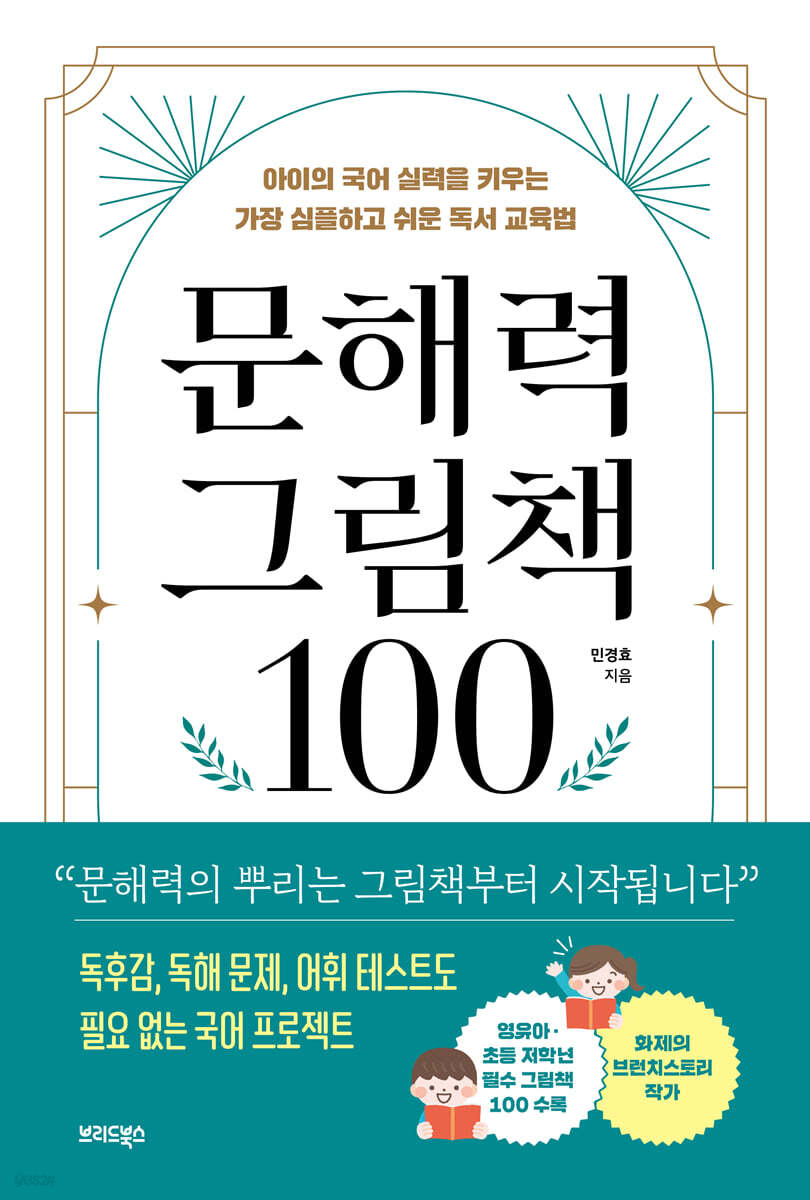
100 Literacy Picture Books
 |
Description
Book Introduction
“The roots of literacy begin with picture books.”
100 Picture Book Projects from a Literacy Expert and Elementary School Teacher Mom
Both at school and at home, we do many activities to improve children's literacy, such as writing book reports, solving reading comprehension problems, and taking vocabulary tests.
However, the more these activities are added, the more children perceive reading as a burdensome learning task rather than an enjoyable activity.
This book suggests reading picture books as the simplest and easiest way for children from toddlers to elementary school students to develop literacy skills.
This book is the result of the author's 15 years of experience as a teacher teaching literacy since 2007, 10 years of experience as a mother playing with picture books with her two children, and two years of research on early literacy in graduate school.
The author simply selected picture books that children would like and read them at school and at home, but as the number of picture books read together accumulated, the children's understanding of text, vocabulary, and writing skills gradually grew. Based on this, the author noted that the roots of literacy begin with picture books.
This book is a friendly picture book consultation center that introduces a list of 100 books specially selected by literacy experts and provides specific methods for teaching literacy through picture books.
100 Picture Book Projects from a Literacy Expert and Elementary School Teacher Mom
Both at school and at home, we do many activities to improve children's literacy, such as writing book reports, solving reading comprehension problems, and taking vocabulary tests.
However, the more these activities are added, the more children perceive reading as a burdensome learning task rather than an enjoyable activity.
This book suggests reading picture books as the simplest and easiest way for children from toddlers to elementary school students to develop literacy skills.
This book is the result of the author's 15 years of experience as a teacher teaching literacy since 2007, 10 years of experience as a mother playing with picture books with her two children, and two years of research on early literacy in graduate school.
The author simply selected picture books that children would like and read them at school and at home, but as the number of picture books read together accumulated, the children's understanding of text, vocabulary, and writing skills gradually grew. Based on this, the author noted that the roots of literacy begin with picture books.
This book is a friendly picture book consultation center that introduces a list of 100 books specially selected by literacy experts and provides specific methods for teaching literacy through picture books.
- You can preview some of the book's contents.
Preview
index
Part 1: Why Read Picture Books?
Reading Comprehension - Does Reading Picture Books Improve Reading Comprehension?
Vocabulary - Your vocabulary will increase without you having to put in any effort.
Background knowledge _ You can build background knowledge
Critical Thinking _ Develop the power to think critically
Fluency _ Reading together helps develop fluency.
Phonological Awareness _ Developing Phonological Awareness
Reading skills - You can learn print knowledge and reading strategies.
Writing skills _ Writing skills develop
Part 2: What picture book should we read?
* Reading comprehension
001 It's Okay to Be Clumsy 《How to Wipe a Superhero's Poop》
002 You Can Be Happy Regardless of Your Grades 《Creepy Crayon!》
003 Oh, are you okay? "It's Okay, Mister"
004 Think of Your Grandfather (My Grandfather)
005 I Really Like Red Cats 《What's Wrong with Red》
006 Even if you're afraid, you can do it. 《Octopus Bathhouse》
007 Expressing Your Heart to Your Tired Parents (Battery Dad)
008 Feel the power of your creative imagination in "Which school do you like?"
009 You Can Grow Yourself 《Creepy Panties!》
010 Enjoy your creative imagination in "Watermelon Pool"
011 Thinking about a good friend 《Momo and Toto》
012 Enjoy the feeling of a vacation away from your tiring daily life with "Hot Dog"
013 Guess the characters' thoughts and feelings by looking at the picture. "Mom's Summer Vacation"
014 When courage is needed, find hope through picture books. "Do you remember?"
* Vocabulary
015 Discover diverse vocabulary in picture books for older audiences: "My Mom Who Sucked Up the Goblin"
016 What kind of mood should we go shopping for? 《Mood Shop》
017 Everyone is so cute 《My heart ㅅㅅㅎ》
018 Let's understand each other by sharing our stories 《Kongkongkong》
019 Feel the fun of fantasy in "Mom's Vending Machine"
020 Guess the Unrevealed Part 《Lion Mart》
021 Sharing Makes You Happy 《Word Collector》
022 Feel the taste of summer 《Taste of Summer》
023 Learn new vocabulary naturally 《Kongkongkong Ddangdang》
* Background knowledge
024 You can also enjoy it as a musical, "The Fairy of Longevity Soup"
025 I Want to Read an Old Story: "Ho-Raeng-Myeon"
026 Learn about the author of "Carousel"
027 Learn to maintain a positive attitude that doesn't waver in the face of adversity. "The School Where Hope Falls"
028 Compare the changes over time in "Raspberry Cream Bonbon"
029 Finding What I Really Love 《Super Turtle》
030 Share your thoughts on pets: "What should I do?! Cats?"
031 Imagine something related to the moon 《Moon Dust》
032 Learn by reading the informative picture book "To You Who Came to Earth"
033 Save the Sick Sea 《Grandma's Dragon Palace Journey》
034 I read and feel it in relation to my own experience. 《Strange Mother》
035 Explore the mother born with me: "Mom's Guide"
036 Let's imagine a fun Santa story: How does Santa go down the chimney?
* Critical thinking skills
037 You can draw with an eraser too 《Perfect》
038 Are wolves always bad? The Wolf's Tale of the Three Little Pigs
039 Think Critically 《The Fish with a Cold》
040 We all think differently. "Please give me the perfect fried egg."
041 I Want to See My Mom's Smiling Face (Pig Book)
042 See the World Differently 《A Strange Day》
043 Wit and humor shine through in "Dr. DeSoto, the Dentist"
044 Compare it to our family's appearance. "Please give me some potatoes!"
045 Thinking about misunderstandings and prejudices 《Iparapyanyamnyam》
046 Let's find a way out of the pit. 《How do I get out of the pit?》
047 Break the stereotypes and imagine "This is not a box"
048 Believe in Yourself as You Are and Be Courageous 《The Wall Climbing Boy》
049 Thinking about something great 《Something Great》
050 Developing the Will to Overcome Difficult and Uncomfortable Situations: Anatole's Little Pot
* Fluency
051 Hahaha, I'm laughing 《Horangtteok House》
052 "I should try it when I get home today!" "I'll open them all for you."
053 Guess by looking at part of the picture 《Teddy Bear Panties》
054 Meet a book with various page-turning directions, "Let's Go!"
055 Feel the fun of onomatopoeia and mimetic words in "Holljak Holjak Hororok"
056 Reading a Summer Picture Book in the Summer: The Sun King Suba
057 Everyone Has Worries 《Peeing a Little》
058 If you have the courage to take on a challenge, you will be happy. 《Elephant Beauty Salon》
059 Feeling My Preciousness 《Kim Peanut Went to Space》
* Phonological awareness skills
060 Something more enjoyable than you think will happen. 《What should I do?》
061 Picture Books Are Getting Better "What Kind of Bathroom Do You Like?"
062 Enjoy the spooky yet fun story "Dralala Dental Clinic"
063 Love My Short-Eared Rabbit
064 Shall we be brave like the protagonist in "Alsatang"?
065 Imagine the characters' minds in "The Bread Ghost"
066 Let's go on an outing 《It's nice to be out》
067 Share Your Heart with Children: The Rainbow Fish
068 You can feel it deeply if you read it multiple times. 《Dal Shabet》
069 Nothing Else Is Wrong 《The Summer of the Mole》
070 How can hatred disappear? 《Hatred》
071 When I'm Sad, I Find My Own Solution 《Tearful Bread》
072 Praise is Powerful 《Edward the Worst Boy in the World》
073 Thinking Deeply About Myself: Is This Really Me?
* Reading skills
074 I Want to Go to School (Carrot Kindergarten)
075 I Want to Know the Panda's Secret "Panda Bathhouse"
076 Growing up little by little 《Dot》
077 Feel the picture "Grandma's Summer Vacation"
078 Understanding the meaning through pictures 《Tulip Hotel》
079 Even if you're embarrassed, admit your mistakes. 《Creepy Convenience Store》
080 Travel between the worlds of reality and fantasy in "Zoo"
081 Feel the characters' pain and empathize with them in "Hulhul Dorur Magic Hospital"
082 Enjoy a variety of drawing styles 《Saturday Saturday》
083 Feel the various compositions of picture books "Look Up"
084 Meet Mom's Childhood 《Midnight Ant Fairy》
085 Jealousy Blows Away 《Jealousy Out, Baseball Glove!》
086 Waves and a Girl, Have Fun in the Water 《Let's Play, Waves》
087 Growing Curiosity 《Shadow Play》
088 Enjoy playing with picture books. 《Turn the pages once》
089 You are a children's author. The Strange Guest.
* Writing skills
090 Feel spring more vividly with "Spring Forest Playground"
091 Empathize with the characters in "The Land of Monsters"
092 I feel so refreshed 《Sea of Tears》
093 When I get angry, I find a solution. "Betty is so, so angry!"
094 Let your imagination run wild and have fun with "Growing Up!"
095 Meet the Grass and Flowers That Never Became the Main Characters "Whenever I Have the Chance"
096 Why Doesn't George Bark? "Bark, George"
097 Embark on an Imaginary Journey: The Magic Bed
098 Meet the picture book with a twist: "Run Away, Cookie Trio!"
099 No One Is Perfect 《Teacher is a Monster!》
Understand the situations and feelings of 100 characters in "I'm Going to Be Twisted!"
Part 3: How to Read Picture Books
Q1 When should I start reading picture books?
Q2 How to Increase Empathy with Picture Books
Q3 How long should we read picture books?
Q4 How to Establish a Picture Book Reading Routine
Q5 How should I ask a question?
Q6 How to Create a Literacy Environment
Q7 How to Enrich Your Experience with Books
Q8 How to encounter classic picture books
Q9: Reading deeply rather than quickly or extensively
Q10 Are picture books better viewed on a tablet?
Q11 Can I read the same picture book repeatedly?
Reading Comprehension - Does Reading Picture Books Improve Reading Comprehension?
Vocabulary - Your vocabulary will increase without you having to put in any effort.
Background knowledge _ You can build background knowledge
Critical Thinking _ Develop the power to think critically
Fluency _ Reading together helps develop fluency.
Phonological Awareness _ Developing Phonological Awareness
Reading skills - You can learn print knowledge and reading strategies.
Writing skills _ Writing skills develop
Part 2: What picture book should we read?
* Reading comprehension
001 It's Okay to Be Clumsy 《How to Wipe a Superhero's Poop》
002 You Can Be Happy Regardless of Your Grades 《Creepy Crayon!》
003 Oh, are you okay? "It's Okay, Mister"
004 Think of Your Grandfather (My Grandfather)
005 I Really Like Red Cats 《What's Wrong with Red》
006 Even if you're afraid, you can do it. 《Octopus Bathhouse》
007 Expressing Your Heart to Your Tired Parents (Battery Dad)
008 Feel the power of your creative imagination in "Which school do you like?"
009 You Can Grow Yourself 《Creepy Panties!》
010 Enjoy your creative imagination in "Watermelon Pool"
011 Thinking about a good friend 《Momo and Toto》
012 Enjoy the feeling of a vacation away from your tiring daily life with "Hot Dog"
013 Guess the characters' thoughts and feelings by looking at the picture. "Mom's Summer Vacation"
014 When courage is needed, find hope through picture books. "Do you remember?"
* Vocabulary
015 Discover diverse vocabulary in picture books for older audiences: "My Mom Who Sucked Up the Goblin"
016 What kind of mood should we go shopping for? 《Mood Shop》
017 Everyone is so cute 《My heart ㅅㅅㅎ》
018 Let's understand each other by sharing our stories 《Kongkongkong》
019 Feel the fun of fantasy in "Mom's Vending Machine"
020 Guess the Unrevealed Part 《Lion Mart》
021 Sharing Makes You Happy 《Word Collector》
022 Feel the taste of summer 《Taste of Summer》
023 Learn new vocabulary naturally 《Kongkongkong Ddangdang》
* Background knowledge
024 You can also enjoy it as a musical, "The Fairy of Longevity Soup"
025 I Want to Read an Old Story: "Ho-Raeng-Myeon"
026 Learn about the author of "Carousel"
027 Learn to maintain a positive attitude that doesn't waver in the face of adversity. "The School Where Hope Falls"
028 Compare the changes over time in "Raspberry Cream Bonbon"
029 Finding What I Really Love 《Super Turtle》
030 Share your thoughts on pets: "What should I do?! Cats?"
031 Imagine something related to the moon 《Moon Dust》
032 Learn by reading the informative picture book "To You Who Came to Earth"
033 Save the Sick Sea 《Grandma's Dragon Palace Journey》
034 I read and feel it in relation to my own experience. 《Strange Mother》
035 Explore the mother born with me: "Mom's Guide"
036 Let's imagine a fun Santa story: How does Santa go down the chimney?
* Critical thinking skills
037 You can draw with an eraser too 《Perfect》
038 Are wolves always bad? The Wolf's Tale of the Three Little Pigs
039 Think Critically 《The Fish with a Cold》
040 We all think differently. "Please give me the perfect fried egg."
041 I Want to See My Mom's Smiling Face (Pig Book)
042 See the World Differently 《A Strange Day》
043 Wit and humor shine through in "Dr. DeSoto, the Dentist"
044 Compare it to our family's appearance. "Please give me some potatoes!"
045 Thinking about misunderstandings and prejudices 《Iparapyanyamnyam》
046 Let's find a way out of the pit. 《How do I get out of the pit?》
047 Break the stereotypes and imagine "This is not a box"
048 Believe in Yourself as You Are and Be Courageous 《The Wall Climbing Boy》
049 Thinking about something great 《Something Great》
050 Developing the Will to Overcome Difficult and Uncomfortable Situations: Anatole's Little Pot
* Fluency
051 Hahaha, I'm laughing 《Horangtteok House》
052 "I should try it when I get home today!" "I'll open them all for you."
053 Guess by looking at part of the picture 《Teddy Bear Panties》
054 Meet a book with various page-turning directions, "Let's Go!"
055 Feel the fun of onomatopoeia and mimetic words in "Holljak Holjak Hororok"
056 Reading a Summer Picture Book in the Summer: The Sun King Suba
057 Everyone Has Worries 《Peeing a Little》
058 If you have the courage to take on a challenge, you will be happy. 《Elephant Beauty Salon》
059 Feeling My Preciousness 《Kim Peanut Went to Space》
* Phonological awareness skills
060 Something more enjoyable than you think will happen. 《What should I do?》
061 Picture Books Are Getting Better "What Kind of Bathroom Do You Like?"
062 Enjoy the spooky yet fun story "Dralala Dental Clinic"
063 Love My Short-Eared Rabbit
064 Shall we be brave like the protagonist in "Alsatang"?
065 Imagine the characters' minds in "The Bread Ghost"
066 Let's go on an outing 《It's nice to be out》
067 Share Your Heart with Children: The Rainbow Fish
068 You can feel it deeply if you read it multiple times. 《Dal Shabet》
069 Nothing Else Is Wrong 《The Summer of the Mole》
070 How can hatred disappear? 《Hatred》
071 When I'm Sad, I Find My Own Solution 《Tearful Bread》
072 Praise is Powerful 《Edward the Worst Boy in the World》
073 Thinking Deeply About Myself: Is This Really Me?
* Reading skills
074 I Want to Go to School (Carrot Kindergarten)
075 I Want to Know the Panda's Secret "Panda Bathhouse"
076 Growing up little by little 《Dot》
077 Feel the picture "Grandma's Summer Vacation"
078 Understanding the meaning through pictures 《Tulip Hotel》
079 Even if you're embarrassed, admit your mistakes. 《Creepy Convenience Store》
080 Travel between the worlds of reality and fantasy in "Zoo"
081 Feel the characters' pain and empathize with them in "Hulhul Dorur Magic Hospital"
082 Enjoy a variety of drawing styles 《Saturday Saturday》
083 Feel the various compositions of picture books "Look Up"
084 Meet Mom's Childhood 《Midnight Ant Fairy》
085 Jealousy Blows Away 《Jealousy Out, Baseball Glove!》
086 Waves and a Girl, Have Fun in the Water 《Let's Play, Waves》
087 Growing Curiosity 《Shadow Play》
088 Enjoy playing with picture books. 《Turn the pages once》
089 You are a children's author. The Strange Guest.
* Writing skills
090 Feel spring more vividly with "Spring Forest Playground"
091 Empathize with the characters in "The Land of Monsters"
092 I feel so refreshed 《Sea of Tears》
093 When I get angry, I find a solution. "Betty is so, so angry!"
094 Let your imagination run wild and have fun with "Growing Up!"
095 Meet the Grass and Flowers That Never Became the Main Characters "Whenever I Have the Chance"
096 Why Doesn't George Bark? "Bark, George"
097 Embark on an Imaginary Journey: The Magic Bed
098 Meet the picture book with a twist: "Run Away, Cookie Trio!"
099 No One Is Perfect 《Teacher is a Monster!》
Understand the situations and feelings of 100 characters in "I'm Going to Be Twisted!"
Part 3: How to Read Picture Books
Q1 When should I start reading picture books?
Q2 How to Increase Empathy with Picture Books
Q3 How long should we read picture books?
Q4 How to Establish a Picture Book Reading Routine
Q5 How should I ask a question?
Q6 How to Create a Literacy Environment
Q7 How to Enrich Your Experience with Books
Q8 How to encounter classic picture books
Q9: Reading deeply rather than quickly or extensively
Q10 Are picture books better viewed on a tablet?
Q11 Can I read the same picture book repeatedly?
Detailed image

Into the book
Many parents choose workbooks or workbooks that require their children to read a given passage and find a topic or solve a problem.
As if to reflect parents' concerns and worries about reading comprehension, there are already many reading comprehension workbooks on the market.
But I am concerned about this part.
The learning style of reading short texts and repeatedly solving problems can easily tire children and reduce their interest in reading itself.
It's heartbreaking to see young students who, as a result of being exposed to workbooks and workbooks from an early age, come to hate reading itself.
So, I would like to recommend that you develop your reading comprehension skills through picture books rather than reading comprehension workbooks that require you to solve problems repeatedly.
---From "Part 1: Why Read Picture Books"
Background knowledge is accumulated through our direct experiences and indirect experiences such as reading.
As parents, it is best to provide opportunities for our children to build diverse background knowledge, both directly and indirectly, through actual experiences and reading picture books.
This background knowledge also helps develop literacy skills.
Even if the text is more difficult than the child's level, if the child already has background knowledge, it will be easier to read and understand more deeply.
Background knowledge makes reading easier, and your ability to understand the entire text also grows.
---From "Part 1: Why Read Picture Books"
The protagonist's attempt to find hope in the face of unfamiliar and frightening circumstances is deeply moving.
In the conversation between mother and child, we were able to see the strength of a family that can overcome any difficulty.
Some children may not yet understand this story or may find it difficult, but I hope you keep it in your heart.
I hope that when you face hardship and difficulties, when you need courage, you can take out this quietly folded picture book and find a small ray of hope.
---From "Part 2: What Picture Book Should I Read?"
Many parents often pass the baton to their children as if they were running a race, once their children begin to read on their own.
However, children's listening and reading skills do not reach similar levels until around the second year of middle school.
Therefore, children at an earlier age can understand texts that they had difficulty reading on their own much better when they listened to them.
For children who are considered too old to read to, it's a good idea to read books that are a little more challenging.
If parents read books that are slightly above their child's level, the child will be able to understand them much more easily than if he or she reads them on his or her own.
---From "Part 3: How to Read Picture Books"
Do you engage in frequent conversations with your child while reading picture books at home? Children expressing their thoughts while reading picture books, or engaging in conversations with their parents while reading, are crucial for developing literacy and Korean language skills.
It helps develop thinking and expressive skills because children organize their thoughts and express them verbally to their parents.
However, there is one thing to keep in mind at this time.
It is best to avoid interrupting your child while he or she is reading a picture book and asking questions.
First, wait for your child to become absorbed in the story and appreciate it, then ask a few essential questions, and then discuss the story in more depth after the child has finished reading the book.
As if to reflect parents' concerns and worries about reading comprehension, there are already many reading comprehension workbooks on the market.
But I am concerned about this part.
The learning style of reading short texts and repeatedly solving problems can easily tire children and reduce their interest in reading itself.
It's heartbreaking to see young students who, as a result of being exposed to workbooks and workbooks from an early age, come to hate reading itself.
So, I would like to recommend that you develop your reading comprehension skills through picture books rather than reading comprehension workbooks that require you to solve problems repeatedly.
---From "Part 1: Why Read Picture Books"
Background knowledge is accumulated through our direct experiences and indirect experiences such as reading.
As parents, it is best to provide opportunities for our children to build diverse background knowledge, both directly and indirectly, through actual experiences and reading picture books.
This background knowledge also helps develop literacy skills.
Even if the text is more difficult than the child's level, if the child already has background knowledge, it will be easier to read and understand more deeply.
Background knowledge makes reading easier, and your ability to understand the entire text also grows.
---From "Part 1: Why Read Picture Books"
The protagonist's attempt to find hope in the face of unfamiliar and frightening circumstances is deeply moving.
In the conversation between mother and child, we were able to see the strength of a family that can overcome any difficulty.
Some children may not yet understand this story or may find it difficult, but I hope you keep it in your heart.
I hope that when you face hardship and difficulties, when you need courage, you can take out this quietly folded picture book and find a small ray of hope.
---From "Part 2: What Picture Book Should I Read?"
Many parents often pass the baton to their children as if they were running a race, once their children begin to read on their own.
However, children's listening and reading skills do not reach similar levels until around the second year of middle school.
Therefore, children at an earlier age can understand texts that they had difficulty reading on their own much better when they listened to them.
For children who are considered too old to read to, it's a good idea to read books that are a little more challenging.
If parents read books that are slightly above their child's level, the child will be able to understand them much more easily than if he or she reads them on his or her own.
---From "Part 3: How to Read Picture Books"
Do you engage in frequent conversations with your child while reading picture books at home? Children expressing their thoughts while reading picture books, or engaging in conversations with their parents while reading, are crucial for developing literacy and Korean language skills.
It helps develop thinking and expressive skills because children organize their thoughts and express them verbally to their parents.
However, there is one thing to keep in mind at this time.
It is best to avoid interrupting your child while he or she is reading a picture book and asking questions.
First, wait for your child to become absorbed in the story and appreciate it, then ask a few essential questions, and then discuss the story in more depth after the child has finished reading the book.
---From "Part 3: How to Read Picture Books"
Publisher's Review
Reading picture books naturally improves literacy.
Literacy classes that don't require writing book reports, solving reading comprehension problems, or even vocabulary tests.
Literacy refers to the ability to read and understand text.
Furthermore, based on this, you should be able to effectively express your thoughts and communicate smoothly with others.
Although the academic level of Korean students is generally high, it is true that they lack vocabulary and the ability to accurately understand and express the meaning of text.
Because of this literacy crisis, many activities are being implemented both at school and at home to improve children's literacy, such as writing book reports, solving reading comprehension problems, and taking vocabulary tests.
However, the more these activities are added, the more children perceive reading as a burdensome learning task rather than an enjoyable activity.
The author, an elementary school teacher with 15 years of experience and a mother of two, simply chose picture books that her children liked and read them to them at school and at home. However, she confirmed that as the number of picture books she read together increased, her children's understanding of text, vocabulary, and writing skills gradually improved.
Understanding language and writing can be acquired through natural reading, but is difficult to acquire through study.
As I realized the importance of literacy, I studied literacy professionally in graduate school and, based on this, I noticed that reading picture books was the simplest and easiest way for children from infancy to early elementary school to develop literacy.
The author says that reading picture books is the most effective way for children to become familiar with books and develop literacy skills through them.
So why does reading picture books help develop literacy? And how and which picture books should we read to foster literacy? This book offers a friendly answer to the question of how reading picture books can foster literacy.
“If the child finds it fun, he will read it.
If you don't find it fun, just read another book.”
7 Reasons Why Picture Book Literacy Classes Matter and 100 Picture Books
A picture book is a book that tells a story through a combination of pictures and text.
Through picture books, children come to understand that words are expressed through letters, develop their visual sense by looking at pictures, understand stories, and learn knowledge.
And these activities form the foundation for reading and writing, which are the foundation of language learning.
That is why reading picture books in childhood can be said to be the root of literacy development.
This book focuses on the fact that picture books are not only the first books in a child's life and toys, but also important teaching materials for literacy development.
Part 1 explains how reading picture books helps with literacy, categorizing it into seven elements: reading comprehension, vocabulary, background knowledge, critical thinking, fluency, phonological awareness, reading ability, and writing ability.
When you choose a book that they like and read it to them, children become absorbed in the joy of reading.
When children are immersed in this way, they gain a comprehensive understanding of the text and its meaning, and when parents ask questions about picture books, the child learns language by answering them.
So, what picture books should we read and what questions should we ask them? In Part 2, I present 100 picture books specially selected by literacy experts.
In addition, I present specific questioning activities by appropriately incorporating teaching know-how accumulated through teaching picture books as a teacher for over 10 years.
Teachers and parents will find it useful, as it contains a variety of questions that can help students understand the structure of the book, grasp the context of the story, and even elicit emotional empathy.
When should I start reading picture books and how long should I stop? What should I do when my child gets bored? What are some appropriate post-reading activities? Many people ask me about picture book parenting through social media.
Part 3 summarizes the principles and specific tips for picture book parenting.
All of this content is trustworthy because it is based on the author's own experiences and learnings in the classroom and while raising children.
This book is the simplest and easiest literacy guide for parents who want to develop their children's literacy skills through reading picture books at home without much burden, as well as teachers who want to teach picture books in the classroom.
Literacy classes that don't require writing book reports, solving reading comprehension problems, or even vocabulary tests.
Literacy refers to the ability to read and understand text.
Furthermore, based on this, you should be able to effectively express your thoughts and communicate smoothly with others.
Although the academic level of Korean students is generally high, it is true that they lack vocabulary and the ability to accurately understand and express the meaning of text.
Because of this literacy crisis, many activities are being implemented both at school and at home to improve children's literacy, such as writing book reports, solving reading comprehension problems, and taking vocabulary tests.
However, the more these activities are added, the more children perceive reading as a burdensome learning task rather than an enjoyable activity.
The author, an elementary school teacher with 15 years of experience and a mother of two, simply chose picture books that her children liked and read them to them at school and at home. However, she confirmed that as the number of picture books she read together increased, her children's understanding of text, vocabulary, and writing skills gradually improved.
Understanding language and writing can be acquired through natural reading, but is difficult to acquire through study.
As I realized the importance of literacy, I studied literacy professionally in graduate school and, based on this, I noticed that reading picture books was the simplest and easiest way for children from infancy to early elementary school to develop literacy.
The author says that reading picture books is the most effective way for children to become familiar with books and develop literacy skills through them.
So why does reading picture books help develop literacy? And how and which picture books should we read to foster literacy? This book offers a friendly answer to the question of how reading picture books can foster literacy.
“If the child finds it fun, he will read it.
If you don't find it fun, just read another book.”
7 Reasons Why Picture Book Literacy Classes Matter and 100 Picture Books
A picture book is a book that tells a story through a combination of pictures and text.
Through picture books, children come to understand that words are expressed through letters, develop their visual sense by looking at pictures, understand stories, and learn knowledge.
And these activities form the foundation for reading and writing, which are the foundation of language learning.
That is why reading picture books in childhood can be said to be the root of literacy development.
This book focuses on the fact that picture books are not only the first books in a child's life and toys, but also important teaching materials for literacy development.
Part 1 explains how reading picture books helps with literacy, categorizing it into seven elements: reading comprehension, vocabulary, background knowledge, critical thinking, fluency, phonological awareness, reading ability, and writing ability.
When you choose a book that they like and read it to them, children become absorbed in the joy of reading.
When children are immersed in this way, they gain a comprehensive understanding of the text and its meaning, and when parents ask questions about picture books, the child learns language by answering them.
So, what picture books should we read and what questions should we ask them? In Part 2, I present 100 picture books specially selected by literacy experts.
In addition, I present specific questioning activities by appropriately incorporating teaching know-how accumulated through teaching picture books as a teacher for over 10 years.
Teachers and parents will find it useful, as it contains a variety of questions that can help students understand the structure of the book, grasp the context of the story, and even elicit emotional empathy.
When should I start reading picture books and how long should I stop? What should I do when my child gets bored? What are some appropriate post-reading activities? Many people ask me about picture book parenting through social media.
Part 3 summarizes the principles and specific tips for picture book parenting.
All of this content is trustworthy because it is based on the author's own experiences and learnings in the classroom and while raising children.
This book is the simplest and easiest literacy guide for parents who want to develop their children's literacy skills through reading picture books at home without much burden, as well as teachers who want to teach picture books in the classroom.
GOODS SPECIFICS
- Date of issue: October 25, 2024
- Page count, weight, size: 376 pages | 152*225*30mm
- ISBN13: 9791198545343
- ISBN10: 1198545348
You may also like
카테고리
korean


korean

![GQ KOREA Mark (Monthly): December [2025]](http://librairie.coreenne.fr/cdn/shop/files/8ef265dbbfbf186523ed75ba7319009d.jpg?v=1765340328&width=3840)


