

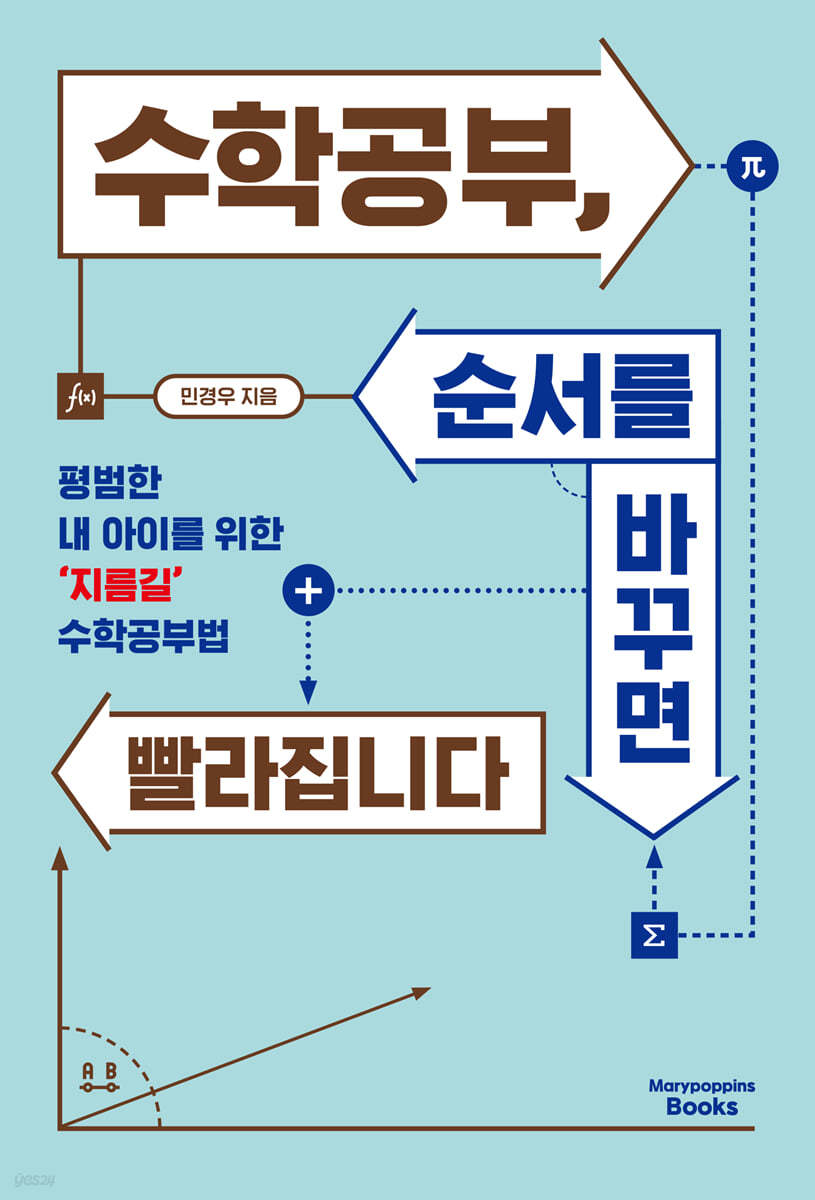
Studying Math: Changing the Order Makes It Faster
 |
Description
Book Introduction
“It is a huge misconception that the curriculum is structured to fit the CSAT!
“The more difficult math becomes, the more you need to change the order in which you study right now.”
"If you change the order in which you study math, you'll learn faster" raises radical questions about the current state of math education.
The question is, 'Is the curriculum structured in a reasonable order that is suitable for the CSAT?'
The author, who has been teaching mathematics in the field for a long time, answers this question.
I would like to say that the order in which we have studied mathematics up to now is completely wrong.
The author compares our existing math learning method to the 'Mugunghwa' train.
The learning method we have been following up until now, step by step, is like the 'Mugunghwa train'.
He points out the weaknesses of the current curriculum, which is 'boring and long-winded without any emphasis'.
Currently, Korean students study diligently following a set curriculum starting in elementary school, but the content that is truly necessary for the college entrance exam is only learned in the second year of high school.
This means that it is impossible to prepare for the CSAT, which requires advanced problem-solving training, within a time limit.
Of course, if you are a student who is good at math, it is possible to study steadily and prepare perfectly for the CSAT within one to two years.
However, for the majority of ordinary students, the curriculum ends up being indigestible.
The author points out that this is the reason why there are so many 'dropouts' in our country.
That's why he says.
“The price of studying step by step is terrifying!”
This book contains the author's achievements and insights from ten years of teaching mathematics in a new order, dreaming of educational reform.
It contains all the most efficient methods for teaching math, at what time and in what order.
With this, the author aims to present a novel solution that will help students with 'ordinary brains' not give up on math and ultimately succeed in the college entrance exam.
If the goal of studying math for 12 years is to pass the college entrance exam, the destination is the same.
Should you take the long detour on the Mugunghwa train or the KTX? Read this book and take the shortcut on the KTX!
“The more difficult math becomes, the more you need to change the order in which you study right now.”
"If you change the order in which you study math, you'll learn faster" raises radical questions about the current state of math education.
The question is, 'Is the curriculum structured in a reasonable order that is suitable for the CSAT?'
The author, who has been teaching mathematics in the field for a long time, answers this question.
I would like to say that the order in which we have studied mathematics up to now is completely wrong.
The author compares our existing math learning method to the 'Mugunghwa' train.
The learning method we have been following up until now, step by step, is like the 'Mugunghwa train'.
He points out the weaknesses of the current curriculum, which is 'boring and long-winded without any emphasis'.
Currently, Korean students study diligently following a set curriculum starting in elementary school, but the content that is truly necessary for the college entrance exam is only learned in the second year of high school.
This means that it is impossible to prepare for the CSAT, which requires advanced problem-solving training, within a time limit.
Of course, if you are a student who is good at math, it is possible to study steadily and prepare perfectly for the CSAT within one to two years.
However, for the majority of ordinary students, the curriculum ends up being indigestible.
The author points out that this is the reason why there are so many 'dropouts' in our country.
That's why he says.
“The price of studying step by step is terrifying!”
This book contains the author's achievements and insights from ten years of teaching mathematics in a new order, dreaming of educational reform.
It contains all the most efficient methods for teaching math, at what time and in what order.
With this, the author aims to present a novel solution that will help students with 'ordinary brains' not give up on math and ultimately succeed in the college entrance exam.
If the goal of studying math for 12 years is to pass the college entrance exam, the destination is the same.
Should you take the long detour on the Mugunghwa train or the KTX? Read this book and take the shortcut on the KTX!
- You can preview some of the book's contents.
Preview
index
Recommendation
prolog
Part 1 - We're on a long, winding road
Familiarity ruins a child's brain
KTX does not stop at every station.
Don't study 'step by step'
Without a goal, the college entrance exam process becomes prolonged.
There is nothing wrong with prior learning.
Part 2 - College Entrance Exam Success Requires Bold Decisions
3 Misconceptions People Have
① You have to start from the basics
② Preparation for the CSAT should begin in the first year of high school.
③ The order is the difficulty.
Raising successful children requires boldness.
Get used to new learning methods
Risk your life between 4th grade and 7th grade
Part 3 - Studying for Math Shortcuts
A Guide for Parents
Exponents, roots, and logarithms that take mathematics to the next level
〈Equation 1〉Algebra using letters instead of numbers
〈Equation 2〉Negative numbers for understanding the formalism of mathematics
Equation 3: The Ultimate Middle School Math: Quadratic Equations and Root Formulas
6 Tips for Mastering Equations
A better function when solved by differentiation
Coordinate geometry and trigonometry beyond the ruler and compass
High school math made easy to understand in everyday life
Roadmap by grade level
Part 4 - Customized guidance is needed based on the child's personality.
There is a natural talent for studying.
Teaching methods tailored to my child's personality
A turnaround is possible with management and effort.
Private education is also necessary
How the Third Group Succeeds
If your child is a water blisters
The students are the masters of the class.
Epilogue
supplement
prolog
Part 1 - We're on a long, winding road
Familiarity ruins a child's brain
KTX does not stop at every station.
Don't study 'step by step'
Without a goal, the college entrance exam process becomes prolonged.
There is nothing wrong with prior learning.
Part 2 - College Entrance Exam Success Requires Bold Decisions
3 Misconceptions People Have
① You have to start from the basics
② Preparation for the CSAT should begin in the first year of high school.
③ The order is the difficulty.
Raising successful children requires boldness.
Get used to new learning methods
Risk your life between 4th grade and 7th grade
Part 3 - Studying for Math Shortcuts
A Guide for Parents
Exponents, roots, and logarithms that take mathematics to the next level
〈Equation 1〉Algebra using letters instead of numbers
〈Equation 2〉Negative numbers for understanding the formalism of mathematics
Equation 3: The Ultimate Middle School Math: Quadratic Equations and Root Formulas
6 Tips for Mastering Equations
A better function when solved by differentiation
Coordinate geometry and trigonometry beyond the ruler and compass
High school math made easy to understand in everyday life
Roadmap by grade level
Part 4 - Customized guidance is needed based on the child's personality.
There is a natural talent for studying.
Teaching methods tailored to my child's personality
A turnaround is possible with management and effort.
Private education is also necessary
How the Third Group Succeeds
If your child is a water blisters
The students are the masters of the class.
Epilogue
supplement
Detailed image

Into the book
Not only the roots learned in the third year of middle school, but generally all mathematics before calculus is the same in terms of intellectual level.
In other words, fractions, roots, sequences, exponents, and logarithms that appear in the second year of high school are on the same intellectual level.
The only difference is the ‘curriculum structure’.
--- p.24
Unfortunately, our children are stopping at countless stops at school because they are told to.
Then, starting from the first or second year of high school, you learn the most important parts of college entrance exams over a short period of time.
Given this situation, it is difficult to solve math problems on the college entrance exam.
--- p.35
I advise you to study simply to fit your goal of passing the CSAT.
As mentioned earlier, from the perspective of the CSAT math, I think about 10% of middle school math is sufficient.
--- p.41
My shortcut solution is to simplify middle school math as much as possible, prioritize second and third year high school math, and then work on first year high school math in parallel.
--- p.71
Therefore, please do not forget that exponents, roots, and logarithms are not separate and distinct concepts, but are all connected from an exponent perspective.
Knowing this will greatly enhance children's understanding of mathematics.
--- p.118
The shortcut math study method targets students from the 4th grade of elementary school to the 1st grade of middle school.
This is because this period is the best time to focus on learning the necessary concepts without being distracted by your grades.
--- p.165
After middle school, the pressure from exams and grades is intense.
It will be difficult to make time for school exams.
When you get into calculus, I recommend focusing on understanding the concepts of calculus rather than solving in-depth problems.
--- p.166
The third year of middle school is another golden time for advanced learning.
From this point on, you can focus on solving calculus problems.
--- p.167
Although the lower and middle ranks can also take the lead, their learning speed is bound to be slower than that of the upper ranks.
Therefore, it is naturally difficult to handle the enormous amount of study presented in the CSAT.
That is why students in the lower and middle ranks need a ‘shortcut math study method’ even more.
It's already difficult to keep up with the pace, but studying everything is even more difficult.
The key strategy is to quickly repeat the necessary study.
--- p.175
The purpose of education during adolescence is to bring out children's potential and help them grow.
This requires patience, persistence, and teaching routine.
--- p.190
Everyone has innate talents, and they need to be acknowledged to some extent to grow.
This is why the role of parents is important.
Although the starting point may be different, the destination may be different depending on how parents discipline their children.
Especially for the third and lower groups, parental discipline has a significant impact.
--- p.200
If your child is a water phobic, let's first check their 'attitude'.
If your attitude is not good, it is more likely that you have become a failure because of your attitude rather than your brain.
In cases like this, you need to change your attitude first.
In other words, fractions, roots, sequences, exponents, and logarithms that appear in the second year of high school are on the same intellectual level.
The only difference is the ‘curriculum structure’.
--- p.24
Unfortunately, our children are stopping at countless stops at school because they are told to.
Then, starting from the first or second year of high school, you learn the most important parts of college entrance exams over a short period of time.
Given this situation, it is difficult to solve math problems on the college entrance exam.
--- p.35
I advise you to study simply to fit your goal of passing the CSAT.
As mentioned earlier, from the perspective of the CSAT math, I think about 10% of middle school math is sufficient.
--- p.41
My shortcut solution is to simplify middle school math as much as possible, prioritize second and third year high school math, and then work on first year high school math in parallel.
--- p.71
Therefore, please do not forget that exponents, roots, and logarithms are not separate and distinct concepts, but are all connected from an exponent perspective.
Knowing this will greatly enhance children's understanding of mathematics.
--- p.118
The shortcut math study method targets students from the 4th grade of elementary school to the 1st grade of middle school.
This is because this period is the best time to focus on learning the necessary concepts without being distracted by your grades.
--- p.165
After middle school, the pressure from exams and grades is intense.
It will be difficult to make time for school exams.
When you get into calculus, I recommend focusing on understanding the concepts of calculus rather than solving in-depth problems.
--- p.166
The third year of middle school is another golden time for advanced learning.
From this point on, you can focus on solving calculus problems.
--- p.167
Although the lower and middle ranks can also take the lead, their learning speed is bound to be slower than that of the upper ranks.
Therefore, it is naturally difficult to handle the enormous amount of study presented in the CSAT.
That is why students in the lower and middle ranks need a ‘shortcut math study method’ even more.
It's already difficult to keep up with the pace, but studying everything is even more difficult.
The key strategy is to quickly repeat the necessary study.
--- p.175
The purpose of education during adolescence is to bring out children's potential and help them grow.
This requires patience, persistence, and teaching routine.
--- p.190
Everyone has innate talents, and they need to be acknowledged to some extent to grow.
This is why the role of parents is important.
Although the starting point may be different, the destination may be different depending on how parents discipline their children.
Especially for the third and lower groups, parental discipline has a significant impact.
--- p.200
If your child is a water phobic, let's first check their 'attitude'.
If your attitude is not good, it is more likely that you have become a failure because of your attitude rather than your brain.
In cases like this, you need to change your attitude first.
--- p.203
GOODS SPECIFICS
- Date of issue: October 21, 2024
- Page count, weight, size: 240 pages | 135*195*20mm
- ISBN13: 9791194347026
- ISBN10: 1194347029
You may also like
카테고리
korean


korean

![GQ KOREA Mark (Monthly): December [2025]](http://librairie.coreenne.fr/cdn/shop/files/8ef265dbbfbf186523ed75ba7319009d.jpg?v=1765340328&width=3840)


