

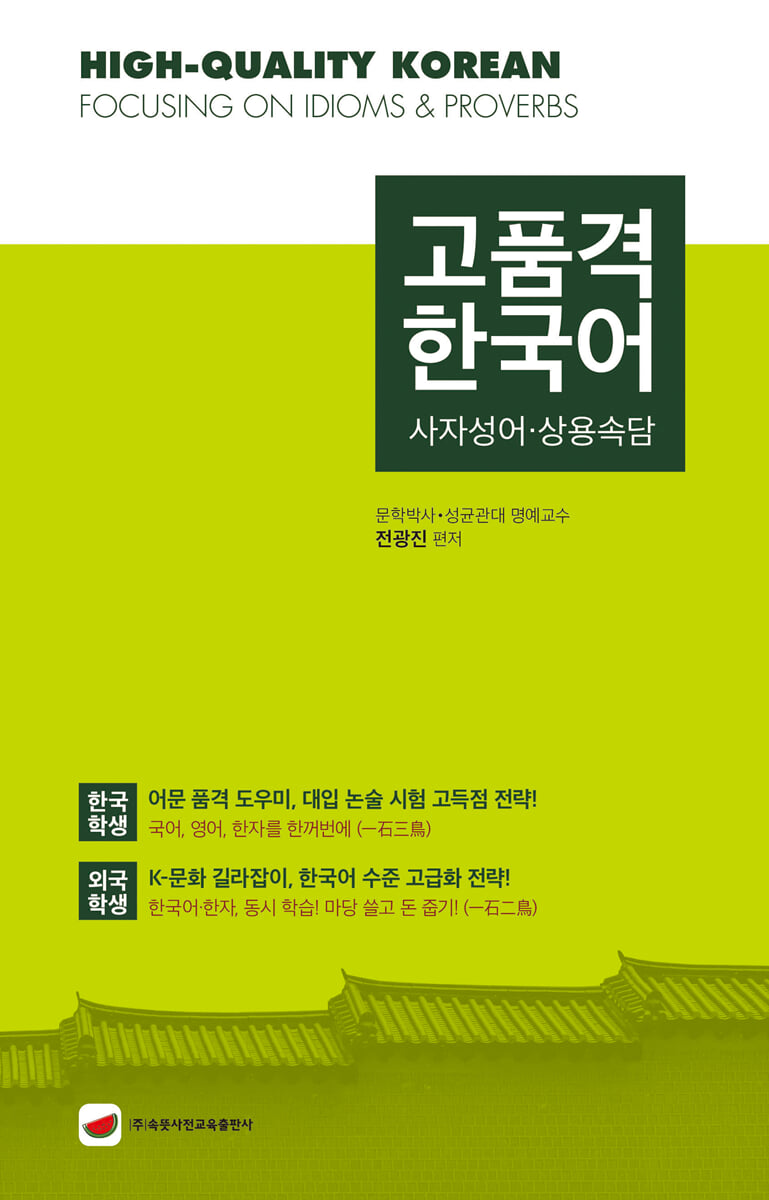
High-Quality Korean: Idioms and Common Proverbs
 |
Description
Book Introduction
Korean language to the world!
World Wide Korean!
Let's give our Korean language two wings.
Let's add two wings to our Korean!
With the publication of “High-Quality Korean: Idioms and Common Proverbs,” it seems that the day when the above slogan will be realized will not be far off.
In the future, works that promote the Korean language or Korean culture will likely be published in Korean-English editions like this book.
The sight of Korean standing shoulder to shoulder with English! That in itself is truly beautiful.
World Wide Korean!
Let's give our Korean language two wings.
Let's add two wings to our Korean!
With the publication of “High-Quality Korean: Idioms and Common Proverbs,” it seems that the day when the above slogan will be realized will not be far off.
In the future, works that promote the Korean language or Korean culture will likely be published in Korean-English editions like this book.
The sight of Korean standing shoulder to shoulder with English! That in itself is truly beautiful.
- You can preview some of the book's contents.
Preview
Detailed image
.jpg)
Publisher's Review
“The tiger is coming down.
“The tiger is coming down.”
(Representative of Korean rhythm, 300 million views worldwide on YouTube!)
K-culture craze sweeping the globe! Korean language learning is taking off!
Four-character idioms and common proverbs that elevate the Korean language!
Two tigers descend.
“A tiger is coming, another tiger is coming.”
K-culture craze around the world!
Korean language storm!
Idioms and proverbs enhance the quality of the Korean language!
Two tigers are coming now!
**********************************
The status of the Korean language has risen worldwide.
It's not just because Korean culture like K-pop and K-dramas are sweeping the world.
This is due to the growing trend of young people dreaming of becoming employees of local corporations as Korean companies expand globally.
Korean language departments are sprouting up like mushrooms in universities around the world.
The good news that the support rate and popularity of the department far surpass those of the Chinese or Japanese departments is being continuously reported to Korean academic societies overseas.
Korean is very easy to learn at a beginner level.
This is thanks to Hangul, which consists of 24 letters.
But Korean is becoming increasingly difficult.
This applies not only to foreigners but also to Koreans.
This is because more than 70% of Korean words are Chinese characters.
To speak Korean at a high level, you must learn Chinese characters, especially four-character idioms, and know many proverbs.
The two pillars that elevate and support the Korean language are four-character idioms and common proverbs.
As the demand for learning Korean increases quantitatively, the demand for quality is also increasing significantly.
In other words, there was a need to give Korean two wings.
A book that has been published at the right time to meet this demand at home and abroad is attracting attention.
A book explaining four-character idioms and common proverbs, the two wings of the high-quality Korean language, in both Korean and English (published by Sokmi Dictionary Education Publishing Co.) is expected to play a significant role in encouraging the Korean language craze both domestically and internationally, like beating a drum and blowing a flute.
This will improve the quality of Korean language for Koreans and people around the world.
Furthermore, it is expected that the globalization of K-culture will be further accelerated.
This book provides a detailed explanation of the meanings of 424 four-character idioms selected by the Korean Language Association for grades 8 through 2, making it easy to understand why and what they mean.
The most notable feature of this book is the explanation of the hidden meanings of Chinese characters.
It is explained in an easy-to-understand way even without basic knowledge of Chinese characters, and English is also provided.
So you can study English and Chinese characters at the same time.
You can learn Chinese characters through four-character idioms, and the accumulated Chinese character knowledge can help you learn other four-character idioms, creating a virtuous cycle.
Appendix 1, “Summary of Idioms,” is also very useful and informative.
Even if you just read this little by little every day, you will easily learn four-character idioms.
Appendix 3, which contains 50 idioms based on old stories and explained in cartoon form, is also very interesting.
These three appendices are a great help in making learning idioms truly fun and effective.
The author of this book (69 years old, Jeon Gwang-jin, Professor Emeritus of Chinese Literature, Sungkyunkwan University) is also famous as the scholar who has written the most papers on ‘Hangeul export’ and ‘Hangeul globalization’, which are about spreading Hangeul to ethnic minorities who do not have their own written language.
He developed the theory that “Hangul makes reading easier, and Chinese characters make thinking easier,” and was the first to propose the “Hangul-Hanja-Sushiron” (匙箸論) that if Hangul is a spoon, then Chinese characters are chopsticks.
It is regrettable that in the era of Hangul-only, students do not receive proper education in Chinese characters, and thus rely solely on memorization without understanding the meaning of the words.
We have made various efforts to overcome the miserable reality of poor literacy due to the cancer of learning, idiom.
We compiled a series of dictionary meanings (〈Korean Chinese Character Dictionary of Meanings〉, 〈Elementary Korean Dictionary with Meaning Explanations〉, and 〈Teacher’s Chinese Character Book〉) so that even students who have not learned Chinese characters can use them as hints.
Through these continuous efforts, he led the 'educational revolution in Korea from memorization to understanding.'
His two major works published in China (Taiwan) (〈A Comprehensive Study of Sino-Tibetan Equivalent Vocabulary〉: A Comprehensive Study of Sino-Tibetan Equivalent Vocabulary, and 〈A Study of Homonymous Gacha Characters in Zhou Bronze Age Inscriptions〉: A Study of Homonymous Gacha Characters in Zhou Bronze Age Inscriptions) are considered to be professional works in the fields of Chinese etymology and Chinese paleography.
It is always kept in the libraries of universities in each country that have a Chinese literature department.
Although this book is a practical academic book, it contains many unprecedented ideas.
They are all rooted in the author's solid professional and academic foundation.
This was possible because of his unparalleled academic skills and dedication.
“The tiger is coming down.”
(Representative of Korean rhythm, 300 million views worldwide on YouTube!)
K-culture craze sweeping the globe! Korean language learning is taking off!
Four-character idioms and common proverbs that elevate the Korean language!
Two tigers descend.
“A tiger is coming, another tiger is coming.”
K-culture craze around the world!
Korean language storm!
Idioms and proverbs enhance the quality of the Korean language!
Two tigers are coming now!
**********************************
The status of the Korean language has risen worldwide.
It's not just because Korean culture like K-pop and K-dramas are sweeping the world.
This is due to the growing trend of young people dreaming of becoming employees of local corporations as Korean companies expand globally.
Korean language departments are sprouting up like mushrooms in universities around the world.
The good news that the support rate and popularity of the department far surpass those of the Chinese or Japanese departments is being continuously reported to Korean academic societies overseas.
Korean is very easy to learn at a beginner level.
This is thanks to Hangul, which consists of 24 letters.
But Korean is becoming increasingly difficult.
This applies not only to foreigners but also to Koreans.
This is because more than 70% of Korean words are Chinese characters.
To speak Korean at a high level, you must learn Chinese characters, especially four-character idioms, and know many proverbs.
The two pillars that elevate and support the Korean language are four-character idioms and common proverbs.
As the demand for learning Korean increases quantitatively, the demand for quality is also increasing significantly.
In other words, there was a need to give Korean two wings.
A book that has been published at the right time to meet this demand at home and abroad is attracting attention.
A book explaining four-character idioms and common proverbs, the two wings of the high-quality Korean language, in both Korean and English (published by Sokmi Dictionary Education Publishing Co.) is expected to play a significant role in encouraging the Korean language craze both domestically and internationally, like beating a drum and blowing a flute.
This will improve the quality of Korean language for Koreans and people around the world.
Furthermore, it is expected that the globalization of K-culture will be further accelerated.
This book provides a detailed explanation of the meanings of 424 four-character idioms selected by the Korean Language Association for grades 8 through 2, making it easy to understand why and what they mean.
The most notable feature of this book is the explanation of the hidden meanings of Chinese characters.
It is explained in an easy-to-understand way even without basic knowledge of Chinese characters, and English is also provided.
So you can study English and Chinese characters at the same time.
You can learn Chinese characters through four-character idioms, and the accumulated Chinese character knowledge can help you learn other four-character idioms, creating a virtuous cycle.
Appendix 1, “Summary of Idioms,” is also very useful and informative.
Even if you just read this little by little every day, you will easily learn four-character idioms.
Appendix 3, which contains 50 idioms based on old stories and explained in cartoon form, is also very interesting.
These three appendices are a great help in making learning idioms truly fun and effective.
The author of this book (69 years old, Jeon Gwang-jin, Professor Emeritus of Chinese Literature, Sungkyunkwan University) is also famous as the scholar who has written the most papers on ‘Hangeul export’ and ‘Hangeul globalization’, which are about spreading Hangeul to ethnic minorities who do not have their own written language.
He developed the theory that “Hangul makes reading easier, and Chinese characters make thinking easier,” and was the first to propose the “Hangul-Hanja-Sushiron” (匙箸論) that if Hangul is a spoon, then Chinese characters are chopsticks.
It is regrettable that in the era of Hangul-only, students do not receive proper education in Chinese characters, and thus rely solely on memorization without understanding the meaning of the words.
We have made various efforts to overcome the miserable reality of poor literacy due to the cancer of learning, idiom.
We compiled a series of dictionary meanings (〈Korean Chinese Character Dictionary of Meanings〉, 〈Elementary Korean Dictionary with Meaning Explanations〉, and 〈Teacher’s Chinese Character Book〉) so that even students who have not learned Chinese characters can use them as hints.
Through these continuous efforts, he led the 'educational revolution in Korea from memorization to understanding.'
His two major works published in China (Taiwan) (〈A Comprehensive Study of Sino-Tibetan Equivalent Vocabulary〉: A Comprehensive Study of Sino-Tibetan Equivalent Vocabulary, and 〈A Study of Homonymous Gacha Characters in Zhou Bronze Age Inscriptions〉: A Study of Homonymous Gacha Characters in Zhou Bronze Age Inscriptions) are considered to be professional works in the fields of Chinese etymology and Chinese paleography.
It is always kept in the libraries of universities in each country that have a Chinese literature department.
Although this book is a practical academic book, it contains many unprecedented ideas.
They are all rooted in the author's solid professional and academic foundation.
This was possible because of his unparalleled academic skills and dedication.
GOODS SPECIFICS
- Date of issue: March 3, 2024
- Page count, weight, size: 394 pages | 676g | 144*225*23mm
- ISBN13: 9788993858013
- ISBN10: 8993858012
You may also like
카테고리
korean


korean

![ELLE 엘르 스페셜 에디션 A형 : 12월 [2025]](http://librairie.coreenne.fr/cdn/shop/files/b8e27a3de6c9538896439686c6b0e8fb.jpg?v=1766436872&width=3840)


