

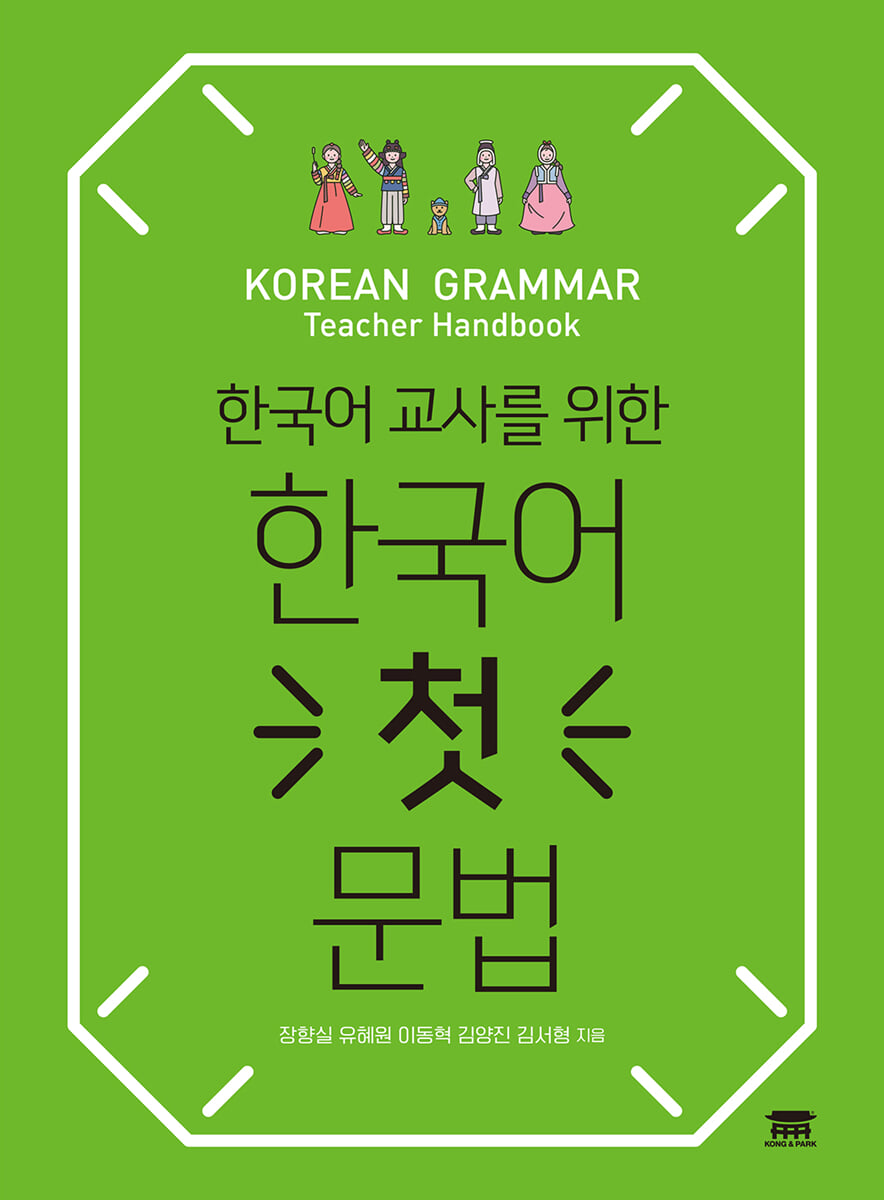
Korean Grammar for Beginners for Korean Teachers
 |
Description
Book Introduction
You can use it right away in your Korean language classes.
Korean Grammar Guide in Q&A Format
As interest in K-culture grows worldwide, the number of Korean language learners is also rapidly increasing.
In Korea, the influx of international students and workers has increased, centered around international Korean language centers within universities. Overseas, Korean has been adopted as a first foreign language in Vietnam, and as a second foreign language in Turkey, India, Hong Kong, and Russia.
Accordingly, the demand for Korean language teachers is also increasing explosively.
The National Institute of the Korean Language, which establishes policies related to the Korean language, operates the 'Overseas Korean Language Teacher (K-Teacher) Program' and focuses on training Korean language teachers. Furthermore, various organizations and groups under the Ministry of Culture, Sports and Tourism, the Ministry of Foreign Affairs, and the Ministry of Justice, including the Sejong Institute Foundation, are actively operating Korean language teacher training programs for these diverse groups of learners.
This book focuses on recent changes in the Korean language education market and is written by Korean language education scholars and scholars with over 30 years of experience in Korean language education, who provide optimal teaching methods to help Korean language teachers properly respond to questions from students in their classrooms.
In particular, the authors planned this book based on a survey of teachers' difficulties while operating the 'Online Training Program for Overseas Korean School Teachers' at the Overseas Koreans Foundation, so it is a field-oriented book that provides effective answers for running smooth Korean language classes.
Through this book, Korean language teachers can not only study teaching methods in the field of Korean language education, but also share model answers that will help Korean language learners achieve accurate understanding.
Korean Grammar Guide in Q&A Format
As interest in K-culture grows worldwide, the number of Korean language learners is also rapidly increasing.
In Korea, the influx of international students and workers has increased, centered around international Korean language centers within universities. Overseas, Korean has been adopted as a first foreign language in Vietnam, and as a second foreign language in Turkey, India, Hong Kong, and Russia.
Accordingly, the demand for Korean language teachers is also increasing explosively.
The National Institute of the Korean Language, which establishes policies related to the Korean language, operates the 'Overseas Korean Language Teacher (K-Teacher) Program' and focuses on training Korean language teachers. Furthermore, various organizations and groups under the Ministry of Culture, Sports and Tourism, the Ministry of Foreign Affairs, and the Ministry of Justice, including the Sejong Institute Foundation, are actively operating Korean language teacher training programs for these diverse groups of learners.
This book focuses on recent changes in the Korean language education market and is written by Korean language education scholars and scholars with over 30 years of experience in Korean language education, who provide optimal teaching methods to help Korean language teachers properly respond to questions from students in their classrooms.
In particular, the authors planned this book based on a survey of teachers' difficulties while operating the 'Online Training Program for Overseas Korean School Teachers' at the Overseas Koreans Foundation, so it is a field-oriented book that provides effective answers for running smooth Korean language classes.
Through this book, Korean language teachers can not only study teaching methods in the field of Korean language education, but also share model answers that will help Korean language learners achieve accurate understanding.
- You can preview some of the book's contents.
Preview
index
Part 1 Phonemes
01 How should we teach the vowels 'ㅔ' and 'ㅐ'?
02 What are monophthongs and diphthongs?
03 How are semivowels different from short vowels?
04 Is the 'ㅇ' used before a vowel the same as the 'ㅇ' used as a final consonant?
05 I want to know about initial consonants, medial vowels, and final consonants.
06 How should I teach the vowels 'ㅓ, ㅗ, ㅡ, ㅜ' effectively?
07 How should we teach the pronunciation of the Korean letter 'ㄹ'?
08 How should we teach pronunciations such as 'ㅂ/ㅍ/ㅃ' by differentiating them?
09 Which Korean consonants or vowels should I teach first?
10 I am curious about the order in which vowels are presented in an educationally effective manner.
11 How should we teach the pronunciation of final consonants?
12 Why isn't 'clothes inside' pronounced as [osan]?
13 Why is 'Kkeut-i' pronounced as [Kkeut-chi] and not [Kkeut-ti]?
14 How should I teach double consonant pronunciation?
15 Why is the pronunciation of 'like' [joayo]?
16 Why do Korean learners mispronounce 'Silla' as [Silla]?
17 Why do native English speakers mispronounce '집만' as [집만] or [지프만]?
18 When does the phenomenon of lenition occur?
Should we teach the difference in length of the 19 word sounds?
Part 2 Syntax
01 What types of particles are there in Korean?
02 How do Korean particles differ from English prepositions?
03 I want to know about cases where 'of' can be omitted.
04 Is it okay to say 'I'm going home' as 'I'm going home'?
05 In 'Our school won this match.', is 'at our school' the subject?
06 Should I teach the vocative particle?
07 What is the difference between 'eun/neun' and 'i/ga'?
08 I am curious about the basic sentence patterns in Korean.
09 What are connected sentences, enclosed sentences, and enclosed sentences?
10 What is the difference between '-neun geot', '-gi', and '-(eu)m' in Korean?
11 How do you express direct and indirect quotations?
12 Is there an easy way to distinguish between passive and causative voices?
13 Why can't adjectives be combined with imperative or quorum endings?
14 I am curious about a teaching method that makes it easy to distinguish irregular verbs.
Part 3 Meaning
01 Is the word 'galda' in "sharpen a knife" and "plow a field" a synonym or a homonym?
02 Why do polysemy occur?
03 Blue traffic light and green traffic light, which expression is correct?
04 How can I effectively explain the expression '(the soup) is refreshing'?
05 I am curious about the Korean honorific system.
06 I'm curious about the tense of 'He is the person I'm going to meet tomorrow.'
07 Is the tense of “I had nothing to do yesterday, so I went out to see a movie with a friend” correct?
08 Can I express 'I often go there' as 'I went there often'?
09 Should '-geunji alda/moruda' always be used with an interrogative pronoun?
10 Is there a difference in meaning between '-아/어 노다' and '-아/어 두다'?
11 Is there a difference in meaning between “There is only water” and “There is nothing but water”?
12 What is the difference between '안' and '안-' in negation?
13 Is there a difference in meaning between '-(으)ㄹ 수 있습니다' and '-지 할하다'?
14 Is it wrong to say “Thank you for your hard work” to your superior?
Part 4: Linguistic Norms
01 How can I teach spacing?
02 Why should the investigation be written at the beginning of the word?
03 I am curious about spacing when one-syllable words are consecutive or when numbers and unit nouns are connected.
04 Could you please explain more about spacing when writing numbers?
05 When reading numbers in Korean, what is the difference between reading them in native Korean and reading them in Chinese character form?
06 I am curious about the spacing of auxiliary verbs.
07 Should I write it as ‘Mr. Hong Gil-dong’ or should I write it as ‘Mr. Hong Gil-dong’?
08 Please explain the spacing of technical terms.
09 Which is correct, 'See you next time/See you later'?
10 Which expression is correct, 'Doeyo' or 'Doeyo'?
11 Is 'Barae' the wrong expression and 'Bara' the correct expression?
12 What is correct between ‘helper’ and ‘helper’, ‘guardian’ and ‘guardian’?
13 How did 'kkungchungkkung' become standard language?
14 Is it '가세요' or '가세요'?
15 Which is the standard language, 'confusing' or 'confused'?
01 How should we teach the vowels 'ㅔ' and 'ㅐ'?
02 What are monophthongs and diphthongs?
03 How are semivowels different from short vowels?
04 Is the 'ㅇ' used before a vowel the same as the 'ㅇ' used as a final consonant?
05 I want to know about initial consonants, medial vowels, and final consonants.
06 How should I teach the vowels 'ㅓ, ㅗ, ㅡ, ㅜ' effectively?
07 How should we teach the pronunciation of the Korean letter 'ㄹ'?
08 How should we teach pronunciations such as 'ㅂ/ㅍ/ㅃ' by differentiating them?
09 Which Korean consonants or vowels should I teach first?
10 I am curious about the order in which vowels are presented in an educationally effective manner.
11 How should we teach the pronunciation of final consonants?
12 Why isn't 'clothes inside' pronounced as [osan]?
13 Why is 'Kkeut-i' pronounced as [Kkeut-chi] and not [Kkeut-ti]?
14 How should I teach double consonant pronunciation?
15 Why is the pronunciation of 'like' [joayo]?
16 Why do Korean learners mispronounce 'Silla' as [Silla]?
17 Why do native English speakers mispronounce '집만' as [집만] or [지프만]?
18 When does the phenomenon of lenition occur?
Should we teach the difference in length of the 19 word sounds?
Part 2 Syntax
01 What types of particles are there in Korean?
02 How do Korean particles differ from English prepositions?
03 I want to know about cases where 'of' can be omitted.
04 Is it okay to say 'I'm going home' as 'I'm going home'?
05 In 'Our school won this match.', is 'at our school' the subject?
06 Should I teach the vocative particle?
07 What is the difference between 'eun/neun' and 'i/ga'?
08 I am curious about the basic sentence patterns in Korean.
09 What are connected sentences, enclosed sentences, and enclosed sentences?
10 What is the difference between '-neun geot', '-gi', and '-(eu)m' in Korean?
11 How do you express direct and indirect quotations?
12 Is there an easy way to distinguish between passive and causative voices?
13 Why can't adjectives be combined with imperative or quorum endings?
14 I am curious about a teaching method that makes it easy to distinguish irregular verbs.
Part 3 Meaning
01 Is the word 'galda' in "sharpen a knife" and "plow a field" a synonym or a homonym?
02 Why do polysemy occur?
03 Blue traffic light and green traffic light, which expression is correct?
04 How can I effectively explain the expression '(the soup) is refreshing'?
05 I am curious about the Korean honorific system.
06 I'm curious about the tense of 'He is the person I'm going to meet tomorrow.'
07 Is the tense of “I had nothing to do yesterday, so I went out to see a movie with a friend” correct?
08 Can I express 'I often go there' as 'I went there often'?
09 Should '-geunji alda/moruda' always be used with an interrogative pronoun?
10 Is there a difference in meaning between '-아/어 노다' and '-아/어 두다'?
11 Is there a difference in meaning between “There is only water” and “There is nothing but water”?
12 What is the difference between '안' and '안-' in negation?
13 Is there a difference in meaning between '-(으)ㄹ 수 있습니다' and '-지 할하다'?
14 Is it wrong to say “Thank you for your hard work” to your superior?
Part 4: Linguistic Norms
01 How can I teach spacing?
02 Why should the investigation be written at the beginning of the word?
03 I am curious about spacing when one-syllable words are consecutive or when numbers and unit nouns are connected.
04 Could you please explain more about spacing when writing numbers?
05 When reading numbers in Korean, what is the difference between reading them in native Korean and reading them in Chinese character form?
06 I am curious about the spacing of auxiliary verbs.
07 Should I write it as ‘Mr. Hong Gil-dong’ or should I write it as ‘Mr. Hong Gil-dong’?
08 Please explain the spacing of technical terms.
09 Which is correct, 'See you next time/See you later'?
10 Which expression is correct, 'Doeyo' or 'Doeyo'?
11 Is 'Barae' the wrong expression and 'Bara' the correct expression?
12 What is correct between ‘helper’ and ‘helper’, ‘guardian’ and ‘guardian’?
13 How did 'kkungchungkkung' become standard language?
14 Is it '가세요' or '가세요'?
15 Which is the standard language, 'confusing' or 'confused'?
Detailed image
Publisher's Review
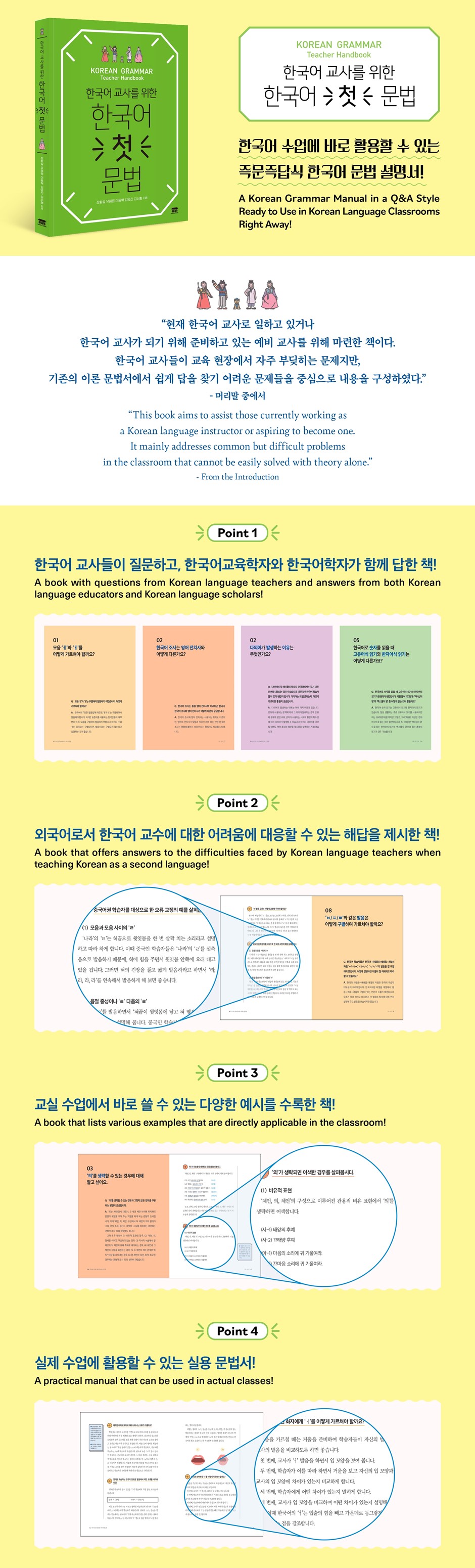
“This book is designed for those who are currently working as Korean language teachers or are preparing to become Korean language teachers.
“The content is structured around problems that Korean language teachers frequently encounter in the classroom, but for which answers are difficult to find in existing theoretical grammar books.”
- From the preface
Features of this book
1.
A book where Korean language teachers ask questions and Korean language education scholars and scholars jointly answer! This book presents common teaching challenges faced by Korean language teachers in the form of questions about phonology, syntax, semantics, and grammar norms. By providing immediate answers, it proposes Korean language teaching methods from the perspective of Korean teachers.
2.
A practical grammar book you can use in your classroom! This book combines the authors' 30 years of teaching experience with school grammar to present optimal teaching methods that Korean language teachers can immediately apply in their classrooms.
3.
This book offers solutions to the challenges of teaching Korean as a foreign language! This book helps native Korean teachers proactively address the challenges of teaching Korean as a foreign language, offering teaching methods tailored to the unique characteristics of each Korean learner.
4.
A book filled with examples you can immediately apply in your classroom! This book is designed to help Korean teachers increase the effectiveness of their classes by presenting specific and diverse examples that promote easy and quick understanding among Korean learners.
“The content is structured around problems that Korean language teachers frequently encounter in the classroom, but for which answers are difficult to find in existing theoretical grammar books.”
- From the preface
Features of this book
1.
A book where Korean language teachers ask questions and Korean language education scholars and scholars jointly answer! This book presents common teaching challenges faced by Korean language teachers in the form of questions about phonology, syntax, semantics, and grammar norms. By providing immediate answers, it proposes Korean language teaching methods from the perspective of Korean teachers.
2.
A practical grammar book you can use in your classroom! This book combines the authors' 30 years of teaching experience with school grammar to present optimal teaching methods that Korean language teachers can immediately apply in their classrooms.
3.
This book offers solutions to the challenges of teaching Korean as a foreign language! This book helps native Korean teachers proactively address the challenges of teaching Korean as a foreign language, offering teaching methods tailored to the unique characteristics of each Korean learner.
4.
A book filled with examples you can immediately apply in your classroom! This book is designed to help Korean teachers increase the effectiveness of their classes by presenting specific and diverse examples that promote easy and quick understanding among Korean learners.
GOODS SPECIFICS
- Date of issue: January 22, 2024
- Page count, weight, size: 288 pages | 860g | 188*255*20mm
- ISBN13: 9788997134595
- ISBN10: 8997134590
You may also like
카테고리
korean


korean

![ELLE 엘르 스페셜 에디션 A형 : 12월 [2025]](http://librairie.coreenne.fr/cdn/shop/files/b8e27a3de6c9538896439686c6b0e8fb.jpg?v=1766436872&width=3840)


