

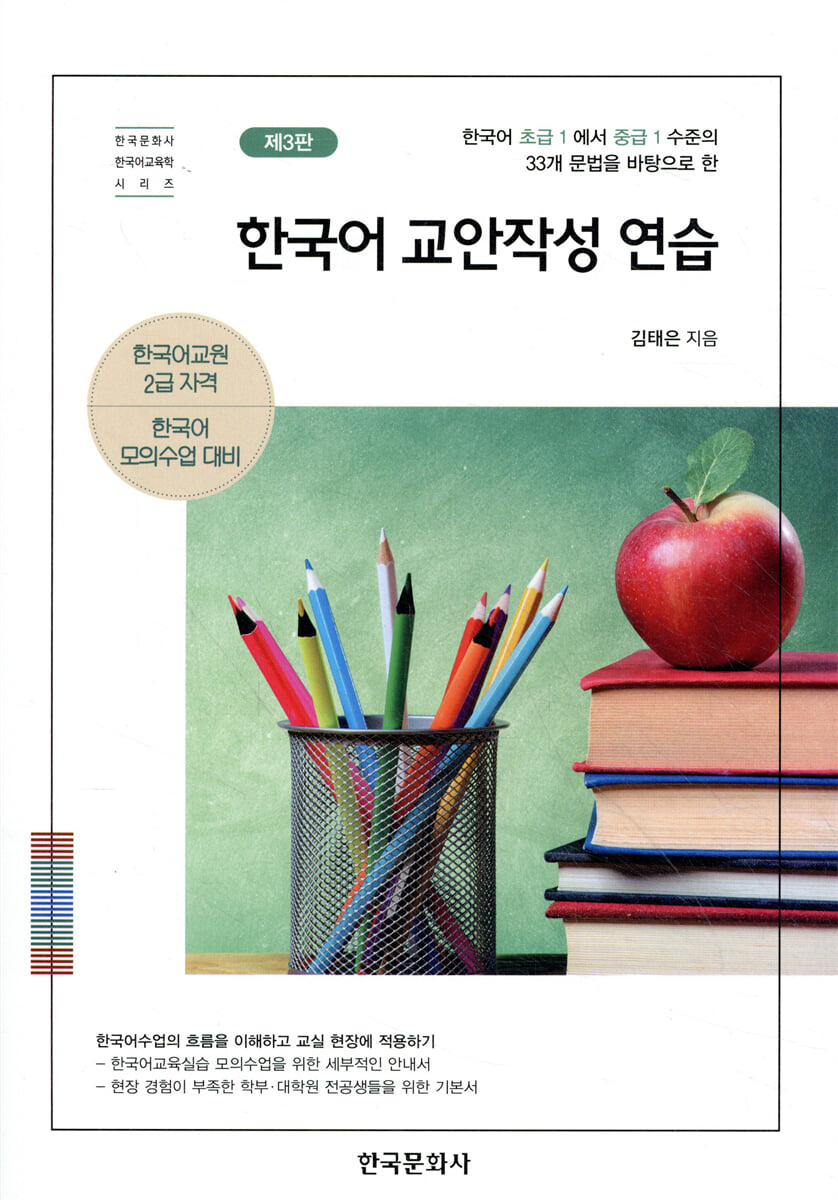
Korean lesson plan writing practice
 |
Description
Book Introduction
- Understand the flow of Korean language classes and apply it to the classroom.
- Detailed guide for Korean language teaching practice mock classes
- A basic book for undergraduate and graduate students who lack field experience.
Some people easily assume that any Korean can teach Korean, but teaching Korean to a foreigner whose native language has grammatical rules that differ from Korean is not an easy task.
Writing lesson plans is a very important task that allows you to practice the process of introducing and concluding a Korean language class.
This textbook will serve as a helpful guide for prospective teachers who are unfamiliar with lesson plan writing.
- Detailed guide for Korean language teaching practice mock classes
- A basic book for undergraduate and graduate students who lack field experience.
Some people easily assume that any Korean can teach Korean, but teaching Korean to a foreigner whose native language has grammatical rules that differ from Korean is not an easy task.
Writing lesson plans is a very important task that allows you to practice the process of introducing and concluding a Korean language class.
This textbook will serve as a helpful guide for prospective teachers who are unfamiliar with lesson plan writing.
- You can preview some of the book's contents.
Preview
index
introduction
1 Understanding the lesson plan
01 Concept of lesson plan
02 Format of the lesson plan
03 Writing tips for each class stage
04 Elements to be included in the lesson plan
05 Types of lesson plans
06 Structure of the lesson plan
2. Teaching material guidance examples
01 A/V + - High
02 A/V + -Arthur/Arthur
03 L Elimination
04 V+ -Ah/uh than
05 V + -(으)로
06 V+ -(으)ㄹ래?
07 A + -Ajida/Eojida
08 V + -아/에도 할 수 있습니다
09 V + -(으)면 is not allowed
10 A + -(으)ㄴ가 나look, V + -나look
11 V + -i, hi, ri, gi-
It's 12 V + -
13 V + -was/was
3 Practice writing lesson plans
01 V + -(to) go/come
02 N + degrees
03 A/V + -Arthur/Ersha (Class tip)
04 A/V + -? (Class tip)
05 V + -(to) try
06 V + -(으)면
07 V + -(으)면
08 V + -ah/eo than
09 A/V + -(으)니
10 V + -
11 V + -
12 V + -
13 V + - instead
14 A + -say / V + -n/say
15 V + -
16 V + -(으)ㄹ다
17 V + -
18 A/V + -Aya/Should be
19 V + - in the wind
20 A/V + -
1 Understanding the lesson plan
01 Concept of lesson plan
02 Format of the lesson plan
03 Writing tips for each class stage
04 Elements to be included in the lesson plan
05 Types of lesson plans
06 Structure of the lesson plan
2. Teaching material guidance examples
01 A/V + - High
02 A/V + -Arthur/Arthur
03 L Elimination
04 V+ -Ah/uh than
05 V + -(으)로
06 V+ -(으)ㄹ래?
07 A + -Ajida/Eojida
08 V + -아/에도 할 수 있습니다
09 V + -(으)면 is not allowed
10 A + -(으)ㄴ가 나look, V + -나look
11 V + -i, hi, ri, gi-
It's 12 V + -
13 V + -was/was
3 Practice writing lesson plans
01 V + -(to) go/come
02 N + degrees
03 A/V + -Arthur/Ersha (Class tip)
04 A/V + -? (Class tip)
05 V + -(to) try
06 V + -(으)면
07 V + -(으)면
08 V + -ah/eo than
09 A/V + -(으)니
10 V + -
11 V + -
12 V + -
13 V + - instead
14 A + -say / V + -n/say
15 V + -
16 V + -(으)ㄹ다
17 V + -
18 A/V + -Aya/Should be
19 V + - in the wind
20 A/V + -
Into the book
03 Writing tips for each class stage
1) Introduction
· You must present situations in which the target grammar can actually be used.
· It is a good idea to plan ahead for some situations.
If you fail to introduce something when you have prepared only one, you may be very embarrassed, and the introduction you have prepared may not apply to all targets.
· Interaction with students is very important.
· The target grammar must be exposed through interaction.
2) Presentation
· In the introduction, have students guess the meaning through examples of interactions with the students.
· When presenting the target grammar, you must present the conjunction information (e.g., A/V + -(으)나, N +(이)나).
· Usage information for the target grammar should include meaning, form, constraints, and (for learned grammar only) comparative grammar.
· The target grammar should be presented in the most concise form possible so that it can be presented explicitly, and care should be taken to control words and grammar when explaining.
3) Practice
· Practice is needed to improve the accuracy of target grammar.
· It is recommended to prepare three types of practice (taking into account the level of difficulty) in order from easy to difficult.
4) Utilization
· You should plan integrated activities that present situations and demonstrate how the target grammar is actually used.
· Since this is a step to improve fluency in target grammar, prepare mainly with activities that take real-life situations into account.
For example, students can engage in integrated activities of 'speaking', 'listening', and 'writing' through a series of processes such as asking questions about each other's situations, listening to them, taking notes, and presenting them.
5) Summary
· Briefly explain the target grammar or give a concluding utterance using the target grammar.
· Check students' understanding of the target grammar.
Chapter 2 was created based on the teaching materials submitted by students in the actual teaching practice course.
The principle was to use the original, but in cases where the source of the content or image was unclear or commercial use was restricted, some of the content was replaced or reorganized according to changes in the image.
Although we continuously requested revisions during the three feedback processes, we used the original version as it was for spelling errors, spacing errors, and punctuation errors that were not corrected until the final lesson plan.
Many people are making the same mistakes, so I recommend that you consider readability while looking at the lesson plan.
We have received prior permission to use the teaching materials of the teaching interns.
1) Introduction
· You must present situations in which the target grammar can actually be used.
· It is a good idea to plan ahead for some situations.
If you fail to introduce something when you have prepared only one, you may be very embarrassed, and the introduction you have prepared may not apply to all targets.
· Interaction with students is very important.
· The target grammar must be exposed through interaction.
2) Presentation
· In the introduction, have students guess the meaning through examples of interactions with the students.
· When presenting the target grammar, you must present the conjunction information (e.g., A/V + -(으)나, N +(이)나).
· Usage information for the target grammar should include meaning, form, constraints, and (for learned grammar only) comparative grammar.
· The target grammar should be presented in the most concise form possible so that it can be presented explicitly, and care should be taken to control words and grammar when explaining.
3) Practice
· Practice is needed to improve the accuracy of target grammar.
· It is recommended to prepare three types of practice (taking into account the level of difficulty) in order from easy to difficult.
4) Utilization
· You should plan integrated activities that present situations and demonstrate how the target grammar is actually used.
· Since this is a step to improve fluency in target grammar, prepare mainly with activities that take real-life situations into account.
For example, students can engage in integrated activities of 'speaking', 'listening', and 'writing' through a series of processes such as asking questions about each other's situations, listening to them, taking notes, and presenting them.
5) Summary
· Briefly explain the target grammar or give a concluding utterance using the target grammar.
· Check students' understanding of the target grammar.
Chapter 2 was created based on the teaching materials submitted by students in the actual teaching practice course.
The principle was to use the original, but in cases where the source of the content or image was unclear or commercial use was restricted, some of the content was replaced or reorganized according to changes in the image.
Although we continuously requested revisions during the three feedback processes, we used the original version as it was for spelling errors, spacing errors, and punctuation errors that were not corrected until the final lesson plan.
Many people are making the same mistakes, so I recommend that you consider readability while looking at the lesson plan.
We have received prior permission to use the teaching materials of the teaching interns.
--- From the text
Publisher's Review
The Korean Language Education Practical Training course is an area that includes all processes such as observing actual sites and conducting mock classes, and can be said to be an essential course for improving the quality of Korean language teachers.
To obtain a Level 2 Korean language teacher qualification, you can major in it at an undergraduate or graduate school, but recently, many people are taking various courses and obtaining the qualification.
However, many people start out thinking that any Korean can teach Korean, but once they start learning, they say they didn't realize that Korean was this difficult.
Since the target audience for teaching is foreigners, not Koreans, it is not easy to explain each and every grammar point that we naturally know and use, and it takes a lot of time and effort to be able to teach by thinking of only words and grammar that are appropriate for the learners' level.
Teaching Korean to foreigners is certainly enjoyable, but it also comes with a heavy sense of responsibility.
Some of the students I teach fail to advance to university or graduate school or extend their visas because their Korean language skills do not meet the standards.
I would like to tell this to prospective teachers who dream of teaching in the Korean language education field.
Having worked in the Korean language education field for about 14 years, I am now very familiar with teaching, but when I first started teaching Korean, I was always busy trying to figure out things I didn't know, and I really needed a lot of help from others.
This textbook contains as much of the experience I have accumulated as a Korean language teacher.
In particular, while teaching the Korean language teaching practice course, I tried to clearly explain why the errors frequently made by the trainees were wrong and how they should be improved.
This book consists of three parts.
Part 1 presents how to write lesson plans, and Part 2 presents actual lesson plan examples taught during Korean language teaching practice.
In Part 3, we have written down the content that needs to be done in each class stage so that you can practice it.
In particular, examples 03 and 04 in Part 3 include teaching tips.
Here, we've re-emphasized some helpful information for prospective teachers, including things to keep in mind when explaining grammar and how to avoid unconsciously abbreviating grammar that students haven't learned.
This book is structured to help you write your own lesson plans following the flow of Korean language classes, which proceed in the order of 'Introduction - Presentation - Practice - Utilization - Summary'.
While writing the textbook, I pondered over whether it would be better to include all the steps, from introduction to conclusion, in the example lesson plan.
However, this book focuses on helping those who have difficulty writing because they have difficulty writing the first sentence, who do not know how to introduce the material, and who do not know the order in which to explain, to practice writing lesson plans sequentially and reduce their fear of writing lesson plans.
And now, there are many good workbooks and activity materials on the market, published by senior teachers who have worked in this field first and have helped junior teachers teach better.
If you diligently practice writing lesson plans using this textbook and also look at and utilize many textbooks on the market, you will be able to write good lesson plans using any grammar.
Over the years of running the Korean Language Education Practical Training program, I have met many different people.
I am grateful to all of you, but I would especially like to bow my head in sincere gratitude to the first and second batches of 2019 teaching interns in the Korean Language Teacher Training Program under the Credit Bank System.
Without those who encouraged me and willingly shared their teaching materials, hoping that by sharing the difficulties they faced during their teaching practice, whether they were used as good or bad examples, it would be helpful to trainees and prospective teachers preparing for the Level 2 Korean Language Certification, this textbook, based on real-life cases, would not have been possible.
I would like to express my deepest gratitude to Professor Hong Yun-gi of Kyung Hee University, who never spares support and encouragement for even the smallest steps of his students, and who always gives me strength with his strong and warm spirit.
I would also like to thank Deputy Director Jo Jeong-heum of Korean Culture Publishing for his trust and support throughout the entire process, from planning to writing, which made this book possible, and Editor Kim Joo-ri for her unwavering support throughout the complex content and numerous revisions.
We hope this textbook will be helpful to prospective and new Korean language teachers currently enrolled in cyber universities, online and offline lifelong education centers, credit bank systems, and undergraduate and graduate schools, especially those preparing to conduct mock classes during their Korean language teaching practice.
To obtain a Level 2 Korean language teacher qualification, you can major in it at an undergraduate or graduate school, but recently, many people are taking various courses and obtaining the qualification.
However, many people start out thinking that any Korean can teach Korean, but once they start learning, they say they didn't realize that Korean was this difficult.
Since the target audience for teaching is foreigners, not Koreans, it is not easy to explain each and every grammar point that we naturally know and use, and it takes a lot of time and effort to be able to teach by thinking of only words and grammar that are appropriate for the learners' level.
Teaching Korean to foreigners is certainly enjoyable, but it also comes with a heavy sense of responsibility.
Some of the students I teach fail to advance to university or graduate school or extend their visas because their Korean language skills do not meet the standards.
I would like to tell this to prospective teachers who dream of teaching in the Korean language education field.
Having worked in the Korean language education field for about 14 years, I am now very familiar with teaching, but when I first started teaching Korean, I was always busy trying to figure out things I didn't know, and I really needed a lot of help from others.
This textbook contains as much of the experience I have accumulated as a Korean language teacher.
In particular, while teaching the Korean language teaching practice course, I tried to clearly explain why the errors frequently made by the trainees were wrong and how they should be improved.
This book consists of three parts.
Part 1 presents how to write lesson plans, and Part 2 presents actual lesson plan examples taught during Korean language teaching practice.
In Part 3, we have written down the content that needs to be done in each class stage so that you can practice it.
In particular, examples 03 and 04 in Part 3 include teaching tips.
Here, we've re-emphasized some helpful information for prospective teachers, including things to keep in mind when explaining grammar and how to avoid unconsciously abbreviating grammar that students haven't learned.
This book is structured to help you write your own lesson plans following the flow of Korean language classes, which proceed in the order of 'Introduction - Presentation - Practice - Utilization - Summary'.
While writing the textbook, I pondered over whether it would be better to include all the steps, from introduction to conclusion, in the example lesson plan.
However, this book focuses on helping those who have difficulty writing because they have difficulty writing the first sentence, who do not know how to introduce the material, and who do not know the order in which to explain, to practice writing lesson plans sequentially and reduce their fear of writing lesson plans.
And now, there are many good workbooks and activity materials on the market, published by senior teachers who have worked in this field first and have helped junior teachers teach better.
If you diligently practice writing lesson plans using this textbook and also look at and utilize many textbooks on the market, you will be able to write good lesson plans using any grammar.
Over the years of running the Korean Language Education Practical Training program, I have met many different people.
I am grateful to all of you, but I would especially like to bow my head in sincere gratitude to the first and second batches of 2019 teaching interns in the Korean Language Teacher Training Program under the Credit Bank System.
Without those who encouraged me and willingly shared their teaching materials, hoping that by sharing the difficulties they faced during their teaching practice, whether they were used as good or bad examples, it would be helpful to trainees and prospective teachers preparing for the Level 2 Korean Language Certification, this textbook, based on real-life cases, would not have been possible.
I would like to express my deepest gratitude to Professor Hong Yun-gi of Kyung Hee University, who never spares support and encouragement for even the smallest steps of his students, and who always gives me strength with his strong and warm spirit.
I would also like to thank Deputy Director Jo Jeong-heum of Korean Culture Publishing for his trust and support throughout the entire process, from planning to writing, which made this book possible, and Editor Kim Joo-ri for her unwavering support throughout the complex content and numerous revisions.
We hope this textbook will be helpful to prospective and new Korean language teachers currently enrolled in cyber universities, online and offline lifelong education centers, credit bank systems, and undergraduate and graduate schools, especially those preparing to conduct mock classes during their Korean language teaching practice.
GOODS SPECIFICS
- Publication date: February 25, 2022
- Page count, weight, size: 240 pages | 175*250*20mm
- ISBN13: 9791166850738
- ISBN10: 1166850730
You may also like
카테고리
korean


korean

![ELLE 엘르 스페셜 에디션 A형 : 12월 [2025]](http://librairie.coreenne.fr/cdn/shop/files/b8e27a3de6c9538896439686c6b0e8fb.jpg?v=1766436872&width=3840)


