

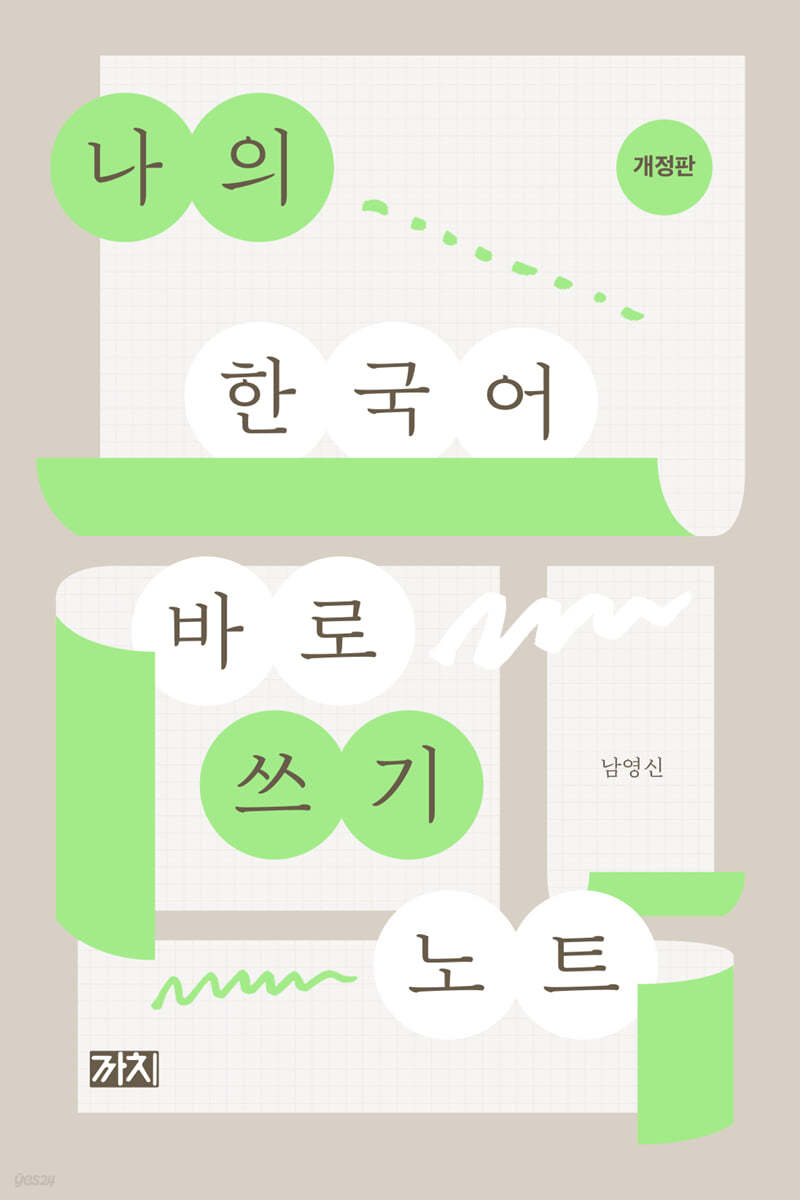
My Korean Writing Notes
 |
Description
Book Introduction
“A correct sentence is beautiful.”
Nam Young-shin, Director of the National Language and Culture Movement Headquarters, guides you through precise and accurate Korean writing.
"My Korean Writing Notes," which has served as a guide to Korean for countless readers by accurately and concisely explaining the correct use of particles and endings that Koreans find most confusing, as well as the resonance of sentence components, is now back with revised content and a new cover.
We often assume that we can speak Korean perfectly, but on the other hand, we often encounter various problems, such as the nuances of particle and suffix use, and the correct use of honorifics and titles.
As the director of the National Language and Culture Movement Headquarters, the author has been at the forefront of the movement to write Korean correctly for decades. He examines these common difficulties in Korean one by one and guides students to use Korean appropriately through various examples and practice problems.
This book, which covers the correct use of Korean particles and endings, the correspondence between sentences and logic, the agreement between tense and honorifics, and purification and refinement for concise and clear sentences, provides examples of various texts we encounter in our daily lives to help readers understand.
The author carefully selects sentences that appear well-written but contain errors that we may have overlooked, and then provides clues for making those sentences more accurate.
Additionally, practice problems allow readers to test their own skills.
In the revised edition, in line with the author's intention of pursuing 'easy and plain writing,' a "purification" section was added, and as a first step toward changing the vertical communication structure of the Korean language, content related to titles and references was added as an appendix.
Nam Young-shin, Director of the National Language and Culture Movement Headquarters, guides you through precise and accurate Korean writing.
"My Korean Writing Notes," which has served as a guide to Korean for countless readers by accurately and concisely explaining the correct use of particles and endings that Koreans find most confusing, as well as the resonance of sentence components, is now back with revised content and a new cover.
We often assume that we can speak Korean perfectly, but on the other hand, we often encounter various problems, such as the nuances of particle and suffix use, and the correct use of honorifics and titles.
As the director of the National Language and Culture Movement Headquarters, the author has been at the forefront of the movement to write Korean correctly for decades. He examines these common difficulties in Korean one by one and guides students to use Korean appropriately through various examples and practice problems.
This book, which covers the correct use of Korean particles and endings, the correspondence between sentences and logic, the agreement between tense and honorifics, and purification and refinement for concise and clear sentences, provides examples of various texts we encounter in our daily lives to help readers understand.
The author carefully selects sentences that appear well-written but contain errors that we may have overlooked, and then provides clues for making those sentences more accurate.
Additionally, practice problems allow readers to test their own skills.
In the revised edition, in line with the author's intention of pursuing 'easy and plain writing,' a "purification" section was added, and as a first step toward changing the vertical communication structure of the Korean language, content related to titles and references was added as an appendix.
- You can preview some of the book's contents.
Preview
index
Preface to the Revised Edition
Preface to the First Edition
Introduction: The Importance of Writing Korean Correctly
Chapter 1: Investigation
1.
'This/that' and 'This/that'
2.
'E' and 'Eseo'
3.
'E' and 'Ro'
4.
'E' and 'to' and 'from'
5.
The conjunction particle 'wa/gwa'
6.
Direct quote particle 'say/says'
7.
Omit investigation
Chapter 2 Mother
1.
Suffixes '-go' and '-myeo'
2.
The endings '-a/-eo' and '-aseo/-eoseo'
3.
The ending '-muro' and the particle '-eo'
4.
The ending '-do-rok'
Chapter 3 Response
1.
Compliance is compliance with constraints.
2.
Syntactic response
3.
logical response
4.
Lexical Responsiveness and Constraints: Do Vocabulary Love Each Other?
5.
Response and metaphor
Chapter 4 Agreement
1.
Agreement of tenses
2.
Matching honorifics
3.
Agreement between active and passive voices
4.
Matching the list
Chapter 5 Purification
1.
Easy and ordinary
2.
Concise and simple
3.
Accurately and clearly
4.
Expressions to avoid
Chapter 6 Retirement
1.
Let's shorten the too long adjectives.
2.
Check for unnecessary paragraphs
Appendix Publication of Names and References
1.
Raising the issue of titles and references
2.
The origin of the problem of titles and references
3.
Public disclosure
4.
Conclusion
Preface to the First Edition
Introduction: The Importance of Writing Korean Correctly
Chapter 1: Investigation
1.
'This/that' and 'This/that'
2.
'E' and 'Eseo'
3.
'E' and 'Ro'
4.
'E' and 'to' and 'from'
5.
The conjunction particle 'wa/gwa'
6.
Direct quote particle 'say/says'
7.
Omit investigation
Chapter 2 Mother
1.
Suffixes '-go' and '-myeo'
2.
The endings '-a/-eo' and '-aseo/-eoseo'
3.
The ending '-muro' and the particle '-eo'
4.
The ending '-do-rok'
Chapter 3 Response
1.
Compliance is compliance with constraints.
2.
Syntactic response
3.
logical response
4.
Lexical Responsiveness and Constraints: Do Vocabulary Love Each Other?
5.
Response and metaphor
Chapter 4 Agreement
1.
Agreement of tenses
2.
Matching honorifics
3.
Agreement between active and passive voices
4.
Matching the list
Chapter 5 Purification
1.
Easy and ordinary
2.
Concise and simple
3.
Accurately and clearly
4.
Expressions to avoid
Chapter 6 Retirement
1.
Let's shorten the too long adjectives.
2.
Check for unnecessary paragraphs
Appendix Publication of Names and References
1.
Raising the issue of titles and references
2.
The origin of the problem of titles and references
3.
Public disclosure
4.
Conclusion
Detailed image

Publisher's Review
'This/that', 'This/that', 'This/that', 'This/that', 'This/that', 'This/that'...
Knowing the particles and endings allows you to convey your intentions accurately.
All Koreans speak Korean naturally, but not everyone speaks Korean correctly.
Among them, the particles that Koreans confuse the most are '이/가' and '은/는', and '에' and 에서'.
These particles, which at first glance appear to have little difference in meaning, clearly reveal the author's intention when used.
For example, “What is this?” and “What is this?” have no difference in meaning in foreign languages such as English, but they have a clear difference in nuance in Korean.
Unlike the nominative particle 'i/ga' that indicates the qualification of the subject, the auxiliary particle 'eun/neun' has the function of expressing the meaning of comparison or contrast or revealing the subject of the sentence.
There are also subtle differences in the usage of '에' and '에서', which indicate places.
For example, when used in conjunction with '살다', when there is no distinction between a specific place and an action, '에' is used, whereas when the action at the place is felt more strongly and the meaning that the subject chose the place is emphasized, '에서' is used.
There are also confusing things about mothers.
'-go' and '-myeo', which are located in the same position in a sentence, are sometimes used with the same meaning, but sometimes they are completely different.
While '-go' lists actions, '-myeo' indicates that two actions are taking place simultaneously.
This difference becomes clearer when we substitute '-goseo' for '-go' and '-myeonseo' for '-myeo'.
The subtle differences in meaning between seemingly similar particles and endings suggest that not learning them properly can lead to mistakes in communication.
This book specifically selects particles that Koreans have particular difficulty with, such as '이/가' and '은/는', '에' and '에서', '에게' and '에서', the endings '-며', '-고', '-머로', '-아서/-서' and '-아/-어', and examines how to use them correctly.
Considering the correspondence of sentence components, vocabulary, and logic
How to make correct sentences
One of the things that many people struggle with when writing is making the elements that make up a sentence work together.
This book defines responsiveness as "compliance with constraints," then explores how to make each sentence element and vocabulary responsive, and explores how to logically achieve responsiveness through examples that use contradictory words and make leaps in logic.
Finally, by examining metaphors that are grammatically incompatible but are permissible as rhetorical expressions, we examine the process of expanding the scope of the Korean language beyond precise sentences.
Since this chapter covers topics that Koreans find particularly difficult, it provides ample practice problems to help readers hone their skills.
Through approximately 20 problems consisting of various case studies, readers will be able to learn the practical aspects of responsiveness.
Changing the vertical communication structure increases communication efficiency.
Korean title and designation issues
This revised edition includes an appendix detailing the author's journey toward a horizontal communication structure.
In 1998, when the Korean language culture movement began, the author resolved to change the Korean greetings, informal speech, titles, and references to a simpler and more horizontal structure. In the process of putting this into practice, he led a movement to use equal titles regardless of rank within companies.
Although the 'title-destroying movement' was only promoted at the level of individual companies, the author looks back on the social repercussions it brought about and emphasizes that it is still necessary for us today, and suggests practical methods to simplify titles.
Nam Young-shin, who has been recognized for his contributions to exploring and popularizing correct writing methods in Korean, argues that in the 21st-century knowledge-information society, using accurate and sophisticated Korean makes it easier to convey information.
This book, designed to help readers learn Korean and correct their mistakes by presenting appropriate examples and practice problems, will enable readers to write sophisticated Korean more concisely and accurately.
Knowing the particles and endings allows you to convey your intentions accurately.
All Koreans speak Korean naturally, but not everyone speaks Korean correctly.
Among them, the particles that Koreans confuse the most are '이/가' and '은/는', and '에' and 에서'.
These particles, which at first glance appear to have little difference in meaning, clearly reveal the author's intention when used.
For example, “What is this?” and “What is this?” have no difference in meaning in foreign languages such as English, but they have a clear difference in nuance in Korean.
Unlike the nominative particle 'i/ga' that indicates the qualification of the subject, the auxiliary particle 'eun/neun' has the function of expressing the meaning of comparison or contrast or revealing the subject of the sentence.
There are also subtle differences in the usage of '에' and '에서', which indicate places.
For example, when used in conjunction with '살다', when there is no distinction between a specific place and an action, '에' is used, whereas when the action at the place is felt more strongly and the meaning that the subject chose the place is emphasized, '에서' is used.
There are also confusing things about mothers.
'-go' and '-myeo', which are located in the same position in a sentence, are sometimes used with the same meaning, but sometimes they are completely different.
While '-go' lists actions, '-myeo' indicates that two actions are taking place simultaneously.
This difference becomes clearer when we substitute '-goseo' for '-go' and '-myeonseo' for '-myeo'.
The subtle differences in meaning between seemingly similar particles and endings suggest that not learning them properly can lead to mistakes in communication.
This book specifically selects particles that Koreans have particular difficulty with, such as '이/가' and '은/는', '에' and '에서', '에게' and '에서', the endings '-며', '-고', '-머로', '-아서/-서' and '-아/-어', and examines how to use them correctly.
Considering the correspondence of sentence components, vocabulary, and logic
How to make correct sentences
One of the things that many people struggle with when writing is making the elements that make up a sentence work together.
This book defines responsiveness as "compliance with constraints," then explores how to make each sentence element and vocabulary responsive, and explores how to logically achieve responsiveness through examples that use contradictory words and make leaps in logic.
Finally, by examining metaphors that are grammatically incompatible but are permissible as rhetorical expressions, we examine the process of expanding the scope of the Korean language beyond precise sentences.
Since this chapter covers topics that Koreans find particularly difficult, it provides ample practice problems to help readers hone their skills.
Through approximately 20 problems consisting of various case studies, readers will be able to learn the practical aspects of responsiveness.
Changing the vertical communication structure increases communication efficiency.
Korean title and designation issues
This revised edition includes an appendix detailing the author's journey toward a horizontal communication structure.
In 1998, when the Korean language culture movement began, the author resolved to change the Korean greetings, informal speech, titles, and references to a simpler and more horizontal structure. In the process of putting this into practice, he led a movement to use equal titles regardless of rank within companies.
Although the 'title-destroying movement' was only promoted at the level of individual companies, the author looks back on the social repercussions it brought about and emphasizes that it is still necessary for us today, and suggests practical methods to simplify titles.
Nam Young-shin, who has been recognized for his contributions to exploring and popularizing correct writing methods in Korean, argues that in the 21st-century knowledge-information society, using accurate and sophisticated Korean makes it easier to convey information.
This book, designed to help readers learn Korean and correct their mistakes by presenting appropriate examples and practice problems, will enable readers to write sophisticated Korean more concisely and accurately.
GOODS SPECIFICS
- Date of issue: October 9, 2023
- Page count, weight, size: 298 pages | 452g | 140*210*18mm
- ISBN13: 9788972918059
- ISBN10: 8972918059
You may also like
카테고리
korean


korean

![GQ KOREA Mark (Monthly): December [2025]](http://librairie.coreenne.fr/cdn/shop/files/8ef265dbbfbf186523ed75ba7319009d.jpg?v=1765340328&width=3840)


