

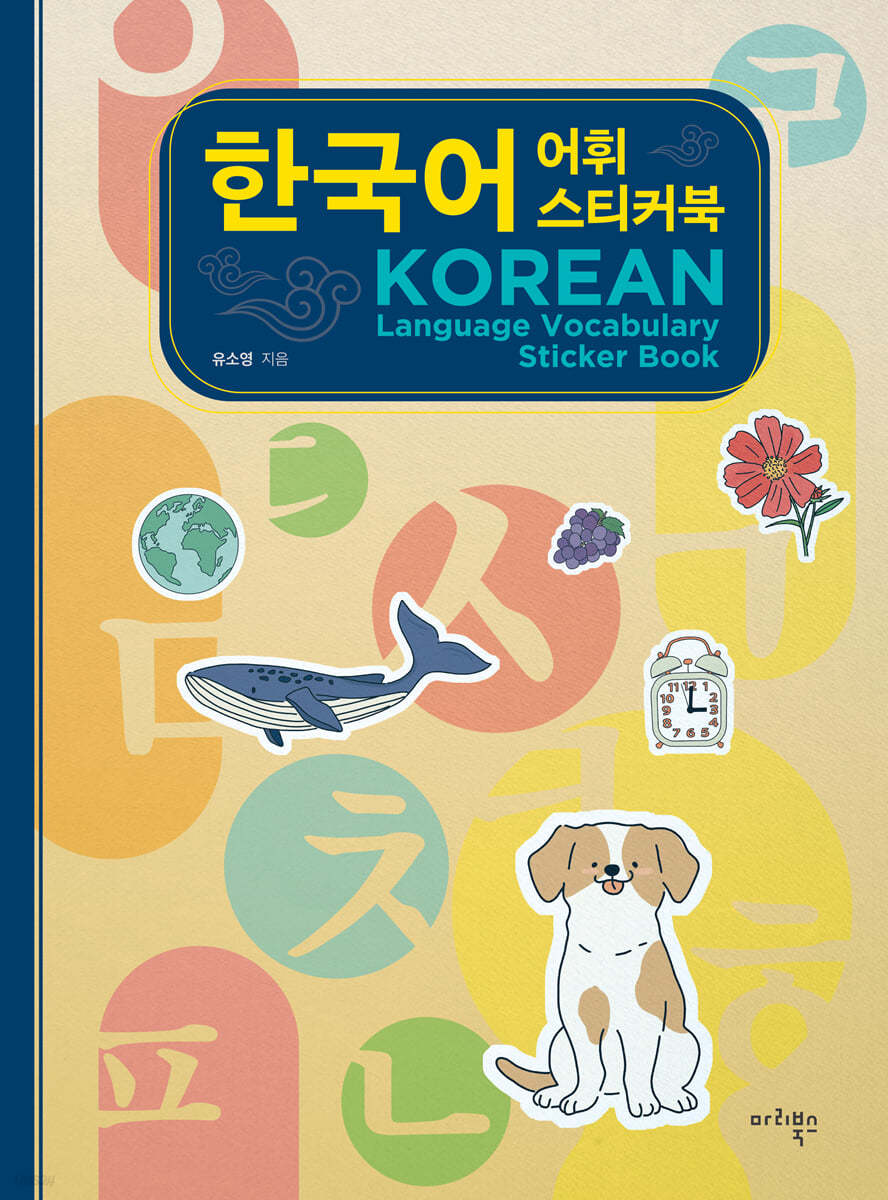
Korean Vocabulary Sticker Book
 |
Description
Book Introduction
The core of studying Korean,
Let's study related vocabulary together!
One of the best ways to learn Korean is to know a lot of Korean vocabulary.
Knowing a lot of vocabulary will help you read better and have better conversations.
So, how should you study vocabulary? It's best to study vocabulary by grouping related words together.
By studying related vocabulary words in conjunction with each other, you can naturally learn their meanings, and by studying antonyms, synonyms, and antonyms together, you can broaden your vocabulary.
Additionally, there are more expressions that can be used in the same situation.
For example, let's say we're studying vocabulary related to time.
If you study by connecting the words 'morning', 'lunch', 'dinner', 'yesterday', 'today', and 'tomorrow', you can expand the question, "What's the weather like this morning?" to "What's the weather like tomorrow evening?"
And if we don't stop here and connect 'morning', 'lunch', and 'dinner' into the word 'day', we can expand it to everyday expressions like "How was your day today?"
In this way, vocabulary is the core of language study.
Let's study related vocabulary together!
One of the best ways to learn Korean is to know a lot of Korean vocabulary.
Knowing a lot of vocabulary will help you read better and have better conversations.
So, how should you study vocabulary? It's best to study vocabulary by grouping related words together.
By studying related vocabulary words in conjunction with each other, you can naturally learn their meanings, and by studying antonyms, synonyms, and antonyms together, you can broaden your vocabulary.
Additionally, there are more expressions that can be used in the same situation.
For example, let's say we're studying vocabulary related to time.
If you study by connecting the words 'morning', 'lunch', 'dinner', 'yesterday', 'today', and 'tomorrow', you can expand the question, "What's the weather like this morning?" to "What's the weather like tomorrow evening?"
And if we don't stop here and connect 'morning', 'lunch', and 'dinner' into the word 'day', we can expand it to everyday expressions like "How was your day today?"
In this way, vocabulary is the core of language study.
- You can preview some of the book's contents.
Preview
index
Author's Note
Curriculum
How to use the textbook
Part 1 Vowels and Consonants
1.
Vowels and Consonants 1
2.
Vowels and Consonants 2
3.
Vowels and Consonants 3
Part 2 Support
4.
Support 1
5.
Support 2
Part 3 Vocabulary Practice
6.
fruit
7.
food
8.
drinkables
9.
weather
10.
hour
11.
location
12.
person
13.
thing
14.
traffic
15.
flower
16.
tree
17.
animal
18.
hobby
19.
what are you doing?
20.
how is it?
index
Curriculum
How to use the textbook
Part 1 Vowels and Consonants
1.
Vowels and Consonants 1
2.
Vowels and Consonants 2
3.
Vowels and Consonants 3
Part 2 Support
4.
Support 1
5.
Support 2
Part 3 Vocabulary Practice
6.
fruit
7.
food
8.
drinkables
9.
weather
10.
hour
11.
location
12.
person
13.
thing
14.
traffic
15.
flower
16.
tree
17.
animal
18.
hobby
19.
what are you doing?
20.
how is it?
index
Detailed image
Publisher's Review
Drawings, coloring pages, sticker books, etc.
《Korean Vocabulary Sticker Book》: Learning through Fun Play
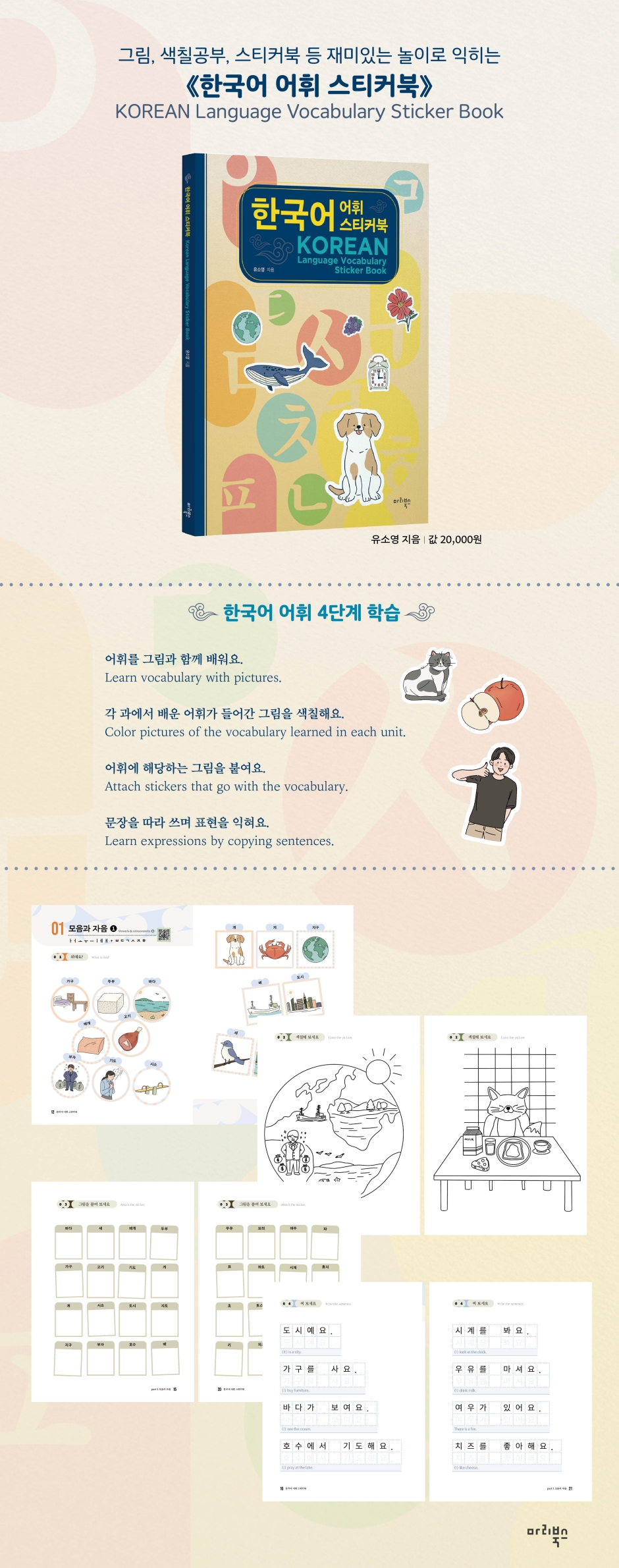
This book is designed to be fun to study with pictures, coloring pages, stickers, and other related vocabulary that you can see at a glance.
In the first unit, 'Vowels and Consonants', you will learn vocabulary composed of the corresponding vowels and consonants.
Even for learners who have just learned vowels and consonants, words without final consonants are introduced first so that they can gradually learn vocabulary.
By recognizing the QR code in the book, you can hear the pronunciation of each word, allowing you to study both the spelling and pronunciation of vocabulary at once.
In the second unit, 'Balchi', you will learn vocabulary that contains 받침.
To make it easier to learn the final consonants, let's first look at vocabulary with the final consonants ㅂ, ㄷ, ㄱ, and then look at vocabulary with the final consonants ㅁ, ㄴ, ㅇ, ㄹ.
It is a method of studying sounds that have similar pronunciation characteristics by grouping them together.
In the last unit, 'Vocabulary Practice', we study vocabulary related to topics such as fruits, hobbies, weather, and animals.
As you complete each lesson, you will find that your vocabulary has grown.
4-step learning process for learning Korean vocabulary
Learn vocabulary by looking at the pictures, then color them, put stickers on them,
Build your vocabulary by writing sentences
This book teaches vocabulary through four activities.
First, learn vocabulary with pictures.
This book presents words and pictures together so you can immediately understand what the words represent.
The illustrations in this book are designed to appeal to everyone from children to teenagers and adults, making them suitable for anyone studying Korean.
The next activity is coloring.
This is a play activity where you review each word by coloring a picture containing the vocabulary learned in each lesson.
You can also review by writing the corresponding word next to the picture you colored.
The next activity is sticker-sticking, which is the core of this book.
This is a play activity where you find the appropriate sticker and stick it on the box where the vocabulary is written.
The final activity is to write the sentences.
Develop your expressive power by writing sentences using the vocabulary you learned earlier.
_Learn vocabulary with pictures.
Learn vocabulary with pictures.
_Color the pictures containing the vocabulary you learned in each lesson.
Color pictures of the vocabulary learned in each unit.
_Attach a picture that corresponds to the vocabulary.
Attach stickers that go with the vocabulary.
_Learn expressions by following the sentences.
Learn expressions by copying sentences.
《Korean Vocabulary Sticker Book》: Learning through Fun Play
This book is designed to be fun to study with pictures, coloring pages, stickers, and other related vocabulary that you can see at a glance.
In the first unit, 'Vowels and Consonants', you will learn vocabulary composed of the corresponding vowels and consonants.
Even for learners who have just learned vowels and consonants, words without final consonants are introduced first so that they can gradually learn vocabulary.
By recognizing the QR code in the book, you can hear the pronunciation of each word, allowing you to study both the spelling and pronunciation of vocabulary at once.
In the second unit, 'Balchi', you will learn vocabulary that contains 받침.
To make it easier to learn the final consonants, let's first look at vocabulary with the final consonants ㅂ, ㄷ, ㄱ, and then look at vocabulary with the final consonants ㅁ, ㄴ, ㅇ, ㄹ.
It is a method of studying sounds that have similar pronunciation characteristics by grouping them together.
In the last unit, 'Vocabulary Practice', we study vocabulary related to topics such as fruits, hobbies, weather, and animals.
As you complete each lesson, you will find that your vocabulary has grown.
4-step learning process for learning Korean vocabulary
Learn vocabulary by looking at the pictures, then color them, put stickers on them,
Build your vocabulary by writing sentences
This book teaches vocabulary through four activities.
First, learn vocabulary with pictures.
This book presents words and pictures together so you can immediately understand what the words represent.
The illustrations in this book are designed to appeal to everyone from children to teenagers and adults, making them suitable for anyone studying Korean.
The next activity is coloring.
This is a play activity where you review each word by coloring a picture containing the vocabulary learned in each lesson.
You can also review by writing the corresponding word next to the picture you colored.
The next activity is sticker-sticking, which is the core of this book.
This is a play activity where you find the appropriate sticker and stick it on the box where the vocabulary is written.
The final activity is to write the sentences.
Develop your expressive power by writing sentences using the vocabulary you learned earlier.
_Learn vocabulary with pictures.
Learn vocabulary with pictures.
_Color the pictures containing the vocabulary you learned in each lesson.
Color pictures of the vocabulary learned in each unit.
_Attach a picture that corresponds to the vocabulary.
Attach stickers that go with the vocabulary.
_Learn expressions by following the sentences.
Learn expressions by copying sentences.
GOODS SPECIFICS
- Date of issue: March 20, 2023
- Page count, weight, size: 120 pages | 484g | 188*257*12mm
- ISBN13: 9791189943851
- ISBN10: 1189943859
You may also like
카테고리
korean


korean

![ELLE 엘르 스페셜 에디션 A형 : 12월 [2025]](http://librairie.coreenne.fr/cdn/shop/files/b8e27a3de6c9538896439686c6b0e8fb.jpg?v=1766436872&width=3840)


