

Korean language teaching practice
 |
Description
Book Introduction
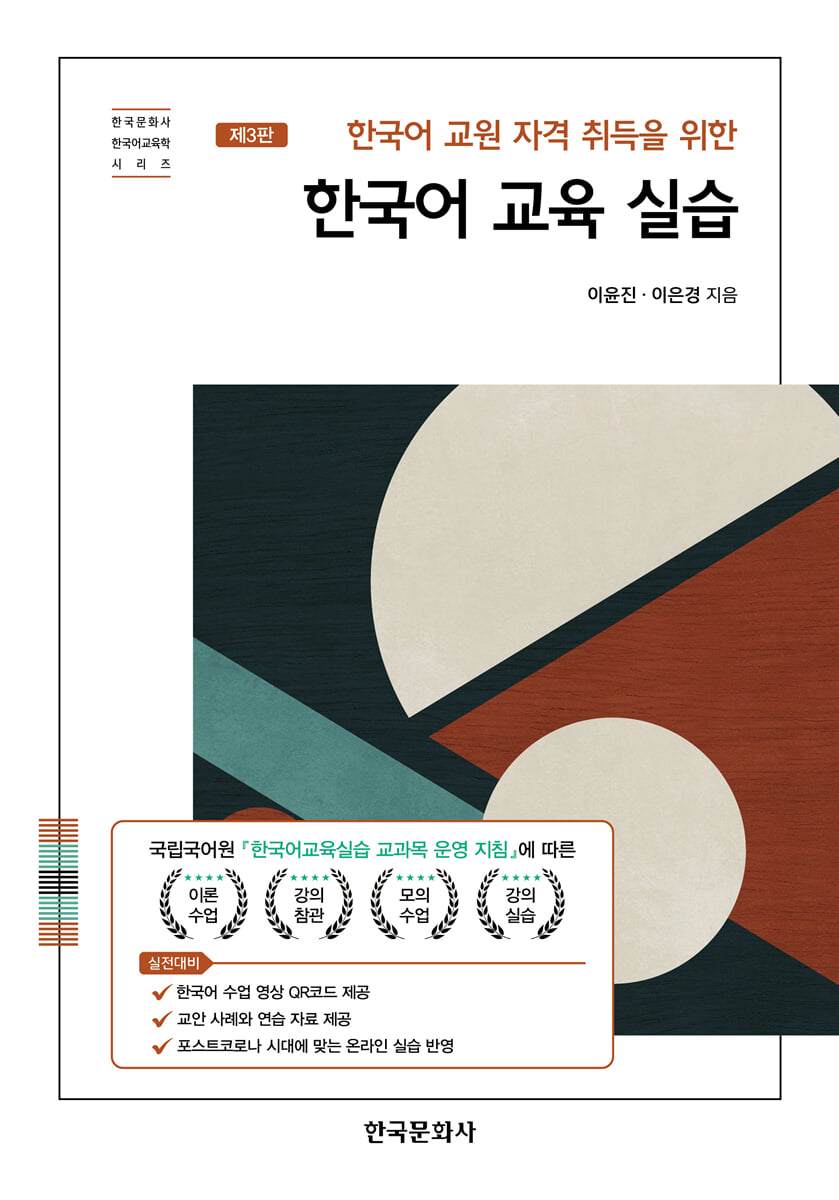
This is the first textbook (first edition, 2018) to focus on "actual operational cases and sites" of the Korean Language Education Practical Training course. The third edition reflects the latest information and materials, including online (non-face-to-face) practice content, to suit the post-COVID-19 era.
Additionally, the content is compiled based on the lecture materials, operational experience, vivid know-how, actual operational cases and materials, and realistic concerns of the two authors who teach Korean language education practice courses.
It is characterized by the fact that it has been given maximum consideration to be useful not only for bachelor's/master's courses but also for non-degree courses (preparation for the Korean Language Teacher Level 3 certificate).
Additionally, the content is compiled based on the lecture materials, operational experience, vivid know-how, actual operational cases and materials, and realistic concerns of the two authors who teach Korean language education practice courses.
It is characterized by the fact that it has been given maximum consideration to be useful not only for bachelor's/master's courses but also for non-degree courses (preparation for the Korean Language Teacher Level 3 certificate).
- You can preview some of the book's contents.
Preview
index
preface
Part 1
Chapter 1: Overview of Korean Language Education Practice
1.
The concept of Korean language teaching practice
2.
The significance of Korean language teaching practice
3.
Korean Language Education Practice Course Operation Guidelines
4.
Korean language teaching practice structure
5.
Practice Structure ①: Lecture Observation
6.
Practice Structure ②: Mock Class
7.
Practical Training Structure ③: Lecture Practice
Chapter 2 Korean Language Learners
1.
The concept of Korean language learners
2.
Classification of Korean language learners
3.
Characteristics of Korean language learners by type
4.
Considerations for Korean Learners
Chapter 3 Korean Teacher
1.
What is a Korean teacher?
2.
The Role of Korean Language Teachers
3.
Qualifications of a Korean teacher
4.
Teacher's Note in Korean Class
5.
Teacher's gestures in Korean language classes
Chapter 4: Instructional Design and Class Operation
1.
Faculty Design
2.
Instructional Design Development
3.
Understanding the Instructional Design Process for Good Classes
4.
Operating Korean language classes for interns
Chapter 5 Korean Language Education Institutions
1.
Overview of Korean Language Education Institutions
2.
Korean language education practice and Korean language education institutions
3.
Korean language education institutions in Korea
4.
Overseas Korean language education institutions
Part 2
Chapter 6 Understanding the Lesson Plan
1.
The concept of lesson plans
2.
Structure of the lesson plan
3.
Teaching techniques and notation methods
4.
Elements of the lesson plan
5.
Composition of lesson plans according to class progress
6.
Classification of lesson plans
Chapter 7: How to Write a Lesson Plan by Content
1.
Characteristics of Korean language teaching materials by content
2.
How to write vocabulary-centered lesson plans
3.
Grammar-focused lesson plan writing method
4.
How to write a function-centered lesson plan
Chapter 8: Writing Lesson Plans by Purpose
1.
Characteristics of Korean language teaching materials by purpose of writing
2.
How to write lesson plans for actual classes
3.
How to write lesson plans for mock classes
4.
How to Write a Lesson Plan for the Korean Language Teacher Proficiency Test
Chapter 9: Practical Exercises for Writing Lesson Plans
1.
Practice writing lesson plans by component
2.
Practice writing lesson plans for mock classes
3.
Practice writing exam materials
Part 3
Chapter 10: The Reality of Lecture Observation
1.
Lecture Observation Overview
2.
Lecture Observation Procedures
3.
Main contents of lecture observation
4.
Things to keep in mind when attending a lecture
5.
Lecture observation recording methods and examples
6.
Lecture observation practice
Chapter 11: The Reality of Mock Classes
1.
Mock Class Overview
2.
How mock classes are run
3.
Preparation before the mock class
4.
Mock class progress procedure
5.
Mock class evaluation and feedback
6.
Practical training through mock class video analysis
Chapter 12: The Reality of Teaching Practice
1.
Teaching Practice Overview
2.
Teaching practice progress procedures
3.
Things to keep in mind when requesting a lecture practice
4.
Lecture Practice Recording Methods and Cases
supplement
Practical Practice in Writing Lesson Plans: Sample Answers
- Practice writing the introduction
- Practice writing vocabulary
- Practice writing grammar sections
- Practice writing the concluding part
Forms related to Korean language education practice ①
-Korean Language Education Practice Form Guide
-On-site training agreement
-Practice Request Form
- Field Training Guidance Management Department
-Korean Language Education Field Training Certificate
-Lecture Observation Log
-Teaching Practice Log
-Practice Request Results Report
-Intern Evaluation Form
Forms related to Korean language education practice ②
-Korean class lesson plan (A)
-Korean class lesson plan (B)
-Mock Class Self-Checklist
-Mock class evaluation form
-Cover of lecture observation results report
-Lecture Observation Schedule
-Cover of the lecture practice results report
-Lecture practice schedule
Part 1
Chapter 1: Overview of Korean Language Education Practice
1.
The concept of Korean language teaching practice
2.
The significance of Korean language teaching practice
3.
Korean Language Education Practice Course Operation Guidelines
4.
Korean language teaching practice structure
5.
Practice Structure ①: Lecture Observation
6.
Practice Structure ②: Mock Class
7.
Practical Training Structure ③: Lecture Practice
Chapter 2 Korean Language Learners
1.
The concept of Korean language learners
2.
Classification of Korean language learners
3.
Characteristics of Korean language learners by type
4.
Considerations for Korean Learners
Chapter 3 Korean Teacher
1.
What is a Korean teacher?
2.
The Role of Korean Language Teachers
3.
Qualifications of a Korean teacher
4.
Teacher's Note in Korean Class
5.
Teacher's gestures in Korean language classes
Chapter 4: Instructional Design and Class Operation
1.
Faculty Design
2.
Instructional Design Development
3.
Understanding the Instructional Design Process for Good Classes
4.
Operating Korean language classes for interns
Chapter 5 Korean Language Education Institutions
1.
Overview of Korean Language Education Institutions
2.
Korean language education practice and Korean language education institutions
3.
Korean language education institutions in Korea
4.
Overseas Korean language education institutions
Part 2
Chapter 6 Understanding the Lesson Plan
1.
The concept of lesson plans
2.
Structure of the lesson plan
3.
Teaching techniques and notation methods
4.
Elements of the lesson plan
5.
Composition of lesson plans according to class progress
6.
Classification of lesson plans
Chapter 7: How to Write a Lesson Plan by Content
1.
Characteristics of Korean language teaching materials by content
2.
How to write vocabulary-centered lesson plans
3.
Grammar-focused lesson plan writing method
4.
How to write a function-centered lesson plan
Chapter 8: Writing Lesson Plans by Purpose
1.
Characteristics of Korean language teaching materials by purpose of writing
2.
How to write lesson plans for actual classes
3.
How to write lesson plans for mock classes
4.
How to Write a Lesson Plan for the Korean Language Teacher Proficiency Test
Chapter 9: Practical Exercises for Writing Lesson Plans
1.
Practice writing lesson plans by component
2.
Practice writing lesson plans for mock classes
3.
Practice writing exam materials
Part 3
Chapter 10: The Reality of Lecture Observation
1.
Lecture Observation Overview
2.
Lecture Observation Procedures
3.
Main contents of lecture observation
4.
Things to keep in mind when attending a lecture
5.
Lecture observation recording methods and examples
6.
Lecture observation practice
Chapter 11: The Reality of Mock Classes
1.
Mock Class Overview
2.
How mock classes are run
3.
Preparation before the mock class
4.
Mock class progress procedure
5.
Mock class evaluation and feedback
6.
Practical training through mock class video analysis
Chapter 12: The Reality of Teaching Practice
1.
Teaching Practice Overview
2.
Teaching practice progress procedures
3.
Things to keep in mind when requesting a lecture practice
4.
Lecture Practice Recording Methods and Cases
supplement
Practical Practice in Writing Lesson Plans: Sample Answers
- Practice writing the introduction
- Practice writing vocabulary
- Practice writing grammar sections
- Practice writing the concluding part
Forms related to Korean language education practice ①
-Korean Language Education Practice Form Guide
-On-site training agreement
-Practice Request Form
- Field Training Guidance Management Department
-Korean Language Education Field Training Certificate
-Lecture Observation Log
-Teaching Practice Log
-Practice Request Results Report
-Intern Evaluation Form
Forms related to Korean language education practice ②
-Korean class lesson plan (A)
-Korean class lesson plan (B)
-Mock Class Self-Checklist
-Mock class evaluation form
-Cover of lecture observation results report
-Lecture Observation Schedule
-Cover of the lecture practice results report
-Lecture practice schedule
Detailed image

Publisher's Review
preface
‘Korean language teaching practice’ is an essential step in obtaining Korean language teacher qualifications.
'Korean Language Education Practical Training' is a valuable opportunity for prospective Korean language teachers to prepare for the real world before entering the field of education, and it is also a significant subject in that it can help dispel any fears and uncertainties they may have about the field of Korean language education.
For successful Korean language teaching practice, the Korean language teacher training institution, the instructor in charge, and the students must all faithfully fulfill their respective roles and responsibilities.
First, Korean language teacher training institutions must ensure that systematic and rigorous training is conducted in accordance with the National Institute of the Korean Language’s “Korean Language Education Practical Training Curriculum Operation Guidelines.”
The instructor in charge of the Korean language education training program meticulously manages, carefully guides, and strictly evaluates every step of the training, from planning to operation.
Students taking the Korean Language Education Practical Training program will proactively seek and consider ways to apply the Korean language education theories they have learned to the field, and will diligently participate in all stages of the "before-practical training" process, thereby growing into true Korean language teachers.
Unlike in the past, when it was difficult to find suitable teaching materials for Korean language education practice, related achievements are now being continuously published.
The status of Korean language teaching practice has also been noticeably elevated, and a consensus has been formed regarding the importance of the roles of Korean language teacher training institutions, instructors, and students in the operation of Korean language teaching practice.
However, as the composition, operation, and participation of Korean language teaching practice must be flexibly applied to the situations of Korean language teacher training institutions and students, there is a significant demand in the field for a teaching and learning guide for 'Korean language teaching practice.'
This book is the first textbook (first edition, 2018) to focus on "actual operational cases and fieldwork" in the Korean Language Education Practical Training course. The third edition reflects the latest information and materials, including online (non-face-to-face) practice content, to suit the post-COVID-19 era.
Additionally, the content is compiled based on the lecture materials, operational experience, vivid know-how, actual operational cases and materials, and realistic concerns of the two authors who teach Korean language education practice courses.
It is characterized by the fact that it has been given maximum consideration to be useful not only for bachelor's/master's courses but also for non-degree courses (preparation for the Korean Language Teacher Level 3 certificate).
This book was planned and written based on the following three principles.
First, faithfully follow the direction and content of the National Institute of the Korean Language's 'Korean Language Education Practice Operation Guidelines'.
Second, the structure, procedures, and content of Korean language education training will be made more specific and detailed, while allowing for flexible application according to the characteristics of each institution.
Third, we provide ample opportunities for practical examples and practice in Korean language teaching to encourage self-directed participation in practice and enhance Korean language teaching skills.
This book is largely divided into three parts.
In Part 1, you will learn about the concept and importance of Korean language teaching practice and prepare for full-scale practice.
After providing an overview of Korean language teaching practice, we will help you understand specifically 'Korean language teachers,' 'Korean language learners,' 'instructional design and class operation,' and 'Korean language education institutions.'
Part 2 focuses on understanding and writing Korean language lesson plans.
First, you will learn the essentials about lesson plans, and then you will learn the principles and examples of lesson plan writing methods based on teaching content and writing purpose.
Based on this, let's try some practical practice in writing lesson plans.
This reflects the needs of prospective Korean language teachers who are preparing for the Level 2 Korean Language Teacher Certification and the Level 3 exam as well as the needs of the field as much as possible.
Part 3 focuses on the practical aspects of ‘lecture observation,’ ‘mock classes,’ and ‘lecture practice,’ which form the practical foundation of Korean language teaching practice.
Each practical step is supported by an overview, methods, procedures, considerations, and case studies, along with practical exercises.
In particular, the 'Korean class videos' provided in this book will allow you to analyze classes by observing them in advance, and the 'mock class videos' provided by trainees will allow you to look at mock classes from a third-party perspective.
This book is permeated with the long-standing struggles of the two authors, who sought to find the optimal intersection between the theoretical knowledge required of prospective Korean language teachers and the practical skills required in the classroom.
I would like to express my sincere gratitude to the editorial staff of Korean Culture History for their hard work in every aspect of this book, from planning to publication.
I would also like to bow my head and express my gratitude to each and every reader of this book who will learn and teach Korean language education.
I hope you find this book useful.
‘Korean language teaching practice’ is an essential step in obtaining Korean language teacher qualifications.
'Korean Language Education Practical Training' is a valuable opportunity for prospective Korean language teachers to prepare for the real world before entering the field of education, and it is also a significant subject in that it can help dispel any fears and uncertainties they may have about the field of Korean language education.
For successful Korean language teaching practice, the Korean language teacher training institution, the instructor in charge, and the students must all faithfully fulfill their respective roles and responsibilities.
First, Korean language teacher training institutions must ensure that systematic and rigorous training is conducted in accordance with the National Institute of the Korean Language’s “Korean Language Education Practical Training Curriculum Operation Guidelines.”
The instructor in charge of the Korean language education training program meticulously manages, carefully guides, and strictly evaluates every step of the training, from planning to operation.
Students taking the Korean Language Education Practical Training program will proactively seek and consider ways to apply the Korean language education theories they have learned to the field, and will diligently participate in all stages of the "before-practical training" process, thereby growing into true Korean language teachers.
Unlike in the past, when it was difficult to find suitable teaching materials for Korean language education practice, related achievements are now being continuously published.
The status of Korean language teaching practice has also been noticeably elevated, and a consensus has been formed regarding the importance of the roles of Korean language teacher training institutions, instructors, and students in the operation of Korean language teaching practice.
However, as the composition, operation, and participation of Korean language teaching practice must be flexibly applied to the situations of Korean language teacher training institutions and students, there is a significant demand in the field for a teaching and learning guide for 'Korean language teaching practice.'
This book is the first textbook (first edition, 2018) to focus on "actual operational cases and fieldwork" in the Korean Language Education Practical Training course. The third edition reflects the latest information and materials, including online (non-face-to-face) practice content, to suit the post-COVID-19 era.
Additionally, the content is compiled based on the lecture materials, operational experience, vivid know-how, actual operational cases and materials, and realistic concerns of the two authors who teach Korean language education practice courses.
It is characterized by the fact that it has been given maximum consideration to be useful not only for bachelor's/master's courses but also for non-degree courses (preparation for the Korean Language Teacher Level 3 certificate).
This book was planned and written based on the following three principles.
First, faithfully follow the direction and content of the National Institute of the Korean Language's 'Korean Language Education Practice Operation Guidelines'.
Second, the structure, procedures, and content of Korean language education training will be made more specific and detailed, while allowing for flexible application according to the characteristics of each institution.
Third, we provide ample opportunities for practical examples and practice in Korean language teaching to encourage self-directed participation in practice and enhance Korean language teaching skills.
This book is largely divided into three parts.
In Part 1, you will learn about the concept and importance of Korean language teaching practice and prepare for full-scale practice.
After providing an overview of Korean language teaching practice, we will help you understand specifically 'Korean language teachers,' 'Korean language learners,' 'instructional design and class operation,' and 'Korean language education institutions.'
Part 2 focuses on understanding and writing Korean language lesson plans.
First, you will learn the essentials about lesson plans, and then you will learn the principles and examples of lesson plan writing methods based on teaching content and writing purpose.
Based on this, let's try some practical practice in writing lesson plans.
This reflects the needs of prospective Korean language teachers who are preparing for the Level 2 Korean Language Teacher Certification and the Level 3 exam as well as the needs of the field as much as possible.
Part 3 focuses on the practical aspects of ‘lecture observation,’ ‘mock classes,’ and ‘lecture practice,’ which form the practical foundation of Korean language teaching practice.
Each practical step is supported by an overview, methods, procedures, considerations, and case studies, along with practical exercises.
In particular, the 'Korean class videos' provided in this book will allow you to analyze classes by observing them in advance, and the 'mock class videos' provided by trainees will allow you to look at mock classes from a third-party perspective.
This book is permeated with the long-standing struggles of the two authors, who sought to find the optimal intersection between the theoretical knowledge required of prospective Korean language teachers and the practical skills required in the classroom.
I would like to express my sincere gratitude to the editorial staff of Korean Culture History for their hard work in every aspect of this book, from planning to publication.
I would also like to bow my head and express my gratitude to each and every reader of this book who will learn and teach Korean language education.
I hope you find this book useful.
GOODS SPECIFICS
- Date of issue: March 10, 2023
- Page count, weight, size: 348 pages | 175*250*30mm
- ISBN13: 9791169190879
- ISBN10: 1169190871
You may also like
카테고리
korean


korean

![GQ KOREA Mark (Monthly): December [2025]](http://librairie.coreenne.fr/cdn/shop/files/8ef265dbbfbf186523ed75ba7319009d.jpg?v=1765340328&width=3840)


