

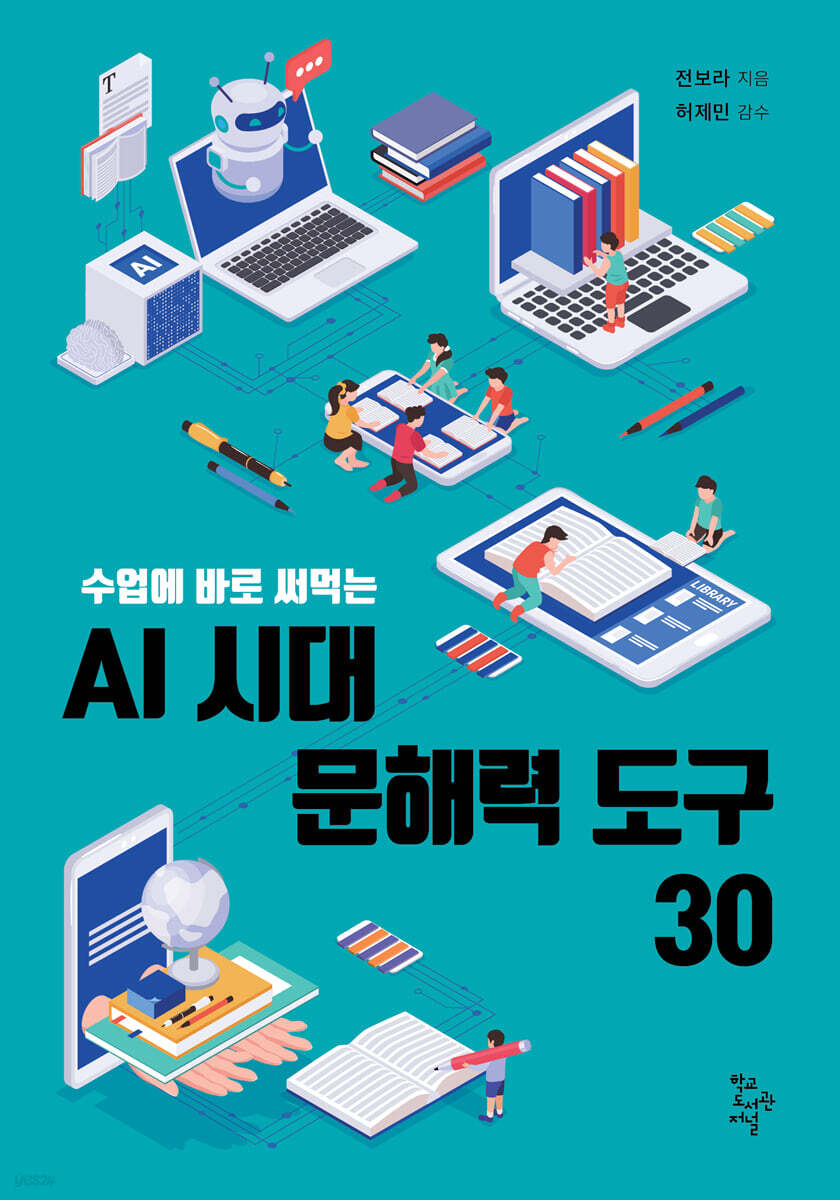
30 Literacy Tools for the AI Era
 |
Description
Book Introduction
How can we help today's students, accustomed to using AI, learn to use it as a tool for thinking, rather than being swayed by it? The author proposes AI literacy classes that focus on reading and understanding various texts, images, and media, as well as understanding and utilizing AI in various ways.
It is said that literacy activities that broaden background knowledge, ask questions while reading, critically interpret various texts, and express what is read in a multifaceted way can help students develop the ability to acquire or reconstruct knowledge using AI.
It is said that by expanding literacy and gaining experience collaborating with AI, one can become a subject of knowledge construction.
He adds that if we take the time to critically review the process of utilizing AI, we can seize the initiative while coexisting with AI.
This book contains methods for implementing literacy classes required in this AI era.
The author guides students through lessons using 30 literacy tools that can be immediately applied in the classroom. If you're a teacher concerned about the literacy skills of your AI-native students and considering using AI in your classroom, this book will provide you with solid answers.
It is said that literacy activities that broaden background knowledge, ask questions while reading, critically interpret various texts, and express what is read in a multifaceted way can help students develop the ability to acquire or reconstruct knowledge using AI.
It is said that by expanding literacy and gaining experience collaborating with AI, one can become a subject of knowledge construction.
He adds that if we take the time to critically review the process of utilizing AI, we can seize the initiative while coexisting with AI.
This book contains methods for implementing literacy classes required in this AI era.
The author guides students through lessons using 30 literacy tools that can be immediately applied in the classroom. If you're a teacher concerned about the literacy skills of your AI-native students and considering using AI in your classroom, this book will provide you with solid answers.
- You can preview some of the book's contents.
Preview
index
Chapter 1: Literacy: Building the Foundations of Knowledge with Background Knowledge
1. Building background knowledge with side text: Preview
2. Expand your background knowledge with keywords: Predicting
3. Reading with Logical Knowledge: The Framework of the Text
4. Reading using knowledge of story structure: Story structure diagram
5. Reading with knowledge of the flow of events: Plot diagrams
Chapter 2: Literacy through Questions
1. Asking Questions with Courage: Question Storming
2. Deepen your learning with follow-up questions: KWLS
3. Doubting and Doubting the Answer: Reading with Question Marks
4. Creating Questions at Different Levels: Questioning Frameworks
5. Self-assess and improve the accuracy of information: CRAAP
Chapter 3: Literacy: Finding Answers in Multiple Texts
1. Verify your answer with a recent example: Newspaper article
2 Reading the World Beyond Algorithms: Newsletter
3. Encountering Life's Problems That AI Doesn't Have: Magazine
4. Solving Problems with Big Data: News Big Data
5. Digging Deeper to Find a Solid Alternative: Academic Articles
Chapter 4: Literacy through Images
1. Capturing and Refining Disappearing Information: Drawing Concept Maps
2 Expressing Nonverbally: Connecting with Pictures
3. Conveying a lot of information in one page: Creating infographics
4 Visualize Key Content at a Glance: Drawing a Poster
5 Re-creating Artwork in Digital Language: Translating with Emojis
Chapter 5: Expanding Literacy with Artificial Intelligence
1. Exploring a Topic with a Chain of Questions: The Question Continuum
2 Fact-checking generative AI's answers: Noticing
3. Expressing Reading Content in Pictures: Drawing with Image-Generating AI
4. Re-creating a work of art into music: Creating a theme song with music-generating AI
5 Understanding the Production Ethics of AI: Understanding the Underside of AI
Chapter 6: Literacy: Evaluating and Reflecting on the Process
1. Reflecting with a Sense of Ownership: Self-Reflective Assessment
2. Reflecting on the Reading and Writing Process: PMI Chart
3. Reflecting on the Team Play Process: Peer Evaluation
4. Developing the Power of Speaking, Listening, and Empathy: Oral Assessment
5. Share your thoughts with the whole group: Question Gallery Walk
References
1. Building background knowledge with side text: Preview
2. Expand your background knowledge with keywords: Predicting
3. Reading with Logical Knowledge: The Framework of the Text
4. Reading using knowledge of story structure: Story structure diagram
5. Reading with knowledge of the flow of events: Plot diagrams
Chapter 2: Literacy through Questions
1. Asking Questions with Courage: Question Storming
2. Deepen your learning with follow-up questions: KWLS
3. Doubting and Doubting the Answer: Reading with Question Marks
4. Creating Questions at Different Levels: Questioning Frameworks
5. Self-assess and improve the accuracy of information: CRAAP
Chapter 3: Literacy: Finding Answers in Multiple Texts
1. Verify your answer with a recent example: Newspaper article
2 Reading the World Beyond Algorithms: Newsletter
3. Encountering Life's Problems That AI Doesn't Have: Magazine
4. Solving Problems with Big Data: News Big Data
5. Digging Deeper to Find a Solid Alternative: Academic Articles
Chapter 4: Literacy through Images
1. Capturing and Refining Disappearing Information: Drawing Concept Maps
2 Expressing Nonverbally: Connecting with Pictures
3. Conveying a lot of information in one page: Creating infographics
4 Visualize Key Content at a Glance: Drawing a Poster
5 Re-creating Artwork in Digital Language: Translating with Emojis
Chapter 5: Expanding Literacy with Artificial Intelligence
1. Exploring a Topic with a Chain of Questions: The Question Continuum
2 Fact-checking generative AI's answers: Noticing
3. Expressing Reading Content in Pictures: Drawing with Image-Generating AI
4. Re-creating a work of art into music: Creating a theme song with music-generating AI
5 Understanding the Production Ethics of AI: Understanding the Underside of AI
Chapter 6: Literacy: Evaluating and Reflecting on the Process
1. Reflecting with a Sense of Ownership: Self-Reflective Assessment
2. Reflecting on the Reading and Writing Process: PMI Chart
3. Reflecting on the Team Play Process: Peer Evaluation
4. Developing the Power of Speaking, Listening, and Empathy: Oral Assessment
5. Share your thoughts with the whole group: Question Gallery Walk
References
Detailed image

Into the book
In today's ecosystem, where artificial intelligence has been added to reading and writing, the most important thing is to become a subject that constructs knowledge.
We must let go of our reliance solely on artificial intelligence and continue to practice literacy by reading, digesting, and creatively reconstructing various texts.
--- From the "Preface"
Even when leveraging AI, having background knowledge can help you generate good prompts to obtain the necessary information, easily find errors in data, and take quick follow-up actions.
--- From "Literacy: Building the Foundations of Knowledge with Background Knowledge"
In a reading context that utilizes AI, a reader who raises an initial question and then fails to ask follow-up questions is like entering a search term in an online reading task, reading the first post on the first page, and then ending the task.
To gain accurate knowledge, you need to identify any unresolved questions and ask questions to obtain additional information.
--- From "Literacy Developed Through Questions"
You must be able to directly access and verify source data, interpret information in different contexts, and address the issue of hallucinations.
In addition, we must develop the ability to read and digest various texts and creatively reconstruct them.
--- From "Literacy: Finding Answers in Multiple Texts"
One of the most important things in today's communication is visual literacy, the ability to read and write the meaning of images.
Visual literacy allows you to read real-world texts effectively.
--- From "Literacy through Images"
Recently, there has been an increase in the number of students relying on artificial intelligence to solve problems.
As constructors of knowledge, we need guidance to enable them to move forward in new ways of reading and writing by utilizing artificial intelligence without losing their initiative.
To coexist with artificial intelligence, we must be able to utilize it functionally, reflectively, and critically.
--- From "Expanding Literacy with Artificial Intelligence"
If we evaluate students practicing expanded literacy by examining their reflections and collaborations during the process of reading and writing, our reading and writing in the age of artificial intelligence will become more profound.
We must let go of our reliance solely on artificial intelligence and continue to practice literacy by reading, digesting, and creatively reconstructing various texts.
--- From the "Preface"
Even when leveraging AI, having background knowledge can help you generate good prompts to obtain the necessary information, easily find errors in data, and take quick follow-up actions.
--- From "Literacy: Building the Foundations of Knowledge with Background Knowledge"
In a reading context that utilizes AI, a reader who raises an initial question and then fails to ask follow-up questions is like entering a search term in an online reading task, reading the first post on the first page, and then ending the task.
To gain accurate knowledge, you need to identify any unresolved questions and ask questions to obtain additional information.
--- From "Literacy Developed Through Questions"
You must be able to directly access and verify source data, interpret information in different contexts, and address the issue of hallucinations.
In addition, we must develop the ability to read and digest various texts and creatively reconstruct them.
--- From "Literacy: Finding Answers in Multiple Texts"
One of the most important things in today's communication is visual literacy, the ability to read and write the meaning of images.
Visual literacy allows you to read real-world texts effectively.
--- From "Literacy through Images"
Recently, there has been an increase in the number of students relying on artificial intelligence to solve problems.
As constructors of knowledge, we need guidance to enable them to move forward in new ways of reading and writing by utilizing artificial intelligence without losing their initiative.
To coexist with artificial intelligence, we must be able to utilize it functionally, reflectively, and critically.
--- From "Expanding Literacy with Artificial Intelligence"
If we evaluate students practicing expanded literacy by examining their reflections and collaborations during the process of reading and writing, our reading and writing in the age of artificial intelligence will become more profound.
--- From "Literacy that Evaluates and Reflects on the Process"
Publisher's Review
A Guide to Literacy Classes to Develop Learners Leading the AI Era
The author says that observing students relying on ChatGPT to complete assignments made him realize the need for guidance that would allow students to utilize AI to create new reading and writing skills without losing control as knowledge constructors.
While prioritizing classes that solidify the fundamentals of reading and writing, we attempted an AI literacy class that understood the principles and limitations of AI data composition and utilized various AIs.
In this way, while gradually improving students' literacy, classes that expand to include media literacy and visual literacy are presented step by step in Chapters 1 through 5.
Chapter 6 introduces methods for self-evaluation and reflection on the processes of previous literacy activities.
Chapter 6 presents 30 tools to enhance literacy and provides specific examples of lessons that utilize these tools.
The author says that through these classes, "by observing students, I learned what each task needed to be mastered amidst the wave of AI." If you're looking to develop a course that enhances students' literacy in the AI era, this book will help you map out the big picture.
Easy-to-understand literacy tools, literacy classes you can try right away.
As in his previous work, "Literacy Tools for Classroom Use," the author introduces useful tools that can be applied widely if you know them, and explains lessons that can be completed in a jiffy through various examples.
In particular, the case studies of classes that applied 30 literacy tools are meticulously recorded throughout the various classes, making it easy to understand the lessons.
Additionally, we provided specific materials used in each class activity and vivid examples of activity sheets created by actual students, allowing anyone to try the class.
At the end of each lesson, we included lesson notes, a sample activity sheet, and helpful resources for guiding students, allowing teachers to tailor their lessons to the specific situation.
As the author puts it, this book "explains what to focus on when implementing reading and writing classes for students who will coexist with AI, and provides various examples and guidelines to help students collaborate with AI rather than be swayed by it."
A case study for instructors who want to try AI-powered classes right away.
Unlike typical AI textbooks or guides, this book doesn't offer lengthy explanations of the concepts and principles of each type of AI, difficult-to-follow AI cases, or a litany of prompts and examples. Even the sections introducing AI-based lessons offer case studies that can be adapted and applied to meet specific needs. If you're looking to develop a literacy course focused on AI, consider Chapter 5, "Expanding Literacy with AI."
Through activities such as 'Exploring ChatGPT topics using a question continuum', 'Verifying the authenticity of generative AI answers', 'Using generative AI to convert what you read into pictures and music', and 'Reading the other side of AI', you will be able to practice how to use AI functionally, reflectively, and critically.
It would also be possible to conduct activities tailored to each subject based on the presented lesson ideas.
The author says that observing students relying on ChatGPT to complete assignments made him realize the need for guidance that would allow students to utilize AI to create new reading and writing skills without losing control as knowledge constructors.
While prioritizing classes that solidify the fundamentals of reading and writing, we attempted an AI literacy class that understood the principles and limitations of AI data composition and utilized various AIs.
In this way, while gradually improving students' literacy, classes that expand to include media literacy and visual literacy are presented step by step in Chapters 1 through 5.
Chapter 6 introduces methods for self-evaluation and reflection on the processes of previous literacy activities.
Chapter 6 presents 30 tools to enhance literacy and provides specific examples of lessons that utilize these tools.
The author says that through these classes, "by observing students, I learned what each task needed to be mastered amidst the wave of AI." If you're looking to develop a course that enhances students' literacy in the AI era, this book will help you map out the big picture.
Easy-to-understand literacy tools, literacy classes you can try right away.
As in his previous work, "Literacy Tools for Classroom Use," the author introduces useful tools that can be applied widely if you know them, and explains lessons that can be completed in a jiffy through various examples.
In particular, the case studies of classes that applied 30 literacy tools are meticulously recorded throughout the various classes, making it easy to understand the lessons.
Additionally, we provided specific materials used in each class activity and vivid examples of activity sheets created by actual students, allowing anyone to try the class.
At the end of each lesson, we included lesson notes, a sample activity sheet, and helpful resources for guiding students, allowing teachers to tailor their lessons to the specific situation.
As the author puts it, this book "explains what to focus on when implementing reading and writing classes for students who will coexist with AI, and provides various examples and guidelines to help students collaborate with AI rather than be swayed by it."
A case study for instructors who want to try AI-powered classes right away.
Unlike typical AI textbooks or guides, this book doesn't offer lengthy explanations of the concepts and principles of each type of AI, difficult-to-follow AI cases, or a litany of prompts and examples. Even the sections introducing AI-based lessons offer case studies that can be adapted and applied to meet specific needs. If you're looking to develop a literacy course focused on AI, consider Chapter 5, "Expanding Literacy with AI."
Through activities such as 'Exploring ChatGPT topics using a question continuum', 'Verifying the authenticity of generative AI answers', 'Using generative AI to convert what you read into pictures and music', and 'Reading the other side of AI', you will be able to practice how to use AI functionally, reflectively, and critically.
It would also be possible to conduct activities tailored to each subject based on the presented lesson ideas.
GOODS SPECIFICS
- Date of issue: May 15, 2025
- Page count, weight, size: 280 pages | 140*200*20mm
- ISBN13: 9788969151858
- ISBN10: 8969151850
You may also like
카테고리
korean


korean

![GQ KOREA Mark (Monthly): December [2025]](http://librairie.coreenne.fr/cdn/shop/files/8ef265dbbfbf186523ed75ba7319009d.jpg?v=1765340328&width=3840)


