

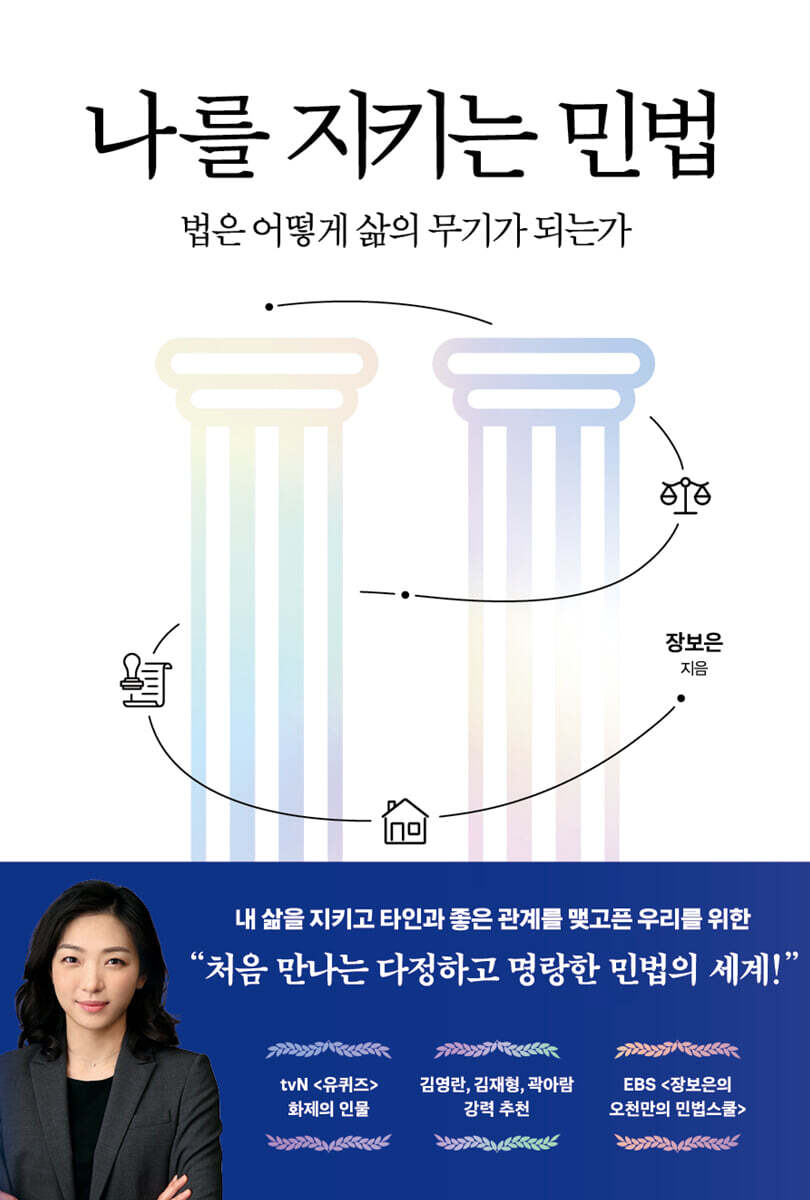
Civil law that protects me
 |
Description
Book Introduction
“When life is uncertain, you should read the civil law!”
From large-scale transactions to guarantees, collateral, marriage and divorce, and inheritance.
The power to add confidence to life's important decisions!
Most of the important decisions you make in life fall within the realm of civil law.
From buying a cup of coffee on the way to work, to signing the first rental contract I secured on my own, to registering my marriage with my lover, to inheriting an inheritance for my remaining family, we are living 'according to the civil law.'
Civil law is like a companion that is deeply involved in my daily life.
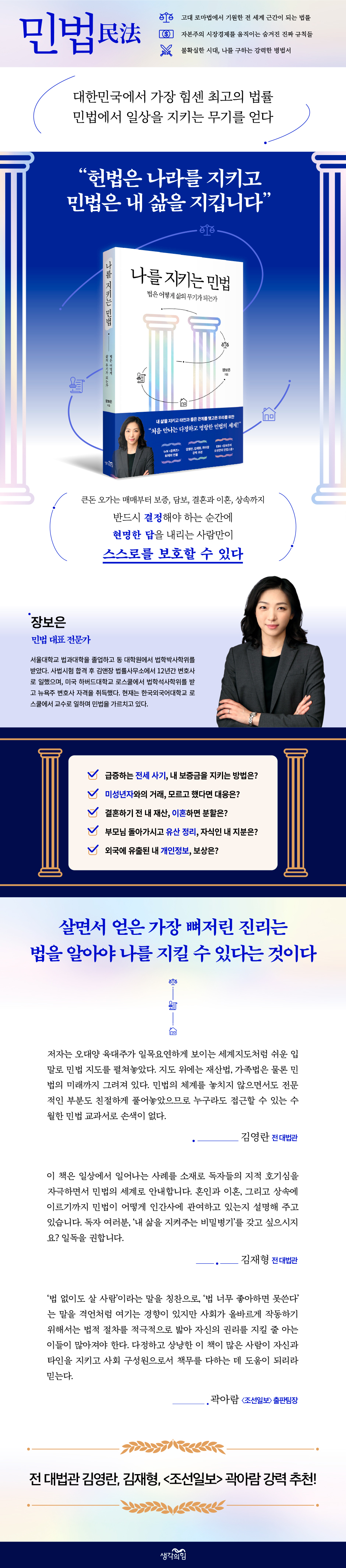
Professor Jang Bo-eun, who worked as a lawyer for 12 years at Kim & Chang, one of South Korea's largest law firms, and is currently a law school professor, says that civil law is the strongest weapon we can have, and that we must encounter civil law at all times in our lives.
Because through civil law, which defines individual rights and obligations and resolves conflicts between people, we can confidently claim our share, protect our loved ones, and protect our lives from hardship.
For those who have ever felt crushed by the weight of life, lamenting, "Why do I have so many things to protect as I get older?", "Civil Law That Protects Me" will be a powerful force that will protect your troubled life.
From large-scale transactions to guarantees, collateral, marriage and divorce, and inheritance.
The power to add confidence to life's important decisions!
Most of the important decisions you make in life fall within the realm of civil law.
From buying a cup of coffee on the way to work, to signing the first rental contract I secured on my own, to registering my marriage with my lover, to inheriting an inheritance for my remaining family, we are living 'according to the civil law.'
Civil law is like a companion that is deeply involved in my daily life.
Professor Jang Bo-eun, who worked as a lawyer for 12 years at Kim & Chang, one of South Korea's largest law firms, and is currently a law school professor, says that civil law is the strongest weapon we can have, and that we must encounter civil law at all times in our lives.
Because through civil law, which defines individual rights and obligations and resolves conflicts between people, we can confidently claim our share, protect our loved ones, and protect our lives from hardship.
For those who have ever felt crushed by the weight of life, lamenting, "Why do I have so many things to protect as I get older?", "Civil Law That Protects Me" will be a powerful force that will protect your troubled life.
- You can preview some of the book's contents.
Preview
index
Entering_For a wise social life, I recommend civil law.
PART Ⅰ.
Starting the class
1.
| Introduction | For a wise social life, we recommend the Civil Code.
PART Ⅱ.
Property Law for Your Wise Economic Life
2.
| Contract | The promise that drives the capitalist economy
3.
| Contents of the contract | For the contract to be recognized as valid
4.
| Parties to a Contract and Their Expression of Intent | 'Who' and 'How' Can a Valid Contract Be Made?
5.
| Ownership | The right to the things I own
6.
| Publication | How to mark it as mine
7.
| Lease | Right to own and right to rent
8.
| Statute of Limitations | What Happens to Rights Over Time?
9.
| Illegal Act | What if I suffered damage due to the other party's illegal act?
10.
| Compensation for damages | Restoration to the state in which the illegal act occurred
11.
| Unjust Enrichment | How to Redress Profits That Go to the Wrong Person
12.
| Collateral System | What do people look for when lending money?
PART Ⅲ.
Family law that protects precious family relationships
13.
| Marriage | What does "Will you marry me?" mean?
14.
| Divorce | To break the promise of 'let's be together forever'
15.
| Inheritance | What happens to my estate when I die?
PART IV.
The future of civil law
16.
| Personal Rights | A New Era, New Values
PART V.
Wrapping up the class
17.
| Conclusion | The Secret Weapon That Protects Me
PART Ⅰ.
Starting the class
1.
| Introduction | For a wise social life, we recommend the Civil Code.
PART Ⅱ.
Property Law for Your Wise Economic Life
2.
| Contract | The promise that drives the capitalist economy
3.
| Contents of the contract | For the contract to be recognized as valid
4.
| Parties to a Contract and Their Expression of Intent | 'Who' and 'How' Can a Valid Contract Be Made?
5.
| Ownership | The right to the things I own
6.
| Publication | How to mark it as mine
7.
| Lease | Right to own and right to rent
8.
| Statute of Limitations | What Happens to Rights Over Time?
9.
| Illegal Act | What if I suffered damage due to the other party's illegal act?
10.
| Compensation for damages | Restoration to the state in which the illegal act occurred
11.
| Unjust Enrichment | How to Redress Profits That Go to the Wrong Person
12.
| Collateral System | What do people look for when lending money?
PART Ⅲ.
Family law that protects precious family relationships
13.
| Marriage | What does "Will you marry me?" mean?
14.
| Divorce | To break the promise of 'let's be together forever'
15.
| Inheritance | What happens to my estate when I die?
PART IV.
The future of civil law
16.
| Personal Rights | A New Era, New Values
PART V.
Wrapping up the class
17.
| Conclusion | The Secret Weapon That Protects Me
Detailed image
Into the book
Unless we are stranded on a desert island, we cannot live apart from society.
You will form relationships with other people, make transactions, and even form property relationships.
They grow up within their families and even get married and form new families.
In this regard, understanding the rules by which our society operates, its basic systems, and its principles will be a great weapon in our lives.
--- From "Entering"
Thinking like a lawyer can actually be very helpful in solving many problems.
If you understand the principles of what rights you have and what rights others have, where these rights conflict or conflict arise, and how to adjust and resolve them, your perspective on problems and the way you resolve disputes will change.
This will undoubtedly be a very useful tool for you, no matter what you do, even in your relationships with family and friends, even if you're not a lawyer.
--- 「1.
Introduction | From “Why We Need Civil Law”
Article 103 states that “any legal act that contains any matter that violates good customs or other social order shall be invalid.”
'Good customs' and 'other social order' are sometimes abbreviated as public order and morals.
If you've ever heard the term "violation of public order and morals," that's Article 103.
Good customs refer to the general moral or ethical concepts of our society, and social order refers to the public order or general interests of our society.
--- 「3.
Contents of the contract | In order for the contract to be recognized as valid,
Capitalist society is based on free competition and a market economy.
People produce and consume goods to make a profit.
The economic activities of individuals, which are the main concern of civil law, are based on private property and division of labor.
If the division of labor and exchange between individuals are clearly expressed in contractual relationships, then the guarantee of private property is expressed in ownership rights.
Absolute respect for property rights is the foundation of the capitalist economic system.
--- 「5.
Ownership | The right to the things I own
While this doesn't mean that true rights holders shouldn't be protected, ensuring that people can transact safely is also an important value that the law should pursue.
A balance must be struck between these two values.
So, the civil law sets a certain period of time to better protect the true rights holder during that period, and after that period, it places greater importance on the safety of the transaction or so-called legal stability.
There's a saying that "those who sleep on their rights have no protection." This doesn't mean that rights aren't important or that rights holders have a duty to exercise them, but rather that legal certainty becomes more important to those who don't exercise their rights for a long time.
There are cases where it is unfair to claim that the statute of limitations has expired and one's obligations are no longer applicable.
Article 2 of the Civil Act states that “the exercise of rights and performance of obligations must be done faithfully and in good faith” and that “rights cannot be abused.”
This is called the principle of good faith, or simply the principle of good faith.
There are cases where asserting the statute of limitations does not comply with the principle of good faith.
--- 「8.
Statute of Limitations | What Happens to Rights as Time Passes?
It's been a while since I've reviewed the table of contents in the Civil Code. It might be a good idea to go back to page 32 and review it.
The content from Part 1 to Part 3 now looks somewhat familiar.
That's right. Part 4, Relatives, and Part 5, Inheritance, fall under family law, and that's why family law is also called the law of inheritance by relatives.
Family law is the law that governs the entire process from birth to growth, meeting a partner, getting married, having children, raising them, and passing on one's property after death.
--- 「13.
Marriage | The Meaning of “Will You Marry Me?”
Parental authority refers to the rights and obligations granted to parents to protect and educate their minor children (Article 913).
The parent with parental authority becomes the child's legal representative (Article 911).
Although it may seem like a parental right just by looking at the name, it actually has a strong nature of obligation because parental authority must be exercised with the child's welfare as a priority (Article 912).
When parents divorce, they must agree on who will have custody. If they cannot agree or cannot reach an agreement, the court will decide who will have custody.
--- 「14.
Divorce | From "To Break the Promise of 'Let's Be Together Forever'"
To resolve these cases, the Civil Code established a system called reserved portion.
That is, while acknowledging the freedom of will, it also ensures that at least a certain amount of the inherited property goes to the heirs specified by law.
For example, in the previous example, the spouse could claim back at least half of his or her share of the estate from the person or entity that inherited the entire estate.
This is to protect the survivors' right to survival and guarantee their contribution to the formation of the inheritance or their expectations regarding the inheritance.
--- 「15.
Inheritance | What will happen to my property when I die?
Among all laws, civil law is the law closest to our lives.
So, if we understand civil law well, we can also understand our lives better.
Because civil law teaches us how to protect our rights and reasonably resolve disputes between people as we live in this world.
I hope the stories we've shared so far will help you build your thinking muscles and be of use to you wherever you are.
You will form relationships with other people, make transactions, and even form property relationships.
They grow up within their families and even get married and form new families.
In this regard, understanding the rules by which our society operates, its basic systems, and its principles will be a great weapon in our lives.
--- From "Entering"
Thinking like a lawyer can actually be very helpful in solving many problems.
If you understand the principles of what rights you have and what rights others have, where these rights conflict or conflict arise, and how to adjust and resolve them, your perspective on problems and the way you resolve disputes will change.
This will undoubtedly be a very useful tool for you, no matter what you do, even in your relationships with family and friends, even if you're not a lawyer.
--- 「1.
Introduction | From “Why We Need Civil Law”
Article 103 states that “any legal act that contains any matter that violates good customs or other social order shall be invalid.”
'Good customs' and 'other social order' are sometimes abbreviated as public order and morals.
If you've ever heard the term "violation of public order and morals," that's Article 103.
Good customs refer to the general moral or ethical concepts of our society, and social order refers to the public order or general interests of our society.
--- 「3.
Contents of the contract | In order for the contract to be recognized as valid,
Capitalist society is based on free competition and a market economy.
People produce and consume goods to make a profit.
The economic activities of individuals, which are the main concern of civil law, are based on private property and division of labor.
If the division of labor and exchange between individuals are clearly expressed in contractual relationships, then the guarantee of private property is expressed in ownership rights.
Absolute respect for property rights is the foundation of the capitalist economic system.
--- 「5.
Ownership | The right to the things I own
While this doesn't mean that true rights holders shouldn't be protected, ensuring that people can transact safely is also an important value that the law should pursue.
A balance must be struck between these two values.
So, the civil law sets a certain period of time to better protect the true rights holder during that period, and after that period, it places greater importance on the safety of the transaction or so-called legal stability.
There's a saying that "those who sleep on their rights have no protection." This doesn't mean that rights aren't important or that rights holders have a duty to exercise them, but rather that legal certainty becomes more important to those who don't exercise their rights for a long time.
There are cases where it is unfair to claim that the statute of limitations has expired and one's obligations are no longer applicable.
Article 2 of the Civil Act states that “the exercise of rights and performance of obligations must be done faithfully and in good faith” and that “rights cannot be abused.”
This is called the principle of good faith, or simply the principle of good faith.
There are cases where asserting the statute of limitations does not comply with the principle of good faith.
--- 「8.
Statute of Limitations | What Happens to Rights as Time Passes?
It's been a while since I've reviewed the table of contents in the Civil Code. It might be a good idea to go back to page 32 and review it.
The content from Part 1 to Part 3 now looks somewhat familiar.
That's right. Part 4, Relatives, and Part 5, Inheritance, fall under family law, and that's why family law is also called the law of inheritance by relatives.
Family law is the law that governs the entire process from birth to growth, meeting a partner, getting married, having children, raising them, and passing on one's property after death.
--- 「13.
Marriage | The Meaning of “Will You Marry Me?”
Parental authority refers to the rights and obligations granted to parents to protect and educate their minor children (Article 913).
The parent with parental authority becomes the child's legal representative (Article 911).
Although it may seem like a parental right just by looking at the name, it actually has a strong nature of obligation because parental authority must be exercised with the child's welfare as a priority (Article 912).
When parents divorce, they must agree on who will have custody. If they cannot agree or cannot reach an agreement, the court will decide who will have custody.
--- 「14.
Divorce | From "To Break the Promise of 'Let's Be Together Forever'"
To resolve these cases, the Civil Code established a system called reserved portion.
That is, while acknowledging the freedom of will, it also ensures that at least a certain amount of the inherited property goes to the heirs specified by law.
For example, in the previous example, the spouse could claim back at least half of his or her share of the estate from the person or entity that inherited the entire estate.
This is to protect the survivors' right to survival and guarantee their contribution to the formation of the inheritance or their expectations regarding the inheritance.
--- 「15.
Inheritance | What will happen to my property when I die?
Among all laws, civil law is the law closest to our lives.
So, if we understand civil law well, we can also understand our lives better.
Because civil law teaches us how to protect our rights and reasonably resolve disputes between people as we live in this world.
I hope the stories we've shared so far will help you build your thinking muscles and be of use to you wherever you are.
--- 「17.
Conclusuion | From "The Secret Weapon That Protects Me"
Conclusuion | From "The Secret Weapon That Protects Me"
Publisher's Review
★Former lawyer at Kim & Chang law firm who appeared on tvN's "You Quiz"
Recommended by Kim Young-ran, Kim Jae-hyung, and Kwak A-ram
★ Civil law expert appearing on EBS's "Jang Bo-eun's 50 Million Civil Law School"
Why is it important to know civil law, especially in uncertain times?
A smart weapon for a life where defense is more important than offense.
Civil law is a powerful weapon that firmly protects my precious daily life.
If the Constitution is the cornerstone that protects the country, the Civil Code is like a military manual that safely protects me, my family, my home, and my property.
Because the freedom to spend, earn, and invest as I please, and the rights and obligations I can confidently claim for myself, are guaranteed by the Civil Code.
The Civil Code, whose importance has been overshadowed by the Constitution, is in fact a huge cog that drives capitalism and the market economy.
From the birth certificate that declares our birth into this world to marriage, divorce, inheritance, and death, our lives all flow within and are influenced by the time of civil law.
This is why people who understand civil law win in the real world of life.
Professor Jang Bo-eun, who worked at Kim & Chang and deeply experienced how civil law affects human affairs, wrote “Civil Law that Protects Me” in the hope that no one will be left vulnerable due to ignorance of civil law.
The author, who began the first class with the moving history of the civil law of our country after liberation, explains the two major pillars that support civil law, property law and family law, using 10 key concepts.
Furthermore, it covers the trends and future of civil law related to AI, which has recently been the subject of intensifying disputes.
The final class is a time to embody five training exercises that will help you open your closed 'eyes of law' and understand the world with your logical 'head of law.'
Anyone who has ever been on the fringes of the law will, upon completing this course, gain a weapon to navigate life's uncertain times.
Knowing the principles and rules of the world opens up a different life.
The Golden Rule Hidden in the Game of Society: Civil Law
Having worked in the legal battlefield for over 15 years as a lawyer and professor, the author realized that the law resembles the golden rules of a grand game.
This is because the systematic principles and rules for the normal operation of a capitalist market economy were hidden in the civil law.
As 'free, equal, and rational' human beings as presupposed by civil law, we can contract and own things as we wish within this game.
Contrary to the prejudice that the law is always rigid, civil law affirms and protects the desires of individuals striving for success.
As the saying goes, 'Life is a real battle,' so studying civil law is like obtaining a cheat key to living a special life.
In this book, the author argues that ordinary people should also cultivate a "legal mind," which has long been considered a secret weapon only for lawyers.
Thinking like a lawyer can actually be incredibly helpful in solving many problems.
If you understand the principles of what rights you have and what rights others have, where these rights conflict or conflict arise, and how to adjust and resolve them, your perspective on problems and the way you resolve disputes will change.
Having a legal mind, which means the ability to understand, analyze, and apply legal concepts and principles, or the ability to reason and argue rationally, can help you easily solve a variety of problems, such as avoiding traps in contracts, gaining the upper hand in a damages battle, or securing your share in a divorce.
The Civil Code, which is filled with logic accumulated over 70 years, is the best training ground for practicing this.
If you have unknowingly committed an illegal act by engaging in a large-sum transaction with someone who lied about being a minor, you can prove your innocence by showing that the other party's lie was intentional, according to Article 17 of the Civil Act.
Article 17 (Deception by persons with limited capacity)
① If a person with limited capacity tricks another person into believing that he or she is a person with capacity, that act cannot be cancelled.
② Even if a minor or a person under limited guardianship deceives others into believing that they have the consent of their legal representative, the same shall apply as in paragraph 1.
If you learn the hidden rules of civil law, where a battle of reason and rationality takes place rather than a battle of power, you can gain the strength to overcome even the most difficult missions.
“He who sleeps on his rights loses them.”
A story about civil law that is cold because it is fair, but hot because it is changeable.
If you lend money to a friend and haven't pressed for it for ten years, will you ever get it back? If you built a house on land you haven't cared for for a long time and the real owner shows up and demands eviction, will you be evicted without a warrant? If you answered "yes" to these questions, you'll need to relearn civil law.
Surprisingly, the statute of limitations and the acquisitive prescription are recognized under Articles 162 and 245 of the Civil Act, respectively, so you cannot get your money back and you can refuse to comply with the landlord's request to vacate.
Article 162 (Statute of limitations for claims and property rights)
① If a bond is not exercised for 10 years, the statute of limitations is completed.
② Property rights other than claims and ownership rights are subject to statute of limitations if not exercised for 20 years.
Although at first glance it may seem that this measure does not protect the true rights holders, it is a manifestation of the important value of civil law that legal certainty is the priority.
As the old adage goes, “He who sleeps on his rights will not be protected,” civil law guides us to become aware citizens by not showing mercy to those who neglect their rights.
The author argues that when compassion and the law clash in such seemingly ruthless cases, we should stop immediately condemning the law and instead seek a better way.
This is because civil law is a rule to maintain social order, not a fight to blame one side.
When the tragic incident of parents who failed to raise their children properly claiming to be the heirs after their children died occurred, the civil law added the reasons for disqualification from inheritance to ensure that the deceased would be taken care of until after their death, recognized same-sex couples who could not register their marriage as common-law spouses and granted them the status of dependents covered by health insurance, and gave priority to protecting minors or those who have difficulty expressing their opinions due to physical or mental reasons from unfavorable contracts, etc., becoming our refuge with the warmest presence in times of need.
Civil law has a long history, but it is a living law that flexibly accepts the dynamic spirit of the times and changes.
If you have ever felt that civil law was rigid and conservative, reading this book will make it more approachable and easier to understand.
“Exercise your rights and fulfill your duties faithfully and in good faith.”
The power of civil law to help me grow into the master of my own life
Civil law constantly pushes us to live as active human beings.
This is because the Civil Code speaks not only of the rights that are naturally inherited as human beings, but also of the duties that must be fulfilled as citizens.
Article 2 of the Civil Act, which states that "the exercise of rights and performance of obligations must be done faithfully and in good faith," urges us to faithfully perform the precious rights and obligations we have won through fierce struggle, in good faith, that is, in accordance with faith and duty.
People often joke that 'there are people who can live without the law', but here's why this is only half true.
As we can see from the statute of limitations that takes away our rights if we are lazy about them, asserting our rights when necessary is the same as becoming the master of our own lives and living actively and subjectively.
Article 103, also known as the General Provisions, sets forth the standards of "good customs" and "social order" in conflicts and disputes, thereby helping to distinguish right from wrong and resolve problems wisely.
Article 103 (Legal acts that violate social order) Any legal act that contains matters that violate good customs or other social order shall be invalid.
Article 103, which embodies the meaning of "public order and good customs," leaves open the possibility that we can flexibly weigh the scales according to the situation, as justice and ethics are not fixed, as people's thoughts and values also change as society changes.
Therefore, we cannot help but continue to ask questions.
'What is just?' 'Are the ethics of the past still valid in the present?' 'What exactly are good customs and social order?'
With the social and political climate becoming increasingly unstable and interest in the law growing, now is the time to engage with civil law.
The Civil Law that Protects Me will become a solid support for us who were born as human beings and live our lives waveringly.
Recommended by Kim Young-ran, Kim Jae-hyung, and Kwak A-ram
★ Civil law expert appearing on EBS's "Jang Bo-eun's 50 Million Civil Law School"
Why is it important to know civil law, especially in uncertain times?
A smart weapon for a life where defense is more important than offense.
Civil law is a powerful weapon that firmly protects my precious daily life.
If the Constitution is the cornerstone that protects the country, the Civil Code is like a military manual that safely protects me, my family, my home, and my property.
Because the freedom to spend, earn, and invest as I please, and the rights and obligations I can confidently claim for myself, are guaranteed by the Civil Code.
The Civil Code, whose importance has been overshadowed by the Constitution, is in fact a huge cog that drives capitalism and the market economy.
From the birth certificate that declares our birth into this world to marriage, divorce, inheritance, and death, our lives all flow within and are influenced by the time of civil law.
This is why people who understand civil law win in the real world of life.
Professor Jang Bo-eun, who worked at Kim & Chang and deeply experienced how civil law affects human affairs, wrote “Civil Law that Protects Me” in the hope that no one will be left vulnerable due to ignorance of civil law.
The author, who began the first class with the moving history of the civil law of our country after liberation, explains the two major pillars that support civil law, property law and family law, using 10 key concepts.
Furthermore, it covers the trends and future of civil law related to AI, which has recently been the subject of intensifying disputes.
The final class is a time to embody five training exercises that will help you open your closed 'eyes of law' and understand the world with your logical 'head of law.'
Anyone who has ever been on the fringes of the law will, upon completing this course, gain a weapon to navigate life's uncertain times.
Knowing the principles and rules of the world opens up a different life.
The Golden Rule Hidden in the Game of Society: Civil Law
Having worked in the legal battlefield for over 15 years as a lawyer and professor, the author realized that the law resembles the golden rules of a grand game.
This is because the systematic principles and rules for the normal operation of a capitalist market economy were hidden in the civil law.
As 'free, equal, and rational' human beings as presupposed by civil law, we can contract and own things as we wish within this game.
Contrary to the prejudice that the law is always rigid, civil law affirms and protects the desires of individuals striving for success.
As the saying goes, 'Life is a real battle,' so studying civil law is like obtaining a cheat key to living a special life.
In this book, the author argues that ordinary people should also cultivate a "legal mind," which has long been considered a secret weapon only for lawyers.
Thinking like a lawyer can actually be incredibly helpful in solving many problems.
If you understand the principles of what rights you have and what rights others have, where these rights conflict or conflict arise, and how to adjust and resolve them, your perspective on problems and the way you resolve disputes will change.
Having a legal mind, which means the ability to understand, analyze, and apply legal concepts and principles, or the ability to reason and argue rationally, can help you easily solve a variety of problems, such as avoiding traps in contracts, gaining the upper hand in a damages battle, or securing your share in a divorce.
The Civil Code, which is filled with logic accumulated over 70 years, is the best training ground for practicing this.
If you have unknowingly committed an illegal act by engaging in a large-sum transaction with someone who lied about being a minor, you can prove your innocence by showing that the other party's lie was intentional, according to Article 17 of the Civil Act.
Article 17 (Deception by persons with limited capacity)
① If a person with limited capacity tricks another person into believing that he or she is a person with capacity, that act cannot be cancelled.
② Even if a minor or a person under limited guardianship deceives others into believing that they have the consent of their legal representative, the same shall apply as in paragraph 1.
If you learn the hidden rules of civil law, where a battle of reason and rationality takes place rather than a battle of power, you can gain the strength to overcome even the most difficult missions.
“He who sleeps on his rights loses them.”
A story about civil law that is cold because it is fair, but hot because it is changeable.
If you lend money to a friend and haven't pressed for it for ten years, will you ever get it back? If you built a house on land you haven't cared for for a long time and the real owner shows up and demands eviction, will you be evicted without a warrant? If you answered "yes" to these questions, you'll need to relearn civil law.
Surprisingly, the statute of limitations and the acquisitive prescription are recognized under Articles 162 and 245 of the Civil Act, respectively, so you cannot get your money back and you can refuse to comply with the landlord's request to vacate.
Article 162 (Statute of limitations for claims and property rights)
① If a bond is not exercised for 10 years, the statute of limitations is completed.
② Property rights other than claims and ownership rights are subject to statute of limitations if not exercised for 20 years.
Although at first glance it may seem that this measure does not protect the true rights holders, it is a manifestation of the important value of civil law that legal certainty is the priority.
As the old adage goes, “He who sleeps on his rights will not be protected,” civil law guides us to become aware citizens by not showing mercy to those who neglect their rights.
The author argues that when compassion and the law clash in such seemingly ruthless cases, we should stop immediately condemning the law and instead seek a better way.
This is because civil law is a rule to maintain social order, not a fight to blame one side.
When the tragic incident of parents who failed to raise their children properly claiming to be the heirs after their children died occurred, the civil law added the reasons for disqualification from inheritance to ensure that the deceased would be taken care of until after their death, recognized same-sex couples who could not register their marriage as common-law spouses and granted them the status of dependents covered by health insurance, and gave priority to protecting minors or those who have difficulty expressing their opinions due to physical or mental reasons from unfavorable contracts, etc., becoming our refuge with the warmest presence in times of need.
Civil law has a long history, but it is a living law that flexibly accepts the dynamic spirit of the times and changes.
If you have ever felt that civil law was rigid and conservative, reading this book will make it more approachable and easier to understand.
“Exercise your rights and fulfill your duties faithfully and in good faith.”
The power of civil law to help me grow into the master of my own life
Civil law constantly pushes us to live as active human beings.
This is because the Civil Code speaks not only of the rights that are naturally inherited as human beings, but also of the duties that must be fulfilled as citizens.
Article 2 of the Civil Act, which states that "the exercise of rights and performance of obligations must be done faithfully and in good faith," urges us to faithfully perform the precious rights and obligations we have won through fierce struggle, in good faith, that is, in accordance with faith and duty.
People often joke that 'there are people who can live without the law', but here's why this is only half true.
As we can see from the statute of limitations that takes away our rights if we are lazy about them, asserting our rights when necessary is the same as becoming the master of our own lives and living actively and subjectively.
Article 103, also known as the General Provisions, sets forth the standards of "good customs" and "social order" in conflicts and disputes, thereby helping to distinguish right from wrong and resolve problems wisely.
Article 103 (Legal acts that violate social order) Any legal act that contains matters that violate good customs or other social order shall be invalid.
Article 103, which embodies the meaning of "public order and good customs," leaves open the possibility that we can flexibly weigh the scales according to the situation, as justice and ethics are not fixed, as people's thoughts and values also change as society changes.
Therefore, we cannot help but continue to ask questions.
'What is just?' 'Are the ethics of the past still valid in the present?' 'What exactly are good customs and social order?'
With the social and political climate becoming increasingly unstable and interest in the law growing, now is the time to engage with civil law.
The Civil Law that Protects Me will become a solid support for us who were born as human beings and live our lives waveringly.
GOODS SPECIFICS
- Date of issue: February 20, 2025
- Page count, weight, size: 299 pages | 546g | 153*224*20mm
- ISBN13: 9791193166901
- ISBN10: 119316690X
You may also like
카테고리
korean


korean

![GQ KOREA Mark (Monthly): December [2025]](http://librairie.coreenne.fr/cdn/shop/files/8ef265dbbfbf186523ed75ba7319009d.jpg?v=1765340328&width=3840)


