

Baking Capital in a Country Bakery
 |
Description
Book Introduction
Amazon Japan's #1 bestseller in the social, political, and economics categories!
"Money, which doesn't corrupt or circulate, is what gave birth to the contradictions of capitalism."
A silent economic revolution at Darumari, a small country bakery in Katsuyama, a remote Japanese village.
Marx's 'Das Kapital' is resurfacing worldwide.
With the fall of communism, capitalism, which was perceived as a superior system to socialism, is rapidly revealing its true nature of inequality and unfairness.
As voices of self-reflection grow louder among intellectuals around the world, the Japanese archipelago is paying attention to the silent economic revolution of a bakery owner in a small village on the outskirts of Japan.
The protagonist is Itaru Watanabe, a baker and owner of a bakery in a rural town called Katsuyama, in the northern part of Okayama Prefecture, an area with an unfamiliar name.
Originally, he vaguely dreamed of becoming a farmer living in the countryside, but it was not until he was in his thirties that he finally managed to get a job at an organic produce wholesale company.
I was thrilled at the thought of working in the countryside and farming that I had always admired, but then I felt disgusted and skeptical about the company that was committing corruption such as false country of origin labeling and bribery.
He gradually began to yearn for the authenticity of life and began to listen to his inner voice.
My grandfather studied natural bacteria, and my father was obsessed with Marx.
Having inherited their capabilities, he came to the conclusion that he wanted to do something 'true, even if it was small', and finally decided to open a bakery.
However, he learned baking skills to escape to the 'outside' world because he hated the world where corruption was rampant according to the logic of capital, but he soon realized that even the bakery workshop, which was supposed to be the 'outside' world, was located in the middle of the economic system.
Harsh labor, absurd economic structure, threatened food… .
As he faced this reality, his philosophy of life on how to live became stronger, and at the bakery 'Darumari', which was born based on this, he put into practice the responsibility for human life and the small, clumsy sense of justice he inherited from his grandfather and father.
His efforts to maintain his own lifestyle while remaining within the confines of established society and finding balance in life resonated deeply with many Japanese people.
As if to demonstrate this, after its publication, "Baking Capital in a Country Bakery" instantly took first place in the Society, Politics, and Economics categories on Amazon Japan, and has continued to receive interest, encouragement, and praise from the media and readers.
His image as a conscientious capitalist will provide a good opportunity for many who are desperately trying to avoid an unstable and contradictory reality to reconsider the true value of life and the meaning of labor, and to suggest an alternative way of life.
"Money, which doesn't corrupt or circulate, is what gave birth to the contradictions of capitalism."
A silent economic revolution at Darumari, a small country bakery in Katsuyama, a remote Japanese village.
Marx's 'Das Kapital' is resurfacing worldwide.
With the fall of communism, capitalism, which was perceived as a superior system to socialism, is rapidly revealing its true nature of inequality and unfairness.
As voices of self-reflection grow louder among intellectuals around the world, the Japanese archipelago is paying attention to the silent economic revolution of a bakery owner in a small village on the outskirts of Japan.
The protagonist is Itaru Watanabe, a baker and owner of a bakery in a rural town called Katsuyama, in the northern part of Okayama Prefecture, an area with an unfamiliar name.
Originally, he vaguely dreamed of becoming a farmer living in the countryside, but it was not until he was in his thirties that he finally managed to get a job at an organic produce wholesale company.
I was thrilled at the thought of working in the countryside and farming that I had always admired, but then I felt disgusted and skeptical about the company that was committing corruption such as false country of origin labeling and bribery.
He gradually began to yearn for the authenticity of life and began to listen to his inner voice.
My grandfather studied natural bacteria, and my father was obsessed with Marx.
Having inherited their capabilities, he came to the conclusion that he wanted to do something 'true, even if it was small', and finally decided to open a bakery.
However, he learned baking skills to escape to the 'outside' world because he hated the world where corruption was rampant according to the logic of capital, but he soon realized that even the bakery workshop, which was supposed to be the 'outside' world, was located in the middle of the economic system.
Harsh labor, absurd economic structure, threatened food… .
As he faced this reality, his philosophy of life on how to live became stronger, and at the bakery 'Darumari', which was born based on this, he put into practice the responsibility for human life and the small, clumsy sense of justice he inherited from his grandfather and father.
His efforts to maintain his own lifestyle while remaining within the confines of established society and finding balance in life resonated deeply with many Japanese people.
As if to demonstrate this, after its publication, "Baking Capital in a Country Bakery" instantly took first place in the Society, Politics, and Economics categories on Amazon Japan, and has continued to receive interest, encouragement, and praise from the media and readers.
His image as a conscientious capitalist will provide a good opportunity for many who are desperately trying to avoid an unstable and contradictory reality to reconsider the true value of life and the meaning of labor, and to suggest an alternative way of life.
- You can preview some of the book's contents.
Preview
index
prolog
Part 1: A Corrupt-Free Economy
Chapter 1: Something Wrong - My Salaried Worker's Legacy from My Grandfather
Thirty, Baptized into an Unreasonable World | The Forgery of Origin I've Only Heard of...? | I Want to Do Something Real, Even if It's Small |
Try making bread
Chapter 2: Encountering Marx - The Legacy My Father Left Me
A fierce management meeting just before the opening | Speculative funds that ran amok in the bakery | In the midst of the Lehman Brothers shock and financial crisis |
The Marx we know?
Chapter 3: Marx and the Story of Labor Power
The Bakery's Cruel History (21st Century, Tokyo) | The Bakery's Cruel History (19th Century, London) | A Reality Exactly Like 150 Years Ago | Labor is the Key
Marx's Lecture at the Country Bakery 1: What is a commodity?
Marx's Lecture at the Country Bakery 2: The Secret Hidden in the "Price" of Goods
Marx's Lecture at the Country Bakery 3: The Identity of My "Wages"
Marx's Lecture at the Country Bakery 4: The Birth of Profit
Marx's Lecture 5 at the Country Bakery: I sold my labor, but in the end...
Chapter 4: The Story of Fungi and Technological Innovation
Bread Born from an Absurd Mistake | The Mysterious Process of Fermentation That Makes You Feel the Presence of God |
Even yeast has its own personality | Super yeast that "doesn't spoil" food
Marx's Lecture 6 at the Country Bakery: Technological Innovation Increases Profits
Marx's Lectures at the Country Bakery 7: Technological Innovation for Whom?
Marx Lectures at the Country Bakery 8: The Last Laugher
Marx's Lectures at the Country Bakery 9: Cheap Work, Cheap Food
Chapter 5: Incorruptible Bread and Incorruptible Money
Natural yeast in a sack | Additive-free bread | The reason I sniffed | Bread that doesn't rot | Money that doesn't rot |
An Incorruptible Economy | Let's Corrupt the Economy
Part 2: The Corrupt Economy
Chapter 1 Welcome.
This is a 'country bakery'.
A town where "fungi" grow and children grow | Introducing Darumari | Our store's nickname is "The Odd Bakery."
Listen to the voice of the Jang family
A showdown between 'fungi' and 'artisans' | The great power of small fungi | The difference between natural and pure cultures | The wind before the storm |
Have you heard of 'natural yeast'? | Food culture created by yeast | Bread doesn't rise... ... .
| Natural cultivation and natural fungi | Natural yeast bread created through the perfect combination | The boundary between fermentation and decay | The invisible hand of fungi | What fungi love to do | 'Fungus-centered' bread that puts fungi at the center | The power of 'subtraction' to bring out potential | Fungi and ingredients grown in the same soil | A non-corrupt economy as seen by fungi
Chapter 3: True Country Life is Circular
Guided by fungi, we finally arrived at Katsuyama | Katsuyama, where history lives and breathes | The power of water that transformed bread | Two lives become one | An ordinary youth | Real food encountered in Hungary | And… … Dreaming of the countryside | Opportunity after ordeal | The meaning of making bread in the countryside | The extraordinary determination of rural residents | Creating a regional 'circulation' with bread | Making bread like local currency
Chapter 4: Non-exploitative Management - Not Making a Profit
Country bakeries, now independent! | The bonds of small business owners that fuel society | A growing small business association | Cheerful comrades nurturing a decaying economy | Small business owners don't chase profit | Only those who have used pesticides know how scary it is | Selling bread at a fair 'high price' | Darumari's bread, which became her last supper
Chapter 5: Another Challenge: Growing Bread and Raising People
A day in the bakery begins with the scent of wheat | Learning from fungi and children | Why lightning is called 'rice's wife' | A life guided by fungi, and the happiness and relief gained from it | The eyes that support technology are all over the body | Flowers that bloom after passionate challenges | Artisans in rural villages | The sad reality of bamboo craftsmanship that is disappearing | Bread that passes down skills and spirit | Similarities between bakers and carpenters | A job that accompanies life | Why there are many holidays in Darumari | Another challenge to nurture people | Reconciliation with father | Money is the right to vote to choose the future
Epilogue
Part 1: A Corrupt-Free Economy
Chapter 1: Something Wrong - My Salaried Worker's Legacy from My Grandfather
Thirty, Baptized into an Unreasonable World | The Forgery of Origin I've Only Heard of...? | I Want to Do Something Real, Even if It's Small |
Try making bread
Chapter 2: Encountering Marx - The Legacy My Father Left Me
A fierce management meeting just before the opening | Speculative funds that ran amok in the bakery | In the midst of the Lehman Brothers shock and financial crisis |
The Marx we know?
Chapter 3: Marx and the Story of Labor Power
The Bakery's Cruel History (21st Century, Tokyo) | The Bakery's Cruel History (19th Century, London) | A Reality Exactly Like 150 Years Ago | Labor is the Key
Marx's Lecture at the Country Bakery 1: What is a commodity?
Marx's Lecture at the Country Bakery 2: The Secret Hidden in the "Price" of Goods
Marx's Lecture at the Country Bakery 3: The Identity of My "Wages"
Marx's Lecture at the Country Bakery 4: The Birth of Profit
Marx's Lecture 5 at the Country Bakery: I sold my labor, but in the end...
Chapter 4: The Story of Fungi and Technological Innovation
Bread Born from an Absurd Mistake | The Mysterious Process of Fermentation That Makes You Feel the Presence of God |
Even yeast has its own personality | Super yeast that "doesn't spoil" food
Marx's Lecture 6 at the Country Bakery: Technological Innovation Increases Profits
Marx's Lectures at the Country Bakery 7: Technological Innovation for Whom?
Marx Lectures at the Country Bakery 8: The Last Laugher
Marx's Lectures at the Country Bakery 9: Cheap Work, Cheap Food
Chapter 5: Incorruptible Bread and Incorruptible Money
Natural yeast in a sack | Additive-free bread | The reason I sniffed | Bread that doesn't rot | Money that doesn't rot |
An Incorruptible Economy | Let's Corrupt the Economy
Part 2: The Corrupt Economy
Chapter 1 Welcome.
This is a 'country bakery'.
A town where "fungi" grow and children grow | Introducing Darumari | Our store's nickname is "The Odd Bakery."
Listen to the voice of the Jang family
A showdown between 'fungi' and 'artisans' | The great power of small fungi | The difference between natural and pure cultures | The wind before the storm |
Have you heard of 'natural yeast'? | Food culture created by yeast | Bread doesn't rise... ... .
| Natural cultivation and natural fungi | Natural yeast bread created through the perfect combination | The boundary between fermentation and decay | The invisible hand of fungi | What fungi love to do | 'Fungus-centered' bread that puts fungi at the center | The power of 'subtraction' to bring out potential | Fungi and ingredients grown in the same soil | A non-corrupt economy as seen by fungi
Chapter 3: True Country Life is Circular
Guided by fungi, we finally arrived at Katsuyama | Katsuyama, where history lives and breathes | The power of water that transformed bread | Two lives become one | An ordinary youth | Real food encountered in Hungary | And… … Dreaming of the countryside | Opportunity after ordeal | The meaning of making bread in the countryside | The extraordinary determination of rural residents | Creating a regional 'circulation' with bread | Making bread like local currency
Chapter 4: Non-exploitative Management - Not Making a Profit
Country bakeries, now independent! | The bonds of small business owners that fuel society | A growing small business association | Cheerful comrades nurturing a decaying economy | Small business owners don't chase profit | Only those who have used pesticides know how scary it is | Selling bread at a fair 'high price' | Darumari's bread, which became her last supper
Chapter 5: Another Challenge: Growing Bread and Raising People
A day in the bakery begins with the scent of wheat | Learning from fungi and children | Why lightning is called 'rice's wife' | A life guided by fungi, and the happiness and relief gained from it | The eyes that support technology are all over the body | Flowers that bloom after passionate challenges | Artisans in rural villages | The sad reality of bamboo craftsmanship that is disappearing | Bread that passes down skills and spirit | Similarities between bakers and carpenters | A job that accompanies life | Why there are many holidays in Darumari | Another challenge to nurture people | Reconciliation with father | Money is the right to vote to choose the future
Epilogue
Detailed image
Into the book
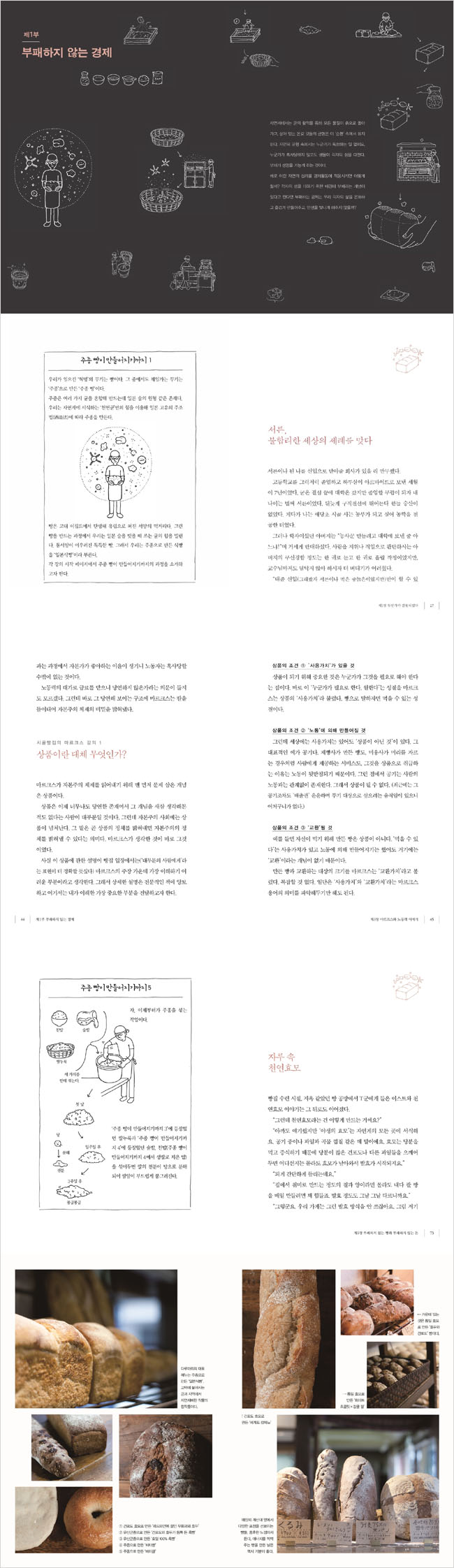
In the balance of nature, each living thing lives out its life without anyone monopolizing it or being overworked.
Corruption makes life possible.
What if we applied this very law of nature to economic activity? If the concept of corruption is the basis for each person's life, wouldn't a corrupt economy make each of our lives more peaceful, more enjoyable, and brighter?
Let's corrupt the economy
When was it?
A regular customer once asked me to send bread to his father who was nearing death.
“My father really liked bread.
I really want to treat you to some bread before you go back.
The request was, “Please eat Darumari’s bread and close your eyes comfortably.”
Could you send it to me on time? I baked the bread with more sincerity than usual.
We poured all our heart into the packaging of the bread and sent it out quickly so that it would be delivered.
After a while, I got a call again.
“My father died while eating Darumari bread.
He slowly and deliciously savored a piece of bread in his mouth, and passed away quietly with a smile.
“The bread from that house was my father’s last supper.”
Bread is the food of life and the food of the soul.
Bread nourishes the body and soul of those who eat it.
Is our bread really like that?
As I baked bread, asking myself this question every day, five years passed by in the blink of an eye.
The number of people supporting us around us has also increased.
There is nothing more joyful and thankful than this.
We want to continue baking bread for something more important than profit.
Among the breads of Daruma that became the last supper
My father said this.
“I once told the seminar students about your store.
They say that they sell expensive bread in the countryside and that they have been doing well for several years without going bankrupt.
They insist on using good ingredients and techniques to make bread that is good for the environment and good for the human body. What do you think?
Then the students said this.
'Most foods produced by capitalism are like garbage.
It's like fodder for exploiting people cheaply.
But in this world, making real food, the bread your son makes has value.' I may have drawn a conclusion from this, but...
It's great to know that there are people who understand what you do.
Moreover, I realized that people who live and eat also have to think a lot about food.
The bread you make may not be available nationwide through supermarkets or convenience stores, but your bread has a different value than cheap bread.
The significance lies in approaching the problems facing modern society—globalization, food problems, and the restoration of the global community—through bread.
I support Darumari as he tackles it at the grassroots level.
So, cheer up.”
During reconciliation with my father
The way we spend money is what makes a society.
Once established and the fungi grow, the food ferments.
Likewise, if small businessmen and artisans grow, the economy will flourish.
An economy where people, fungi, and crops can grow abundantly and their potential can be fully realized.
That is the new capitalism baked by a country bakery.
We, who bake bread, feel the dawn of a quiet revolution taking place in the rural outskirts.
Corruption makes life possible.
What if we applied this very law of nature to economic activity? If the concept of corruption is the basis for each person's life, wouldn't a corrupt economy make each of our lives more peaceful, more enjoyable, and brighter?
Let's corrupt the economy
When was it?
A regular customer once asked me to send bread to his father who was nearing death.
“My father really liked bread.
I really want to treat you to some bread before you go back.
The request was, “Please eat Darumari’s bread and close your eyes comfortably.”
Could you send it to me on time? I baked the bread with more sincerity than usual.
We poured all our heart into the packaging of the bread and sent it out quickly so that it would be delivered.
After a while, I got a call again.
“My father died while eating Darumari bread.
He slowly and deliciously savored a piece of bread in his mouth, and passed away quietly with a smile.
“The bread from that house was my father’s last supper.”
Bread is the food of life and the food of the soul.
Bread nourishes the body and soul of those who eat it.
Is our bread really like that?
As I baked bread, asking myself this question every day, five years passed by in the blink of an eye.
The number of people supporting us around us has also increased.
There is nothing more joyful and thankful than this.
We want to continue baking bread for something more important than profit.
Among the breads of Daruma that became the last supper
My father said this.
“I once told the seminar students about your store.
They say that they sell expensive bread in the countryside and that they have been doing well for several years without going bankrupt.
They insist on using good ingredients and techniques to make bread that is good for the environment and good for the human body. What do you think?
Then the students said this.
'Most foods produced by capitalism are like garbage.
It's like fodder for exploiting people cheaply.
But in this world, making real food, the bread your son makes has value.' I may have drawn a conclusion from this, but...
It's great to know that there are people who understand what you do.
Moreover, I realized that people who live and eat also have to think a lot about food.
The bread you make may not be available nationwide through supermarkets or convenience stores, but your bread has a different value than cheap bread.
The significance lies in approaching the problems facing modern society—globalization, food problems, and the restoration of the global community—through bread.
I support Darumari as he tackles it at the grassroots level.
So, cheer up.”
During reconciliation with my father
The way we spend money is what makes a society.
Once established and the fungi grow, the food ferments.
Likewise, if small businessmen and artisans grow, the economy will flourish.
An economy where people, fungi, and crops can grow abundantly and their potential can be fully realized.
That is the new capitalism baked by a country bakery.
We, who bake bread, feel the dawn of a quiet revolution taking place in the rural outskirts.
---From the text
Publisher's Review
Amazon Japan's #1 bestseller in the social, political, and economics categories!
"Money, which doesn't corrupt or circulate, is what gave birth to the contradictions of capitalism."
A silent economic revolution at Darumari, a small country bakery in Katsuyama, a remote Japanese village.
Marx's 'Das Kapital' is resurfacing worldwide.
With the fall of communism, capitalism, which was perceived as a superior system to socialism, is rapidly revealing its true nature of inequality and unfairness.
As voices of self-reflection grow louder among intellectuals around the world, the Japanese archipelago is paying attention to the silent economic revolution of a bakery owner in a small village on the outskirts of Japan.
The protagonist is Itaru Watanabe, a baker and owner of a bakery in a rural town called Katsuyama, in the northern part of Okayama Prefecture, an area with an unfamiliar name.
Originally, he vaguely dreamed of becoming a farmer living in the countryside, but it was not until he was in his thirties that he finally managed to get a job at an organic produce wholesale company.
I was thrilled at the thought of working in the countryside and farming that I had always admired, but then I felt disgusted and skeptical about the company that was committing corruption such as false country of origin labeling and bribery.
He gradually began to yearn for the authenticity of life and began to listen to his inner voice.
My grandfather studied natural bacteria, and my father was obsessed with Marx.
Having inherited their capabilities, he came to the conclusion that he wanted to do something 'true, even if it was small', and finally decided to open a bakery.
However, he learned baking skills to escape to the 'outside' world because he hated the world where corruption was rampant according to the logic of capital, but he soon realized that even the bakery workshop, which was supposed to be the 'outside' world, was located in the middle of the economic system.
Harsh labor, absurd economic structure, threatened food… .
As he faced this reality, his philosophy of life on how to live became stronger, and at the bakery 'Darumari', which was born based on this, he put into practice the responsibility for human life and the small, clumsy sense of justice he inherited from his grandfather and father.
His efforts to maintain his own lifestyle while remaining within the confines of established society and finding balance in life resonated deeply with many Japanese people.
As if to demonstrate this, after its publication, "Baking Capital in a Country Bakery" instantly took first place in the Society, Politics, and Economics categories on Amazon Japan, and has continued to receive interest, encouragement, and praise from the media and readers.
His image as a conscientious capitalist will provide a good opportunity for many who are desperately trying to avoid an unstable and contradictory reality to reconsider the true value of life and the meaning of labor, and to suggest an alternative way of life.
A lecture on Marx by a country baker,
Finding an alternative to capitalism between the fermentation and decay of bread.
In this book, the author unfolds Marx's lectures over nine chapters, harmoniously combining the two areas of 'Marx' and 'natural bacteria-fermentation'.
As I was making bread and listening to the voices of the 'bacteria' that are essential to making bread, I began to realize that the voices the bacteria were giving me were similar to the voices of Marx, a man from 150 years ago.
In this book, the author compares the labor reality of 21st century Tokyo, Japan and 19th century London, England, where the Industrial Revolution took place.
Just as in the past, when adults and even children were forced to work long hours for low wages, harsh working conditions persist even today.
In addition, it covers the conditions of products, the secrets of prices, the stagnation of wages, the process of profit creation, and the uselessness of technological innovation.
And so begins the encounter between Marx and natural bacteria.
All substances that exist in nature change their appearance over time and eventually return to earth.
In other words, their balance is maintained within a ‘cycle.’
And all of this is accomplished through ‘fermentation’ and ‘rotting’ by the action of fungi.
However, artificially cultured fungi like yeast can even turn substances that should originally decay and return to the soil into food.
It is a fungus, but it is an artificial fungus that deviates from the natural order and creates 'non-perishable' food.
These non-perishable foods lower the price of food and create cheaper jobs.
Furthermore, cheap food sacrifices the safety of food and disguises its use value, thereby robbing the food makers of the skills and dignity that should belong to them.
“Industry profits when grain and all food products are cheap.
Because whatever factors are driving up prices, if prices are high, labor inevitably becomes more expensive as well.
(Omitted) Food prices inevitably affect the price of labor.
“If the prices of necessities of life fall, the price of labor will continue to fall.” (Capital, Volume 1, Part 4, Chapter 10)
Moreover, the labor of producing food has become so simple that workers cannot acquire unique skills no matter how long they work.
“Technological innovation never enriches workers.
“Capital is merely a means for dominating workers and making more profits.” (Marx)
“The worker is reduced to an appendage of the machine, and from him, as an appendage, only the simplest, most monotonous, and most easily acquired skills are required.” (The Communist Manifesto)
He names what he is pursuing through his study of 『Capital』 as a ‘corrupt economy.’
Money does not return to dust over time.
It means that it will never decay.
Far from being corrupt, it has the property of endlessly increasing due to the 'profit' gained through investment and the interest generated through lending (finance).
Ultimately, this 'corrupt and non-circulating' money is what gave rise to the contradictions of capitalism.
He says that in a 'corrupt economy' we can find the true meaning of life.
His attitude toward life, of not giving up despite numerous failures and of standing up to irrationality to uphold his beliefs, makes us think about what true abundance is.
Moreover, his aspirations and search for a sustainable life and society will continue to invigorate today's society.
I want to bake bread for something precious, not for profit.
How to Fill Without Overflowing: Learn True Abundance
The author's bakery, Darumari, has earned the nickname "Strange Bakery" from people.
A bakery in the mountains, over two hours away by train from Okayama Station.
The bread is made by fermenting the yeast that grows in the old house, and the price of the bread is somewhat expensive.
In addition, it is closed three days a week and for a month every year for extended vacation.
This means that if we are to sell good food to those who want it at a fair price and if we are to be respected for our skilled craftsmanship, we must be able to rest well and live a decent life.
Moreover, Darumari's management philosophy is 'not leaving any profit'.
We ignore the typical standards of business and marketing success, strive to make the best bread without compromise, and strive to revitalize the local economy through corruption and circulation.
The core of the 'rotten and circular economy' discovered at this rural bakery is fermentation and circulation, not leaving a profit, and raising bread and people: these four things, and Darumari is pursuing and practicing all of these.
To achieve this, even today, Darumari carefully makes bread by generating natural yeast, no matter how difficult it may be, without mixing in yeast or additives.
He speaks of his 'small but big' wish to continue baking bread for something precious rather than 'profit'.
"Money, which doesn't corrupt or circulate, is what gave birth to the contradictions of capitalism."
A silent economic revolution at Darumari, a small country bakery in Katsuyama, a remote Japanese village.
Marx's 'Das Kapital' is resurfacing worldwide.
With the fall of communism, capitalism, which was perceived as a superior system to socialism, is rapidly revealing its true nature of inequality and unfairness.
As voices of self-reflection grow louder among intellectuals around the world, the Japanese archipelago is paying attention to the silent economic revolution of a bakery owner in a small village on the outskirts of Japan.
The protagonist is Itaru Watanabe, a baker and owner of a bakery in a rural town called Katsuyama, in the northern part of Okayama Prefecture, an area with an unfamiliar name.
Originally, he vaguely dreamed of becoming a farmer living in the countryside, but it was not until he was in his thirties that he finally managed to get a job at an organic produce wholesale company.
I was thrilled at the thought of working in the countryside and farming that I had always admired, but then I felt disgusted and skeptical about the company that was committing corruption such as false country of origin labeling and bribery.
He gradually began to yearn for the authenticity of life and began to listen to his inner voice.
My grandfather studied natural bacteria, and my father was obsessed with Marx.
Having inherited their capabilities, he came to the conclusion that he wanted to do something 'true, even if it was small', and finally decided to open a bakery.
However, he learned baking skills to escape to the 'outside' world because he hated the world where corruption was rampant according to the logic of capital, but he soon realized that even the bakery workshop, which was supposed to be the 'outside' world, was located in the middle of the economic system.
Harsh labor, absurd economic structure, threatened food… .
As he faced this reality, his philosophy of life on how to live became stronger, and at the bakery 'Darumari', which was born based on this, he put into practice the responsibility for human life and the small, clumsy sense of justice he inherited from his grandfather and father.
His efforts to maintain his own lifestyle while remaining within the confines of established society and finding balance in life resonated deeply with many Japanese people.
As if to demonstrate this, after its publication, "Baking Capital in a Country Bakery" instantly took first place in the Society, Politics, and Economics categories on Amazon Japan, and has continued to receive interest, encouragement, and praise from the media and readers.
His image as a conscientious capitalist will provide a good opportunity for many who are desperately trying to avoid an unstable and contradictory reality to reconsider the true value of life and the meaning of labor, and to suggest an alternative way of life.
A lecture on Marx by a country baker,
Finding an alternative to capitalism between the fermentation and decay of bread.
In this book, the author unfolds Marx's lectures over nine chapters, harmoniously combining the two areas of 'Marx' and 'natural bacteria-fermentation'.
As I was making bread and listening to the voices of the 'bacteria' that are essential to making bread, I began to realize that the voices the bacteria were giving me were similar to the voices of Marx, a man from 150 years ago.
In this book, the author compares the labor reality of 21st century Tokyo, Japan and 19th century London, England, where the Industrial Revolution took place.
Just as in the past, when adults and even children were forced to work long hours for low wages, harsh working conditions persist even today.
In addition, it covers the conditions of products, the secrets of prices, the stagnation of wages, the process of profit creation, and the uselessness of technological innovation.
And so begins the encounter between Marx and natural bacteria.
All substances that exist in nature change their appearance over time and eventually return to earth.
In other words, their balance is maintained within a ‘cycle.’
And all of this is accomplished through ‘fermentation’ and ‘rotting’ by the action of fungi.
However, artificially cultured fungi like yeast can even turn substances that should originally decay and return to the soil into food.
It is a fungus, but it is an artificial fungus that deviates from the natural order and creates 'non-perishable' food.
These non-perishable foods lower the price of food and create cheaper jobs.
Furthermore, cheap food sacrifices the safety of food and disguises its use value, thereby robbing the food makers of the skills and dignity that should belong to them.
“Industry profits when grain and all food products are cheap.
Because whatever factors are driving up prices, if prices are high, labor inevitably becomes more expensive as well.
(Omitted) Food prices inevitably affect the price of labor.
“If the prices of necessities of life fall, the price of labor will continue to fall.” (Capital, Volume 1, Part 4, Chapter 10)
Moreover, the labor of producing food has become so simple that workers cannot acquire unique skills no matter how long they work.
“Technological innovation never enriches workers.
“Capital is merely a means for dominating workers and making more profits.” (Marx)
“The worker is reduced to an appendage of the machine, and from him, as an appendage, only the simplest, most monotonous, and most easily acquired skills are required.” (The Communist Manifesto)
He names what he is pursuing through his study of 『Capital』 as a ‘corrupt economy.’
Money does not return to dust over time.
It means that it will never decay.
Far from being corrupt, it has the property of endlessly increasing due to the 'profit' gained through investment and the interest generated through lending (finance).
Ultimately, this 'corrupt and non-circulating' money is what gave rise to the contradictions of capitalism.
He says that in a 'corrupt economy' we can find the true meaning of life.
His attitude toward life, of not giving up despite numerous failures and of standing up to irrationality to uphold his beliefs, makes us think about what true abundance is.
Moreover, his aspirations and search for a sustainable life and society will continue to invigorate today's society.
I want to bake bread for something precious, not for profit.
How to Fill Without Overflowing: Learn True Abundance
The author's bakery, Darumari, has earned the nickname "Strange Bakery" from people.
A bakery in the mountains, over two hours away by train from Okayama Station.
The bread is made by fermenting the yeast that grows in the old house, and the price of the bread is somewhat expensive.
In addition, it is closed three days a week and for a month every year for extended vacation.
This means that if we are to sell good food to those who want it at a fair price and if we are to be respected for our skilled craftsmanship, we must be able to rest well and live a decent life.
Moreover, Darumari's management philosophy is 'not leaving any profit'.
We ignore the typical standards of business and marketing success, strive to make the best bread without compromise, and strive to revitalize the local economy through corruption and circulation.
The core of the 'rotten and circular economy' discovered at this rural bakery is fermentation and circulation, not leaving a profit, and raising bread and people: these four things, and Darumari is pursuing and practicing all of these.
To achieve this, even today, Darumari carefully makes bread by generating natural yeast, no matter how difficult it may be, without mixing in yeast or additives.
He speaks of his 'small but big' wish to continue baking bread for something precious rather than 'profit'.
GOODS SPECIFICS
- Date of issue: June 2, 2014
- Page count, weight, size: 235 pages | 446g | 150*210*20mm
- ISBN13: 9788994418735
- ISBN10: 8994418733
You may also like
카테고리
korean


korean

![GQ KOREA Mark (Monthly): December [2025]](http://librairie.coreenne.fr/cdn/shop/files/8ef265dbbfbf186523ed75ba7319009d.jpg?v=1765340328&width=3840)


