

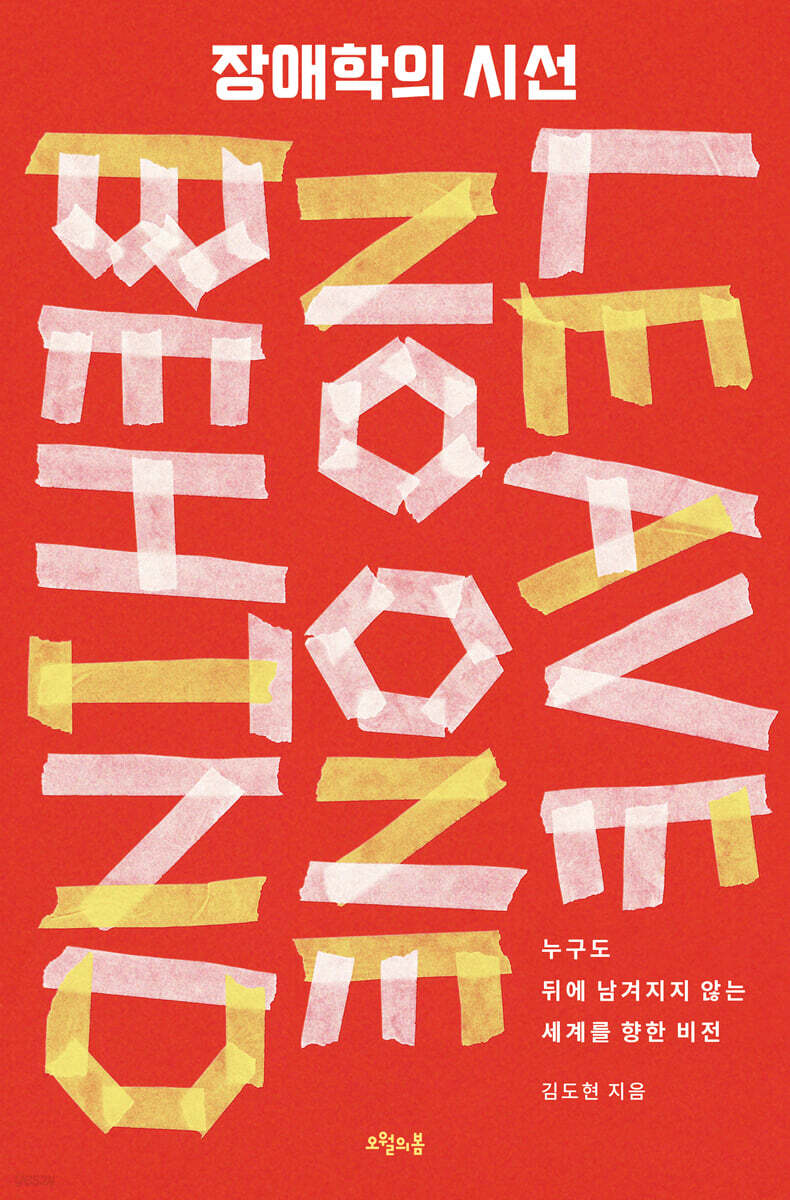
Disability Studies Perspective
 |
Description
Book Introduction
Researcher Kim Do-hyun, who sharply analyzed the fundamental oppression and discrimination that permeates our society through "The Challenge of Disability Studies" and popularized the critical and practical discipline of "disability studies," has returned with a new book after six years.
The title “research activist” reveals his position as someone who has been engaged in both on-site struggles to “eliminate discrimination against people with disabilities” and research work, while also having the broader meaning of “a person who contributes to activities through research.”
Since establishing the Noddle Disability Studies Institute in 2017, the author has become even more dedicated to research, writing, and lectures. He now sees his role as organizing and widely disseminating the meaning of the disability movement.
This issue of "Perspectives on Disability Studies" builds on the various works (manuscripts and lectures) that have been undertaken to fulfill this role, demonstrating just how diverse the spectrum of "disability studies" can be.
While my previous work focused on how disability studies, a "peripheral perspective," can dismantle the non-disabled-centered framework of perception and lead us to a different horizon of thought, this book unfolds what it means to view the world through the "perspective of disability studies" through practical interventions in various agendas and discourses.
We sought to incorporate disability studies' own responses to a wide range of social issues that are intertwined with and connected to disability issues, such as sex and gender, disasters and catastrophes, meritocracy, labor, and the climate crisis.
2025 marks the quarter-century anniversary of the second-generation disability movement in Korean society, which emerged in February 2001 when people occupied the subway tracks at Seoul Station and demanded the right to mobility.
Furthermore, the subway protest on the way to work, which began under the slogan of “A time when people with disabilities can move as citizens,” reached its 900th day on August 21, 2025, and the sit-in protest in Yeouido to “abolish the Korean version of T-4 (Nazi policy of massacring people with disabilities)” has also reached its 1,620th day.
If you want to understand the meaning engraved in these numbers, if you feel lost as to how a transition to a world where "no one is left behind" is possible, this book, which can be considered the forefront of Korean disability studies, will be an excellent companion.
The title “research activist” reveals his position as someone who has been engaged in both on-site struggles to “eliminate discrimination against people with disabilities” and research work, while also having the broader meaning of “a person who contributes to activities through research.”
Since establishing the Noddle Disability Studies Institute in 2017, the author has become even more dedicated to research, writing, and lectures. He now sees his role as organizing and widely disseminating the meaning of the disability movement.
This issue of "Perspectives on Disability Studies" builds on the various works (manuscripts and lectures) that have been undertaken to fulfill this role, demonstrating just how diverse the spectrum of "disability studies" can be.
While my previous work focused on how disability studies, a "peripheral perspective," can dismantle the non-disabled-centered framework of perception and lead us to a different horizon of thought, this book unfolds what it means to view the world through the "perspective of disability studies" through practical interventions in various agendas and discourses.
We sought to incorporate disability studies' own responses to a wide range of social issues that are intertwined with and connected to disability issues, such as sex and gender, disasters and catastrophes, meritocracy, labor, and the climate crisis.
2025 marks the quarter-century anniversary of the second-generation disability movement in Korean society, which emerged in February 2001 when people occupied the subway tracks at Seoul Station and demanded the right to mobility.
Furthermore, the subway protest on the way to work, which began under the slogan of “A time when people with disabilities can move as citizens,” reached its 900th day on August 21, 2025, and the sit-in protest in Yeouido to “abolish the Korean version of T-4 (Nazi policy of massacring people with disabilities)” has also reached its 1,620th day.
If you want to understand the meaning engraved in these numbers, if you feel lost as to how a transition to a world where "no one is left behind" is possible, this book, which can be considered the forefront of Korean disability studies, will be an excellent companion.
- You can preview some of the book's contents.
Preview
index
Publishing a bookㆍ5
Chapter 1: Perspectives on Disability Studies: Fragmentsㆍ17
A Gaze of Gazes | People with Disabilities | Cohort Isolation and the 'Already' | Love and Prejudice | The Parties, Partisanship, and Relationship Theory | The Real Politics of Fake Parties | Enact an Anti-Discrimination Act Now | What to Do About 'Fairness' | The 'Categories' of Disability and Illness | Transformation, Transformation, and the Climate Crisis | Those Who Stay Here Even After Death
Chapter 2: Rethinking "Damage and Disability" Through the Discourse of "Sex and Gender"ㆍ49
Gender and Disability: Ambiguous and Confusing Concepts | Explanations and Critiques of the Social Model of Damage and Disability | A Provisional Approach to Understanding Sex and Disability
Chapter 3: The Politics of Discrimination, Disability, and Insecurity: A Relational Reflection on the Right to Safetyㆍ67
Lives/Life Exposed to Disaster, People with Disabilities | The Problem Is Not Danger, but the Inability to Respond to It | People with Disabilities as a Threat to the Safety of Members of Society | How Should We View the Nation? | 'No One Left Behind' and 'Leave No One Behind'
Chapter 4: Disability Studies, Disability History, "History of Disability"ㆍ91
A Basic Understanding of Disability History | Disability in North American Indigenous Societies | Ableism and Abilityism |
The Intersectionality of Resistance Against Ableism | Labor Rights, Deinstitutionalization, and the Unfinished Task of Disability Liberation
Chapter 5: History and Future Tasks of the Disability Liberation Movementㆍ115
The Disability Movement as a Liberation Movement | Phase 1: The Establishment and Discontinuation of a Labor Rights-Centered Transformative Disability Movement | Phase 2: The Growth of a Basic Rights-Centered Militant Independent Living Movement and Parents' Movement | Phase 3: The Struggle for Systemic Transformation Beyond Individual Rights | Future Tasks: Abolishing the Institutionalized Society and Building a Labor Society for All
Chapter 6: Personal Budgets for the Disabled: Useless or Badㆍ139
What to Know for Discussion | The Uselessness and Harmfulness of Personal Budgets for Persons with Disabilities | Is Sweden Implementing a Personal Budget? | The Alternative: A Disability Rights Budget Based on "Self-Directed Assessment by Service" | The Neoliberalization of Politics and Personal Budgets for Persons with Disabilities
Chapter 7: The "Temporary Utopia" of Labor Liberation: Basic Income or Public Citizen Labor?ㆍ159
The Age of the Unneserseriat: Human Labor | How Should We Perceive Labor? | The Dual Nature of Labor and Two Paths to Labor Liberation | The Problems and Fundamentals of Public Citizen Labor | Basic Income vs. Public Citizen Labor
Chapter 8: Climate Crisis and Disabilityㆍ193
The Age of Warming Is Over | People with Disabilities as Frontline Participants in the Climate Crisis | Disability and Climate Justice in International Human Rights Norms | Participatory (In)justice in Climate Action and Policy | Just Transition and Public Citizen Labor
Americasㆍ221
Searchㆍ232
Chapter 1: Perspectives on Disability Studies: Fragmentsㆍ17
A Gaze of Gazes | People with Disabilities | Cohort Isolation and the 'Already' | Love and Prejudice | The Parties, Partisanship, and Relationship Theory | The Real Politics of Fake Parties | Enact an Anti-Discrimination Act Now | What to Do About 'Fairness' | The 'Categories' of Disability and Illness | Transformation, Transformation, and the Climate Crisis | Those Who Stay Here Even After Death
Chapter 2: Rethinking "Damage and Disability" Through the Discourse of "Sex and Gender"ㆍ49
Gender and Disability: Ambiguous and Confusing Concepts | Explanations and Critiques of the Social Model of Damage and Disability | A Provisional Approach to Understanding Sex and Disability
Chapter 3: The Politics of Discrimination, Disability, and Insecurity: A Relational Reflection on the Right to Safetyㆍ67
Lives/Life Exposed to Disaster, People with Disabilities | The Problem Is Not Danger, but the Inability to Respond to It | People with Disabilities as a Threat to the Safety of Members of Society | How Should We View the Nation? | 'No One Left Behind' and 'Leave No One Behind'
Chapter 4: Disability Studies, Disability History, "History of Disability"ㆍ91
A Basic Understanding of Disability History | Disability in North American Indigenous Societies | Ableism and Abilityism |
The Intersectionality of Resistance Against Ableism | Labor Rights, Deinstitutionalization, and the Unfinished Task of Disability Liberation
Chapter 5: History and Future Tasks of the Disability Liberation Movementㆍ115
The Disability Movement as a Liberation Movement | Phase 1: The Establishment and Discontinuation of a Labor Rights-Centered Transformative Disability Movement | Phase 2: The Growth of a Basic Rights-Centered Militant Independent Living Movement and Parents' Movement | Phase 3: The Struggle for Systemic Transformation Beyond Individual Rights | Future Tasks: Abolishing the Institutionalized Society and Building a Labor Society for All
Chapter 6: Personal Budgets for the Disabled: Useless or Badㆍ139
What to Know for Discussion | The Uselessness and Harmfulness of Personal Budgets for Persons with Disabilities | Is Sweden Implementing a Personal Budget? | The Alternative: A Disability Rights Budget Based on "Self-Directed Assessment by Service" | The Neoliberalization of Politics and Personal Budgets for Persons with Disabilities
Chapter 7: The "Temporary Utopia" of Labor Liberation: Basic Income or Public Citizen Labor?ㆍ159
The Age of the Unneserseriat: Human Labor | How Should We Perceive Labor? | The Dual Nature of Labor and Two Paths to Labor Liberation | The Problems and Fundamentals of Public Citizen Labor | Basic Income vs. Public Citizen Labor
Chapter 8: Climate Crisis and Disabilityㆍ193
The Age of Warming Is Over | People with Disabilities as Frontline Participants in the Climate Crisis | Disability and Climate Justice in International Human Rights Norms | Participatory (In)justice in Climate Action and Policy | Just Transition and Public Citizen Labor
Americasㆍ221
Searchㆍ232
Into the book
Although the book is composed of independent chapters, as you read, you will find that the contents become interconnected and gradually become clearer.
Disability is not a secondary issue to be addressed as an add-on to general human problems; it is a key to fully elucidating the contradictions and discrimination in human society, and "no one can be liberated unless everyone is liberated."
--- p.8~9
Think about the word 'gaze'.
People with disabilities, like other minorities such as women, sexual minorities, immigrants, and the homeless, are subject to much gaze from others.
What kind of gaze is it? It's either a gaze of discrimination or a gaze of pity.
The word 'sight' also means 'giving charity', so to use a little wordplay, we get 'the sight of charity'.
--- p.20
There is a coined word used in disability studies called 'sitpoint'.
In contrast to 'standpoint', which means 'standing', this term is intended to highlight the different perspective of a being 'sitting' in a wheelchair.
--- p.35
The reason I didn't have any queer friends or disabled friends during my school days is because in this society, we were forced to live as if sexual minorities and disabled people didn't exist.
The most basic starting point for changing that reality is the anti-discrimination law.
--- p.37
The disability movement can also be said to be a movement that slows down the pace of time by imprinting the physicality and temporality of disabled people on society, rather than time-speed based on normality.
In this space and time where the principles of competition and efficiency dominate, it will inevitably cause conflict and create a rupture, but it will probably make our society a safer place.
--- p.90
Unless a certain rupture is created within the capitalist world system, where labor exists as a commodity, securing labor rights for people with disabilities will inevitably remain an unfinished task for a considerable period of time.
--- p.110
We must remember once again that the deinstitutionalization movement goes beyond simply eliminating facilities; it is a movement to transform the communities that need and produce them.
--- p.114
Maybe from now on, the truly difficult fight will begin.
The fact that the abolition of the institutionalized society and the establishment of a labor society for all are directly linked to the liberation of the disabled means that these two issues are also inextricably linked to the transformation of the system, and therefore, it may not be easy to produce proper, tangible results.
Disability is not a secondary issue to be addressed as an add-on to general human problems; it is a key to fully elucidating the contradictions and discrimination in human society, and "no one can be liberated unless everyone is liberated."
--- p.8~9
Think about the word 'gaze'.
People with disabilities, like other minorities such as women, sexual minorities, immigrants, and the homeless, are subject to much gaze from others.
What kind of gaze is it? It's either a gaze of discrimination or a gaze of pity.
The word 'sight' also means 'giving charity', so to use a little wordplay, we get 'the sight of charity'.
--- p.20
There is a coined word used in disability studies called 'sitpoint'.
In contrast to 'standpoint', which means 'standing', this term is intended to highlight the different perspective of a being 'sitting' in a wheelchair.
--- p.35
The reason I didn't have any queer friends or disabled friends during my school days is because in this society, we were forced to live as if sexual minorities and disabled people didn't exist.
The most basic starting point for changing that reality is the anti-discrimination law.
--- p.37
The disability movement can also be said to be a movement that slows down the pace of time by imprinting the physicality and temporality of disabled people on society, rather than time-speed based on normality.
In this space and time where the principles of competition and efficiency dominate, it will inevitably cause conflict and create a rupture, but it will probably make our society a safer place.
--- p.90
Unless a certain rupture is created within the capitalist world system, where labor exists as a commodity, securing labor rights for people with disabilities will inevitably remain an unfinished task for a considerable period of time.
--- p.110
We must remember once again that the deinstitutionalization movement goes beyond simply eliminating facilities; it is a movement to transform the communities that need and produce them.
--- p.114
Maybe from now on, the truly difficult fight will begin.
The fact that the abolition of the institutionalized society and the establishment of a labor society for all are directly linked to the liberation of the disabled means that these two issues are also inextricably linked to the transformation of the system, and therefore, it may not be easy to produce proper, tangible results.
--- p.134
Publisher's Review
A world for people with disabilities? A liberating community where no one is left behind!
Each chapter (Chapters 1-8) of 《Perspectives on Disability Studies》 deals with different, independent topics, but as you read on, you will find that the contents of each are intertwined and connected.
Within that connectivity, several points stand out clearly.
“Disability is not a field that can be dealt with as a secondary issue to general human problems; it is a key to fully elucidating the contradictions and discrimination of human society, and ‘no one can be liberated unless everyone is liberated.’”
The belief that what disability studies pursues is not simply a world for people with disabilities, but a community of liberation where no one is left behind ('No one left behind', 'Leave no one behind') permeates this book as an attitude.
In that sense, the author actively seeks to discover and propose to a wider audience the aspects of disability studies that explore “a certain vision and ethics for the transition to a new system.”
“I will do what I can, even if it is slow and steady, to read the world through the lens of disability studies and communicate with activists and readers to the best of my ability.
(……) I hope that this book will be of some use to us as we move forward together without giving up on the world of ‘coalition’ and ‘symbiosis’ that we dream of.”
Rewriting ‘Partisanship’ and ‘Partisanship’: Beyond the Violence of Gaze
If the "disability studies perspective" is what makes a world saturated with ableism—a world dominated by ableism and ableism—quite unfamiliar, what about the perspectives we see toward "people with disabilities" in real life? What kind of gaze do they receive? It's often one of discrimination and pity, another name for hatred.
“Pity and compassion are often considered opposite emotions to disgust, but they are actually two sides of the same coin.
(……) Both are emotions that can be converted very easily.
Moreover, sympathy is more solid and difficult to break because it is not perceived as hate and is packaged as good intentions.”
Twenty-five years have passed since the struggle for the right to mobility began, but society's view of people with disabilities has not fundamentally changed.
This is especially true of those in power who hold power.
“People with disabilities have been fighting for the things they need to live a human life as their rightful rights, but those in power still view it as a kind of consideration and charity.” In fact, this is also the view of the majority of non-disabled people.
The countless disparaging expressions about disabilities that we use without even realizing it reveal that “like misogyny, ableism is not simply a matter of an individual’s attitude, but is ‘structured’ socio-culturally.”
Avoiding such ableist expressions may be simpler than you think.
It is about sensing the existence of people with disabilities.
That they are citizens who breathe and live alongside me.
It would also be very important to realize that we are all persons with disabilities (or co-partners), that is, to accept the perspective of disability studies that disability is a social problem in which all members of the community are 'implicated'.
Of course, we must also be fully aware of the potential dangers of the proposition that "we are all parties involved."
In short, for this proposition to have political authenticity, partisanship is necessary, and partisanship here should be understood as relational rather than fixed and essential.
“If the basic ethics of partisanship pursued by the oppressed and social movements are to stand on the side of the oppressed, then the positions of the oppressor and the oppressed, the majority and the minority, also change depending on context and circumstances.”
Revisiting Disaster and Catastrophe: "For People with Severe Disabilities, This Society Has Always Been Sewol"
It is a serious problem that people with disabilities are forced to live as if they are invisible in this society, that is, as if they do not exist, but for them, living in society is also a great risk.
This is because we are inevitably exposed to various disasters and calamities on a daily basis.
Even after the 2001 Oido Station disabled lift accident that sparked the struggle for mobility rights, disabled people continued to die in the same way.
“I had to risk my life just to ride the subway, which is public transportation.” And that’s not all.
Disabled people froze to death from water leaking from frozen water pipes, burned to death in fires that broke out when activity support services were not provided, and were driven to death after being judged as not eligible for basic livelihood benefits during a disability rating reevaluation.
Unlike the dangerous outside world, people died even more gruesomely in the supposedly safe facility.
They were beaten to death, suffered forced labor, and died from mass infection with COVID-19 in confined environments.
Why did they have to die like this? Because of an accident? No.
“It wasn’t ‘because an accident happened,’ but ‘because an accident was allowed to happen,’ it wasn’t ‘because a fire broke out,’ but ‘because they couldn’t escape.’” (Hong Eun-jeon, “This society has always been a disaster to you”).
There is no such thing as a life without any risks.
There is always a certain amount of risk lurking in our lives.
So the problem is not the risk itself.
The author parodies Marx's famous passage, which contains the essence of historical materialism, saying:
“Risk is just risk.
“Only within a specific relationship does a risk become a disaster.” If so, the important thing is to ask what specific relationship makes a risk a disaster.
What are the relationships or conditions that make people with disabilities "unable" to cope with risks? Here, we discover that the words "ability" (non-disabled = ability/ability to do) and "disability" (disabled = inability/inability to do) and the semantic networks surrounding them themselves function as an ideology.
But this is nothing more than a grammatical illusion.
“Because ability/disability and inability/disability are not fundamentally things that are ‘owned’ or ‘held with.’”
“Whether I can/cannot freely do something can always be discussed only in relation to other beings and within the conditions and environment surrounding me.”
In this context, it is important to keep in mind that people with disabilities are not 'people with disabilities' but 'disabled people'.
The latter word always omits 'by', and it is this omission (and therefore not readily apparent) that prevents the disabled person from doing something.
The 'ability/ability to do' and 'inability/inability to do' that permeate our entire lives, let alone dealing with risk, are ultimately issues of relationships, and in that sense, precisely political issues.
This is why the deaths of the disabled people mentioned above can be understood as social murder.
“If there had been elevators instead of lifts, if activity support services had been sufficiently provided according to their needs, if their right to basic livelihood had not been restricted by things like support obligations or unreasonable work ability assessments, if the community had institutional conditions that allowed people with disabilities to leave institutions at will (or if they could have avoided being admitted to institutions against their will in the first place),” would they have died like that?
The fact that the advocates of the independent living movement spoke of the "right to experience risk" tells us a lot.
Ultimately, what is needed is not unconditional safety.
It is even more unacceptable for a facility to confine disabled people and deprive them of their personal lives under the pretext of ensuring their safety.
We must build relationships in which people with disabilities are not relegated to the status of incapable beings, that is, relationships in which they can freely do things according to their own will without discrimination or oppression.
The disability movement is a movement that questions the relationship between certain beings being 'disabled/incapacitated'.
Labor Rights and Deinstitutionalization: A Historical Challenge to Disability Liberation
Meanwhile, by reading books that deal with 'disability history,' we can more closely grasp the tension inherent in the category of 'disabled people.'
The author is Sarah F.
This paper presents two different approaches to understanding the history of disability, encompassing works such as Rose's No Right to Be Idle (2017) and Bill Hughes' A Historical Sociology (2019).
While some see the concept of “disabled people” as something invented during the transition to modern society, others, like Bill Hughes, “describe the history of disability from ancient times through the Christian Middle Ages to the Renaissance, using a consistent logic and methodology.”
The latter holds a different perspective from the social model of disability, which sees the ‘medical disability model’ as having been formed through the interplay of the commodification of labor during the transition to capitalist society, the formation of modern anthropology, and the emergence of clinical medicine based on biomedicine.
Kim Nielsen's A History of Disability (2012) avoids these sharp debates while still providing valuable insights into the field of disability history.
Contrary to the impression given by the title, this book is closer to “a history of the United States read from the ‘position of view’ of disability” rather than a book about the history of people with disabilities in the United States.
This is because it aims to show “what it means to use disability to ask and answer questions about history, and how disability is intertwined with race, gender, class, and sexual orientation” (History of Disability, translated by Seungseop Kim, p. 27).
In fact, in the United States, disability (inability) has been used to justify relegating people like African Americans, immigrants, gays and lesbians, the poor, and women to second-class citizenship.
Examples include describing slaves as having “severe physical and mental disabilities” and describing Chinese immigrants as “too handicapped to support democracy” (A History of Disability, pp. 200–201).
In this way, "A History of Disability" presents an intersectional history of hatred toward people with disabilities and minorities, pointing out that the essence of ableism lies in none other than ableism.
Ultimately, “unless we abolish ableism, ableism will never disappear, and conversely, unless we abolish ableism, a meritocratic society will never collapse.”
The author also emphasizes in many places that the concept/category of disabled people itself is a historical product of capitalism.
“The concept of ‘disabled people,’ which emerged during the transition to modern society, was a category referring to people excluded from the new form of capitalist labor system, and the separate facilities to which they were sent formed the origin of facilities for the disabled.” Therefore, while winning labor rights for the disabled is a core issue of the disability movement, it is also a difficult task to achieve “unless a certain rupture is created within the capitalist world system in which labor exists as a commodity.”
It will be difficult to achieve tangible results on this issue without a substantial 'system shift'.
The difficulties faced by disability movements around the world, including in Korea, the United States, and Japan, stem from this very source.
How can we transform this capitalist society, which opposes the physicality and temporality of people with disabilities? In this regard, the true challenges of disability liberation are undoubtedly the "abolition of the labor society that excludes people with disabilities" (building a labor society for all) and the "abolition of the institutionalized society."
Labor issues and facility issues are “very fundamental issues that are historically intertwined with the very creation of the concept of ‘disabled people.’”
In a rigid capitalist system, the right to work for people with disabilities is a kind of oxymoron, and the issue of facilities also directly encapsulates “the way the modern capitalist system governs people with disabilities.”
If we can define an institutional society as “a society with a system that divides and isolates the living spaces and lifestyles of people with disabilities from the non-disabled world,” then even if there are no physical facilities, if such a division and isolation system is in operation, then that society is an institutional society.
A Provisional Utopia of Labor Liberation: Beyond the Historical Shackles of Unrecognized Workers
What we must keep in mind when thinking about labor is that “labor has a fundamentally dual nature.”
In other words, labor was both an object of rejection (hardship and pain) and an object of praise (reward and accomplishment), and was both a duty and a right.
The author argues that from this dual nature of labor, two "non-reformist reforms" for labor liberation—reforms that stimulate and trigger the transition to a new system—can be derived.
One is to free oneself from the obligation to work through a ‘basic income’ system, and the other is to make ‘public citizen labor’ into “true citizenship, as labor, which has never been established as a universal right because it exists in the form of a commodity in capitalist society.”
If the former is based on the line of ‘liberation from labor’ (post-labor society), the latter can be said to follow the line of ‘liberation toward labor.’
The author first officially proposed the concept of “public citizen labor” and the “public employment system for the severely disabled” at a discussion in 2014. Public citizen labor means that “labor” is a “citizen” right and should therefore be guaranteed in the “public” sphere.
After that, the National Coalition for the Elimination of Discrimination against Persons with Disabilities has been continuously fighting since the end of 2017, demanding '10,000 public sector jobs for people with severe disabilities', and as a result, 'Rights-centered, customized public sector jobs for people with severe disabilities' were implemented in Seoul in the second half of 2020.
This is the first employment system based on the concept of public citizen labor.
Although not yet a precisely defined system, public citizen labor holds greater potential than basic income as a non-reformist reform.
Unlike basic income, which is “a system that only restructures the realm of redistribution corresponding to the surface of the capitalist system,” it partially achieves the decommodification of labor by seeking “the restructuring of labor in the deeper realm of production.”
A decisive step toward a society in which the labor of people with disabilities is guaranteed as a universal right is ultimately the dismantling and reconstruction of the capitalist labor system.
And public civic labor can become a concrete blueprint for such reconstruction.
If this plan is properly implemented, people with severe or developmental disabilities will also be able to break free from the historical shackles of being “unrecognized workers.”
And “only when a labor society for all is built through this kind of restructuring of labor will labor be able to establish itself as a civil right that allows all members of society, including people with disabilities, to realize the value of their lives, rather than a ‘musical chairs’ where one must push others out to sit down.”
Climate Justice, Disability Justice, and a Just Transition
In the summer of 2022, a tragedy occurred in which a woman with a developmental disability in her 40s and her family of three, living in a semi-basement apartment in Sillim-dong, Seoul, died when their house flooded due to heavy rain in Seoul and the metropolitan area.
On the same day, a woman with a developmental disability in her 50s lost her life in a similar accident in a semi-basement apartment in Sangdo-dong.
Climate change-related disasters affect everyone globally, but as this 2022 disaster symbolically demonstrates, people with disabilities are particularly disproportionately affected.
For example, the vulnerability of people with disabilities to heat waves was found to be 2.5 times higher overall than that of people without disabilities, and in particular, for people with mental and intellectual disabilities, it was found to be 4 times and 4.6 times higher, respectively.
In other words, people with disabilities are the 'frontline stakeholders in the climate crisis' discussed in the climate justice movement.
However, current climate policies and actions are showing a serious level of participatory injustice, with people with disabilities being structurally excluded.
In an era of routine climate disasters, the need for participatory justice is not simply because people with disabilities are exposed to greater harm.
As frontline climate crisis victims and survivors, the insights that people with disabilities can offer are not reflected in climate policy, increasing the vulnerability of the general public.
In this context, American disability justice activist Patty Byrne said, “In this moment of climate chaos, we say,
Welcome to our world.
We all have something to teach us to survive.
“If you are willing to listen to me,” he says.
Furthermore, in order to achieve the "just transition" emphasized by climate justice in the process of moving toward a decarbonized economy, the labor sector cannot be left to the market, and public intervention is absolutely required.
Therefore, public civic labor as a non-reformist reform can form part of a transition strategy that actively intervenes in the contemporary conditions of the climate crisis and seeks a systemic transformation.
Each chapter (Chapters 1-8) of 《Perspectives on Disability Studies》 deals with different, independent topics, but as you read on, you will find that the contents of each are intertwined and connected.
Within that connectivity, several points stand out clearly.
“Disability is not a field that can be dealt with as a secondary issue to general human problems; it is a key to fully elucidating the contradictions and discrimination of human society, and ‘no one can be liberated unless everyone is liberated.’”
The belief that what disability studies pursues is not simply a world for people with disabilities, but a community of liberation where no one is left behind ('No one left behind', 'Leave no one behind') permeates this book as an attitude.
In that sense, the author actively seeks to discover and propose to a wider audience the aspects of disability studies that explore “a certain vision and ethics for the transition to a new system.”
“I will do what I can, even if it is slow and steady, to read the world through the lens of disability studies and communicate with activists and readers to the best of my ability.
(……) I hope that this book will be of some use to us as we move forward together without giving up on the world of ‘coalition’ and ‘symbiosis’ that we dream of.”
Rewriting ‘Partisanship’ and ‘Partisanship’: Beyond the Violence of Gaze
If the "disability studies perspective" is what makes a world saturated with ableism—a world dominated by ableism and ableism—quite unfamiliar, what about the perspectives we see toward "people with disabilities" in real life? What kind of gaze do they receive? It's often one of discrimination and pity, another name for hatred.
“Pity and compassion are often considered opposite emotions to disgust, but they are actually two sides of the same coin.
(……) Both are emotions that can be converted very easily.
Moreover, sympathy is more solid and difficult to break because it is not perceived as hate and is packaged as good intentions.”
Twenty-five years have passed since the struggle for the right to mobility began, but society's view of people with disabilities has not fundamentally changed.
This is especially true of those in power who hold power.
“People with disabilities have been fighting for the things they need to live a human life as their rightful rights, but those in power still view it as a kind of consideration and charity.” In fact, this is also the view of the majority of non-disabled people.
The countless disparaging expressions about disabilities that we use without even realizing it reveal that “like misogyny, ableism is not simply a matter of an individual’s attitude, but is ‘structured’ socio-culturally.”
Avoiding such ableist expressions may be simpler than you think.
It is about sensing the existence of people with disabilities.
That they are citizens who breathe and live alongside me.
It would also be very important to realize that we are all persons with disabilities (or co-partners), that is, to accept the perspective of disability studies that disability is a social problem in which all members of the community are 'implicated'.
Of course, we must also be fully aware of the potential dangers of the proposition that "we are all parties involved."
In short, for this proposition to have political authenticity, partisanship is necessary, and partisanship here should be understood as relational rather than fixed and essential.
“If the basic ethics of partisanship pursued by the oppressed and social movements are to stand on the side of the oppressed, then the positions of the oppressor and the oppressed, the majority and the minority, also change depending on context and circumstances.”
Revisiting Disaster and Catastrophe: "For People with Severe Disabilities, This Society Has Always Been Sewol"
It is a serious problem that people with disabilities are forced to live as if they are invisible in this society, that is, as if they do not exist, but for them, living in society is also a great risk.
This is because we are inevitably exposed to various disasters and calamities on a daily basis.
Even after the 2001 Oido Station disabled lift accident that sparked the struggle for mobility rights, disabled people continued to die in the same way.
“I had to risk my life just to ride the subway, which is public transportation.” And that’s not all.
Disabled people froze to death from water leaking from frozen water pipes, burned to death in fires that broke out when activity support services were not provided, and were driven to death after being judged as not eligible for basic livelihood benefits during a disability rating reevaluation.
Unlike the dangerous outside world, people died even more gruesomely in the supposedly safe facility.
They were beaten to death, suffered forced labor, and died from mass infection with COVID-19 in confined environments.
Why did they have to die like this? Because of an accident? No.
“It wasn’t ‘because an accident happened,’ but ‘because an accident was allowed to happen,’ it wasn’t ‘because a fire broke out,’ but ‘because they couldn’t escape.’” (Hong Eun-jeon, “This society has always been a disaster to you”).
There is no such thing as a life without any risks.
There is always a certain amount of risk lurking in our lives.
So the problem is not the risk itself.
The author parodies Marx's famous passage, which contains the essence of historical materialism, saying:
“Risk is just risk.
“Only within a specific relationship does a risk become a disaster.” If so, the important thing is to ask what specific relationship makes a risk a disaster.
What are the relationships or conditions that make people with disabilities "unable" to cope with risks? Here, we discover that the words "ability" (non-disabled = ability/ability to do) and "disability" (disabled = inability/inability to do) and the semantic networks surrounding them themselves function as an ideology.
But this is nothing more than a grammatical illusion.
“Because ability/disability and inability/disability are not fundamentally things that are ‘owned’ or ‘held with.’”
“Whether I can/cannot freely do something can always be discussed only in relation to other beings and within the conditions and environment surrounding me.”
In this context, it is important to keep in mind that people with disabilities are not 'people with disabilities' but 'disabled people'.
The latter word always omits 'by', and it is this omission (and therefore not readily apparent) that prevents the disabled person from doing something.
The 'ability/ability to do' and 'inability/inability to do' that permeate our entire lives, let alone dealing with risk, are ultimately issues of relationships, and in that sense, precisely political issues.
This is why the deaths of the disabled people mentioned above can be understood as social murder.
“If there had been elevators instead of lifts, if activity support services had been sufficiently provided according to their needs, if their right to basic livelihood had not been restricted by things like support obligations or unreasonable work ability assessments, if the community had institutional conditions that allowed people with disabilities to leave institutions at will (or if they could have avoided being admitted to institutions against their will in the first place),” would they have died like that?
The fact that the advocates of the independent living movement spoke of the "right to experience risk" tells us a lot.
Ultimately, what is needed is not unconditional safety.
It is even more unacceptable for a facility to confine disabled people and deprive them of their personal lives under the pretext of ensuring their safety.
We must build relationships in which people with disabilities are not relegated to the status of incapable beings, that is, relationships in which they can freely do things according to their own will without discrimination or oppression.
The disability movement is a movement that questions the relationship between certain beings being 'disabled/incapacitated'.
Labor Rights and Deinstitutionalization: A Historical Challenge to Disability Liberation
Meanwhile, by reading books that deal with 'disability history,' we can more closely grasp the tension inherent in the category of 'disabled people.'
The author is Sarah F.
This paper presents two different approaches to understanding the history of disability, encompassing works such as Rose's No Right to Be Idle (2017) and Bill Hughes' A Historical Sociology (2019).
While some see the concept of “disabled people” as something invented during the transition to modern society, others, like Bill Hughes, “describe the history of disability from ancient times through the Christian Middle Ages to the Renaissance, using a consistent logic and methodology.”
The latter holds a different perspective from the social model of disability, which sees the ‘medical disability model’ as having been formed through the interplay of the commodification of labor during the transition to capitalist society, the formation of modern anthropology, and the emergence of clinical medicine based on biomedicine.
Kim Nielsen's A History of Disability (2012) avoids these sharp debates while still providing valuable insights into the field of disability history.
Contrary to the impression given by the title, this book is closer to “a history of the United States read from the ‘position of view’ of disability” rather than a book about the history of people with disabilities in the United States.
This is because it aims to show “what it means to use disability to ask and answer questions about history, and how disability is intertwined with race, gender, class, and sexual orientation” (History of Disability, translated by Seungseop Kim, p. 27).
In fact, in the United States, disability (inability) has been used to justify relegating people like African Americans, immigrants, gays and lesbians, the poor, and women to second-class citizenship.
Examples include describing slaves as having “severe physical and mental disabilities” and describing Chinese immigrants as “too handicapped to support democracy” (A History of Disability, pp. 200–201).
In this way, "A History of Disability" presents an intersectional history of hatred toward people with disabilities and minorities, pointing out that the essence of ableism lies in none other than ableism.
Ultimately, “unless we abolish ableism, ableism will never disappear, and conversely, unless we abolish ableism, a meritocratic society will never collapse.”
The author also emphasizes in many places that the concept/category of disabled people itself is a historical product of capitalism.
“The concept of ‘disabled people,’ which emerged during the transition to modern society, was a category referring to people excluded from the new form of capitalist labor system, and the separate facilities to which they were sent formed the origin of facilities for the disabled.” Therefore, while winning labor rights for the disabled is a core issue of the disability movement, it is also a difficult task to achieve “unless a certain rupture is created within the capitalist world system in which labor exists as a commodity.”
It will be difficult to achieve tangible results on this issue without a substantial 'system shift'.
The difficulties faced by disability movements around the world, including in Korea, the United States, and Japan, stem from this very source.
How can we transform this capitalist society, which opposes the physicality and temporality of people with disabilities? In this regard, the true challenges of disability liberation are undoubtedly the "abolition of the labor society that excludes people with disabilities" (building a labor society for all) and the "abolition of the institutionalized society."
Labor issues and facility issues are “very fundamental issues that are historically intertwined with the very creation of the concept of ‘disabled people.’”
In a rigid capitalist system, the right to work for people with disabilities is a kind of oxymoron, and the issue of facilities also directly encapsulates “the way the modern capitalist system governs people with disabilities.”
If we can define an institutional society as “a society with a system that divides and isolates the living spaces and lifestyles of people with disabilities from the non-disabled world,” then even if there are no physical facilities, if such a division and isolation system is in operation, then that society is an institutional society.
A Provisional Utopia of Labor Liberation: Beyond the Historical Shackles of Unrecognized Workers
What we must keep in mind when thinking about labor is that “labor has a fundamentally dual nature.”
In other words, labor was both an object of rejection (hardship and pain) and an object of praise (reward and accomplishment), and was both a duty and a right.
The author argues that from this dual nature of labor, two "non-reformist reforms" for labor liberation—reforms that stimulate and trigger the transition to a new system—can be derived.
One is to free oneself from the obligation to work through a ‘basic income’ system, and the other is to make ‘public citizen labor’ into “true citizenship, as labor, which has never been established as a universal right because it exists in the form of a commodity in capitalist society.”
If the former is based on the line of ‘liberation from labor’ (post-labor society), the latter can be said to follow the line of ‘liberation toward labor.’
The author first officially proposed the concept of “public citizen labor” and the “public employment system for the severely disabled” at a discussion in 2014. Public citizen labor means that “labor” is a “citizen” right and should therefore be guaranteed in the “public” sphere.
After that, the National Coalition for the Elimination of Discrimination against Persons with Disabilities has been continuously fighting since the end of 2017, demanding '10,000 public sector jobs for people with severe disabilities', and as a result, 'Rights-centered, customized public sector jobs for people with severe disabilities' were implemented in Seoul in the second half of 2020.
This is the first employment system based on the concept of public citizen labor.
Although not yet a precisely defined system, public citizen labor holds greater potential than basic income as a non-reformist reform.
Unlike basic income, which is “a system that only restructures the realm of redistribution corresponding to the surface of the capitalist system,” it partially achieves the decommodification of labor by seeking “the restructuring of labor in the deeper realm of production.”
A decisive step toward a society in which the labor of people with disabilities is guaranteed as a universal right is ultimately the dismantling and reconstruction of the capitalist labor system.
And public civic labor can become a concrete blueprint for such reconstruction.
If this plan is properly implemented, people with severe or developmental disabilities will also be able to break free from the historical shackles of being “unrecognized workers.”
And “only when a labor society for all is built through this kind of restructuring of labor will labor be able to establish itself as a civil right that allows all members of society, including people with disabilities, to realize the value of their lives, rather than a ‘musical chairs’ where one must push others out to sit down.”
Climate Justice, Disability Justice, and a Just Transition
In the summer of 2022, a tragedy occurred in which a woman with a developmental disability in her 40s and her family of three, living in a semi-basement apartment in Sillim-dong, Seoul, died when their house flooded due to heavy rain in Seoul and the metropolitan area.
On the same day, a woman with a developmental disability in her 50s lost her life in a similar accident in a semi-basement apartment in Sangdo-dong.
Climate change-related disasters affect everyone globally, but as this 2022 disaster symbolically demonstrates, people with disabilities are particularly disproportionately affected.
For example, the vulnerability of people with disabilities to heat waves was found to be 2.5 times higher overall than that of people without disabilities, and in particular, for people with mental and intellectual disabilities, it was found to be 4 times and 4.6 times higher, respectively.
In other words, people with disabilities are the 'frontline stakeholders in the climate crisis' discussed in the climate justice movement.
However, current climate policies and actions are showing a serious level of participatory injustice, with people with disabilities being structurally excluded.
In an era of routine climate disasters, the need for participatory justice is not simply because people with disabilities are exposed to greater harm.
As frontline climate crisis victims and survivors, the insights that people with disabilities can offer are not reflected in climate policy, increasing the vulnerability of the general public.
In this context, American disability justice activist Patty Byrne said, “In this moment of climate chaos, we say,
Welcome to our world.
We all have something to teach us to survive.
“If you are willing to listen to me,” he says.
Furthermore, in order to achieve the "just transition" emphasized by climate justice in the process of moving toward a decarbonized economy, the labor sector cannot be left to the market, and public intervention is absolutely required.
Therefore, public civic labor as a non-reformist reform can form part of a transition strategy that actively intervenes in the contemporary conditions of the climate crisis and seeks a systemic transformation.
GOODS SPECIFICS
- Date of issue: September 17, 2025
- Page count, weight, size: 240 pages | 308g | 136*205*16mm
- ISBN13: 9791168731608
- ISBN10: 1168731607
You may also like
카테고리
korean


korean

![GQ KOREA Mark (Monthly): December [2025]](http://librairie.coreenne.fr/cdn/shop/files/8ef265dbbfbf186523ed75ba7319009d.jpg?v=1765340328&width=3840)


