

The Basics of Quantitative Investing
 |
Description
Book Introduction
From an asset under management (AUM) perspective, most stock investments are based on fundamental analysis, with portfolio managers using this analysis to identify investment opportunities and convert them into portfolios.
Over the past 30 years, the financial industry has become more mature and sophisticated, and factor modeling has become a core concept in this process.
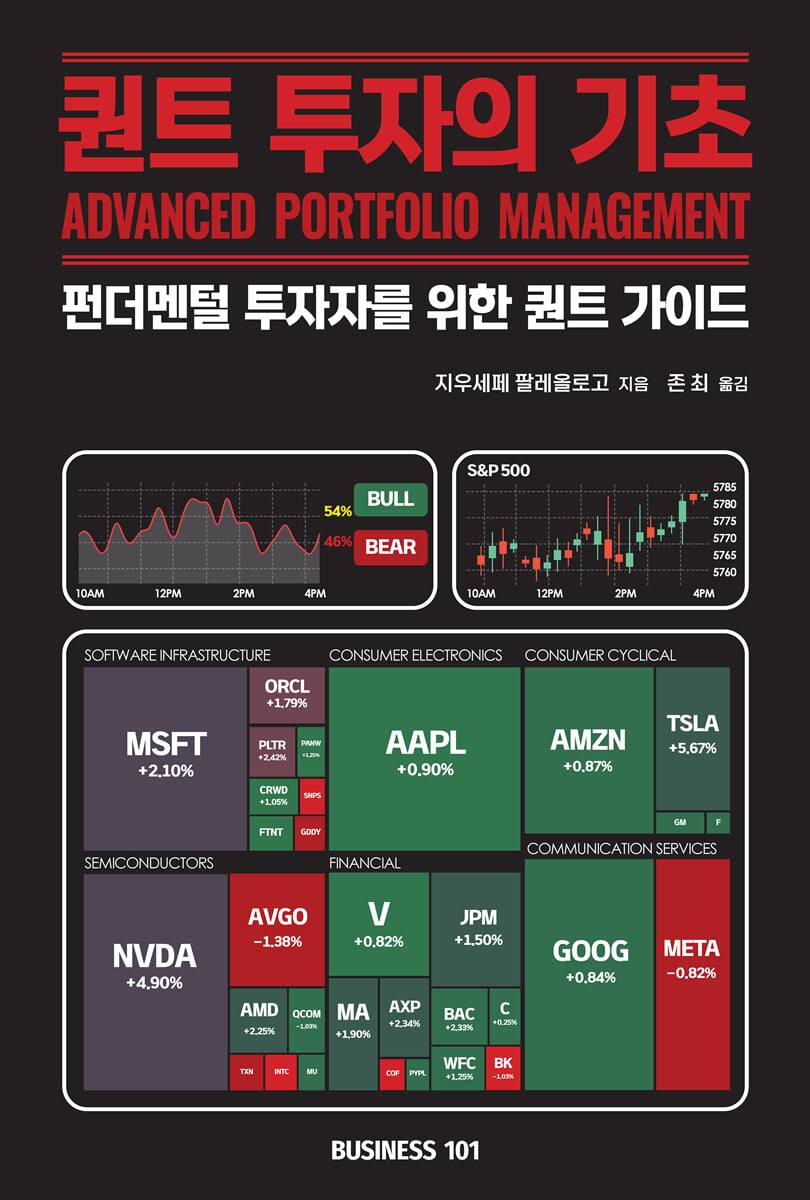
『Fundamentals of Quantitative Investment (original title: Advanced Portfolio Management)』 is a practical investment book written by Giuseppe Paleologo, an expert in risk and finance, providing the insights needed to convert investment ideas and knowledge into actual returns.
This book presents a systematic framework for portfolio construction and risk management, based on theories proven in the real market by successful portfolio managers.
This book introduces simple yet effective rules, along with advanced techniques to overcome the various challenges investors face as their asset size and strategy complexity increase.
This book will teach readers how to distinguish between individual stock return factors and market factors, and how to quantify and decompose risk.
"Fundamentals of Quantitative Investing" provides a widely applicable factor modeling framework for investment risk analysis, portfolio evaluation, and the development of flexible asset management strategies.
Additionally, the appendix includes advanced materials for practicing quantitative analysts, enhancing practical usability.
Even if you don't have a background in complex mathematics or risk models, this book is designed to provide practical help.
"The Fundamentals of Quantitative Investing" will be an essential reference for buy-side investors and analysts, as well as professional investors seeking alpha (excess returns) that consistently outperform the market.
Over the past 30 years, the financial industry has become more mature and sophisticated, and factor modeling has become a core concept in this process.
『Fundamentals of Quantitative Investment (original title: Advanced Portfolio Management)』 is a practical investment book written by Giuseppe Paleologo, an expert in risk and finance, providing the insights needed to convert investment ideas and knowledge into actual returns.
This book presents a systematic framework for portfolio construction and risk management, based on theories proven in the real market by successful portfolio managers.
This book introduces simple yet effective rules, along with advanced techniques to overcome the various challenges investors face as their asset size and strategy complexity increase.
This book will teach readers how to distinguish between individual stock return factors and market factors, and how to quantify and decompose risk.
"Fundamentals of Quantitative Investing" provides a widely applicable factor modeling framework for investment risk analysis, portfolio evaluation, and the development of flexible asset management strategies.
Additionally, the appendix includes advanced materials for practicing quantitative analysts, enhancing practical usability.
Even if you don't have a background in complex mathematics or risk models, this book is designed to provide practical help.
"The Fundamentals of Quantitative Investing" will be an essential reference for buy-side investors and analysts, as well as professional investors seeking alpha (excess returns) that consistently outperform the market.
- You can preview some of the book's contents.
Preview
index
Preface 8
Chapter 1: Who Should Read This Book, How, and Why? 13
1.1 What you will learn from this book 14
1.2 The Meaning of the Star★ and How to Read This Book 16
Chapter 2: Turning Investment Ideas into Profits 17
2.1 How to Invest in Your Strengths and Hedge the Rest 20
2.2 How to Determine Position Size 22
2.3 How to Learn from the Past 22
2.4 Efficient Trading Methods 23
2.5 How to Limit Factor Risk 24
2.6 How to Control Maximum Loss 24
2.7 How to Determine Leverage 25
2.8 How to Analyze New Data Sources 25
Chapter 3: Risk and Performance Analysis 27
3.1 Introduction 28
3.2 Alpha and Beta 31
3.3 Where does alpha come from? 34
3.4 Estimating Risks in Advance 38
3.4.1 What is Risk? 38
3.4.2 Risk and Performance Measurement 43
3.5 The First Step to Risk Decomposition 52
3.6 Simple Hedging 54
3.7 Separation of Concerns 57
3.8 Key Summary 60
Chapter 4: Fundamentals of Multifactor Models 61
4.1 From single factor to multi-factor 62
4.2 ★ Frequently Asked Questions - Risk Model 70
4.3 ★ Risk Model Structure 79
4.4 Key Summary 83
Chapter 5: Understanding Factors 84
5.1 Economic Environment 88
5.1.1 Country 88
5.1.2 Industry 90
5.1.3 Beta 93
5.1.4 Volatility 98
5.2 Trading Environment 101
5.2.1 Short Selling Balance 102
5.2.2 Active Manager Holding Status 106
5.2.3 Momentum 111
5.3 Company - Valuation Factor 119
5.3.1 Value 120
5.4 Key Summary 128
Chapter 6: Applying Effective Rules of Thumb for Alpha Sizing 129
6.1 Sharpe ratio 132
6.2 Estimating Expected Returns 136
6.3 Risk-Based Weighting Determination 140
6.4 ★ Empirical Analysis of Position Sizing Rules 144
6.5 Turning Ideas into Positions 154
6.6 Portfolio Weight Adjustment Strategy Using Time Series Risk 157
6.7 ★ Frequently Asked Questions About Performance 164
6.8 Key Summary 166
Chapter 7: Factor Risk Management 168
7.1 Tactical Factor Risk Management 169
7.1.1 Optimize when absolutely necessary 178
7.2 Strategic Factor Risk Management 182
7.2.1 Setting an Upper Limit for Factor Risk 182
7.2.2 Setting Market Exposure Limits 188
7.2.3 Setting a limit on the proportion of investment in a single stock 192
7.2.4 Setting Single Factor Exposure Limits 198
7.3 Systematic Hedging and Portfolio Management 202
7.4 Key Summary 207
Chapter 8: Understanding Your Investment Performance 209
8.1 Factor 210
8.1.1 Performance Analysis 210
8.2 Individual stock returns 214
8.2.1 Stock Selection, Weighting, and Timing 215
8.2.2 The Relationship Between Performance and Diversification 228
8.3 Trading Events Efficiently 232
8.4 ★ Use Alternative Data 238
8.5 ★ Frequently Asked Questions About Performance 245
8.4 Key Summary 247
Chapter 9 Loss Management 249
9.1 How Stop Loss Works 250
9.2 Why Do We Need Stop-Loss Rules? 253
9.3 Costs and Benefits of Stop-Loss 258
9.4 Key Summary 265
Chapter 10 ★ Setting the Leverage Ratio for Sustainable Operations 266
10.1 Leverage Decision Framework 268
10.2 Key Summary 276
Chapter 11 ★★ Appendix 277
11.1 Core Risk Model Formula 277
11.2 Diversification 281
11.3 Mean-Variance Optimization Formula 283
11.4 Proportional Decreasing Rule Formula 288
11.5 Creating a Custom Factor 290
11.6 Optimization Formula 297
11.7 Tactical Portfolio Optimization 299
11.8 Hedge Formula 302
11.9 Event-Based Optimal Trading Strategy 309
Chapter 1: Who Should Read This Book, How, and Why? 13
1.1 What you will learn from this book 14
1.2 The Meaning of the Star★ and How to Read This Book 16
Chapter 2: Turning Investment Ideas into Profits 17
2.1 How to Invest in Your Strengths and Hedge the Rest 20
2.2 How to Determine Position Size 22
2.3 How to Learn from the Past 22
2.4 Efficient Trading Methods 23
2.5 How to Limit Factor Risk 24
2.6 How to Control Maximum Loss 24
2.7 How to Determine Leverage 25
2.8 How to Analyze New Data Sources 25
Chapter 3: Risk and Performance Analysis 27
3.1 Introduction 28
3.2 Alpha and Beta 31
3.3 Where does alpha come from? 34
3.4 Estimating Risks in Advance 38
3.4.1 What is Risk? 38
3.4.2 Risk and Performance Measurement 43
3.5 The First Step to Risk Decomposition 52
3.6 Simple Hedging 54
3.7 Separation of Concerns 57
3.8 Key Summary 60
Chapter 4: Fundamentals of Multifactor Models 61
4.1 From single factor to multi-factor 62
4.2 ★ Frequently Asked Questions - Risk Model 70
4.3 ★ Risk Model Structure 79
4.4 Key Summary 83
Chapter 5: Understanding Factors 84
5.1 Economic Environment 88
5.1.1 Country 88
5.1.2 Industry 90
5.1.3 Beta 93
5.1.4 Volatility 98
5.2 Trading Environment 101
5.2.1 Short Selling Balance 102
5.2.2 Active Manager Holding Status 106
5.2.3 Momentum 111
5.3 Company - Valuation Factor 119
5.3.1 Value 120
5.4 Key Summary 128
Chapter 6: Applying Effective Rules of Thumb for Alpha Sizing 129
6.1 Sharpe ratio 132
6.2 Estimating Expected Returns 136
6.3 Risk-Based Weighting Determination 140
6.4 ★ Empirical Analysis of Position Sizing Rules 144
6.5 Turning Ideas into Positions 154
6.6 Portfolio Weight Adjustment Strategy Using Time Series Risk 157
6.7 ★ Frequently Asked Questions About Performance 164
6.8 Key Summary 166
Chapter 7: Factor Risk Management 168
7.1 Tactical Factor Risk Management 169
7.1.1 Optimize when absolutely necessary 178
7.2 Strategic Factor Risk Management 182
7.2.1 Setting an Upper Limit for Factor Risk 182
7.2.2 Setting Market Exposure Limits 188
7.2.3 Setting a limit on the proportion of investment in a single stock 192
7.2.4 Setting Single Factor Exposure Limits 198
7.3 Systematic Hedging and Portfolio Management 202
7.4 Key Summary 207
Chapter 8: Understanding Your Investment Performance 209
8.1 Factor 210
8.1.1 Performance Analysis 210
8.2 Individual stock returns 214
8.2.1 Stock Selection, Weighting, and Timing 215
8.2.2 The Relationship Between Performance and Diversification 228
8.3 Trading Events Efficiently 232
8.4 ★ Use Alternative Data 238
8.5 ★ Frequently Asked Questions About Performance 245
8.4 Key Summary 247
Chapter 9 Loss Management 249
9.1 How Stop Loss Works 250
9.2 Why Do We Need Stop-Loss Rules? 253
9.3 Costs and Benefits of Stop-Loss 258
9.4 Key Summary 265
Chapter 10 ★ Setting the Leverage Ratio for Sustainable Operations 266
10.1 Leverage Decision Framework 268
10.2 Key Summary 276
Chapter 11 ★★ Appendix 277
11.1 Core Risk Model Formula 277
11.2 Diversification 281
11.3 Mean-Variance Optimization Formula 283
11.4 Proportional Decreasing Rule Formula 288
11.5 Creating a Custom Factor 290
11.6 Optimization Formula 297
11.7 Tactical Portfolio Optimization 299
11.8 Hedge Formula 302
11.9 Event-Based Optimal Trading Strategy 309
Detailed image

GOODS SPECIFICS
- Date of issue: September 1, 2025
- Page count, weight, size: 320 pages | 152*225*19mm
- ISBN13: 9791198748645
- ISBN10: 1198748648
You may also like
카테고리
korean


korean

![GQ KOREA Mark (Monthly): December [2025]](http://librairie.coreenne.fr/cdn/shop/files/8ef265dbbfbf186523ed75ba7319009d.jpg?v=1765340328&width=3840)


