

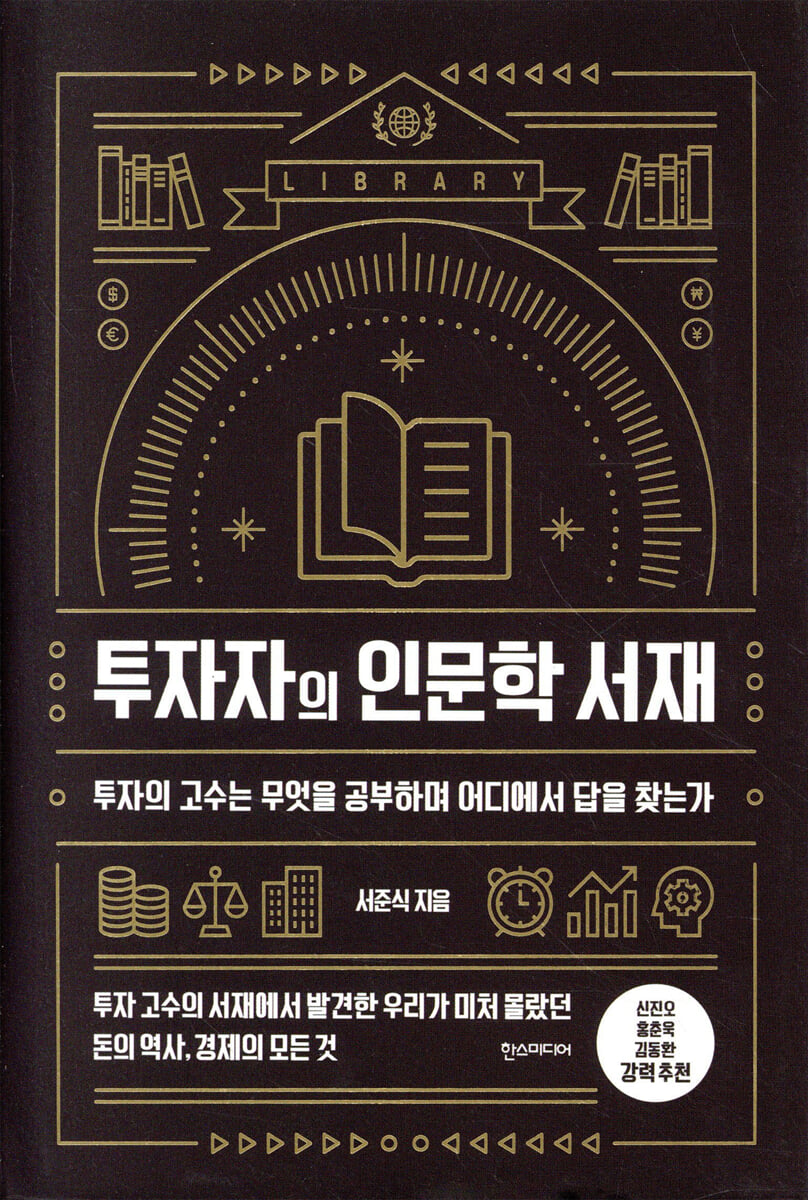
Investor's Humanities Library
 |
Description
Book Introduction
- A word from MD
- Who would generate higher returns between two investors: one with a knack for math and statistics, or one with a keen understanding of the humanities? Successful investor Seo Jun-sik unequivocally chooses the latter.
A special investment philosophy of a value investor: "If you don't understand the essence of the economy, you shouldn't invest even a single dollar."
- Economic Management MD Kim Joo-ri
“Why is bond trader Seo Jun-sik not Warren Buffett to investors?
“Are we talking about Adam Smith and Keynes first?”
Author Seo Jun-sik, who has received enthusiastic support from investors for his book, "Rewriting the Stock Investment Textbook," has now traced the history of "economy" and "money" from a humanistic perspective.
"The Investor's Humanities Library" is a book that retraces the important moments in human history, which have risen and fallen over the centuries surrounding "money," and seeks to answer the question of what constitutes sound investment.
Through this book, the author emphasizes that “investment theory should become a humanities discipline within the scope of common sense that everyone should know,” and that “for more successful investment, we need to develop the habit of observing and interpreting numerous historical and social phenomena from the perspective of ‘economics’ and ‘money.’”
Through this book, readers will be able to grasp the principles of economics and markets by examining major economic history at a glance, and will also be able to develop their own investment philosophy following the author's example as a value investor.
“Are we talking about Adam Smith and Keynes first?”
Author Seo Jun-sik, who has received enthusiastic support from investors for his book, "Rewriting the Stock Investment Textbook," has now traced the history of "economy" and "money" from a humanistic perspective.
"The Investor's Humanities Library" is a book that retraces the important moments in human history, which have risen and fallen over the centuries surrounding "money," and seeks to answer the question of what constitutes sound investment.
Through this book, the author emphasizes that “investment theory should become a humanities discipline within the scope of common sense that everyone should know,” and that “for more successful investment, we need to develop the habit of observing and interpreting numerous historical and social phenomena from the perspective of ‘economics’ and ‘money.’”
Through this book, readers will be able to grasp the principles of economics and markets by examining major economic history at a glance, and will also be able to develop their own investment philosophy following the author's example as a value investor.
- You can preview some of the book's contents.
Preview
index
Recommendation
Introduction: The Korean people are particularly indifferent to the financial and economic sectors.
Chapter 1: Economic History Through the Eyes of a Fund Manager (Part 1)
: From the Iron Age to the Rise of Industrial Democracy
◆ The starting point of economic history, the Iron Age civilization
◆ Economic theories of Greek genius philosophers
Thomas Aquinas sowed the seeds of capitalism in the Middle Ages.
The Medici family proves that money can make history.
The discovery of the New World and the Age of Exploration began with venture investment.
◆ Stock companies are changing the map of world hegemony.
The bourgeoisie ushered in democracy and industrialization.
The British East India Company, which laid the foundation for capitalism along with the empire on which the sun never sets
◆ 1776, the year capitalism reached its peak, and the Industrial Revolution took off.
◆ The bourgeois-led revolutions in the United States and France
Chapter 2: Finding the Essence of Economics in Classics
: A Quick Look at the Three Great Economic Bestsellers and Reflections on National Wealth
Economics? You can see it if you understand value.
◆ Bestseller 1: 『The Wealth of Nations』 - How does the 'invisible hand' work?
Bestseller 2: 『Capital』 - The 'Invisible Hand' Will Break Down
◆ The invisible hand hides the government's economic intervention.
◆ Bestseller 3: 『General Theory』 - Just revise it well, why throw away such a good thing?
◆ A comprehensive overview of economic schools and economic thought
◆ A Different Perspective on Economic Indicators Leads to Ahead
Chapter 3: Economic History Through the Eyes of Fund Managers (Part 2)
: The repeated crises of capitalism in the age of mass production and their overcoming
The Belle Époque and the Great Gatsby era, led by the Second Industrial Revolution
The Great Depression has finally arrived.
Capitalism, modified by Keynesianism, enjoys a golden age.
The shock to Keynesianism caused by the oil shock
Free-market thinking returns to the mainstream, and the middle class shrinks.
◆ A Lesson in Learning: Japan's Lost 30 Years
◆ Major economic events in South Korea after the oil shock
Chapter 4: The Path to Successful Investment: Knowing Value
◆ Useful investment tips you should know
◆ The psychology of investors who lose money, as explained by behavioral economics
How to Deal with the Foreign Exchange Market: The Invisible Hand
Those who understand interest rates are good at investing.
◆ Stocks can be both poison and medicine. Let's invest, not speculate.
◆ Consider diversification and correlations between assets.
Concluding Thoughts: Reflections on Life-Changing Values
Introduction: The Korean people are particularly indifferent to the financial and economic sectors.
Chapter 1: Economic History Through the Eyes of a Fund Manager (Part 1)
: From the Iron Age to the Rise of Industrial Democracy
◆ The starting point of economic history, the Iron Age civilization
◆ Economic theories of Greek genius philosophers
Thomas Aquinas sowed the seeds of capitalism in the Middle Ages.
The Medici family proves that money can make history.
The discovery of the New World and the Age of Exploration began with venture investment.
◆ Stock companies are changing the map of world hegemony.
The bourgeoisie ushered in democracy and industrialization.
The British East India Company, which laid the foundation for capitalism along with the empire on which the sun never sets
◆ 1776, the year capitalism reached its peak, and the Industrial Revolution took off.
◆ The bourgeois-led revolutions in the United States and France
Chapter 2: Finding the Essence of Economics in Classics
: A Quick Look at the Three Great Economic Bestsellers and Reflections on National Wealth
Economics? You can see it if you understand value.
◆ Bestseller 1: 『The Wealth of Nations』 - How does the 'invisible hand' work?
Bestseller 2: 『Capital』 - The 'Invisible Hand' Will Break Down
◆ The invisible hand hides the government's economic intervention.
◆ Bestseller 3: 『General Theory』 - Just revise it well, why throw away such a good thing?
◆ A comprehensive overview of economic schools and economic thought
◆ A Different Perspective on Economic Indicators Leads to Ahead
Chapter 3: Economic History Through the Eyes of Fund Managers (Part 2)
: The repeated crises of capitalism in the age of mass production and their overcoming
The Belle Époque and the Great Gatsby era, led by the Second Industrial Revolution
The Great Depression has finally arrived.
Capitalism, modified by Keynesianism, enjoys a golden age.
The shock to Keynesianism caused by the oil shock
Free-market thinking returns to the mainstream, and the middle class shrinks.
◆ A Lesson in Learning: Japan's Lost 30 Years
◆ Major economic events in South Korea after the oil shock
Chapter 4: The Path to Successful Investment: Knowing Value
◆ Useful investment tips you should know
◆ The psychology of investors who lose money, as explained by behavioral economics
How to Deal with the Foreign Exchange Market: The Invisible Hand
Those who understand interest rates are good at investing.
◆ Stocks can be both poison and medicine. Let's invest, not speculate.
◆ Consider diversification and correlations between assets.
Concluding Thoughts: Reflections on Life-Changing Values
Detailed image

Publisher's Review
What we didn't know we found in the study of an investment expert
The History of Money, Everything About Economics
From what perspective do successful investors view the economy and how do they develop their own investment perspectives?
"The Investor's Humanities Library" is a book that answers these readers' questions.
Seo Jun-sik, Executive Vice President of Shinhan BNP Paribas Asset Management, responsible for 40 trillion won in assets under management, has revealed the treasure trove of knowledge that helped him develop his own investment philosophy.
Readers will be able to learn the principles of economics and investment by strolling through the author's living, breathing study.
Developing investment skills and adding depth to philosophy through humanistic reflection
A value investor's special investment study method
How can we make good investments? The author's answer, surprisingly, is "humanities."
The world of investing, like the natural sciences, is a complex field of causal relationships where cause and effect are not constant, and opposite results can occur even in the same situation or environment.
In other words, you cannot succeed in investing just by being proficient in mathematical calculations.
Rather, we are accustomed to seeing investors who blindly trust their mathematical abilities perform poorly.
Will advanced science and technology lead to higher investment returns? However, even with sophisticated technologies like AI, success in this volatile world of investment is not easy.
Therefore, the author emphasizes that “we must be able to properly understand the essence hidden within a phenomenon rather than just the outwardly apparent phenomenon.”
He also emphasized, “I believe that the higher your level of humanities knowledge, the more insight you will have on investments, which will enable you to make successful investments.”
The investment returns of investors with a high level of humanities knowledge about the economy as a whole are particularly good compared to those who are well-versed in math or statistics programs.
For example, Warren Buffett and Charlie Munger, who are considered the best investors, are also well-known readers and are widely known for their extensive knowledge of the humanities.
For this reason, the author strives to broaden his humanistic knowledge rather than focusing on new investment techniques or cutting-edge news or information.
Even in interviews for new fund managers, questions tend to be more about history or the arts than financial expertise.
This is because we know from experience that layer upon layer of humanistic insights serve as the foundation for fund performance and investment returns.
Looking back at major economic philosophies from Aristotle to Keynes,
From the Iron Age to the Industrial Revolution, the crisis of capitalism and its overcoming…
A glance at the major economic history driven by 'money'
Based on this philosophy, the author compiled in this book common sense and knowledge related to finance and economics that would be useful to know for sound investment.
In particular, it vividly examines the important moments in human history that have risen and fallen over the centuries, particularly surrounding 'money'.
At this time, the author looks at history through the eyes of an ‘economic view of history.’
In other words, the reason for the large and small changes in human history is that 'economic factors' have been the main driving force.
If we delve into history under the author's guidance, we can see that economic factors were a major starting point for reasons such as the fall of Rome and the outbreak of the American Civil War.
From Chapter 1, the economic history told by a fund manager unfolds in an exciting way.
The author, as a friendly commentator, captures the moment when humanity discovered a new means of production called iron and accumulated wealth, to the moment when the seeds of capitalism sprouted in a harsh era when the logic of war and religion prevailed.
Additionally, we can witness how Aristotle, who advocated for the active use of currency, and the Medici family, who dominated politics, economy, and culture in Florence with their great wealth, developed the Renaissance era and created a brilliant cultural heritage.
You can witness firsthand the Age of Exploration, which began with venture capital, the birth of the first joint-stock company and stock exchange with the Dutch East India Company, and the process by which the bourgeoisie ushered in democracy and industrialization, setting off the train of the Industrial Revolution.
Chapter 2 examines the major economic ideas of Adam Smith, Karl Marx, and Keynes, who are considered the most important economists in history.
In particular, he clearly interpreted the core contents of the three economists' major works: The Wealth of Nations, Capital, and The General Theory.
The total volume of the three volumes is approximately 4,000 pages, but this has been condensed into approximately 40 pages, providing a concise explanation of the core information, making it a truly valuable gift to readers.
By listening to the commentary on these three books on national wealth, you will be able to deepen your understanding of the overall macroeconomics, including the effectiveness of government economic policies and the principles and limitations of economic indicators.
Chapter 3 presents economic history from the perspective of a fund manager.
This time, it's a history from a more recent past.
It talks about the repeated crises of capitalism and how to overcome them, from the Great Depression in the United States and subsequent stagflation, to the collapse of Japan's bubble economy, the IMF foreign exchange crisis in Korea, and the global financial crisis.
If you have already remembered the voices of the great economists who advocated different economic policies in Chapter 2, you will find Chapter 3 more interesting.
Through these economic lessons, the author argues that “we should be wary of ‘white elephant policies’ that are uneconomical, and that the government’s economic policies should be implemented in a way that creates as much effective demand as possible.”
“If you don’t understand the essence of the economy,
Don't invest even a single dollar!
The Path to Successful Investing from Value Investors
Chapter 4 contains the author's key investment theories and useful investment tips, as well as his "value investing evangelist."
It also provides a friendly explanation of the principles of the 'bond-type stock investment method' that allows you to experience the essence of value investing.
Value investing is an investment method that analyzes the intrinsic value of an investment asset and then executes it, unlike momentum investing, which invests by predicting and forecasting the price of the investment asset.
The author calculates the intrinsic value of stocks and explains in an easy-to-understand way how to achieve successful investing through the magic of compound interest.
It helped readers who had previously been enlightened about the great currents of the economy to actually generate real profits and win in the capital markets.
In particular, the author emphasizes that “investment theory should become a humanities discipline within the scope of common sense that everyone should know.”
Whether you invest or not, investment common sense should be universal knowledge that everyone should know, and there is a need to increase universal understanding of foreign exchange, bonds, stocks, and interest rates.
The gift that "The Investor's Humanities Library" gives its readers is undoubtedly a new "perspective."
Let's explore the intrinsic value of economic indicators and investment assets through the eyes of an "economic historian" with the author.
Only investors who can read the inner workings of the capital market may be able to create a forest of wealth.
The History of Money, Everything About Economics
From what perspective do successful investors view the economy and how do they develop their own investment perspectives?
"The Investor's Humanities Library" is a book that answers these readers' questions.
Seo Jun-sik, Executive Vice President of Shinhan BNP Paribas Asset Management, responsible for 40 trillion won in assets under management, has revealed the treasure trove of knowledge that helped him develop his own investment philosophy.
Readers will be able to learn the principles of economics and investment by strolling through the author's living, breathing study.
Developing investment skills and adding depth to philosophy through humanistic reflection
A value investor's special investment study method
How can we make good investments? The author's answer, surprisingly, is "humanities."
The world of investing, like the natural sciences, is a complex field of causal relationships where cause and effect are not constant, and opposite results can occur even in the same situation or environment.
In other words, you cannot succeed in investing just by being proficient in mathematical calculations.
Rather, we are accustomed to seeing investors who blindly trust their mathematical abilities perform poorly.
Will advanced science and technology lead to higher investment returns? However, even with sophisticated technologies like AI, success in this volatile world of investment is not easy.
Therefore, the author emphasizes that “we must be able to properly understand the essence hidden within a phenomenon rather than just the outwardly apparent phenomenon.”
He also emphasized, “I believe that the higher your level of humanities knowledge, the more insight you will have on investments, which will enable you to make successful investments.”
The investment returns of investors with a high level of humanities knowledge about the economy as a whole are particularly good compared to those who are well-versed in math or statistics programs.
For example, Warren Buffett and Charlie Munger, who are considered the best investors, are also well-known readers and are widely known for their extensive knowledge of the humanities.
For this reason, the author strives to broaden his humanistic knowledge rather than focusing on new investment techniques or cutting-edge news or information.
Even in interviews for new fund managers, questions tend to be more about history or the arts than financial expertise.
This is because we know from experience that layer upon layer of humanistic insights serve as the foundation for fund performance and investment returns.
Looking back at major economic philosophies from Aristotle to Keynes,
From the Iron Age to the Industrial Revolution, the crisis of capitalism and its overcoming…
A glance at the major economic history driven by 'money'
Based on this philosophy, the author compiled in this book common sense and knowledge related to finance and economics that would be useful to know for sound investment.
In particular, it vividly examines the important moments in human history that have risen and fallen over the centuries, particularly surrounding 'money'.
At this time, the author looks at history through the eyes of an ‘economic view of history.’
In other words, the reason for the large and small changes in human history is that 'economic factors' have been the main driving force.
If we delve into history under the author's guidance, we can see that economic factors were a major starting point for reasons such as the fall of Rome and the outbreak of the American Civil War.
From Chapter 1, the economic history told by a fund manager unfolds in an exciting way.
The author, as a friendly commentator, captures the moment when humanity discovered a new means of production called iron and accumulated wealth, to the moment when the seeds of capitalism sprouted in a harsh era when the logic of war and religion prevailed.
Additionally, we can witness how Aristotle, who advocated for the active use of currency, and the Medici family, who dominated politics, economy, and culture in Florence with their great wealth, developed the Renaissance era and created a brilliant cultural heritage.
You can witness firsthand the Age of Exploration, which began with venture capital, the birth of the first joint-stock company and stock exchange with the Dutch East India Company, and the process by which the bourgeoisie ushered in democracy and industrialization, setting off the train of the Industrial Revolution.
Chapter 2 examines the major economic ideas of Adam Smith, Karl Marx, and Keynes, who are considered the most important economists in history.
In particular, he clearly interpreted the core contents of the three economists' major works: The Wealth of Nations, Capital, and The General Theory.
The total volume of the three volumes is approximately 4,000 pages, but this has been condensed into approximately 40 pages, providing a concise explanation of the core information, making it a truly valuable gift to readers.
By listening to the commentary on these three books on national wealth, you will be able to deepen your understanding of the overall macroeconomics, including the effectiveness of government economic policies and the principles and limitations of economic indicators.
Chapter 3 presents economic history from the perspective of a fund manager.
This time, it's a history from a more recent past.
It talks about the repeated crises of capitalism and how to overcome them, from the Great Depression in the United States and subsequent stagflation, to the collapse of Japan's bubble economy, the IMF foreign exchange crisis in Korea, and the global financial crisis.
If you have already remembered the voices of the great economists who advocated different economic policies in Chapter 2, you will find Chapter 3 more interesting.
Through these economic lessons, the author argues that “we should be wary of ‘white elephant policies’ that are uneconomical, and that the government’s economic policies should be implemented in a way that creates as much effective demand as possible.”
“If you don’t understand the essence of the economy,
Don't invest even a single dollar!
The Path to Successful Investing from Value Investors
Chapter 4 contains the author's key investment theories and useful investment tips, as well as his "value investing evangelist."
It also provides a friendly explanation of the principles of the 'bond-type stock investment method' that allows you to experience the essence of value investing.
Value investing is an investment method that analyzes the intrinsic value of an investment asset and then executes it, unlike momentum investing, which invests by predicting and forecasting the price of the investment asset.
The author calculates the intrinsic value of stocks and explains in an easy-to-understand way how to achieve successful investing through the magic of compound interest.
It helped readers who had previously been enlightened about the great currents of the economy to actually generate real profits and win in the capital markets.
In particular, the author emphasizes that “investment theory should become a humanities discipline within the scope of common sense that everyone should know.”
Whether you invest or not, investment common sense should be universal knowledge that everyone should know, and there is a need to increase universal understanding of foreign exchange, bonds, stocks, and interest rates.
The gift that "The Investor's Humanities Library" gives its readers is undoubtedly a new "perspective."
Let's explore the intrinsic value of economic indicators and investment assets through the eyes of an "economic historian" with the author.
Only investors who can read the inner workings of the capital market may be able to create a forest of wealth.
GOODS SPECIFICS
- Date of issue: February 17, 2020
- Format: Hardcover book binding method guide
- Page count, weight, size: 372 pages | 568g | 136*196*27mm
- ISBN13: 9791160074673
- ISBN10: 1160074674
You may also like
카테고리
korean


korean

![GQ KOREA Mark (Monthly): December [2025]](http://librairie.coreenne.fr/cdn/shop/files/8ef265dbbfbf186523ed75ba7319009d.jpg?v=1765340328&width=3840)


