

Who wrote this copy?
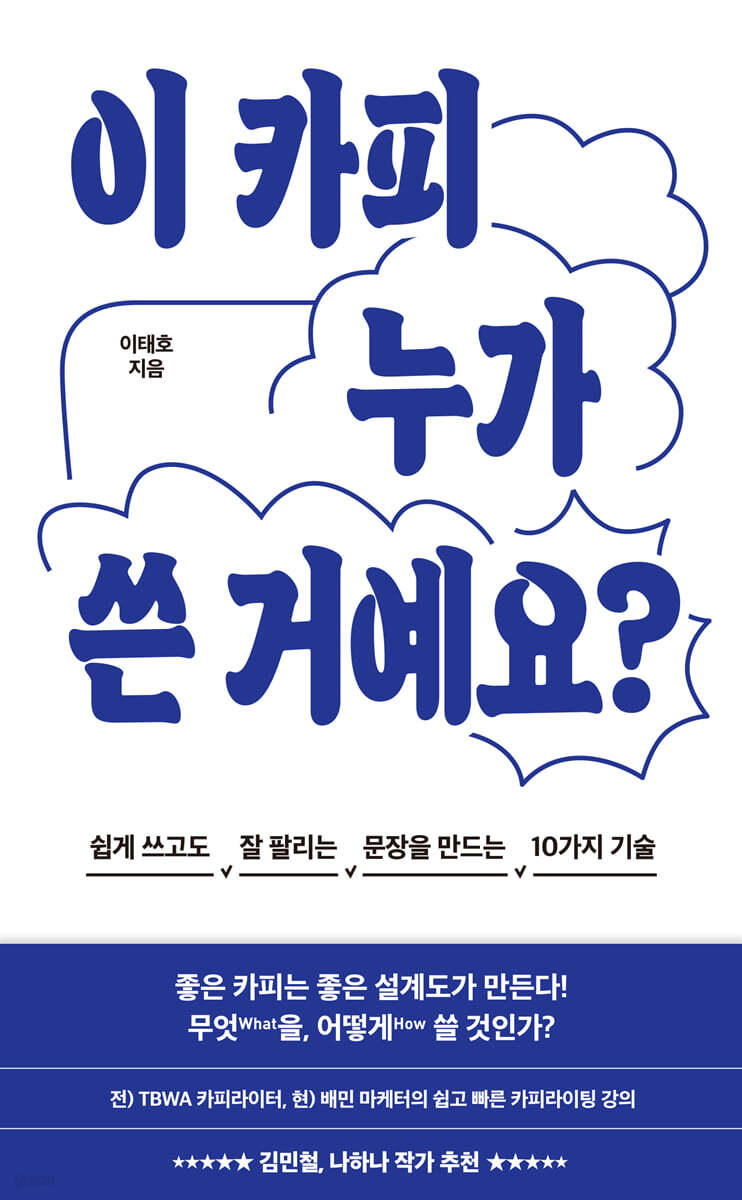 |
Description
Book Introduction
"Good copy is made from good blueprints! What should we write, and how should we write it?"
Only a former TBWA copywriter and current Baemin marketer can tell you
10 Formulas for Creating Easy-to-Write, Selling Sentences
Marketing meetings, concept meetings, planning meetings... for all the office workers who rack their brains, unable to come up with any sentences or words to present before countless meetings, the super-speed copywriting textbook "Who Wrote This Copy?" has been published.
Even if you thought, "I don't have to write copy," we live in a fiercely competitive personal branding era where people are shouting, "Hateful comments are better than no comments."
From marketers and planners to individual creators and even small business owners, there comes a time when everyone must write at least one line that represents their business concept.
The author, who worked as a copywriter at advertising agency TBWA and is currently working as a brand marketer at the delivery platform Baemin, preaches only the essence of 'one-line writing' in this book.
For anyone who wants to write something that "moves people's hearts" and even "sells," this book teaches you how to craft a single, powerful line.
We present 10 blueprints for creating copy that moves readers' hearts, along with a fast and powerful 'copy cheat key' to complete it.
If you're still writing with your butt, I recommend "Who Wrote This Copy?", a daily copywriting course that focuses on skill rather than passion (it's easy, quick to read, and, as a bonus, fun).
Only a former TBWA copywriter and current Baemin marketer can tell you
10 Formulas for Creating Easy-to-Write, Selling Sentences
Marketing meetings, concept meetings, planning meetings... for all the office workers who rack their brains, unable to come up with any sentences or words to present before countless meetings, the super-speed copywriting textbook "Who Wrote This Copy?" has been published.
Even if you thought, "I don't have to write copy," we live in a fiercely competitive personal branding era where people are shouting, "Hateful comments are better than no comments."
From marketers and planners to individual creators and even small business owners, there comes a time when everyone must write at least one line that represents their business concept.
The author, who worked as a copywriter at advertising agency TBWA and is currently working as a brand marketer at the delivery platform Baemin, preaches only the essence of 'one-line writing' in this book.
For anyone who wants to write something that "moves people's hearts" and even "sells," this book teaches you how to craft a single, powerful line.
We present 10 blueprints for creating copy that moves readers' hearts, along with a fast and powerful 'copy cheat key' to complete it.
If you're still writing with your butt, I recommend "Who Wrote This Copy?", a daily copywriting course that focuses on skill rather than passion (it's easy, quick to read, and, as a bonus, fun).
- You can preview some of the book's contents.
Preview
index
Recommendation
Author's Note
Entering_Don't just use copy with your butt
Lesson 0.
what to say and how to say
Part T: Pretend to be T and write copy
Lecture 1.
Numbers speak louder than words [Fact]
Lecture 2.
2nd place draws a line like 2nd place
3rd lecture.
If you're going to follow, follow me [Leadership]
Semifinals.
Let's look at the issues that have been put off [Trend]
Lecture 5.
(I haven't written a single line of copy) Are you sleepy now? [Threat]
Part F: Pretend to be F and Write Copy
Lecture 6.
The Best Way to Relax Your Shoulders [Repeat]
Lesson 7.
Meaning × Fun = Mimi [Pun]
Quarterfinals.
The more unfamiliar it is, the more welcome it becomes [Gap]
Lesson 9.
[A twist] that unfolds only after expectations are dashed
Lesson 10.
My Heart I Didn't Know [Benefit]
How to Check Your Own Copy
To conclude once more_This copy was written by 'everyone'!
Author's Note
Entering_Don't just use copy with your butt
Lesson 0.
what to say and how to say
Part T: Pretend to be T and write copy
Lecture 1.
Numbers speak louder than words [Fact]
Lecture 2.
2nd place draws a line like 2nd place
3rd lecture.
If you're going to follow, follow me [Leadership]
Semifinals.
Let's look at the issues that have been put off [Trend]
Lecture 5.
(I haven't written a single line of copy) Are you sleepy now? [Threat]
Part F: Pretend to be F and Write Copy
Lecture 6.
The Best Way to Relax Your Shoulders [Repeat]
Lesson 7.
Meaning × Fun = Mimi [Pun]
Quarterfinals.
The more unfamiliar it is, the more welcome it becomes [Gap]
Lesson 9.
[A twist] that unfolds only after expectations are dashed
Lesson 10.
My Heart I Didn't Know [Benefit]
How to Check Your Own Copy
To conclude once more_This copy was written by 'everyone'!
Detailed image
.jpg)
Into the book
Before we begin, I would like to point out one last thing.
Honestly, copywriting is something you have to do with your butt, whether you like it or not.
It's not easy for someone who thought about it for a long time to win over someone who thought about it for a short time.
However, in today's busy society, office workers are not given much time to think of a single line of copy that will be remembered for a long time.
The most important thing is to get the most efficiency in a short period of time.
So, let's resolve not to use our mindset as a butt.
Just looking at the monitor won't solve the problem.
--- p.13
There's something as important as numbers that I'd like to explain.
The question is, 'What is the situation of the viewer?'
This is a copy that takes into account the so-called TPO (Time/Place/Occasion).
Depending on whether it's a theater commercial that viewers are likely to be paying close attention to, a YouTube ad that viewers are just about ready to skip, or a subway commercial on the hectic commute to and from work, the copywriting will have to be different.
--- p.42
If you read books on branding or marketing, you'll often see the term "positioning" used in a fancy way.
Sometimes I get tired because it often seems like an effort to put all the good words in the world together.
When a good word party doesn't go well, let's have a bad word party with our colleagues instead.
We'll find all the things we can say that might offend our competitors and upload them to a shared worksheet in real time.
As we do this, the path our brand and our copy should take will naturally become clear.
Positioning is not a sentence that makes you look like you exist, but a sentence that makes the other person look like they don't exist.
--- p.68
A veteran in the industry once asked me this question.
“What makes a good brand a good brand?” “Well,
“A good image?” “Of course.
“Are you a copywriter?” “(Getting worked up) That’s a good adjective, isn’t it? Image is just an adjective, after all.” “No, that’s too obvious.
“A good brand should have good verbs.” Adjectives like “stylish,” “hip,” and “cool” are modifiers that will be lost in a few years.
That's what 'debt' is.
But the verbs that the brand promises to consumers can have unchanging value.
In other words, if you are a number one brand, you must have a verb.
That's what 'asset' is.
--- p.83
Copywriting should also follow this tactic.
In that sense, the first way to become a trend is to rely on trendy expressions.
That's why all kinds of buzzwords and memes are incorporated into copy.
But there are side effects too.
There is no copyright on words that have become popular.
If I can write, then everyone else can write, right?
There was a time when a character called 'chill guy' became so popular that it became a meme all over the world.
In Korea, the use of the character's word chill as a play on words has become a sort of established practice.
And then, all the news outlets and brand advertisements on the feed started using this chill drip, which was a really chill situation.
--- p.95~96
Humans feel a certain pleasure when they see a gap.
I think that's an instinct engraved in our mental world.
In the world of sports, when underdogs beat champions, in the world of romance, when lovers fight for forbidden love, and when small brands try to overtake big ones.
So, exploiting gaps in copywriting is probably one of the cleverest ways to exploit human instinct.
--- p.169~170
If elevator instructions are the epitome of writing that doesn't take the reader into consideration, then advertising copywriting should be at the very opposite end of the spectrum.
No matter how much you want to say or how important it is, think about who will be listening.
The listener will see the advertisement while moving somewhere.
If you just keep talking about what you want to say, can you really get that person's attention? It's impossible.
That's why the term 'consumer benefit' is often used in copywriting.
It's a weird expression that's like a mishmash of English and Korean, but you'll understand it right away (I couldn't bring myself to call it consumer benefit...).
--- p.195~196
I once read a saying that the one who loves more loses, but losing is actually winning in love.
It's suddenly like an IU song, but in the end, copy is also love, and the one who loves more wins.
If we define love as 'taking more care of the other person'.
The easiest way to understand Benefit's perspective is through letters.
There's something I always say when I open a copybook.
Write it like you're writing a letter to a consumer.
Honestly, I was dumbfounded every time I saw that kind of talk.
You're telling me to write a letter to someone I know, but to a person named 'Bija' with the last name 'So' whose name I don't know and who he is?
But as my experience writing copy gradually grew, I realized
The best copy is the one that is written as if it were a letter to the consumer, as if 'the answer was in the textbook after all.'
--- p.200
More important than deciding what to write is deciding what not to write.
(I don't think there's a saying like this in the industry) but I think thinking about "not to say" is more important now than ever.
Because we live in a time when the risks of a brand making an incorrect statement, whether politically or gender-wise, are so great.
Even if you really like the copy, if it could make someone uncomfortable, it would be right not to put it out there.
--- p.218~219
As some of you may have noticed, T and F, who were the 'owners' of the copy in the episode 'Easy Live', in some ways show a long-term and a short-term perspective.
T is a bit closer to the perspective of considering the long-term breathing and broad vision of a brand or service.
F can also be interpreted as a view to create a bigger impact and repercussion in a shorter period of time.
It may just be a difference in personality, but depending on whether you are a practitioner or a leader, the perspectives of T and F can be mixed.
If you're thinking about the direction of your brand, put a little more emphasis on T.
Instead of waiting for your team members to come up with good copy, you should give direction based on the nature of the suggestion.
If you're a team member, instead of waiting for the leader's interpretation, it would be good to think about how to approach it from the customer's perspective, considering the immediate impact, and then delve a little deeper into the F.
Because when it comes to thinking from the customer's perspective, practitioners are better at it than leaders.
Good copy isn't created without a mix of these two perspectives.
Honestly, copywriting is something you have to do with your butt, whether you like it or not.
It's not easy for someone who thought about it for a long time to win over someone who thought about it for a short time.
However, in today's busy society, office workers are not given much time to think of a single line of copy that will be remembered for a long time.
The most important thing is to get the most efficiency in a short period of time.
So, let's resolve not to use our mindset as a butt.
Just looking at the monitor won't solve the problem.
--- p.13
There's something as important as numbers that I'd like to explain.
The question is, 'What is the situation of the viewer?'
This is a copy that takes into account the so-called TPO (Time/Place/Occasion).
Depending on whether it's a theater commercial that viewers are likely to be paying close attention to, a YouTube ad that viewers are just about ready to skip, or a subway commercial on the hectic commute to and from work, the copywriting will have to be different.
--- p.42
If you read books on branding or marketing, you'll often see the term "positioning" used in a fancy way.
Sometimes I get tired because it often seems like an effort to put all the good words in the world together.
When a good word party doesn't go well, let's have a bad word party with our colleagues instead.
We'll find all the things we can say that might offend our competitors and upload them to a shared worksheet in real time.
As we do this, the path our brand and our copy should take will naturally become clear.
Positioning is not a sentence that makes you look like you exist, but a sentence that makes the other person look like they don't exist.
--- p.68
A veteran in the industry once asked me this question.
“What makes a good brand a good brand?” “Well,
“A good image?” “Of course.
“Are you a copywriter?” “(Getting worked up) That’s a good adjective, isn’t it? Image is just an adjective, after all.” “No, that’s too obvious.
“A good brand should have good verbs.” Adjectives like “stylish,” “hip,” and “cool” are modifiers that will be lost in a few years.
That's what 'debt' is.
But the verbs that the brand promises to consumers can have unchanging value.
In other words, if you are a number one brand, you must have a verb.
That's what 'asset' is.
--- p.83
Copywriting should also follow this tactic.
In that sense, the first way to become a trend is to rely on trendy expressions.
That's why all kinds of buzzwords and memes are incorporated into copy.
But there are side effects too.
There is no copyright on words that have become popular.
If I can write, then everyone else can write, right?
There was a time when a character called 'chill guy' became so popular that it became a meme all over the world.
In Korea, the use of the character's word chill as a play on words has become a sort of established practice.
And then, all the news outlets and brand advertisements on the feed started using this chill drip, which was a really chill situation.
--- p.95~96
Humans feel a certain pleasure when they see a gap.
I think that's an instinct engraved in our mental world.
In the world of sports, when underdogs beat champions, in the world of romance, when lovers fight for forbidden love, and when small brands try to overtake big ones.
So, exploiting gaps in copywriting is probably one of the cleverest ways to exploit human instinct.
--- p.169~170
If elevator instructions are the epitome of writing that doesn't take the reader into consideration, then advertising copywriting should be at the very opposite end of the spectrum.
No matter how much you want to say or how important it is, think about who will be listening.
The listener will see the advertisement while moving somewhere.
If you just keep talking about what you want to say, can you really get that person's attention? It's impossible.
That's why the term 'consumer benefit' is often used in copywriting.
It's a weird expression that's like a mishmash of English and Korean, but you'll understand it right away (I couldn't bring myself to call it consumer benefit...).
--- p.195~196
I once read a saying that the one who loves more loses, but losing is actually winning in love.
It's suddenly like an IU song, but in the end, copy is also love, and the one who loves more wins.
If we define love as 'taking more care of the other person'.
The easiest way to understand Benefit's perspective is through letters.
There's something I always say when I open a copybook.
Write it like you're writing a letter to a consumer.
Honestly, I was dumbfounded every time I saw that kind of talk.
You're telling me to write a letter to someone I know, but to a person named 'Bija' with the last name 'So' whose name I don't know and who he is?
But as my experience writing copy gradually grew, I realized
The best copy is the one that is written as if it were a letter to the consumer, as if 'the answer was in the textbook after all.'
--- p.200
More important than deciding what to write is deciding what not to write.
(I don't think there's a saying like this in the industry) but I think thinking about "not to say" is more important now than ever.
Because we live in a time when the risks of a brand making an incorrect statement, whether politically or gender-wise, are so great.
Even if you really like the copy, if it could make someone uncomfortable, it would be right not to put it out there.
--- p.218~219
As some of you may have noticed, T and F, who were the 'owners' of the copy in the episode 'Easy Live', in some ways show a long-term and a short-term perspective.
T is a bit closer to the perspective of considering the long-term breathing and broad vision of a brand or service.
F can also be interpreted as a view to create a bigger impact and repercussion in a shorter period of time.
It may just be a difference in personality, but depending on whether you are a practitioner or a leader, the perspectives of T and F can be mixed.
If you're thinking about the direction of your brand, put a little more emphasis on T.
Instead of waiting for your team members to come up with good copy, you should give direction based on the nature of the suggestion.
If you're a team member, instead of waiting for the leader's interpretation, it would be good to think about how to approach it from the customer's perspective, considering the immediate impact, and then delve a little deeper into the F.
Because when it comes to thinking from the customer's perspective, practitioners are better at it than leaders.
Good copy isn't created without a mix of these two perspectives.
--- p.226
Publisher's Review
“If it’s easy to write, it’ll be easy to read, and if it’s easy to read, it’ll sell well.”
Writing Skills Training for Today's Marketers Who Write Copy Without a Senior
If you've ever been flustered by the sound of "Who wrote this?" echoing through a conference room, or if you've ever been at a loss staring at a blank white document with only a blinking cursor on the screen, this book is your savior.
The days when a direct shooter would be there to take care of everything from start to finish are over.
Now, each person must take responsibility for creating a 'word that sells' in their own place, in their own language.
Author Taeho Lee, who started his career as a copywriter and is currently working as a brand marketer, presents just 10 formulas for creating good sentences and good copy.
The lecture format provides a friendly explanation of writing strategies that readers can immediately apply in real life.
Above all, this book is different in that it is written in the language of practitioners working in the field.
The author, who has experienced almost every situation requiring a "selling word," from small coupon texts on Baemin to billboard advertisements, does not speak of innate creativity or ideas.
Instead, it teaches the language of practitioners working in the field, how to structure business sentences, and the decomposition of copy into detailed, word-by-word analysis.
“Is your writing MBTI type T or F?”
The Crossroads of Copywriting: What to Say and How to Say It
This book, which is in a lecture format that uses pleasant, colloquial language rather than complex theories or lengthy explanations, is divided into two parts.
A total of 10 lectures will be developed, with 5 lectures each centered around the two axes of ‘what to say’ and ‘how to say’.
The most refreshing aspect of this book is the sentence training method using MBTI-based characters.
Two (virtual) marketers, identified as T (rational type) and F (emotional type), appear as team members of a (also virtual) startup called 'Pyeonhaesaja'.
When writing for a practical mission, T focuses on logic and structure, while F focuses on emotions and storytelling.
This contrast isn't just a humorous setup; it actually forces the reader to diagnose where they were stuck when writing.
The author has conveniently placed vivid episodes that unfold on the stage of the lion in the introduction of each lecture.
This course presents realistic and relatable writing scenarios, such as how to communicate a 50% sale, how to advertise free shipping, and how to connect with a new category like furniture, more realistic than any marketing textbook, and then provides a class to solve these situations.
The vivid narrative, which seems to give a glimpse into the story behind the creation of actual advertising copy, adds to the fun of reading.
If your writing MBTI is T, you can focus on "what to write" and establish the direction of your message through strategies such as facts, drawing lines, leadership, a sense of the trend, and threat appeal.
And if it's F, it goes further and focuses on 'how to write', showing you how to convey the message in a more sophisticated and persuasive way using techniques such as repetition, puns, reversals, gaps, and consumer benefits.
“They say people don’t change, but I believe they can change with lighting.”
A writing class that moves the heart and actions of others with a single sentence
The author expresses these 10 copywriting formulas as "flags," indicating the destinations where sentences should reach, and puts them in the hands of readers so they can wave them freely.
Through real-life examples such as 'This time, the actual delivery fee is Bbangwon (Baemin)' and 'If you're tired of separate beans (McCafe)', it vividly shows how finely structured sentences lead to consumer behavior.
We analyze examples of advertising copy that utilizes various strategies, and at the end of each lecture, we summarize the main points of what we just learned in the 'Practice in Practice' section.
At the end of each lecture, we included some leisurely reading material, such as “Words Copywriters (Marketers) Like” and “Words Copywriters (Marketers) Hate,” to create a break time similar to the actual lectures.
As I mentioned earlier, "Who Wrote This Copy?" is not just a book for copywriters.
This is a necessary strategy book for anyone who wants to move the hearts of others with their own writing and engages in the work of 'persuasion through words.'
This is an introductory and secret book on copywriting that makes full use of the author's spoken language, making it easy to understand, a quick read, and occasionally evoking a chuckle, but also training readers to immediately apply the content in practice.
We've moved beyond the era of writing with our butts to an era where we must create our own results with meticulously designed sentences.
Now, it's your turn to ask the same question as the title of this book in the sentence you wrote.
Writing Skills Training for Today's Marketers Who Write Copy Without a Senior
If you've ever been flustered by the sound of "Who wrote this?" echoing through a conference room, or if you've ever been at a loss staring at a blank white document with only a blinking cursor on the screen, this book is your savior.
The days when a direct shooter would be there to take care of everything from start to finish are over.
Now, each person must take responsibility for creating a 'word that sells' in their own place, in their own language.
Author Taeho Lee, who started his career as a copywriter and is currently working as a brand marketer, presents just 10 formulas for creating good sentences and good copy.
The lecture format provides a friendly explanation of writing strategies that readers can immediately apply in real life.
Above all, this book is different in that it is written in the language of practitioners working in the field.
The author, who has experienced almost every situation requiring a "selling word," from small coupon texts on Baemin to billboard advertisements, does not speak of innate creativity or ideas.
Instead, it teaches the language of practitioners working in the field, how to structure business sentences, and the decomposition of copy into detailed, word-by-word analysis.
“Is your writing MBTI type T or F?”
The Crossroads of Copywriting: What to Say and How to Say It
This book, which is in a lecture format that uses pleasant, colloquial language rather than complex theories or lengthy explanations, is divided into two parts.
A total of 10 lectures will be developed, with 5 lectures each centered around the two axes of ‘what to say’ and ‘how to say’.
The most refreshing aspect of this book is the sentence training method using MBTI-based characters.
Two (virtual) marketers, identified as T (rational type) and F (emotional type), appear as team members of a (also virtual) startup called 'Pyeonhaesaja'.
When writing for a practical mission, T focuses on logic and structure, while F focuses on emotions and storytelling.
This contrast isn't just a humorous setup; it actually forces the reader to diagnose where they were stuck when writing.
The author has conveniently placed vivid episodes that unfold on the stage of the lion in the introduction of each lecture.
This course presents realistic and relatable writing scenarios, such as how to communicate a 50% sale, how to advertise free shipping, and how to connect with a new category like furniture, more realistic than any marketing textbook, and then provides a class to solve these situations.
The vivid narrative, which seems to give a glimpse into the story behind the creation of actual advertising copy, adds to the fun of reading.
If your writing MBTI is T, you can focus on "what to write" and establish the direction of your message through strategies such as facts, drawing lines, leadership, a sense of the trend, and threat appeal.
And if it's F, it goes further and focuses on 'how to write', showing you how to convey the message in a more sophisticated and persuasive way using techniques such as repetition, puns, reversals, gaps, and consumer benefits.
“They say people don’t change, but I believe they can change with lighting.”
A writing class that moves the heart and actions of others with a single sentence
The author expresses these 10 copywriting formulas as "flags," indicating the destinations where sentences should reach, and puts them in the hands of readers so they can wave them freely.
Through real-life examples such as 'This time, the actual delivery fee is Bbangwon (Baemin)' and 'If you're tired of separate beans (McCafe)', it vividly shows how finely structured sentences lead to consumer behavior.
We analyze examples of advertising copy that utilizes various strategies, and at the end of each lecture, we summarize the main points of what we just learned in the 'Practice in Practice' section.
At the end of each lecture, we included some leisurely reading material, such as “Words Copywriters (Marketers) Like” and “Words Copywriters (Marketers) Hate,” to create a break time similar to the actual lectures.
As I mentioned earlier, "Who Wrote This Copy?" is not just a book for copywriters.
This is a necessary strategy book for anyone who wants to move the hearts of others with their own writing and engages in the work of 'persuasion through words.'
This is an introductory and secret book on copywriting that makes full use of the author's spoken language, making it easy to understand, a quick read, and occasionally evoking a chuckle, but also training readers to immediately apply the content in practice.
We've moved beyond the era of writing with our butts to an era where we must create our own results with meticulously designed sentences.
Now, it's your turn to ask the same question as the title of this book in the sentence you wrote.
GOODS SPECIFICS
- Date of issue: May 30, 2025
- Page count, weight, size: 228 pages | 354g | 130*210*15mm
- ISBN13: 9788925573595
- ISBN10: 8925573598
You may also like
카테고리
korean


korean

![GQ KOREA Mark (Monthly): December [2025]](http://librairie.coreenne.fr/cdn/shop/files/8ef265dbbfbf186523ed75ba7319009d.jpg?v=1765340328&width=3840)


