

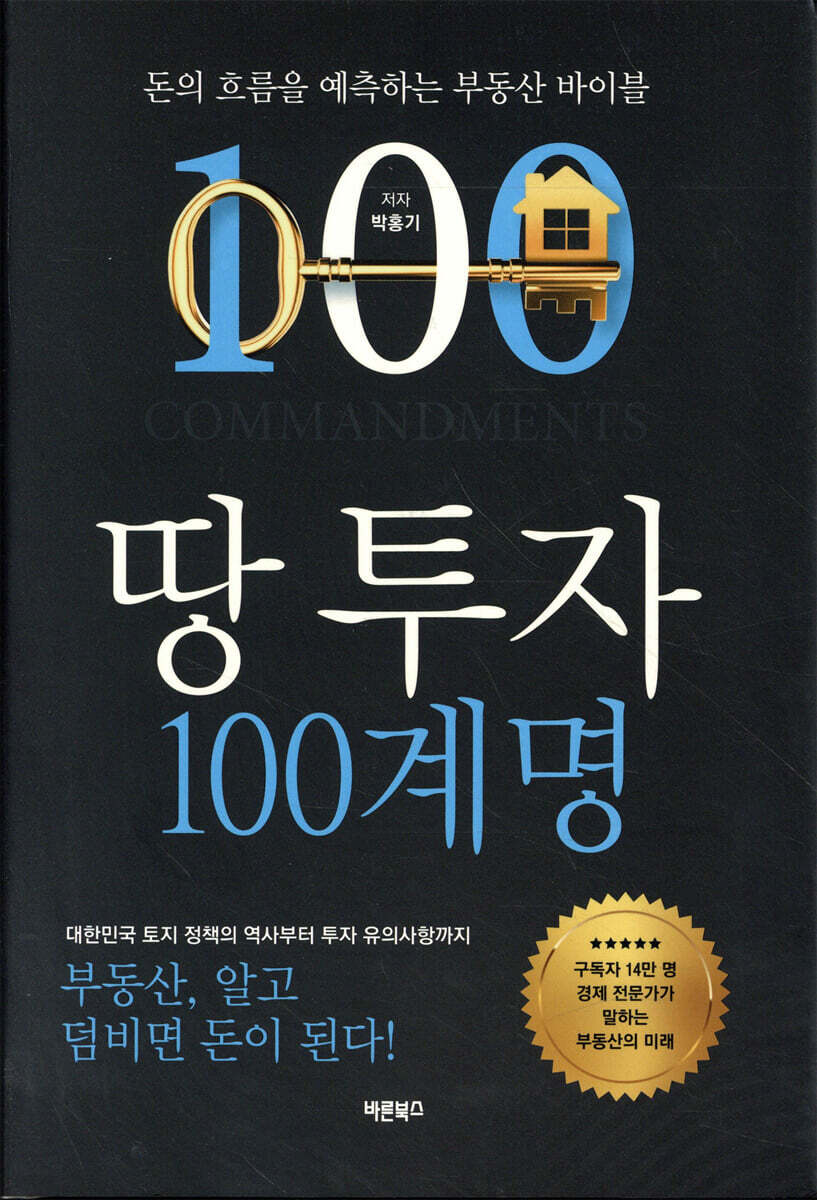
100 Commandments of Land Investment
 |
Description
Book Introduction
Real Estate Investments That Never Fail "100 Commandments of Land Investment," the real estate bible that predicts money flow Regional Analysis and Summary of the 5th Comprehensive National Land Plan Includes 100 Commandments of Land Investment Principles, organized with a focus on practice. A must-read book to understand the real estate market! "100 Commandments for Land Investment" is a book that looks back on the history of the real estate market, understands its current state, and outlines its future. Park Hong-gi, an economic expert from YouTube channel "Dobong Park Hong-gi," with 140,000 subscribers and 150 million cumulative views, has returned with his fourth book. The author argues that blindly investing based solely on the myth of real estate's invincibility is a surefire path to ruin and ruin. Future real estate investments require a thorough understanding of the region's history, policy changes, and international competitiveness, as well as the foresight to anticipate future development potential. In "100 Commandments for Land Investment," the author, who has lectured extensively on various economic fields, including international finance, stocks, and real estate, analyzes Korea's real estate policies and the rising trend of land prices to date, offering generous advice on real estate investment. |
- You can preview some of the book's contents.
Preview
index
Ⅰ.
Changes in our country's real estate policy
1.
The rapid urbanization and surge in land prices in Korea
1) The birth of urbanization
2) Period of city district revision (1910s)
3) The so-called urban planning movement period (after the 1920s)
4) Urbanization and industrialization in our country before liberation
2.
Class division in Seoul
3.
1930s-1940s, Japanese military supply base
4.
Land reform and Syngman Rhee
5.
1960s, development of industrial complexes centered on light industry
6.
1970s, Gangnam development begins
7.
1980s, the period of urbanization maturity
8.
The 1990s: The Era of Demand-Driven Differentiation
9.
2000s, Promoting Balanced National Development
Ⅱ.
Real estate policies by past governments
1.
1960s to mid-1990s
1) Park Chung-hee government (1962-1979)
2) Chun Doo-hwan government (1980-1986)
3) Roh Tae-woo government (1987-1992)
4) Kim Young-sam government (1993-1997)
2.
Since the late 1990s
1) Kim Dae-jung government (1998-2002)
2) Roh Moo-hyun administration (2003-2008)
3) Lee Myung-bak administration (2008-2012)
4) Park Geun-hye administration (2013-2017)
5) Moon Jae-in administration (2017~)
Ⅲ.
Trends in rising land prices in our country
1.
Economic growth and rising land prices
2.
Three periods of skyrocketing land prices
1) 1964~1971
2) 1975~1979
3) 1988~1990
3.
Since the 90s
Ⅳ.
Justifications and measures to curb concentration in the metropolitan area
1.
3rd New Town Development Direction and Characteristics
1) Designation of new city districts and selection of sites
2) Improving accessibility to downtown Seoul by securing a transportation network.
3) Creation of a self-sufficient city
2.
Metropolitan Transportation Vision 2030
1) Building a world-class express metropolitan transportation network
2) Construction of a metropolitan outer ring expressway network
3) Improving bus and transfer convenience and strengthening public service
3. GTX (Greater Seoul Area Rapid Transit Network)
1) GTX route-specific implementation plan
2) Implementation plan for each express train route
3) Effect of transportation mode share
4.
National Railway Network Construction Plan
1) Background of the 4th National Railway Network Construction Plan
2) Tasks to be promoted in each of the seven major directions
V.
Summary of the 5th Comprehensive National Land Plan by Region
1.
Seoul Metropolitan City
1) Status and role as a central city of the Republic of Korea
2) Strengthening the global competitiveness of Seoul and the Seoul metropolitan area.
3) Creating smart cities to foster innovation and create new industries.
2.
Busan Metropolitan City
1) Basic goals
2) Development direction
3.
Daegu Metropolitan City
1) A stepping stone to becoming a world-class city
2) Strengthening shared growth through inter-regional cooperation
4.
Incheon Metropolitan City
1) Expansion of the public transportation system and transformation of the urban spatial structure centered on station areas.
2) Promoting a customized urban regeneration New Deal that reflects the conditions and characteristics of downtown areas.
3) Fostering future strategic industries centered on free economic zones
4) Expanding industrial infrastructure and promoting industrial regeneration to enhance international competitiveness.
5) Response to the era of West Sea peace cooperation in the metropolitan area following the easing of tensions between North and South Korea.
6) Review of infrastructure expansion to strengthen the Incheon International Airport economic zone.
7) To enhance the competitiveness of the metropolitan area and promote mutual development as a metropolitan area.
5.
Sejong Special Self-Governing City
1) Basic goals
2) Development direction
6.
gyeonggi-do
1) Basic goals
2) Development direction
7.
Gangwon-do
1) Basic goals
2) Development direction
8.
South Chungcheong Province
1) Basic goals
2) Development direction
9.
Gyeongsangbuk-do
1) Basic goals
2) Development direction
10.
Gyeongsangnam-do
1) Basic goals
2) Development direction
11.
Jeollabuk-do
1) Basic goals
2) Development direction
12.
Jeju Special Self-Governing Province
1) Basic goals
2) Development direction
Ⅵ.
The Future of Real Estate
1.
Convergence content
1) Paju Book City
2) Promotion of convergence projects in other cities
2.
UNESCO Creative Cities Network
1) Literary Creative City
2) Creative City of Crafts and Folk Arts
3) Music Creative City
4) Design Creative City
5) Media Art Creative City
6) Creative Food City
7) Film Creative City
Ⅶ.
Seoul 2030 Plan
1.
Population structure changes
2.
Slowing economic growth and polarization
3.
Diversification of development axes for regional specialization
4.
Seoul City's Railway Plan and Expected Effects
1) Seoul City-related railway plan
2) Expected effects of expansion of Seoul's railway network
3) Changes in congestion levels on existing Seoul subways
Ⅷ.
The Future of Real Estate and Land Investment in Korea
1.
Entering the international city competition
1) Promotion of a unified economic special zone linked to the second phase of the Kaesong Industrial Complex project.
2) Strengthening international competitiveness through twin cities
2.
Park Hong-ki's 100 Commandments for Land Investment
Changes in our country's real estate policy
1.
The rapid urbanization and surge in land prices in Korea
1) The birth of urbanization
2) Period of city district revision (1910s)
3) The so-called urban planning movement period (after the 1920s)
4) Urbanization and industrialization in our country before liberation
2.
Class division in Seoul
3.
1930s-1940s, Japanese military supply base
4.
Land reform and Syngman Rhee
5.
1960s, development of industrial complexes centered on light industry
6.
1970s, Gangnam development begins
7.
1980s, the period of urbanization maturity
8.
The 1990s: The Era of Demand-Driven Differentiation
9.
2000s, Promoting Balanced National Development
Ⅱ.
Real estate policies by past governments
1.
1960s to mid-1990s
1) Park Chung-hee government (1962-1979)
2) Chun Doo-hwan government (1980-1986)
3) Roh Tae-woo government (1987-1992)
4) Kim Young-sam government (1993-1997)
2.
Since the late 1990s
1) Kim Dae-jung government (1998-2002)
2) Roh Moo-hyun administration (2003-2008)
3) Lee Myung-bak administration (2008-2012)
4) Park Geun-hye administration (2013-2017)
5) Moon Jae-in administration (2017~)
Ⅲ.
Trends in rising land prices in our country
1.
Economic growth and rising land prices
2.
Three periods of skyrocketing land prices
1) 1964~1971
2) 1975~1979
3) 1988~1990
3.
Since the 90s
Ⅳ.
Justifications and measures to curb concentration in the metropolitan area
1.
3rd New Town Development Direction and Characteristics
1) Designation of new city districts and selection of sites
2) Improving accessibility to downtown Seoul by securing a transportation network.
3) Creation of a self-sufficient city
2.
Metropolitan Transportation Vision 2030
1) Building a world-class express metropolitan transportation network
2) Construction of a metropolitan outer ring expressway network
3) Improving bus and transfer convenience and strengthening public service
3. GTX (Greater Seoul Area Rapid Transit Network)
1) GTX route-specific implementation plan
2) Implementation plan for each express train route
3) Effect of transportation mode share
4.
National Railway Network Construction Plan
1) Background of the 4th National Railway Network Construction Plan
2) Tasks to be promoted in each of the seven major directions
V.
Summary of the 5th Comprehensive National Land Plan by Region
1.
Seoul Metropolitan City
1) Status and role as a central city of the Republic of Korea
2) Strengthening the global competitiveness of Seoul and the Seoul metropolitan area.
3) Creating smart cities to foster innovation and create new industries.
2.
Busan Metropolitan City
1) Basic goals
2) Development direction
3.
Daegu Metropolitan City
1) A stepping stone to becoming a world-class city
2) Strengthening shared growth through inter-regional cooperation
4.
Incheon Metropolitan City
1) Expansion of the public transportation system and transformation of the urban spatial structure centered on station areas.
2) Promoting a customized urban regeneration New Deal that reflects the conditions and characteristics of downtown areas.
3) Fostering future strategic industries centered on free economic zones
4) Expanding industrial infrastructure and promoting industrial regeneration to enhance international competitiveness.
5) Response to the era of West Sea peace cooperation in the metropolitan area following the easing of tensions between North and South Korea.
6) Review of infrastructure expansion to strengthen the Incheon International Airport economic zone.
7) To enhance the competitiveness of the metropolitan area and promote mutual development as a metropolitan area.
5.
Sejong Special Self-Governing City
1) Basic goals
2) Development direction
6.
gyeonggi-do
1) Basic goals
2) Development direction
7.
Gangwon-do
1) Basic goals
2) Development direction
8.
South Chungcheong Province
1) Basic goals
2) Development direction
9.
Gyeongsangbuk-do
1) Basic goals
2) Development direction
10.
Gyeongsangnam-do
1) Basic goals
2) Development direction
11.
Jeollabuk-do
1) Basic goals
2) Development direction
12.
Jeju Special Self-Governing Province
1) Basic goals
2) Development direction
Ⅵ.
The Future of Real Estate
1.
Convergence content
1) Paju Book City
2) Promotion of convergence projects in other cities
2.
UNESCO Creative Cities Network
1) Literary Creative City
2) Creative City of Crafts and Folk Arts
3) Music Creative City
4) Design Creative City
5) Media Art Creative City
6) Creative Food City
7) Film Creative City
Ⅶ.
Seoul 2030 Plan
1.
Population structure changes
2.
Slowing economic growth and polarization
3.
Diversification of development axes for regional specialization
4.
Seoul City's Railway Plan and Expected Effects
1) Seoul City-related railway plan
2) Expected effects of expansion of Seoul's railway network
3) Changes in congestion levels on existing Seoul subways
Ⅷ.
The Future of Real Estate and Land Investment in Korea
1.
Entering the international city competition
1) Promotion of a unified economic special zone linked to the second phase of the Kaesong Industrial Complex project.
2) Strengthening international competitiveness through twin cities
2.
Park Hong-ki's 100 Commandments for Land Investment
Detailed image
.jpg)
Into the book
If you jump into something without knowing anything, the probability of failure is 100%.
To reduce these failures, we examine the history of our country's real estate policy and examine the 100 commandments of real estate investment to determine which lands to invest in and which ones have a certain future value.
--- p.
5 "Introductory Remarks"
Real estate requires a good understanding of the flow of the times and history.
And to know about the land, you need to know the national regional development plan.
If you understand the 5th Comprehensive National Land Plan (2020-2040), you can know where you live and where you need to go.
If you understand how our country's real estate policies and circumstances have changed over time, as we've seen so far, you'll have a sense of where and what kind of land to choose.
--- p.
239 「Ⅷ.
The Future of Real Estate and Land Investment in Korea
Investing is real.
Romance must end in romance.
Most people have a certain degree of romanticism and vanity, and so they are sometimes swayed by the tricks of real estate agents.
In other words, sweet words like ‘have your own island’ or ‘enjoy your own kingdom’ stimulate the fantasies of many people.
If you fan fantasy, romance, and unnecessary vanity, you should think that real estate prices will double.
To reduce these failures, we examine the history of our country's real estate policy and examine the 100 commandments of real estate investment to determine which lands to invest in and which ones have a certain future value.
--- p.
5 "Introductory Remarks"
Real estate requires a good understanding of the flow of the times and history.
And to know about the land, you need to know the national regional development plan.
If you understand the 5th Comprehensive National Land Plan (2020-2040), you can know where you live and where you need to go.
If you understand how our country's real estate policies and circumstances have changed over time, as we've seen so far, you'll have a sense of where and what kind of land to choose.
--- p.
239 「Ⅷ.
The Future of Real Estate and Land Investment in Korea
Investing is real.
Romance must end in romance.
Most people have a certain degree of romanticism and vanity, and so they are sometimes swayed by the tricks of real estate agents.
In other words, sweet words like ‘have your own island’ or ‘enjoy your own kingdom’ stimulate the fantasies of many people.
If you fan fantasy, romance, and unnecessary vanity, you should think that real estate prices will double.
--- p.255 "Park Hong-gi's 100 Commandments for Land Investment"
Publisher's Review
From the history of South Korea's land policy to investment considerations
Accessibility to information determines the success or failure of real estate investments.
“Real estate requires a good understanding of the flow of the times and history.
And to know about the land, you need to know the national regional development plan.
If you understand the 5th Comprehensive National Land Plan (2020-2040), you can know where you live and where you need to go.
(Omitted) Now is the time when industrialization is coming to an end.
In a post-industrial society, real estate decisions should not be made solely based on the situation in a particular region or immediate, visible benefits.
“With the advent of the information society, missing the flow of global environmental changes will only lead to failure.” _From “The Future of Real Estate and Land Investment in Korea”
Until now, in Korea, there have been many cases where the price of real estate went up if you bought it and waited.
As a result, there were many people who did not know much about real estate but tried to buy real estate with even a small amount of spare money.
However, in today's information-rich era, people try to make better investments through their own information collection and analysis, but it is difficult to discern what is good information.
Real estate creates its value through a complex interplay of factors, including trends in the times, national policies, and future competitiveness.
In the future, our country's status on the international stage will also become a factor that cannot be ignored.
"100 Commandments for Land Investment" provides analysis of the overall economy, changes in real estate policy, and the city's international competitiveness, as well as information on development and permitting.
The author also presents 100 commandments for real estate investment, organized with a focus on practical application.
The history of the land reveals the direction of investment. Let go of romanticism and face reality!
“Thirteen, romanticizing the land is a shortcut to ruin.
Investing is real.
Romance must end in romance.” _From “Park Hong-ki’s 100 Commandments for Land Investment”
In our country, where the land area is small, at some point the belief that owning real estate would make money arose.
Today, apartments are essential living spaces for families to live together.
Nevertheless, with real estate prices continuing to rise, the perception that houses and land are not considered as a means of housing or a factor of production, but rather as a means of increasing wealth, has taken root in our people's consciousness.
It is not easy for ordinary office workers to buy and sell real estate with just their income.
In this situation, looking at the soaring housing prices only makes me more anxious.
In this situation, self-deprecating expressions such as 'Yeonggeul', which means to buy a house by gathering one's soul, and 'Suddenly poor', which means that people who do not buy real estate due to the rapid rise in real estate prices, have become 'suddenly poor', have emerged.
However, it is even more dangerous to dream of winning the lottery, gamble, or take on debt you cannot afford to lose in order to invest in real estate.
The author says, “If you jump into something without knowing anything, the probability of failure is 100%.”
Rather than having hasty romantic notions about real estate investment, you should prepare and study step by step.
In "100 Commandments of Land Investment," we examine the history of Korea's real estate policy from the 1910s to the present to reduce real estate investment failures, and organize the real estate policies of each government from the Park Chung-hee administration to the Moon Jae-in administration, summarizing the flow of real estate in Korea in one volume.
It also forecasts the future of real estate and suggests the right direction for investment by summarizing and analyzing the railway network construction plan, the 3rd new city plan, and the 5th National Comprehensive Plan for 12 regions from Seoul to Jeju.
Where are real estate trends heading now? Where is the future value of real estate certain? Only by understanding the current trends and understanding the value of land can we seize the future of real estate.
I hope that "100 Commandments of Land Investment" will serve as a starting point for wiser real estate investment.
Accessibility to information determines the success or failure of real estate investments.
“Real estate requires a good understanding of the flow of the times and history.
And to know about the land, you need to know the national regional development plan.
If you understand the 5th Comprehensive National Land Plan (2020-2040), you can know where you live and where you need to go.
(Omitted) Now is the time when industrialization is coming to an end.
In a post-industrial society, real estate decisions should not be made solely based on the situation in a particular region or immediate, visible benefits.
“With the advent of the information society, missing the flow of global environmental changes will only lead to failure.” _From “The Future of Real Estate and Land Investment in Korea”
Until now, in Korea, there have been many cases where the price of real estate went up if you bought it and waited.
As a result, there were many people who did not know much about real estate but tried to buy real estate with even a small amount of spare money.
However, in today's information-rich era, people try to make better investments through their own information collection and analysis, but it is difficult to discern what is good information.
Real estate creates its value through a complex interplay of factors, including trends in the times, national policies, and future competitiveness.
In the future, our country's status on the international stage will also become a factor that cannot be ignored.
"100 Commandments for Land Investment" provides analysis of the overall economy, changes in real estate policy, and the city's international competitiveness, as well as information on development and permitting.
The author also presents 100 commandments for real estate investment, organized with a focus on practical application.
The history of the land reveals the direction of investment. Let go of romanticism and face reality!
“Thirteen, romanticizing the land is a shortcut to ruin.
Investing is real.
Romance must end in romance.” _From “Park Hong-ki’s 100 Commandments for Land Investment”
In our country, where the land area is small, at some point the belief that owning real estate would make money arose.
Today, apartments are essential living spaces for families to live together.
Nevertheless, with real estate prices continuing to rise, the perception that houses and land are not considered as a means of housing or a factor of production, but rather as a means of increasing wealth, has taken root in our people's consciousness.
It is not easy for ordinary office workers to buy and sell real estate with just their income.
In this situation, looking at the soaring housing prices only makes me more anxious.
In this situation, self-deprecating expressions such as 'Yeonggeul', which means to buy a house by gathering one's soul, and 'Suddenly poor', which means that people who do not buy real estate due to the rapid rise in real estate prices, have become 'suddenly poor', have emerged.
However, it is even more dangerous to dream of winning the lottery, gamble, or take on debt you cannot afford to lose in order to invest in real estate.
The author says, “If you jump into something without knowing anything, the probability of failure is 100%.”
Rather than having hasty romantic notions about real estate investment, you should prepare and study step by step.
In "100 Commandments of Land Investment," we examine the history of Korea's real estate policy from the 1910s to the present to reduce real estate investment failures, and organize the real estate policies of each government from the Park Chung-hee administration to the Moon Jae-in administration, summarizing the flow of real estate in Korea in one volume.
It also forecasts the future of real estate and suggests the right direction for investment by summarizing and analyzing the railway network construction plan, the 3rd new city plan, and the 5th National Comprehensive Plan for 12 regions from Seoul to Jeju.
Where are real estate trends heading now? Where is the future value of real estate certain? Only by understanding the current trends and understanding the value of land can we seize the future of real estate.
I hope that "100 Commandments of Land Investment" will serve as a starting point for wiser real estate investment.
GOODS SPECIFICS
- Publication date: July 26, 2021
- Page count, weight, size: 336 pages | 152*224*30mm
- ISBN13: 9791165454425
- ISBN10: 1165454424
You may also like
카테고리
korean


korean

![GQ KOREA Mark (Monthly): December [2025]](http://librairie.coreenne.fr/cdn/shop/files/8ef265dbbfbf186523ed75ba7319009d.jpg?v=1765340328&width=3840)


