

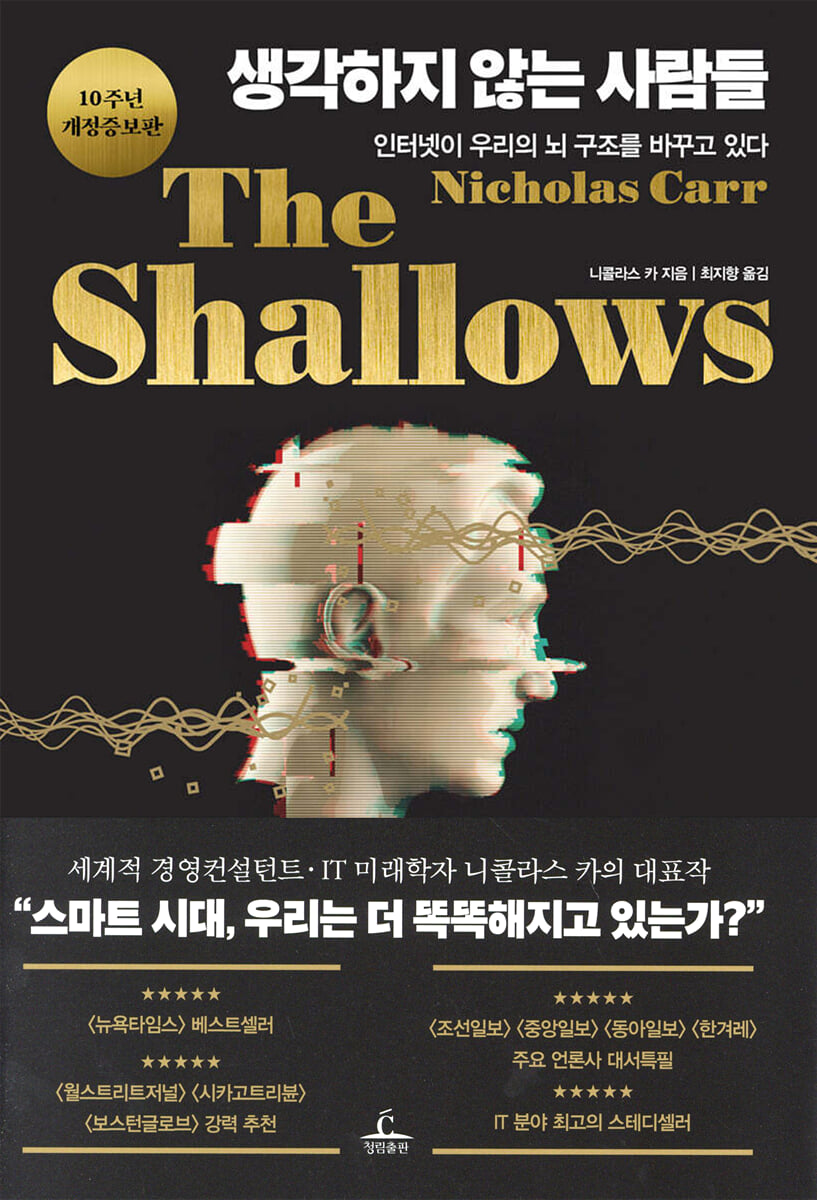
People Who Don't Think (10th Anniversary Revised and Expanded Edition)
 |
Description
Book Introduction
A Warning for the Digital Age, 10 Years Later…
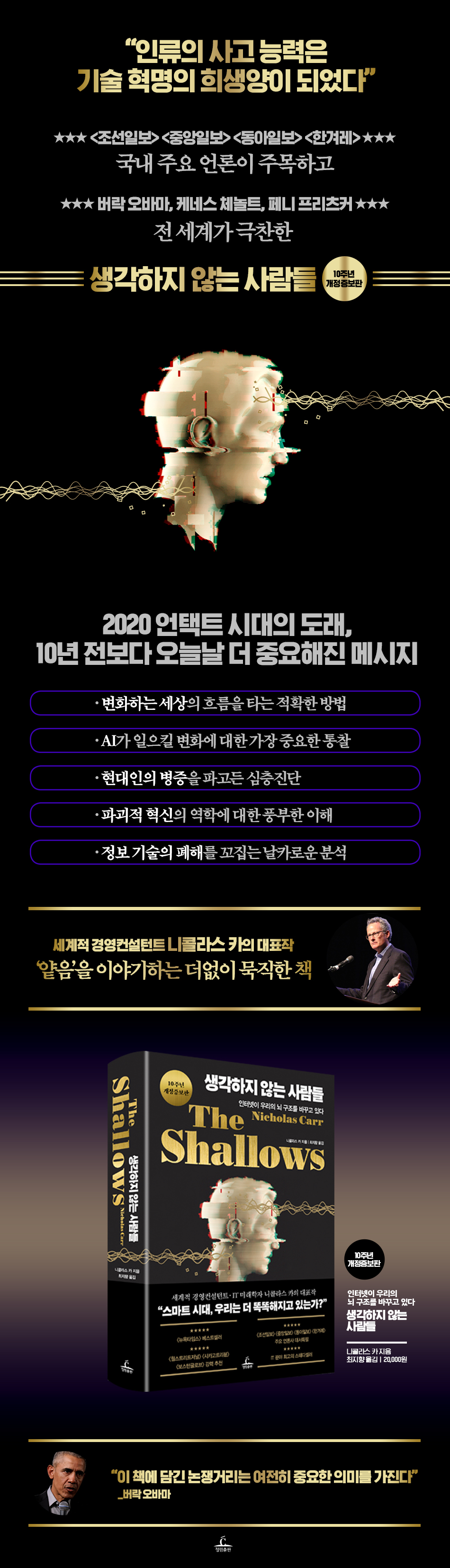
“Humanity's ability to think has become a victim of the technological revolution.”
Nicholas Carr, a world-renowned management consultant and IT futurist, has returned with a revised and expanded edition of his best-selling book, "The Unthinkable." It's been 10 years since its publication.
This book, which has captured the world's attention and become the basis for one of the most important debates of our time, suggests that while humanity enjoys the abundance provided by the Internet, it is losing its ability to think.
This revised and expanded edition, in particular, contains in-depth research on the Internet's impact on the human brain and exposes the giant social media companies that program us.
With the advent of the contactless era, this book has become even more relevant than it was 10 years ago, once again warning of the reality of humanity's declining cognitive abilities.
“Humanity's ability to think has become a victim of the technological revolution.”
Nicholas Carr, a world-renowned management consultant and IT futurist, has returned with a revised and expanded edition of his best-selling book, "The Unthinkable." It's been 10 years since its publication.
This book, which has captured the world's attention and become the basis for one of the most important debates of our time, suggests that while humanity enjoys the abundance provided by the Internet, it is losing its ability to think.
This revised and expanded edition, in particular, contains in-depth research on the Internet's impact on the human brain and exposes the giant social media companies that program us.
With the advent of the contactless era, this book has become even more relevant than it was 10 years ago, once again warning of the reality of humanity's declining cognitive abilities.
- You can preview some of the book's contents.
Preview
index
Preface to the Revised Edition
Preface: The Watchdog and the Thief
Part 1: The Writing Revolution and the Expansion of Human Thought
Chapter 1: The Computer and Me
The Internet Is More Than Just a Distribution Channel for Information | Losing Your Brain
Chapter 2 Living Passage
The Amazing Complexity of the Human Brain | Can Our Brains Change? | Brain Plasticity | The Brain Changes as We Think | Survival of the Busiest
* The brain that thinks
Chapter 3: Letters, a Tool for New Thinking
Technology Creates Revolutionary Mindsets | How Letters Affect Our Thinking
Chapter 4: The Stage of Deepening Thought
The Beginning of Deep Reading | Gutenberg, Changing the World | The Advent of a New World Beyond the Bookshelf
* Lee DeForest and his amazing audio
Part 2: The Internet: Changing Beyond Thought to Brain Structure
Chapter 5 Media with the Most Common Characteristics
The Impact of Increased Internet Use | Media Consumed by the Internet | Changes in Media Consumption Patterns
Chapter 6: The Rise of E-Books: The End of Books?
The Kindle: A Look into the Future of Digital Readers | The Impact It Will Have on Writing | Will Books Ever Be Replaced by Other Media | The Truth About Multitasking
Chapter 7 The Acrobatic Brain
Our brain is sensitive to the Internet | When the brain is overworked, it becomes distracted | The relationship between hypertext and cognitive ability | The Internet divides your concentration | Reading by scanning documents | The impact of online habits | Direct knowledge vs.
Knowledge that can be found
* The average IQ score is gradually increasing?
Chapter 8: The Empire Called 'Google'
Google Makes Information Scanning Faster | All Knowledge Gathers on Google | Google Book Search, Prelude to Book Digitization | Efficient Information Gathering vs.
Inefficient Thinking | Google: A Gift from an Angel or a Temptation from the Devil?
Chapter 9 Search and Memory
Memory enhancement is based on genetic mutations. Human memory is constantly being renewed. The Internet is accustoming us to forgetting. Outsourcing memory causes culture to wither.
* My confession
Chapter 10: Computers, the Internet, and Humans
The Potential and Limitations of Tools | Technology Traded for the Most Human of Things | The Nervous System and Computers: More Dangerous Because They're Similar | Computers Reduce the Brain's Ability to Form Schemas | Embracing the Frenzy of Technology
Postscript to the Revised Edition: The Most Interesting Thing in the World
Acknowledgements
Recommended books
main
Preface: The Watchdog and the Thief
Part 1: The Writing Revolution and the Expansion of Human Thought
Chapter 1: The Computer and Me
The Internet Is More Than Just a Distribution Channel for Information | Losing Your Brain
Chapter 2 Living Passage
The Amazing Complexity of the Human Brain | Can Our Brains Change? | Brain Plasticity | The Brain Changes as We Think | Survival of the Busiest
* The brain that thinks
Chapter 3: Letters, a Tool for New Thinking
Technology Creates Revolutionary Mindsets | How Letters Affect Our Thinking
Chapter 4: The Stage of Deepening Thought
The Beginning of Deep Reading | Gutenberg, Changing the World | The Advent of a New World Beyond the Bookshelf
* Lee DeForest and his amazing audio
Part 2: The Internet: Changing Beyond Thought to Brain Structure
Chapter 5 Media with the Most Common Characteristics
The Impact of Increased Internet Use | Media Consumed by the Internet | Changes in Media Consumption Patterns
Chapter 6: The Rise of E-Books: The End of Books?
The Kindle: A Look into the Future of Digital Readers | The Impact It Will Have on Writing | Will Books Ever Be Replaced by Other Media | The Truth About Multitasking
Chapter 7 The Acrobatic Brain
Our brain is sensitive to the Internet | When the brain is overworked, it becomes distracted | The relationship between hypertext and cognitive ability | The Internet divides your concentration | Reading by scanning documents | The impact of online habits | Direct knowledge vs.
Knowledge that can be found
* The average IQ score is gradually increasing?
Chapter 8: The Empire Called 'Google'
Google Makes Information Scanning Faster | All Knowledge Gathers on Google | Google Book Search, Prelude to Book Digitization | Efficient Information Gathering vs.
Inefficient Thinking | Google: A Gift from an Angel or a Temptation from the Devil?
Chapter 9 Search and Memory
Memory enhancement is based on genetic mutations. Human memory is constantly being renewed. The Internet is accustoming us to forgetting. Outsourcing memory causes culture to wither.
* My confession
Chapter 10: Computers, the Internet, and Humans
The Potential and Limitations of Tools | Technology Traded for the Most Human of Things | The Nervous System and Computers: More Dangerous Because They're Similar | Computers Reduce the Brain's Ability to Form Schemas | Embracing the Frenzy of Technology
Postscript to the Revised Edition: The Most Interesting Thing in the World
Acknowledgements
Recommended books
main
Detailed image
Into the book
In a 2010 Pew Research Center survey of over 400 prominent thinkers, over 80 percent agreed that “by 2020, Internet use will increase human intelligence, and with access to unprecedented amounts of information, people will be smarter and make better choices.”
The year 2020 has arrived.
We are not getting smarter and we are not making better choices.
--- p.5-6, from the “Preface to the Revised Edition”
I was the kind of person who could easily concentrate on a book or a long article.
My mind could easily follow the deliberately twisted narrative structure or the shifts in argument, and I could wander through long prose passages for hours.
But these days, that's not easy to do.
Even if I only read one or two pages, my concentration starts to waver.
Then, you start to fidget, lose the context, and quickly start looking for something else to do.
I try to pull my restless brain back into focus and focus on my writing again.
The act of concentrating on reading like before has become a struggle.
--- p.25, from “Chapter 1: Computers and Me”
What Nietzsche realized when he typed words onto paper in his typewriter was that the tools we use to write, read, and manipulate information have some effect on our thinking, just as our thinking influences the machines.
This has been a central theme in intellectual and cultural history.
--- p.85, from “Chapter 3: Letters, a Tool for New Thinking”
Jumping through digital documents has become easier than ever before, thanks to links that make searching easier and faster than ever before.
Concentration on documents became weaker and more ephemeral.
Search has also led to the fragmentation of online works.
Search engines often capture our attention by showing us fragments of documents or a few words from sentences that are deeply related to what we're looking for at the time, but they rarely provide us with a basis for understanding the work as a whole.
When you search the web, you don't see the forest.
I can't even see the trees.
All I can see are twigs and leaves.
--- p.155, from “Chapter 5: Media with the Most Universal Characteristics”
As I started reading, I noticed that although the book was very well written and contained a wealth of information, I found it very difficult to concentrate.
I was scrolling back and forth, searching for keywords, stopping more often than usual to get coffee, check email, catch up on news, and reorganize files in my desk drawer, so I couldn't read properly.
Eventually I finished the book and was glad I did it.
But what I realized a week later was that it wasn't easy to remember what I had read.
--- p.175, from “Chapter 6: The Rise of E-Books, the End of Books?”
Google's online world leaves little room for the ambiguous detours of thoughtful silence or meditation for deep reading.
Ambiguity is not a starting point for insight, it is a bug to be fixed.
The human brain is just an old-fashioned computer that needs faster processors, bigger hard drives, and better algorithms to guide our thought processes.
--- p.282, from “Chapter 8: The Empire Called ‘Google’”
The proliferation of smartphones, with over 10 billion units sold, and the subsequent growth of social media have had a far-reaching impact on nearly every aspect of our lives and culture.
Smartphones have brought new texture and speed to our lives.
It overturned social norms and relationships.
The public sphere and the political arena were also reorganized.
Moreover, the proliferation of smartphones has allowed a few companies to dominate the way we see, act, and express ourselves.
The year 2020 has arrived.
We are not getting smarter and we are not making better choices.
--- p.5-6, from the “Preface to the Revised Edition”
I was the kind of person who could easily concentrate on a book or a long article.
My mind could easily follow the deliberately twisted narrative structure or the shifts in argument, and I could wander through long prose passages for hours.
But these days, that's not easy to do.
Even if I only read one or two pages, my concentration starts to waver.
Then, you start to fidget, lose the context, and quickly start looking for something else to do.
I try to pull my restless brain back into focus and focus on my writing again.
The act of concentrating on reading like before has become a struggle.
--- p.25, from “Chapter 1: Computers and Me”
What Nietzsche realized when he typed words onto paper in his typewriter was that the tools we use to write, read, and manipulate information have some effect on our thinking, just as our thinking influences the machines.
This has been a central theme in intellectual and cultural history.
--- p.85, from “Chapter 3: Letters, a Tool for New Thinking”
Jumping through digital documents has become easier than ever before, thanks to links that make searching easier and faster than ever before.
Concentration on documents became weaker and more ephemeral.
Search has also led to the fragmentation of online works.
Search engines often capture our attention by showing us fragments of documents or a few words from sentences that are deeply related to what we're looking for at the time, but they rarely provide us with a basis for understanding the work as a whole.
When you search the web, you don't see the forest.
I can't even see the trees.
All I can see are twigs and leaves.
--- p.155, from “Chapter 5: Media with the Most Universal Characteristics”
As I started reading, I noticed that although the book was very well written and contained a wealth of information, I found it very difficult to concentrate.
I was scrolling back and forth, searching for keywords, stopping more often than usual to get coffee, check email, catch up on news, and reorganize files in my desk drawer, so I couldn't read properly.
Eventually I finished the book and was glad I did it.
But what I realized a week later was that it wasn't easy to remember what I had read.
--- p.175, from “Chapter 6: The Rise of E-Books, the End of Books?”
Google's online world leaves little room for the ambiguous detours of thoughtful silence or meditation for deep reading.
Ambiguity is not a starting point for insight, it is a bug to be fixed.
The human brain is just an old-fashioned computer that needs faster processors, bigger hard drives, and better algorithms to guide our thought processes.
--- p.282, from “Chapter 8: The Empire Called ‘Google’”
The proliferation of smartphones, with over 10 billion units sold, and the subsequent growth of social media have had a far-reaching impact on nearly every aspect of our lives and culture.
Smartphones have brought new texture and speed to our lives.
It overturned social norms and relationships.
The public sphere and the political arena were also reorganized.
Moreover, the proliferation of smartphones has allowed a few companies to dominate the way we see, act, and express ourselves.
--- p.359, from “Afterword to the Revised Edition: The Most Interesting Thing in the World”
Publisher's Review
“In the smart age, are we getting smarter?”
A masterpiece by world-renowned management consultant Nicholas Carr
The 10th Anniversary Revised and Expanded Edition of "The Unthinking"
★ [New York Times] Bestseller
★ A book that has garnered worldwide attention, including from [Harvard Business Review] and [Wall Street Journal].
★ [Chosun Ilbo] [JoongAng Ilbo] [Dong-A Ilbo] [Hankyoreh] Major domestic media outlets featured in the headlines
★ Highly recommended by Barack Obama, Kenneth Chenault, and Penny Pritzker
★ Pulitzer Prize Finalist Nominee
A Warning for the Digital Age, 10 Years Later…
“Humanity's ability to think has become a victim of the technological revolution.”
Nicholas Carr, a world-renowned management consultant and IT futurist, has returned with a revised and expanded edition of his best-selling book, "The Unthinkable." It's been 10 years since its publication.
This book, which has captured the world's attention and become the basis for one of the most important debates of our time, suggests that while humanity enjoys the abundance provided by the Internet, it is losing its ability to think.
This revised and expanded edition, in particular, contains in-depth research on the Internet's impact on the human brain and exposes the giant social media companies that program us.
With the advent of the contactless era, this book has become even more relevant than it was 10 years ago, once again warning of the reality of humanity's declining cognitive abilities.
The Internet has changed our way of thinking.
Make it shallow and light
As soon as I wake up in the morning, I pick up my smartphone and check the news feed that has accumulated over the night, and on the subway to work, I watch a drama on Netflix.
After work, I eat dinner and watch videos recommended by the YouTube algorithm for hours before falling asleep.
The daily life of modern people who never let go of their smartphones from morning to night.
We can no longer imagine a world without smartphones and the Internet.
Even today, people do not seek the information or knowledge they need from libraries.
With the internet, we can easily acquire information anytime, anywhere with just a few searches, and naturally, efficiency and speed are more important than depth of knowledge.
People think they are getting smarter as information technology advances.
Have we really become smarter?
Since the dawn of the Internet age, more and more people have been complaining of lack of concentration and forgetfulness.
This book uses brain science theory to meticulously diagnose how our ability to think deeply, analyze, and gain insight is diminishing as we drift through the algorithms of the Internet and YouTube.
As digital technology develops, we only seek out context-free information through the Internet.
The Internet now simplifies and fragments information and communication itself, robbing us of the ability to think deeply.
A glance at the development of human thought
The greatest classic of the 21st century
In this book, the author traces the development of civilization and explains in detail the process of change in human thinking ability.
This book covers the impact of the development of writing systems, from cuneiform to hieroglyphics to the Greek alphabet, on how we read and write; how the development of maps and printing media shaped abstract thinking; and how the invention of the clock became a major driving force behind the idea of individualism.
Next, he diagnoses the amazing intellectual changes brought about by today's information technology, clearly revealing both the amazing conveniences the Internet has given us and its harmful effects.
This book, called the online version of Understanding Media, written by Marshall McLuhan, a renowned communication scholar and considered the most important thinker after Newton, Darwin, Freud, Einstein, and Pavlov, will provide us with the most important insights in today's world where new technologies continue to emerge.
The advent of the contactless era in 2020,
A message more important today than it was 10 years ago
As of 2020, the smartphone penetration rate in Korea is 95%, making smartphones and the internet increasingly inseparable from us.
Even now, giant internet companies are cleverly manipulating our thoughts and choices, programming us to “maximize the time we spend on our devices.”
The various studies showing that the Internet changes the structure of our brains and reduces our ability to think deeply, and the paradoxical fact that Steve Jobs and Bill Gates, who played a major role in creating today's digital environment, strictly control their children's use of smart devices, have much to say about us.
The influence of the Internet on us will only grow in the future.
If you believe digital culture is harmless, if you believe humans are becoming increasingly intelligent with the advancement of smart devices, if you find yourself surrendering your mind to an endless stream of hyperlinks and algorithms, this is a must-read.
A masterpiece by world-renowned management consultant Nicholas Carr
The 10th Anniversary Revised and Expanded Edition of "The Unthinking"
★ [New York Times] Bestseller
★ A book that has garnered worldwide attention, including from [Harvard Business Review] and [Wall Street Journal].
★ [Chosun Ilbo] [JoongAng Ilbo] [Dong-A Ilbo] [Hankyoreh] Major domestic media outlets featured in the headlines
★ Highly recommended by Barack Obama, Kenneth Chenault, and Penny Pritzker
★ Pulitzer Prize Finalist Nominee
A Warning for the Digital Age, 10 Years Later…
“Humanity's ability to think has become a victim of the technological revolution.”
Nicholas Carr, a world-renowned management consultant and IT futurist, has returned with a revised and expanded edition of his best-selling book, "The Unthinkable." It's been 10 years since its publication.
This book, which has captured the world's attention and become the basis for one of the most important debates of our time, suggests that while humanity enjoys the abundance provided by the Internet, it is losing its ability to think.
This revised and expanded edition, in particular, contains in-depth research on the Internet's impact on the human brain and exposes the giant social media companies that program us.
With the advent of the contactless era, this book has become even more relevant than it was 10 years ago, once again warning of the reality of humanity's declining cognitive abilities.
The Internet has changed our way of thinking.
Make it shallow and light
As soon as I wake up in the morning, I pick up my smartphone and check the news feed that has accumulated over the night, and on the subway to work, I watch a drama on Netflix.
After work, I eat dinner and watch videos recommended by the YouTube algorithm for hours before falling asleep.
The daily life of modern people who never let go of their smartphones from morning to night.
We can no longer imagine a world without smartphones and the Internet.
Even today, people do not seek the information or knowledge they need from libraries.
With the internet, we can easily acquire information anytime, anywhere with just a few searches, and naturally, efficiency and speed are more important than depth of knowledge.
People think they are getting smarter as information technology advances.
Have we really become smarter?
Since the dawn of the Internet age, more and more people have been complaining of lack of concentration and forgetfulness.
This book uses brain science theory to meticulously diagnose how our ability to think deeply, analyze, and gain insight is diminishing as we drift through the algorithms of the Internet and YouTube.
As digital technology develops, we only seek out context-free information through the Internet.
The Internet now simplifies and fragments information and communication itself, robbing us of the ability to think deeply.
A glance at the development of human thought
The greatest classic of the 21st century
In this book, the author traces the development of civilization and explains in detail the process of change in human thinking ability.
This book covers the impact of the development of writing systems, from cuneiform to hieroglyphics to the Greek alphabet, on how we read and write; how the development of maps and printing media shaped abstract thinking; and how the invention of the clock became a major driving force behind the idea of individualism.
Next, he diagnoses the amazing intellectual changes brought about by today's information technology, clearly revealing both the amazing conveniences the Internet has given us and its harmful effects.
This book, called the online version of Understanding Media, written by Marshall McLuhan, a renowned communication scholar and considered the most important thinker after Newton, Darwin, Freud, Einstein, and Pavlov, will provide us with the most important insights in today's world where new technologies continue to emerge.
The advent of the contactless era in 2020,
A message more important today than it was 10 years ago
As of 2020, the smartphone penetration rate in Korea is 95%, making smartphones and the internet increasingly inseparable from us.
Even now, giant internet companies are cleverly manipulating our thoughts and choices, programming us to “maximize the time we spend on our devices.”
The various studies showing that the Internet changes the structure of our brains and reduces our ability to think deeply, and the paradoxical fact that Steve Jobs and Bill Gates, who played a major role in creating today's digital environment, strictly control their children's use of smart devices, have much to say about us.
The influence of the Internet on us will only grow in the future.
If you believe digital culture is harmless, if you believe humans are becoming increasingly intelligent with the advancement of smart devices, if you find yourself surrendering your mind to an endless stream of hyperlinks and algorithms, this is a must-read.
GOODS SPECIFICS
- Date of issue: October 5, 2020
- Format: Hardcover book binding method guide
- Page count, weight, size: 424 pages | 810g | 145*216*30mm
- ISBN13: 9788935213269
- ISBN10: 8935213268
You may also like
카테고리
korean


korean

![GQ KOREA Mark (Monthly): December [2025]](http://librairie.coreenne.fr/cdn/shop/files/8ef265dbbfbf186523ed75ba7319009d.jpg?v=1765340328&width=3840)


