

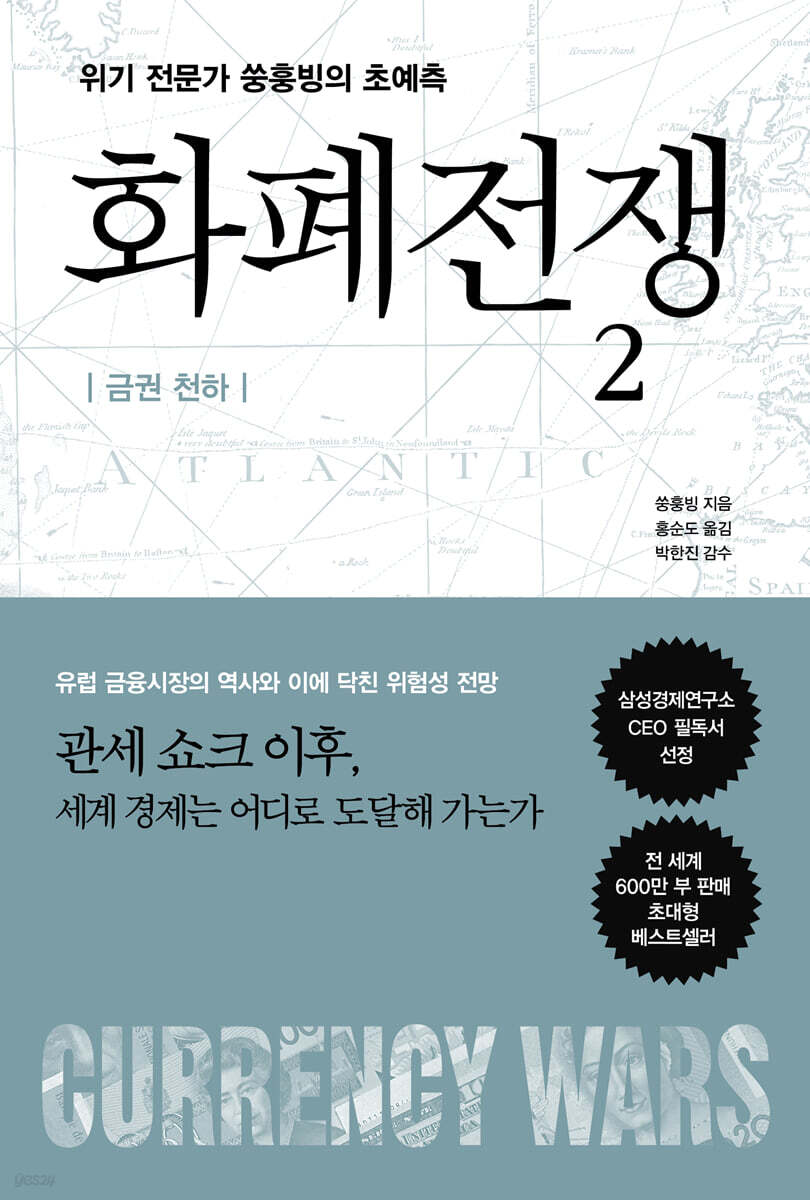
Currency Wars 2: The World of Money
 |
Description
Book Introduction
“Post-Brexit: Is there a solution?”
How European Finance Developed and What Risks Does It Face?
The true nature of the financial powers that manipulate the global economy behind the scenes.
The latest revised edition of "Currency Wars 2: The World of Money," which has garnered much attention for revealing the hidden power of the financial sector behind numerous historical events, including wars and revolutions, is now available.
This book, which has sold over 6 million copies worldwide, has become the bible of 'money', receiving overwhelming recommendations from numerous economic organizations and business figures, including the Samsung Economic Research Institute, since its first publication in Korea in 2008.
Author Song Hongbing, a Chinese international finance scholar, draws on his experience working in the American financial industry to sharply dissect the inner workings of the US-centric international financial order.
It reveals the deep involvement of financial conglomerates in the center of global finance, including the United States, and further reveals how the current international order is based on a flawed foundation.
Volume 2 thoroughly traces the formation, development, and mergers and acquisitions of 17 major financial families in Europe and the United States that have dominated the world over the past 300 years.
This book argues, with extensive historical materials and cool logic, the past struggles and future strategies of the international financial families who invariably cast a dark shadow behind wars, depressions, and revolutions around the world, including the French Revolution, the Napoleonic Wars, World Wars I and II, the founding of Israel, post-war German hyperinflation, Hitler's rise to power, and the birth and growth of the British Intelligence Service, the OSS, the Mossad, and the CIA.
It shows how the European and American economies are being manipulated by a few financial families, exposing vulnerabilities we have overlooked when looking at the West.
This book, which predicted the 2008 financial crisis in the United States, still holds value as a predictive book.
In recent years, China has been attempting to realize its "Chinese Dream" by establishing the Asian Infrastructure Investment Bank (AIIB) and developing a digital yuan, thereby breaking away from the US dollar's hegemony and establishing the yuan as a reserve currency.
The United States is also keeping China in check and cracking down on Chinese government interference in public trade.
The new Cold War between the United States and China is truly the beginning of a 'currency war.'
This book will serve as a guide to how countries around the world will compete for financial hegemony in the future.
How European Finance Developed and What Risks Does It Face?
The true nature of the financial powers that manipulate the global economy behind the scenes.
The latest revised edition of "Currency Wars 2: The World of Money," which has garnered much attention for revealing the hidden power of the financial sector behind numerous historical events, including wars and revolutions, is now available.
This book, which has sold over 6 million copies worldwide, has become the bible of 'money', receiving overwhelming recommendations from numerous economic organizations and business figures, including the Samsung Economic Research Institute, since its first publication in Korea in 2008.
Author Song Hongbing, a Chinese international finance scholar, draws on his experience working in the American financial industry to sharply dissect the inner workings of the US-centric international financial order.
It reveals the deep involvement of financial conglomerates in the center of global finance, including the United States, and further reveals how the current international order is based on a flawed foundation.
Volume 2 thoroughly traces the formation, development, and mergers and acquisitions of 17 major financial families in Europe and the United States that have dominated the world over the past 300 years.
This book argues, with extensive historical materials and cool logic, the past struggles and future strategies of the international financial families who invariably cast a dark shadow behind wars, depressions, and revolutions around the world, including the French Revolution, the Napoleonic Wars, World Wars I and II, the founding of Israel, post-war German hyperinflation, Hitler's rise to power, and the birth and growth of the British Intelligence Service, the OSS, the Mossad, and the CIA.
It shows how the European and American economies are being manipulated by a few financial families, exposing vulnerabilities we have overlooked when looking at the West.
This book, which predicted the 2008 financial crisis in the United States, still holds value as a predictive book.
In recent years, China has been attempting to realize its "Chinese Dream" by establishing the Asian Infrastructure Investment Bank (AIIB) and developing a digital yuan, thereby breaking away from the US dollar's hegemony and establishing the yuan as a reserve currency.
The United States is also keeping China in check and cracking down on Chinese government interference in public trade.
The new Cold War between the United States and China is truly the beginning of a 'currency war.'
This book will serve as a guide to how countries around the world will compete for financial hegemony in the future.
- You can preview some of the book's contents.
Preview
index
Recommendation
Reviewer's note
To Korean readers
introduction
Chapter 1: Germany: The Birthplace of International Banking Families
Who are the international banking families? | The war suddenly stopped | Samuel Bleichröder: The Rothschilds' agent | Oppenheim: The financial debacle in Cologne | The revolution of 1848 and the banking industry rescue project | The rise of Bismarck | Bleichröder: Bismarck's private banking family | The Danish crisis: Bismarck's unexpected opportunity | The Prussian-Danish War: Plutocracy slowly reveals its true colors | Parliamentary liberals: The biggest obstacle on the road to a united Germany | Privatization of the Cologne-Münden railway: The finances of the Austro-Prussian War | Why did the war suddenly stop? | The Franco-Prussian War: France loses millions in a single cannon shot | The 5 billion franc war reparations: A huge burden on the banking families
Chapter 2 Britain: Seizing the High Ground of Money
Francis: Founder of the Barings Dynasty | The Netherlands: The pinnacle of commercial capitalism | The Alliance with the Hopes: The Barings become Europe's richest men | High-ranking businessmen: Buying power with money | A transatlantic network of connections | The Louisiana Purchase loan: One of history's most shocking cases | The Anglo-American War of 1812: The Barings monopolize everything, both inside and out | France's postwar reparations: The Barings rise to become one of Europe's six great powers | The French public bond contract: Two heroic families become enemies | The plot is finalized, then action begins: The Rothschilds are finally routed | Financiers and politicians | The Suez Canal: The Rothschilds' lightning-fast financial maneuver | Rescue efforts to save their archenemy, the Barings Bank | The reign of gold | The march of the Chinese army
Chapter 3 France: The Rise of Money
The Swiss Banking Family Behind the French Revolution | The Bank of France: The Investment Returns of the 18th Brumaire | The Collapse of the Monopoly Cartel: The Rise of the Jewish Banking Families | The Revolution of Financial Innovation | Crédit Mobilier: The Challenge of the Ferrer Family | Fraudsters and Prophets | The Bank of France: Seizing the Strategic High Ground for the Ferrer Family's Defeat | The Crimean War | The Catholic Banking Families: The Third Force | The Evolution of Plutocracy: From Ownership to Control
Chapter 4: America: Inside the Money Connection
Seligman: From Obscure Grocer to International Banking Family | August Belmont's 'Federal Reserve Bank' | New York's High Society | Seligman, the Emperor of Treasury Bonds | Seligman Shakes the Treasury Secretary | Seligman: America's Rothschild | Seligman, the True 'Founding Father of Panama' | The Schiff Era | The Schiff Family and the Russo-Japanese War | The Battle Between New and Traditional Connections
Chapter 5: Europe in Chaos
The Unquenchable Yearning: Towards Zion | The German Bankers: The Flame of Hope Burns Home | The Plight of Palestine | The Blockade and the Rise: Strategic Competition between Britain and Germany | HAPAG: The Struggle for Maritime Hegemony | Max Warburg: The Economic Tsar of the Future | The Berlin-Baghdad Railway: Germany's Strategic Exit from the British Naval Blockade | The Agadir Affair: A German Manipulation | The Balfour Declaration and the Bankers' Dreams | Betrayal: The Conflict between the British Ruling Class and Zionism | Economic Weapons and the Treaty of Versailles | The Independence of the Reichsbank in 1922: The Explosion of Hyperinflation | The 'Currency War' That Caused the Fall of the Weimar Republic | Hjalmar Schacht's Defense of the 'Rentenmark' | Dawes Ahn: A Turning Point for Germany's Rebirth
Chapter 6: Hitler's New Deal
Hitler the Rebel | Feder: Hitler's Financial Mentor | The Beer Hall Putsch: Hitler's Rise to Fame | Fortune Rolls in for Hitler | The Habara Agreement | Hjalmar Schacht: The Broker of the International Banking Family | The Great Clash of the Worlds Surrounding Hitler's Rise to Power | The Power Sector in German Society That Formed the Foundation of the Nazi Regime | Nazi Germany's Economic System | Hitler's 'New Deal' | The First Measure of Hitler's 'New Deal': Nationalization of the Central Bank | 'Federal Currency': Germany's Greenback | 'Financial Innovation', the Savior of the German Economy | The Rothschilds and Hitler | Hitler's Scheming
Chapter 7: Bankers and Information Networks
The KGB's 'Five Spies of Cambridge' | 'The Fifth Man' | The Cambridge Apostolic Connection | Kim Philby's Father | Kim Philby and Victor Rothschild | 'Five Spies of Cambridge' Infiltrate British Intelligence | Victor Rothschild Gains Between the US and the Soviet Union | Top Secrets | Victor Rothschild's Demands: The Big Deal for the Atomic Bomb and the Establishment of Israel | 'Target Pattern' | The Story of Bill Donovan | OSS - 'Oh So Social' | The Motive for Pattern's Murder
Chapter 8: The Ruling Elite and the Financial Oligarchs Behind It
The mysterious shooting down of Korean Air Flight 007 | The Diamond Empire and the Elite Group's Leader | The Rose Society: The Military Academy of the British Ruling Elite Group | The Milner Group | Two Key Points of the Milner Group's Policy toward Germany | The Anglo-American Power Group | Foundations: The Best Way to Hide Wealth | Chicken Soup for the Soul: The More You Give Up, the More You Gain | Are the Rockefellers Really in Decline? | Leverage and Wealth Control | Congressional Investigation into the Rockefeller Family's Assets | Foundations, the Elite Group, and the Government | Foundations and the Education System | Manipulating Public Opinion | World Government: The Goals the Anglo-American Power Group Strives for
Chapter 9: After the Financial Tsunami
Greenspan: The Economic Engineer | The Korean War Makes Greenspan a Celebrity | Ayn Rand: Greenspan's Mentor | Who is the Hand of God? | Ayn Rand's False Proposition | If Atlas's 'Giant Gods' Really Went on Strike | Gold: The Ruling Elite's Ideal Currency | The Distorted Dollar and the 'Debt Dam' | The Future of the World Economy: A 'Consumption Ice Age' in the Next 14 Years
Chapter 10: Back to the Future
January 1, 2024, the Launch of a Single Global Currency | Single Currency: The End of History | When You Think It's a Crisis, It's an Opportunity | The Fate of Currency and the Fate of Nations | A Perfect, but Deadly Combination: Single Global Currency = Gold + Carbon Dioxide | The End of the Dollar | The World as Seen by the 'Giant Gods'
Translator's Note
main
Search
Reviewer's note
To Korean readers
introduction
Chapter 1: Germany: The Birthplace of International Banking Families
Who are the international banking families? | The war suddenly stopped | Samuel Bleichröder: The Rothschilds' agent | Oppenheim: The financial debacle in Cologne | The revolution of 1848 and the banking industry rescue project | The rise of Bismarck | Bleichröder: Bismarck's private banking family | The Danish crisis: Bismarck's unexpected opportunity | The Prussian-Danish War: Plutocracy slowly reveals its true colors | Parliamentary liberals: The biggest obstacle on the road to a united Germany | Privatization of the Cologne-Münden railway: The finances of the Austro-Prussian War | Why did the war suddenly stop? | The Franco-Prussian War: France loses millions in a single cannon shot | The 5 billion franc war reparations: A huge burden on the banking families
Chapter 2 Britain: Seizing the High Ground of Money
Francis: Founder of the Barings Dynasty | The Netherlands: The pinnacle of commercial capitalism | The Alliance with the Hopes: The Barings become Europe's richest men | High-ranking businessmen: Buying power with money | A transatlantic network of connections | The Louisiana Purchase loan: One of history's most shocking cases | The Anglo-American War of 1812: The Barings monopolize everything, both inside and out | France's postwar reparations: The Barings rise to become one of Europe's six great powers | The French public bond contract: Two heroic families become enemies | The plot is finalized, then action begins: The Rothschilds are finally routed | Financiers and politicians | The Suez Canal: The Rothschilds' lightning-fast financial maneuver | Rescue efforts to save their archenemy, the Barings Bank | The reign of gold | The march of the Chinese army
Chapter 3 France: The Rise of Money
The Swiss Banking Family Behind the French Revolution | The Bank of France: The Investment Returns of the 18th Brumaire | The Collapse of the Monopoly Cartel: The Rise of the Jewish Banking Families | The Revolution of Financial Innovation | Crédit Mobilier: The Challenge of the Ferrer Family | Fraudsters and Prophets | The Bank of France: Seizing the Strategic High Ground for the Ferrer Family's Defeat | The Crimean War | The Catholic Banking Families: The Third Force | The Evolution of Plutocracy: From Ownership to Control
Chapter 4: America: Inside the Money Connection
Seligman: From Obscure Grocer to International Banking Family | August Belmont's 'Federal Reserve Bank' | New York's High Society | Seligman, the Emperor of Treasury Bonds | Seligman Shakes the Treasury Secretary | Seligman: America's Rothschild | Seligman, the True 'Founding Father of Panama' | The Schiff Era | The Schiff Family and the Russo-Japanese War | The Battle Between New and Traditional Connections
Chapter 5: Europe in Chaos
The Unquenchable Yearning: Towards Zion | The German Bankers: The Flame of Hope Burns Home | The Plight of Palestine | The Blockade and the Rise: Strategic Competition between Britain and Germany | HAPAG: The Struggle for Maritime Hegemony | Max Warburg: The Economic Tsar of the Future | The Berlin-Baghdad Railway: Germany's Strategic Exit from the British Naval Blockade | The Agadir Affair: A German Manipulation | The Balfour Declaration and the Bankers' Dreams | Betrayal: The Conflict between the British Ruling Class and Zionism | Economic Weapons and the Treaty of Versailles | The Independence of the Reichsbank in 1922: The Explosion of Hyperinflation | The 'Currency War' That Caused the Fall of the Weimar Republic | Hjalmar Schacht's Defense of the 'Rentenmark' | Dawes Ahn: A Turning Point for Germany's Rebirth
Chapter 6: Hitler's New Deal
Hitler the Rebel | Feder: Hitler's Financial Mentor | The Beer Hall Putsch: Hitler's Rise to Fame | Fortune Rolls in for Hitler | The Habara Agreement | Hjalmar Schacht: The Broker of the International Banking Family | The Great Clash of the Worlds Surrounding Hitler's Rise to Power | The Power Sector in German Society That Formed the Foundation of the Nazi Regime | Nazi Germany's Economic System | Hitler's 'New Deal' | The First Measure of Hitler's 'New Deal': Nationalization of the Central Bank | 'Federal Currency': Germany's Greenback | 'Financial Innovation', the Savior of the German Economy | The Rothschilds and Hitler | Hitler's Scheming
Chapter 7: Bankers and Information Networks
The KGB's 'Five Spies of Cambridge' | 'The Fifth Man' | The Cambridge Apostolic Connection | Kim Philby's Father | Kim Philby and Victor Rothschild | 'Five Spies of Cambridge' Infiltrate British Intelligence | Victor Rothschild Gains Between the US and the Soviet Union | Top Secrets | Victor Rothschild's Demands: The Big Deal for the Atomic Bomb and the Establishment of Israel | 'Target Pattern' | The Story of Bill Donovan | OSS - 'Oh So Social' | The Motive for Pattern's Murder
Chapter 8: The Ruling Elite and the Financial Oligarchs Behind It
The mysterious shooting down of Korean Air Flight 007 | The Diamond Empire and the Elite Group's Leader | The Rose Society: The Military Academy of the British Ruling Elite Group | The Milner Group | Two Key Points of the Milner Group's Policy toward Germany | The Anglo-American Power Group | Foundations: The Best Way to Hide Wealth | Chicken Soup for the Soul: The More You Give Up, the More You Gain | Are the Rockefellers Really in Decline? | Leverage and Wealth Control | Congressional Investigation into the Rockefeller Family's Assets | Foundations, the Elite Group, and the Government | Foundations and the Education System | Manipulating Public Opinion | World Government: The Goals the Anglo-American Power Group Strives for
Chapter 9: After the Financial Tsunami
Greenspan: The Economic Engineer | The Korean War Makes Greenspan a Celebrity | Ayn Rand: Greenspan's Mentor | Who is the Hand of God? | Ayn Rand's False Proposition | If Atlas's 'Giant Gods' Really Went on Strike | Gold: The Ruling Elite's Ideal Currency | The Distorted Dollar and the 'Debt Dam' | The Future of the World Economy: A 'Consumption Ice Age' in the Next 14 Years
Chapter 10: Back to the Future
January 1, 2024, the Launch of a Single Global Currency | Single Currency: The End of History | When You Think It's a Crisis, It's an Opportunity | The Fate of Currency and the Fate of Nations | A Perfect, but Deadly Combination: Single Global Currency = Gold + Carbon Dioxide | The End of the Dollar | The World as Seen by the 'Giant Gods'
Translator's Note
main
Search
Detailed image
.jpg)
Into the book
The Schilds believed that the reason they were able to influence their financial empire for over 200 years was none other than war and revolution.
Whether it's revolution or war, both sides inevitably need massive amounts of financing to carry out organized violent actions.
Moreover, the war and revolution themselves had a major impact on the existing feudal society and church order, providing the financial families with an opportunity to expand their political influence.
Massive capital loans were also essential for reconstruction projects following war and revolution.
In short, it can be said that war and revolution provided the Rothschilds with three birds with one stone.
--- p.212
In fact, money uses more methods of seduction than of coercion to achieve its goals.
Money only brings out the desires of people's hearts, and never exerts external pressure.
Money power emphasizes the equal distribution of profits, and never distinguishes between friends and enemies.
Throughout the 19th century, a large number of international banking families emerged in the United States.
Among them, the group that received the most attention was the Jewish family.
Representative Jewish banking families include Seligman, Belmont, Schiff, Kuhn, Loew, Warburg, Speyer, Lehman, Goldman, and Sachs.
The most striking thing these families have in common is that they all came from Germany.
If the Jewish banking family controls 90% of the financial power on Wall Street today, then the German banking family mentioned above can be said to be the foundation supporting Wall Street's money power.
Therefore, understanding the backgrounds and connections of these families is essential for making fundamental judgments about the ongoing global financial tsunami and trends in global financial markets.
--- p.226
Nazi Germany surprised the world with its powerful military and advanced military equipment during World War II.
And Adolf Hitler was branded a villain, despised and hated by the people.
However, outside of academia, few people were interested in Nazi Germany's monetary and economic systems at the time.
The Great Depression that swept the world in the 1930s completely ruined the German economy.
The Nazis' legal seizure of power through democratic elections was also closely related to Germany's economic crisis.
At that time, German society was unstable, and public sentiment was turning towards social reform.
The Nazis took advantage of this opportunity to implement the New Deal policy to overcome the economic crisis and won the general election.
--- p.356
Did Federal Reserve Chairman Alan Greenspan, the guiding light of US monetary policy, truly fail to notice the signs of a financial crisis until early 2006, just before his retirement? Was his policy of allowing the reckless issuance of derivatives a coincidence or a deliberate one? Was the once-in-a-century global financial crisis truly a "serendipitous" and "unpredictable" event?
To answer all these questions, we need to look into the minds of Federal Reserve Chairman Alan Greenspan, who bears significant responsibility for triggering this financial crisis, and the true thoughts of the ruling elite group he represents.
What strategic objectives do they have? In what direction is the world headed? In what new forms will this crisis evolve?
Whether it's revolution or war, both sides inevitably need massive amounts of financing to carry out organized violent actions.
Moreover, the war and revolution themselves had a major impact on the existing feudal society and church order, providing the financial families with an opportunity to expand their political influence.
Massive capital loans were also essential for reconstruction projects following war and revolution.
In short, it can be said that war and revolution provided the Rothschilds with three birds with one stone.
--- p.212
In fact, money uses more methods of seduction than of coercion to achieve its goals.
Money only brings out the desires of people's hearts, and never exerts external pressure.
Money power emphasizes the equal distribution of profits, and never distinguishes between friends and enemies.
Throughout the 19th century, a large number of international banking families emerged in the United States.
Among them, the group that received the most attention was the Jewish family.
Representative Jewish banking families include Seligman, Belmont, Schiff, Kuhn, Loew, Warburg, Speyer, Lehman, Goldman, and Sachs.
The most striking thing these families have in common is that they all came from Germany.
If the Jewish banking family controls 90% of the financial power on Wall Street today, then the German banking family mentioned above can be said to be the foundation supporting Wall Street's money power.
Therefore, understanding the backgrounds and connections of these families is essential for making fundamental judgments about the ongoing global financial tsunami and trends in global financial markets.
--- p.226
Nazi Germany surprised the world with its powerful military and advanced military equipment during World War II.
And Adolf Hitler was branded a villain, despised and hated by the people.
However, outside of academia, few people were interested in Nazi Germany's monetary and economic systems at the time.
The Great Depression that swept the world in the 1930s completely ruined the German economy.
The Nazis' legal seizure of power through democratic elections was also closely related to Germany's economic crisis.
At that time, German society was unstable, and public sentiment was turning towards social reform.
The Nazis took advantage of this opportunity to implement the New Deal policy to overcome the economic crisis and won the general election.
--- p.356
Did Federal Reserve Chairman Alan Greenspan, the guiding light of US monetary policy, truly fail to notice the signs of a financial crisis until early 2006, just before his retirement? Was his policy of allowing the reckless issuance of derivatives a coincidence or a deliberate one? Was the once-in-a-century global financial crisis truly a "serendipitous" and "unpredictable" event?
To answer all these questions, we need to look into the minds of Federal Reserve Chairman Alan Greenspan, who bears significant responsibility for triggering this financial crisis, and the true thoughts of the ruling elite group he represents.
What strategic objectives do they have? In what direction is the world headed? In what new forms will this crisis evolve?
--- p.560~561
Publisher's Review
Dissecting the Network of 17 Financial Families That Have Ruled the World for 300 Years
A blueprint for global finance, eagerly read by Chinese officials and businessmen
Were the 1997 Asian financial crisis and the 2008 global economic crisis truly unpredictable and unstoppable natural disasters? Author Song Hongbing, who became interested in the hidden role of financial elites during the 1997 Asian financial crisis, served as a consultant for the US financial industry, particularly Fannie Mae and Freddie Mac, the government-backed mortgage companies, and gained exposure to derivatives, solidifying his perspective.
In Volume 1, the author traced in detail how the monetary system evolved according to the interests of the international financial elite, focusing on the dollar. In "Currency Wars 2: The World of Money," the author uses extensive historical materials and cool logic to trace how the international financial elite families formed and developed over a period of 300 years and came to reign as the de facto rulers of Western society.
In historical studies, the influence of the interests of the ruling class on society is always considered important.
However, when we move on to modern and contemporary Western history, the analysis of the ruling class suddenly disappears, and various international issues are treated as public issues, such as issues of national interests or ideology.
It is at this very point that the author raises a question.
Does this mean all those in power and the ruling class have suddenly vanished from the stage of history? He points out that the West, like the East, is a society driven by people, and emphasizes the need to focus on the intricate networks of financial elite families, intertwined through marriage and alliances.
The network of connections that play a crucial role in the international community, including the financial industry, government agencies, major oil companies, the arms industry, the pharmaceutical industry, mass media and lobbyists, judicial and legislative bodies, NGOs, the vast foundation system, and think tanks, is said to be a compass that accurately understands trends in the international community, such as financial crises, wars, revolutions, riots, and coups.
In the preface, the author states, “All human social structures are typically pyramidal in shape.
Only a critical minority of people have the opportunity to rise through the social ladder through their intelligence and diligence.
In some cases, violence and deception are used.
In any case, when these people acquire sufficient wealth and influence, they turn the tables and try to solidify or expand their vested interests,” he says, thoroughly applying his perspective on human characteristics and human history to the entire contents of this book.
Through extensive research, it shows that behind all wars, revolutions, and crises around the world, that is, events with large vested interests, there was invariably a fierce battle between international financial families that cast a shadow, such as Bismarck's unification of Germany, World Wars I and II, the founding of Israel, post-war hyperinflation in Germany, Hitler's rise to power, the development of nuclear weapons, spy wars, the birth and growth of the British Intelligence Service, the OSS, the Mossad, and the CIA, the 1997 Asian financial crisis, and the 2008 global economic crisis.
Song Hongbing continues to emphasize that we must learn lessons from history.
Inflation, public funds being injected to save too-big-to-fail banks, and other such incidents have been repeated throughout history.
Every time we experience a deliberately engineered crisis, enormous wealth is transferred from ordinary people to the financial elite.
Looking back on past history, what he wants to say is a warning for the future.
The aging of the baby boomers in the US and Europe, who have driven the global economic boom for the past two decades, and the exponentially increasing US debt inevitably portend the decline of the dollar.
He presents various evidences showing that the international financial elites are planning to make a fresh start in the era of a new world single currency by transferring the dollar's decline not to the downfall of the United States, but to export-oriented countries that have earned foreign currency through the bankruptcy and debt relief of the United States, including China, which holds a lot of US Treasury bonds.
A blueprint for global finance, eagerly read by Chinese officials and businessmen
Were the 1997 Asian financial crisis and the 2008 global economic crisis truly unpredictable and unstoppable natural disasters? Author Song Hongbing, who became interested in the hidden role of financial elites during the 1997 Asian financial crisis, served as a consultant for the US financial industry, particularly Fannie Mae and Freddie Mac, the government-backed mortgage companies, and gained exposure to derivatives, solidifying his perspective.
In Volume 1, the author traced in detail how the monetary system evolved according to the interests of the international financial elite, focusing on the dollar. In "Currency Wars 2: The World of Money," the author uses extensive historical materials and cool logic to trace how the international financial elite families formed and developed over a period of 300 years and came to reign as the de facto rulers of Western society.
In historical studies, the influence of the interests of the ruling class on society is always considered important.
However, when we move on to modern and contemporary Western history, the analysis of the ruling class suddenly disappears, and various international issues are treated as public issues, such as issues of national interests or ideology.
It is at this very point that the author raises a question.
Does this mean all those in power and the ruling class have suddenly vanished from the stage of history? He points out that the West, like the East, is a society driven by people, and emphasizes the need to focus on the intricate networks of financial elite families, intertwined through marriage and alliances.
The network of connections that play a crucial role in the international community, including the financial industry, government agencies, major oil companies, the arms industry, the pharmaceutical industry, mass media and lobbyists, judicial and legislative bodies, NGOs, the vast foundation system, and think tanks, is said to be a compass that accurately understands trends in the international community, such as financial crises, wars, revolutions, riots, and coups.
In the preface, the author states, “All human social structures are typically pyramidal in shape.
Only a critical minority of people have the opportunity to rise through the social ladder through their intelligence and diligence.
In some cases, violence and deception are used.
In any case, when these people acquire sufficient wealth and influence, they turn the tables and try to solidify or expand their vested interests,” he says, thoroughly applying his perspective on human characteristics and human history to the entire contents of this book.
Through extensive research, it shows that behind all wars, revolutions, and crises around the world, that is, events with large vested interests, there was invariably a fierce battle between international financial families that cast a shadow, such as Bismarck's unification of Germany, World Wars I and II, the founding of Israel, post-war hyperinflation in Germany, Hitler's rise to power, the development of nuclear weapons, spy wars, the birth and growth of the British Intelligence Service, the OSS, the Mossad, and the CIA, the 1997 Asian financial crisis, and the 2008 global economic crisis.
Song Hongbing continues to emphasize that we must learn lessons from history.
Inflation, public funds being injected to save too-big-to-fail banks, and other such incidents have been repeated throughout history.
Every time we experience a deliberately engineered crisis, enormous wealth is transferred from ordinary people to the financial elite.
Looking back on past history, what he wants to say is a warning for the future.
The aging of the baby boomers in the US and Europe, who have driven the global economic boom for the past two decades, and the exponentially increasing US debt inevitably portend the decline of the dollar.
He presents various evidences showing that the international financial elites are planning to make a fresh start in the era of a new world single currency by transferring the dollar's decline not to the downfall of the United States, but to export-oriented countries that have earned foreign currency through the bankruptcy and debt relief of the United States, including China, which holds a lot of US Treasury bonds.
GOODS SPECIFICS
- Date of publication: September 14, 2020
- Page count, weight, size: 676 pages | 954g | 152*225*35mm
- ISBN13: 9788925589893
- ISBN10: 8925589893
You may also like
카테고리
korean


korean

![GQ KOREA Mark (Monthly): December [2025]](http://librairie.coreenne.fr/cdn/shop/files/8ef265dbbfbf186523ed75ba7319009d.jpg?v=1765340328&width=3840)


