

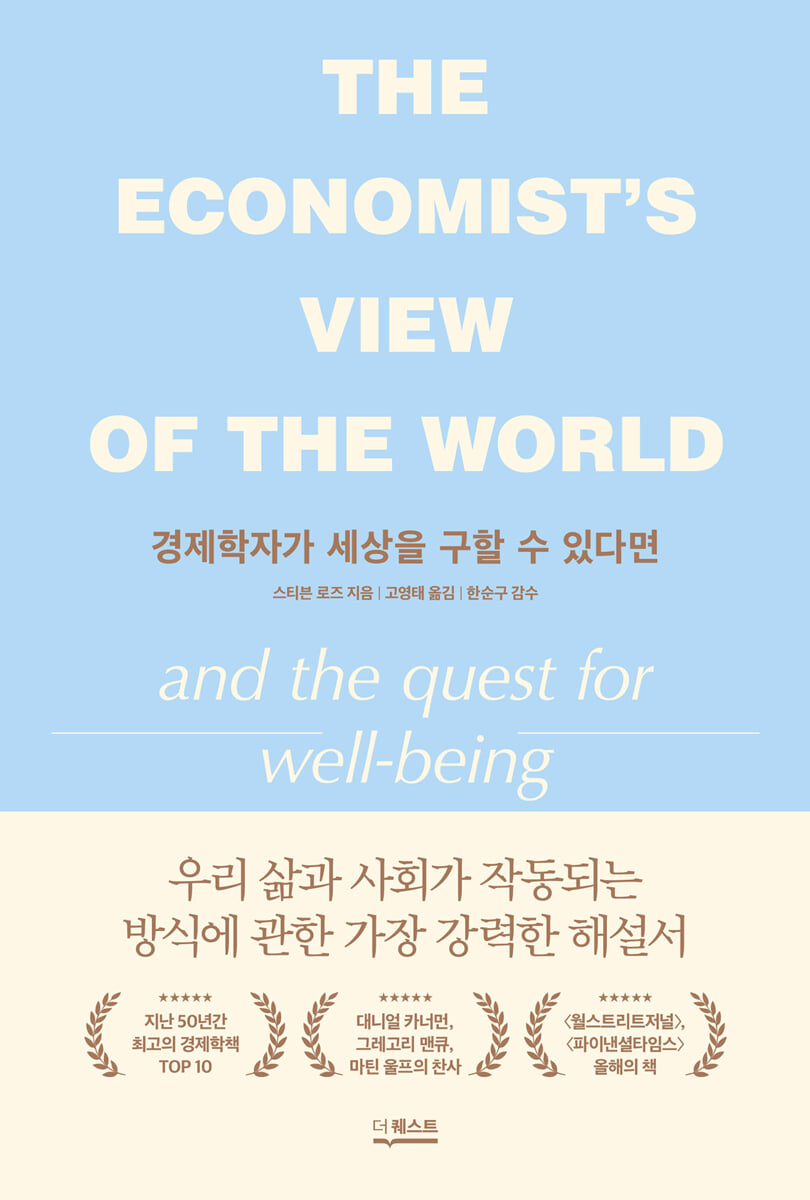
If economists could save the world
 |
Description
Book Introduction
***** Recommended by Nobel Prize winner in Economics Daniel Kahneman! ***** Top 10 Best Economics Books of the Last 50 Years! An economics guide for citizens who dream of a fairer and better world. No matter who you read, there is no doubt that knowledge of economics is essential for citizens living in a democratic society today. And economics is the subject with the greatest political influence in universities, next only to law. 'Economy' is about 'everyday life'. If you are a citizen, policy maker, or leader who makes choices and decisions for a better day for all of us, you must know economics. "If Economists Could Save the World" explores social issues such as education, housing, healthcare, the environment, labor, and industrial policy through an economic lens, and explores ideas for creating a better society. This book, which has been praised by Nobel Prize winner in economics Daniel Kahneman and Harvard professor Gregory Mankiw, is considered the best book for learning economic thinking. Through this book, you will finally understand the complex economy, look at frustrating politics in a new way, and come up with various ideas for our lives. |
- You can preview some of the book's contents.
Preview
index
Part 1.
Useful concepts
1 Opportunity cost
2 Marginalism
3 Economic incentives
Part 2.
Government and Market, Efficiency and Equity
4 Government and Economy
5 Economists and Equity
6 Externalities and Government Intervention
Part 3.
The Limits of Economics
7. Personal Happiness as Perceived by Economists
8 Who Can Lead Discussion and Change?
9 Conclusion
Useful concepts
1 Opportunity cost
2 Marginalism
3 Economic incentives
Part 2.
Government and Market, Efficiency and Equity
4 Government and Economy
5 Economists and Equity
6 Externalities and Government Intervention
Part 3.
The Limits of Economics
7. Personal Happiness as Perceived by Economists
8 Who Can Lead Discussion and Change?
9 Conclusion
Detailed image

Into the book
Social scientists sometimes hope that polling on the most important issues in a community or the areas where the public believes cuts should be made in times of budgetary constraints will influence budget policy.
But economists are skeptical about this.
This is because when the public is asked these questions, they are rarely provided with specific information about the expected effects and costs.
So respondents generally answer with total utility in mind, and as a result, budget cuts to life-saving departments like police and fire departments receive little support.
--- p.68
One of the most repeated slogans by politicians running for elected office is "Jobs, jobs, jobs."
Of course, economists also like to shout about jobs when unemployment is high.
Rising unemployment hinders economic growth, and unemployed people are more likely to use illegal drugs or suffer from depression.
But even when unemployment rates are lower than historical norms, the slogan "Jobs, jobs, jobs" rings out.
Think of Trump.
He believed the United States was losing good manufacturing jobs to Mexico.
--- p.153
The question, "Should companies be kinder to their workers?" sums up the grievances of economists and will likely provoke the ire of many center-left political commentators.
“I told you so.
Economists are so obsessed with markets that they don't care if the benefits of economic growth go only to the top." To avoid this criticism, economists do not oppose government attempts to help ordinary workers through economic intervention.
But it is clear that there is still reluctance to support it.
Most economists would prefer income redistribution through higher taxes on high-income earners rather than direct market intervention, which is often untargeted and has unintended consequences.
--- p.174
Traditionally, economists have opposed area-based policies, arguing that poor "people" should be supported rather than poor "areas."
In the past, this argument was persuasive because low-income people tended to move to areas with more jobs and higher wages, and poor areas also tended to develop.
But now it seems that low-income people and a significant number of people are not moving to seek better economic opportunities.
So three Harvard economists—Benjamin Austin, Larry Summers, and Edward Glaeser—wrote a report for the Brookings Institution suggesting further discussion about the benefits of policies supporting local communities.
--- p.202
Without growth, liberalism could never have triumphed.
The improvement in material welfare of the “one-third of the people” that President Roosevelt spoke of since the 1930s was not a small redistribution of income from the better-off two-thirds, but rather material progress enjoyed by the entire nation, that is, increased income.
--- p.209
Mainstream economists say that some degree of transitional unemployment always occurs as businesses close or workers move to new jobs.
But they raise the question:
Once other types of unemployment are resolved in Year A, if workers do the same work in the same factory with the same equipment in Year B, will the economy grow more? No.
Growing GDP per worker requires new ways of doing things, new inventions, new technologies, and new investments.
--- p.211
To preserve free externalities like air, water, and land, a free enterprise system can only function if there is a competitive system that imposes the same kinds of regulations and obligations on everyone.
Therefore, there must be regulation, and such regulation must be an effective national regulatory program.
--- p.254
The government has called for various programs to combat obesity.
For example, many restaurants are now required to display the total number of calories next to their menu items.
Unfortunately, research suggests there's little evidence to suggest that these regulations lead to healthier food choices.
One study found that after New York City mandated calorie labeling on menus, 25 percent of restaurant diners said they chose lower-calorie options after seeing the information.
But the reality was different.
The total calories customers ordered did not change before and after calorie labeling on menus was made mandatory.
A study of mandatory menu calorie labeling in 30 cities found that the mandates had little effect on obesity.
For example, the weight of an adult male of 175 centimeters tall decreased only slightly, from about 86.18 kilograms to 85.95 kilograms.
But economists are skeptical about this.
This is because when the public is asked these questions, they are rarely provided with specific information about the expected effects and costs.
So respondents generally answer with total utility in mind, and as a result, budget cuts to life-saving departments like police and fire departments receive little support.
--- p.68
One of the most repeated slogans by politicians running for elected office is "Jobs, jobs, jobs."
Of course, economists also like to shout about jobs when unemployment is high.
Rising unemployment hinders economic growth, and unemployed people are more likely to use illegal drugs or suffer from depression.
But even when unemployment rates are lower than historical norms, the slogan "Jobs, jobs, jobs" rings out.
Think of Trump.
He believed the United States was losing good manufacturing jobs to Mexico.
--- p.153
The question, "Should companies be kinder to their workers?" sums up the grievances of economists and will likely provoke the ire of many center-left political commentators.
“I told you so.
Economists are so obsessed with markets that they don't care if the benefits of economic growth go only to the top." To avoid this criticism, economists do not oppose government attempts to help ordinary workers through economic intervention.
But it is clear that there is still reluctance to support it.
Most economists would prefer income redistribution through higher taxes on high-income earners rather than direct market intervention, which is often untargeted and has unintended consequences.
--- p.174
Traditionally, economists have opposed area-based policies, arguing that poor "people" should be supported rather than poor "areas."
In the past, this argument was persuasive because low-income people tended to move to areas with more jobs and higher wages, and poor areas also tended to develop.
But now it seems that low-income people and a significant number of people are not moving to seek better economic opportunities.
So three Harvard economists—Benjamin Austin, Larry Summers, and Edward Glaeser—wrote a report for the Brookings Institution suggesting further discussion about the benefits of policies supporting local communities.
--- p.202
Without growth, liberalism could never have triumphed.
The improvement in material welfare of the “one-third of the people” that President Roosevelt spoke of since the 1930s was not a small redistribution of income from the better-off two-thirds, but rather material progress enjoyed by the entire nation, that is, increased income.
--- p.209
Mainstream economists say that some degree of transitional unemployment always occurs as businesses close or workers move to new jobs.
But they raise the question:
Once other types of unemployment are resolved in Year A, if workers do the same work in the same factory with the same equipment in Year B, will the economy grow more? No.
Growing GDP per worker requires new ways of doing things, new inventions, new technologies, and new investments.
--- p.211
To preserve free externalities like air, water, and land, a free enterprise system can only function if there is a competitive system that imposes the same kinds of regulations and obligations on everyone.
Therefore, there must be regulation, and such regulation must be an effective national regulatory program.
--- p.254
The government has called for various programs to combat obesity.
For example, many restaurants are now required to display the total number of calories next to their menu items.
Unfortunately, research suggests there's little evidence to suggest that these regulations lead to healthier food choices.
One study found that after New York City mandated calorie labeling on menus, 25 percent of restaurant diners said they chose lower-calorie options after seeing the information.
But the reality was different.
The total calories customers ordered did not change before and after calorie labeling on menus was made mandatory.
A study of mandatory menu calorie labeling in 30 cities found that the mandates had little effect on obesity.
For example, the weight of an adult male of 175 centimeters tall decreased only slightly, from about 86.18 kilograms to 85.95 kilograms.
--- p.291
Publisher's Review
★★★★★ Recommended by Nobel Prize winner in economics Daniel Kahneman!
★★★★★ Book of the Year by the Wall Street Journal and Financial Times!
★★★★★ An immortal masterpiece that teaches you how to think economically!
Now, we have a reality that is as cold as a veil.
We need an 'economist's eye'!
When the author, a political scientist, said he was writing an economics book, many people were skeptical.
But his motivation was clear.
The author, who worked at the U.S. Office of the Budget, witnessed Congress formulate and execute budgets without careful scrutiny.
National funds may feel like someone else's money to individuals, making it easy to spend it and overlook its importance, but strictly speaking, it is the money of each individual citizen.
If you think of it as 'the price I pay,' it's natural to ponder 'which choice will produce a better outcome?'
And in such considerations, the economist's way of thinking, which prioritizes utility and profit, can be the most useful and effective framework.
Therefore, the author has chosen economics as the top priority for college and graduate students who will become future administrators and politicians, as well as for conscious citizens, and has been teaching basic economics for over 30 years.
"If Economists Could Save the World" began about 35 years ago when the author decided to write it himself because there was no suitable textbook for the course.
Is it because of the unique ‘start’?
When this book, which contains economic principles and examples that apply in our society and reality, was published, it received favorable reviews, saying, "This book breathed life into economics, which is often called a gloomy science."
“Your book was like the textbook I used to use when I first started learning economics.” Nobel laureate Daniel Kahneman even emailed the author directly to express his gratitude after hearing about the latest edition’s publication.
As such, "If Economists Could Save the World" is the book that best explains economic thinking and its application, and has been consistently loved since its first publication in 1985.
This book, which has sparked in-depth discussion in the United States and other English-speaking countries, is now being introduced in Korea.
I hope that this will serve as a foundation for advancing Korea's political, social, and economic discussions to the next level.
From education and environment to healthcare, housing, labor, and industrial policy
A unique economist's perspectives and ideas for creating a fairer and better world.
(Scene 1)
I thought the dark ages in the real estate market would be long.
There is no sign of an interest rate cut, and it is still a long way to go before housing prices fall by the same amount that they have risen so 'crazy' over the past two to three years.
However, the government's housing price support policy implemented earlier this year led to a rebound in the real estate market.
It was a policy mortgage theory called the ‘Special Deposit Loan Theory.’
(Scene 2)
Mr. Kim, 72, who lives in Gangdong-gu, Seoul, has been enjoying mealtimes recently.
Previously, I had trouble eating because my wisdom teeth hurt, but recently, I regained the joy of eating thanks to implant treatment.
This change was a result of implant treatment being covered by health insurance as part of a health/insurance policy designed to reduce national medical expenses in the long term.
(Scene 3)
There is a heated debate over expanding the number of doctors.
The government announced that it would increase the number of medical school students to prepare for regional medical gaps and national disasters.
The medical community and some experts are strongly opposed to this.
Considering the number of medical institutions and hospital beds, the current number of doctors is already excessive, and further increasing the number of doctors could lead to competition and overheating in the medical field, and burden the health insurance finances.
The power of policy is strong.
The policies formulated and implemented by the government are powerful and swift enough to overturn the systems that drive society and the market in just one or two months, and they directly and minutely impact our daily lives, bringing joy to citizens' three meals a day.
Moreover, the scope is enormous.
It is involved in every aspect of life, including housing, education, medical services, environment, labor, and childbirth/childcare.
Therefore, understanding and verifying public policies is essential for the happiness of each individual.
However, in policy discussions and decisions, not only politicians but also social leaders and citizens often prioritize partisan, ideological, and ethical values.
This then leads to policy decisions and discussions that are shockingly disconnected from reality, trapped in a fantasy of profit and no reward.
Economics provides the most excellent perspective and standards for understanding market principles and coordinating the interests of market participants.
In this book, the author persistently explores the effectiveness and direction of public and economic policies through the perspectives of economists.
If you read this book
The complex economy is finally understood, and the frustrating politics is seen in a new light.
It gives me ideas for a better society!
Part 1 of the book explains the fundamental principles by which economists view the world: opportunity cost, marginalism, and economic incentives.
Part 2 deals with the real world as seen and understood through the worldview of an economist.
It shows how social issues we encounter in our daily lives, such as education, medical services, environmental issues, housing, labor, and anti-monopoly, are examined from an economic perspective, and further provides food for thought on how they should be decided and managed.
He then explains why mainstream economists, including left-wing economists like Paul Krugman, value free markets.
This does not mean that the economic way of thinking is praised in its entirety.
Part 3 points out the limitations of the economic approach, which assumes that self-interest dominates behavior in interpreting the world and human beings, and provides an opportunity to reflect on social and individual happiness from a broader perspective through research in philosophy and psychology.
Citizens, policymakers, and leaders seeking to create a more just and prosperous world will find this book a new framework for understanding the world and valuable insights for analyzing and discerning the various policies and social issues that profoundly impact our lives.
★★★★★ Book of the Year by the Wall Street Journal and Financial Times!
★★★★★ An immortal masterpiece that teaches you how to think economically!
Now, we have a reality that is as cold as a veil.
We need an 'economist's eye'!
When the author, a political scientist, said he was writing an economics book, many people were skeptical.
But his motivation was clear.
The author, who worked at the U.S. Office of the Budget, witnessed Congress formulate and execute budgets without careful scrutiny.
National funds may feel like someone else's money to individuals, making it easy to spend it and overlook its importance, but strictly speaking, it is the money of each individual citizen.
If you think of it as 'the price I pay,' it's natural to ponder 'which choice will produce a better outcome?'
And in such considerations, the economist's way of thinking, which prioritizes utility and profit, can be the most useful and effective framework.
Therefore, the author has chosen economics as the top priority for college and graduate students who will become future administrators and politicians, as well as for conscious citizens, and has been teaching basic economics for over 30 years.
"If Economists Could Save the World" began about 35 years ago when the author decided to write it himself because there was no suitable textbook for the course.
Is it because of the unique ‘start’?
When this book, which contains economic principles and examples that apply in our society and reality, was published, it received favorable reviews, saying, "This book breathed life into economics, which is often called a gloomy science."
“Your book was like the textbook I used to use when I first started learning economics.” Nobel laureate Daniel Kahneman even emailed the author directly to express his gratitude after hearing about the latest edition’s publication.
As such, "If Economists Could Save the World" is the book that best explains economic thinking and its application, and has been consistently loved since its first publication in 1985.
This book, which has sparked in-depth discussion in the United States and other English-speaking countries, is now being introduced in Korea.
I hope that this will serve as a foundation for advancing Korea's political, social, and economic discussions to the next level.
From education and environment to healthcare, housing, labor, and industrial policy
A unique economist's perspectives and ideas for creating a fairer and better world.
(Scene 1)
I thought the dark ages in the real estate market would be long.
There is no sign of an interest rate cut, and it is still a long way to go before housing prices fall by the same amount that they have risen so 'crazy' over the past two to three years.
However, the government's housing price support policy implemented earlier this year led to a rebound in the real estate market.
It was a policy mortgage theory called the ‘Special Deposit Loan Theory.’
(Scene 2)
Mr. Kim, 72, who lives in Gangdong-gu, Seoul, has been enjoying mealtimes recently.
Previously, I had trouble eating because my wisdom teeth hurt, but recently, I regained the joy of eating thanks to implant treatment.
This change was a result of implant treatment being covered by health insurance as part of a health/insurance policy designed to reduce national medical expenses in the long term.
(Scene 3)
There is a heated debate over expanding the number of doctors.
The government announced that it would increase the number of medical school students to prepare for regional medical gaps and national disasters.
The medical community and some experts are strongly opposed to this.
Considering the number of medical institutions and hospital beds, the current number of doctors is already excessive, and further increasing the number of doctors could lead to competition and overheating in the medical field, and burden the health insurance finances.
The power of policy is strong.
The policies formulated and implemented by the government are powerful and swift enough to overturn the systems that drive society and the market in just one or two months, and they directly and minutely impact our daily lives, bringing joy to citizens' three meals a day.
Moreover, the scope is enormous.
It is involved in every aspect of life, including housing, education, medical services, environment, labor, and childbirth/childcare.
Therefore, understanding and verifying public policies is essential for the happiness of each individual.
However, in policy discussions and decisions, not only politicians but also social leaders and citizens often prioritize partisan, ideological, and ethical values.
This then leads to policy decisions and discussions that are shockingly disconnected from reality, trapped in a fantasy of profit and no reward.
Economics provides the most excellent perspective and standards for understanding market principles and coordinating the interests of market participants.
In this book, the author persistently explores the effectiveness and direction of public and economic policies through the perspectives of economists.
If you read this book
The complex economy is finally understood, and the frustrating politics is seen in a new light.
It gives me ideas for a better society!
Part 1 of the book explains the fundamental principles by which economists view the world: opportunity cost, marginalism, and economic incentives.
Part 2 deals with the real world as seen and understood through the worldview of an economist.
It shows how social issues we encounter in our daily lives, such as education, medical services, environmental issues, housing, labor, and anti-monopoly, are examined from an economic perspective, and further provides food for thought on how they should be decided and managed.
He then explains why mainstream economists, including left-wing economists like Paul Krugman, value free markets.
This does not mean that the economic way of thinking is praised in its entirety.
Part 3 points out the limitations of the economic approach, which assumes that self-interest dominates behavior in interpreting the world and human beings, and provides an opportunity to reflect on social and individual happiness from a broader perspective through research in philosophy and psychology.
Citizens, policymakers, and leaders seeking to create a more just and prosperous world will find this book a new framework for understanding the world and valuable insights for analyzing and discerning the various policies and social issues that profoundly impact our lives.
GOODS SPECIFICS
- Date of issue: December 6, 2023
- Page count, weight, size: 496 pages | 714g | 152*225*24mm
- ISBN13: 9791140707195
- ISBN10: 1140707191
You may also like
카테고리
korean


korean

![GQ KOREA Mark (Monthly): December [2025]](http://librairie.coreenne.fr/cdn/shop/files/8ef265dbbfbf186523ed75ba7319009d.jpg?v=1765340328&width=3840)


