

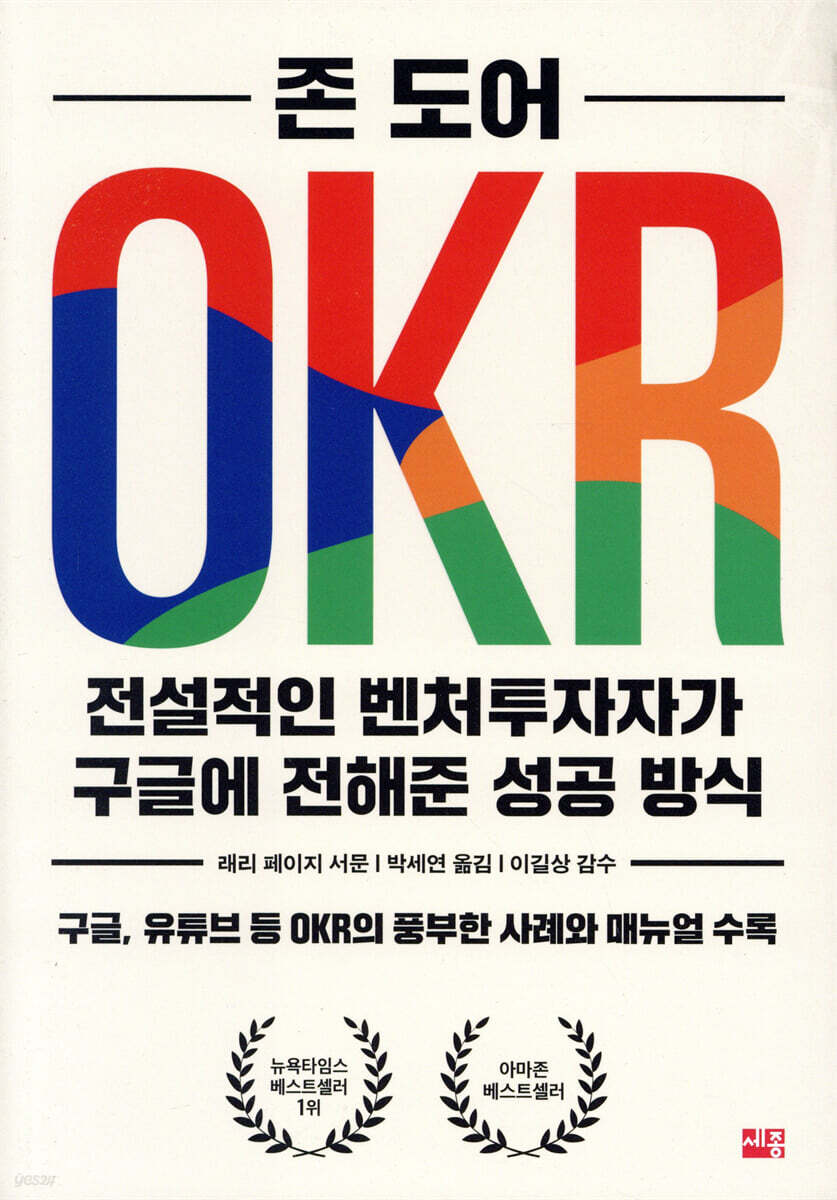
OKR: The Success Formula That Legendary Venture Investor Taught Google
 |
Description
Book Introduction
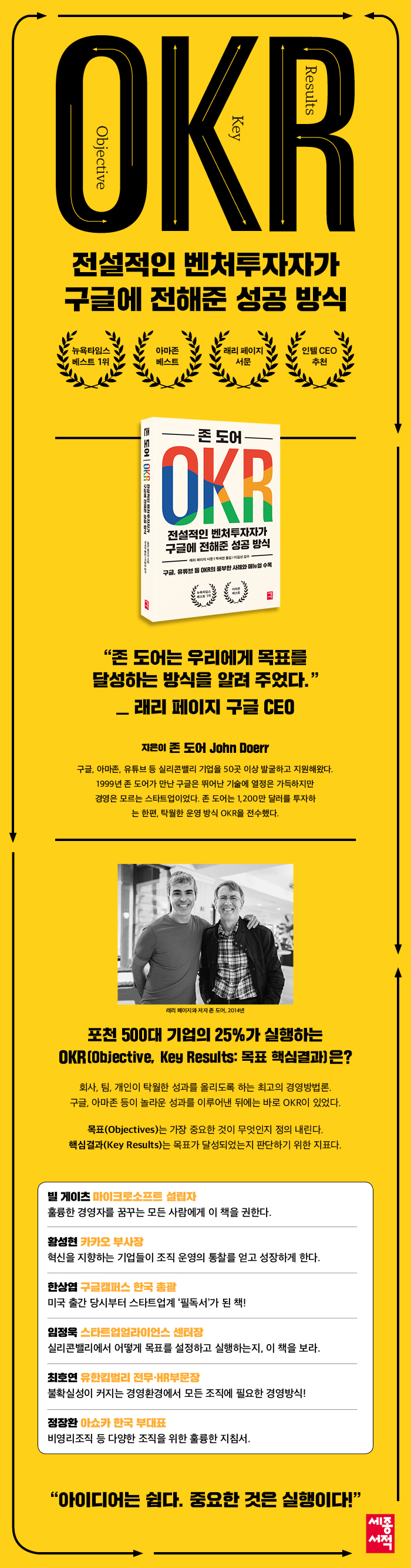
-'Lee Hyung, who quit his job' Trackers Book Club selection -Bill Gates' recommended book: "A book for everyone who wants to become a better leader." -#1 New York Times Bestseller John Doerr spread the word to Silicon Valley, including Google and Amazon. The Success Formula: Everything About OKR Do you have an exciting objective? Measure it with key results! John Doerr, known as the Warren Buffett of the venture capital industry and the pioneer of Silicon Valley's success method, OKR, is the ultimate management methodology for driving exceptional performance across companies, teams, and individuals. OKRs were behind the amazing achievements of Google, Amazon, and others. Objectives define what is most important. Key Results are indicators used to determine whether goals have been achieved. Around the time when Korea was eagerly adopting KPI and MBO-based relative evaluation as global standards during the IMF era, Google adopted OKR at the urging of John Doerr. Behind Silicon Valley's success lies the legacy of a spirit passed down from Intel's Andy Grove to John Doerr and innovative companies like Google. OKR is the most powerful yet simple system for setting and executing inspiring goals. This book can be called the 'OKR textbook' written by John Doerr, who has widely promoted OKR. It contains specific examples from various companies such as Google, YouTube, Adobe, and Intuit, as well as non-profit foundations and social movements. The stories of CEOs of global companies applying OKR stand out, along with a manual to reduce trial and error. The original title was 『Measure What Matters』, and it ranked first in the New York Times immediately after its publication. |
- You can preview some of the book's contents.
Preview
index
Reviewer's note
Foreword | Larry Page
Part 1: The Beginning of OKR
Chapter 1.
Google Meets OKR
Chapter 2. The Father of OKR
Chapter 3.
Operation Crush: The Intel Story
Chapter 4.
Superpower #1: Focusing on Priorities
Chapter 5.
Focus: Remind Story
Chapter 6.
Dedication: Sister Story
Chapter 7.
Superpower #2: Team Alignment and Connection
Chapter 8.
Sort by: MyFitnessPal Stories
Chapter 9.
Connect: The Intuit Story
Chapter 10.
Superpower #3: Accountability
Chapter 11.
Tracking: The Gates Foundation Story
Chapter 12.
Superpower #4: The Challenge to the Top
Chapter 13.
Challenge: The Google Chrome Story
Chapter 14.
Challenge: YouTube Stories
Part 2: The New Business World
Chapter 15.
Continuous Performance Management: OKR & CFR
Chapter 16.
Eliminating Year-End Performance Awards: The Adobe Story
Chapter 17.
Making Pizza Tastier Every Day: The Zoom Pizza Story
Chapter 18.
culture
Chapter 19.
Changing the Culture: Rumorless Stories
Chapter 20.
Changing the Culture: The Story of Bono's One Campaign
Chapter 21.
Future goals
[References] 1: Google's OKR Playbook (Manual) │ 2: Typical OKR Cycle │ 3: Discussion-Performance Evaluation │ 4: Summary
│5: Further Reading
Foreword | Larry Page
Part 1: The Beginning of OKR
Chapter 1.
Google Meets OKR
Chapter 2. The Father of OKR
Chapter 3.
Operation Crush: The Intel Story
Chapter 4.
Superpower #1: Focusing on Priorities
Chapter 5.
Focus: Remind Story
Chapter 6.
Dedication: Sister Story
Chapter 7.
Superpower #2: Team Alignment and Connection
Chapter 8.
Sort by: MyFitnessPal Stories
Chapter 9.
Connect: The Intuit Story
Chapter 10.
Superpower #3: Accountability
Chapter 11.
Tracking: The Gates Foundation Story
Chapter 12.
Superpower #4: The Challenge to the Top
Chapter 13.
Challenge: The Google Chrome Story
Chapter 14.
Challenge: YouTube Stories
Part 2: The New Business World
Chapter 15.
Continuous Performance Management: OKR & CFR
Chapter 16.
Eliminating Year-End Performance Awards: The Adobe Story
Chapter 17.
Making Pizza Tastier Every Day: The Zoom Pizza Story
Chapter 18.
culture
Chapter 19.
Changing the Culture: Rumorless Stories
Chapter 20.
Changing the Culture: The Story of Bono's One Campaign
Chapter 21.
Future goals
[References] 1: Google's OKR Playbook (Manual) │ 2: Typical OKR Cycle │ 3: Discussion-Performance Evaluation │ 4: Summary
│5: Further Reading
Detailed image
Into the book
One day in 1999, John Doerr came to us and gave a lecture on Objectives and Key Results (OKRs) and management methods based on his experience at Intel.
At the time, we were familiar with Intel's advanced management, and John's story was full of wisdom.
We decided to give his advice a try.
Looking back now, it was a great choice.
--- From "Foreword (Larry Page)"
Google's success is rooted in strong and stable leadership, abundant technical resources, transparency, teamwork, and a values-based organizational culture that constantly pursues innovation.
But OKRs also play an important role.
I can't imagine the Googleplex without OKRs.
I also can't imagine Larry and Sergey abandoning OKRs.
(……) Eric Schmidt says that OKR has the power to “completely transform a business.”
--- 「Chapter 1.
From "Google Meets OKR"
Andy Grove used to say:
“Bad companies fall in a crisis, but good companies survive.
And great companies grow through crises.” This saying also applies to Operation Crush.
In 1986, when Intel abandoned its then-growth memory chip business to focus on its microprocessor business, the 8086 regained 85 percent of the 16-bit market share.
And with the release of the 8088, a more economical version of the 8086, IBM saw an opportunity to boost revenue and brand recognition from its first computer, which set the standard for personal computers.
Today, the billions of microcontrollers inside computers, cars, smart thermostats, and blood bank centrifuges are all based on Intel architecture.
Let me emphasize once again that all of this was possible thanks to OKR.
--- 「Chapter 3.
From Operation Crush: The Intel Story
Above all, corporate goals must be "important." OKRs are neither a jumbled wish list nor a compilation of routine tasks. They are a carefully selected set of tasks worthy of special attention and designed to drive progress for all team members.
OKRs also connect to a larger mission we must pursue.
Grove commented:
“Management skills are about identifying the one to three most important tasks that contribute the most from a multitude of seemingly similar ones and focusing on those.” Similarly, Larry Page pointed out:
Successful organizations “put more wood in fewer arrows.” In conclusion, focus is the most important superpower in OKRs.
--- Chapter 4.
From "Superpower #1: Focusing on Priorities"
When John came to us, I was clueless about strategic planning.
We had to gradually adapt to the OKR system.
We shouldn't have been so eager to build the entire system at once.
After making mistakes in the beginning, I took on the challenge seriously once again.
Ultimately, Remind became an efficient organization thanks to the OKR system.
And just three quarters after launching OKR, we successfully secured $40 million in Series C funding.
Our future has become even more secure.
--- 「Chapter 5.
From "Focus: Remind Story"
When I visited Bangalore, India, an employee told me this story.
“I took the key results from my boss’s OKRs and turned them into my goals.
The boss's OKR is directly linked to EBS's higher-level goals.
And again, EBS's top goal is closely tied to the corporate goal of 'moving to the cloud market.'
"I understand very well how my work in India connects to the company's mission." This is a crucial realization. OKRs have a powerful impact even on remote team members.
By setting goals systematically and publicly, you can break down barriers that hinder organizational integration.
--- Chapter 9.
From "Connect: The Intuit Story"
The most important resource in a service company is passionate employees who believe they can drive change and move the organization forward.
That is why a high turnover rate is a huge loss for an organization.
The best form of job change is one within the organization.
In other words, it is a way to develop an individual's career within an organization without moving to another company.
Employees don't dream of a nomadic life.
However, he just wants to move to a place where he can fully exert his influence.
Adobe's check-in system fulfills that desire.
--- 「Chapter 16.
From "Abolishing Year-End Performance Awards: The Adobe Story"
One-on-one meetings are a powerful way to get employees engaged and focused on their work.
Employees get ideas to overcome problems in one-on-one meetings.
One leader points out:
“This goal is very important to you.
But there hasn't been much progress in two weeks.
“Why?” It may sound paradoxical, but non-work-related one-on-one meetings are a forum for ongoing performance feedback.
By listening to employees share their personal goals, leaders can learn how to develop their careers or empower them to overcome difficult situations.
--- Chapter 17.
Making Pizza More Delicious Every Day: From the Zoom Pizza Story
Vision-based management is superior to command-and-control systems.
The flatter the organization, the more agile the company becomes.
When performance management is two-way or networked, employees move together toward greatness.
Ultimately, this is a story about relationships.
As Dub explains, “Collaboration, or the ability to build ‘relationships,’ is the driving force behind growth and innovation.”--- 「Chapter 19.
From "Culture"
As the organization grew, OneCampaign attempted a fundamental cultural change based on OKR.
They shifted their focus from a business 'for' Africa to a business 'in' Africa and 'with' Africa.
David explained:
“There has been a fundamental shift in social perception of support projects for developing countries.
It was about helping these countries grow on their own.
“OKRs played a crucial role in this process of changing perception.”
At the time, we were familiar with Intel's advanced management, and John's story was full of wisdom.
We decided to give his advice a try.
Looking back now, it was a great choice.
--- From "Foreword (Larry Page)"
Google's success is rooted in strong and stable leadership, abundant technical resources, transparency, teamwork, and a values-based organizational culture that constantly pursues innovation.
But OKRs also play an important role.
I can't imagine the Googleplex without OKRs.
I also can't imagine Larry and Sergey abandoning OKRs.
(……) Eric Schmidt says that OKR has the power to “completely transform a business.”
--- 「Chapter 1.
From "Google Meets OKR"
Andy Grove used to say:
“Bad companies fall in a crisis, but good companies survive.
And great companies grow through crises.” This saying also applies to Operation Crush.
In 1986, when Intel abandoned its then-growth memory chip business to focus on its microprocessor business, the 8086 regained 85 percent of the 16-bit market share.
And with the release of the 8088, a more economical version of the 8086, IBM saw an opportunity to boost revenue and brand recognition from its first computer, which set the standard for personal computers.
Today, the billions of microcontrollers inside computers, cars, smart thermostats, and blood bank centrifuges are all based on Intel architecture.
Let me emphasize once again that all of this was possible thanks to OKR.
--- 「Chapter 3.
From Operation Crush: The Intel Story
Above all, corporate goals must be "important." OKRs are neither a jumbled wish list nor a compilation of routine tasks. They are a carefully selected set of tasks worthy of special attention and designed to drive progress for all team members.
OKRs also connect to a larger mission we must pursue.
Grove commented:
“Management skills are about identifying the one to three most important tasks that contribute the most from a multitude of seemingly similar ones and focusing on those.” Similarly, Larry Page pointed out:
Successful organizations “put more wood in fewer arrows.” In conclusion, focus is the most important superpower in OKRs.
--- Chapter 4.
From "Superpower #1: Focusing on Priorities"
When John came to us, I was clueless about strategic planning.
We had to gradually adapt to the OKR system.
We shouldn't have been so eager to build the entire system at once.
After making mistakes in the beginning, I took on the challenge seriously once again.
Ultimately, Remind became an efficient organization thanks to the OKR system.
And just three quarters after launching OKR, we successfully secured $40 million in Series C funding.
Our future has become even more secure.
--- 「Chapter 5.
From "Focus: Remind Story"
When I visited Bangalore, India, an employee told me this story.
“I took the key results from my boss’s OKRs and turned them into my goals.
The boss's OKR is directly linked to EBS's higher-level goals.
And again, EBS's top goal is closely tied to the corporate goal of 'moving to the cloud market.'
"I understand very well how my work in India connects to the company's mission." This is a crucial realization. OKRs have a powerful impact even on remote team members.
By setting goals systematically and publicly, you can break down barriers that hinder organizational integration.
--- Chapter 9.
From "Connect: The Intuit Story"
The most important resource in a service company is passionate employees who believe they can drive change and move the organization forward.
That is why a high turnover rate is a huge loss for an organization.
The best form of job change is one within the organization.
In other words, it is a way to develop an individual's career within an organization without moving to another company.
Employees don't dream of a nomadic life.
However, he just wants to move to a place where he can fully exert his influence.
Adobe's check-in system fulfills that desire.
--- 「Chapter 16.
From "Abolishing Year-End Performance Awards: The Adobe Story"
One-on-one meetings are a powerful way to get employees engaged and focused on their work.
Employees get ideas to overcome problems in one-on-one meetings.
One leader points out:
“This goal is very important to you.
But there hasn't been much progress in two weeks.
“Why?” It may sound paradoxical, but non-work-related one-on-one meetings are a forum for ongoing performance feedback.
By listening to employees share their personal goals, leaders can learn how to develop their careers or empower them to overcome difficult situations.
--- Chapter 17.
Making Pizza More Delicious Every Day: From the Zoom Pizza Story
Vision-based management is superior to command-and-control systems.
The flatter the organization, the more agile the company becomes.
When performance management is two-way or networked, employees move together toward greatness.
Ultimately, this is a story about relationships.
As Dub explains, “Collaboration, or the ability to build ‘relationships,’ is the driving force behind growth and innovation.”--- 「Chapter 19.
From "Culture"
As the organization grew, OneCampaign attempted a fundamental cultural change based on OKR.
They shifted their focus from a business 'for' Africa to a business 'in' Africa and 'with' Africa.
David explained:
“There has been a fundamental shift in social perception of support projects for developing countries.
It was about helping these countries grow on their own.
“OKRs played a crucial role in this process of changing perception.”
--- 「Chapter 20.
From "Changing Culture: Bono's One Campaign Story"
From "Changing Culture: Bono's One Campaign Story"
Publisher's Review
John Doerr showed us how to achieve our goals.
- Larry Page (Google CEO)
Behind Silicon Valley's culture of innovation
'Andy Grove 〉 John Doerr 〉 Google'
There is an OKR method for achieving goals.
There are 50 global companies, including Google and YouTube, that John Doerr invested in and mentored to achieve success.
John Doerr first encountered OKRs at Intel in the 1970s.
The author, who happened to work as a summer intern at Intel, heard a lecture by Andy Grove, then vice president of Intel.
Andy Grove, a Hungarian refugee who fled the Nazis to the United States, rose to the top solely through his talent.
He transformed Intel from a crisis-ridden company in the 1980s to the world's largest microprocessor company, and the secret to his success was OKR.
John Doerr inherited Andy Grove's OKR and further developed it, successfully spreading it to numerous companies in Silicon Valley.
“Are you measuring the core?”
The original title of this book is 'Measure What Matters'.
A well-made 'metric' that is as good as the goal moves people.
“Goals inspire from afar, while key results ground us and provide a baseline.”
Also, the key result is a “yardstick to aim at the target.”
The authors say that if you choose the right goals, three to five key results are enough.
Too many metrics only distract from focus and make measurement difficult.
However, each key result must be “a daunting challenge in its own right.”
If the task is too easy, no one will give it their all.
How does Google's incredible success tie into OKRs? Twenty years ago, when Google co-founders Larry Page and Sergey Brin met John Doerr, Google was a "party latecomer."
The search engine market was already saturated with strong competitors expanding their territory.
The material they presented to John Doerr was a mere seventeen-page PowerPoint presentation.
The goal achievement method that John Doerr taught me at that time is OKR.
Eric Schmidt, former CEO of Google, revealed in his book How Google Works that he used OKR as “a simple tool to realize the founder’s ‘think big’ spirit.”
Larry Page dedicated two days every quarter to reviewing each employee's OKRs and holding marathon meetings with managers to set OKR goals.
Even today, Google still develops its strategies around OKRs.
"I wish I had read this book 19 years ago, when I co-founded Google. Or even better, back when I was more self-focused! Simply put, great ideas, backed by great execution, are how we create magic.
And this is where OKRs come into play.” (From Larry Page’s foreword)
Korea's organizational culture lacks autonomy-
Companies adopting OKR
Recommendations from large corporations, tech companies, and startup entrepreneurs, including Kakao, Google Campus Korea, Startup Alliance, and Yuhan-Kimberly.
When I was working at the company, I was disappointed that MBO, which was a very good goal management method, was not well implemented.
I felt similar frustration when I invested in startups later.
I believe this book will be an excellent guide for many different types of organizations on setting goals and achieving results.
And this can be confirmed by looking at how John Doerr invested in companies like Google and Amazon and spread the OKR principle.
- Jeong Jang-hwan, Vice President of Ashoka Korea
The core of the problem is the habit of running hard, thinking that everyone agrees on the goal.
Even within a startup with three people, it's surprising how often you'll find yourself with different goals.
It won't be easy, but if startups embrace the shared goals and transparency emphasized by OKR, we will finally have the opportunity to transform "Korean organizational culture."
Park Sang-hyun, Head of Mediati Content Lab
Nonprofit foundations and social enterprises also realize their dreams with OKR.
A second-generation Korean woman created the medical app "Nuna" for her autistic younger sibling.
- Bono, the world-renowned rock star who saves lives in Africa
Nuna, founded by second-generation Korean immigrant Jeanie Kim, leverages data analytics to help millions of people most in need effectively navigate the Medicaid system. The OKR system serves as the foundation for Nuna's goal-setting.
We brought together engineers and data scientists with diverse work styles and challenges, and we motivated them to work passionately toward challenging goals.
(Chapter 6: Dedication: Sister's Story)
Here's an example of OKRs from the OneCampaign, a campaign led by world-renowned rock star Bono to eradicate poverty and disease in Africa.
[target]
Integrating diverse perspectives from Africa through the One Campaign project,
Closely aligned with the challenges facing Africa,
By leveraging and sharing the political assets of the One Campaign,
Driving significant policy change within Africa
[Key Results]
1.
Hire three Africans (by April) and bring two Africans onto the board (by July).
2.
Launch the African Advisory Committee (by July) and hold two meetings (by December).
3.
Collaborate with 10-15 leading, active African thinkers who can advise on OneCampaign policy direction and external initiatives.
4.
Four visits to Africa in 2010
(Chapter 20: Changing Culture: Bono's One Campaign Story)
- Larry Page (Google CEO)
Behind Silicon Valley's culture of innovation
'Andy Grove 〉 John Doerr 〉 Google'
There is an OKR method for achieving goals.
There are 50 global companies, including Google and YouTube, that John Doerr invested in and mentored to achieve success.
John Doerr first encountered OKRs at Intel in the 1970s.
The author, who happened to work as a summer intern at Intel, heard a lecture by Andy Grove, then vice president of Intel.
Andy Grove, a Hungarian refugee who fled the Nazis to the United States, rose to the top solely through his talent.
He transformed Intel from a crisis-ridden company in the 1980s to the world's largest microprocessor company, and the secret to his success was OKR.
John Doerr inherited Andy Grove's OKR and further developed it, successfully spreading it to numerous companies in Silicon Valley.
“Are you measuring the core?”
The original title of this book is 'Measure What Matters'.
A well-made 'metric' that is as good as the goal moves people.
“Goals inspire from afar, while key results ground us and provide a baseline.”
Also, the key result is a “yardstick to aim at the target.”
The authors say that if you choose the right goals, three to five key results are enough.
Too many metrics only distract from focus and make measurement difficult.
However, each key result must be “a daunting challenge in its own right.”
If the task is too easy, no one will give it their all.
How does Google's incredible success tie into OKRs? Twenty years ago, when Google co-founders Larry Page and Sergey Brin met John Doerr, Google was a "party latecomer."
The search engine market was already saturated with strong competitors expanding their territory.
The material they presented to John Doerr was a mere seventeen-page PowerPoint presentation.
The goal achievement method that John Doerr taught me at that time is OKR.
Eric Schmidt, former CEO of Google, revealed in his book How Google Works that he used OKR as “a simple tool to realize the founder’s ‘think big’ spirit.”
Larry Page dedicated two days every quarter to reviewing each employee's OKRs and holding marathon meetings with managers to set OKR goals.
Even today, Google still develops its strategies around OKRs.
"I wish I had read this book 19 years ago, when I co-founded Google. Or even better, back when I was more self-focused! Simply put, great ideas, backed by great execution, are how we create magic.
And this is where OKRs come into play.” (From Larry Page’s foreword)
Korea's organizational culture lacks autonomy-
Companies adopting OKR
Recommendations from large corporations, tech companies, and startup entrepreneurs, including Kakao, Google Campus Korea, Startup Alliance, and Yuhan-Kimberly.
When I was working at the company, I was disappointed that MBO, which was a very good goal management method, was not well implemented.
I felt similar frustration when I invested in startups later.
I believe this book will be an excellent guide for many different types of organizations on setting goals and achieving results.
And this can be confirmed by looking at how John Doerr invested in companies like Google and Amazon and spread the OKR principle.
- Jeong Jang-hwan, Vice President of Ashoka Korea
The core of the problem is the habit of running hard, thinking that everyone agrees on the goal.
Even within a startup with three people, it's surprising how often you'll find yourself with different goals.
It won't be easy, but if startups embrace the shared goals and transparency emphasized by OKR, we will finally have the opportunity to transform "Korean organizational culture."
Park Sang-hyun, Head of Mediati Content Lab
Nonprofit foundations and social enterprises also realize their dreams with OKR.
A second-generation Korean woman created the medical app "Nuna" for her autistic younger sibling.
- Bono, the world-renowned rock star who saves lives in Africa
Nuna, founded by second-generation Korean immigrant Jeanie Kim, leverages data analytics to help millions of people most in need effectively navigate the Medicaid system. The OKR system serves as the foundation for Nuna's goal-setting.
We brought together engineers and data scientists with diverse work styles and challenges, and we motivated them to work passionately toward challenging goals.
(Chapter 6: Dedication: Sister's Story)
Here's an example of OKRs from the OneCampaign, a campaign led by world-renowned rock star Bono to eradicate poverty and disease in Africa.
[target]
Integrating diverse perspectives from Africa through the One Campaign project,
Closely aligned with the challenges facing Africa,
By leveraging and sharing the political assets of the One Campaign,
Driving significant policy change within Africa
[Key Results]
1.
Hire three Africans (by April) and bring two Africans onto the board (by July).
2.
Launch the African Advisory Committee (by July) and hold two meetings (by December).
3.
Collaborate with 10-15 leading, active African thinkers who can advise on OneCampaign policy direction and external initiatives.
4.
Four visits to Africa in 2010
(Chapter 20: Changing Culture: Bono's One Campaign Story)
GOODS SPECIFICS
- Date of issue: March 25, 2019
- Page count, weight, size: 388 pages | 548g | 150*215*24mm
- ISBN13: 9788984077560
- ISBN10: 8984077569
You may also like
카테고리
korean


korean

![GQ KOREA Mark (Monthly): December [2025]](http://librairie.coreenne.fr/cdn/shop/files/8ef265dbbfbf186523ed75ba7319009d.jpg?v=1765340328&width=3840)


