

Break the cycle of complexity
 |
Description
Book Introduction
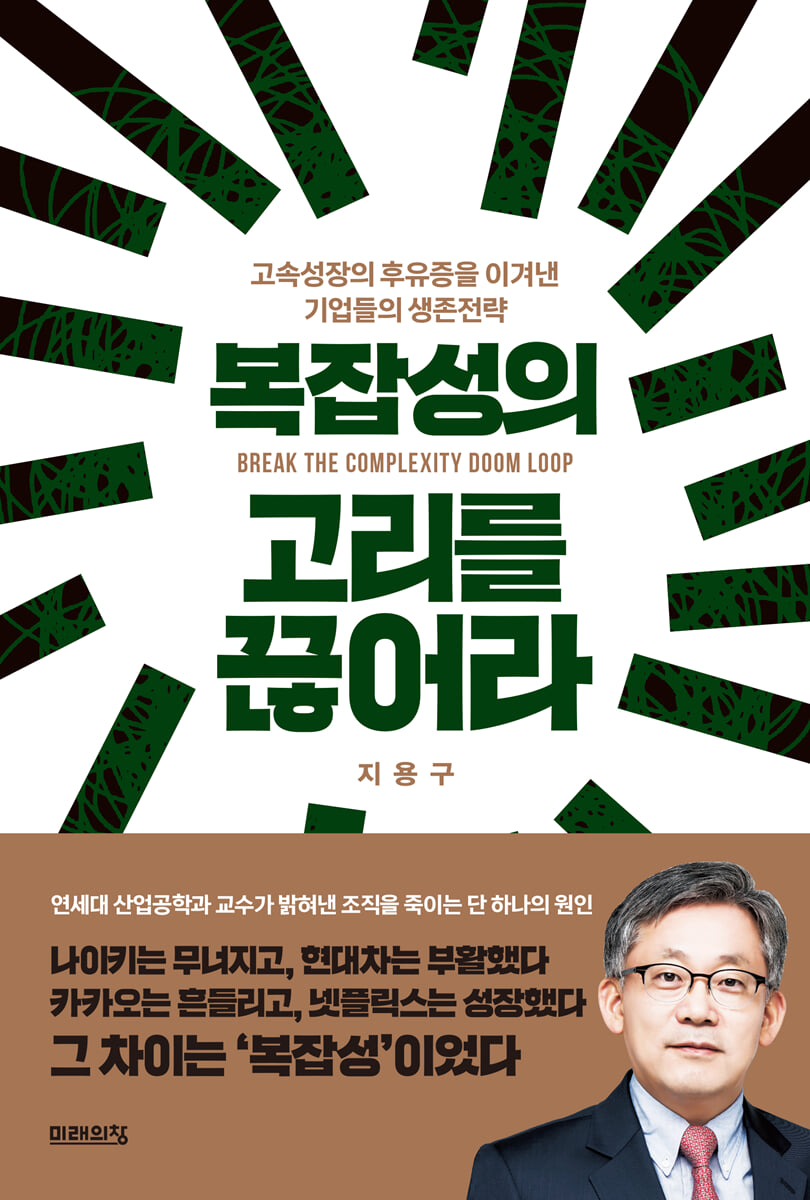
Nike collapsed, Hyundai was resurrected.
Netflix grew, and Kakao faltered.
What determined success or failure was not ‘technical prowess’ but ‘complexity’.
Endless meetings, ever-expanding reporting lines, and diversified strategies without direction... Many companies call these "growing pains," but in reality, they're the trap of complexity that slowly destroys the organization.
"Break the Chain of Complexity" is a book that empirically analyzes "complexity," a fatal risk factor hidden behind corporate growth.
The author, Professor Ji Yong-gu, is an expert who has been diagnosing organizational efficiency and strategic issues at major domestic and international companies, including Samsung, Hyundai Motors, and LG, for 20 years.
In this book, he explains the true nature of the inefficiency that companies experience as they grow through the concept of "complexity," and explores how it quietly but fatally paralyzes organizations.
Netflix grew, and Kakao faltered.
What determined success or failure was not ‘technical prowess’ but ‘complexity’.
Endless meetings, ever-expanding reporting lines, and diversified strategies without direction... Many companies call these "growing pains," but in reality, they're the trap of complexity that slowly destroys the organization.
"Break the Chain of Complexity" is a book that empirically analyzes "complexity," a fatal risk factor hidden behind corporate growth.
The author, Professor Ji Yong-gu, is an expert who has been diagnosing organizational efficiency and strategic issues at major domestic and international companies, including Samsung, Hyundai Motors, and LG, for 20 years.
In this book, he explains the true nature of the inefficiency that companies experience as they grow through the concept of "complexity," and explores how it quietly but fatally paralyzes organizations.
- You can preview some of the book's contents.
Preview
index
prolog
Part 1: The Circle of Destruction: Complexity Kills Organizations
Chapter 1 | Introduction | The Advent of the Age of Complexity
The Law of Organizational Entropy: Why Big Companies Slow Down
The Silent Killer: Four Ways Complexity Kills Organizations
Chapter 2 | The Ring of Doom | Collapse Scenario
Stage 1: The Golden Age of Goldilocks Balance
The Sweet Temptation of Stage 2 Siren Growth
Stage 3: The Vortex of Internal Contradiction in a Tornado
Stage 4 tsunami: uncontrollable chain collapse
The only way to break the vicious cycle of decomplexification
The End of a Company That Failed to Decomplexify
Part 2: A Crossroads of Life and Death: The Choices That Determine a Company's Fate
Chapter 3 | Victory | Champions Who Mastered Complexity
Costco's Simplicity Creates Loyalty
Netflix's Autonomy and Responsibility Create Ruleless Management
Raising Keynes: The Power of Simplicity in Focusing on One Thing
Xiaomi Designed for Efficiency with Simplicity
Chapter 4 | Warning | Temptation from the Pinnacle of Success
The Paradox of Southwest Airlines' Efficiency
The Risks of Growth Without Apple's Innovation
Tesla, the king of diversification mired in a swamp
Chapter 5 | Tornado Victims | Internal Contradictions Explode
Nike's Triple Crisis: Customer Value, Distribution, and Leadership
Starbucks: A Brand That Lost Its Third Space
Triple warning for Kakao Tornado
The Rigidity Behind Hyundai's Quality Myth
Chapter 6 | Martyrs of the Tsunami | A Chainsaw Collapse Out of Control
The price of Lotte Group's octopus-like expansion
Complexity Spread by the Kakao Tsunami
Boeing's Safety Myth Falls from the Sky
Intel's semiconductor empire has lost its innovative DNA.
Chapter 7 | The Final Destination | Becoming Irreversible
Nokia and Kodak: Princes of the Past Who Couldn't See the Future
Enron: A massive fraud wrapped in complexity
The global catastrophe caused by Lehman Brothers' greed
The mirage of Daewoo Group's global management
Part 3: The Great Escape: Practical Strategies to Break the Chain of Destruction
Chapter 8 | The Law | The Four Principles of Decomplexification
Strategy selection and focus
Reduce organizational layers and increase authority
The fewer products and services, the stronger they are.
Balancing process automation and standardization
Chapter 9 | Resurrection | Companies Breaking the Chain of Doom and Returning
The Power of Hyundai Motor Company's Simple and Clear Leadership
GE Culp's Major Surgery: De-Complexity
The Return of Apple Jobs
Panera Bread Ditches Menu to Win Back Customers
Chapter 10 | Manual | Decomplexification: Start Now
Personal Complexity Diagnosis
Diagnosing organizational complexity
Decomplexification Action Plan
Acknowledgements
References
Part 1: The Circle of Destruction: Complexity Kills Organizations
Chapter 1 | Introduction | The Advent of the Age of Complexity
The Law of Organizational Entropy: Why Big Companies Slow Down
The Silent Killer: Four Ways Complexity Kills Organizations
Chapter 2 | The Ring of Doom | Collapse Scenario
Stage 1: The Golden Age of Goldilocks Balance
The Sweet Temptation of Stage 2 Siren Growth
Stage 3: The Vortex of Internal Contradiction in a Tornado
Stage 4 tsunami: uncontrollable chain collapse
The only way to break the vicious cycle of decomplexification
The End of a Company That Failed to Decomplexify
Part 2: A Crossroads of Life and Death: The Choices That Determine a Company's Fate
Chapter 3 | Victory | Champions Who Mastered Complexity
Costco's Simplicity Creates Loyalty
Netflix's Autonomy and Responsibility Create Ruleless Management
Raising Keynes: The Power of Simplicity in Focusing on One Thing
Xiaomi Designed for Efficiency with Simplicity
Chapter 4 | Warning | Temptation from the Pinnacle of Success
The Paradox of Southwest Airlines' Efficiency
The Risks of Growth Without Apple's Innovation
Tesla, the king of diversification mired in a swamp
Chapter 5 | Tornado Victims | Internal Contradictions Explode
Nike's Triple Crisis: Customer Value, Distribution, and Leadership
Starbucks: A Brand That Lost Its Third Space
Triple warning for Kakao Tornado
The Rigidity Behind Hyundai's Quality Myth
Chapter 6 | Martyrs of the Tsunami | A Chainsaw Collapse Out of Control
The price of Lotte Group's octopus-like expansion
Complexity Spread by the Kakao Tsunami
Boeing's Safety Myth Falls from the Sky
Intel's semiconductor empire has lost its innovative DNA.
Chapter 7 | The Final Destination | Becoming Irreversible
Nokia and Kodak: Princes of the Past Who Couldn't See the Future
Enron: A massive fraud wrapped in complexity
The global catastrophe caused by Lehman Brothers' greed
The mirage of Daewoo Group's global management
Part 3: The Great Escape: Practical Strategies to Break the Chain of Destruction
Chapter 8 | The Law | The Four Principles of Decomplexification
Strategy selection and focus
Reduce organizational layers and increase authority
The fewer products and services, the stronger they are.
Balancing process automation and standardization
Chapter 9 | Resurrection | Companies Breaking the Chain of Doom and Returning
The Power of Hyundai Motor Company's Simple and Clear Leadership
GE Culp's Major Surgery: De-Complexity
The Return of Apple Jobs
Panera Bread Ditches Menu to Win Back Customers
Chapter 10 | Manual | Decomplexification: Start Now
Personal Complexity Diagnosis
Diagnosing organizational complexity
Decomplexification Action Plan
Acknowledgements
References
Detailed image

Into the book
“Faster, more, cheaper.” This has been the golden rule that has governed corporate management for the past 100 years.
From the 20th century to the early 21st century, companies lived in the 'age of efficiency.'
Taylorism and Fordism represented this, and companies maximized productivity while reducing costs through mass production.
For example, Ford Motor Company reduced the time it takes to produce a single car from 12 hours to 93 minutes by innovating its assembly process. GE saved billions of dollars over five years through Six Sigma.
Economic historian Alfred Chandler explained this in terms of economies of scale and economies of scope.
Standardization and efficiency were the spirit of the times.
But the pursuit of efficiency has had unintended consequences.
As efficiency measures such as quality management systems, performance metrics, and compliance procedures pile up, organizations become complex labyrinths.
--- p.15
The point is this.
Decomplexification is possible at every level, but the cost and pain increase exponentially as the level increases.
At the Goldilocks level, 10 efforts are enough, but at the Tsunami level, 1,000 efforts are needed.
--- p.34~5
Companies that have successfully maintained the Goldilocks state of complexity have something in common: it's surprisingly simple.
They all first decide “what not to do.”
Leadership and strategy redefine customer value and discard bad profits.
Organizations and cultures secure diversity by recruiting external talent.
The process eliminates bad rules and duplication and drives automation.
Products and services eliminate zombie products and simplify brands.
--- p.53
Some companies choose radical simplification, which prevents complexity from growing at its source, while others find a balance, maintaining manageable complexity in their strategy or product portfolio.
But there is one core thing that all companies share.
It is the belief in the simplification of leadership.
This belief is essential for organizations to survive and thrive amidst market volatility and uncertainty.
Costco, Netflix, Raising Canes, and Xiaomi have proven their success through simplicity.
But why do so many companies fail to follow this proven path? Why do even those that succeed through simplification fall back into the swamp of complexity? The answer is simple.
Because the lure of complexity is that powerful.
--- p.65
Apple is a leading company that has led the IT industry with innovative products.
However, the recent reckless expansion of the product portfolio has led to a surge in complexity.
“They haven’t invented anything great in a long time,” Meta CEO Mark Zuckerberg said on Joe Rogan’s podcast in January 2025. “Steve Jobs invented the iPhone, and 20 years later, they’re just sitting there.”
How did Apple end up in this crisis?
--- p.74
All three tornadoes of Kakao started from the same source.
It was the result of forgetting the initial customer value of connection and focusing only on profits.
The affiliates that grew like octopus tentacles caused cannibalization instead of synergy.
The Pangyo fire was not a simple accident, but the explosion of a complex tornado.
The complexity tornado was just the beginning.
--- p.100
When Europe tightened diesel regulations in 2018, Hyundai had no alternative.
As Tesla sparked the electric vehicle revolution, Hyundai had no choice but to watch.
The Kona Electric was only released in 2018.
The bigger problem was the lack of direction.
There was no clear focus on electric, hydrogen, or hybrid vehicles.
I did a little bit of everything.
Instead of choosing and focusing, they chose a 'both this and that' strategy.
The market was in confusion.
--- p.105~6
Nike's stock price plummeted in a single day as the complexity tornado swept through it.
Starbucks has made the same mistake three times in 17 years.
Kakao was suffocated by the complexity of its affiliates, and its founder
He faced the tragedy of being imprisoned.
Lotte, Boeing, and Intel were swept away by the tsunami of complexity, while Nokia, Kodak, Enron, Lehman Brothers, and Daewoo Group ultimately collapsed.
Now is the time to ask the question.
Where does your organization stand now? Has it fallen prey to the siren call of complexity, or has the tornado already begun? Wherever you are, there's no need to despair.
There are companies that have escaped complexity.
Let's now look at the specific methods by which they escaped the swamp of complexity.
--- p.145
Hyundai Motor Company has achieved remarkable results through its decomplexity strategy.
In 2021, sales began to rise to KRW 117.6106 trillion, and operating profit to approximately KRW 6.6789 trillion.
(…) In the first half of 2025, Hyundai Motor Company and Kia Motors’ combined operating profit margin was 8.7 percent, ranking second globally after Toyota’s 9.2 percent and maintaining the industry’s highest level.
--- p.172
Lisa Bodell proposed five steps for decomplexification: 'recognize, judge, prioritize, execute, and make it a habit.'
Among them, the first step, ‘accurate recognition’, is the most important.
Because complexity that is not accurately recognized cannot be resolved.
To effectively solve complex problems, it is essential to accurately understand the nature of the problem.
--- p.187
Most of us know the value of simplicity, but fail to put it into practice.
Why is living simply so difficult? Because humans have an instinctive tendency to complicate things rather than simplify them.
Of course, changing long-standing habits is not easy.
Steve Jobs was a representative figure who applied Gandhi's philosophy to real life.
He wore the same clothes every day to reduce morning decision fatigue and focus the saved energy on product innovation and creative thinking.
Decomplexification doesn't make life smaller; it allows us to focus more resources on what matters.
From the 20th century to the early 21st century, companies lived in the 'age of efficiency.'
Taylorism and Fordism represented this, and companies maximized productivity while reducing costs through mass production.
For example, Ford Motor Company reduced the time it takes to produce a single car from 12 hours to 93 minutes by innovating its assembly process. GE saved billions of dollars over five years through Six Sigma.
Economic historian Alfred Chandler explained this in terms of economies of scale and economies of scope.
Standardization and efficiency were the spirit of the times.
But the pursuit of efficiency has had unintended consequences.
As efficiency measures such as quality management systems, performance metrics, and compliance procedures pile up, organizations become complex labyrinths.
--- p.15
The point is this.
Decomplexification is possible at every level, but the cost and pain increase exponentially as the level increases.
At the Goldilocks level, 10 efforts are enough, but at the Tsunami level, 1,000 efforts are needed.
--- p.34~5
Companies that have successfully maintained the Goldilocks state of complexity have something in common: it's surprisingly simple.
They all first decide “what not to do.”
Leadership and strategy redefine customer value and discard bad profits.
Organizations and cultures secure diversity by recruiting external talent.
The process eliminates bad rules and duplication and drives automation.
Products and services eliminate zombie products and simplify brands.
--- p.53
Some companies choose radical simplification, which prevents complexity from growing at its source, while others find a balance, maintaining manageable complexity in their strategy or product portfolio.
But there is one core thing that all companies share.
It is the belief in the simplification of leadership.
This belief is essential for organizations to survive and thrive amidst market volatility and uncertainty.
Costco, Netflix, Raising Canes, and Xiaomi have proven their success through simplicity.
But why do so many companies fail to follow this proven path? Why do even those that succeed through simplification fall back into the swamp of complexity? The answer is simple.
Because the lure of complexity is that powerful.
--- p.65
Apple is a leading company that has led the IT industry with innovative products.
However, the recent reckless expansion of the product portfolio has led to a surge in complexity.
“They haven’t invented anything great in a long time,” Meta CEO Mark Zuckerberg said on Joe Rogan’s podcast in January 2025. “Steve Jobs invented the iPhone, and 20 years later, they’re just sitting there.”
How did Apple end up in this crisis?
--- p.74
All three tornadoes of Kakao started from the same source.
It was the result of forgetting the initial customer value of connection and focusing only on profits.
The affiliates that grew like octopus tentacles caused cannibalization instead of synergy.
The Pangyo fire was not a simple accident, but the explosion of a complex tornado.
The complexity tornado was just the beginning.
--- p.100
When Europe tightened diesel regulations in 2018, Hyundai had no alternative.
As Tesla sparked the electric vehicle revolution, Hyundai had no choice but to watch.
The Kona Electric was only released in 2018.
The bigger problem was the lack of direction.
There was no clear focus on electric, hydrogen, or hybrid vehicles.
I did a little bit of everything.
Instead of choosing and focusing, they chose a 'both this and that' strategy.
The market was in confusion.
--- p.105~6
Nike's stock price plummeted in a single day as the complexity tornado swept through it.
Starbucks has made the same mistake three times in 17 years.
Kakao was suffocated by the complexity of its affiliates, and its founder
He faced the tragedy of being imprisoned.
Lotte, Boeing, and Intel were swept away by the tsunami of complexity, while Nokia, Kodak, Enron, Lehman Brothers, and Daewoo Group ultimately collapsed.
Now is the time to ask the question.
Where does your organization stand now? Has it fallen prey to the siren call of complexity, or has the tornado already begun? Wherever you are, there's no need to despair.
There are companies that have escaped complexity.
Let's now look at the specific methods by which they escaped the swamp of complexity.
--- p.145
Hyundai Motor Company has achieved remarkable results through its decomplexity strategy.
In 2021, sales began to rise to KRW 117.6106 trillion, and operating profit to approximately KRW 6.6789 trillion.
(…) In the first half of 2025, Hyundai Motor Company and Kia Motors’ combined operating profit margin was 8.7 percent, ranking second globally after Toyota’s 9.2 percent and maintaining the industry’s highest level.
--- p.172
Lisa Bodell proposed five steps for decomplexification: 'recognize, judge, prioritize, execute, and make it a habit.'
Among them, the first step, ‘accurate recognition’, is the most important.
Because complexity that is not accurately recognized cannot be resolved.
To effectively solve complex problems, it is essential to accurately understand the nature of the problem.
--- p.187
Most of us know the value of simplicity, but fail to put it into practice.
Why is living simply so difficult? Because humans have an instinctive tendency to complicate things rather than simplify them.
Of course, changing long-standing habits is not easy.
Steve Jobs was a representative figure who applied Gandhi's philosophy to real life.
He wore the same clothes every day to reduce morning decision fatigue and focus the saved energy on product innovation and creative thinking.
Decomplexification doesn't make life smaller; it allows us to focus more resources on what matters.
--- p.200
Publisher's Review
5 Steps to Silently Destroy an Organization
The Complexity Cycle of Doom
Why is the daily life of Korean companies so hectic, yet so little progress? It's because the systems and procedures built for efficiency have turned the organization into a complex maze.
The author explains this with the concept of the 'Complexity Doom Loop'.
Goldilocks → Siren → Tornado → Tsunami → Destruction.
This five-step complexity-destructive cycle is not an abstract warning, but a reality that countless companies have already experienced.
'Goldilocks' is the time when everything seems just right.
Sales and market share are not bad.
But beneath the surface, complexity is quietly building.
When it reaches the 'Siren' stage, practitioners feel that something is wrong.
Decision-making is delayed and accountability becomes unclear.
But management is still reassured by the decent financial statements.
When we get to 'Tornado', the problems really come into focus.
Nike's stock price plummeted and its market capitalization evaporated by $27.5 billion after it expanded its product line.
Daewoo Group is in the process of dissolution after reckless expansion.
In the 'tsunami' stage, the crisis spreads throughout the company.
Boeing cut back on its R&D investments, which ultimately resulted in the fatal crash of the 737 MAX.
The last is 'destruction', which is irreversible.
Enron, Lehman Brothers, and Nokia followed that path.
Where does complexity begin?
Four dimensions: strategy, product, process, and organization
"Breaking the Chain of Complexity" is an excellent case study in management, not a list of rigid management theories, but a vivid portrayal of the rise and fall of companies and a dynamic approach to navigating crises.
Author Ji Yong-gu divides complexity into four areas: strategy, product, process, and organization.
Beyond simply raising questions, we analyze the choices actual companies made in each area and how they escaped crises or headed for ruin.
A particularly interesting part of this book is the process by which companies mired in complexity are reborn as efficient, innovative organizations.
Before the transformation, Apple's product lineup was a result of diversification and evidence of complexity.
Jobs discontinued dozens of products and focused on four core products.
Simplification led to improved quality, streamlined processes, and increased productivity, ultimately reviving Apple.
Hyundai Motor Company also faced a crisis after resting on its quality myth, but succeeded in reviving itself through process simplification.
In 2024, Hyundai Motor Company recorded record sales of 175 trillion won and an operating profit margin of 8.1%.
Why Complexity Management Now?
Managing complexity means seeing into the very essence of an organization.
In the 21st century, we live in an age of complexity, whether we agree with it or not.
As businesses navigate the laws of digital transformation and global competition, and we too are caught in that flow, we must accurately grasp the complexity.
But in reality, we know little about the complexity of organizations.
Companies tend to think that growth is a natural progression, but they pay little attention to the risks lurking behind that growth, where those crises come from, or the mechanisms that drive increased complexity.
Breaking the Chain of Complexity focuses on the precarious moments during an organization's growth period.
This book, which summarizes what makes organizations sick and how to restore them to health through outstanding management consulting experience and interesting case studies, shows that managing complexity is no longer an option, but a condition of survival.
The Complexity Cycle of Doom
Why is the daily life of Korean companies so hectic, yet so little progress? It's because the systems and procedures built for efficiency have turned the organization into a complex maze.
The author explains this with the concept of the 'Complexity Doom Loop'.
Goldilocks → Siren → Tornado → Tsunami → Destruction.
This five-step complexity-destructive cycle is not an abstract warning, but a reality that countless companies have already experienced.
'Goldilocks' is the time when everything seems just right.
Sales and market share are not bad.
But beneath the surface, complexity is quietly building.
When it reaches the 'Siren' stage, practitioners feel that something is wrong.
Decision-making is delayed and accountability becomes unclear.
But management is still reassured by the decent financial statements.
When we get to 'Tornado', the problems really come into focus.
Nike's stock price plummeted and its market capitalization evaporated by $27.5 billion after it expanded its product line.
Daewoo Group is in the process of dissolution after reckless expansion.
In the 'tsunami' stage, the crisis spreads throughout the company.
Boeing cut back on its R&D investments, which ultimately resulted in the fatal crash of the 737 MAX.
The last is 'destruction', which is irreversible.
Enron, Lehman Brothers, and Nokia followed that path.
Where does complexity begin?
Four dimensions: strategy, product, process, and organization
"Breaking the Chain of Complexity" is an excellent case study in management, not a list of rigid management theories, but a vivid portrayal of the rise and fall of companies and a dynamic approach to navigating crises.
Author Ji Yong-gu divides complexity into four areas: strategy, product, process, and organization.
Beyond simply raising questions, we analyze the choices actual companies made in each area and how they escaped crises or headed for ruin.
A particularly interesting part of this book is the process by which companies mired in complexity are reborn as efficient, innovative organizations.
Before the transformation, Apple's product lineup was a result of diversification and evidence of complexity.
Jobs discontinued dozens of products and focused on four core products.
Simplification led to improved quality, streamlined processes, and increased productivity, ultimately reviving Apple.
Hyundai Motor Company also faced a crisis after resting on its quality myth, but succeeded in reviving itself through process simplification.
In 2024, Hyundai Motor Company recorded record sales of 175 trillion won and an operating profit margin of 8.1%.
Why Complexity Management Now?
Managing complexity means seeing into the very essence of an organization.
In the 21st century, we live in an age of complexity, whether we agree with it or not.
As businesses navigate the laws of digital transformation and global competition, and we too are caught in that flow, we must accurately grasp the complexity.
But in reality, we know little about the complexity of organizations.
Companies tend to think that growth is a natural progression, but they pay little attention to the risks lurking behind that growth, where those crises come from, or the mechanisms that drive increased complexity.
Breaking the Chain of Complexity focuses on the precarious moments during an organization's growth period.
This book, which summarizes what makes organizations sick and how to restore them to health through outstanding management consulting experience and interesting case studies, shows that managing complexity is no longer an option, but a condition of survival.
GOODS SPECIFICS
- Date of issue: November 12, 2025
- Page count, weight, size: 224 pages | 152*225*20mm
- ISBN13: 9791124073988
- ISBN10: 1124073981
You may also like
카테고리
korean


korean

![GQ KOREA Mark (Monthly): December [2025]](http://librairie.coreenne.fr/cdn/shop/files/8ef265dbbfbf186523ed75ba7319009d.jpg?v=1765340328&width=3840)


