

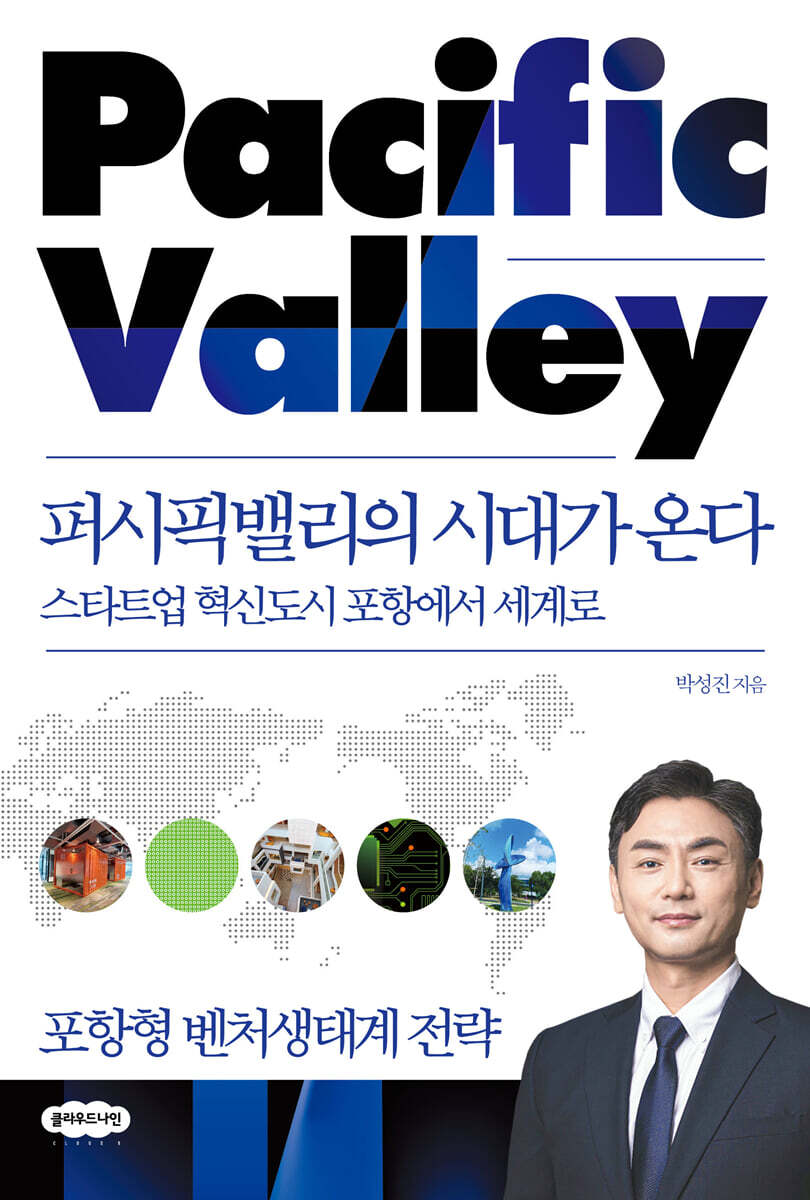
The era of Pacific Valley has arrived.
 |
Description
Book Introduction
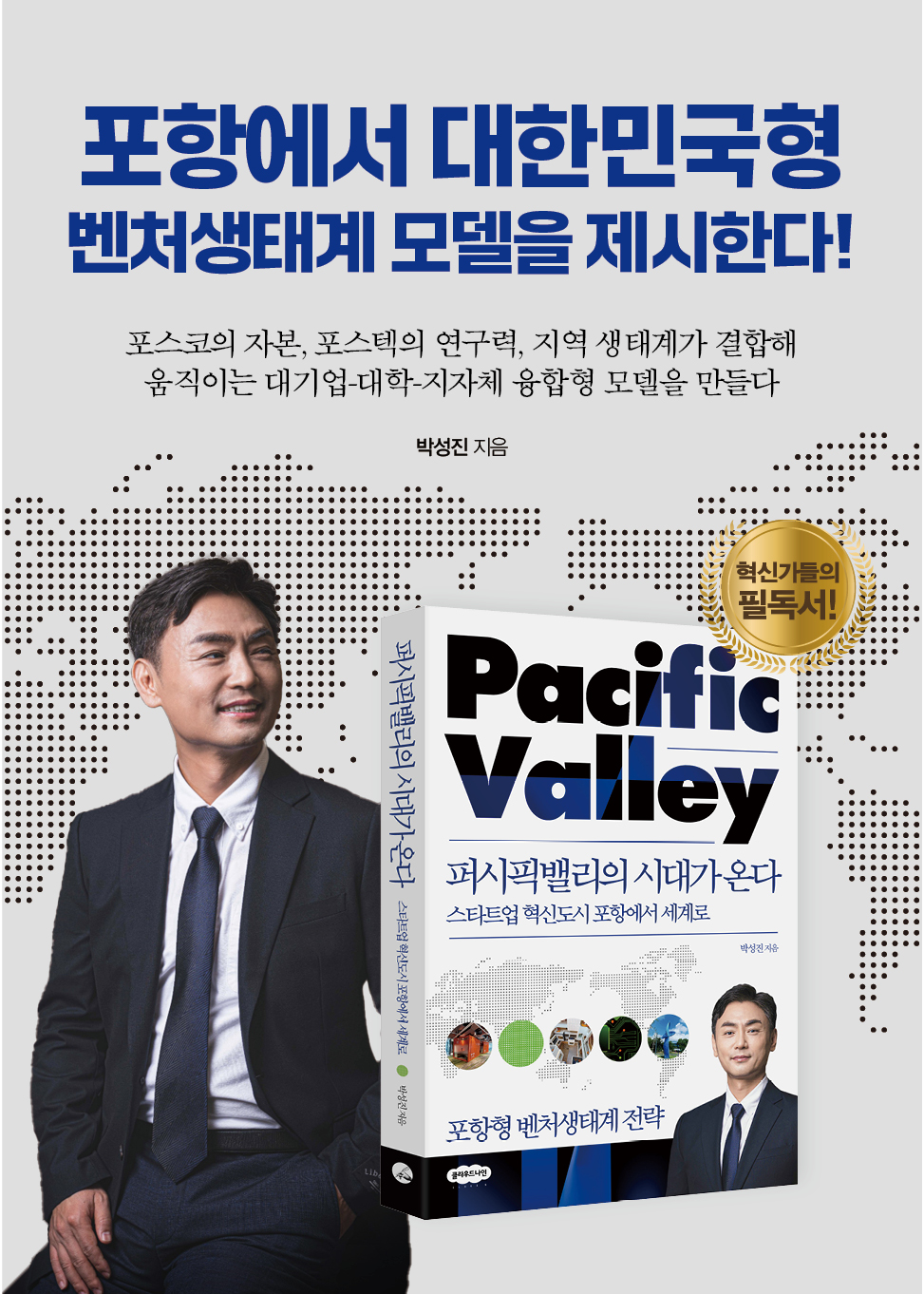
Pohang presents a model for a Korean venture ecosystem!
Pacific Valley is a place where POSCO's capital, POSTECH's research capabilities, and the local ecosystem are combined.
It is a combined model of large corporations, universities, and local governments that move together!
This book presents the Pacific Valley Strategy, a Korean-style venture ecosystem model centered on POSCO, POSTECH, industry-academia-research institutes, local governments, and the private sector, based on the author, Professor Park Seong-jin's 30 years of experience in industry-academia cooperation and venture ecosystem development.
He tried to transplant the virtuous cycle of 'research-entrepreneurship-investment-reinvestment' that he had personally witnessed at MIT to Korea.
As a result, a startup ecosystem consisting of over 100 companies with over 1,100 employees was established in Pohang, Gyeongbuk, through a venture ecosystem centered around POSCO and POSTECH.
Additionally, more than 50 companies, including the headquarters of 12 companies in the metropolitan area, moved to Pohang, creating approximately 300 new jobs.
The 'Pohang-type startup ecosystem' has become a reality.
The Pohang-type startup ecosystem is not simply a regional development project, but the first experiment in a paradigm shift where large corporations are entering the venture ecosystem.
This book simultaneously examines POSCO's identity and crisis.
Behind the great legacy of "unwavering challenge" and "serving the nation through steel production" lies the reality of a concentration of steel in the country, insufficient investment in research and development (R&D), and a drain on talent.
And he asserts that the solution is for POSCO to equip a second engine called the 'venture ecosystem' together with POSTECH.
A structure that commercializes POSTECH's research and combines POSCO's capital and experience to simultaneously achieve the speed of a venture and the trust of a large corporation? That's Pacific Valley.
'Pacific Valley' is not just the name of a region, but a growth platform for South Korea to leap from $40,000 to $50,000 in GDP per capita.
This is a blueprint for innovative national development that aims to solve national challenges such as local extinction, population cliff, and youth unemployment through the venture ecosystem.
Pacific Valley is a place where POSCO's capital, POSTECH's research capabilities, and the local ecosystem are combined.
It is a combined model of large corporations, universities, and local governments that move together!
This book presents the Pacific Valley Strategy, a Korean-style venture ecosystem model centered on POSCO, POSTECH, industry-academia-research institutes, local governments, and the private sector, based on the author, Professor Park Seong-jin's 30 years of experience in industry-academia cooperation and venture ecosystem development.
He tried to transplant the virtuous cycle of 'research-entrepreneurship-investment-reinvestment' that he had personally witnessed at MIT to Korea.
As a result, a startup ecosystem consisting of over 100 companies with over 1,100 employees was established in Pohang, Gyeongbuk, through a venture ecosystem centered around POSCO and POSTECH.
Additionally, more than 50 companies, including the headquarters of 12 companies in the metropolitan area, moved to Pohang, creating approximately 300 new jobs.
The 'Pohang-type startup ecosystem' has become a reality.
The Pohang-type startup ecosystem is not simply a regional development project, but the first experiment in a paradigm shift where large corporations are entering the venture ecosystem.
This book simultaneously examines POSCO's identity and crisis.
Behind the great legacy of "unwavering challenge" and "serving the nation through steel production" lies the reality of a concentration of steel in the country, insufficient investment in research and development (R&D), and a drain on talent.
And he asserts that the solution is for POSCO to equip a second engine called the 'venture ecosystem' together with POSTECH.
A structure that commercializes POSTECH's research and combines POSCO's capital and experience to simultaneously achieve the speed of a venture and the trust of a large corporation? That's Pacific Valley.
'Pacific Valley' is not just the name of a region, but a growth platform for South Korea to leap from $40,000 to $50,000 in GDP per capita.
This is a blueprint for innovative national development that aims to solve national challenges such as local extinction, population cliff, and youth unemployment through the venture ecosystem.
- You can preview some of the book's contents.
Preview
index
Dreaming of the West Gate Pacific Valley
Chapter 1: POSCO and POSTECH: Platforms for Innovation and National Contribution
1.
POSCO and POSTECH's Innovation and National Contribution Venture Ecosystem
The identity of POSCO and POSTECH, driven by challenge and innovation / An ecosystem created by a collective spirit of POSTECH.
2.
POSTECH, Korea's first research-oriented university
The Right-Hyung Woo Spirit and Bathhouse Management Philosophy / POSCO Philosophy and POSTECH's Success / The Rebirth of Park Tae-juns
3.
POSCO's identity
POSCO's Great Legacy and Heavy Footsteps / National Industrial Strategy and the Birth of POSCO / POSCO Must Again Become the Answer to the Times
Chapter 2: How the Venture Ecosystem Works
1.
The Birth of Schools and Research and the Creation of a Venture Ecosystem
The scientific revolution began with the birth of schools and the quantification revolution. The scientific revolution matured with the birth of research and the systematization of technological innovation. The scientific revolution was completed with the commercialization of innovative technologies.
2.
The structure and operating principles of the venture ecosystem
A venture ecosystem born from technology commercialization / Securing funds through capital gains and diversified investments / A venture ecosystem at the center of the talent war
3.
The venture ecosystem, the spirit of the times
The nation's new economic engine / South Korea's growth through education / Innovation in university-centered venture valleys / The zeitgeist of open innovation / A paradigm shift through the power of connection
4.
The Power of Innovation Theory and Philosophy
Individual Greatness as the Starting Point of Innovation / Innovative Business Models and Culture / The Sensing Channels of Large Corporations in an Age of Complexity
5.
Changes in the venture ecosystem and large corporations
The Role and Status of the Chief Technology Officer / Research and Development Linking Research and Business
6.
Driving force of the venture ecosystem
A venture ecosystem designed by financial capital / A new order created by young entrepreneurship / A new growth model created by generosity / A data-driven IT venture ecosystem / A new era driven by data / The rise of the planning and startup bio ecosystem / A foundry-based manufacturing venture ecosystem
Chapter 3: POSCO Venture Ecosystem
1.
Structure of POSCO's Venture Ecosystem
Preparing for the POSCO Venture Ecosystem / The Spirit of the POSCO Venture Ecosystem / An Innovation Platform Where Education and Research Meet / The Engine of Venture Startups Created by POSCO / POSCO's Venture Ecosystem Pipeline
2.
The Role of POSTECH and Pohang Research Institute of Industrial Science and Technology
Educational innovation for a venture ecosystem and global competitiveness / POSCO-style industry-academia-research ecosystem and convergent research innovation / Commercialization innovation of the interface connecting research and business
3.
POSCO's ultra-gap venture ecosystem
An organically evolving deep-tech startup ecosystem / Establishing the ChangeUpground incubation center / A commercialization-focused incubation complex / POSCO Venture Fund designing the ecosystem through investment / POSCO's new business system fostering unicorns
4.
POSCO Venture Ecosystem Achievements
POSCO Venture Valley: Where Experiments Become Reality / POSCO Venture Fund: Proven Profitability / Pacific Valley Ecosystem: Crossing Borders / Sensing Channel: A Strategic Asset in the POSCO Ecosystem / Regional Economic Revitalization Driven by the Venture Ecosystem
Outgoing post
Planting the Roots of Innovation
Chapter 1: POSCO and POSTECH: Platforms for Innovation and National Contribution
1.
POSCO and POSTECH's Innovation and National Contribution Venture Ecosystem
The identity of POSCO and POSTECH, driven by challenge and innovation / An ecosystem created by a collective spirit of POSTECH.
2.
POSTECH, Korea's first research-oriented university
The Right-Hyung Woo Spirit and Bathhouse Management Philosophy / POSCO Philosophy and POSTECH's Success / The Rebirth of Park Tae-juns
3.
POSCO's identity
POSCO's Great Legacy and Heavy Footsteps / National Industrial Strategy and the Birth of POSCO / POSCO Must Again Become the Answer to the Times
Chapter 2: How the Venture Ecosystem Works
1.
The Birth of Schools and Research and the Creation of a Venture Ecosystem
The scientific revolution began with the birth of schools and the quantification revolution. The scientific revolution matured with the birth of research and the systematization of technological innovation. The scientific revolution was completed with the commercialization of innovative technologies.
2.
The structure and operating principles of the venture ecosystem
A venture ecosystem born from technology commercialization / Securing funds through capital gains and diversified investments / A venture ecosystem at the center of the talent war
3.
The venture ecosystem, the spirit of the times
The nation's new economic engine / South Korea's growth through education / Innovation in university-centered venture valleys / The zeitgeist of open innovation / A paradigm shift through the power of connection
4.
The Power of Innovation Theory and Philosophy
Individual Greatness as the Starting Point of Innovation / Innovative Business Models and Culture / The Sensing Channels of Large Corporations in an Age of Complexity
5.
Changes in the venture ecosystem and large corporations
The Role and Status of the Chief Technology Officer / Research and Development Linking Research and Business
6.
Driving force of the venture ecosystem
A venture ecosystem designed by financial capital / A new order created by young entrepreneurship / A new growth model created by generosity / A data-driven IT venture ecosystem / A new era driven by data / The rise of the planning and startup bio ecosystem / A foundry-based manufacturing venture ecosystem
Chapter 3: POSCO Venture Ecosystem
1.
Structure of POSCO's Venture Ecosystem
Preparing for the POSCO Venture Ecosystem / The Spirit of the POSCO Venture Ecosystem / An Innovation Platform Where Education and Research Meet / The Engine of Venture Startups Created by POSCO / POSCO's Venture Ecosystem Pipeline
2.
The Role of POSTECH and Pohang Research Institute of Industrial Science and Technology
Educational innovation for a venture ecosystem and global competitiveness / POSCO-style industry-academia-research ecosystem and convergent research innovation / Commercialization innovation of the interface connecting research and business
3.
POSCO's ultra-gap venture ecosystem
An organically evolving deep-tech startup ecosystem / Establishing the ChangeUpground incubation center / A commercialization-focused incubation complex / POSCO Venture Fund designing the ecosystem through investment / POSCO's new business system fostering unicorns
4.
POSCO Venture Ecosystem Achievements
POSCO Venture Valley: Where Experiments Become Reality / POSCO Venture Fund: Proven Profitability / Pacific Valley Ecosystem: Crossing Borders / Sensing Channel: A Strategic Asset in the POSCO Ecosystem / Regional Economic Revitalization Driven by the Venture Ecosystem
Outgoing post
Planting the Roots of Innovation
Detailed image
Into the book
Alumni Companies Bigger Than POSCO
When I returned from the United States and took up a professorship at POSTECH in 2009, I wanted to put that vision into practice.
As our first effort, we opened a course called ‘Introduction to Venture Companies.’
Starting with this lecture, I met with alumni companies, alumni venture capitalists, alumni lawyers, and patent attorneys.
Afterwards, he served as the Director of the Research Department, Director of the Industry-Academic Cooperation Office, and CEO of POSTECH Technology Holdings, building POSTECH's industry-academic cooperation system and venture ecosystem.
In this process, I came to understand the university system by coming into contact with POSTECH's organization and budget.
Also, through interacting with alumni, I learned that there are already over 300 alumni businesses.
Among these, there were more than 30 companies that were listed or merged.
The size and growth of POSTECH alumni companies was considerably greater than I expected.
The total market capitalization of all alumni companies exceeded 15 trillion won.
There are more than 15 alumni with assets exceeding 100 billion won.
When we analyzed the alumni companies at the time, 50% were IT companies and 30% were bio companies.
However, there was no connection between POSTECH alumni companies and POSCO.
Naturally, the question arose: 'Why can't POSCO strategically utilize POSTECH for IT and bio businesses?'
This question later became the basis for my work at POSCO.
--- p.5
How is the POSTECH spirit instilled in students? This cannot be achieved through the seed-planting process of "knowledge transfer through lectures" and "campus life."
It is possible only when you sprout and take root in the real life you experience after graduating and going out into society.
The adventure I had in the world after leaving POSTECH was not smooth.
Through the hardships I encountered on this adventure, I came to understand the hardships behind the glory of POSCO and POSTECH's success.
There is an anecdote related to this.
It is said that President Park Chung-hee came to the construction site of the Pohang Iron and Steel Company without notice and asked Chairman Park Tae-jun a question.
"President Park, is it right for us to build a steel mill with funds from the Japanese Claims Fund? I often wonder if it wouldn't be better for the country if we used this money for other projects."
It is said that Chairman Park Tae-jun was unable to answer this question, and the two great men remained silent for a while without speaking.
Since they are not gods, they could not avoid being torn between the certainty of success and the reckless challenge.
It is humbling to realize that innovation and success are born only in the midst of such struggles and hardships.
--- p.28
For South Korea to surpass $30,000 in GDP per capita and usher in an era of $50,000, it must add a new economic engine, the venture ecosystem, to the economic engine of large corporations that the previous generation has nurtured.
We need to change the paradigm so that domestic companies, including POSCO, can develop by cooperating with the venture ecosystem, which is the global standard for new businesses.
Rather than bringing the venture ecosystem to large corporations, large corporations should approach and support the venture ecosystem, which is the driving force behind innovation.
This poses a major challenge to the survival of large corporations.
Transformation of a large corporation is difficult and involves as much pain as starting a business.
It is time for POSCO, which owns POSTECH, to embrace a new sense of mission: to present a model for Korea's future in the face of these challenges.
--- p.40
Silicon Valley in the United States is characterized by private sector leadership, accounting for 60% of U.S. venture investment, and innovation clusters have formed around key players in universities, overseas study/immigrants, and the private sector.
It boasts the strengths of being central to the global venture ecosystem and cultural diversity.
Tel Aviv, Israel, stands out for being a civilian-led city based on the spirit of challenge known as chutzpah.
Against this backdrop, an innovation cluster was formed around key players from the military, universities, and the private sector.
A strong entrepreneurial culture and a large number of startups are its strengths.
Singapore is characterized by attracting businesses based on national strategy.
An innovation cluster was formed around the core entities of the government, universities, and foreign capital.
The strengths are the global network and the sophistication of policies.
Fraunhofer is a government-funded research institute in Germany with over 70 research centers across Germany.
An innovation cluster was formed, with companies and research institutes as key players, featuring the development of industry-linked application technologies.
Its strengths are technology commercialization and sustainability.
--- p.58
The area where the venture ecosystem is established is often called 'Venture Valley'.
Silicon Valley in California, USA, is a well-known venture valley.
One of the models that describes Silicon Valley is the 'Vortex University Model'.
We consider universities as a key requirement for Venture Valley.
All cities around the world with venture valleys have research-intensive universities.
Research-focused universities can produce challenging young talents who can work 100 hours a week and have research capabilities that can be protected by patents.
The university is commonly referred to as 'Way Point University'.
I think of college as a point on the path that people take in life.
For those who graduate from college and live a life unrelated to college, college is just a passing period.
In contrast, Vortex University means that people live in a vortex-like manner around the university.
Based on the research results from the university, we start a business around the university and continue research and commercialization in cooperation with the university.
--- p.74-75
So what can experienced CEOs in their 50s and 60s offer to young CEOs in their 20s and 30s? Those in their 50s and 60s can offer their 20s and 30s not just grammar, but financial resources and a global network, creating a larger playing field for them to thrive.
People in their 20s and 30s learn grammar on their own in the actual market.
This is called the 'Playground Model'.
The name of POSCO's venture incubation center, CHANGEUP GROUND, also signifies its intention to provide this model to young entrepreneurs.
This term implies providing the largest possible playing field so that young entrepreneurs can run freely.
In a venture ecosystem where people learn and innovate on their own, the culture needed is generosity.
We must encourage bold action to try again even if we fail.
What the vested interests should give to the young is not the wisdom to avoid hardship, but the courage to face it and overcome it.
--- p.103
The venture ecosystem also influences universities and research institutes that are on the opposite side of companies.
It is said that venture capitalists in Silicon Valley are aware of the research being conducted by leading Stanford University professors.
When important research results come out, we go and propose starting a business.
If the current research completion rate is around 70% and 30% more is needed, it is suggested that the 30% be invested after starting a business and that more manpower and equipment be invested to produce results quickly.
In response to the question of what happens if a company fails, it is said that there is a market where failed companies are traded.
Companies that emerged from this market include COVID-19 vaccine company Moderna and robotics company Boston Dynamics.
The reason quantum computers, metamaterials for creating invisibility cloaks, and small nuclear power plants are coming to market so quickly is because universities and the venture ecosystem collaborate before research is complete.
At the university research stage, the focus is on producing human resources and excellent papers.
Concerns about the market and cost structure are relatively weak.
However, the logic is that venture startups consider the market and cost structure before completing research, which speeds up the commercialization process.
--- p.114
How is the POSCO-style venture ecosystem actually structured? First, looking at how POSCO's 1 trillion won venture fund is being used, 200 billion won is earmarked for building venture valley infrastructure and 800 billion won for venture fund creation.
If the venture fund achieves a multiple of 2 or higher by collaborating with the best accelerators, venture capitalists, and private equity funds, it is designed to use approximately 20% of this performance to maintain the Venture Valley infrastructure, thereby enabling it to become budgetarily independent.
Starting with the establishment of a startup ecosystem that gathers startups, establishing an incubation center infrastructure where startups can move in, the POSCO Venture Fund system for venture investment, and the POSCO new business system are the unique characteristics and strengths of Pohang Venture Valley.
Additionally, Pohang's Venture Valley is building an incubation infrastructure based on customized infrastructure for each field to support startups based on research results from small and medium-sized enterprises (SMEs), IT, and biotechnology, which each account for one-third of POSTECH's research.
Through this, the concept of 'incubating complex' was introduced for the first time in the world.
When I returned from the United States and took up a professorship at POSTECH in 2009, I wanted to put that vision into practice.
As our first effort, we opened a course called ‘Introduction to Venture Companies.’
Starting with this lecture, I met with alumni companies, alumni venture capitalists, alumni lawyers, and patent attorneys.
Afterwards, he served as the Director of the Research Department, Director of the Industry-Academic Cooperation Office, and CEO of POSTECH Technology Holdings, building POSTECH's industry-academic cooperation system and venture ecosystem.
In this process, I came to understand the university system by coming into contact with POSTECH's organization and budget.
Also, through interacting with alumni, I learned that there are already over 300 alumni businesses.
Among these, there were more than 30 companies that were listed or merged.
The size and growth of POSTECH alumni companies was considerably greater than I expected.
The total market capitalization of all alumni companies exceeded 15 trillion won.
There are more than 15 alumni with assets exceeding 100 billion won.
When we analyzed the alumni companies at the time, 50% were IT companies and 30% were bio companies.
However, there was no connection between POSTECH alumni companies and POSCO.
Naturally, the question arose: 'Why can't POSCO strategically utilize POSTECH for IT and bio businesses?'
This question later became the basis for my work at POSCO.
--- p.5
How is the POSTECH spirit instilled in students? This cannot be achieved through the seed-planting process of "knowledge transfer through lectures" and "campus life."
It is possible only when you sprout and take root in the real life you experience after graduating and going out into society.
The adventure I had in the world after leaving POSTECH was not smooth.
Through the hardships I encountered on this adventure, I came to understand the hardships behind the glory of POSCO and POSTECH's success.
There is an anecdote related to this.
It is said that President Park Chung-hee came to the construction site of the Pohang Iron and Steel Company without notice and asked Chairman Park Tae-jun a question.
"President Park, is it right for us to build a steel mill with funds from the Japanese Claims Fund? I often wonder if it wouldn't be better for the country if we used this money for other projects."
It is said that Chairman Park Tae-jun was unable to answer this question, and the two great men remained silent for a while without speaking.
Since they are not gods, they could not avoid being torn between the certainty of success and the reckless challenge.
It is humbling to realize that innovation and success are born only in the midst of such struggles and hardships.
--- p.28
For South Korea to surpass $30,000 in GDP per capita and usher in an era of $50,000, it must add a new economic engine, the venture ecosystem, to the economic engine of large corporations that the previous generation has nurtured.
We need to change the paradigm so that domestic companies, including POSCO, can develop by cooperating with the venture ecosystem, which is the global standard for new businesses.
Rather than bringing the venture ecosystem to large corporations, large corporations should approach and support the venture ecosystem, which is the driving force behind innovation.
This poses a major challenge to the survival of large corporations.
Transformation of a large corporation is difficult and involves as much pain as starting a business.
It is time for POSCO, which owns POSTECH, to embrace a new sense of mission: to present a model for Korea's future in the face of these challenges.
--- p.40
Silicon Valley in the United States is characterized by private sector leadership, accounting for 60% of U.S. venture investment, and innovation clusters have formed around key players in universities, overseas study/immigrants, and the private sector.
It boasts the strengths of being central to the global venture ecosystem and cultural diversity.
Tel Aviv, Israel, stands out for being a civilian-led city based on the spirit of challenge known as chutzpah.
Against this backdrop, an innovation cluster was formed around key players from the military, universities, and the private sector.
A strong entrepreneurial culture and a large number of startups are its strengths.
Singapore is characterized by attracting businesses based on national strategy.
An innovation cluster was formed around the core entities of the government, universities, and foreign capital.
The strengths are the global network and the sophistication of policies.
Fraunhofer is a government-funded research institute in Germany with over 70 research centers across Germany.
An innovation cluster was formed, with companies and research institutes as key players, featuring the development of industry-linked application technologies.
Its strengths are technology commercialization and sustainability.
--- p.58
The area where the venture ecosystem is established is often called 'Venture Valley'.
Silicon Valley in California, USA, is a well-known venture valley.
One of the models that describes Silicon Valley is the 'Vortex University Model'.
We consider universities as a key requirement for Venture Valley.
All cities around the world with venture valleys have research-intensive universities.
Research-focused universities can produce challenging young talents who can work 100 hours a week and have research capabilities that can be protected by patents.
The university is commonly referred to as 'Way Point University'.
I think of college as a point on the path that people take in life.
For those who graduate from college and live a life unrelated to college, college is just a passing period.
In contrast, Vortex University means that people live in a vortex-like manner around the university.
Based on the research results from the university, we start a business around the university and continue research and commercialization in cooperation with the university.
--- p.74-75
So what can experienced CEOs in their 50s and 60s offer to young CEOs in their 20s and 30s? Those in their 50s and 60s can offer their 20s and 30s not just grammar, but financial resources and a global network, creating a larger playing field for them to thrive.
People in their 20s and 30s learn grammar on their own in the actual market.
This is called the 'Playground Model'.
The name of POSCO's venture incubation center, CHANGEUP GROUND, also signifies its intention to provide this model to young entrepreneurs.
This term implies providing the largest possible playing field so that young entrepreneurs can run freely.
In a venture ecosystem where people learn and innovate on their own, the culture needed is generosity.
We must encourage bold action to try again even if we fail.
What the vested interests should give to the young is not the wisdom to avoid hardship, but the courage to face it and overcome it.
--- p.103
The venture ecosystem also influences universities and research institutes that are on the opposite side of companies.
It is said that venture capitalists in Silicon Valley are aware of the research being conducted by leading Stanford University professors.
When important research results come out, we go and propose starting a business.
If the current research completion rate is around 70% and 30% more is needed, it is suggested that the 30% be invested after starting a business and that more manpower and equipment be invested to produce results quickly.
In response to the question of what happens if a company fails, it is said that there is a market where failed companies are traded.
Companies that emerged from this market include COVID-19 vaccine company Moderna and robotics company Boston Dynamics.
The reason quantum computers, metamaterials for creating invisibility cloaks, and small nuclear power plants are coming to market so quickly is because universities and the venture ecosystem collaborate before research is complete.
At the university research stage, the focus is on producing human resources and excellent papers.
Concerns about the market and cost structure are relatively weak.
However, the logic is that venture startups consider the market and cost structure before completing research, which speeds up the commercialization process.
--- p.114
How is the POSCO-style venture ecosystem actually structured? First, looking at how POSCO's 1 trillion won venture fund is being used, 200 billion won is earmarked for building venture valley infrastructure and 800 billion won for venture fund creation.
If the venture fund achieves a multiple of 2 or higher by collaborating with the best accelerators, venture capitalists, and private equity funds, it is designed to use approximately 20% of this performance to maintain the Venture Valley infrastructure, thereby enabling it to become budgetarily independent.
Starting with the establishment of a startup ecosystem that gathers startups, establishing an incubation center infrastructure where startups can move in, the POSCO Venture Fund system for venture investment, and the POSCO new business system are the unique characteristics and strengths of Pohang Venture Valley.
Additionally, Pohang's Venture Valley is building an incubation infrastructure based on customized infrastructure for each field to support startups based on research results from small and medium-sized enterprises (SMEs), IT, and biotechnology, which each account for one-third of POSTECH's research.
Through this, the concept of 'incubating complex' was introduced for the first time in the world.
--- p.186~187
Publisher's Review
The venture ecosystem of openness, circulation, and connection
It is the spirit of the times and the engine of national competitiveness!
Professor Park Sung-jin, the author of this book, entered POSTECH as one of its first students and met the campus built on a barren hill, Chairman Park Tae-joon and President Kim Ho-gil's determination to create "the world's purest school for studying," and the teachers and colleagues who set near-impossible goals as if testing themselves.
What he really learned at POSTECH was not knowledge, but attitude.
The experience changed his world view.
"Challenge, but be pure. Build your skills, but think of your country first." This spirit expanded in a completely new direction after he moved to the United States. At MIT, he saw shocking figures. The market capitalization of companies founded by MIT alumni was 2,500 trillion won, equivalent to the entire listed companies in South Korea at the time, making it the world's ninth-largest economy.
From that day on, he left himself one homework assignment.
“Someday, I will create an alumni company at POSTECH that is even bigger than POSCO.”
After returning to Korea, he took up a professorship at POSTECH and established a venture course. He met with over 500 alumni one by one, uniting their minds and creating an alumni network.
He also invited influential alumni to lecture in his classes, ensuring that their entrepreneurial spirit would be passed on to his juniors at POSTECH.
And we sought realistic ways to commercialize POSTECH's research.
But the reality was not easy.
POSCO was still focused on steel, and its R&D budget was only one-fortieth of Samsung's.
While over 100 PhD-level talents head to Samsung, Hyundai, and LG every year, only a handful enter POSCO.
The author was convinced that unless this structure was changed, POSCO would once again be trapped in the 'steel trap.'
The era of large corporations supporting ventures is over.
Now is the time for large corporations to enter the venture ecosystem.
Now, Pohang has become Pacific Valley, a city where ventures grow!
He began directly changing the structure when he took office as the head of POSCO's Industry-Academia-Research Cooperation Office in 2019.
We designed a venture ecosystem platform by connecting POSCO, POSTECH, and Pohang Research Institute of Industrial Science and Technology, which are each separate entities.
It was not just a simple fund, but a circulating system.
We signed a memorandum of understanding for a venture fund worth 1 trillion won and collaborated with 25 domestic and foreign funds to connect 1,500 venture companies into an investment network.
We reinvest a portion of our profits back into our infrastructure, creating a self-sustainable ecosystem.
Within this structure, Pohang began to change rapidly.
He calls this process 'Pacific Valley'.
It's not a name copied from Silicon Valley.
It refers to a new innovation zone connecting Silicon Valley in the United States and Pohang in Korea, which are on opposite ends of the Pacific Ocean.
Pacific Valley is a convergence model of large corporations, universities, and local governments, powered by the combined power of POSCO's capital, POSTECH's research capabilities, and the local ecosystem.
This structure and model began in Pohang, but is expanding to Gyeongbuk, Jeonnam, Gwangyang, and even overseas.
Today's venture ecosystem is the foundation for corporate survival and the engine of national growth!
This book consists of three chapters.
First, we look back at the spirit of POSCO and POSTECH and show why ‘serving the nation through innovation’ has become a mission of the times.
If POSCO is to become a company that creates the order of the future, rather than a company that preserves the legacy of the past, it needs a new engine.
That engine is the venture ecosystem.
Next, we dissect the operating principles of the venture ecosystem.
Just as schools popularized knowledge and ushered in modern civilization, the venture ecosystem connects research to industry and restructures the economy.
This structure, where technology, capital, talent, and ideas constantly circulate, has already become the world's growth mechanism.
New businesses at large corporations no longer come from internal research labs.
With collaboration, investment, and mergers and acquisitions (M&A) with startups becoming the norm, the venture ecosystem is now the foundation for corporate survival and the engine of the nation.
And it shows how the POSCO venture ecosystem actually works.
ChangeUpGround, the Incubating Complex, and the Future Technology Research Institute are all auxiliary organizations and catalysts of this ecosystem.
A virtuous cycle has been created in which POSTECH's research leads to technology commercialization, which in turn leads to venture growth and new businesses for POSCO.
POSCO's venture fund is not simply a financial investment, but a "sensing channel" for discovering new businesses.
It is an information network and laboratory that captures promising technologies from anywhere in the world and connects them with investments and collaborations.
This book is neither a corporate report nor a regional development white paper.
It is a 'record and roadmap of innovation' written by an engineer as a witness to an era.
If this experiment, which began in Pohang, is successful, South Korea will once again have the opportunity to make a quantum leap.
It is the spirit of the times and the engine of national competitiveness!
Professor Park Sung-jin, the author of this book, entered POSTECH as one of its first students and met the campus built on a barren hill, Chairman Park Tae-joon and President Kim Ho-gil's determination to create "the world's purest school for studying," and the teachers and colleagues who set near-impossible goals as if testing themselves.
What he really learned at POSTECH was not knowledge, but attitude.
The experience changed his world view.
"Challenge, but be pure. Build your skills, but think of your country first." This spirit expanded in a completely new direction after he moved to the United States. At MIT, he saw shocking figures. The market capitalization of companies founded by MIT alumni was 2,500 trillion won, equivalent to the entire listed companies in South Korea at the time, making it the world's ninth-largest economy.
From that day on, he left himself one homework assignment.
“Someday, I will create an alumni company at POSTECH that is even bigger than POSCO.”
After returning to Korea, he took up a professorship at POSTECH and established a venture course. He met with over 500 alumni one by one, uniting their minds and creating an alumni network.
He also invited influential alumni to lecture in his classes, ensuring that their entrepreneurial spirit would be passed on to his juniors at POSTECH.
And we sought realistic ways to commercialize POSTECH's research.
But the reality was not easy.
POSCO was still focused on steel, and its R&D budget was only one-fortieth of Samsung's.
While over 100 PhD-level talents head to Samsung, Hyundai, and LG every year, only a handful enter POSCO.
The author was convinced that unless this structure was changed, POSCO would once again be trapped in the 'steel trap.'
The era of large corporations supporting ventures is over.
Now is the time for large corporations to enter the venture ecosystem.
Now, Pohang has become Pacific Valley, a city where ventures grow!
He began directly changing the structure when he took office as the head of POSCO's Industry-Academia-Research Cooperation Office in 2019.
We designed a venture ecosystem platform by connecting POSCO, POSTECH, and Pohang Research Institute of Industrial Science and Technology, which are each separate entities.
It was not just a simple fund, but a circulating system.
We signed a memorandum of understanding for a venture fund worth 1 trillion won and collaborated with 25 domestic and foreign funds to connect 1,500 venture companies into an investment network.
We reinvest a portion of our profits back into our infrastructure, creating a self-sustainable ecosystem.
Within this structure, Pohang began to change rapidly.
He calls this process 'Pacific Valley'.
It's not a name copied from Silicon Valley.
It refers to a new innovation zone connecting Silicon Valley in the United States and Pohang in Korea, which are on opposite ends of the Pacific Ocean.
Pacific Valley is a convergence model of large corporations, universities, and local governments, powered by the combined power of POSCO's capital, POSTECH's research capabilities, and the local ecosystem.
This structure and model began in Pohang, but is expanding to Gyeongbuk, Jeonnam, Gwangyang, and even overseas.
Today's venture ecosystem is the foundation for corporate survival and the engine of national growth!
This book consists of three chapters.
First, we look back at the spirit of POSCO and POSTECH and show why ‘serving the nation through innovation’ has become a mission of the times.
If POSCO is to become a company that creates the order of the future, rather than a company that preserves the legacy of the past, it needs a new engine.
That engine is the venture ecosystem.
Next, we dissect the operating principles of the venture ecosystem.
Just as schools popularized knowledge and ushered in modern civilization, the venture ecosystem connects research to industry and restructures the economy.
This structure, where technology, capital, talent, and ideas constantly circulate, has already become the world's growth mechanism.
New businesses at large corporations no longer come from internal research labs.
With collaboration, investment, and mergers and acquisitions (M&A) with startups becoming the norm, the venture ecosystem is now the foundation for corporate survival and the engine of the nation.
And it shows how the POSCO venture ecosystem actually works.
ChangeUpGround, the Incubating Complex, and the Future Technology Research Institute are all auxiliary organizations and catalysts of this ecosystem.
A virtuous cycle has been created in which POSTECH's research leads to technology commercialization, which in turn leads to venture growth and new businesses for POSCO.
POSCO's venture fund is not simply a financial investment, but a "sensing channel" for discovering new businesses.
It is an information network and laboratory that captures promising technologies from anywhere in the world and connects them with investments and collaborations.
This book is neither a corporate report nor a regional development white paper.
It is a 'record and roadmap of innovation' written by an engineer as a witness to an era.
If this experiment, which began in Pohang, is successful, South Korea will once again have the opportunity to make a quantum leap.
GOODS SPECIFICS
- Date of issue: September 29, 2025
- Page count, weight, size: 244 pages | 152*225*20mm
- ISBN13: 9791194534419
- ISBN10: 1194534414
You may also like
카테고리
korean


korean

![GQ KOREA Mark (Monthly): December [2025]](http://librairie.coreenne.fr/cdn/shop/files/8ef265dbbfbf186523ed75ba7319009d.jpg?v=1765340328&width=3840)


