

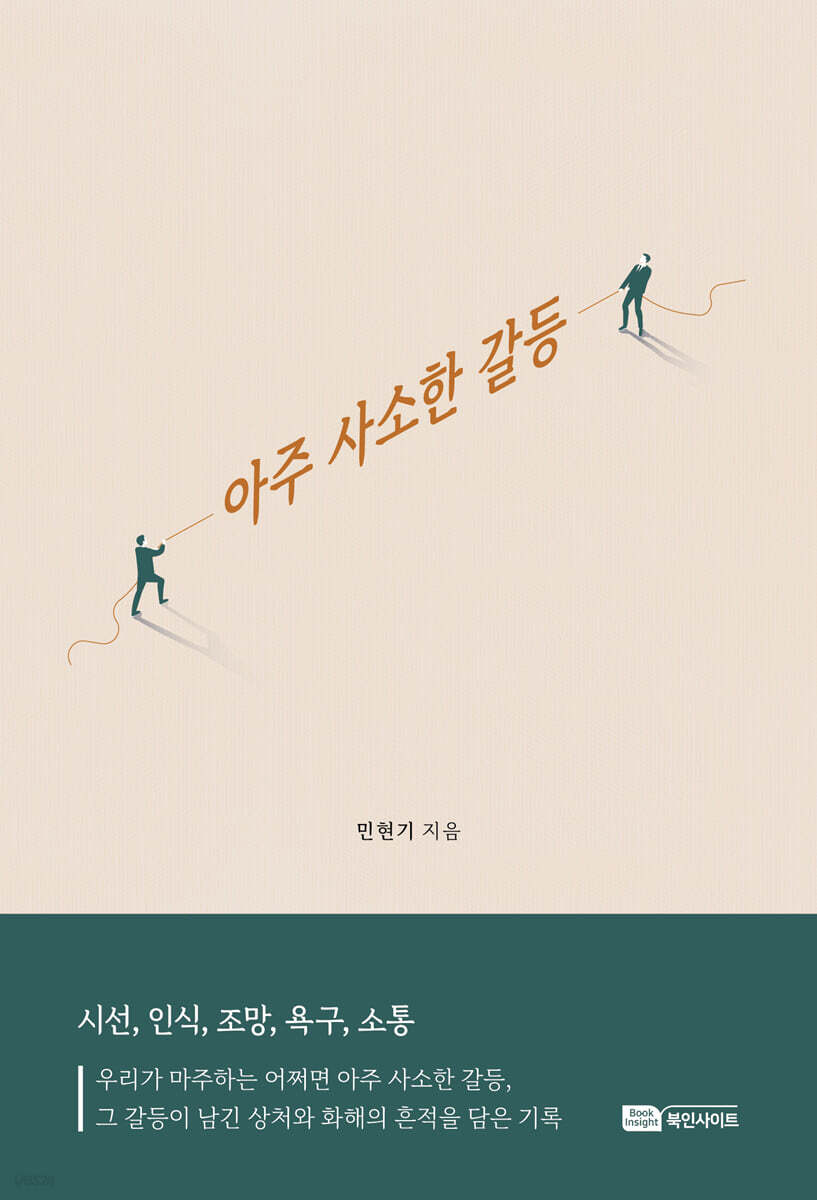
A very minor conflict
 |
Description
Book Introduction
A very minor conflict, coexisting within it
The traces of conflict become my record.
Conflict is like a small wound from a fall.
If you cover it up, it will fester, but if you expose it and disinfect it, it will heal.
If you just hide the various wounds that arise in human relationships, they will soon become a pain that is difficult to deal with.
Even if it's a little uncomfortable, the relationship will survive if you reveal it and fight.
The traces of conflict become my record.
Conflict is like a small wound from a fall.
If you cover it up, it will fester, but if you expose it and disinfect it, it will heal.
If you just hide the various wounds that arise in human relationships, they will soon become a pain that is difficult to deal with.
Even if it's a little uncomfortable, the relationship will survive if you reveal it and fight.
- You can preview some of the book's contents.
Preview
index
Recommendation 004
PROLOGUE 007
Chapter 01: A Window on Conflict | Perspective
1.
Viewing Conflict Without Prejudice · 017
2.
Inevitable Conflict: The Brain's Survival Response · 024
3.
Conflict is the ever-changing weather · 030
4.
The organization is like tofu that breaks easily. 037
5.
Why Relationships Keep Getting Twisted · 042
Chapter 02: Framing Conflict | Perception
1.
Conflict Makes Us Human · 051
2.
Between People, There Is Work · 057
3.
Conflict isn't black and white, it's a gradient. · 066
4.
Don't Hide, Show It: Confronting Conflict Head-on · 073
5.
Why Respect Matters · 079
Chapter 03: Conflict, Viewed Objectively | Perspective
1.
Emotions fuel conflict · 091
2.
Escape the Emotional Swamp · 098
3.
If you let it flow, it will go away · 104
4.
The Principle of No-Ak Presumption · 113
5.
Balance between Relationships and Outcomes · 122
6.
Moving from "I" and "You" to "We" · 130
Chapter 04: Context and a Look into the Abyss | Desire
1.
'Context' over 'Phenomena' · 141
2.
What star are you from? · 148
3.
The Local Sense of an Excellent Traveler · 156
4.
There is a desire in it · 163
5.
Reading Desire Through Emotions, Circumstances, and Content · 168
6.
A Conversation That Meets Desire · 175
Chapter 05: Words That Create Conflict, Words That Reduce Conflict | Communication
1.
Meta-Dialogue: The First Step to Communication That Reduces Conflict · 187
2.
"Did I say something wrong?" is wrong · 196
3.
Memory trumps experience · 204
4.
How to Use "Middle Language" to Ease Conflict · 213
5.
Emotions: 'Correctness' Over 'Honesty' · 222
6.
Sometimes disconnection and avoidance are better communication · 229
7. EPILOGUE 237
PROLOGUE 007
Chapter 01: A Window on Conflict | Perspective
1.
Viewing Conflict Without Prejudice · 017
2.
Inevitable Conflict: The Brain's Survival Response · 024
3.
Conflict is the ever-changing weather · 030
4.
The organization is like tofu that breaks easily. 037
5.
Why Relationships Keep Getting Twisted · 042
Chapter 02: Framing Conflict | Perception
1.
Conflict Makes Us Human · 051
2.
Between People, There Is Work · 057
3.
Conflict isn't black and white, it's a gradient. · 066
4.
Don't Hide, Show It: Confronting Conflict Head-on · 073
5.
Why Respect Matters · 079
Chapter 03: Conflict, Viewed Objectively | Perspective
1.
Emotions fuel conflict · 091
2.
Escape the Emotional Swamp · 098
3.
If you let it flow, it will go away · 104
4.
The Principle of No-Ak Presumption · 113
5.
Balance between Relationships and Outcomes · 122
6.
Moving from "I" and "You" to "We" · 130
Chapter 04: Context and a Look into the Abyss | Desire
1.
'Context' over 'Phenomena' · 141
2.
What star are you from? · 148
3.
The Local Sense of an Excellent Traveler · 156
4.
There is a desire in it · 163
5.
Reading Desire Through Emotions, Circumstances, and Content · 168
6.
A Conversation That Meets Desire · 175
Chapter 05: Words That Create Conflict, Words That Reduce Conflict | Communication
1.
Meta-Dialogue: The First Step to Communication That Reduces Conflict · 187
2.
"Did I say something wrong?" is wrong · 196
3.
Memory trumps experience · 204
4.
How to Use "Middle Language" to Ease Conflict · 213
5.
Emotions: 'Correctness' Over 'Honesty' · 222
6.
Sometimes disconnection and avoidance are better communication · 229
7. EPILOGUE 237
Detailed image

Into the book
In Chinese characters, they are ‘gal (葛)’ and ‘deung (藤)’, which mean kudzu and wisteria.
Its name comes from the appearance of two vines intertwined.
Conflicts are not wars that clash at the root, but are often tangled threads of emotions and positions, like kudzu and wisteria.
No matter how tangled the vines are, if you want to untangle them, you can untangle them one by one.
Conflicts, too, can become more flexible if we try to untangle them.
Complexity doesn't mean impossible.
--- p.20~21
People often perceive conflict as something that has just begun.
It's like, "What did you say today? Why are you acting like that all of a sudden?"
But the conflict is not that simple.
Conflicts develop slowly, permeated by long-accumulated emotions, unspoken wounds, and the gap between expectations and reality.
Like a gradually fading ink painting, it spreads out without clear boundaries.
I call this process 'gradient conflict'.
--- p.67~68
If we categorize conflicts by who did right and who did wrong, we make the mistake of perceiving them as 'problems that need to be resolved.'
If we view conflict as a "problem to be solved," we become fixated on the outcome, which can lead to the use of authority and power, or extreme avoidance.
Conflict is not a problem to be solved, but rather a part of a healthy relationship to be managed.
In order for the two parties to have a good relationship and create better results, the real cause of the conflict must be identified.
It is important to find it together.
--- p.134~135
Conflict is like a camera lens.
Depending on the condition of the lens, the subject may be distorted or the focus may be blurry.
So, if the scene you want to capture looks blurry, clean the lens and adjust the angle and focus.
Sometimes, you even change to a different lens altogether.
When the lens changes like this, a completely different scene is captured in the photo.
Conflict is the same.
If we change the lens of perspective and interpretation, we see a completely different truth.
--- p.141
Starting an important conversation is like embarking on a journey down an unfamiliar road.
Before deciding where to go, it is necessary to first agree on which path to take.
If you don't decide in advance who will drive and when to stop and rest, it's easy to get lost on the road.
The same goes for conversation.
Agreeing on the method before the topic reduces conflict and deepens understanding.
When that agreement is reached, we can continue the conversation while respecting each other's pace and direction, and ultimately arrive at our desired destination safely and peacefully.
Its name comes from the appearance of two vines intertwined.
Conflicts are not wars that clash at the root, but are often tangled threads of emotions and positions, like kudzu and wisteria.
No matter how tangled the vines are, if you want to untangle them, you can untangle them one by one.
Conflicts, too, can become more flexible if we try to untangle them.
Complexity doesn't mean impossible.
--- p.20~21
People often perceive conflict as something that has just begun.
It's like, "What did you say today? Why are you acting like that all of a sudden?"
But the conflict is not that simple.
Conflicts develop slowly, permeated by long-accumulated emotions, unspoken wounds, and the gap between expectations and reality.
Like a gradually fading ink painting, it spreads out without clear boundaries.
I call this process 'gradient conflict'.
--- p.67~68
If we categorize conflicts by who did right and who did wrong, we make the mistake of perceiving them as 'problems that need to be resolved.'
If we view conflict as a "problem to be solved," we become fixated on the outcome, which can lead to the use of authority and power, or extreme avoidance.
Conflict is not a problem to be solved, but rather a part of a healthy relationship to be managed.
In order for the two parties to have a good relationship and create better results, the real cause of the conflict must be identified.
It is important to find it together.
--- p.134~135
Conflict is like a camera lens.
Depending on the condition of the lens, the subject may be distorted or the focus may be blurry.
So, if the scene you want to capture looks blurry, clean the lens and adjust the angle and focus.
Sometimes, you even change to a different lens altogether.
When the lens changes like this, a completely different scene is captured in the photo.
Conflict is the same.
If we change the lens of perspective and interpretation, we see a completely different truth.
--- p.141
Starting an important conversation is like embarking on a journey down an unfamiliar road.
Before deciding where to go, it is necessary to first agree on which path to take.
If you don't decide in advance who will drive and when to stop and rest, it's easy to get lost on the road.
The same goes for conversation.
Agreeing on the method before the topic reduces conflict and deepens understanding.
When that agreement is reached, we can continue the conversation while respecting each other's pace and direction, and ultimately arrive at our desired destination safely and peacefully.
--- p.194
GOODS SPECIFICS
- Date of issue: November 20, 2025
- Page count, weight, size: 248 pages | 128*188*15mm
- ISBN13: 9791199011014
- ISBN10: 1199011010
You may also like
카테고리
korean


korean

![GQ KOREA Mark (Monthly): December [2025]](http://librairie.coreenne.fr/cdn/shop/files/8ef265dbbfbf186523ed75ba7319009d.jpg?v=1765340328&width=3840)


