

Bullet Journal
 |
Description
Book Introduction
The world is now bullet journaling!
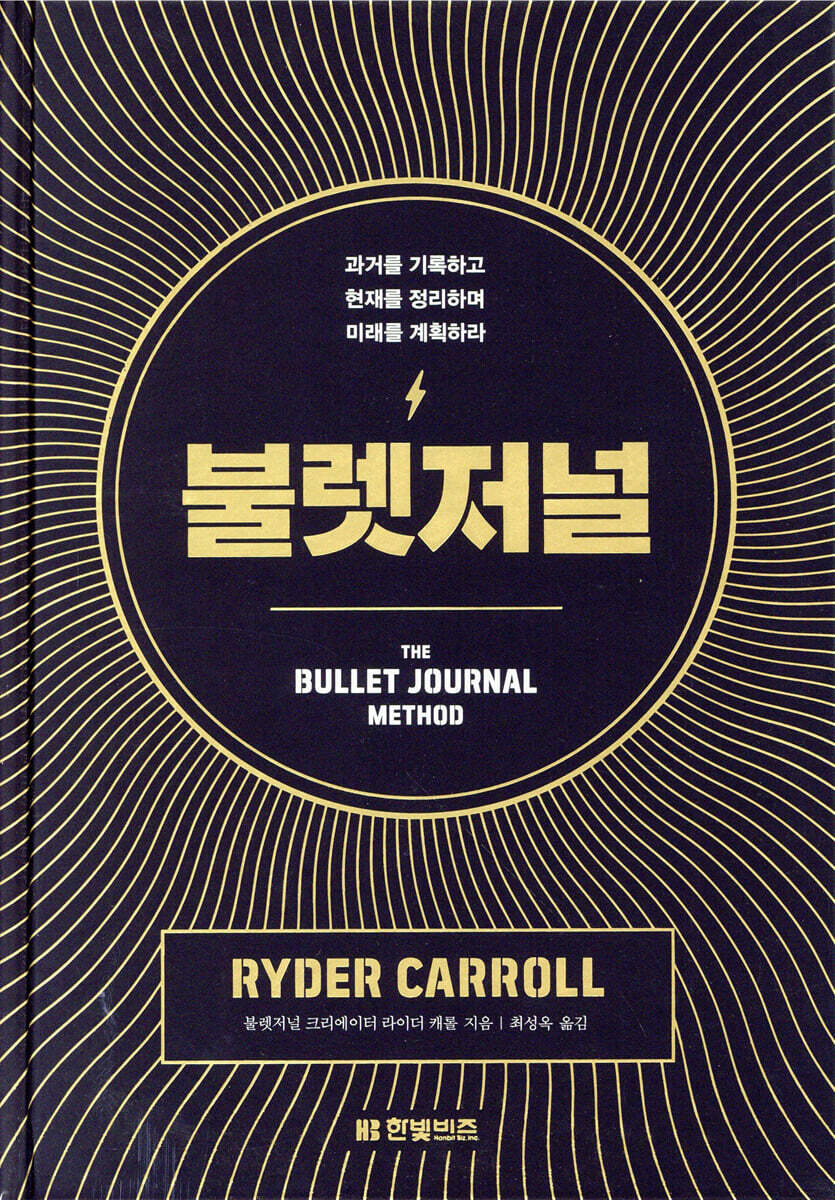
Bullet Journal founder Ryder Carroll's first book
Bullet journaling is a fast-growing schedule management method among young people around the world, and has become a synonym for a schedule management method with its own icon.
Bullet refers to an icon for schedule management, and you can create and add the icons you need.
It is similar to the Franklin Planner craze in that it aims for efficient self-development, but the bullet journal is simple to write in, is not restricted by the shape of a diary, and the shape and composition of the bullets can vary depending on the user, so it has become a global boom with young generations who pursue their own unique style.
This book is about how the author, who suffered from Attention Deficit Disorder (ADD), overcame his difficulties through bullet journaling, and as the creator of the bullet journal, it tells you how to use a bullet journal and what goals can be achieved through the bullet journal.
The book immediately captured the attention of pen-and-paper lovers around the world.
A bullet journal will help you let go of what's unimportant in your life and live a life filled with peace of mind and true passion.
Bullet Journal founder Ryder Carroll's first book
Bullet journaling is a fast-growing schedule management method among young people around the world, and has become a synonym for a schedule management method with its own icon.
Bullet refers to an icon for schedule management, and you can create and add the icons you need.
It is similar to the Franklin Planner craze in that it aims for efficient self-development, but the bullet journal is simple to write in, is not restricted by the shape of a diary, and the shape and composition of the bullets can vary depending on the user, so it has become a global boom with young generations who pursue their own unique style.
This book is about how the author, who suffered from Attention Deficit Disorder (ADD), overcame his difficulties through bullet journaling, and as the creator of the bullet journal, it tells you how to use a bullet journal and what goals can be achieved through the bullet journal.
The book immediately captured the attention of pen-and-paper lovers around the world.
A bullet journal will help you let go of what's unimportant in your life and live a life filled with peace of mind and true passion.
- You can preview some of the book's contents.
Preview
index
Part 1 Preparation
Opening remarks
promise
guide
reason
Organizing your complicated mind
Note
Handwriting
Part 2 System
System
Quick record
Topic and page numbering
Bullet
Things to do
event
memo
Symbols and custom bullets
Collection
Daily Log
Monthly Log
Future Log
index
movement
A letter
How to Write a Bullet Journal
Part 3 Execution
execution
start
Reflection
meaning
target
small steps
hour
Gratitude
Control
brilliance
patience
dissolution
lethargy
imperfection
Part 4 Techniques
techniques
Custom Collection
design
plan
inventory
schedule
tracker
Customization
Community
Conclusion of Part 5
The Right Way to Bullet Journal
Conclusion
Frequently Asked Questions
Acknowledgements
References
Browse content
Opening remarks
promise
guide
reason
Organizing your complicated mind
Note
Handwriting
Part 2 System
System
Quick record
Topic and page numbering
Bullet
Things to do
event
memo
Symbols and custom bullets
Collection
Daily Log
Monthly Log
Future Log
index
movement
A letter
How to Write a Bullet Journal
Part 3 Execution
execution
start
Reflection
meaning
target
small steps
hour
Gratitude
Control
brilliance
patience
dissolution
lethargy
imperfection
Part 4 Techniques
techniques
Custom Collection
design
plan
inventory
schedule
tracker
Customization
Community
Conclusion of Part 5
The Right Way to Bullet Journal
Conclusion
Frequently Asked Questions
Acknowledgements
References
Browse content
Detailed image
.jpg)
Into the book
One day, out of the blue, a mysterious box arrived without warning.
Strangely enough, when I looked at the address, it was clear that my mother had sent it.
A surprise gift? Without any special reason or reason? That's unlikely.
Once I opened the box, I found a pile of old notebooks inside.
For a moment, I was taken aback, and then I took out an orange notebook with a graffiti-decorated cover.
Every page was filled with crude drawings.
Robots, monsters, battle scenes, misspelled words… … .
At that moment, a chill ran down my spine.
Oh my goodness, these notes were mine!
Phew, I took a deep breath and looked around carefully.
This was not a simple trip down memory lane, reminiscing about the old days.
It was more than that.
It felt like I was looking back into the existence of a country that everyone had now forgotten.
As I picked up another notebook and flipped through it, a folded piece of paper fell out.
Out of curiosity, I opened it and saw a strangely drawn image of a man with a face that was covered in paint all the way to the tip of his head.
The man was screaming so loudly, his eyes bulging out and his tongue hanging out.
There were two words written on the page.
The word, which had been sitting shyly in the corner, revealed the identity of the man who was so angry that he was on the verge of fainting.
He was my teacher.
And another word, written in large, jagged letters, was the object of the teacher's fury.
That's right, my name.
The problems I had started as early as elementary school.
Poor grades, angry teachers who made you blush, and private tutors who quit soon after.
His academic performance was so remarkable that he often spent a lot of time at special schools and counseling centers during the summer.
Eventually, I was diagnosed with ADD, Attention Deficit Disorder.
Because this disorder first emerged in the 1980s, it was a difficult time to properly understand my condition.
What little information was available was either too complex or too restricted to be helpful or suitable for me.
Even if there was diarrhea, it was like pouring salt on the wound and making the situation worse.
Nothing understood the way my heart worked.
So I had to do most of it on my own.
The biggest problem was that I couldn't control my concentration.
It's not that I couldn't concentrate at all.
It was just difficult to focus on the right thing at the right time.
Even if I was paying attention to something, if something else came to mind, I would quickly shift my attention to it.
I was constantly distracted and disorganized, and the responsibilities piled up until they were overwhelming me.
I often felt like I was lacking or falling behind.
Every day, I faced those feelings and felt deep distrust and fear of myself.
Nothing distracts me more than being hard on myself.
(syncopation)
After much trial and error, we combined several forms into one effective system.
Right into the wonderfully old-fashioned notebook! It was a hybrid of a planner, diary, to-do list, and sketchbook.
This system has become a practical yet inclusive tool, and it has helped me to organize my anxious and impatient mind.
My distracted mind gradually found stability, the pressure gradually eased, and I became a much more productive person.
From then on, I knew that solving the problem was entirely up to me.
More importantly, I finally realized it.
I can do it too!
- Page 15, opening remarks
Welcome to the bullet journaling world! Thank you so much for taking the time to read this book.
To get the most out of this book, I recommend following it from beginning to end.
This book is structured in a participatory manner.
We can use the power of writing to help us memorize the bullet journal system more quickly.
All you need is a blank piece of paper, a blank notebook, and a pen.
- Page 44, Guide
The first part of this book explains how to create a bullet journal.
The latter part discusses why you should keep a bullet journal.
If you've been bullet journaling for a while, you've probably already noticed.
That it's more than just organizing lists.
Bullet journaling can help you become more aware of your reality, increase your confidence, improve your focus, find stability, and feel inspired.
That's because bullet journaling is based on various sciences and philosophies, helping us live our lives with more intention.
This book aims to lift the curtain and reveal why bullet journaling works.
By digging deeper like this, you'll not only validate what you already know, but you'll also take your bullet journaling to a whole new level.
Whether you're a beginner or an expert, whatever your current level, this book delves into the core of bullet journaling: how mindfulness and productivity come together to help you design the life you want.
- Page 46, Guide
A bullet journal can be a to-do list, a diary, a planner, a sketchbook, or all of these at once.
This flexibility is thanks to the modular structure, which is created by assembling standardized shapes.
If you think of the bullet journal system as a set of Lego pieces, it's easy to understand.
Each section of the bullet journal system performs a specific function.
That is, organize your day, make monthly plans, and set goals.
You can freely mix and match pieces to create a system that meets your individual needs.
As time goes by, each person's needs are bound to change.
But this flexibility allows the system to adapt to changing circumstances and retain its meaning throughout the various seasons of life.
As we evolve, the functions and structure of the bullet journal also evolve.
- Page 83, System
If bullet journaling is a language used for quick note-taking, then bullets are the syntax.
Once you've written down your topic and page numbers, you can then summarize your thoughts in short, objective sentences called bullets.
Each bullet is paired with a specific symbol to categorize what you've written.
Bullets not only save you time, they also help you distill your information into short sentences, allowing you to extract the most valuable information.
Creating effective bullets requires striking a balance between brevity and clarity.
If the content is too short, you won't be able to understand what you're saying later, and if it's too long, writing down your thoughts will become a hassle.
(syncopation)
It takes practice to write concisely without losing meaning.
But as time goes by, your ability to find things to write down in your notes will gradually improve.
Because life's complexities are endless, there is bound to be a lot to record.
That's why this ability is so important.
If you've ever made a list in the past, you're familiar with how quickly they can spiral out of control.
Lists alone don't provide context and priorities.
However, the fast-recording method addresses these issues in several ways.
First, divide the content into the following categories.
1.
Tasks
2.
Experience (Events)
3.
Information you want to remember (Notes)
- Page 100, Bullet
The Daily Log is the workhorse of your bullet journal.
This is a concise template that captures the rush of everyday life in real time.
When you have a lot on your mind, a daily log is essential.
This is because it allows you to organize your thoughts systematically with very little effort and focus on what you are doing.
All you need to do to start a daily log is add the date and page numbers.
That's it! With just Notes, you're ready to quickly jot down tasks, events, and notes as they occur throughout the day.
The purpose of a daily log is to constantly clear your mind.
So you can rest assured knowing that everything is safely recorded in your notes.
- Page 125, Daily Log
Monthly logs allow us to take a step back and catch our breath before diving into the next month.
You can see at a glance not only what you need to do, but also your available time.
If a bullet journal is a book containing the story of one's life, a monthly log is a new chapter.
Monthly logs are small but significant milestones that make up the year.
By writing a monthly log, we periodically look within ourselves.
And this helps us understand the context of the relationship, motivate ourselves, and maintain focus.
The monthly log is written on both sides of the unfolded page.
On the left page, write down the calendar format, and on the right page, write down the to-do list.
The theme of this collection will be the names of the months, and we will add the names of the months to both double-sided pages.
- Page 130, Monthly Log
Bullet journal content is developed based on what is needed at the present time.
So, you might be wondering how you can plan for the future.
For this we use a collection called Future Log.
A future log is where you store items with a specific date set for the current month.
If it's September and you have a project due on December 15th, just write it down in your future log.
The future log is written at the beginning of the bullet journal, right after the index.
It usually requires one or two double-sided pages, or about two to four pages, and can be structured in a variety of ways.
I've included a concise but effective three-month future log example.
So how does a future log actually work? During the day, just write everything down in your daily log.
Even things to do in the future.
Again, keeping a daily log saves you from wasting time figuring out where to write.
A daily log, which holds all sorts of things, holds your thoughts until you're ready to categorize them.
When the time is right, like a daily reflection, confirmed tasks will be moved from the daily log to the future log.
Once you move, make sure to mark it with '[' to indicate that it is scheduled to happen in the daily log.
Once you've done this, you can temporarily put that thing out of your mind.
Think of the future log as a single line waiting for its turn.
Each item is eagerly awaited for its arrival in that month.
- Page 135, Future Log
Strangely enough, when I looked at the address, it was clear that my mother had sent it.
A surprise gift? Without any special reason or reason? That's unlikely.
Once I opened the box, I found a pile of old notebooks inside.
For a moment, I was taken aback, and then I took out an orange notebook with a graffiti-decorated cover.
Every page was filled with crude drawings.
Robots, monsters, battle scenes, misspelled words… … .
At that moment, a chill ran down my spine.
Oh my goodness, these notes were mine!
Phew, I took a deep breath and looked around carefully.
This was not a simple trip down memory lane, reminiscing about the old days.
It was more than that.
It felt like I was looking back into the existence of a country that everyone had now forgotten.
As I picked up another notebook and flipped through it, a folded piece of paper fell out.
Out of curiosity, I opened it and saw a strangely drawn image of a man with a face that was covered in paint all the way to the tip of his head.
The man was screaming so loudly, his eyes bulging out and his tongue hanging out.
There were two words written on the page.
The word, which had been sitting shyly in the corner, revealed the identity of the man who was so angry that he was on the verge of fainting.
He was my teacher.
And another word, written in large, jagged letters, was the object of the teacher's fury.
That's right, my name.
The problems I had started as early as elementary school.
Poor grades, angry teachers who made you blush, and private tutors who quit soon after.
His academic performance was so remarkable that he often spent a lot of time at special schools and counseling centers during the summer.
Eventually, I was diagnosed with ADD, Attention Deficit Disorder.
Because this disorder first emerged in the 1980s, it was a difficult time to properly understand my condition.
What little information was available was either too complex or too restricted to be helpful or suitable for me.
Even if there was diarrhea, it was like pouring salt on the wound and making the situation worse.
Nothing understood the way my heart worked.
So I had to do most of it on my own.
The biggest problem was that I couldn't control my concentration.
It's not that I couldn't concentrate at all.
It was just difficult to focus on the right thing at the right time.
Even if I was paying attention to something, if something else came to mind, I would quickly shift my attention to it.
I was constantly distracted and disorganized, and the responsibilities piled up until they were overwhelming me.
I often felt like I was lacking or falling behind.
Every day, I faced those feelings and felt deep distrust and fear of myself.
Nothing distracts me more than being hard on myself.
(syncopation)
After much trial and error, we combined several forms into one effective system.
Right into the wonderfully old-fashioned notebook! It was a hybrid of a planner, diary, to-do list, and sketchbook.
This system has become a practical yet inclusive tool, and it has helped me to organize my anxious and impatient mind.
My distracted mind gradually found stability, the pressure gradually eased, and I became a much more productive person.
From then on, I knew that solving the problem was entirely up to me.
More importantly, I finally realized it.
I can do it too!
- Page 15, opening remarks
Welcome to the bullet journaling world! Thank you so much for taking the time to read this book.
To get the most out of this book, I recommend following it from beginning to end.
This book is structured in a participatory manner.
We can use the power of writing to help us memorize the bullet journal system more quickly.
All you need is a blank piece of paper, a blank notebook, and a pen.
- Page 44, Guide
The first part of this book explains how to create a bullet journal.
The latter part discusses why you should keep a bullet journal.
If you've been bullet journaling for a while, you've probably already noticed.
That it's more than just organizing lists.
Bullet journaling can help you become more aware of your reality, increase your confidence, improve your focus, find stability, and feel inspired.
That's because bullet journaling is based on various sciences and philosophies, helping us live our lives with more intention.
This book aims to lift the curtain and reveal why bullet journaling works.
By digging deeper like this, you'll not only validate what you already know, but you'll also take your bullet journaling to a whole new level.
Whether you're a beginner or an expert, whatever your current level, this book delves into the core of bullet journaling: how mindfulness and productivity come together to help you design the life you want.
- Page 46, Guide
A bullet journal can be a to-do list, a diary, a planner, a sketchbook, or all of these at once.
This flexibility is thanks to the modular structure, which is created by assembling standardized shapes.
If you think of the bullet journal system as a set of Lego pieces, it's easy to understand.
Each section of the bullet journal system performs a specific function.
That is, organize your day, make monthly plans, and set goals.
You can freely mix and match pieces to create a system that meets your individual needs.
As time goes by, each person's needs are bound to change.
But this flexibility allows the system to adapt to changing circumstances and retain its meaning throughout the various seasons of life.
As we evolve, the functions and structure of the bullet journal also evolve.
- Page 83, System
If bullet journaling is a language used for quick note-taking, then bullets are the syntax.
Once you've written down your topic and page numbers, you can then summarize your thoughts in short, objective sentences called bullets.
Each bullet is paired with a specific symbol to categorize what you've written.
Bullets not only save you time, they also help you distill your information into short sentences, allowing you to extract the most valuable information.
Creating effective bullets requires striking a balance between brevity and clarity.
If the content is too short, you won't be able to understand what you're saying later, and if it's too long, writing down your thoughts will become a hassle.
(syncopation)
It takes practice to write concisely without losing meaning.
But as time goes by, your ability to find things to write down in your notes will gradually improve.
Because life's complexities are endless, there is bound to be a lot to record.
That's why this ability is so important.
If you've ever made a list in the past, you're familiar with how quickly they can spiral out of control.
Lists alone don't provide context and priorities.
However, the fast-recording method addresses these issues in several ways.
First, divide the content into the following categories.
1.
Tasks
2.
Experience (Events)
3.
Information you want to remember (Notes)
- Page 100, Bullet
The Daily Log is the workhorse of your bullet journal.
This is a concise template that captures the rush of everyday life in real time.
When you have a lot on your mind, a daily log is essential.
This is because it allows you to organize your thoughts systematically with very little effort and focus on what you are doing.
All you need to do to start a daily log is add the date and page numbers.
That's it! With just Notes, you're ready to quickly jot down tasks, events, and notes as they occur throughout the day.
The purpose of a daily log is to constantly clear your mind.
So you can rest assured knowing that everything is safely recorded in your notes.
- Page 125, Daily Log
Monthly logs allow us to take a step back and catch our breath before diving into the next month.
You can see at a glance not only what you need to do, but also your available time.
If a bullet journal is a book containing the story of one's life, a monthly log is a new chapter.
Monthly logs are small but significant milestones that make up the year.
By writing a monthly log, we periodically look within ourselves.
And this helps us understand the context of the relationship, motivate ourselves, and maintain focus.
The monthly log is written on both sides of the unfolded page.
On the left page, write down the calendar format, and on the right page, write down the to-do list.
The theme of this collection will be the names of the months, and we will add the names of the months to both double-sided pages.
- Page 130, Monthly Log
Bullet journal content is developed based on what is needed at the present time.
So, you might be wondering how you can plan for the future.
For this we use a collection called Future Log.
A future log is where you store items with a specific date set for the current month.
If it's September and you have a project due on December 15th, just write it down in your future log.
The future log is written at the beginning of the bullet journal, right after the index.
It usually requires one or two double-sided pages, or about two to four pages, and can be structured in a variety of ways.
I've included a concise but effective three-month future log example.
So how does a future log actually work? During the day, just write everything down in your daily log.
Even things to do in the future.
Again, keeping a daily log saves you from wasting time figuring out where to write.
A daily log, which holds all sorts of things, holds your thoughts until you're ready to categorize them.
When the time is right, like a daily reflection, confirmed tasks will be moved from the daily log to the future log.
Once you move, make sure to mark it with '[' to indicate that it is scheduled to happen in the daily log.
Once you've done this, you can temporarily put that thing out of your mind.
Think of the future log as a single line waiting for its turn.
Each item is eagerly awaited for its arrival in that month.
- Page 135, Future Log
--- From the text
Publisher's Review
The opposite of a busy life is an 'intentional life'.
Start today
Many people who start bullet journaling think they are very busy.
Of course, everyone is busy in their own way.
But being busy doesn't mean you're productive.
If we were as productive as we were busy, we would more easily achieve everything we want to do in life.
We feel like we have a lot to do because we have so many more thoughts to manage in our heads.
Research shows that we have more than 50,000 thoughts a day.
It's not your fault that you can't do anything.
There are always a lot of distracting thoughts in your head, making it difficult to achieve what you want.
Bullet journaling helps you live a life of intention, the opposite of a busy life.
Life is to be lived, not endured.
Now let's learn simple and easy techniques to live the life you intend.
For the digital generation
analog system
One of the most common questions people ask Ryder Carroll, the creator of the bullet journal, is, "Is there a bullet journal app?"
And his answer, which surprises many, is a resounding "no."
Some people think it's because he's a luddite.
But he makes it clear:
He's not against new technologies, he says, but rather he's trained in digital product design and loves Instagram and Spotify.
And most importantly, he says, because the bullet journal community was created through the power of social media, it's hypocritical to oppose new technologies.
One of the most powerful components of bullet journaling is physically writing it down—with pen and paper.
The magic of writing on paper by hand is difficult to grasp in a digital experience.
This book tells us about the amazing power of sitting down and writing in a diary using paper and ink.
It also tells us that sitting down with a piece of paper in front of us, writing it down with a pen, and focusing our thoughts can be an antidote to anxiety.
The bullet journal is an analog system for the digital age, freeing us from the technology that limits our happiness and empowering us to live the way we want.
Anxiety, obsessive-compulsive disorder, depression...
Overcoming difficulties with a bullet journal
As mentioned earlier, this method is a journaling method created by the author to overcome ADHD, and the book includes case studies of people using bullet journaling to overcome other mental health issues, including depression, mood disorders, obsessive-compulsive disorder, traumatic stress, and anxiety.
Many people have found peace of mind by using a bullet journal.
Start today
Many people who start bullet journaling think they are very busy.
Of course, everyone is busy in their own way.
But being busy doesn't mean you're productive.
If we were as productive as we were busy, we would more easily achieve everything we want to do in life.
We feel like we have a lot to do because we have so many more thoughts to manage in our heads.
Research shows that we have more than 50,000 thoughts a day.
It's not your fault that you can't do anything.
There are always a lot of distracting thoughts in your head, making it difficult to achieve what you want.
Bullet journaling helps you live a life of intention, the opposite of a busy life.
Life is to be lived, not endured.
Now let's learn simple and easy techniques to live the life you intend.
For the digital generation
analog system
One of the most common questions people ask Ryder Carroll, the creator of the bullet journal, is, "Is there a bullet journal app?"
And his answer, which surprises many, is a resounding "no."
Some people think it's because he's a luddite.
But he makes it clear:
He's not against new technologies, he says, but rather he's trained in digital product design and loves Instagram and Spotify.
And most importantly, he says, because the bullet journal community was created through the power of social media, it's hypocritical to oppose new technologies.
One of the most powerful components of bullet journaling is physically writing it down—with pen and paper.
The magic of writing on paper by hand is difficult to grasp in a digital experience.
This book tells us about the amazing power of sitting down and writing in a diary using paper and ink.
It also tells us that sitting down with a piece of paper in front of us, writing it down with a pen, and focusing our thoughts can be an antidote to anxiety.
The bullet journal is an analog system for the digital age, freeing us from the technology that limits our happiness and empowering us to live the way we want.
Anxiety, obsessive-compulsive disorder, depression...
Overcoming difficulties with a bullet journal
As mentioned earlier, this method is a journaling method created by the author to overcome ADHD, and the book includes case studies of people using bullet journaling to overcome other mental health issues, including depression, mood disorders, obsessive-compulsive disorder, traumatic stress, and anxiety.
Many people have found peace of mind by using a bullet journal.
GOODS SPECIFICS
- Publication date: November 19, 2018
- Format: Hardcover book binding method guide
- Page count, weight, size: 408 pages | 578g | 140*200*30mm
- ISBN13: 9791157842971
- ISBN10: 1157842976
You may also like
카테고리
korean


korean

![ELLE 엘르 스페셜 에디션 A형 : 12월 [2025]](http://librairie.coreenne.fr/cdn/shop/files/b8e27a3de6c9538896439686c6b0e8fb.jpg?v=1766436872&width=3840)


