

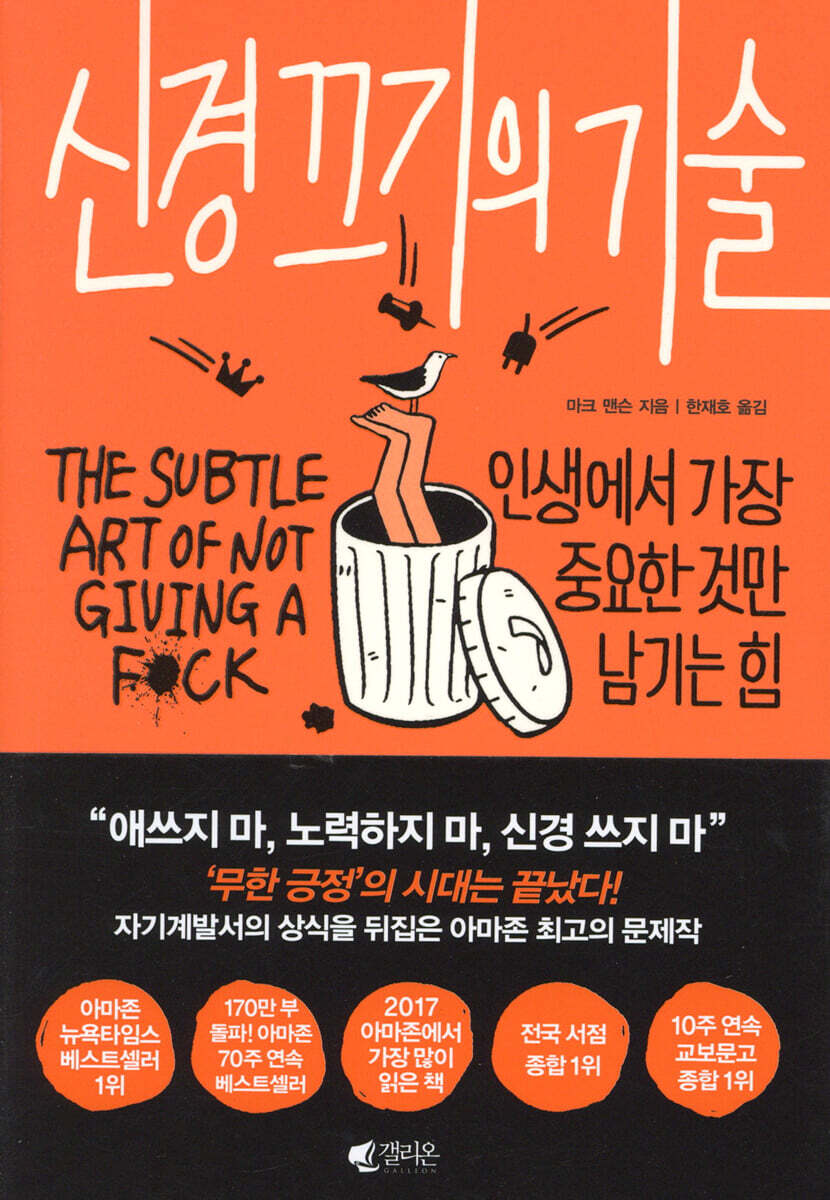
The art of not caring
 |
Description
Book Introduction
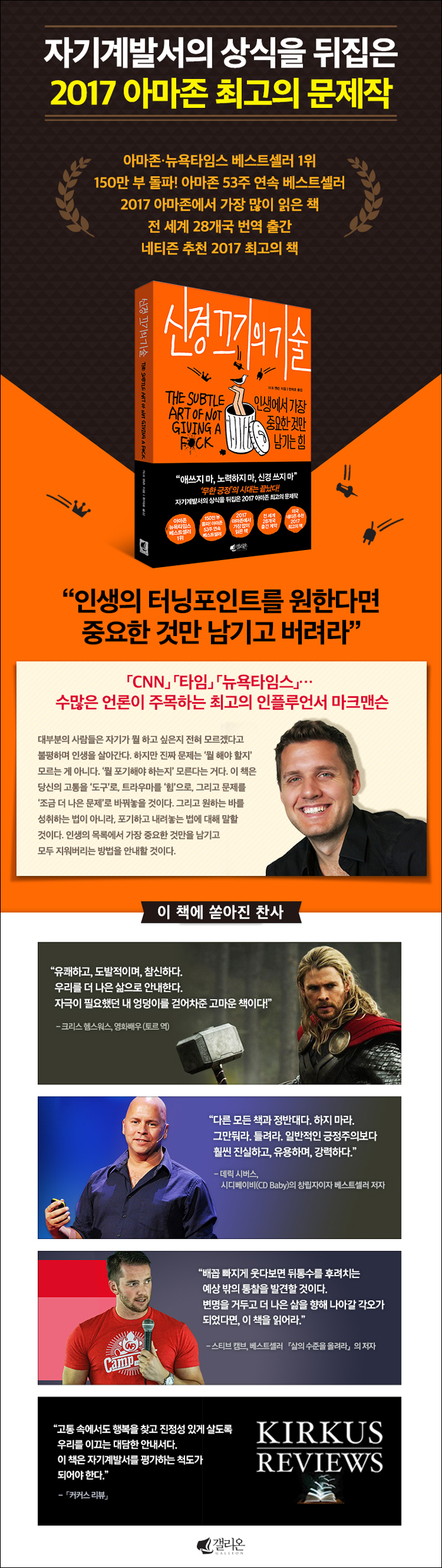
#1 Amazon and New York Times bestseller
Over 1.5 million copies sold! Amazon bestseller for 53 consecutive weeks.
Amazon's Most Read Books of 2017
Published in 28 countries worldwide
The Best Books of 2017 Recommended by American Netizens
A barrage of praise from numerous media outlets, including CNN, Time, Forbes, and the Wall Street Journal.
“Forget the self-help books that only force you to be infinitely positive!”
How to Erase Everything but the Most Important Things for a Turning Point in Your Life
Mark Manson, one of America's most popular influencers, presents a fresh paradigm that overturns conventional self-help books with "The Art of Not Giving a F*ck."
Life does not become special or happy just by believing unconditionally and making efforts, and blind positivity is actually poison.
Because sometimes you have to let go, give up, and care less to discover what's truly important in life.
The author was a troubled student who was expelled from school due to drug problems, and after graduating from college, he was unemployed for a while and couldn't find his purpose in life, but now he is living a completely different life.
With over 2 million followers, his media power rivals that of major media outlets, and he receives thousands of emails every day from people seeking answers to their lives.
Considered one of the best books of 2017, "The Art of Not Giving a F*ck" offers unexpected insight to modern people who, faced with countless choices and opportunity costs, have lost their purpose in life and are struggling with a sense of confusion about their values.
Immediately after its publication, it rose to the top of the Amazon and New York Times bestseller lists, selling over 1.5 million copies and being selected as the 'Most Read Book on Amazon in 2017.'
Numerous media outlets, including CNN, Time, Forbes, and the Wall Street Journal, have praised the book, and reviews from renowned figures in various fields have also poured in.
This book presents five values to eliminate distractions and move toward a better life.
I will take responsibility for everything that happens in my life, let go of the conviction that I am right and accept the possibility that I am wrong, not be afraid of failure, learn the art of rejection, and consider the fact that I will die someday.
If you want to discover the deep insights and truths hidden behind the savage, ruthless humor and the blunt, punchy, and blunt remarks, give yourself this book.
It will transform your pain into a 'tool', your trauma into a 'strength', and your problems into a 'better problem'.
Over 1.5 million copies sold! Amazon bestseller for 53 consecutive weeks.
Amazon's Most Read Books of 2017
Published in 28 countries worldwide
The Best Books of 2017 Recommended by American Netizens
A barrage of praise from numerous media outlets, including CNN, Time, Forbes, and the Wall Street Journal.
“Forget the self-help books that only force you to be infinitely positive!”
How to Erase Everything but the Most Important Things for a Turning Point in Your Life
Mark Manson, one of America's most popular influencers, presents a fresh paradigm that overturns conventional self-help books with "The Art of Not Giving a F*ck."
Life does not become special or happy just by believing unconditionally and making efforts, and blind positivity is actually poison.
Because sometimes you have to let go, give up, and care less to discover what's truly important in life.
The author was a troubled student who was expelled from school due to drug problems, and after graduating from college, he was unemployed for a while and couldn't find his purpose in life, but now he is living a completely different life.
With over 2 million followers, his media power rivals that of major media outlets, and he receives thousands of emails every day from people seeking answers to their lives.
Considered one of the best books of 2017, "The Art of Not Giving a F*ck" offers unexpected insight to modern people who, faced with countless choices and opportunity costs, have lost their purpose in life and are struggling with a sense of confusion about their values.
Immediately after its publication, it rose to the top of the Amazon and New York Times bestseller lists, selling over 1.5 million copies and being selected as the 'Most Read Book on Amazon in 2017.'
Numerous media outlets, including CNN, Time, Forbes, and the Wall Street Journal, have praised the book, and reviews from renowned figures in various fields have also poured in.
This book presents five values to eliminate distractions and move toward a better life.
I will take responsibility for everything that happens in my life, let go of the conviction that I am right and accept the possibility that I am wrong, not be afraid of failure, learn the art of rejection, and consider the fact that I will die someday.
If you want to discover the deep insights and truths hidden behind the savage, ruthless humor and the blunt, punchy, and blunt remarks, give yourself this book.
It will transform your pain into a 'tool', your trauma into a 'strength', and your problems into a 'better problem'.
- You can preview some of the book's contents.
Preview
index
[Prologue] Erase everything but the most important.
Chapter 1: Don't try, don't exert yourself, don't worry
- The man most distant from self-help books in the world
The Truth About Self-Development: "You're Not Enough"
- The endless track of hell called anxiety
- Grandpa said, "Life is like that. Go dig."
- Don't try, don't exert yourself, don't worry.
- The turning point in life, the art of turning off your mind
Chapter 2.
Happy endings only happen in fairy tales.
- Two questions that determine our lives
- The inconvenient truth revealed by the disappointed panda
- A prince who gave up wealth and chose a life of suffering
- The problem persists, it just changes or gets better.
- When you have to swallow a pill you don't want to swallow
Chapter 3.
Why do you think you're special?
- The nonsense that 'everyone can be great'
- A venture capitalist who has delusions about becoming Steve Jobs.
- The obsession with being the best or worst, the 1%
- The worst day ever, when everything falls apart
- You are neither a prospect nor a failure.
Chapter 4: There is no way to avoid suffering.
- People who have dedicated their lives to self-destructive ideals
- The illusion that you are unhappy because you don't have a foreign car
- The man who got kicked out of Metallica overnight
- Former Beatles member who went through the same ordeal but achieved different results
- Ridiculous values that can be completely ignored
- If you want a better life, focus on better values.
※ 5 values that will change our lives
Chapter 5.
If you make a choice, you have to take responsibility for it.
- How to run 42.195 km
- The choice that made a social misfit into a top scholar
- That breakup was ultimately my fault.
- What Malala tried to protect against the gun
- Some patterns are given to us from birth.
- If you're going to do it, do it. If you're going to say it, don't say it. There's no need for 'how'.
Chapter 6.
You're wrong, of course I'm wrong too
- The only thing that is certain is that nothing is certain.
- People who think of lies every moment
- The ridiculous advice of 'do what your heart tells you to do'
- A woman who became a stalker because she blindly believed in false values.
- How dangerous is confidence in myself?
- How to become a less wrong person every day
Chapter 7.
Don't be sad about failing
- I had nothing to lose, so I had nothing to fear.
- Why Picasso was able to paint 30,000 paintings
- Choose the pain you can bear, and endure it.
- Confessions of those who survived the war
How to Accept Failure, "Do Something"
Chapter 8.
Rejection is a life skill.
- What I learned from a trip where I left everything behind
- Choose what you reject, that's you.
- Why Romeo and Juliet's Love Is Unhealthy
- White lies that destroy relationships
- The more options you have, the more skills you need.
Chapter 9.
In the end we all die
- An epiphany that came at the worst moment of my life.
-The question death leaves behind: What will I leave behind?
[Acknowledgements]
[Recommendation]
Chapter 1: Don't try, don't exert yourself, don't worry
- The man most distant from self-help books in the world
The Truth About Self-Development: "You're Not Enough"
- The endless track of hell called anxiety
- Grandpa said, "Life is like that. Go dig."
- Don't try, don't exert yourself, don't worry.
- The turning point in life, the art of turning off your mind
Chapter 2.
Happy endings only happen in fairy tales.
- Two questions that determine our lives
- The inconvenient truth revealed by the disappointed panda
- A prince who gave up wealth and chose a life of suffering
- The problem persists, it just changes or gets better.
- When you have to swallow a pill you don't want to swallow
Chapter 3.
Why do you think you're special?
- The nonsense that 'everyone can be great'
- A venture capitalist who has delusions about becoming Steve Jobs.
- The obsession with being the best or worst, the 1%
- The worst day ever, when everything falls apart
- You are neither a prospect nor a failure.
Chapter 4: There is no way to avoid suffering.
- People who have dedicated their lives to self-destructive ideals
- The illusion that you are unhappy because you don't have a foreign car
- The man who got kicked out of Metallica overnight
- Former Beatles member who went through the same ordeal but achieved different results
- Ridiculous values that can be completely ignored
- If you want a better life, focus on better values.
※ 5 values that will change our lives
Chapter 5.
If you make a choice, you have to take responsibility for it.
- How to run 42.195 km
- The choice that made a social misfit into a top scholar
- That breakup was ultimately my fault.
- What Malala tried to protect against the gun
- Some patterns are given to us from birth.
- If you're going to do it, do it. If you're going to say it, don't say it. There's no need for 'how'.
Chapter 6.
You're wrong, of course I'm wrong too
- The only thing that is certain is that nothing is certain.
- People who think of lies every moment
- The ridiculous advice of 'do what your heart tells you to do'
- A woman who became a stalker because she blindly believed in false values.
- How dangerous is confidence in myself?
- How to become a less wrong person every day
Chapter 7.
Don't be sad about failing
- I had nothing to lose, so I had nothing to fear.
- Why Picasso was able to paint 30,000 paintings
- Choose the pain you can bear, and endure it.
- Confessions of those who survived the war
How to Accept Failure, "Do Something"
Chapter 8.
Rejection is a life skill.
- What I learned from a trip where I left everything behind
- Choose what you reject, that's you.
- Why Romeo and Juliet's Love Is Unhealthy
- White lies that destroy relationships
- The more options you have, the more skills you need.
Chapter 9.
In the end we all die
- An epiphany that came at the worst moment of my life.
-The question death leaves behind: What will I leave behind?
[Acknowledgements]
[Recommendation]
Detailed image
Into the book
"I have no intention of telling you how to achieve what you want.
Instead, I'm going to talk about how to give up and let go.
I'll guide you through making a list of your life, then crossing off everything except the most important items.
It will make you believe that it is okay to close your eyes and fall backwards.
I will teach you techniques that will help you reduce your stress.
I will teach you how not to do it.
- p13
Charles Bukowski, known as the 'underground legend' in American literary circles.
He was a drunkard, a womanizer, a gambler, a scoundrel, a miser, a lazy bum, and to make matters worse, he was also a poet.
No one would have expected to get life advice from him or see his name in a self-help book.
So Bukowski is the perfect person to start this book with.
Bukowski lived his entire life the way he was born.
His genius did not lie in overcoming great adversity or in rising to prominence and becoming a leading writer of his time.
Quite the opposite.
Bukowski revealed himself completely, especially his worst flaws, and shared his flaws with the world with aplomb.
His genius lies in this simple ability.
The real reason Bukowski succeeded was because he was indifferent to his failures.
He lived without caring about things like success.
- p18~19
There is another truth hidden in life.
The point is that you can't be important enough to change someone's life without being a laughing stock or a headache.
That's impossible.
Because we will never lack for hardships.
That won't happen.
As the old saying goes, "Wherever you go, there you are."
The same goes for hardship and failure.
Wherever you go, there's a 200kg 'poop lump' waiting for you.
But that's okay.
The important thing is not to run away from the piece of shit.
The important thing is to find a piece of shit you are willing to accept.
- p33
The question of 'what will you fight for' defines who you are.
People who enjoy the gym grind can compete in triathlons, have rock-solid abs, and lift barbells the size of a house.
Workaholics who enjoy overtime and office politics get promoted very quickly.
People who enjoy the stress and anxiety that comes with being a starving artist are more likely to ultimately succeed as artists.
The question that determines success is not 'What do I enjoy?' but 'What pain can I endure?'
The road to happiness is strewn with shit and shame.
You have to choose something.
You can't live without pain.
You can't only walk on a flowery path.
- p42
Dave Mustaine, a member of Megadeth, one of the most successful bands in heavy metal history, felt like a failure despite his immense fame and success.
Because we value ficklely comparing our own success with that of others.
Because of this, he suffered from the following terrible problems:
'We need to sell 150 million more albums.
The pressure of things like, 'Then everything will be okay', 'The next tour has to be held in a large stadium no matter what'.
Mustaine believed that solving these problems would lead to happiness.
It's only natural that he's unhappy.
- p108
We always live taking responsibility for our ‘experiences’.
Even if it's not 'my fault', it's a part of life.
You are responsible for your situation, not anyone else.
You may blame others for your unhappiness, but the only person responsible for your unhappiness is you.
Because it is always you who chooses how to view, how to respond to, and how to evaluate the events you encounter in life.
It is always you who chooses the criteria by which you evaluate your experience.
- p123
I'm wrong every time.
All of them.
Throughout my life, I have been completely wrong about myself, others, society, culture, the world, the universe, and everything else.
Growth is a never-ending, repetitive process.
As we learn new things, we move from something that is wrong to something that is slightly less wrong.
As I grow older and gain experience, I will gradually reduce my mistakes and become a less wrong person every day.
Michael Jordan said, “I have failed over and over again in my life.
He left behind the famous quote, “That’s why I was successful.”
I have made many misjudgments throughout my life.
That's why my life has improved.
-
Instead, I'm going to talk about how to give up and let go.
I'll guide you through making a list of your life, then crossing off everything except the most important items.
It will make you believe that it is okay to close your eyes and fall backwards.
I will teach you techniques that will help you reduce your stress.
I will teach you how not to do it.
- p13
Charles Bukowski, known as the 'underground legend' in American literary circles.
He was a drunkard, a womanizer, a gambler, a scoundrel, a miser, a lazy bum, and to make matters worse, he was also a poet.
No one would have expected to get life advice from him or see his name in a self-help book.
So Bukowski is the perfect person to start this book with.
Bukowski lived his entire life the way he was born.
His genius did not lie in overcoming great adversity or in rising to prominence and becoming a leading writer of his time.
Quite the opposite.
Bukowski revealed himself completely, especially his worst flaws, and shared his flaws with the world with aplomb.
His genius lies in this simple ability.
The real reason Bukowski succeeded was because he was indifferent to his failures.
He lived without caring about things like success.
- p18~19
There is another truth hidden in life.
The point is that you can't be important enough to change someone's life without being a laughing stock or a headache.
That's impossible.
Because we will never lack for hardships.
That won't happen.
As the old saying goes, "Wherever you go, there you are."
The same goes for hardship and failure.
Wherever you go, there's a 200kg 'poop lump' waiting for you.
But that's okay.
The important thing is not to run away from the piece of shit.
The important thing is to find a piece of shit you are willing to accept.
- p33
The question of 'what will you fight for' defines who you are.
People who enjoy the gym grind can compete in triathlons, have rock-solid abs, and lift barbells the size of a house.
Workaholics who enjoy overtime and office politics get promoted very quickly.
People who enjoy the stress and anxiety that comes with being a starving artist are more likely to ultimately succeed as artists.
The question that determines success is not 'What do I enjoy?' but 'What pain can I endure?'
The road to happiness is strewn with shit and shame.
You have to choose something.
You can't live without pain.
You can't only walk on a flowery path.
- p42
Dave Mustaine, a member of Megadeth, one of the most successful bands in heavy metal history, felt like a failure despite his immense fame and success.
Because we value ficklely comparing our own success with that of others.
Because of this, he suffered from the following terrible problems:
'We need to sell 150 million more albums.
The pressure of things like, 'Then everything will be okay', 'The next tour has to be held in a large stadium no matter what'.
Mustaine believed that solving these problems would lead to happiness.
It's only natural that he's unhappy.
- p108
We always live taking responsibility for our ‘experiences’.
Even if it's not 'my fault', it's a part of life.
You are responsible for your situation, not anyone else.
You may blame others for your unhappiness, but the only person responsible for your unhappiness is you.
Because it is always you who chooses how to view, how to respond to, and how to evaluate the events you encounter in life.
It is always you who chooses the criteria by which you evaluate your experience.
- p123
I'm wrong every time.
All of them.
Throughout my life, I have been completely wrong about myself, others, society, culture, the world, the universe, and everything else.
Growth is a never-ending, repetitive process.
As we learn new things, we move from something that is wrong to something that is slightly less wrong.
As I grow older and gain experience, I will gradually reduce my mistakes and become a less wrong person every day.
Michael Jordan said, “I have failed over and over again in my life.
He left behind the famous quote, “That’s why I was successful.”
I have made many misjudgments throughout my life.
That's why my life has improved.
-
----From the text
Publisher's Review
Erase everything except the most important!
The art of turning off your mind to find your center in a complex world
We live in an age overflowing with opportunity and news.
Success stories of creating something from nothing dominate the media, and people compare themselves to each other and fill out their bucket lists.
The competitive spirit that we must not fall behind others and the constant anxiety to possess something weigh us down.
The formula that a good life is about working harder, rushing harder, and being more successful has spread like a virus.
But there's something we're missing.
The fact is that everything has an opportunity cost.
Bill Gates spent most of his 30s sleeping in the office five days a week, and Steve Jobs failed to properly care for his eldest daughter.
Anything that seems great inevitably requires sacrifice.
To gain something, you have to give up something.
In the same vein, Mark Manson emphasizes that we should first ask what we need to let go of rather than what we need to keep.
The point is that to focus on what's truly important, you need the skill of knowing how to distract yourself from the trivial things.
Many people struggle with their purpose in life, but in this world of over-ambition, the real problem often stems from not knowing what to give up.
So what does it mean to be unconcerned? The unconcern Mark speaks of isn't the same as being indifferent.
First, we must abandon the illusion that we are particularly unfortunate or the pretense that we must be superior to others, and begin by acknowledging that life is inherently accompanied by suffering.
Only then will you have the insight to distinguish between what is truly important and what is not.
The master key to turning life's problems, which everyone must experience, into a better direction is the art of not caring.
To you who have no idea what your life's purpose is or where happiness lies.
A refreshingly blunt statement from America's most controversial writer.
Mark is currently one of the most influential power bloggers in the United States and is on the path to success as a startup CEO, but he was quite the troublemaker in school.
He was expelled from school because of drugs, and after that, he went through the trials of his parents' divorce and the death of a friend, which further led him down the path of wandering.
It was highly unlikely that he had any goals in life, and even after graduating from college and continuing to be unemployed, he was unable to find his bearings for a long time after starting a startup.
What he realized then was that once you do something, difficult things become easy.
With nothing left to lose, he began to try even the simplest things.
Then failure felt trivial.
Since then, I have been living my life facing my life head on and taking responsibility for the trials and tribulations, big and small.
Whenever Mark receives emails from people complaining about not knowing what to do with their lives, he emphasizes the "do something" principle and advises them not to be afraid of failure.
All humans eventually die, and the present will not return, so we must discover our own realistic and meaningful values rather than clinging to self-destructive ideals or absurd values.
There are countless examples of people ruining their lives by being immersed in wrong values.
The same thing happened to Dave Mustaine, who was kicked out of Metallica.
He was a member of Megadeth, one of the most famous bands in heavy metal history, and despite their incredible success, including selling over 25 million records, he lived his entire life feeling like a failure who was kicked out of Metallica.
We must not make the mistake of wasting our lives chasing after vain values, blind to the happiness that lies so close at hand.
"The Art of Not Giving a F*ck" introduces five important values to have in life.
Take responsibility for everything that happens in your life, let go of the belief that you are right, don't be afraid of failure, say no, and accept that one day you will die.
If you keep these values in your heart, you will be able to become a less wrong person every day.
Funny stories, witty and ruthless humor, deep insights,
It has it all!
A hot topic book that changed the paradigm of self-help books that only demand effort and positivity.
Mark's writing delves into life's problems and offers surprising insights, making you laugh out loud but also making you think and adjust your attitude as if you've been hit in the back of the head.
His story is strange and new.
Contrary to conventional self-help books that tell you to believe in the power of positivity, believe in yourself, and work hard to fulfill your life's bucket list, this book teaches you how to give up, let go, and work less.
But paradoxically, all of this is much truer and more powerful than conventional positivism.
"The Art of Not Giving a F*ck," which offers unexpected insight to modern people who struggle with values in the face of countless choices and opportunity costs, quickly rose to the top of the Amazon and New York Times bestseller lists through word of mouth.
It was also selected as 'Amazon's most-read book of 2017' and proved its power by selling over 1.5 million copies and maintaining the bestseller position for 53 consecutive weeks.
Ryan Holiday, author of "Ego is the Enemy," called this book a philosophical and practical masterpiece, and Kirkus Reviews praised it, saying it should be the standard for self-help books. Recommendations are pouring in from various media outlets.
Do you want a new turning point in your life? Do you want true happiness, not mere delusional satisfaction? Do you want freedom from the things that make you anxious? This book will undoubtedly provide the boldest and most surprising answers to those questions.
The art of turning off your mind to find your center in a complex world
We live in an age overflowing with opportunity and news.
Success stories of creating something from nothing dominate the media, and people compare themselves to each other and fill out their bucket lists.
The competitive spirit that we must not fall behind others and the constant anxiety to possess something weigh us down.
The formula that a good life is about working harder, rushing harder, and being more successful has spread like a virus.
But there's something we're missing.
The fact is that everything has an opportunity cost.
Bill Gates spent most of his 30s sleeping in the office five days a week, and Steve Jobs failed to properly care for his eldest daughter.
Anything that seems great inevitably requires sacrifice.
To gain something, you have to give up something.
In the same vein, Mark Manson emphasizes that we should first ask what we need to let go of rather than what we need to keep.
The point is that to focus on what's truly important, you need the skill of knowing how to distract yourself from the trivial things.
Many people struggle with their purpose in life, but in this world of over-ambition, the real problem often stems from not knowing what to give up.
So what does it mean to be unconcerned? The unconcern Mark speaks of isn't the same as being indifferent.
First, we must abandon the illusion that we are particularly unfortunate or the pretense that we must be superior to others, and begin by acknowledging that life is inherently accompanied by suffering.
Only then will you have the insight to distinguish between what is truly important and what is not.
The master key to turning life's problems, which everyone must experience, into a better direction is the art of not caring.
To you who have no idea what your life's purpose is or where happiness lies.
A refreshingly blunt statement from America's most controversial writer.
Mark is currently one of the most influential power bloggers in the United States and is on the path to success as a startup CEO, but he was quite the troublemaker in school.
He was expelled from school because of drugs, and after that, he went through the trials of his parents' divorce and the death of a friend, which further led him down the path of wandering.
It was highly unlikely that he had any goals in life, and even after graduating from college and continuing to be unemployed, he was unable to find his bearings for a long time after starting a startup.
What he realized then was that once you do something, difficult things become easy.
With nothing left to lose, he began to try even the simplest things.
Then failure felt trivial.
Since then, I have been living my life facing my life head on and taking responsibility for the trials and tribulations, big and small.
Whenever Mark receives emails from people complaining about not knowing what to do with their lives, he emphasizes the "do something" principle and advises them not to be afraid of failure.
All humans eventually die, and the present will not return, so we must discover our own realistic and meaningful values rather than clinging to self-destructive ideals or absurd values.
There are countless examples of people ruining their lives by being immersed in wrong values.
The same thing happened to Dave Mustaine, who was kicked out of Metallica.
He was a member of Megadeth, one of the most famous bands in heavy metal history, and despite their incredible success, including selling over 25 million records, he lived his entire life feeling like a failure who was kicked out of Metallica.
We must not make the mistake of wasting our lives chasing after vain values, blind to the happiness that lies so close at hand.
"The Art of Not Giving a F*ck" introduces five important values to have in life.
Take responsibility for everything that happens in your life, let go of the belief that you are right, don't be afraid of failure, say no, and accept that one day you will die.
If you keep these values in your heart, you will be able to become a less wrong person every day.
Funny stories, witty and ruthless humor, deep insights,
It has it all!
A hot topic book that changed the paradigm of self-help books that only demand effort and positivity.
Mark's writing delves into life's problems and offers surprising insights, making you laugh out loud but also making you think and adjust your attitude as if you've been hit in the back of the head.
His story is strange and new.
Contrary to conventional self-help books that tell you to believe in the power of positivity, believe in yourself, and work hard to fulfill your life's bucket list, this book teaches you how to give up, let go, and work less.
But paradoxically, all of this is much truer and more powerful than conventional positivism.
"The Art of Not Giving a F*ck," which offers unexpected insight to modern people who struggle with values in the face of countless choices and opportunity costs, quickly rose to the top of the Amazon and New York Times bestseller lists through word of mouth.
It was also selected as 'Amazon's most-read book of 2017' and proved its power by selling over 1.5 million copies and maintaining the bestseller position for 53 consecutive weeks.
Ryan Holiday, author of "Ego is the Enemy," called this book a philosophical and practical masterpiece, and Kirkus Reviews praised it, saying it should be the standard for self-help books. Recommendations are pouring in from various media outlets.
Do you want a new turning point in your life? Do you want true happiness, not mere delusional satisfaction? Do you want freedom from the things that make you anxious? This book will undoubtedly provide the boldest and most surprising answers to those questions.
GOODS SPECIFICS
- Date of publication: October 27, 2017
- Page count, weight, size: 236 pages | 380g | 140*207*20mm
- ISBN13: 9788901219943
- ISBN10: 8901219948
You may also like
카테고리
korean


korean

![ELLE 엘르 스페셜 에디션 A형 : 12월 [2025]](http://librairie.coreenne.fr/cdn/shop/files/b8e27a3de6c9538896439686c6b0e8fb.jpg?v=1766436872&width=3840)


