

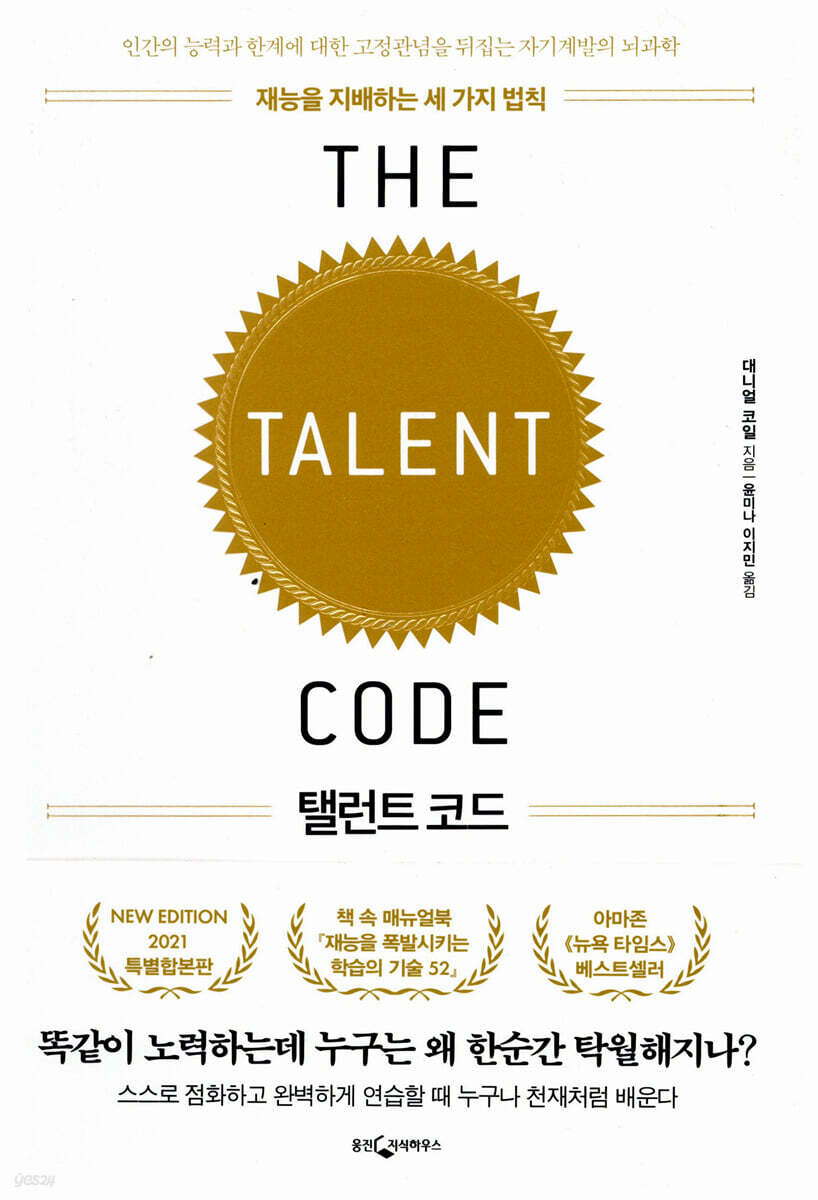
Talent Code (Special Edition)
 |
Description
Book Introduction
It cannot be explained by innate genes, consistent effort, and a good environment alone.
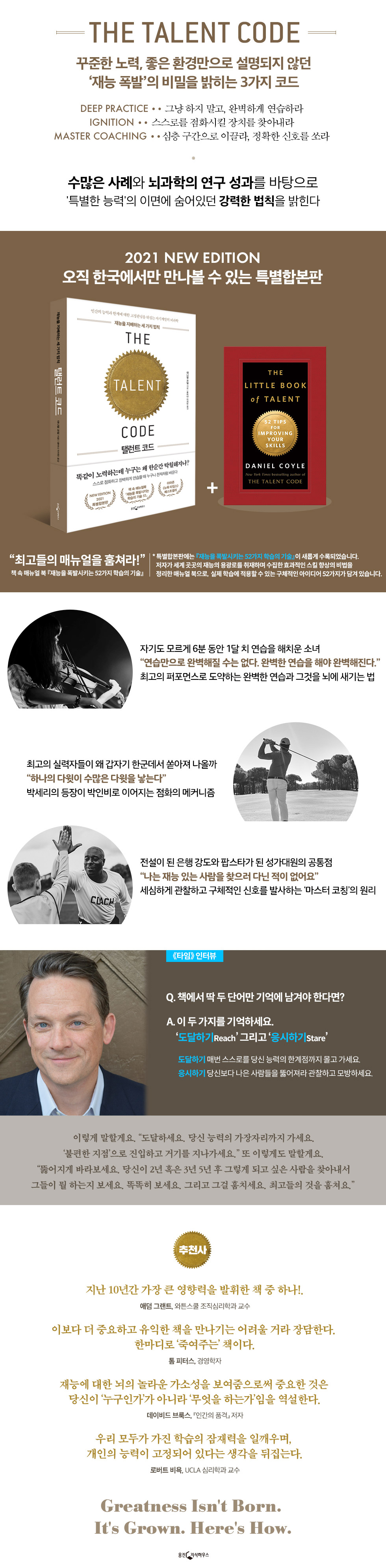
3 Codes That Unlock the Secret of "Talent Explosion"
2021 Special Edition: Includes the manual book "52 Learning Techniques to Unleash Your Talent"
A global bestseller that reveals the powerful laws hidden behind "special abilities," based on numerous case studies and neuroscience research findings.
The author, a journalist, traveled the world for one year and two months to uncover the true nature of talent, a subject of long-standing interest to humanity.
From New York's shabby music academies to Moscow's old tennis courts, we study individuals and groups of extraordinary talent from humble beginnings, discovering patterns of explosive talent that run rampant across them.
And it turns out that these patterns are related to the fundamental mechanisms by which the human brain acquires skills.
The result of extensive research, this book challenges outdated notions of talent and presents evidence of the incredible potential we possess.
The author says that while individual talent and aptitude are important, what has a decisive influence on demonstrating one's abilities is 'how one practices and how one trains one's brain.'
Immediately after its publication, it became a bestseller on Amazon and the New York Times, receiving enthusiastic attention from readers around the world, with reviews calling it “a new self-help book that cleverly captures the revolutionary discoveries of the scientific community.”
Since its publication in Korea in 2009, it has been consistently loved by readers through word of mouth.
The special edition of 『Talent Code』, newly released in 2021, includes the author's follow-up manual, 『52 Learning Techniques to Unleash Your Talent』, as a new book-within-a-book.
This book compiles effective skill improvement secrets collected from researching talent crucibles around the world, and contains 52 specific ideas that can be applied to actual learning.
3 Codes That Unlock the Secret of "Talent Explosion"
2021 Special Edition: Includes the manual book "52 Learning Techniques to Unleash Your Talent"
A global bestseller that reveals the powerful laws hidden behind "special abilities," based on numerous case studies and neuroscience research findings.
The author, a journalist, traveled the world for one year and two months to uncover the true nature of talent, a subject of long-standing interest to humanity.
From New York's shabby music academies to Moscow's old tennis courts, we study individuals and groups of extraordinary talent from humble beginnings, discovering patterns of explosive talent that run rampant across them.
And it turns out that these patterns are related to the fundamental mechanisms by which the human brain acquires skills.
The result of extensive research, this book challenges outdated notions of talent and presents evidence of the incredible potential we possess.
The author says that while individual talent and aptitude are important, what has a decisive influence on demonstrating one's abilities is 'how one practices and how one trains one's brain.'
Immediately after its publication, it became a bestseller on Amazon and the New York Times, receiving enthusiastic attention from readers around the world, with reviews calling it “a new self-help book that cleverly captures the revolutionary discoveries of the scientific community.”
Since its publication in Korea in 2009, it has been consistently loved by readers through word of mouth.
The special edition of 『Talent Code』, newly released in 2021, includes the author's follow-up manual, 『52 Learning Techniques to Unleash Your Talent』, as a new book-within-a-book.
This book compiles effective skill improvement secrets collected from researching talent crucibles around the world, and contains 52 specific ideas that can be applied to actual learning.
- You can preview some of the book's contents.
Preview
index
Author's Preface: All special things follow the same law… 007
Prologue: The Girl Who Kept a Month's Worth of Practice in Six Minutes… 014
PART 1 DEEP PRACTICE Practice until the end
Chapter 1: Finding the Sweet Spot… 027
- 'Chicken Coop Harvard' found all over the world
- Toy Airplane Trainer in Action
Why are Brazilian soccer players, even the nominees, geniuses?
Chapter 2: Were the Brontë Sisters Geniuses? … 051
Debunking the Myth of Special Talent
- The 'Michelangelo System' that made the Renaissance an age of genius
- Humans are myelinus
Chapter 3: Three Rules for Perfect Practice… 077
- When the 'Fucking effect' happens
- Perceiving the task as a huge lump
- Repeat within the deep practice section
- Learn the feeling of concentration
Chapter 4: The Brain Science of Talent… 105
Discovering 'Deep Practice Cells'
- All abilities use the same mechanism
PART 2 IGNITION Find the ignition device
Chapter 5: Primal Suggestion… 137
- Why can't I do it?
- Small but powerful thoughts
- Tom Sawyer 'ignited' his friends.
- I'm a lucky person.
Chapter 6: Exclusivity is Contagious… 171
- The Curacao Little League Baseball Experiment
- Sistine Chapel effect
- What words will ignite your abilities?
Chapter 7: Every Detail Changes the Whole… 193
- The school is moving like an old car.
- California's Unusual Opening Ceremony
PART 3 MASTER COACHING The Power of Master Coaching
Chapter 8: Who Gives Birth to Great People? … 217
- Master Coach of Bank Robbers
- Coach Wooden's Secret Curriculum
- Love makes things special
Chapter 9: Press and press the button again… 241
- Four Qualities of a Master Coach
- Activate the knowledge matrix
- Collect like a reporter
- Is there GPS?
- Act with all your heart
- Why soccer training and violin lessons are different
Chapter 10: Tom Martinez and the $60 Million Gamble… 265
Epilogue: The World of Talent Code… 277
- Toyota's practice method
- The principle of deep practice is also hidden in psychotherapy.
- Correlation between talent and age
- The Secret of Finnish Education
- The idea that children have secret talents
Week 298
[BOOK in BOOK]
52 Learning Skills to Unleash Your Talent
Enter: Steal the Manual of the Best… 312
Step 1.
Getting started
Watch, steal, and be a fool… 317
Step 2.
Skill improvement
Find and reach the sweet spot… 341
Step 3.
Maintain skills
Persevere, repeat, and keep your big goals a secret… 377
Prologue: The Girl Who Kept a Month's Worth of Practice in Six Minutes… 014
PART 1 DEEP PRACTICE Practice until the end
Chapter 1: Finding the Sweet Spot… 027
- 'Chicken Coop Harvard' found all over the world
- Toy Airplane Trainer in Action
Why are Brazilian soccer players, even the nominees, geniuses?
Chapter 2: Were the Brontë Sisters Geniuses? … 051
Debunking the Myth of Special Talent
- The 'Michelangelo System' that made the Renaissance an age of genius
- Humans are myelinus
Chapter 3: Three Rules for Perfect Practice… 077
- When the 'Fucking effect' happens
- Perceiving the task as a huge lump
- Repeat within the deep practice section
- Learn the feeling of concentration
Chapter 4: The Brain Science of Talent… 105
Discovering 'Deep Practice Cells'
- All abilities use the same mechanism
PART 2 IGNITION Find the ignition device
Chapter 5: Primal Suggestion… 137
- Why can't I do it?
- Small but powerful thoughts
- Tom Sawyer 'ignited' his friends.
- I'm a lucky person.
Chapter 6: Exclusivity is Contagious… 171
- The Curacao Little League Baseball Experiment
- Sistine Chapel effect
- What words will ignite your abilities?
Chapter 7: Every Detail Changes the Whole… 193
- The school is moving like an old car.
- California's Unusual Opening Ceremony
PART 3 MASTER COACHING The Power of Master Coaching
Chapter 8: Who Gives Birth to Great People? … 217
- Master Coach of Bank Robbers
- Coach Wooden's Secret Curriculum
- Love makes things special
Chapter 9: Press and press the button again… 241
- Four Qualities of a Master Coach
- Activate the knowledge matrix
- Collect like a reporter
- Is there GPS?
- Act with all your heart
- Why soccer training and violin lessons are different
Chapter 10: Tom Martinez and the $60 Million Gamble… 265
Epilogue: The World of Talent Code… 277
- Toyota's practice method
- The principle of deep practice is also hidden in psychotherapy.
- Correlation between talent and age
- The Secret of Finnish Education
- The idea that children have secret talents
Week 298
[BOOK in BOOK]
52 Learning Skills to Unleash Your Talent
Enter: Steal the Manual of the Best… 312
Step 1.
Getting started
Watch, steal, and be a fool… 317
Step 2.
Skill improvement
Find and reach the sweet spot… 341
Step 3.
Maintain skills
Persevere, repeat, and keep your big goals a secret… 377
Detailed image
Into the book
In a tennis club with only one shabby indoor court to practice in biting weather, they were performing better than in a rich country with a population of 300 million.
Then I happened to come across an important footnote in The Cambridge Guide to Professional Knowledge and Practice.
Introducing the results of a study on the brains of pianists, the relationship between the amount of practice and skill improvement was linked to a substance called myelin in the brain.
Where can we find stories of small islands producing countless talented individuals despite objective difficulties, and brain science?
I flew from Brazil to the Adirondacks to prove it.
(Page 38)
One morning, just like any other day, this ordinary child was caught on video camera doing something remarkably unusual.
According to Dr. McPherson's calculations, Clarissa's performance improved tenfold over a period of exactly 5 minutes and 54 seconds.
But I was completely unaware of this fact.
(…) “My goodness, if there was someone who could bottle that, they would make millions of dollars.”
This book starts with a simple idea.
The same thing is happening in Clarissa's practice room and crucible of talent.
They utilize a unique mechanism in the nervous system that allows for improvement in performance the more often a specific pattern of practice is repeated, tailored to the specific goal.
They were sucked into a period of rapid growth without even realizing it.
There's no way to bottle it, but if you get the hang of it, you can access that section.
So to speak, you can decipher the talent code.
(pages 17-20)
Clifford says:
“I am convinced that this is where the skills of Brazilian players are born.
“It was like finding the missing link.” (…) The famous elastico movement, popularized by Ronaldinho, of winding and releasing the ball like a yo-yo, also originally came from futsal.
(…) Futsal is like compressing the essential skills of soccer into a small box.
Futsal allows players to go into deep practice sessions, making mistakes and correcting them, constantly finding solutions to specific problems.
Futsal players have six times more contact with the ball than players who train in open, bouncy outdoor spaces, so they learn much faster without even realizing it.
(pages 48-49)
A proper understanding of the deep practice will reveal a path to seeing the Brontë sisters accurately.
The immaturity of their early works does not contradict the literary stature they ultimately achieved.
Rather, it is a prerequisite.
They became great writers not because they began with crude imitation, but because they were willing to pour enormous amounts of time and effort into crude imitation.
In other words, I was building myelin in the small but safe space of small books.
The writing they did in their childhood was the product of collaborative, deep practice.
Through that practice, they developed the muscle of storytelling.
(Page 56)
But what does deep practice actually feel like? How do you know you're doing it? Deep practice is a bit like exploring a dark, unfamiliar room.
I start walking slowly, bumping into furniture, and when I do, I stop and think for a moment.
And then it starts again.
Slowly, with a little difficulty, I begin to explore the space again.
Focus on your mistakes and take a little further each time you start over.
Then, I draw a map in my head until I can move around the room quickly and intuitively.
(Page 84)
Something strange happened.
The old car, which seemed like it would collapse at the slightest touch of a finger, began to move with a creaking, knocking sound at some point that fall.
Everyone was astonished. KIPP students faithfully practiced the slogan.
They behaved well and studied hard.
It wasn't just that I worked hard, I worked incredibly hard.
By the end of the first year, 90 percent of all students passed the scholastic ability test.
One could view the KIPP story as a unique example of kind-hearted losers who somehow managed to capture lightning in a bottle.
If that's all, there's no reason to be interested in this story anymore.
But from another perspective, this is an example of pure ignition.
(Page 198)
Banks believed a new era of safety and security had begun.
But that era did not open.
Because the skills of bank robbers have improved.
The new robbers worked during the day, sometimes with a professionalism that even the police were impressed by, and followed a strict timetable.
It was as if bank robbers had suddenly evolved into a highly talented species.
(…) This system, called ‘Baron Ram’s Technique’, was very effective.
From 1919 to 1930, Lamb robbed banks across the United States, amassing hundreds of thousands of dollars.
Ram was the founder and master of modern bank robbery techniques.
(…) The RAM system, which is still in use today, was successful not only because of its conceptual advantages.
Rather, it was because Ram himself effectively transformed and communicated his ideas to smoothly complete the difficult task.
He was an innovative teacher who taught systematically and accurately.
He provided information and prompted action.
In a word, Baron Ram was a 'master coach'.
Then I happened to come across an important footnote in The Cambridge Guide to Professional Knowledge and Practice.
Introducing the results of a study on the brains of pianists, the relationship between the amount of practice and skill improvement was linked to a substance called myelin in the brain.
Where can we find stories of small islands producing countless talented individuals despite objective difficulties, and brain science?
I flew from Brazil to the Adirondacks to prove it.
(Page 38)
One morning, just like any other day, this ordinary child was caught on video camera doing something remarkably unusual.
According to Dr. McPherson's calculations, Clarissa's performance improved tenfold over a period of exactly 5 minutes and 54 seconds.
But I was completely unaware of this fact.
(…) “My goodness, if there was someone who could bottle that, they would make millions of dollars.”
This book starts with a simple idea.
The same thing is happening in Clarissa's practice room and crucible of talent.
They utilize a unique mechanism in the nervous system that allows for improvement in performance the more often a specific pattern of practice is repeated, tailored to the specific goal.
They were sucked into a period of rapid growth without even realizing it.
There's no way to bottle it, but if you get the hang of it, you can access that section.
So to speak, you can decipher the talent code.
(pages 17-20)
Clifford says:
“I am convinced that this is where the skills of Brazilian players are born.
“It was like finding the missing link.” (…) The famous elastico movement, popularized by Ronaldinho, of winding and releasing the ball like a yo-yo, also originally came from futsal.
(…) Futsal is like compressing the essential skills of soccer into a small box.
Futsal allows players to go into deep practice sessions, making mistakes and correcting them, constantly finding solutions to specific problems.
Futsal players have six times more contact with the ball than players who train in open, bouncy outdoor spaces, so they learn much faster without even realizing it.
(pages 48-49)
A proper understanding of the deep practice will reveal a path to seeing the Brontë sisters accurately.
The immaturity of their early works does not contradict the literary stature they ultimately achieved.
Rather, it is a prerequisite.
They became great writers not because they began with crude imitation, but because they were willing to pour enormous amounts of time and effort into crude imitation.
In other words, I was building myelin in the small but safe space of small books.
The writing they did in their childhood was the product of collaborative, deep practice.
Through that practice, they developed the muscle of storytelling.
(Page 56)
But what does deep practice actually feel like? How do you know you're doing it? Deep practice is a bit like exploring a dark, unfamiliar room.
I start walking slowly, bumping into furniture, and when I do, I stop and think for a moment.
And then it starts again.
Slowly, with a little difficulty, I begin to explore the space again.
Focus on your mistakes and take a little further each time you start over.
Then, I draw a map in my head until I can move around the room quickly and intuitively.
(Page 84)
Something strange happened.
The old car, which seemed like it would collapse at the slightest touch of a finger, began to move with a creaking, knocking sound at some point that fall.
Everyone was astonished. KIPP students faithfully practiced the slogan.
They behaved well and studied hard.
It wasn't just that I worked hard, I worked incredibly hard.
By the end of the first year, 90 percent of all students passed the scholastic ability test.
One could view the KIPP story as a unique example of kind-hearted losers who somehow managed to capture lightning in a bottle.
If that's all, there's no reason to be interested in this story anymore.
But from another perspective, this is an example of pure ignition.
(Page 198)
Banks believed a new era of safety and security had begun.
But that era did not open.
Because the skills of bank robbers have improved.
The new robbers worked during the day, sometimes with a professionalism that even the police were impressed by, and followed a strict timetable.
It was as if bank robbers had suddenly evolved into a highly talented species.
(…) This system, called ‘Baron Ram’s Technique’, was very effective.
From 1919 to 1930, Lamb robbed banks across the United States, amassing hundreds of thousands of dollars.
Ram was the founder and master of modern bank robbery techniques.
(…) The RAM system, which is still in use today, was successful not only because of its conceptual advantages.
Rather, it was because Ram himself effectively transformed and communicated his ideas to smoothly complete the difficult task.
He was an innovative teacher who taught systematically and accurately.
He provided information and prompted action.
In a word, Baron Ram was a 'master coach'.
(pages 219-221)
Publisher's Review
Why do some people suddenly become excellent even though they put in the same amount of effort?
The neuroscience of self-improvement that overturns stereotypes about human abilities and limitations.
“One of the most influential books of the past decade.” __Adam Grant
Amazon, New York Times Bestseller
Consistent effort and a good environment didn't make 'them'
A wondrous expedition to discover the world's "melting pots of talent."
How did a poor Russian tennis club with only one indoor court manage to produce more women's players in the world's top 20 than the entire United States combined? Since the first Korean female golfer won an LPGA tournament in 1998, the number of Korean players on the LPGA Tour has grown to a staggering 45 by 2008.
In every case, the same question lingers in my mind.
Where do such extraordinary talents come from? Why do such extraordinary geniuses emerge, even in hordes, despite the harshest environments?
Daniel Coyle, a journalist and bestselling author, noticed that the people he met on his reporting trips with "special abilities" had something in common.
Contrary to popular belief, it wasn't just about innate genes or a good environment.
The 10,000-hour rule? If it's all about "effort," why do such huge differences arise even among people who put in the same amount of effort under similar conditions?
With these questions in mind, he embarked on a journey to find the "melting pots of talent" around the world.
The journey began on a seemingly unassuming tennis court in Moscow, and over the next 14 months, it took me from a small music camp in upstate New York to an elementary school in California to a baseball stadium in the Caribbean, visiting extraordinary talents and their coaches to uncover their secrets.
Why do geniuses suddenly appear in one place?
: Discover the three laws that govern talent.
From the brilliant Brazilian soccer players to the bank robbers who suddenly showed extraordinary performance(?), the author documents and collects historical examples of individuals and groups who have demonstrated extraordinary abilities in seemingly insignificant places.
Many researchers are also trying to find out the true nature of talent.
In the process, we discover a pattern of talent explosion that applies to them in common.
And these patterns capture the fundamental mechanisms by which the human brain acquires skills.
In particular, new scientific discoveries regarding the role of 'myelin' offer us a revolutionary perspective on talent.
Everyone must have felt it at least once.
No matter how much you practice, your skills don't improve, and then suddenly, like a 'flash', your skills improve.
And we have seen it countless times.
A previously unnoticed second-string player suddenly starts hitting home runs like a genius, or a team member who had no presence suddenly hits the jackpot and rises to become a key player who makes every project he puts out a hit.
This is not a story about a critical point that is reached when effort accumulates and the time comes.
Just because you put in 10,000 hours of effort doesn't mean everyone will become excellent.
This book tells you exactly what to do and how to do it during those 10,000 hours.
The key is perfect practice, igniting motivation, and maintaining it.
“Practice alone cannot make perfect.
“Perfect practice makes perfect.” The author suggests three “talent codes”:
DEEP PRACTICE Don't just do it, practice it perfectly.
IGNITION Find the device that will ignite you.
MASTER COACHING Lead to the deep end, send the right signals.
Based on extensive research and investigation, The Talent Code overturns stereotypes and presents a fresh perspective on talent. It has been praised as "a new type of self-help book that cleverly captures revolutionary scientific discoveries," and has garnered enthusiastic responses from readers around the world.
This is a wonderful book that shatters old notions about human capabilities and helps us discover the amazing possibilities we possess through rich storytelling about the process of reaching "reach" through "ignition" and "deep practice."
“Understanding the talent code doesn’t necessarily lead to any special magic.
But with this idea in mind, you can focus on more essential things in life.
Above all, you will stop being impatient with yourself.
Instead, you will observe yourself and others closely.
You will be focusing and observing what signals people are using to move and whether or not perfect practice is in progress.
Above all, we are faced with situations where excuses are impossible.” (From the author’s preface)
A special combined edition available only in Korea.
; Includes "52 Learning Techniques to Unleash Your Talent", a manual stolen from the best.
First introduced in Korea in 2009, 『Talent Code』 is still a book that is consistently sought after by readers through word of mouth in the self-development field even after more than 10 years since its publication.
From learners seeking to advance in their fields to leaders seeking to cultivate the capabilities of their employees, to parents and educators raising and educating children, this book is highly regarded as providing insight and practical guidance for developing abilities and potential.
The newly released special edition of 『Talent Code』 includes the manual book 『52 Learning Techniques to Unleash Your Talent』, which can be considered a sequel and sister book to this book, as a book-within-a-book.
This book assumes that everyone has their own talents and, with the goal of developing them to their fullest potential, introduces 52 learning ideas divided into three stages: "Getting Started," "Improving Skills," and "Maintaining Skills."
This is a manual "stolen from the best," distilling the essence of the secrets gleaned from the best practitioners, their coaches, and neuroscientists the author has personally encountered over the past five years since first delving into this topic.
“15 minutes a day, etch skills into your brain.”
“Break down every movement into chunks.”
“Take a nap”
“After you make a mistake, look at it immediately.”
The advice contained here is field-tested, practical, scientifically grounded, and, above all, concise.
It can be applied immediately to real life and provides practical help in developing all talents regardless of age, field, or region.
It is useful not only for readers interested in their own development, but also for those raising or educating children.
The book also includes episodes where the author personally applied the method to the practices of his own children and the local children's baseball team he coaches, and saw the results.
Charles Duhigg, author of The Power of Habit, said of this book, “Every graduate at commencement, every expectant parent in the delivery room, every executive on their first day at work should read this book.
“This book is a simple yet scientifically proven guide to talent development,” he praised.
If you are someone who is struggling to improve at whatever it is, this book is for you.
The neuroscience of self-improvement that overturns stereotypes about human abilities and limitations.
“One of the most influential books of the past decade.” __Adam Grant
Amazon, New York Times Bestseller
Consistent effort and a good environment didn't make 'them'
A wondrous expedition to discover the world's "melting pots of talent."
How did a poor Russian tennis club with only one indoor court manage to produce more women's players in the world's top 20 than the entire United States combined? Since the first Korean female golfer won an LPGA tournament in 1998, the number of Korean players on the LPGA Tour has grown to a staggering 45 by 2008.
In every case, the same question lingers in my mind.
Where do such extraordinary talents come from? Why do such extraordinary geniuses emerge, even in hordes, despite the harshest environments?
Daniel Coyle, a journalist and bestselling author, noticed that the people he met on his reporting trips with "special abilities" had something in common.
Contrary to popular belief, it wasn't just about innate genes or a good environment.
The 10,000-hour rule? If it's all about "effort," why do such huge differences arise even among people who put in the same amount of effort under similar conditions?
With these questions in mind, he embarked on a journey to find the "melting pots of talent" around the world.
The journey began on a seemingly unassuming tennis court in Moscow, and over the next 14 months, it took me from a small music camp in upstate New York to an elementary school in California to a baseball stadium in the Caribbean, visiting extraordinary talents and their coaches to uncover their secrets.
Why do geniuses suddenly appear in one place?
: Discover the three laws that govern talent.
From the brilliant Brazilian soccer players to the bank robbers who suddenly showed extraordinary performance(?), the author documents and collects historical examples of individuals and groups who have demonstrated extraordinary abilities in seemingly insignificant places.
Many researchers are also trying to find out the true nature of talent.
In the process, we discover a pattern of talent explosion that applies to them in common.
And these patterns capture the fundamental mechanisms by which the human brain acquires skills.
In particular, new scientific discoveries regarding the role of 'myelin' offer us a revolutionary perspective on talent.
Everyone must have felt it at least once.
No matter how much you practice, your skills don't improve, and then suddenly, like a 'flash', your skills improve.
And we have seen it countless times.
A previously unnoticed second-string player suddenly starts hitting home runs like a genius, or a team member who had no presence suddenly hits the jackpot and rises to become a key player who makes every project he puts out a hit.
This is not a story about a critical point that is reached when effort accumulates and the time comes.
Just because you put in 10,000 hours of effort doesn't mean everyone will become excellent.
This book tells you exactly what to do and how to do it during those 10,000 hours.
The key is perfect practice, igniting motivation, and maintaining it.
“Practice alone cannot make perfect.
“Perfect practice makes perfect.” The author suggests three “talent codes”:
DEEP PRACTICE Don't just do it, practice it perfectly.
IGNITION Find the device that will ignite you.
MASTER COACHING Lead to the deep end, send the right signals.
Based on extensive research and investigation, The Talent Code overturns stereotypes and presents a fresh perspective on talent. It has been praised as "a new type of self-help book that cleverly captures revolutionary scientific discoveries," and has garnered enthusiastic responses from readers around the world.
This is a wonderful book that shatters old notions about human capabilities and helps us discover the amazing possibilities we possess through rich storytelling about the process of reaching "reach" through "ignition" and "deep practice."
“Understanding the talent code doesn’t necessarily lead to any special magic.
But with this idea in mind, you can focus on more essential things in life.
Above all, you will stop being impatient with yourself.
Instead, you will observe yourself and others closely.
You will be focusing and observing what signals people are using to move and whether or not perfect practice is in progress.
Above all, we are faced with situations where excuses are impossible.” (From the author’s preface)
A special combined edition available only in Korea.
; Includes "52 Learning Techniques to Unleash Your Talent", a manual stolen from the best.
First introduced in Korea in 2009, 『Talent Code』 is still a book that is consistently sought after by readers through word of mouth in the self-development field even after more than 10 years since its publication.
From learners seeking to advance in their fields to leaders seeking to cultivate the capabilities of their employees, to parents and educators raising and educating children, this book is highly regarded as providing insight and practical guidance for developing abilities and potential.
The newly released special edition of 『Talent Code』 includes the manual book 『52 Learning Techniques to Unleash Your Talent』, which can be considered a sequel and sister book to this book, as a book-within-a-book.
This book assumes that everyone has their own talents and, with the goal of developing them to their fullest potential, introduces 52 learning ideas divided into three stages: "Getting Started," "Improving Skills," and "Maintaining Skills."
This is a manual "stolen from the best," distilling the essence of the secrets gleaned from the best practitioners, their coaches, and neuroscientists the author has personally encountered over the past five years since first delving into this topic.
“15 minutes a day, etch skills into your brain.”
“Break down every movement into chunks.”
“Take a nap”
“After you make a mistake, look at it immediately.”
The advice contained here is field-tested, practical, scientifically grounded, and, above all, concise.
It can be applied immediately to real life and provides practical help in developing all talents regardless of age, field, or region.
It is useful not only for readers interested in their own development, but also for those raising or educating children.
The book also includes episodes where the author personally applied the method to the practices of his own children and the local children's baseball team he coaches, and saw the results.
Charles Duhigg, author of The Power of Habit, said of this book, “Every graduate at commencement, every expectant parent in the delivery room, every executive on their first day at work should read this book.
“This book is a simple yet scientifically proven guide to talent development,” he praised.
If you are someone who is struggling to improve at whatever it is, this book is for you.
GOODS SPECIFICS
- Publication date: February 26, 2021
- Page count, weight, size: 392 pages | 644g | 145*215*22mm
- ISBN13: 9788901248974
- ISBN10: 8901248972
You may also like
카테고리
korean


korean

![ELLE 엘르 스페셜 에디션 A형 : 12월 [2025]](http://librairie.coreenne.fr/cdn/shop/files/b8e27a3de6c9538896439686c6b0e8fb.jpg?v=1766436872&width=3840)


